
The Dogged Victims of Inexorable Fate

It is easy to have a Dan Jenkins section in your personal library since he has been a prolific sports/golf writer for over a half a century.  He has put out countless entertaining books-both fiction and non-fiction-written in his Texas wise-guy cynical and satirical style. The writing is always observant, to the point, and almost merciless in a kind of arms length critical view.

This particular collection of sixteen short pieces was published in 1970 and it covers the full range of golf matters of the time. Unlike today where the writers have to beg for interviews, Dan Jenkins lived with the protagonists week-to-week-traveling, playing cards, drinking beers, and sharing stories. As a result, there was a level of trust and confidence developed between them that offered a clear window into the hearts and minds of the players of the day. In reading this you feel you are getting an insider’s perspective on the development of the game in a golden era.

The name of the book comes from a Bobby Jones quote on the topic of competitive pressures in golf-whether for a championship or a Sunday Nassau.  Jones once wrote,
“On the golf course, a man may be the dogged victim of inexorable fate, be struck down by an appalling stroke of tragedy, become the hero of unbelievable melodrama, or the clown in a sidesplitting comedy-any of these within a few hours, and all without having to bury a corpse or repair a tangled personality”.  Jenkin’s writings bears out how human drama defines the game as guys try to excel at an individual sport that will expose every weakness in technique or resolve in a remorseless competition.

I have recently re-read this book and I found that the subject matter he writes about seems timeless-municipal golf, slow play, head cases, television, majors, the greatest to ever play the game.  The issues today are the same as they were in the 1960’s, the names have just changed to protect the innocent.

There is a wonderful chapter about a regular on the tour who you barely know about-George Low.  He was a journeyman pro in the 30’s and 40’s who realized with the proper balance of schmoozing and familiarity he could make a life for himself without lifting a club.  As Jenkins says, “He was America’s guest, underground comedian, consultant…….a man who conquered the two hardest things in life-how to putt better than anyone ever and how to live lavishly without an income”.  He was a fixture on the veranda at every tour stop, tour watering hole, and putting green.  His prowess with the flatstick and a quick joke made him welcome fixture on the tour for thirty years.

In the chapter called “Wide Open” he describes a tournament with venues of aristocratic reverence, offering a title which guarantees wealth and fame for life, but that could be won by just about anybody or a nobody.  For example, Lee Trevino, “a laughing tub of echiladas in bright red socks with a caddy-hustler’s game” or Orville Moody, “who had a name like … a drag strip mechanic and who didn’t even have a hometown to be poor from.  Just fourteen years of Fort Hoods and Koreas”.

My personal favorite is his piece on Dave Marr “The Pro of 52nd Street”.  Dave Marr was Texas born and bread-pure Banlon in Argyle socks.  In an otherwise undistinguished journeyman’s career he won a major, the PGA at Laurel Valley, and parlayed it into a life- long corporate outing full of networking with the stars and the champions of industry.  You see this charming, likeable, self-deprecating guy realized what Frank Sinatra knew, if you can play NYC you can play anywhere.  So he moved to New York, traded the argyle socks for double breasted blazers and Gucci belts, and adopted the New York lifestyle as his own.   Doing his thing in the bistros and bars he developed life long friendships with celebrities that made him someone to hang with.   In spite of regularly finishing twenty-third or worse, the income flowed from endless corporate outings and a broadcast gig based on his popularity among his peers and an insider knowledge of the game.

The book ends with “The Doggedest Victim” about his good buddy Arnold Palmer.  Jenkin’s personal account of Palmer’s historic and folkloric come from behind victory at Cherrry Hills in the 1960 U.S. Open characterizes the entire book.  In Palmer’s ascent to “the most immeasurable of all golf champions” Jenkin’s characterizes him as the “doggedest victim of us all”.

Dan Jenkins will be inducted into the Golf Hall of Fame in May of 2012, only the fifth golf writer to be so honored and the first to be inducted while he was living.

(Click here to read a typical Jenkin’s reaction to his induction)

As one of the most prolific golf writers in history, his body of work clearly qualifies him for this long overdue honorarium.

Do yourself a favor, the next time you are on the Barnes and Noble web site and need another $10 item to get you over the $25 minimum for Free Shipping buy yourself a copy of “The Dogged Victims of Inexorable Fate”.  It will be a welcome addition on your nightstand or next to your thrown and provide you plenty of laughs and expand your knowledge of the history of the game.

The Dogged Victims of Inexorable Fate

Dan Jenkins  (1970)

The Phantom Limb

In his book,  “The Man Who Mistook His Wife For A Hat” , the neurologist Oliver Sacks talks about the ability of people who have lost a limb to compensate for it by subconsciously imagining the phantom limb is still there.  Witness a real life rendition of this theory by taking a few minutes to watch this inspirational video called “Manuel De Los Santos” produced and directed by Peter Montgomery.

Teeing it up on the 18th at St. Andrews (sportsdoinggood.com)

Manuel De Los Santos grew up in the Dominican Republic and, like so many young athletes his age, hoped to pursue his dream to be a professional baseball player.  Talented and driven he was on his way to doing that with the Toronto Blue Jays in 2003 but his plans were sidetracked by a terrible motorcycle accident where he lost his left leg above his knee.

Following the accident he moved to France where he and his wife happened to see the film “The Legend of Bagger Vance” and it’s moving content inspired Manuel to take up golf.  As you will see in this film, he is an extraordinary athlete and through endless hours of hard work has dedicated himself to being a top caliber golfer.  He routinely hits his driver 300 yards, has a short game to die for, and now plays to a three-handicap and competes in tournaments around the world.

Besides the inspirational aspect to his accomplishments, this man has one hell of a golf swing.  If you look at the video, from the waist up his mechanics are pretty amazing.  He rotates his torso around the inside of his right leg, just like they say in all the instructional videos, and at the top of his swing he fires his left hip first to drop the club perfectly into the power plane on the way down.  From behind you can see he has the perfect balance of a skilled player and uncoils to a full finish with his chest facing the target on the follow through.  As he says in the video, when he gets to the golf course he finds his second leg, it is like it was never gone.  This is the phantom limb theory in action, his left side does not know what is missing and his swing mechanics are just wonderful.

Maybe the best part of the video is his quote that golf brought a smile back to his life.  It has done so for so many of us who use golf as a way to manage the stresses in our daily lives.  Manuel’s attitude and accomplishments are something to behold.  It reminds us that the highest hurdles we perceive in our lives are often self-created and it is up to us to figure out a way to deal with them and put them in our rear view mirror.

(Click here to see this Manuel De Los Santos inspirational video)


Manuel De Los Santos

Produced/Directed By Peter Montgomery (2009)

The Apostles Return

Mitsubishi Championship LogoMai Tais at check-in, breakfast on the beach, metronomic turquoise blue surf, and seas of stunning black lava…..there is a reason the wives of Champion Tour players won’t let their husbands miss the Tournament of Champions event that begins the season at the Hualalai Golf Course of the Four Seasons Resort on the Big Island in Hawaii.  It is no exaggeration to say that this place is like tranquility in a bottle.

The Champions Tour  (a.k.a. The Apostle Tour) begins the year-long Charles Schwab Cup competition every year with the Mitsubishi Electric Championship.  The limited field event includes all the Champions Tour winners from the last two years as well as the guys who won Senior majors the last five years.

The field is stocked with Hall of Fame faces you rooted for the last 30 years including John Cook, Tom Lehman, Apostle Player of the Year and the Charles Schwab Cup winner, Freddie Couples, the ageless Tom Watson, Bernard Langer, and so many more.  The Golf Channel broadcast is in prime time Friday, Saturday, and Sunday so there is no reason to miss this.

The Hualalai Golf Course is a spectacular Nicklaus design on the Kona Coast of the Big Island in Hawaii.  The course was dug out of the black lava landscape created by centuries of volcanic eruptions.   The scenic vistas on this course alone are worth the price of admission.  Nicklaus used the natural up and down flow of the land to route a very interesting layout of holes lined on both sides with acres of black lava that give it a distinctive character you will not forget.

Number 18 is an opportunistic finishing hole for someone with nerve

Number 18 is an opportunistic finishing hole for someone with nerve

At 6600 yards the course is not a killer-past winners have been 20-under or better over three days.  Being a resort course, Nicklaus provided wide driving areas and generous access to the green settings.  But there is plenty to contend with if the wind is up and you don’t control the trajectory of your ball.  Balls forced to wander by the wind that end up on the lava are treated harshly-you would need a sherpa guide to retrieve the ball.  The putting in particular is a real challenge when you have a three-flap wind buffeting your pant legs.

(Click here to read the Moegolf review of the Hualalai Golf Course)

Pure serenity…everywhere you look….

The real attraction for these players and their families is the Four Seasons Resort itself.  This is a seven-star resort on a scale of five.  Of all the Four Seasons Resorts I have ever been to this is by far the nicest and that is saying a lot.  The accommodations, dining, pool, beaches, health club, and golf course are as fine as you will see anywhere in Hawaii.  But the best part is that this is all presented in an informal atmosphere without pretension.  The people who work there are genuinely engaging, gracious, and concerned about your every care during your stay.

It is worth watching this weekend just for the David Marr post-round interviews from the greenside couch.  No matter their score, these guys will be stress free from their week in this small piece of paradise.

(Photos from http://www.fourseasons.com)

January, 2013

Putting It On A Peg

Of the golf paraphernalia we use each day, the most taken for granted piece of equipment is our wooden golf tee.  It lacks the technological wizardry and the marketing hype but it serves us faithfully eighteen times a round.  Made me wonder where it came from and why it has not changed very much over time.

If you go back to the black and white images of the late 1800’s and early 1900’s you will notice a box of wet sand next to the teeing grounds.  The players would take a scoop of the stuff and mold a little tee-pee on the ground from which to launch their gutta percha.  The consistency of this support had to be questionable since most of the guys had trouble bending down in those waistcoats and wool britches.

Vintage Golf Tees from 1892 to 1922 (brinkster.com)

It is not like there were not great minds working on this dilemma.  As you can see in this image a number of guys came up with some innovative man-made teeing platforms to consider.  In fact at least two of these have a current iteration that you can buy from an infomercial for three easy payments, and, if you act now, double your order for free if you just pay the additional shipping.   The problem was these guys lacked enterprising minds and they could not figure out how to widely market their product to generate any income.

Around 1920 a dentist and frustrated hacker from New Jersey named Dr. William Lowell, who clearly was not making enough from producing wood bridges for his patients, decided to go after this fledgling market big time.  He introduced his wooden peg version, The Reddy Tee, which he patented in 1925 and struck a deal with Spalding Company to produce.  The concave platform cradled the ball to hold it in place without wobbling and the red paint gave it a recognizable look.

Dr, Lowell's Reddy Tee 1925 (golf.about.com)

The real challenge was how to market this to the growing populace in America who became infatuated with golf in the Francis Ouimet-Bobby Jones golden era.   Other than major amateur events most people saw their golf through exhibition matches that were put on by the professionals of the day.  There was no one more visible or popular in this platform than the ultimate showman himself Walter Hagen.

Lowell’s marketing genius was to sign Hagen for the outrageous sum of $1,500 to use his tees on exhibition tours in the United States and England.  Hagen handed out hundreds of bags of them at his exhibitions and before long spectators were scrambling to collect them as souvenirs,  It worked like a charm because the Reddy Tee started showing up in pro shops all over the country.  Imitation is the highest form of flattery and knock offs of these tees started coming out of the woodwork, literally.

You might wonder why the tees are not still red today since that was one of Lowell’s basic marketing features.  It turns out they had a humidity issue.  Mark Frost, in his book “The Grand Slam” explains that “The first time Hagen went out with a pocket full in humid conditions he saw a stream of crimson running down his tailored plus fours and thought he had been shot.  Not about to turn his back on the endorsement money, Walter took to carrying a spare Reddy behind his ear”.

It is funny that with all the technological changes in balls, clubs, bags, and everything else we use on the golf course, the tee we use today is pretty much the same one Dr. Lowell patented in 1925-just smidge taller to accommodate those 450cc driver heads. Pure genius knows no substitute.

January, 2012

Missing Links

Entertainment….pure entertainment.

Those of us who have read Sports Illustrated most of our adult lives had a habit of picking up the current issue and immediately turning to the back page to read Rick Reilly’s column.  Rick had a way of turning a phrase on the pressing sports issues of the day like no one in the business.  Cynical, funny, insightful and always entertaining.

In his book, Missing Links, Reilly spins a hilarious tale of a bunch of middle-class slackers in Boston who “wasted their youth” playing and gambling every day at “possibly the worst golf course in America”, a place he called Ponkaquoque Municipal Course and Deli.  The food was bad, but the golf course was worse.

“It was one of the great mysteries of life why grown men would actually arrive at 4 a.m. to put their little golf balls in a rusty old pipe…and then go back and sleep in their cars, just to play a golf course at eight that would have a hard time making Best of Chernobyl”.

The gambling tales of the Chops who played at Ponky are what makes this worth reading.  Among others they include:

Hoover- He really sucked

Thud- The almost human hearse driver for The Peaceful Rest  Mortuary

Crowbar- He was constantly prying himself into any situation

Two-Down- Never lost-as he said “Bets don’t start until I’m two down”.

Stick- The story’s protagonist

Dannie- Old female chop, baseball hat, baggie sweaters but “a cotton         eyed Arkansas accent…with a twelve-car-pileup body and a little nose that could’ve hardly made a dent in a cream pie”.

They bet on anything and made up the games as they went along.  “Reversals” in which your opponent could tee up your ball, turn around, and hit it as far in the opposite direction as he could.  “Alohas” where you double everything on 18.  “Murphys” where once every 9 holes your opponent could pick up your ball and place it anywhere within two club lengths of where it lays.  “It is very discouraging , indeed, to be just about to hit the bejesus out of your drive and than have somebody holler, “Murphy” and walk over and deposit your ball in a ball washer”.

Now Ponky sat adjacent to The Mayflower Club which was “only the finest, snootiest, private, white, sperm-dollar country club on the eastern seaboard”.  It was full of blue blood members with numerals in their names who drove Bentleys and Jaguars into “a kind of green-and-blue Protestant Paradise”.

Which gets us to “The Bet”.

You see The Bet is what really changed it all at Ponky turned the place upside-down and shook out all of the loose change.  It came about when three of the Chops-Two-Down, Dannie, and Stick- decided the ultimate challenge would be to see who could be first person to finagle their way into play the Mayflower Club.  $1,000 a man, winner take all.  Clearly this was to be a no-holds barred, anything goes competition and what unfolds is a series of tales of intrigue and woe as the three of them seek to capture the ultimate Ponky Prize.

Once you start reading this book you won’t be able to put it down, except to catch your breath between sessions of uncontrollable laughter.  It is Rick Reilly at his best…..frat house humor…..pure entertainment.

Missing Links

Rick Reilly (1996)

Rolfing In Hawaii

Golf Channel decided to make the Hyundai Tournament of Champions the hood mount ornament for it’s golf coverage for 2012 by throwing everything including the kitchen sink into the first broadcast of the season from Kapalua in Maui. They covered the event wall-to-wall pulling their all-star broadcast crew from the Golf Channel and NBC Golf stables. I was not sure there was going to be enough headroom in the broadcast tent when they announced that both Johnny Miller and Nick Faldo would be working the 18th tower for the full four days of the event.

Truth be told they did over cover this event like it was a major. But with only 4 of the top 20 players in the world rankings in the field, this was basically the Greenbrier Open staged in paradise. To say that Golf Channel/NBC was stretching for content, they spent 3/4 of the two-hour pre-game show the night before the first round talking about Tiger Woods. Tiger was not only not playing in the event, but he has not even committed to his first appearance in a PGA tournament for 2012. It got a little over the top when the only thing they could find for Kelly Tilghman to do was sit in the tower in her prom outfit and tell us things like where Steve Stricker and the family went to dinner last night in Lahina.

Then there was the fabricated PTI atmosphere of Dan Hicks trying to prod Johnny Miller and Nick Faldo into contradicting each other. It rarely seemed to work. The two were actually quite compatible and somehow managed to leave enough wiggle room for each other to be insightful.

But if you ask me it was the unapologetic Hawaii expertise of Mark Rolfing that saved this broadcast effort. There is no one with the type of inside knowledge of Hawaii, Maui, and the Kapalua Plantation Course like Mark Rolfing. He knows all the local slang, the exotic species of wildlife and flora, and every break in every corner of every green on the Island.

He obviously was a consultant in the Crenshaw-Coore construction of this unique course at Kapalua and provided insight into the strategy of the layout that none of the others on the broadcast team seemed to possess. For example, Rolfing said the putt Stricker was looking at on 17 was a fooler, it looks downhill but is actually uphill because the mountain is in front of him not behind him. Sure enough Stricker left it on the lip a half a revolution short. He pointed out that on that dramatic drive on eighteen where all the pros hit it about 400 yard to the same 4 x 8 foot area in the bottom left of the fairway, Coore and Crenshaw started with the tee about 100 yards further up the hole and just kept moving it back because it did not seem to make any difference on where the ball would end up. They finally ended up with a hole that is 663 yards from the Tournament Tee on the scorecard which makes for some real
“Oh My God” moments in the broadcast.

Local knowledge is a huge asset in a golf broadcast and Mark Rolfing is the ultimate chip to play when the tournament is in Hawaii. Golf Channel could have saved a lot of money and the broadcast would have suffered from much less bloat if they simply miked Rolfing, Miller, and Faldo and let them do it all.

January, 2012

PGA Tour Aloha 2012

The 2012 PGA Tour Season kicks off this week on the sun drenched side hills of the Kapalua Plantation course in Maui with the playing of the Hyundai Tournament of Champions.  This is a limited field event of the winners from last year’s PGA sanctioned events.

Good news is, this is a marvelous visual venue for golf.  If you are stuck in the grip of winter on the mainland the Golf Channel broadcast of this event in prime time each night will warm the cockles of your heart.  Broadcasts are Friday through Monday from 5:30 to 10pm ET.

Hanging Chad-Number 17 Green

(Click here to see my Postcard From Kapalua photo collection)

The bad news is, 11 of the champions eligible for this event will be home snowboarding, surfing, or watching the event from the comfort of their couch.  Missing from the action include (3) major champions-Schwartzel, McIlroy, and Clarke, (3) WGC event winners-Donald, Scott, and Kaymer, and (2) FedEx Playoff event winners-Johnson and Rose.

The absence of highly ranked players from this event is a continuing trend.  Mickelson has not played since 2001 and Tiger last played here in 2005.  Clearly the extended world golf season until early December and the plethora of rich events through the calendar year make the lure of this season opening event much less than it used to be.

Having said that, this is one incredible golf course to see in HD and the elevation changes on the last two holes will offer you some 400 + yard drives to behold.  If the choice is a another silly bowl game or some second rate college hoops I recommend the clicker lands on this broadcast from sunny Hawaii.

(Click here to see the complete Kapalua Plantation course review)

January 2012

Classic Golf

Walter Iooss is one of the most celebrated sports photographers in history.  As their senior sports photographer he has contributed over 300 Sports Illustrated covers to the magazine over his illustrious 40 year career.

This book is a compilation of over 200 black and white and color images that catalog the personalities of the greatest players in golf in the modern era.  In an arena where shutter clicks are verboten during a player’s swing, Iooss somehow stealthly captured the swings of the greatest players in the game in full action.

Hogan, Palmer, Venturi, Chi-Chi, Nicklaus, Trevino, Watson, Miller, Crenshaw, and Tiger-they are all here and so many more.  The common denominator is images of players-their swings, their personas, their unfiltered emotions.  In these photos Iooss captures the drama of the moment as well as the nature of the man in the heat of competition.   With his personal collection, Iooss should have his own room in the USGA museum in Far Hills, New Jersey.

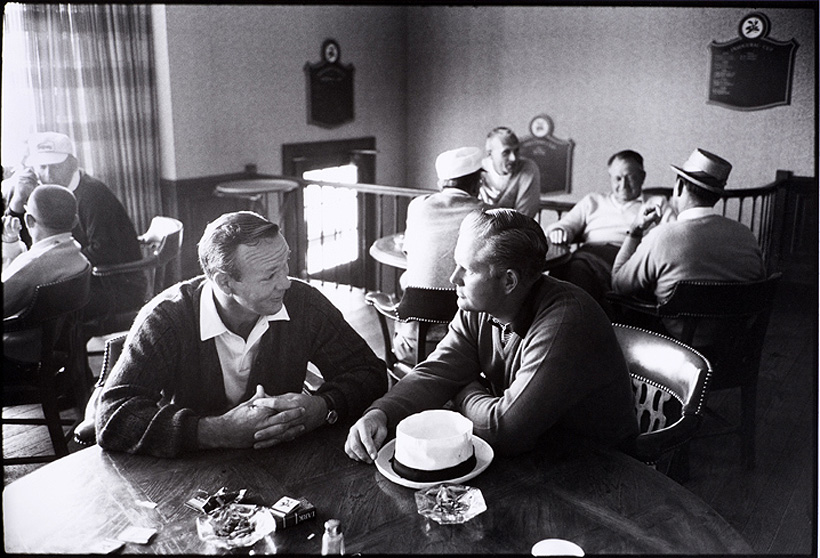
Arnie and Jack   Ligonier, Pa 1965   (walteriooss.com)

As you look through this book you cannot help but shake your head, time and time again, saying to yourself, “I remember that picture, I remember that look”.  It is like a personal bit of time travel for those of us who have religiously followed the game for so long.

Dan Jenkins said, “In this splendid book, Walter Iooss makes the sport of golf look as colorful and thrilling as it actually was in the second half of the twentieth century”.

If you can find this book you should add it to the stack under the coffee table in your family room.  You will find yourself picking it up regularly for another joyous walk down memory lane.

(Click here to review Walter Iooss’s Golf Portfolio on walteriooss.com)

Classic Golf-The Photographs of Walter Iooss Jr.

Walter Iooss (2004)

New Year’s Resolution

We may not think that in the coming year we are going to be better than ever we were, but we are sure that we are going to be better than last year.  That pleasantly fatuous belief never really leaves us, but it flames up more brightly than usual on the first of January, because that day is like the ninth hole in a round.

How often when we start playing very badly we say that we shall do better after the turn, and how often our words come true.  We want just that definite turning point to set us on the right road and the New Year supplies us with it.  On any ordinary summer day of the year if we go to bed slicers we do not expect to wake up driving with a slight, beautiful and controlled shaded draw; but as we take our bedroom candlestick with yawn on the night of December thirty-first, there seems nothing in the least improbable about such a miracle.

Bernard Darwin

New Year’s Eve Cheer

American Golfer, 1933

Johnny Miller 360

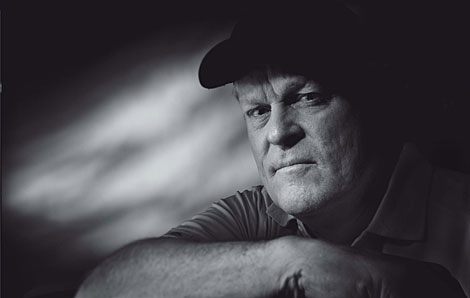
As you can see from the images in this slideshow called “Johnny Miller Through The Years” Johnny always evoked confidence and style throughout his career.

From Brylcreem to full mop he looked and dressed the part for each era.  Bad news was sometimes his taste in clothing was halucious, good news was he had the body type to pull it off.

Deep down in side he was always a traditionalist.  He had great respect for guys like Arnold and Jack and the hallowed traditions of the game.   Just look at the putter he is holding in this picture.  As a friend of mine remarked, “It looks like he got it from Harry Vardon’s garage”.

One of the finest iron players to ever play the game, he practiced what he preached.  Compare some of these images to his theory on hitting good irons.  Review Johnny Miller’s “10 Rules for Sticking Your Irons”.

Enjoy a short jaunt through time…..Johnny Miller’s time…..as we know with Johnny he never fails to elicit a reaction.

(Click here to see Golf Digest’s “Johnny Miller Through The Years”)

Golf Digest

2011