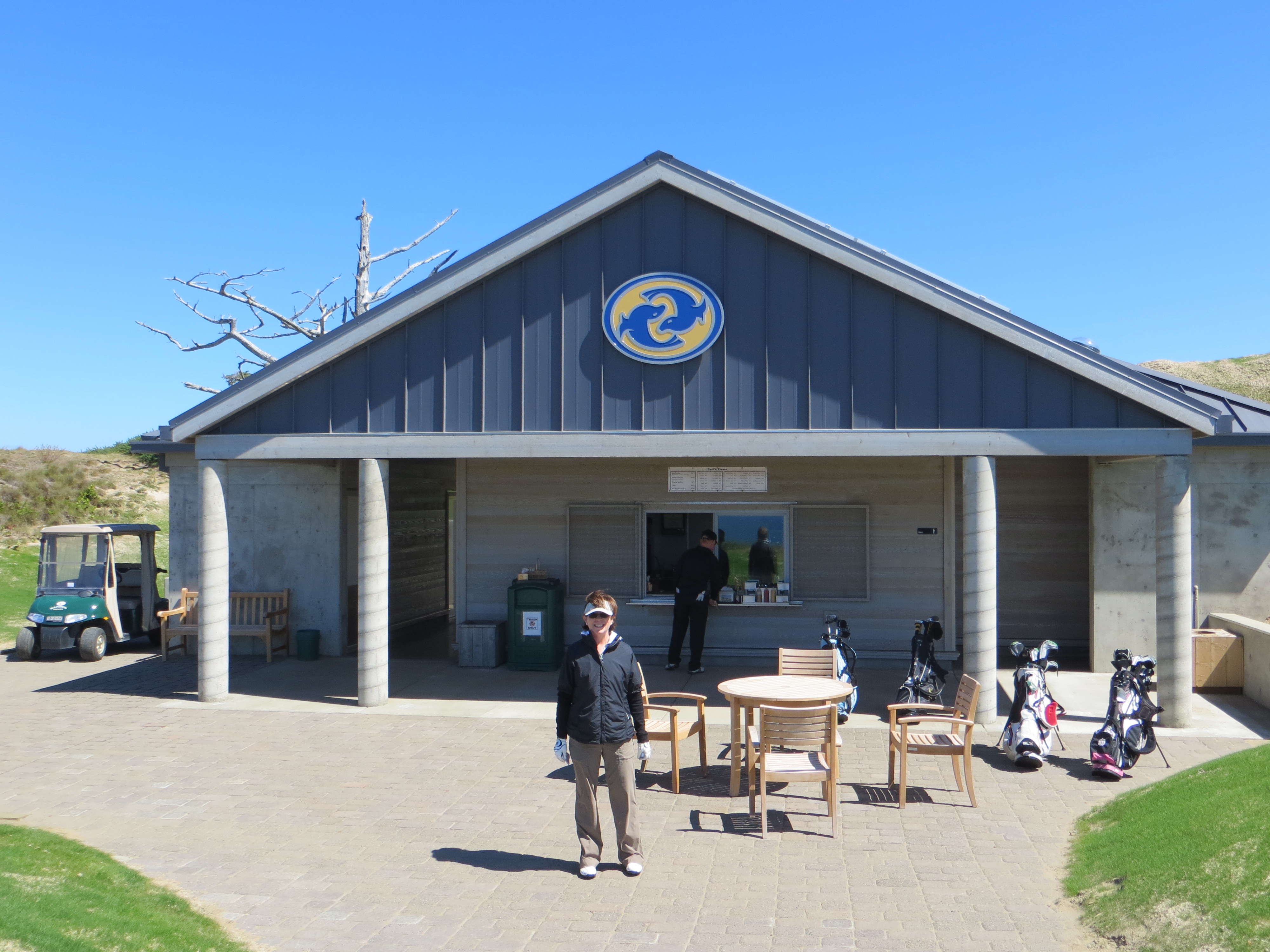

Bandon Trails Golf Course

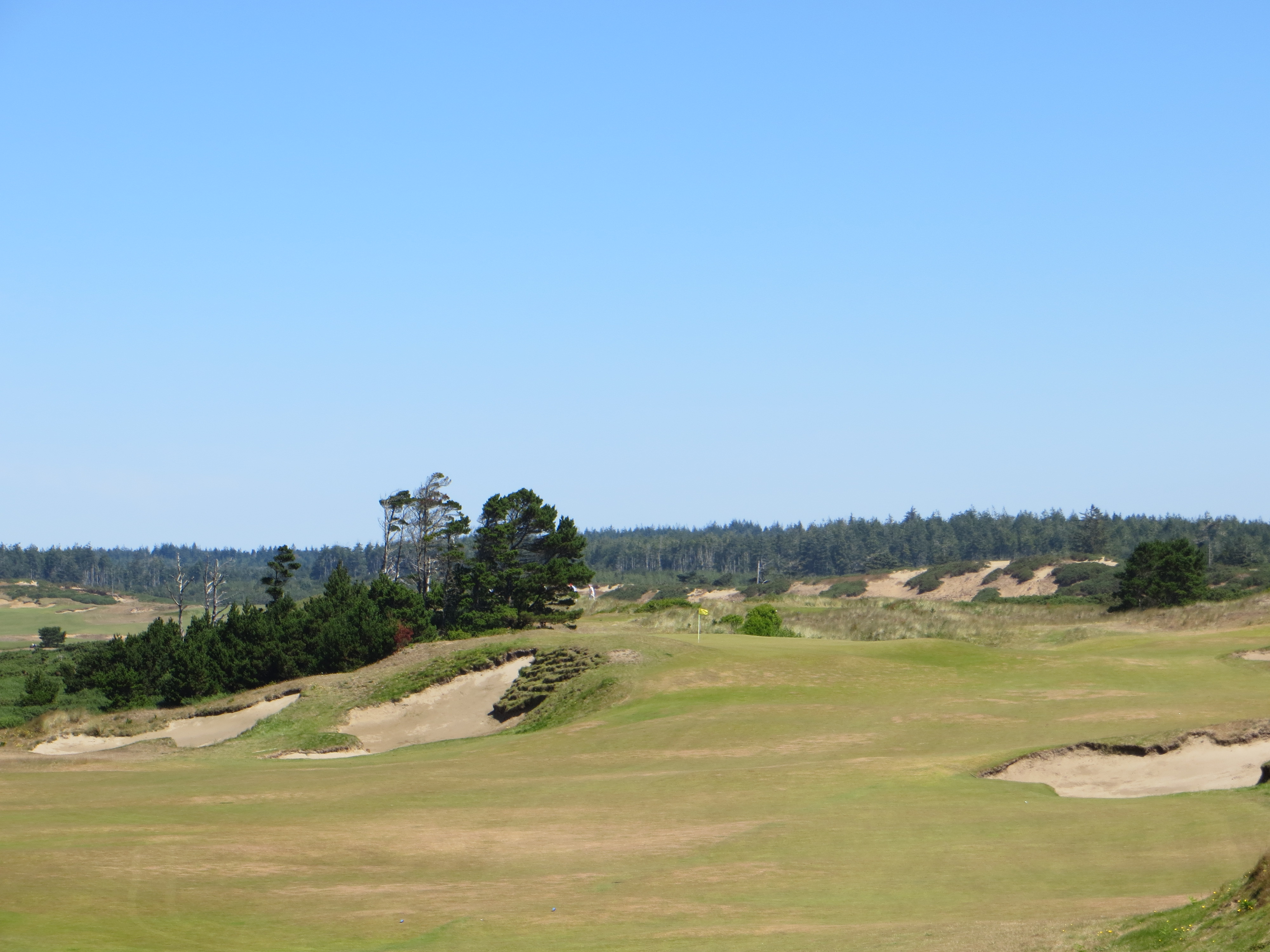
Coore and Crenshaw may have had the hardest task at Bandon being asked to bring a third course on line following the accolade and fanfare the two spectacular links courses Bandon Dunes and Pacific Dunes had received.  The rugged terrain they were working with was much more challenging with distinct elements of sand dunes, grassy meadows, and dense forests.  It was going to be a monumental task to deliver 18 walkable holes with unified character and natural flow.

These guys are key protagonists in the “minimalist” approach to course design that seems to be pervasive today.  Their goal is not to move a bunch of dirt to create holes with a signature Coore-Crenshaw look but rather to discover holes that nature has lurking in the existing terrain.  As Coore says in the book Dream Golf, “We don’t want our holes to look like golf holes…they should look like landscapes which just happen to include a golf hole”.  Their approach to designing Bandon Trails was to spend endless hours walking the ground learning the site discussing all the possibilities as they enticed these holes to reveal themselves.  The result is a cohesive presentation of unique and challenging holes distinctly different than their links cousins but just as enthralling.

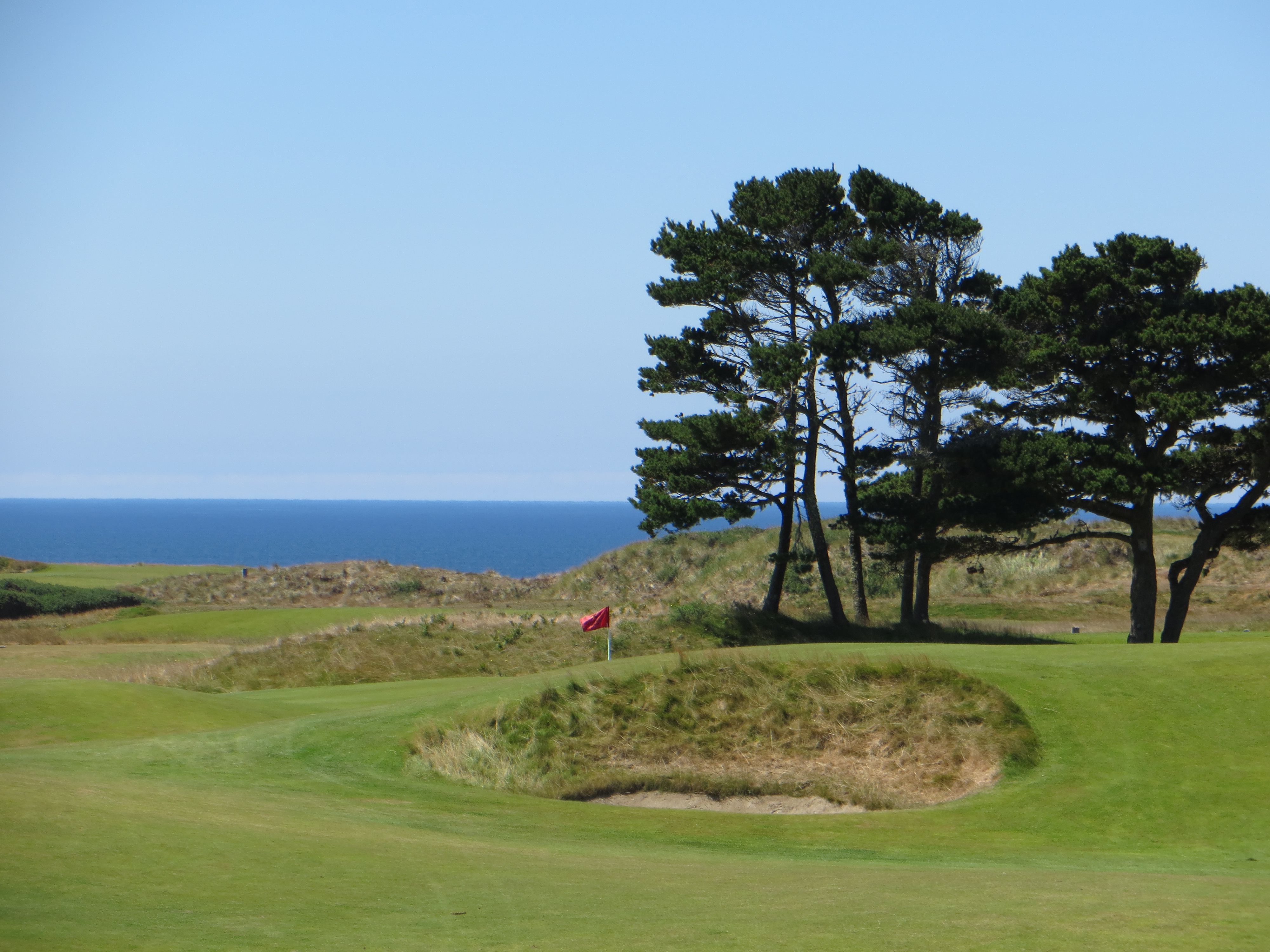
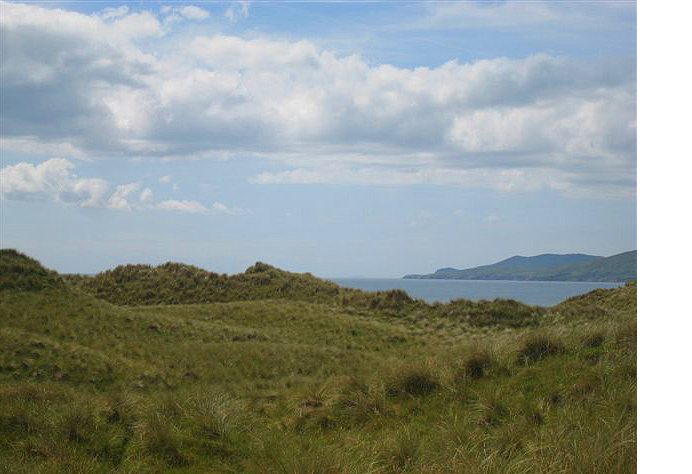
The first would feel right at home at Enniscrone or Waterville in Ireland

(Click on any picture to get an enhanced view of the image)

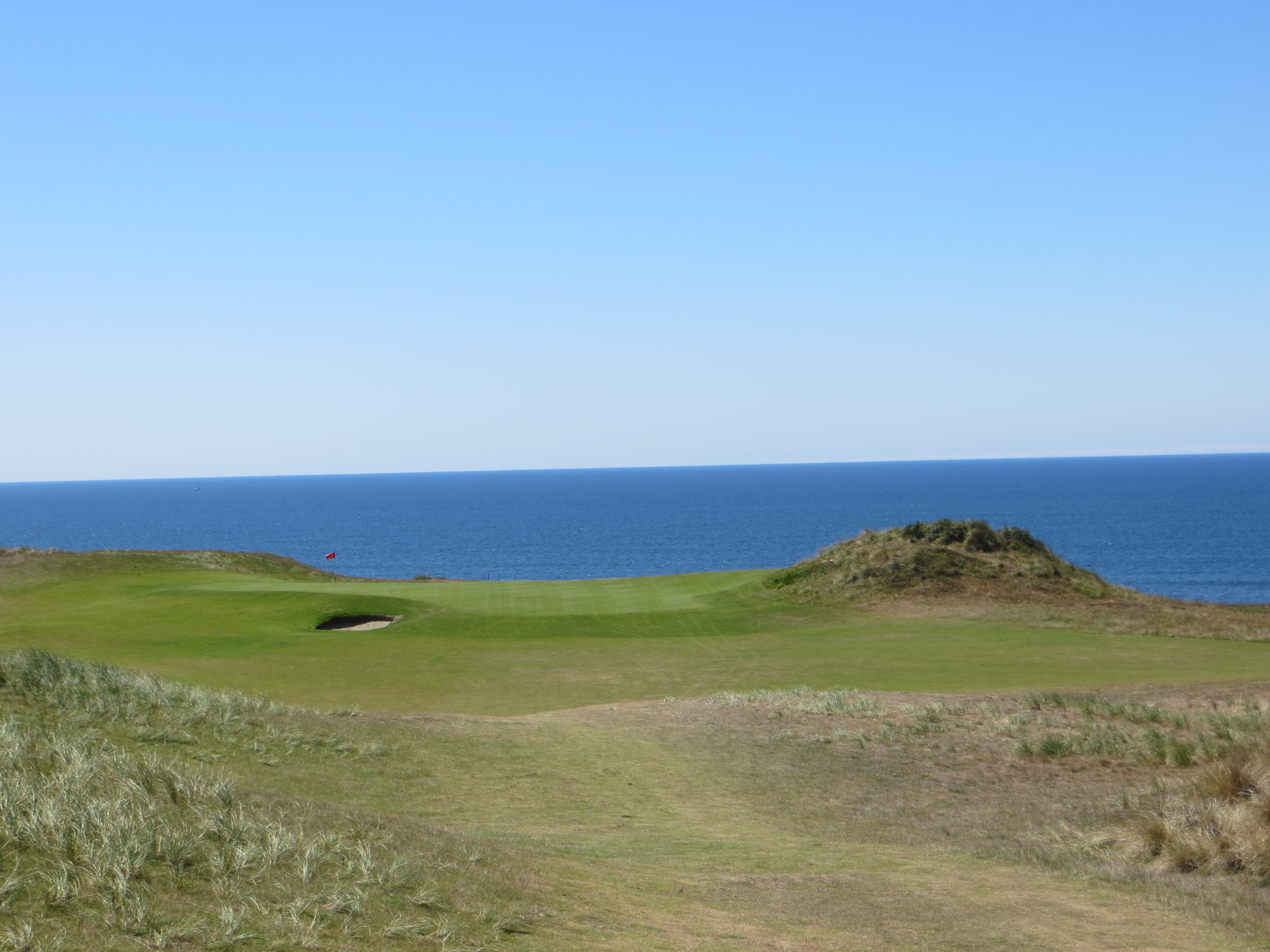
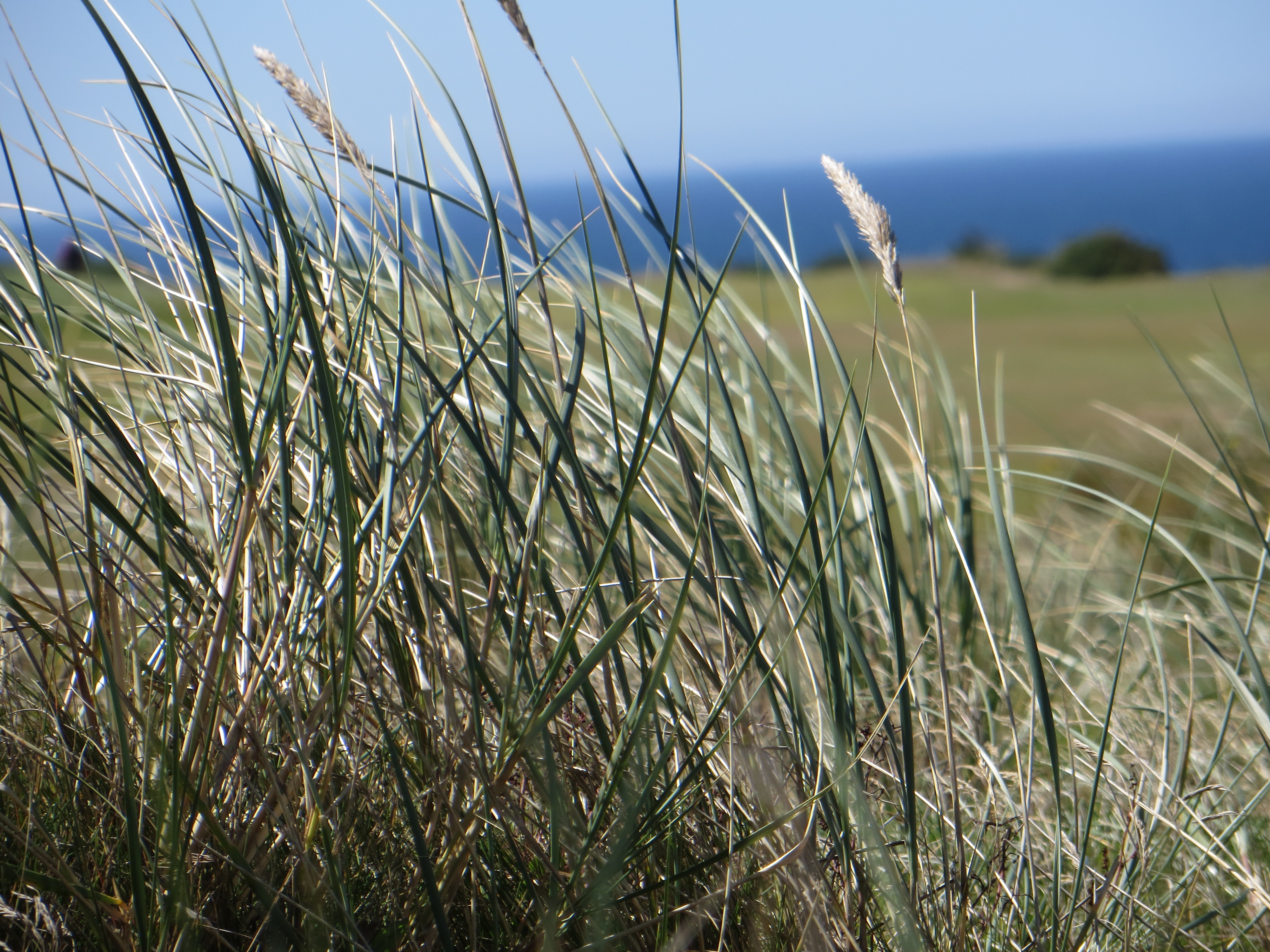
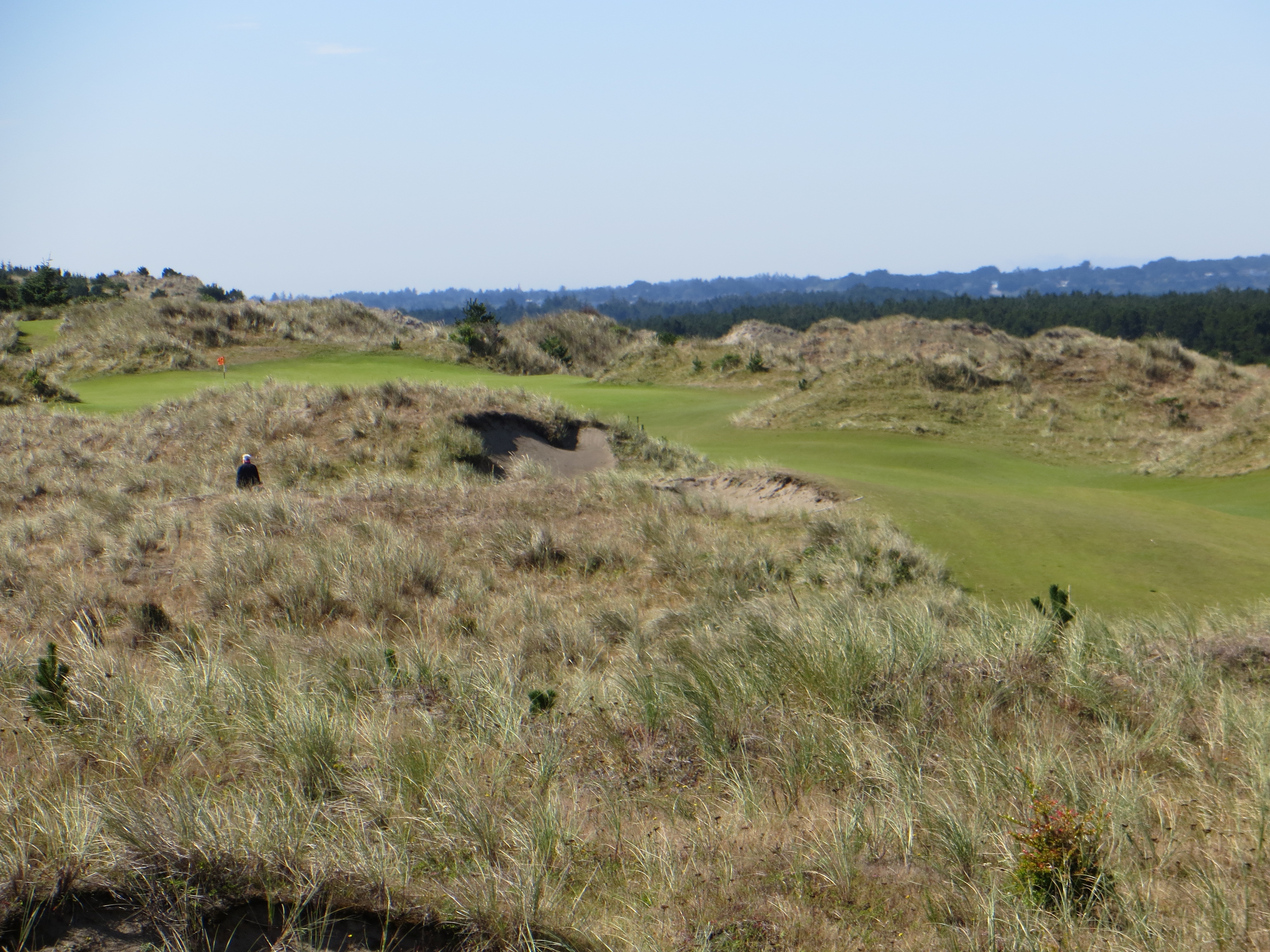
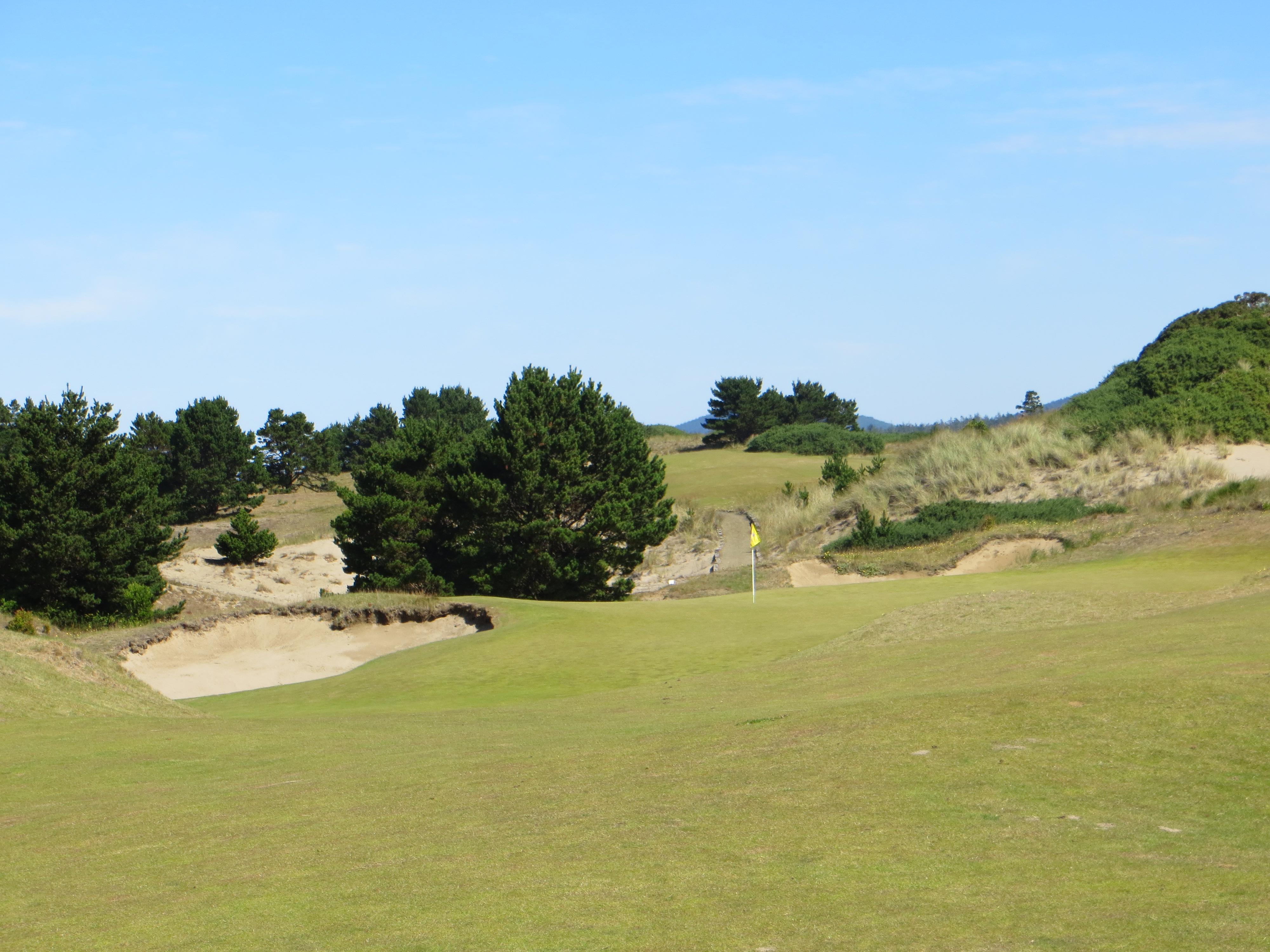
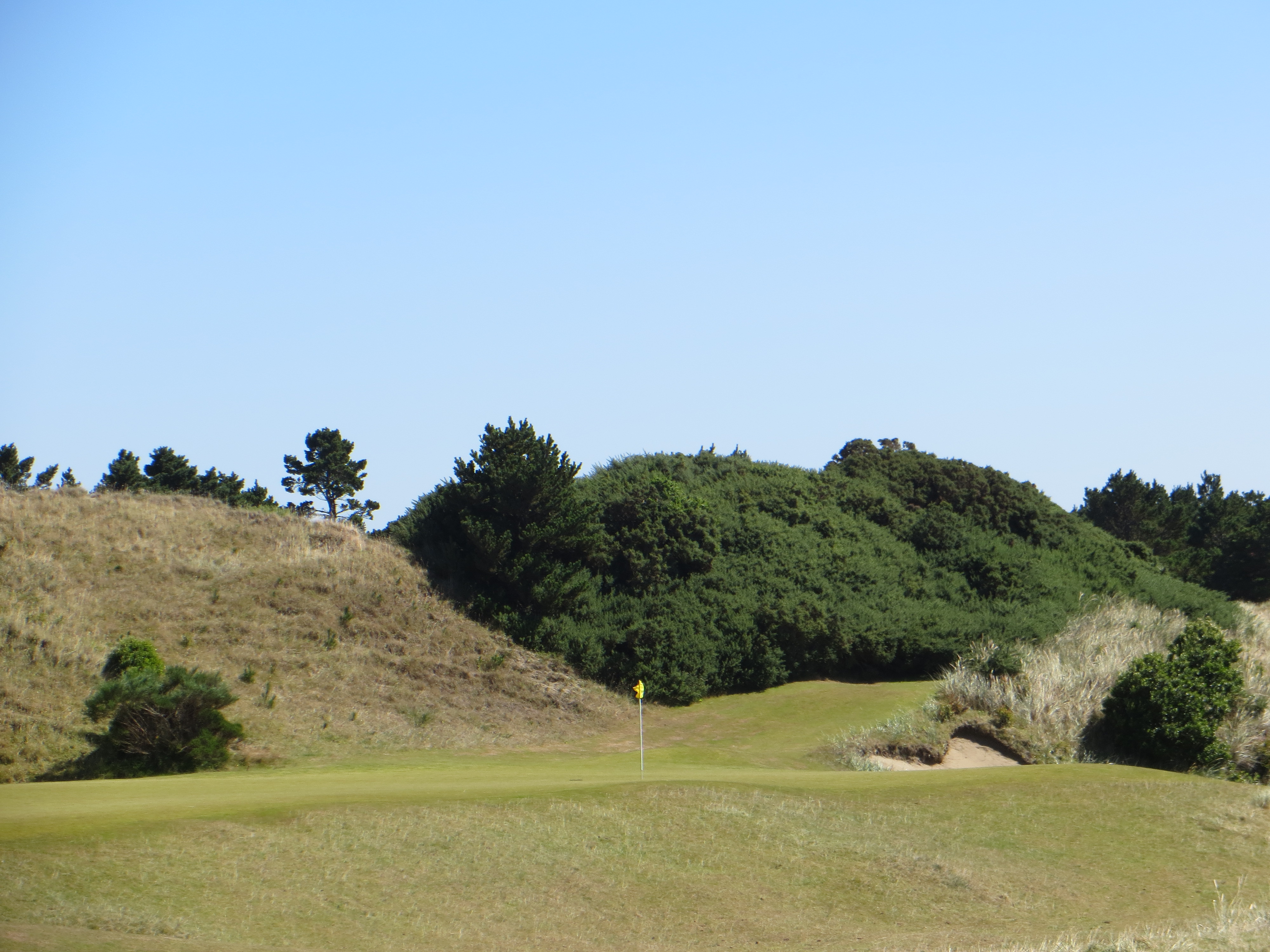
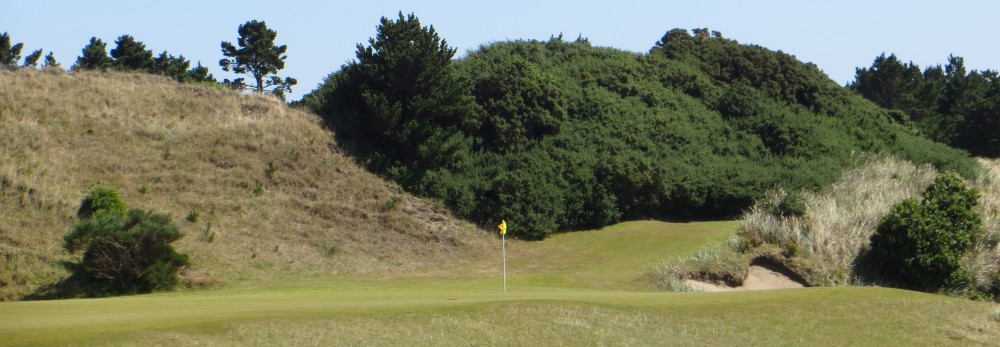
The first hole is a classic links presentation with the tee looking out over a range of sea grass covered sand dunes that barely reveal a path for a golf hole. This is a bit of a design feint since you won’t really see this again until the final hole of the day.  A fairway club with the correct shot shape will search out a path between the massive dunes leaving you a short pitch up to a long and narrow green wedged into the dunes above.
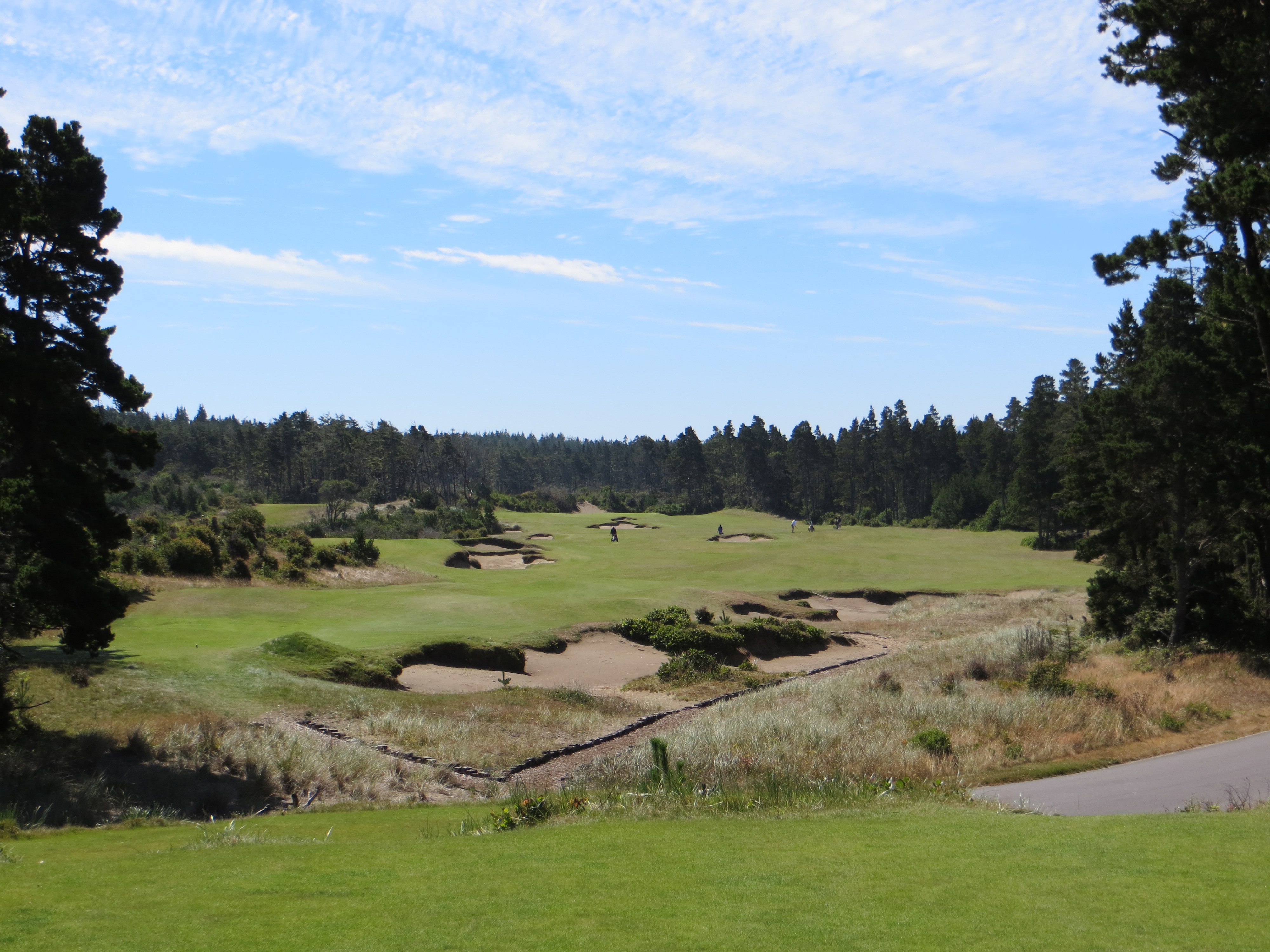
The full Pine Barrens look unfolds across the meadow on #3

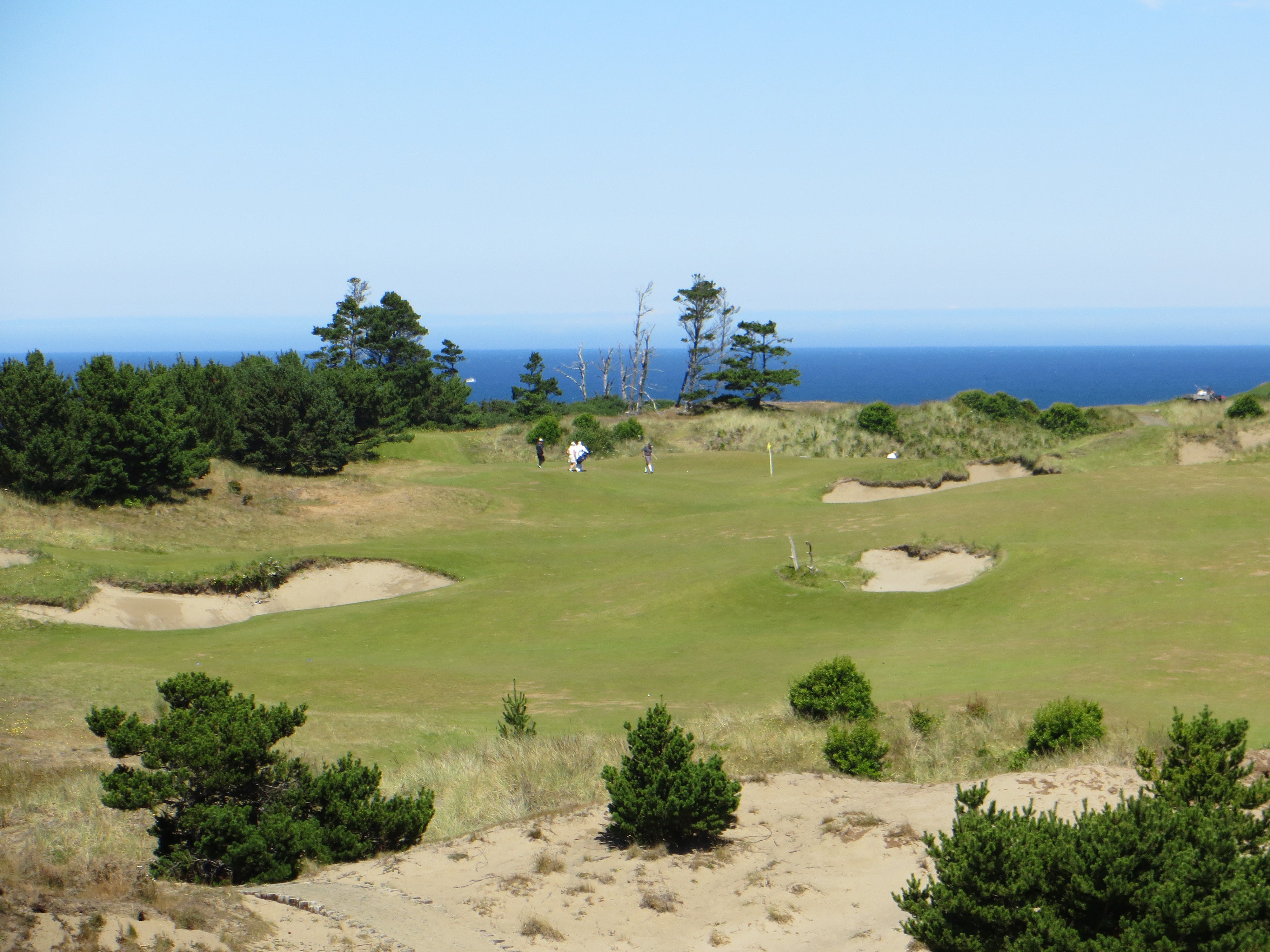
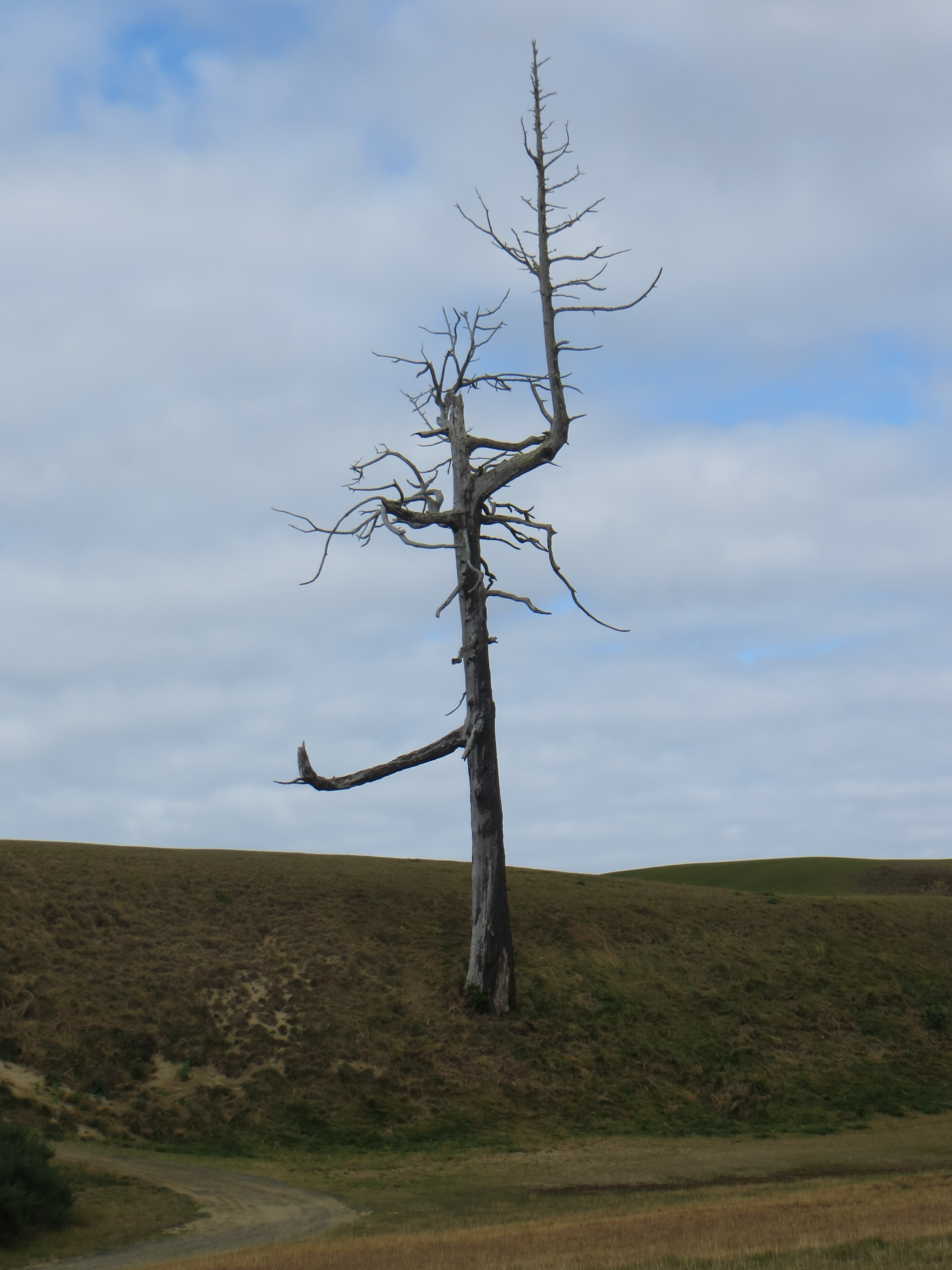
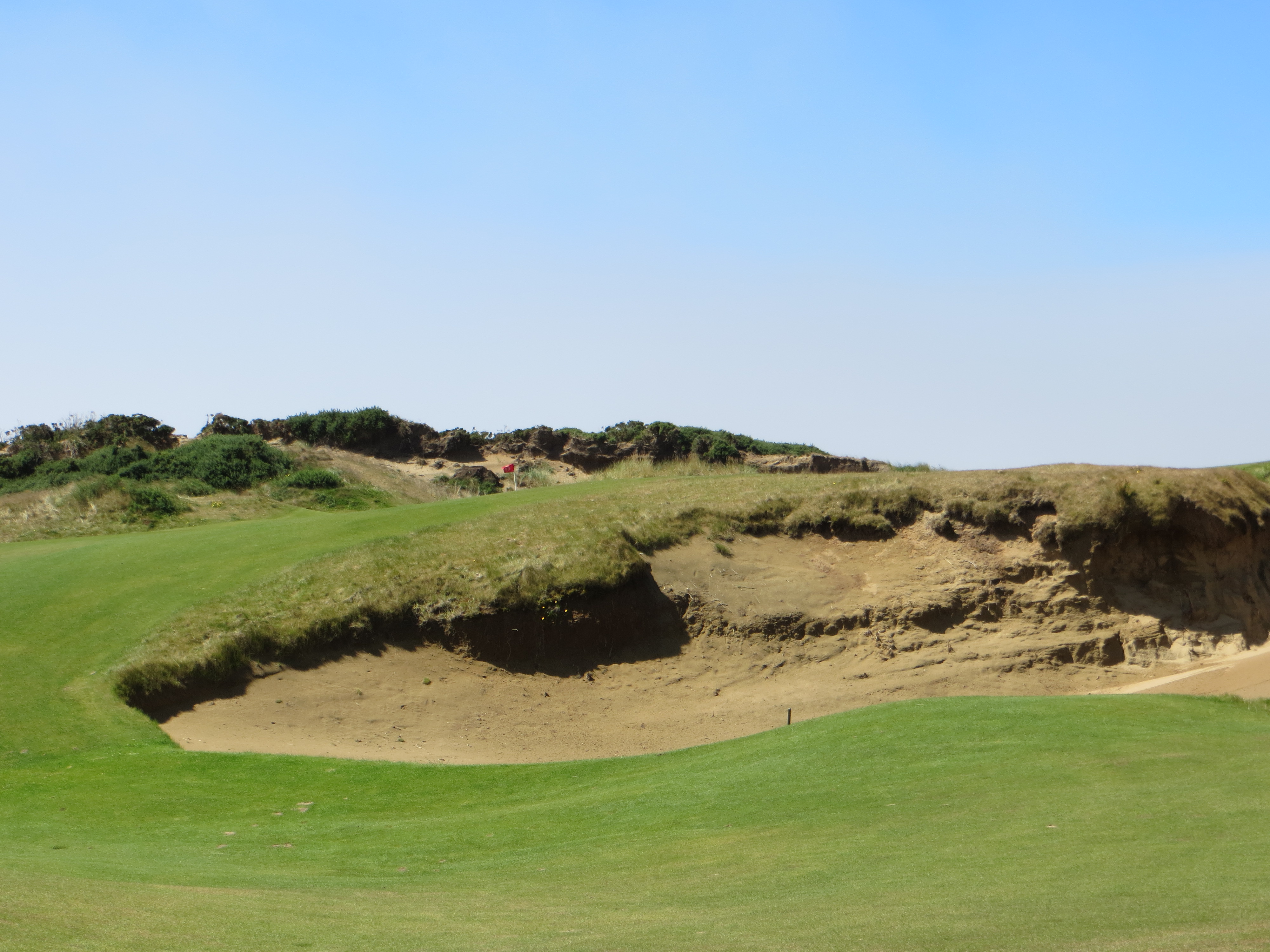
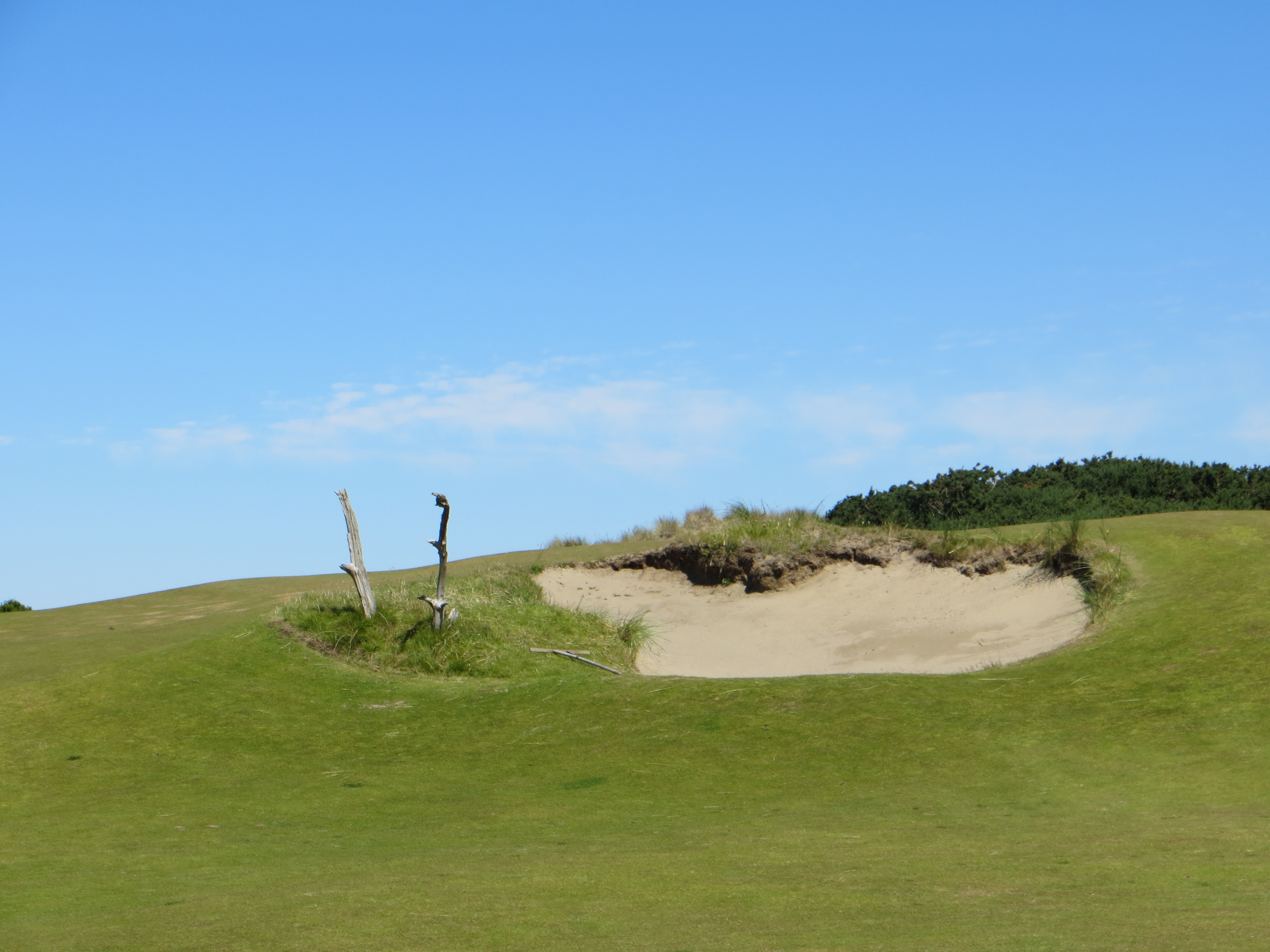
As you come off the first green to the second tee the look transitions quickly from links to sand barrens as you are descending into the meadow.  The next five holes would feel right at home at Fazio’s Pine Barrens course at World Woods as they are characterized by the meadow’s more subtle elevation changes, plentiful waste areas and penal blow-out bunkers, and a blend of fir and spruce trees, native vegetation, and sandy soil.  Thoughtful navigation of these holes is required because the arrays of sand hazards must be avoided and the rolling contour of the firm fairways will make that a challenge.  The third and fourth holes meander across the meadow with the sand and mounds giving you alternative routes to play depending on the wind effect and the pin positions.  The par three fifth hole composes all of the elements in a jaw dropping Kodak moment that will take your breath away.  The hole has a picket fence made of old tree branches in front of the tee and behind the green an indigenous accent used repeatedly throughout the course.

At #7 the ascent into the enchanted forest begins

At the seventh you are leaving the meadow and about to begin scaling the most rugged terrain of the course.  The addition of elevation change to club selection will up the shot values from here out.  The climb begins with a severe uphill par four that is the number one handicap hole on the course.  Transition on this hole is so abrupt that the greenside bunker that has a two-club elevation change of it’s own.
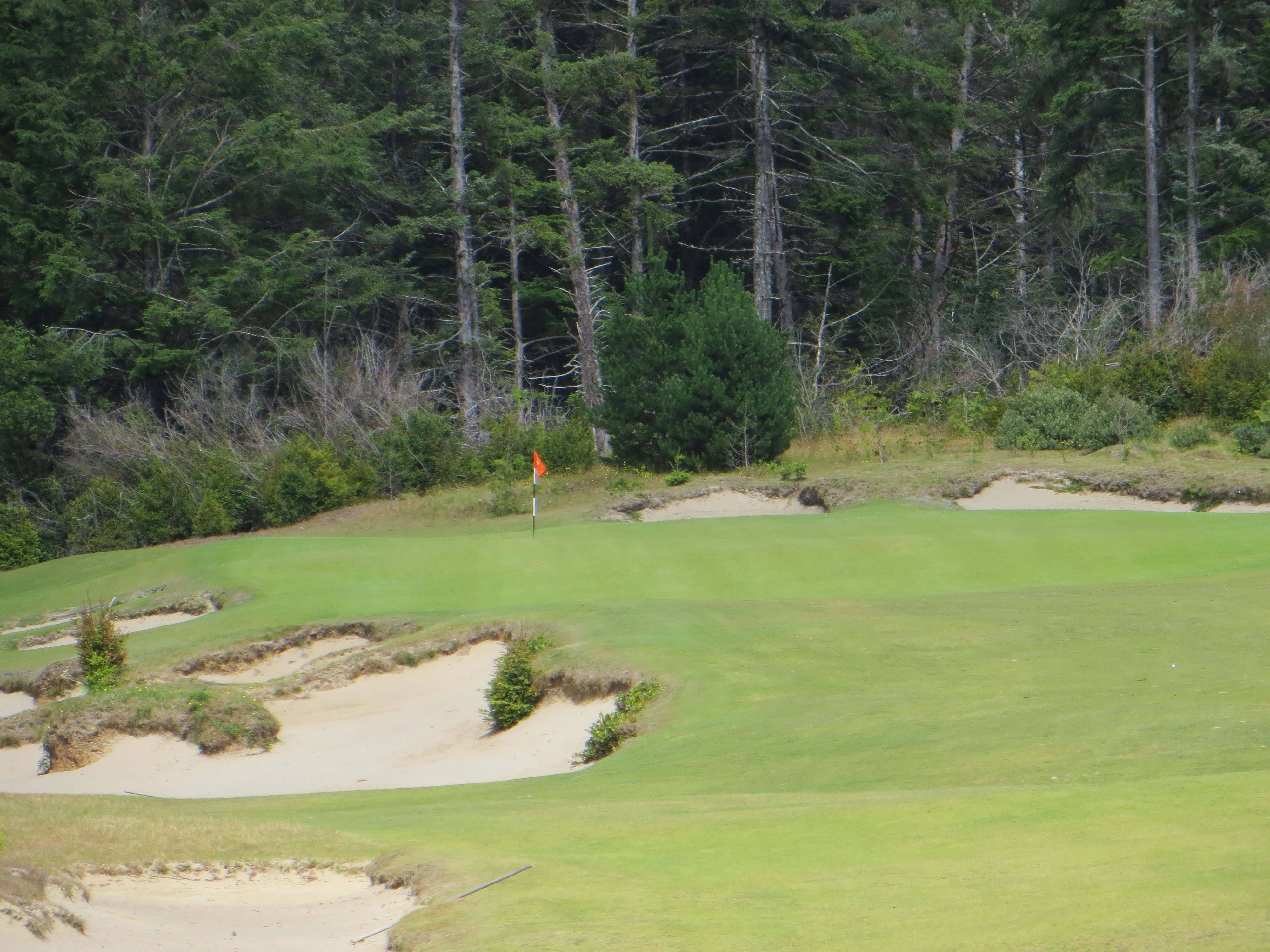
With a solid plan well executed you can avoid the awaiting trouble on #8

A technical test is next in a short,  possibly drivable par four-a tight rope walk across a ridge with serious bunkering waiting to gather a shot without proper conviction.  Lots of choices on how to play this one, it can be a scoring opportunity providing you plan wisely and execute accordingly.

The ascent to the top of the property resumes as you play a very engaging ramped par five to end the front nine.  They used uphill to mask the generosity of  the landing areas on each shot.  This hole has a links feature you see throughout the course in that this green just seems to emanate from the fairway with little texture demarcation,  This provides a very hazy frame of reference for approach and recovery shots.  As you saw on the links courses use of your putter from well off the green can be a valuable tool when approaching a short side pin.

My conviction is that what makes this such a difficult course is controlling your roll outs due to the combination of the firm fairways and the downhill landing areas.  The problems presented by the through space on the drive and approach on ten are good examples of this.  You must shape your shot to move away from the waste areas or else the downhill roll out will bring them into play.  The eleventh is an imaginative natural rolling par four that scurries up and over the existing fall of the land. All they had to do was mow some grass for the tees and green, nature had already done the rest.

The natural beauty of the setbacks frame the experience

In this middle section of the course there is dramatic scale created by the backdrops of dense hardwood trees perched on the rugged hills.  Add to it the aromatic smell of the forest and a bold dash of blue sky above and it will captivate all your senses as you contemplate the shots to be played.   At this point in the round you are as aware of the nature walk you are enjoying as the golf challenge you are experiencing.

From the thirteenth tee to the final green you are going to play a unique array of challenging holes traversing some of the most rugged terrain in Bandon.  On the tee of the par four thirteenth you feel like you are standing in your socks at the top of a playground sliding board-good luck staying on your feet on any shot on this hole.  The green itself is like a bikini waxed tortoise shell-getting the simplest pitch shot to remain where it lands is quite a chore.

The slippery topography on #13 makes controlling your result very difficult

It is such a severe transition from the thirteenth green to the Kitzbuhel starter’s gate that serves as the next tee box that they have to provide you an automated ride.  The fourthteenth is a very enticing short par four where the effective landing area for your tee shot is the size of a picnic blanket.  From the perfect landing spot the pitch required is very precise.  The green is the shape of a size nine left orthotic insert and the surface available is not much bigger.
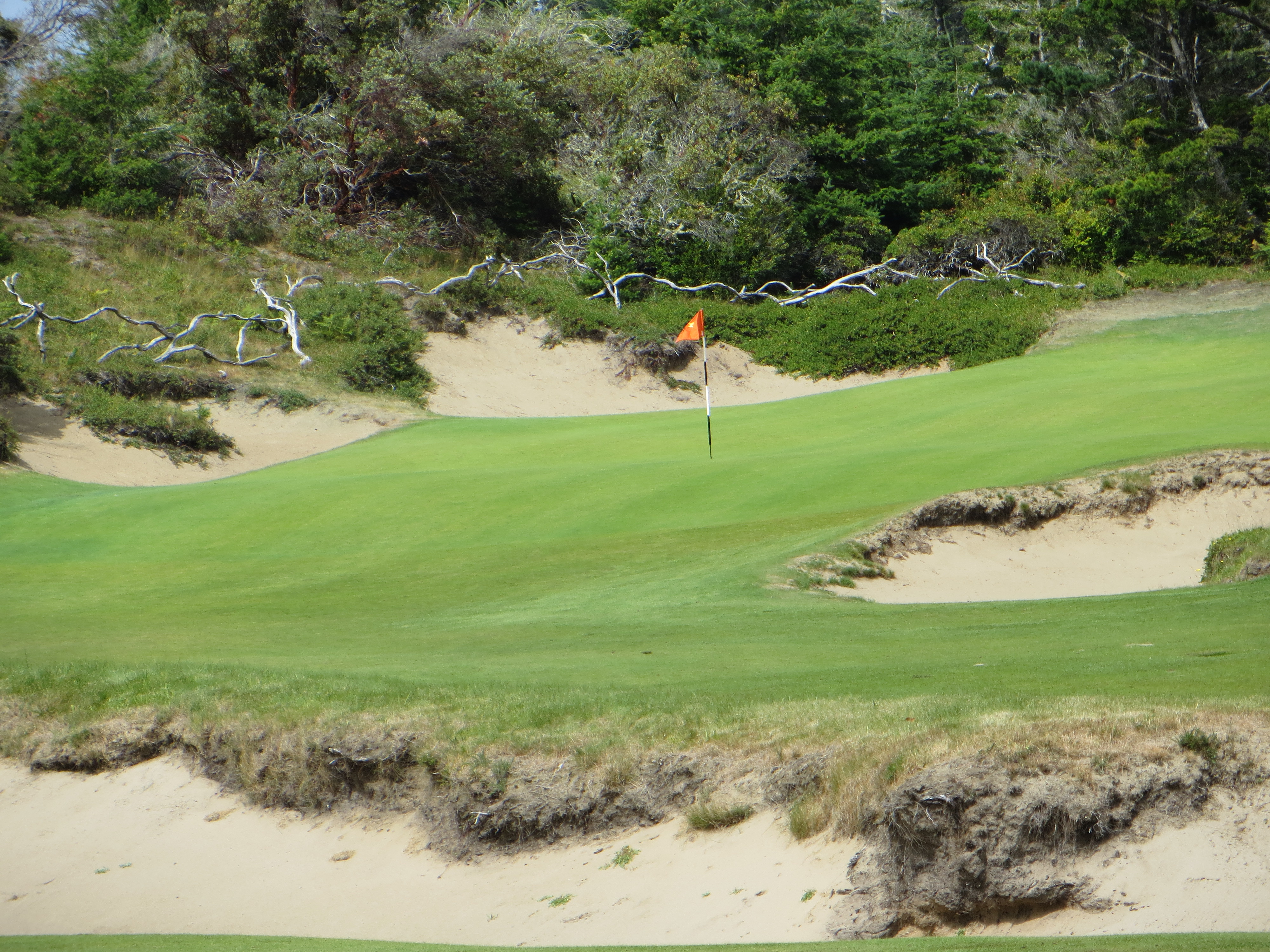
The green complexes like #15 put real pressure on where your approach ends

Fifteen is a quasi-breather because the landing area is sufficiently generous to fool you into believing this is an easy hole.  But the second shot is to a raised narrow green set in a tight alcove of sand and furry growth.  The shot demands the utmost accuracy to keep the ball under the hole and avoid a sure three-putt.
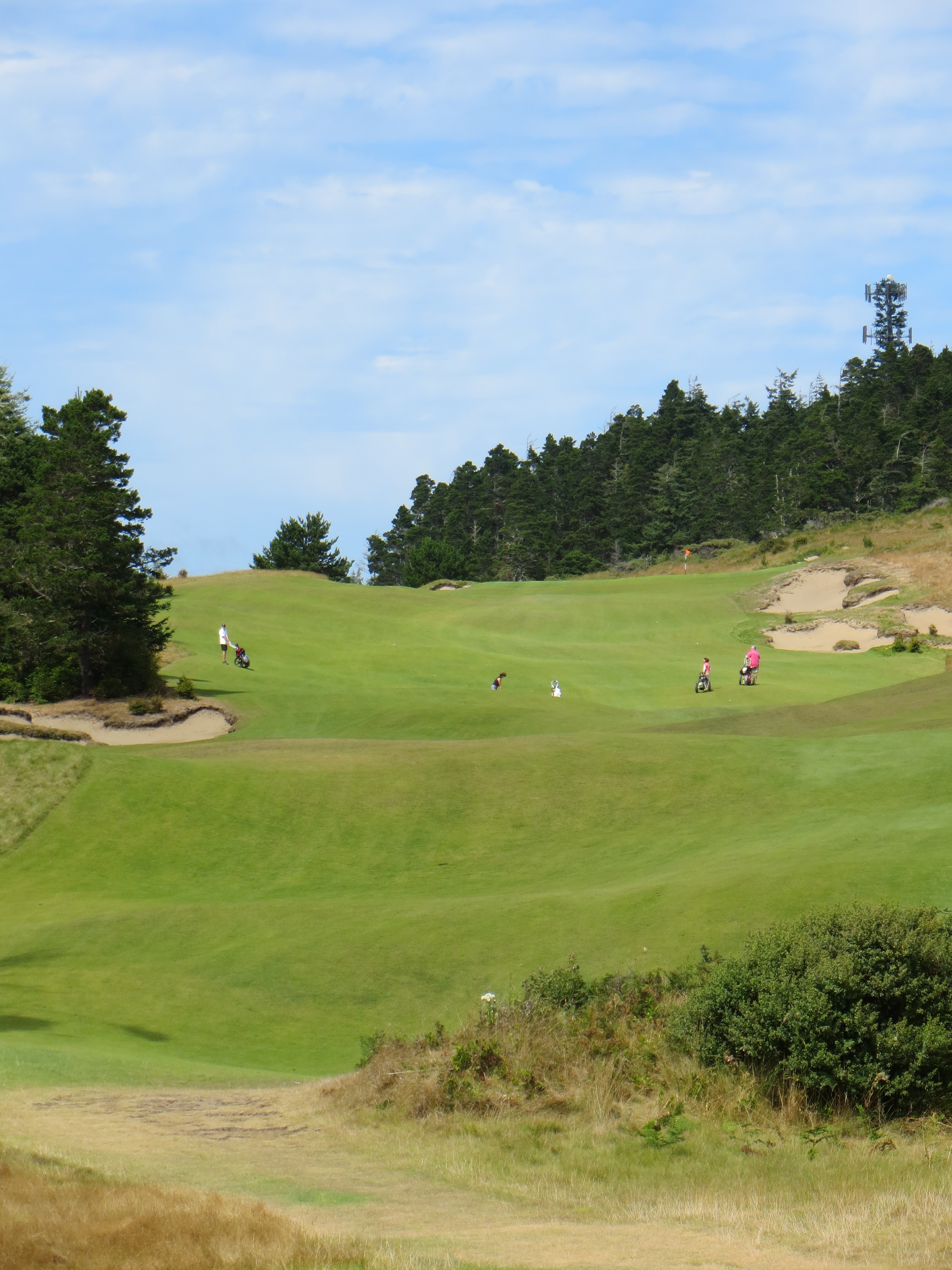
Cannot help but be overwelmed by the scale of the climb on #16

Standing on the sixteenth tee you have a sense of what it is like to be a window washer on the Empire State Building.  You are looking straight up the face of a fairway incline that looks like it will not hold your ball much less your full body weight.  Add a prevailing wind in your face and you have the full Chinese death march par five experience ahead of you.  The good news is the ball seems to not only hold on the steep incline, but with the firm fairway,  it actually bounces forward way more than you expect.  The green sits exposed on another high point on the property so the real challenge here is getting an approach shot to hold on a firm windswept green and then  two-putt on the way out of Dodge.

The devil is in the details at the visual par 3 17th

The par three seventeenth is the most photographed holes on Bandon Trails.  Much like the postcard three par you saw on number five, which just so happens to be about 30 yards to your left, this one is pure eye candy.  But beware this is an unwrapped Halloween treat tinged with a little of the wicked witch’s juice so prepare to be challenged.  You are playing a short shot across an environmental divide to another tortoise shell green wedged between some very unforgiving bunkers.  Good news is they gave you a chipping area long and right.  Bad news is the recovery shots from there are as difficult as from the unforgiving bunkers.  If they offer you a bogey and a free pass to the eighteenth tee I would take it.

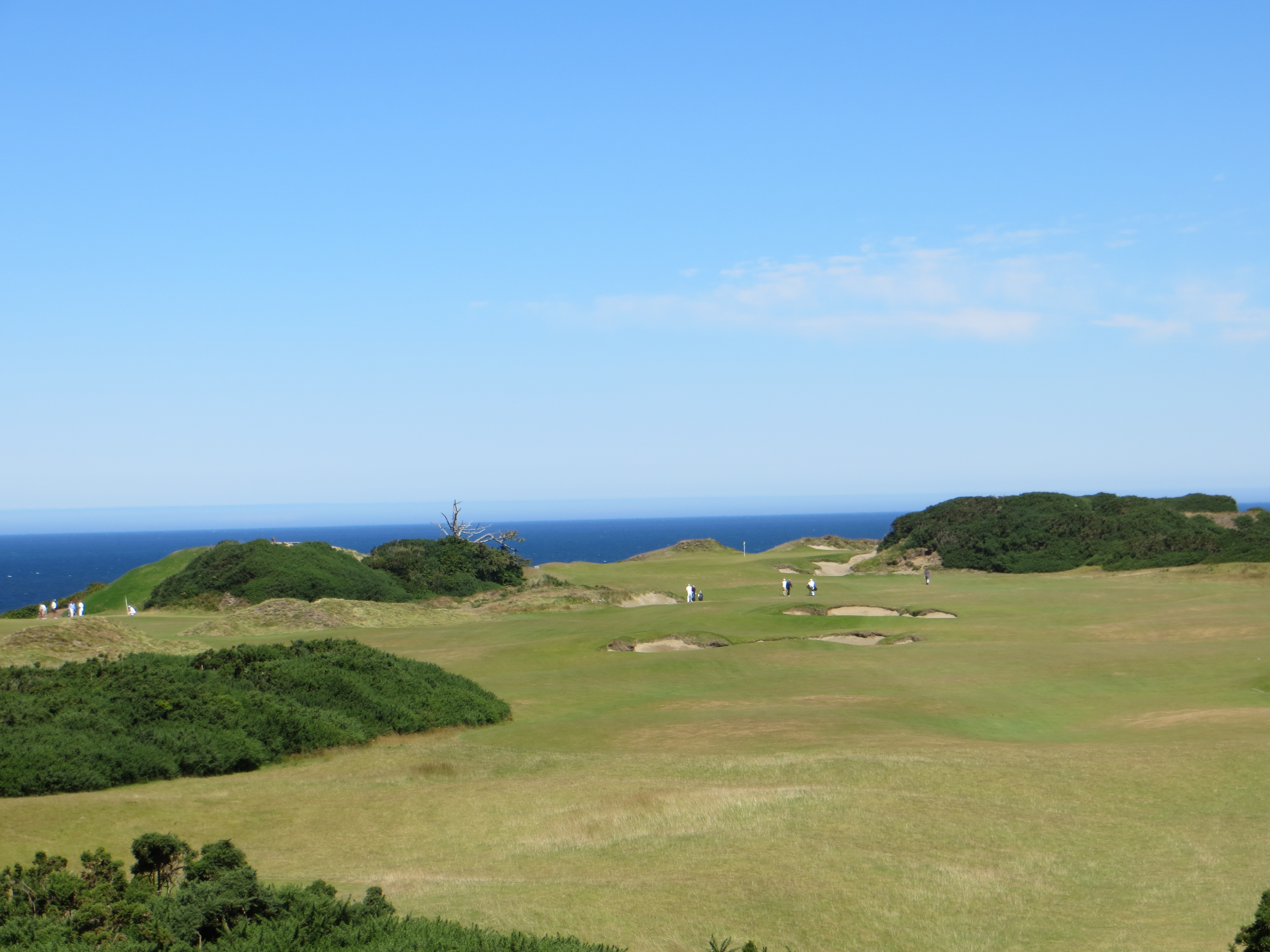
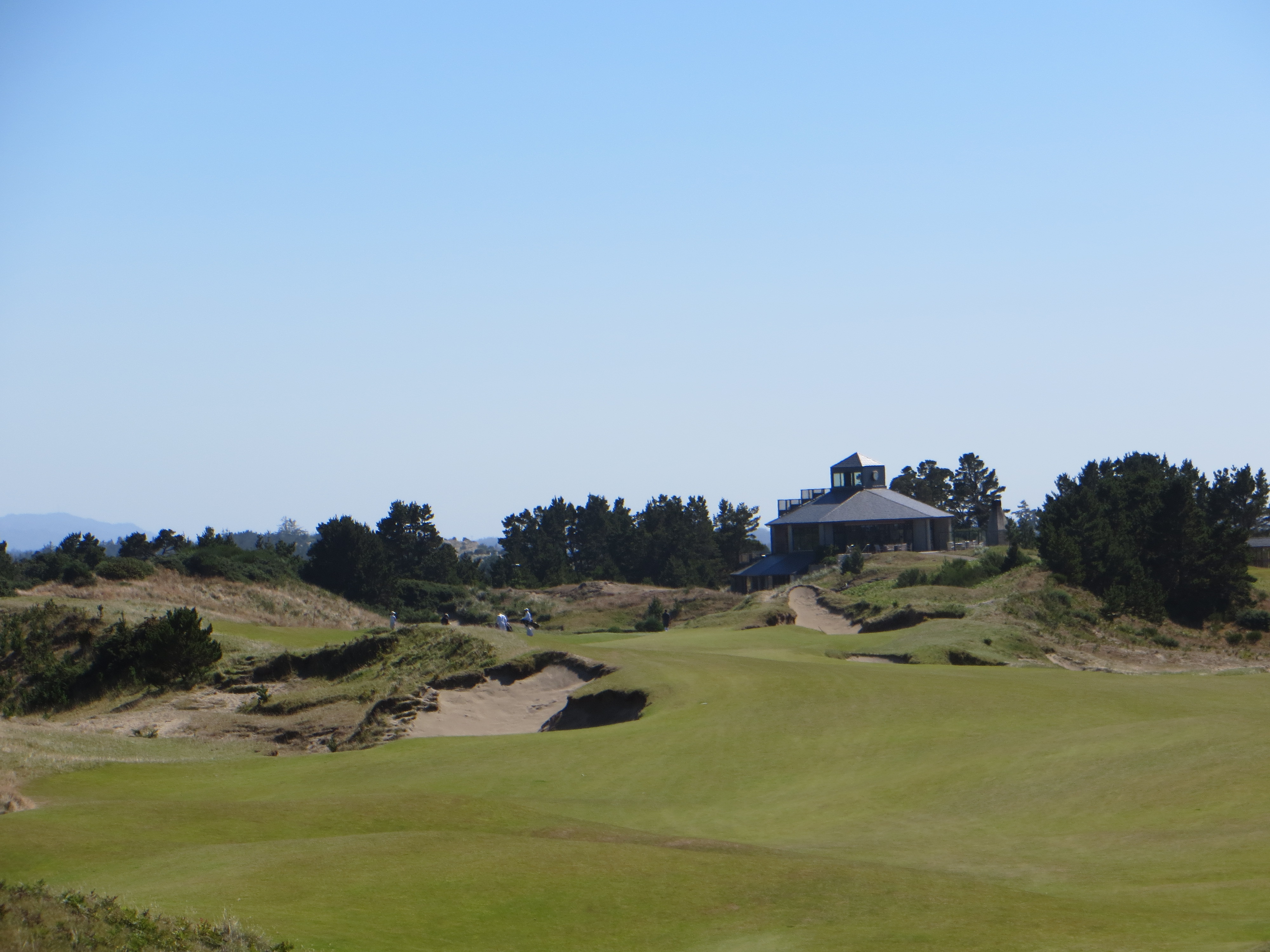
You are now transitioning rapidly out of the sand barrens to the links motif you started with four hours ago.  Much like number one, the Trail ends with a finishing par four that is links golf from tee to green.  The tee shot is a blind carry over a massive hill to an undulating landing hollow below and to the left.  From there you have a three story short iron to a long and narrow green draped across a plateau adjacent to the clubhouse.  This green is exposed to the Pacific winds and will be firm and fast so figure out a way to keep your approach in front of the flag you can barely see.

The final perch…where does the fairway end and the green begin?

Once you have putted out do a 180 and appreciate the stunning view back down this last hole and of the tree laden hills beyond.  It should occur to you what a remarkable achievement it was that Coore and Crenshaw composed such a dramatic and playable golf course on this rugged and diverse terrain.

Bandon, Oregon

Architect:  Bill Coore/Ben Crenshaw (2005)

Tee           Par    Rating      Slope      Yardage
Black        71     73.7         133          6765
Green       71     71.1         129          6260
Orange     71     70.8         122          5064

(Click here to review Bandon Trails Golf Course hole-by-hole descriptions)

For more Bandon Trails images click to see Postcard From Bandon Trails-Day 2.
Survival Of The Fittest

The Ricoh Women’s British Open proved to be a pure test of will against the elements of nasty weather on the western coast of England at Royal Liverpool Golf Club.   Winds gusting to 50 m.p.h. forced cancellation of the second round of the year’s final major on Friday and set the table for a grueling  36 hole finish on Sunday for the championship.  The weather for the morning 18 was good, but during the lunch break a meteorological hell broke loose and the final 18 would turn umbrellas inside-out and make finding fairways and greens a very stern task.

Jiyai Shin shot 64-71 on Saturday and Sunday morning to take a commanding lead at 10 under going into the final loop.  With a triple bogey on the first hole in the final round it looked like it could be anybody’s ball game.  But all the chasers were having their own lorry wrecks as the sideways rain and the gusting winds wreaked havoc on their scorecards.  Continuing her fabulous play the last two weeks, Shin settled down and played steady golf in weather that could have parted the Red Sea.  She made five birdies over the next 17 holes to post 9-under and win the championship rowing away.

Shin won this same major at Sunningdale in 2008 as a 21 year-old LPGA rookie.  She is currently the hottest player on the LPGA Tour.   Between her 9-playoff hole win at Kingsmill last week and this performance at the British she is 25 under par the last two weeks on tour.  Shin is no stranger to the winner’s circle having 10 wins on the LPGA Tour and 38 tournament wins world wide.

The young 15-year amateur phenom Lydia Ko from New Zealand continued to impress the professionals winning low amateur in this major to go along with the same honor she earned in the U.S. Women’s Open.  With her performance this week Ko, who won the Canadian Open a few weeks ago against a very strong field, showed she has the mettle to perform in the most challenging conditions.

This win perpetuates the dominating trend of Asian born players on the LPGA circuit.  Women from the Pacific Rim have won all four majors this year and the last seven going back to 2011.  South Korea’s Sun Young Yoo won the Kraft-Nabisco, China’s Shanshan Feng the LPGA Championship, and South Korea’s Na Yeon Choi the U.S. Women’s Open in 2012.
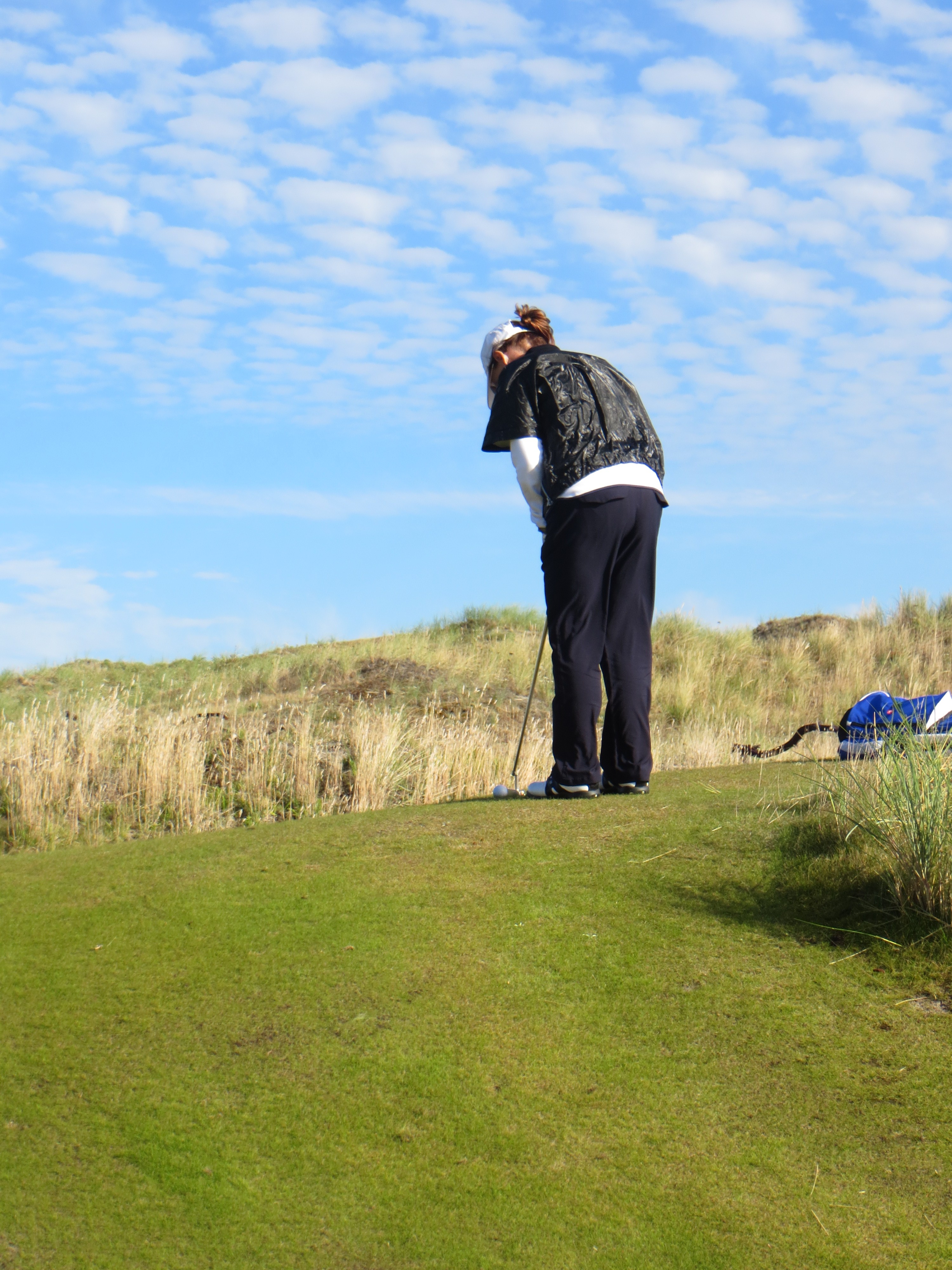
Watching her poise in the adverse conditions faced at Royal Liverpool today had a Darwinian feel to it and speaks volumes to Shin’s resolve to become the next force in women’s golf.   Another win before the season ending CME Group Titleholders and Jiyai Shin could be challenging Yani Tseng for that Rolex #1.
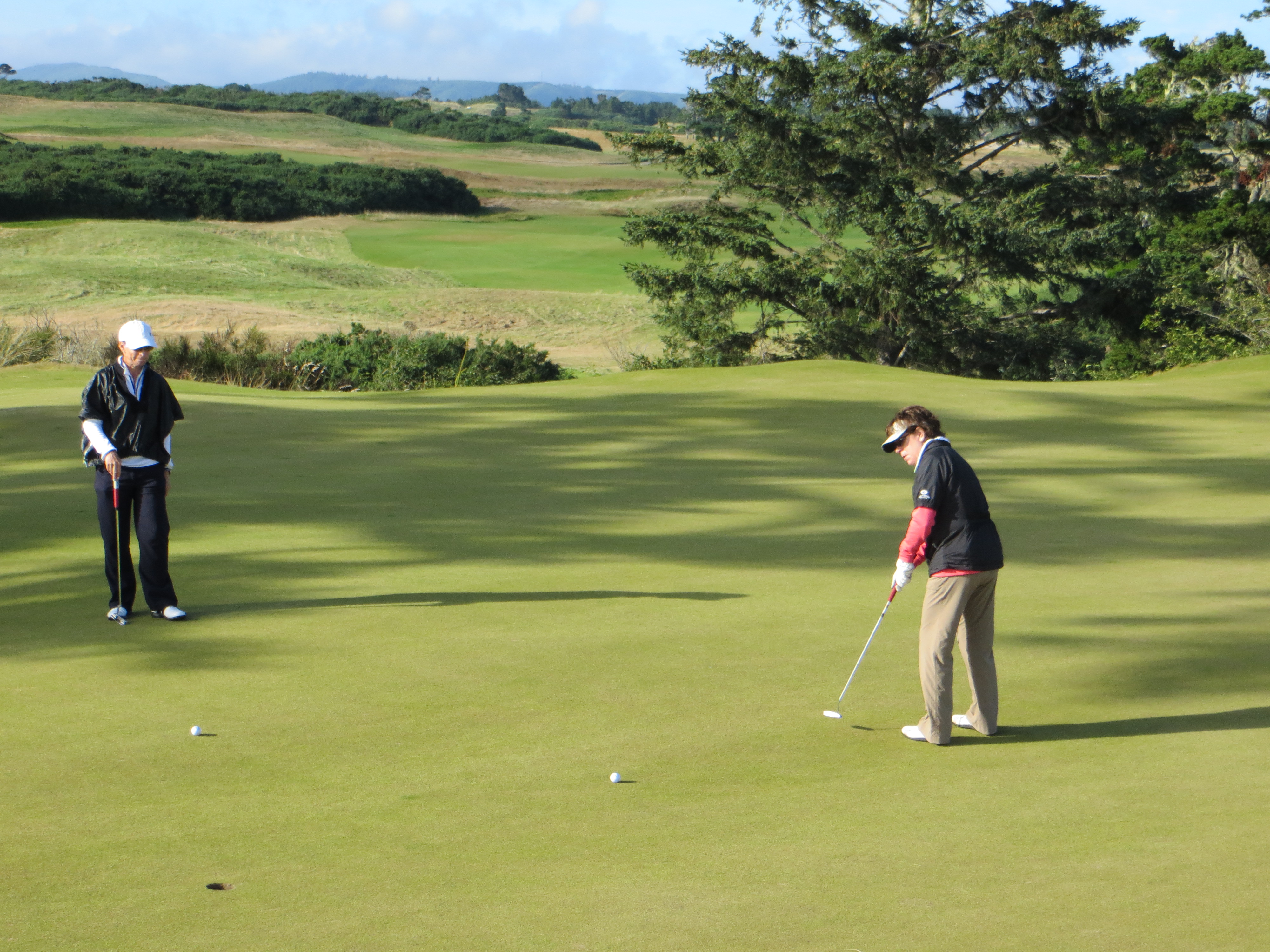
September, 2012

Bandon Dunes Golf Course

Bandon Dunes was the first of the links courses Mike Keiser envisioned for this dreamy piece of coastline in Southern Oregon.  His strategy from the outset was to introduce real links golf to America where it was all about walking the course, dealing with the elements, and playing golf close to the ground.  All the trappings of the resort are simple and understated, he intended to let the courses speak for themselves in the pure language of golf that he experienced in Scotland and Ireland.

The Lodge quietly overlooks the opening and finishing holes.

His idea was to hire a young talent with a knowledge of links design who was not famous enough yet to ignore his suggestions.  Fortunately, as you can read in the book Dream Golf-The Making of Bandon Dunes, Keiser spent years studying links courses all over the world so his opinions were worth taking into consideration.  David Kidd was a twenty-something Scotsman with little design experience, the son of Jimmy Kidd who himself was a bit of a force in Scottish golf as the head caretaker at Gleneagles one of the most fabled resorts in Scotland.  As with so much that has gone down in the development of Bandon Dunes, it was just Keiser’s gut feelings that told him David Kidd was the man for this job.

The landscape canvas Kidd had to work with at Bandon was smothered in gorse, a wiry sticker bush that is native to the British Isles.  Gorse harbors the ultimately unplayable lie and is the signature element of the links courses of Scotland.  The fact that it existed at all in this remote corner of Oregon was the result of a seemingly arbitrary act of an Irishman who settled in this area in 1875 and introduced the plant.  Gorse flourishes like a weed and it quickly came to cover the sand dunes and gorges throughout Bandon.   The gorse provided a unique opportunity to chisel a true links course out of the palisades of this seaside terrain and have it retain an aura of Scotland unfamiliar in this part of the world.

A full array of links elements are present on the par 3 second hole.

(Click on any picture to get an enhanced view of the image)

What Kidd produced was the perfect introduction to links golf in America.  The Bandon Dunes Golf Course has it all-firm sandy turf for hard and fast fairways, gorse and sea grass covered sand dunes through which to wend holes,  natural blow-out bunkers created by the elements pepper fairways and green complexes, stunning cliff-side exposure to the Pacific Ocean for visual drama, and, of course, plenty of seaside wind to validate the links style of golf most suited for the sum of those parts.   To look at what he created it belies his prior lack of experience in links design and confirms Keiser’s feeling that a Scotsman brought up in a family where links course care and maintenance were the topic of conversation at the dinner table every night would be the right man to figure out how to draw eighteen unique and genuine links holes out of this coastland.

The course begins benignly enough from a tee box in front of the viewing windows of the Lodge.  A wide and inviting driving area masks the importance of picking a very particular landing area for the best look at a very severe green complex you cannot see from the tee.  This is a theme that is repeated throughout, very accurate driving lines, particular to the tee marker you are playing from and the wind direction and velocity of the day, is a must to having good chances to hit greens in regulation and putt for pars.  This is why your caddie counsel is crucial to success on all of the Bandon courses-you need local knowledge even the first time you walk these links.

The opening stanza of the first three holes is just a warm up for what is to come-he gives you a chance to find a swing and start to understand the bounce of the turf and the effect of the wind.  After you chase down your drive on the fourth hole you turn the corner and get your first jaw dropping view of the Pacific framing this green.  Your first reminder that this is links golf is in this approach shot.  Links Rule Number 1- the ground is your friend and a low pitch and run into a tight green complex minimizes the influence of the wind and improves your odds of getting it close.

The first ‘Wow’ of the day is the view of the fourth green against the Pacific.

The next two holes turn to the North into the prevailing breeze and now trajectory control on all shots becomes paramount.  Your second shot into number five is a classic links look through a hallway created by ridges of sea grass laden dunes on either side to an alcove green set against a gorse covered back drop.  Yes Dorothy, you are now in Scotland.  What follows is the first of a seemingly endless number of dramatic seaside par threes on these courses that are suspended over the Pacific.   You will find that measured distance means nothing at Bandon-effective distance is what you must determine.  Links Rule Number 2-a one club wind on the inland holes becomes a two to three club wind on those holes exposed to the beach.

Seven to nine turn inland but they do not provide much of a breather.  Kidd used the rippled and rolling topography to create wonderful elevation change and roll out puzzles to solve on each approach shot.  One of the real challenges he presents is trying to determine just where the fairway ends and the putting surface begins on these green complexes.  The grasses used for fairway and greens are so similar and kept tightly mown that you almost get no visual distinction between them.  The good news about that is that without much transition you can often putt from 20 to 50 yards from a hole position.  This is a very valuable arrow to have in your quiver instead of a pitch especially downwind or if you short side yourself on the approach.  Links Rule Number 3-you can putt from anywhere.

At the 10th your driving strategy must account for the blind access to the green.

The inward nine begins the march back to the sea with a funky links hole that will blow your mind.  Another wide open driving area that demands a precise decision to place your ball in a position to negotiate the blind approach to the green created by a giant mound about 50 yards short of the green.  This hole reiterates Links Rule Number 4-measured distance on the scorecard tells you nothing about your likeliness of making a par.

Don’t be fooled by the visual serenity of the par 3 twelfth.

The twelfth hole is probably the most photogenic of all the three pars on the grounds.  It is innocuous enough looking from the elevated tee with the green sprawled across a mound wrapping around a sod-wall bunker and framed by a tufted muffin dune on the right and a small wall of dunes on the left.  Oh, did I mention that there is this ocean that dominates the rest of the horizon.  The shot required from about 150 yards here will take all your guile and talent to pull off.   The best shot is an Irish knock down draw that starts at the front right edge of the green and uses the curve and contour of the putting surface to feed to the pin.  Links Rule Number 5-the best shot path is often not directly at your target.  Using ground contour and roll out in a diversionary approach to your destination is often the preferred route.

Kidd takes you away from the sea for two holes to catch your breath like he did on the front but is setting you up for the crescendo, a finish that will dominate your thoughts well past dinner.  The fifteenth is a marvelous par three, not dissimilar to number six but with a little less visible exposure to the ocean.  When you walk around the dune behind this green to the sixteenth tee prepare to be wowed…..let me take that back…prepare to be overwhelmed by the distracting coastline vista that dominates the next hole.

Shock and Awe from the 16th Tee-click to enlarge the awe   (photo courtesy of Les Samuels)

From the tee on sixteen you look across a rocky gorge at a split fairway created by a furry bunker laden ridge that bisects the landing area.  You likely have a wind aided drive so the upper (and desired) fairway is well within reach.  Links Rule Number 6-the actual size of the challenge is often disproportionate to it’s appearance.  As it says on your side view mirror, things are often closer than they appear.  If you hit a soaring tee ball to the upper fairway the walk up that ridge to rediscover your ball is very pleasing indeed.   It will be followed by a knee-knocking sensation as you contemplate the short pitch to a wind exposed green hanging perilously over the gorge.

Seventeenth green is wedged by a canyon that eats meek or overzealous approaches.

Turning for home the last two play along a cavernous environmental area on the right that separates Bandon Dunes from Bandon Trails and the Bandon Preserve Links Par Three Course.  The visuals here of cypress trees, gorse canyons, and majestic shorelines make it well worth the cost of admission.

A captivating image-a late look down number 10.

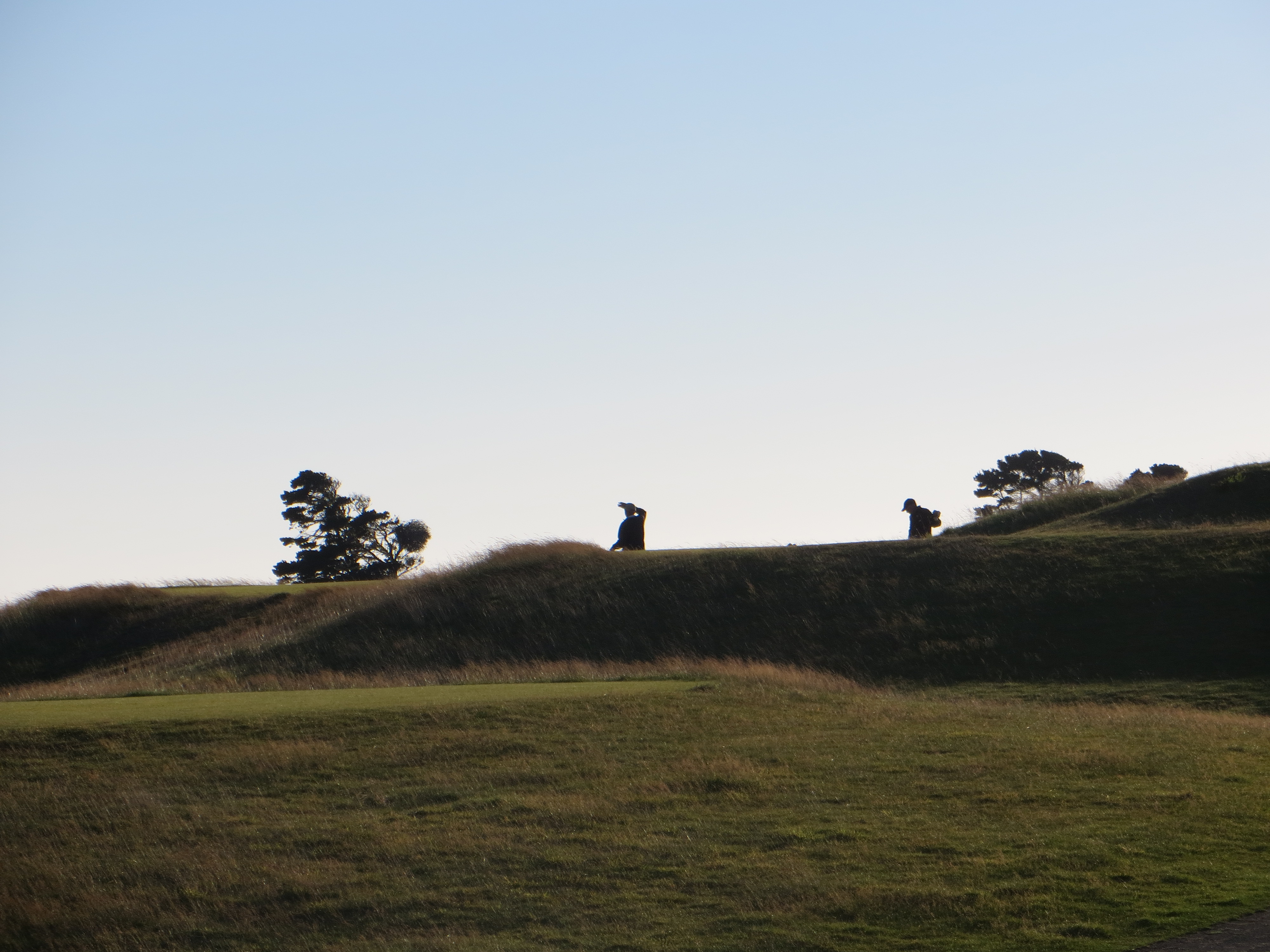
When you are done take the time for a 19th hole refreshment in the Lodge bar that overlooks the tenth tee.  The sublime image late in the day of golfer silhouettes walking into the setting sun captures the true spirit of Bandon Dunes.

Bandon, Oregon

Architect:  David Kidd (1999)

Tee           Par    Rating      Slope      Yardage
Black        72      74.1         143          6732
Green       72      71.7         139          6221
Orange     72      72.4         128          5072

(Click here to review Bandon Dunes Golf Course hole-by-hole descriptions)

For more Bandon Dunes images click to see Postcard From Bandon Dunes-Day 1.

Saturday Night Fever

This is what the PGA Tour pundits had in mind when they created these made-for-television playoffs-a Saturday leader board packed with names like Mickelson, Singh, McIlroy, Scott, Westwood, Johnson, McDowell, and that guy Woods harvesting birdies in bunches jostling for top position going into Sunday of the last qualifying stage for a limited 30-man Tour Championship at East Lake in Atlanta.

Mickelson, who has been the Nowhere Man all summer, suddenly came alive last week  at the Deutsche Bank Championship with a T-4 to move into the top ten in the Fed Ex Cup Standings.  The 42 year-old continued his fine play today as he rocketed up the leader board with 10 birdies on his way to shooting 64 to tie for the lead.  Mickey hit it in the fairway 70% of the time today and was very accurate in his iron approach game.  Using the new claw putting grip Mickelson made putts from everywhere gaining almost 3 strokes in the round on the rest of the field.  He is 13th for the week in Strokes Gained Putting and 5th in Putts on Greens In Regulation.  For the good of the game,  Mickey’s Mojo is back.

It was a page from the past for Vijay Singh who shot 68 to get to 16-under and the lead going into the final round.  Putting has been the dybbuk for Vijay the last few years.  At 49 years-old he still has the length and ball striking to play with the young bucks.  But he has tried more putters, putting grips, and putter grips than Ian Poulter has gaudy shoes in his closet in an effort to find his way back to the winner’s circle.  This week he has driven it down the sprinkler line and putted better than everyone else.  He has over 30 one-putts in the first 54 holes with an average of only 24 putts per round.  The key shot was on the par five fifteenth when he missed the green to a low hollow left of the green and holed an impossible pitch for a birdie to regain the lead.  Unfortunately his aging nerves gave way and two bogies in the last three holes provided some life for the chasing posse.

Young Rory McIlroy did not have his A-Game today but he somehow found a 3-under 69 between his wayward driving results.  He birdied two of the last four to leave himself only one back of the two geriatrics in the lead.  Lee “No Major” Westwood pitched in from behind the green on 10 for the first of his five birdies on in inward nine to tie Rory at 15-under.

Tim Finchem and the boys are smiling anticipating the star-studded Sunday shoot-out that will determine the winner of  this championship.  It will be interesting to see who will be successful strutting their stuff and Stayin’ Alive for the final lawn party at the Tour Championship in two weeks.

September, 2012

An Irishman’s Perspective

Ivan Morris is a dedicated golf nut….he has the award to prove it.  But more than anything he is a thoughtful and insightful student of the game.  This interview with Golf Club Atlas reveals his thinking on a range of subjects including health benefits of golf, preference for match play, the contributions of Eddie Hackett to Irish golf, nuances of links course design, and so much more.

Ivan Morris’s wise old swing with modern equipment (golfclubatlas.com)

In many ways he has a unique Irish view of the development of the game but at the same time it is applicable to all of us.  As the co-author of Larry Lambrecht’s wonderful photographic collection “Emerald Gems-The Links Of Ireland” and a couple of books of his own,  Morris has an articulate and engaging way of expressing his opinion.  I am sure you will find some wise parables that apply to your golf experience in his answers.

On self flagellation: “If only I realized sooner that golf is a privilege….not a crusade or an obligation.  My life would have been more serene if I had realized that.”

On benefits of playing with hickory shafts:  “One is forced to ‘listen’ to the golf club and develop a more harmonious relationship with it.  One has to feel as if the club head passes your hands in the hitting area, a completely different sensation than the ‘late hit’ employed in modern golf.”

On the chances of hosting an Open Championship in Ireland:  “I would suggest that if golfing challenge alone was the criterion, The Open could just as easily be played at The European Club, Portmarnock, Waterville (in Ireland), Kennemar in Holland, Royal Zoute in Belgium, Falsterbo in Sweden, or Barnbougle Dunes in Tasmania.  For heaven sakes, isn’t it supposed to be THE Open?”

The would be site of #2 an Inch Island Links (golfclubatlas.com)

He even takes the time to talk about potentially the best links course in Ireland, Inch Island on the Ring of Kerry, that may never see the light of day because of the myopic views of the Irish Planning Authority.

Take ten minutes and read this interview.  You will come away a bit golf smarter as a result.

(Click to read the Ivan Morris feature interview from Golf Club Atlas)

Ivan Morris Interview
Golf Club Atlas.com
August, 2012

First Tee Glee

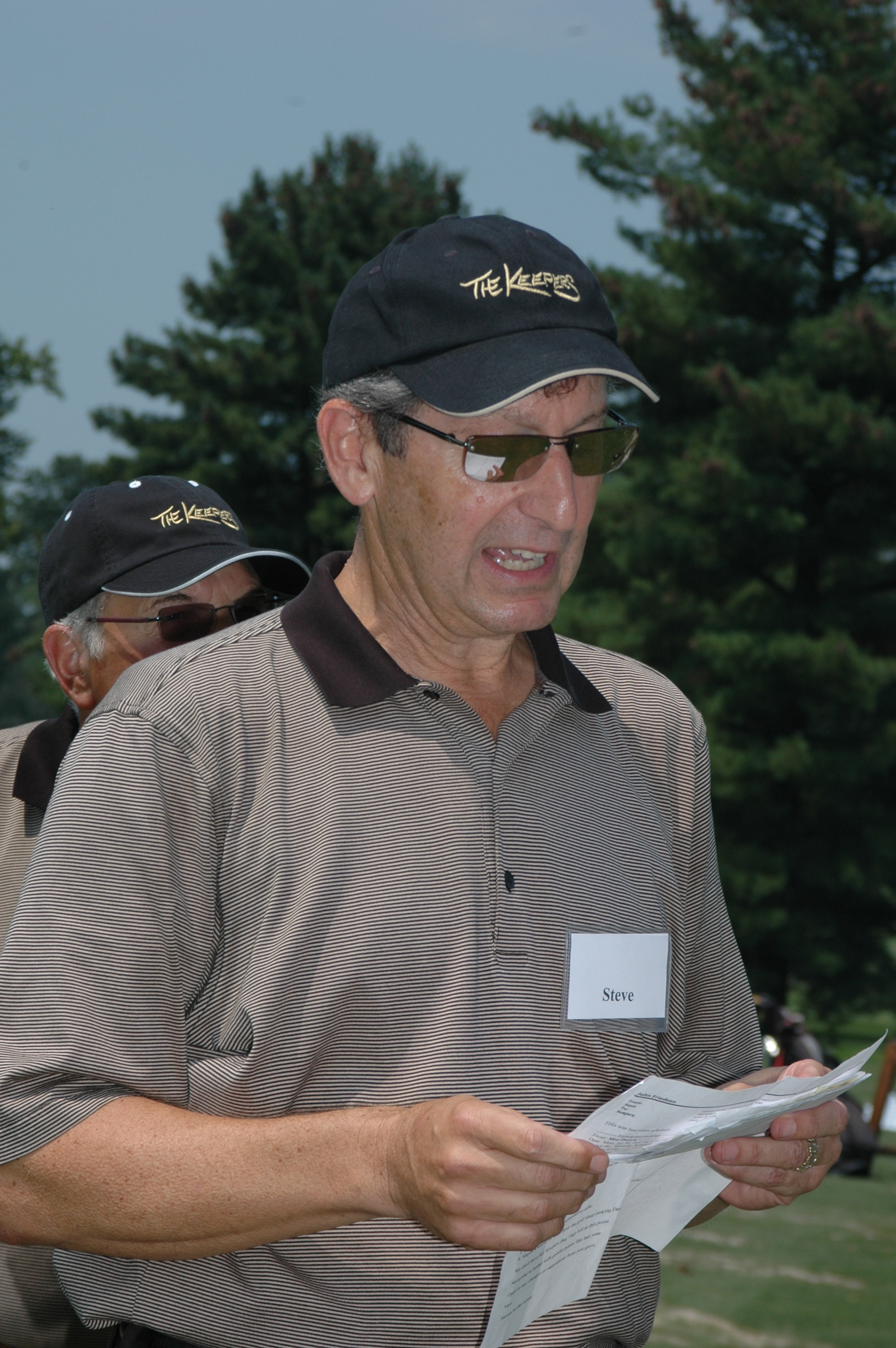
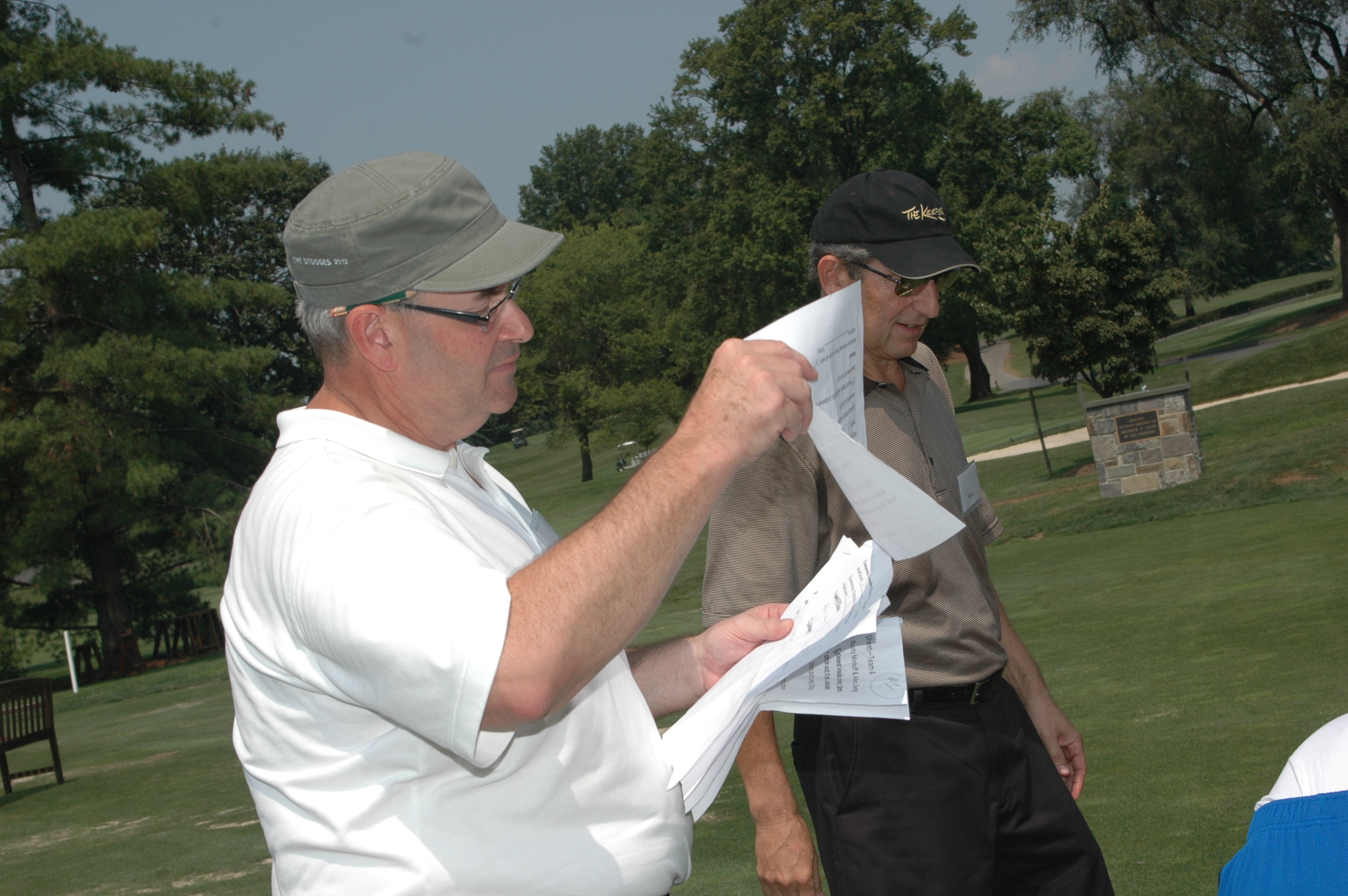
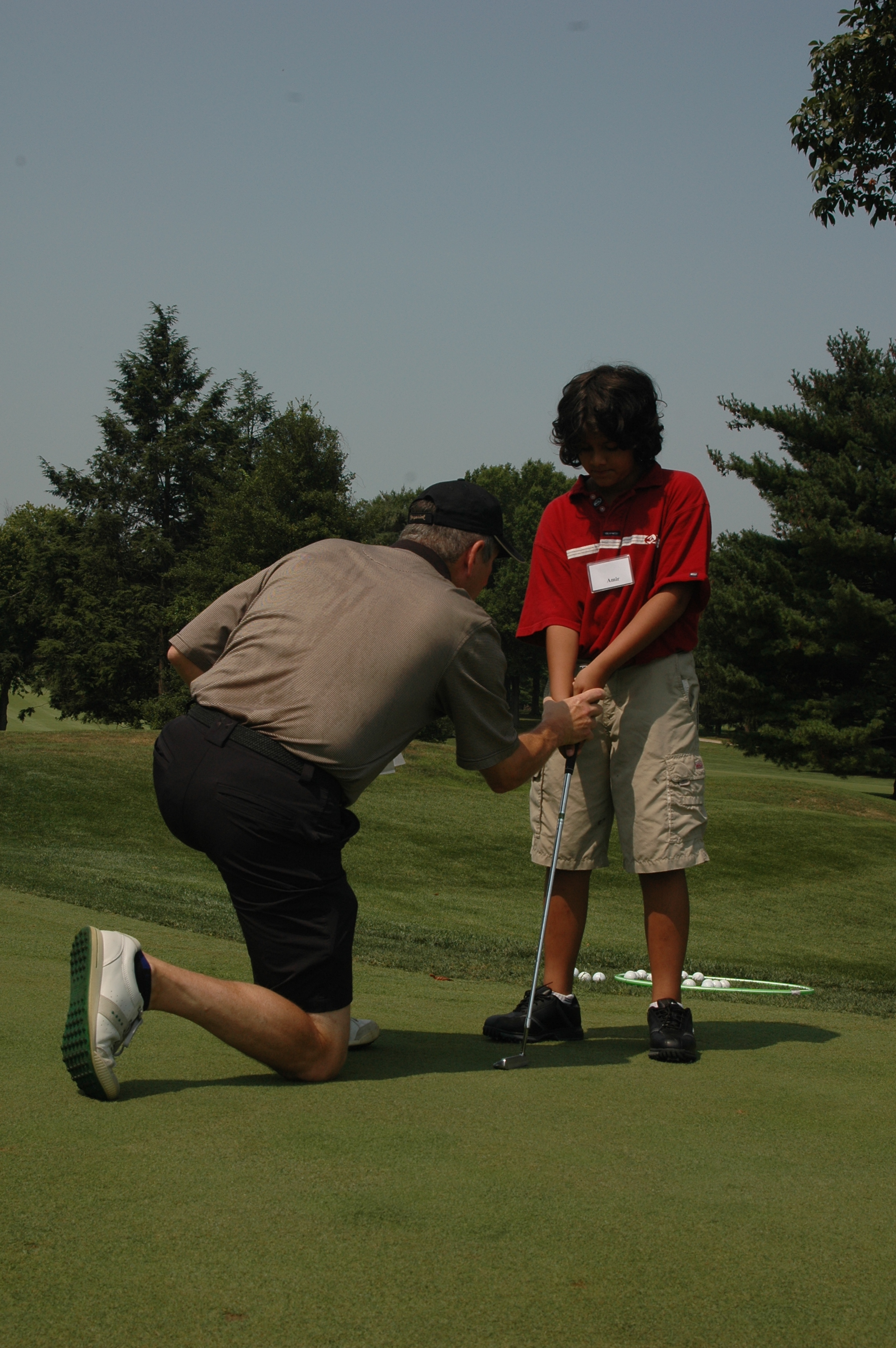
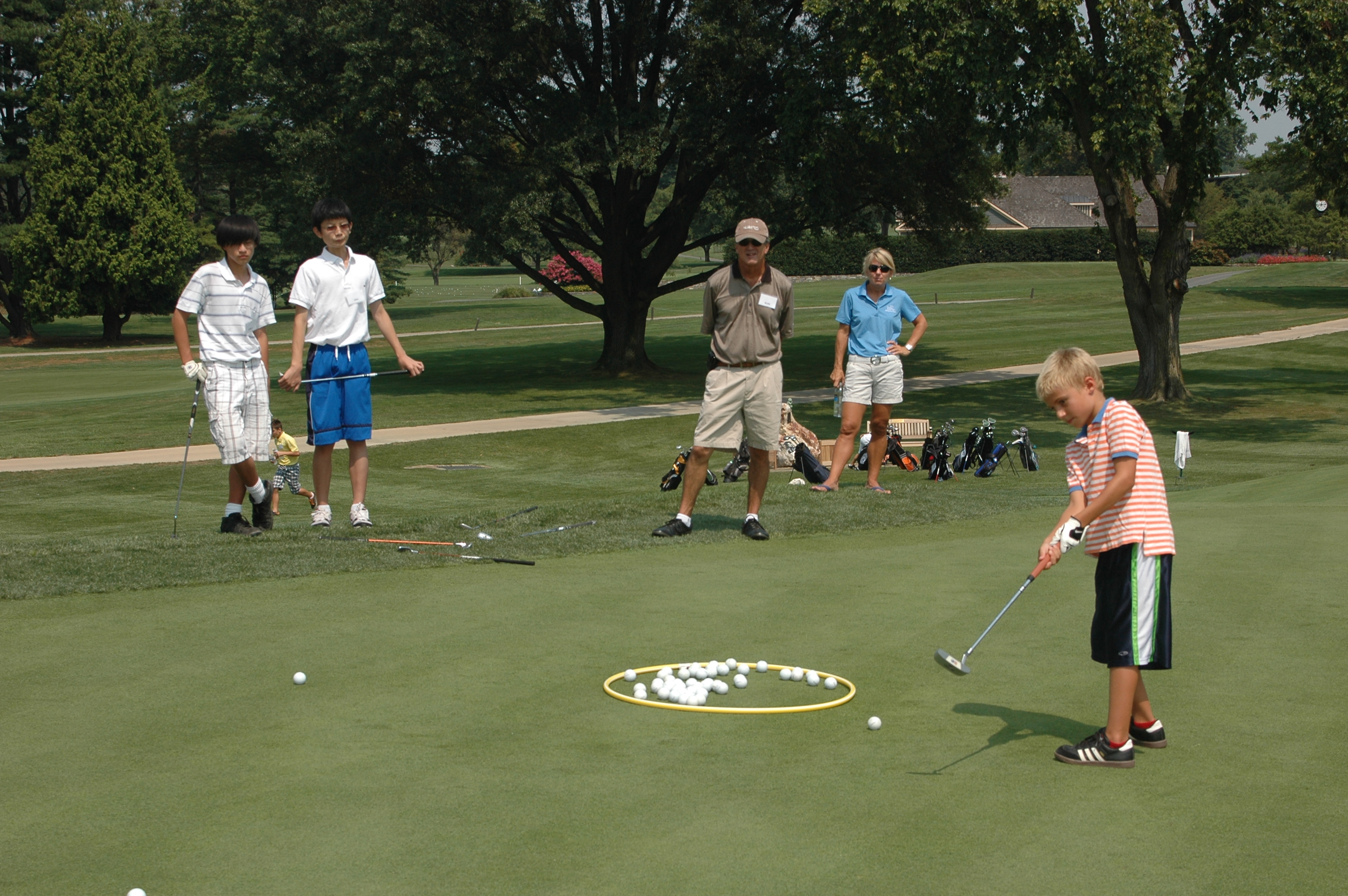
Every summer The Keepers, our men’s group from Woodmont Country Club in Rockville, Maryland, runs a mentoring outing at our place with the kids from the First Tee Program of Montgomery County.  The adults are flabbergasted every year by the golf maturity and enthusiasm of the kids, ages 8 to 15 years old, a testimony to the principles they learn through the First Tee Program.

The day entails some professional attention on the range, a short game competition, food, and seven holes of golf on our South Course.  At the end of the day The Keepers get as much out of this event as the kids-it is smiles and memories all around.

(photos courtesy of Rita Mhley)


It starts with organization.

And direction.

Some professional attention.


Mentor oversight.

Houston we have lift-off.

Maybe a bit of Marius Filmalter putting instruction.

Enthusiasm and support.

It is about the line.

And the stroke.

Kid’s got style.

Rapt attention.

Now that is a throwback look.

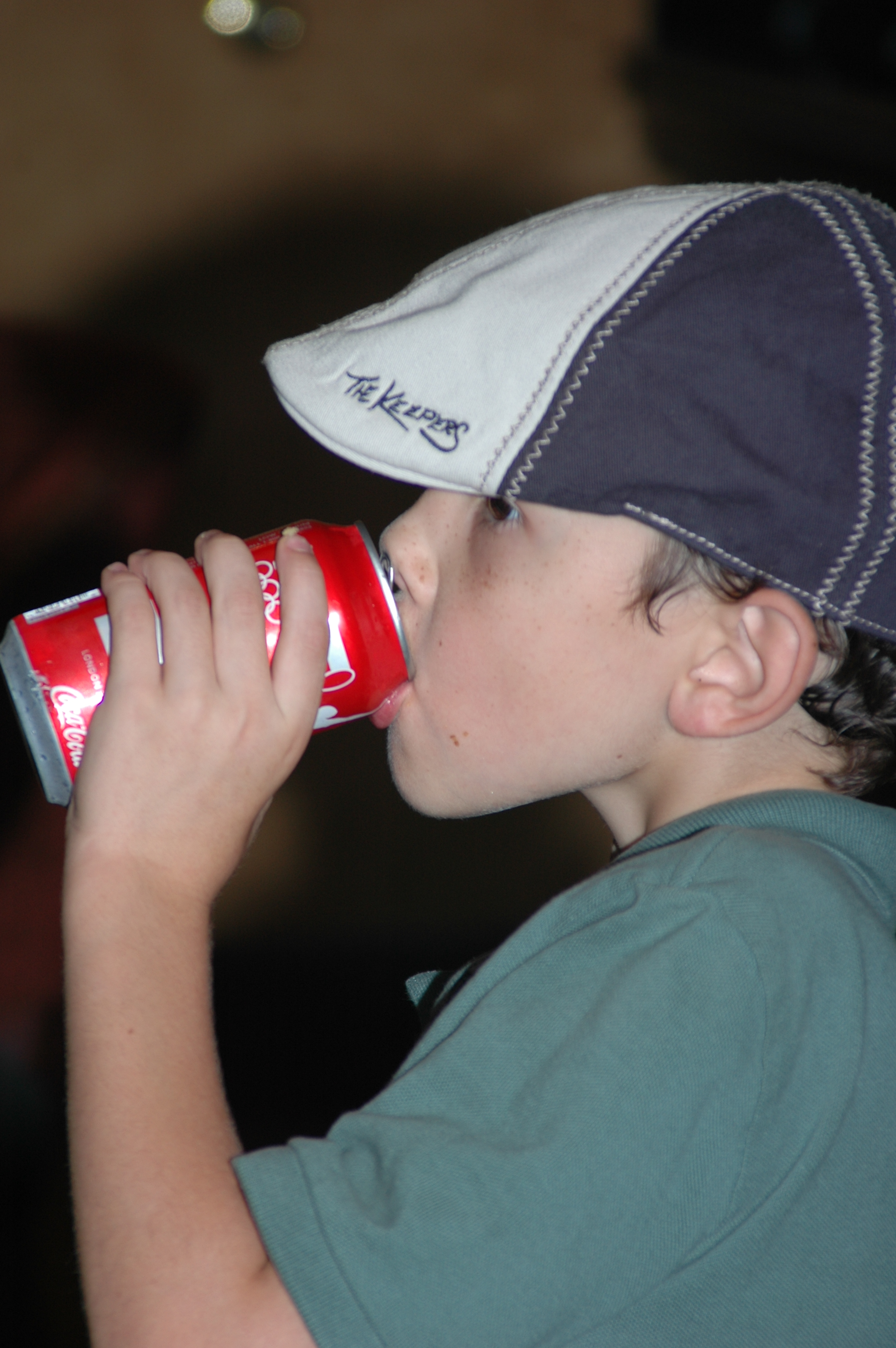
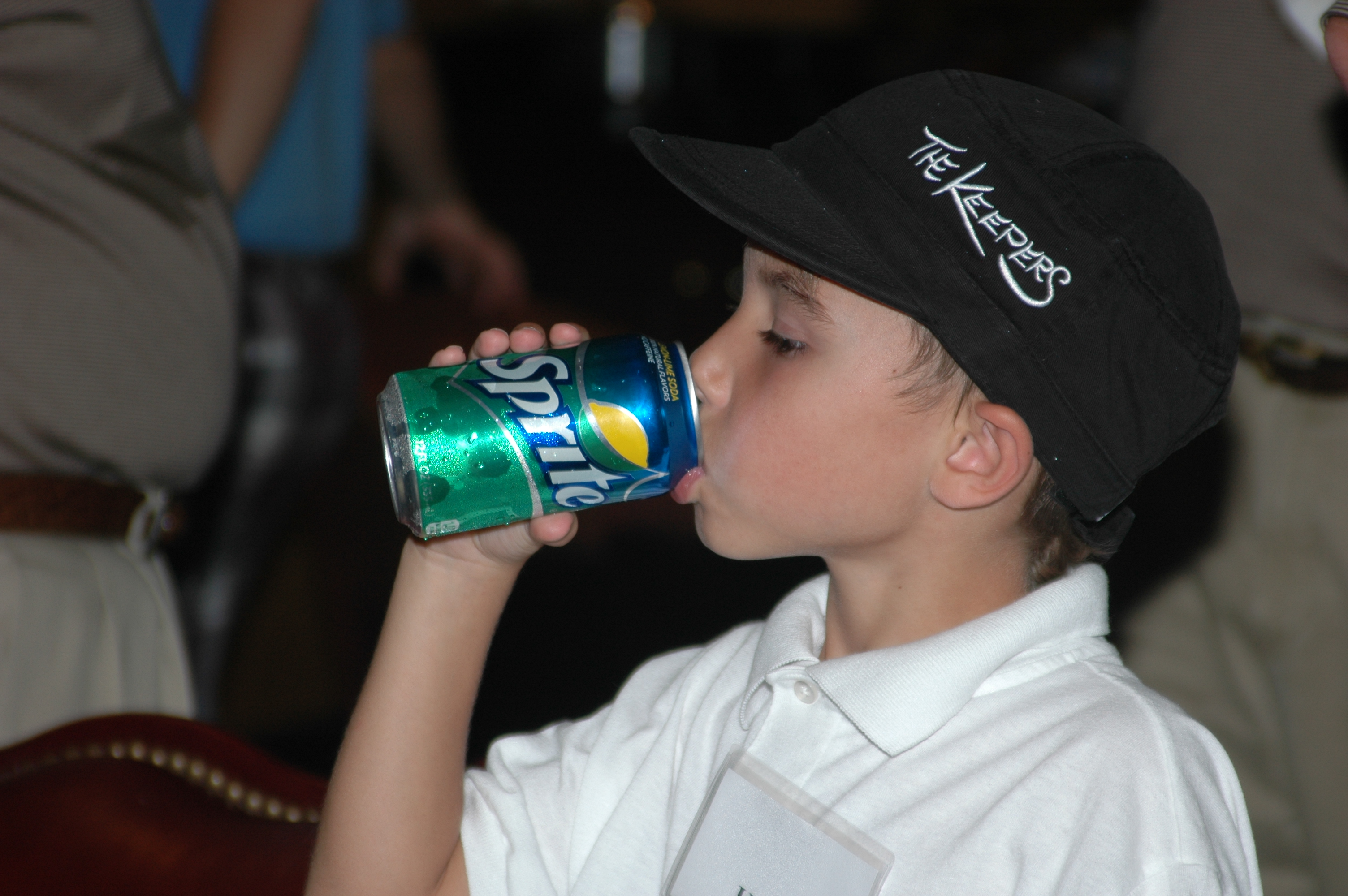
Some lemon refreshment.

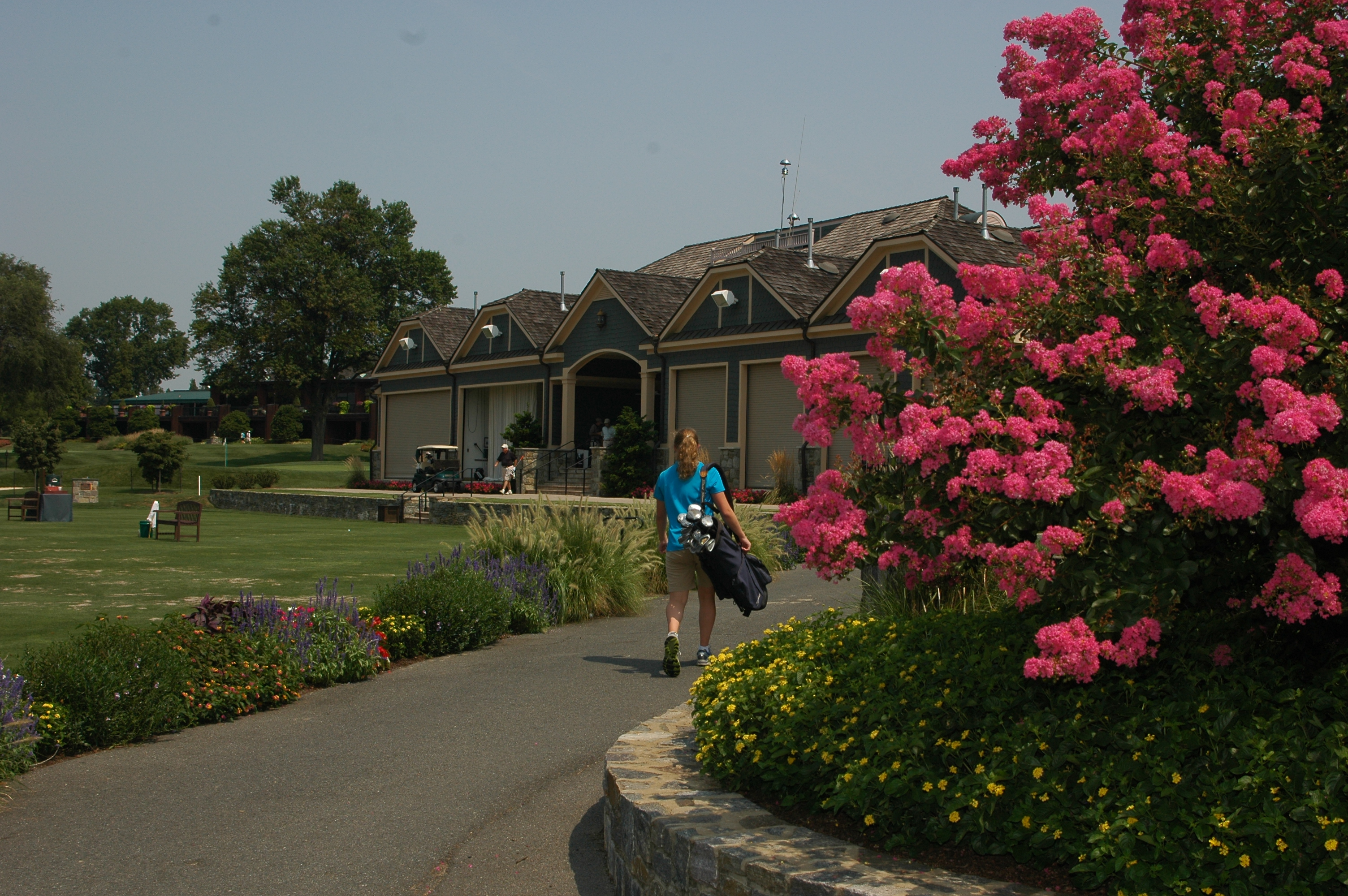
Heading for home.

Lest we forget they are kids!

August, 2012

Ko Canada!

In what probably is the most amazing accomplishment in professional golf this year 15-year old amateur Lydia Ko bested a strong field of LPGA professionals winning the Canadian Open to become the youngest winner in history of an LPGA event. A year ago Lexi Thompson amazed us all winning the Navistar Classic at age 16-Ko beat that by a year and three months. This is the first time in 43 years that an amateur has won an LPGA event. The last person to do that was JoAnne Carner in 1969 and we all know what a storied professional career that lead to.

Lydia’s golf has been nothing short of spectacular the last two years. She has been the leading amateur in the world over that span of time. She won the Australian Amateur in January, 2012. A week later she won the New South Wales Open at age 14 to become the youngest ever to win a professional women’s event. She followed that in July finishing as low amateur in the U.S. Women’s Open at Blackwolf Run. Two weeks ago she won the biggest amateur prize of all, the U.S. Amateur at The Country Club in Cleveland, Ohio.

With a $2,000,000 purse this is one of the richest events on the LPGA Tour and it attracted all the top names including World #1 Yani Tseng, U.S. Open Champ Na Yeon Choi, Evian Masters winner Inbee Park, and #2 on the Money List Stacy Lewis.

Lydia played flawlessly all week shooting 68-68-72 to earn a one shot lead going into the final round. Everyone figured she would buckle under the pressure. But, against all odds, she waxed the field on Sunday, running off four straight birdies to start the inward nine on her way to 67 and a 3-shot margin of victory.

Ko played like a steely veteran not a giddy teenager which was not lost on the professionals whose lunch she ate. As is the custom on the LPGA Tour with a first time winner the other players doused Lydia after she made the winning putt on the 18th green. Albeit with water and not champagne. I guess they were respectful of her being underaged.

Since she is an amateur Ko got bupkis of the $300,000 first place money, the beneficiary of that was Inbee Park who finished top professional at 10 under par. But for her win Lydia Ko got a shiny silver trophy and an invite to the prestigious year-ending CME Group Titleholders invitational in November in Naples, Florida. Word is she is going to play in the Ricoh Women’s British Open next month. She may need to get a hall pass from her high school principal to play but, after what we have seen so far this summer, I would not bet against her winning her first major before she is 16.

August, 2012

Postscript From Bandon Dunes

It has been and will be called everything, but Bandon Dunes is simply a perfect golfing atmosphere.  It is all golf, walking, and memories waiting to happen set on some of the most tranquil dunes you will find anywhere in the world.  If you just came, sat in the Lodge dining room, and stared at the seaside landscape of #10 in front of you it would be all the tonic you need to settle your urban soul.  Hats off to Mike Keiser for dreaming the dream and making it a reality for all of us to enjoy.

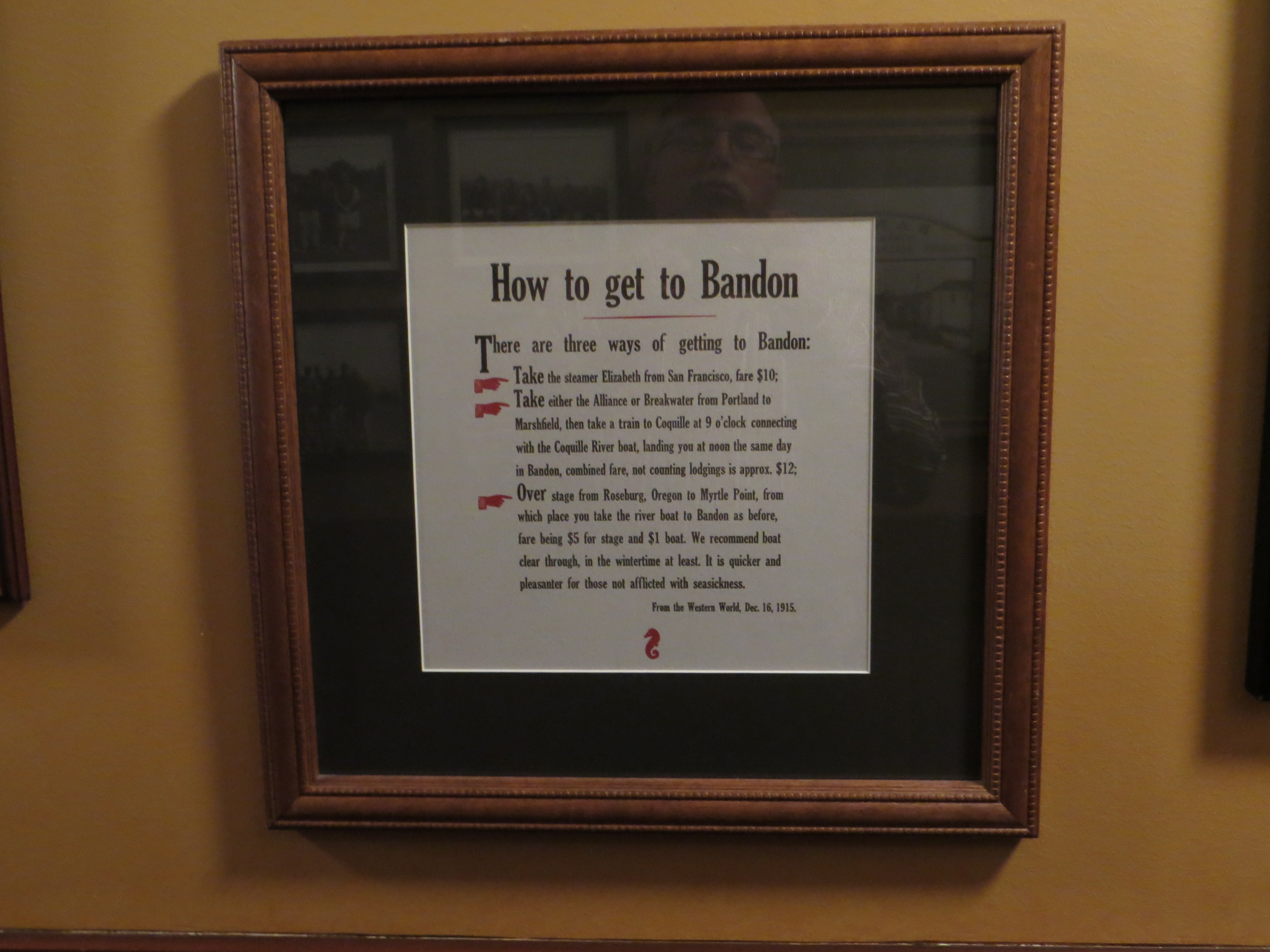
How to get to Bandon….circa 1915.

We came by rental car.

First check each day.

What to avoid.

Nothing is still out there.

In this wind you putt from everywhere.

Keen interest.

Enough happiness to go around.

Distraction.

Replenishing.

First at Bandon Trails has the look of Enniscrone in Ireland.

Intimidation…….on the Par 3 course at Bandon Preserve.

Pacific Dunes #2…Doak says it has all the links elements in one serving.

This Ghost Cedar haunts the early holes at Old Macdonald.

This green complex needs an escalator.

There are no exits forward.

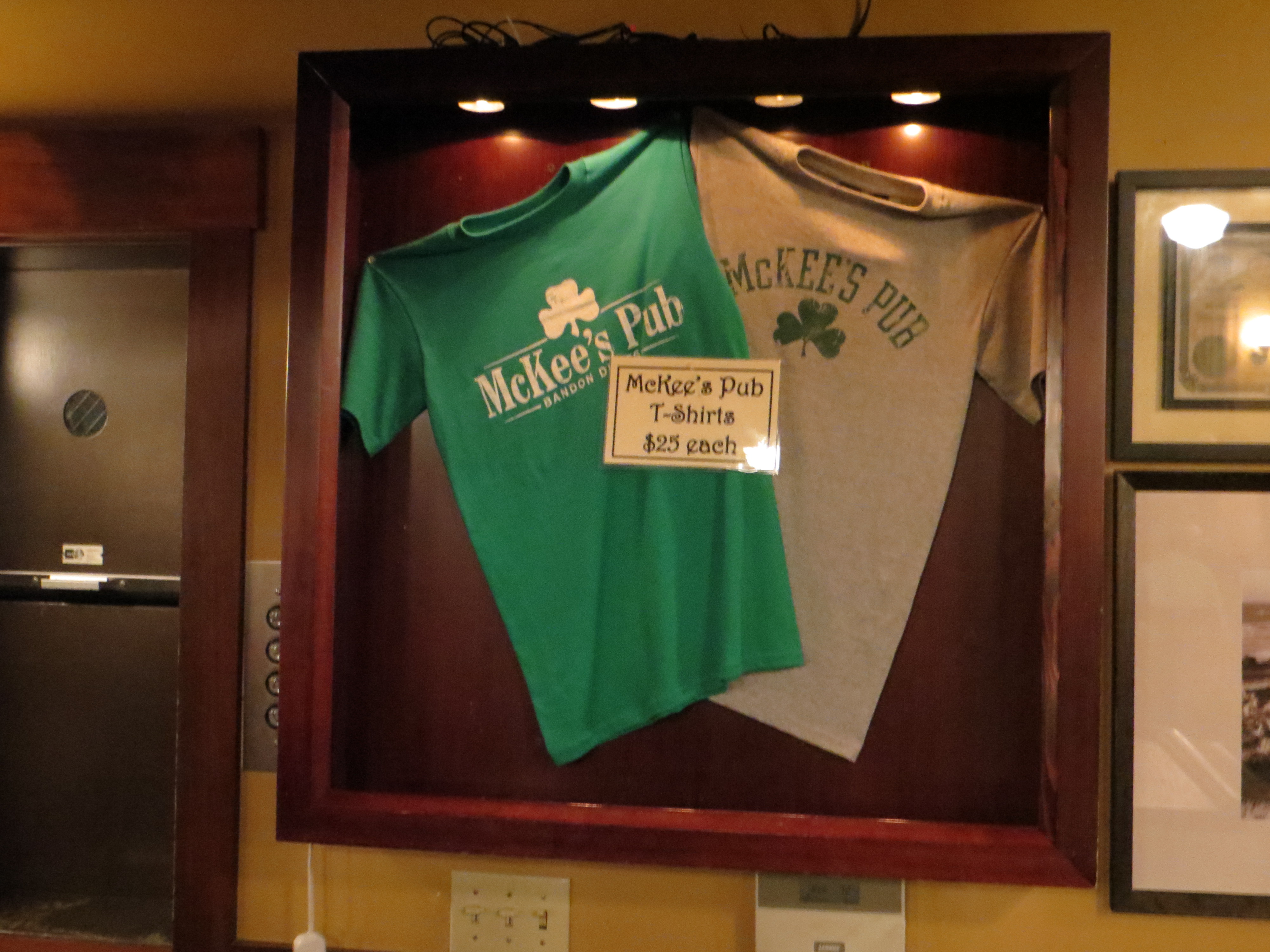
McKees Pub….adult refreshment and more.

More……

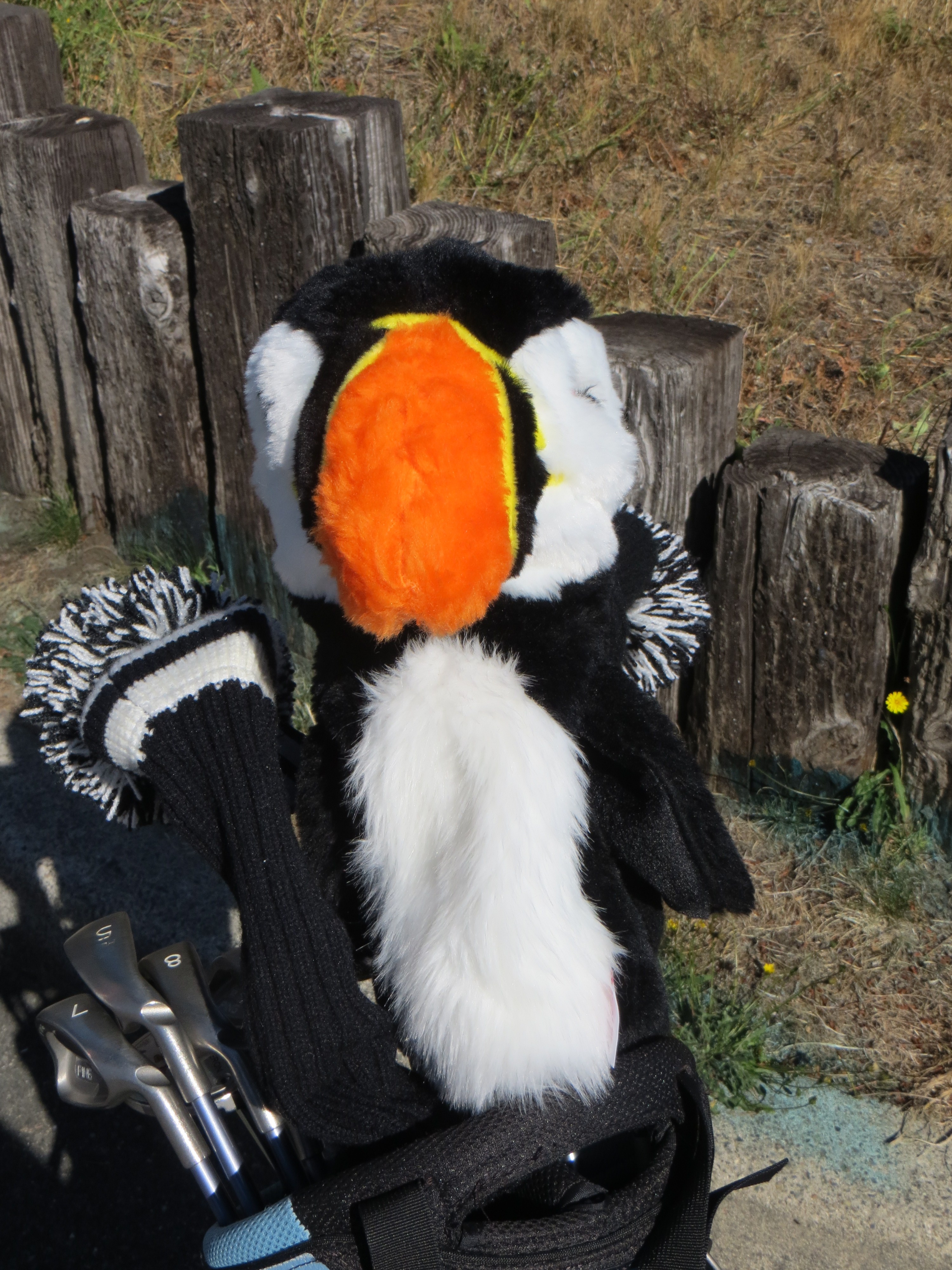
Plenty to buy….including the Puffin.

Sheep says Good-Baaaaa to departing visitors outside Eugene Airport

Last look….into the setting sun at Bandon Dunes.

August, 2012

Postcard From Pacific Dunes-Day 4

These days Pacific Dunes is the most talked about course in Bandon.  It packs the most dramatic dunes on the property many of which are smothered with gorse creating
hallway walls that ensconce the fairways defining the holes.  From the minimalist school of golf architecture, Tom Doak coaxed natural bunkers, used existing mounds and swales for contours, and accented it all with the sea grass and foliage that is native to the Oregon coast.  The ocean front vistas create memorable seaside holes which will take your breath away.

The course presents an amazing variety of holes in an intriguing sequence.  The back nine par 35 has only 2 par fours, 4 par threes, and 3 par fives.  If the wind is down the short holes give real scoring opportunities…if it is up, as it usually is, the shot factors required on the short holes increase geometrically…as can your score.

Pacific Dunes is a seaside links experience in the tradition of the Irish classics like Ballybunion, Waterville, and Royal County Down.  So pour yourself a Guinness when you are done.

All the links elements are evident on the opening hole.

Shoe Bunker was hand sculpted by Bob Gaspar one of Doak’s long time operatives.

Gorse covered dunes delineate many of the holes.

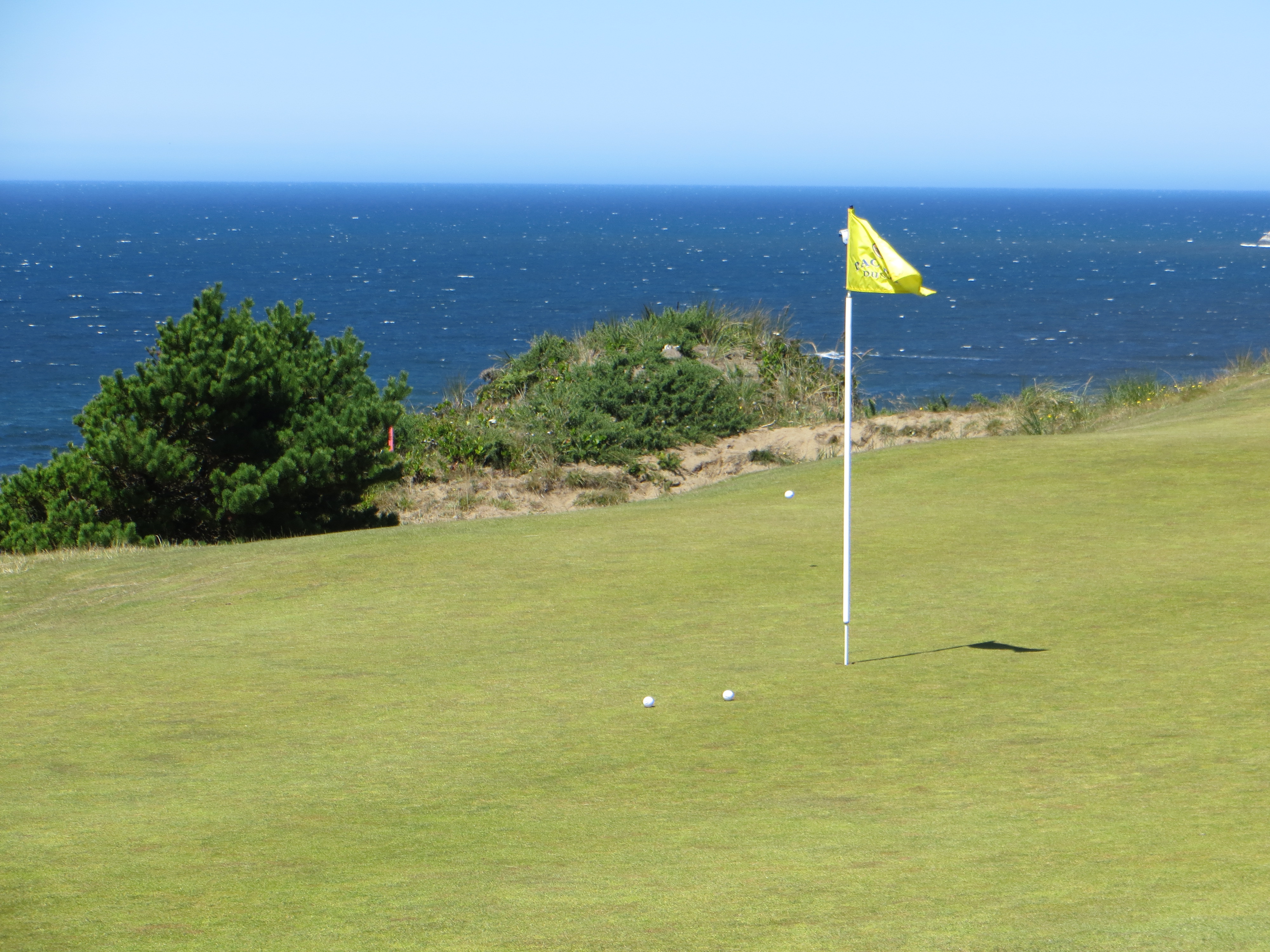
A “Hanging Chad”…..where is one more breath of wind when  you need it?

Sea grass accents the par 3 fifth hole.

Short par four sixth has a cavernous bunker protecting a three story green.

Everything but trolls and burning oil protecting this green setting.

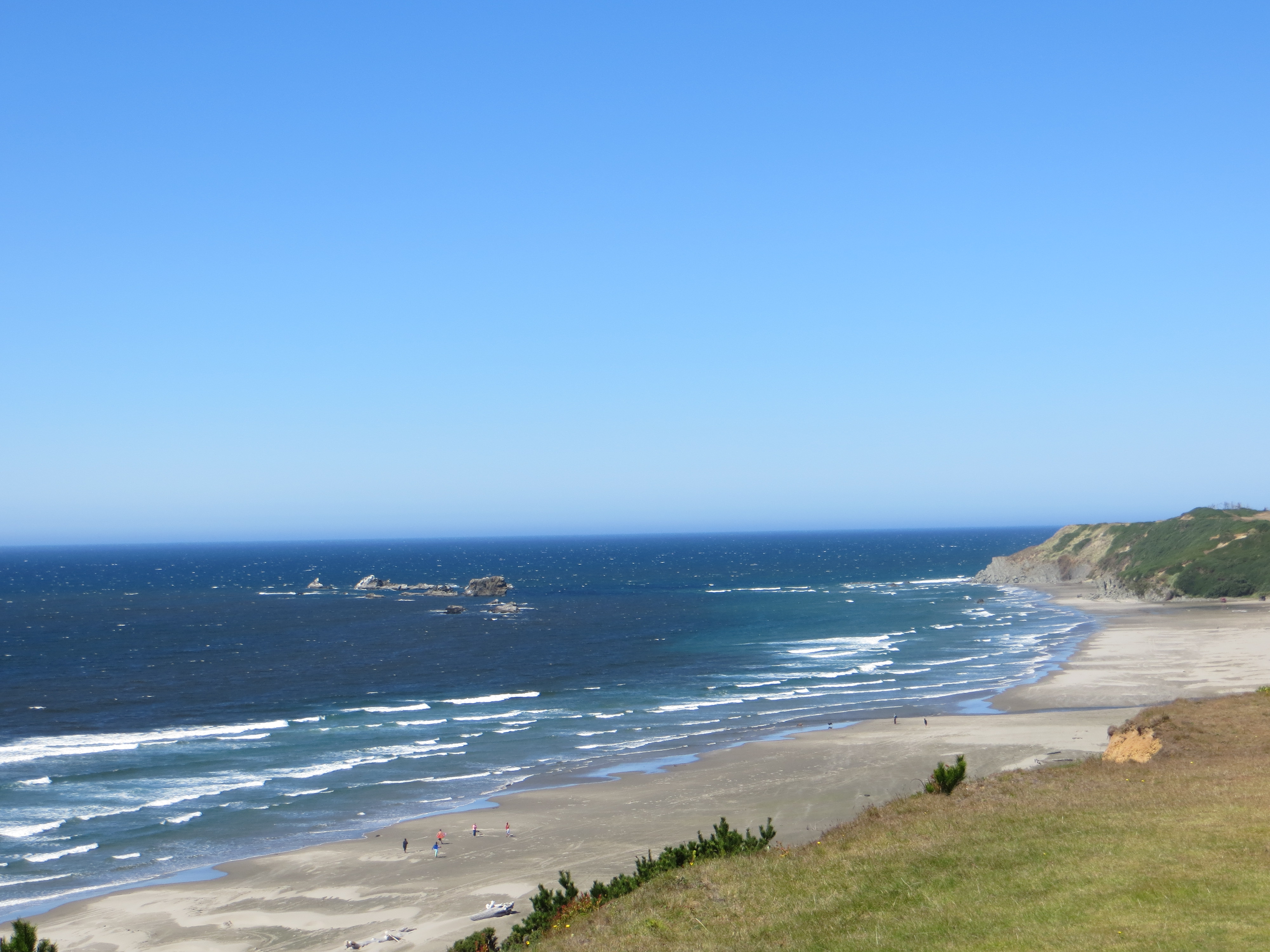
Shore line views are downright distracting.

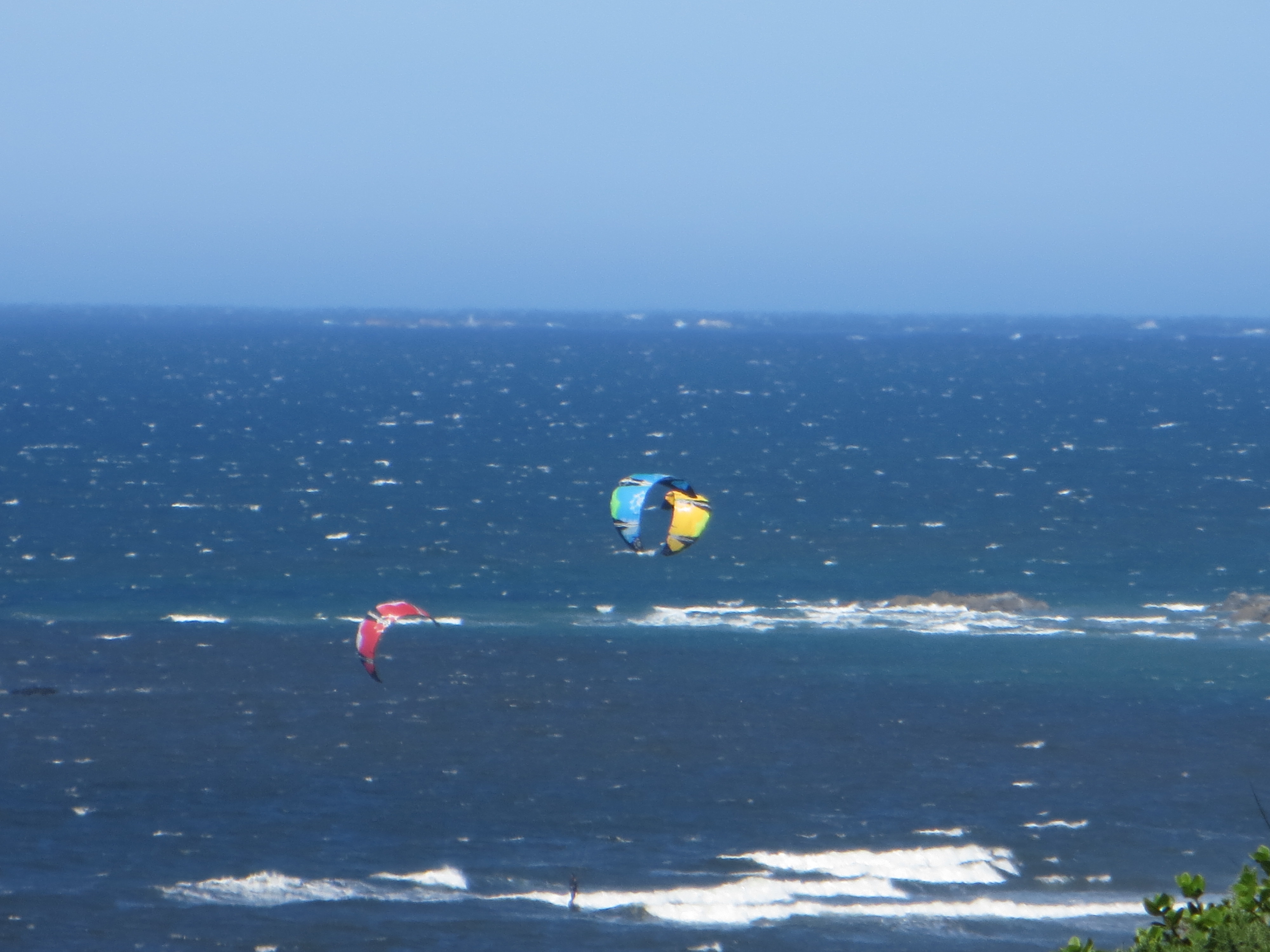
As were the colorful kite surfers.

One of four challenging three pars on the inward nine.

Two surprising close to that tight pin over the gnarly bunker.

The gorse covered dune towers over this shallow par four green.

The view of this finishing hole will cling to you long after you are done.

August, 2012

(Click to read Postscript From Bandon Dunes)

For more course detail click to see Pacific Dunes Course Review