They say that truth is so much more interesting than fiction. When a young American hero story turned into a full blown Shakespearian Tragedy over the back nine at Augusta on Sunday this adage was reiterated in spades.
Jordan Spieth the young Lion King of the PGA Tour led The Masters for three days setting a record having led the Masters over seven consecutive rounds including his wire-to-wire win last year. But a shaky finish over the last two holes on Saturday night was not sitting well with him. His long time swing coach flew in from Dallas for a little swing triage in the morning.
It had the desired effect and Jordan,exclusively using his three-wood off the tee, corrected his rightward driving tendency of the day before leaving unobstructed approaches throughout the front nine. He seemed to have a second consecutive Green Jacket in his grasp when he got to 7-under par after a string of four birdies in a row closing out the front nine. His closest pursuer was five back and was steadily getting smaller in the rear view mirror.
In the midst of Jordan’s birdie barrage on the front nine…everything was going down
But once he stepped on to the tee for the inward half, that swing flaw revisited and the result was three shots wandering aimlessly right into bother resulting in back-to-back bogies on 10 and 11. Then standing on the tee at the 150 yard 12th , one of the most difficult holes in championship golf, the Green Clad Golf Gods must have sensed his mental vulnerability when they stunned him with a pair of taser shots to the midsection. What resulted were two balls into the water and a disastrous quadruple bogey 7. So quickly golf can take a star from fame to infamy and Jordan got the full brunt of that transition in under an hour.
The second of three approach attempts into the 12th….quite a divot on this one
As this story goes the White Knight was an unlikely English hero in 28-year old Danny Willett. Bogey free on the day he seized the moment going birdie-birdie-par from 13 to 15 and then flagged his short iron into the back left pin on the Par 3 16th. Stoically rolling in the birdie putt to get to 5-under par he built an insurmountable 4–shot advantage over Jordan Spieth in the aftermath of folly on the 12th.
Hats off to the new Masters Champion walking off the 18th green
To those who have followed this young man’s rise to 12th in the World Golf Rankings this past year this performance is not that much of a surprise. In 2015 he played steady golf all year taking a share of sixth in the Open Championship on his way to finishing second in the year-long Race to Dubai behind Rory McIlroy. His 2016 began with a huge win in February at the Omega Dubai Desert Classic against a very strong international field and he followed that with a third in the WGC Cadillac Championship a month later at Doral.
In the tough conditions that prevailed at Augusta this week Danny just seemed to hang around par each day when many with much better golf pedigrees were wilting under the stress of the whipping winds and slick crusty greens. Jack Nicklaus, who knows a little bit about winning the big one, said of Danny Willett, “What impressed me so much is that when he realized he was in a position to win, he finished it—and that’s the mark of a champion.”
To his credit Jordan did not fold up his tent after the 12th hole debacle he made a couple of scrappy birdies on the two five pars coming in and stuck it inside 10 feet behind the flag on the Par 3 16th with a chance to close the lead to one. What a difference a year makes, Jordan had made a longer putt for par on almost the same line to this pin during the final round of his win last year but he over read the break this time and his chances of a heroic rise from the ashes faltered when the birdie putt did not drop.
To the winner the spoils…. a few pieces of memorabilia for the plane flight home
There is little doubt that the scars from this jarring incident will not heal quickly for young Jordan, but he can take solace in the thought that all great champions have had Major opportunities slip through their fingers early in their careers. As Tom Watson said in a Masters swan song interview the other day, in spite of all the wins it is the ones that got away that you cannot forget. Tom did all right for himself down the road. I am sure that with his competitive constitution Spieth will find motivation in this disaster and do quite fine as well.
Angst has developed in recent years about how to perpetuate and sustain interest in golf for generations to come. Of all the initiatives out there for “growing the game”, the national Drive, Chip, & Putt Championship that culminates at Augusta National the Sunday before the Masters has to be the most successful of them all.
In a rare moment of cooperative planning and execution the folks from the Masters Tournament, USGA, and PGA of America have fashioned a national golf skill competition for boys and girls ages 7 to 15. Using the successful template of the NFL’s Pass, Punt, and Kick competition combined with an iconic venue for the finals like the Little League World Series, they have created an enticing competitive treat for kids with an itch for the game.
The cannon fire starts Sunday morning with the opening tee shots
.
This has become a huge deal for kids who relish the chance to walk the emerald green fairways, sniff the aroma of pine straw, and emulate the accomplishments of their golf heroes on the hallowed grounds of Augusta National. In just three years the participation levels are astounding with tens of thousands of kids from every state in the union registering each year to play in local, sub-regional, and ten regional qualifying events. In the end, 40 boys and 40 girls anticipate a cherished personal invitation to travel with their family for the final stage competition at Augusta National.
The creators of the DCP Championship did their homework and made sure it has all the characteristics to capture the attention of young kids and foster the growth of their interest in the game.
First they picked an iconic venue, Augusta National, that runs it’s events with clockwork efficiency. With the help of the Augusta members as officials everything from the invitations to the celebration dress-up dinner the night before to Sunday’s final competition has all the swag and kool of a major sporting event.
The Golf Channel presentation of the final stage of the competition has all the pomp and circumstance we have come to know at The Masters. Past champions like Adam Scott, Nick Faldo, Bubba Watson, and other celebrity dignitaries put the full polish on the experience for these kids and make it a day they will never forget.
Seen this on TV before….a young matador striking his best Chi-Chi pose
.
Second they made sure the emphasis of this celebration is on family. Like they do at the Little League World Series in Williamsport each summer the kids participating have the unbridled emotion and support of their family members in attendance on full display.
As we know of the young stars who make it on the PGA and LPGA Tours, golf takes a family mentor, usually a parent or a relative to introduce the game to a kid and steward their development. Whether it is schlepping them to the course, hanging with them on the practice green doing creative short game drills, explaining the fastidious etiquette the game demands, or spending hours on the course sharing one-on-one time, it takes the dedication of a mentor to nurture golf interest. Of course this is usually followed by the ritual apre-game milkshake run to discuss the blow-by-blow details of the day’s events all over again.
. Hours of practice are required to get this fist pump just right
Third, the genius of the competitive format is that it tests combined performance in driving, chipping, and putting talents that all young golfers have in their skill set. With real passion for the game and lots of after school or weekend hours of practice any kid who catches this competition on TV can fashion and pursue the dream of making it to Augusta.
In the end it is a real skills competition-a kid cannot simply participate and move one. Only the best in each gender/age group advance at each stage so there is real-time pressure to get to the next level of the competition. As Nick Faldo said while observing this week at Augusta, it is such a unique opportunity for the young kids to set a goal to get here and have to compete to accomplish it. Imagine competing in a skills competition at the most iconic venue in golf-it is like being thrown in the deep and proving you can swim.
The goal for all of them…..seeing their names on a Major Leaderboard
.
All 80 kids who make it to the finals learn a host of life lessons from the experience. Maybe the most important one is the humility that golf teaches us every weekend when we compete with our friends. To paraphrase Peter Jacobson, these kids learn that for even the greatest champions in the game there are times when they will win and times when they will lose. In the end it is learning how to handle both of these situations with dignity that matters.
.
The annual DCP Championship fans the enthusiasm of kids across the country for the game we love and gives them the rare opportunity to experience it on a field of dreams.
What could be better than this for introducing golf to the next generation and growing the game.
Carnoustie has had it’s share of critics over the last century, most of them said it was too boring, too penal, or had too many weak holes to hold a place in the Open Championship Rota. But in the late 1990s, under the direction of their green superintendent John Philip, an astonishing renovation/restoration of the course was done and the result is a very difficult links golf experience. Of the resultant course changes James Finegan says “A sow’s ear had metamorphosed into a silk purse. This eighteen is the ultimate golfing challenge.”
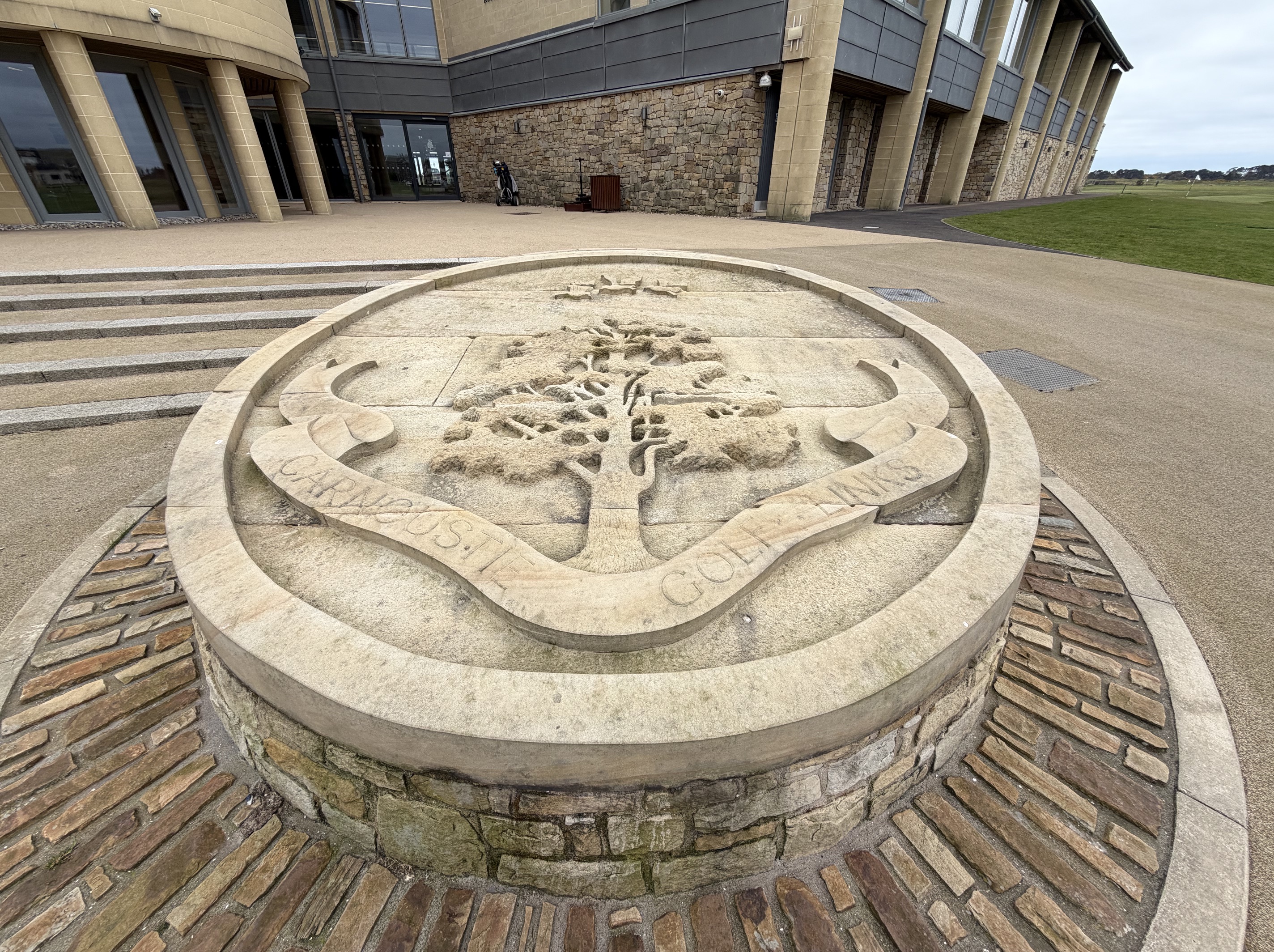
Logo set in stone in front of the clubhouse
This is not a course you can play gripping it and ripping it, you have to play almost every shot with proper forethought and flawless execution. There are no breather holes out here-play with absolute resolve on every hole or your scorecard will be punished. Sound of report of shooting range gunfire from the nearby military installation early in the round should remind you that you are in a full contact skirmish out there.
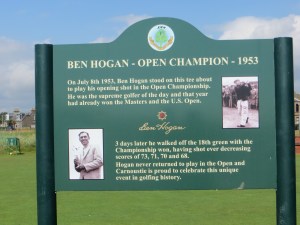
Famous people have left their mark in over 85 years as a championship venue
Built on about as flat a piece of land as any links layout you will ever see the excitement had to be made in the strategic layout of fairway landing areas, green complexes, and the extensive use of burns and OB to cordon off reckless shot execution. As you experience in Florida they incorporated heavy dosages of burns (water) and Barbasol bunkering to make this place very punitive-especially when the wind is present.
A proper Scottish burn….not much water but significant scorecard pain
The closely shaven surrounds to the burns and bunkers give the hazards an especially strong magnetic attraction to a ball hit without sufficient resolve. There are many times when you think you hit the perfect approach and you are scratching your head in disbelief at where it ends up.
Greens that pitch and yaw even without the ever present wind
To add more intrigue the greens are sprawling, oddly shaped with tiers and elevation transitions that make getting the ball close to the day’s pin a big challenge. Without any topography to block the breeze the putting is very wind affected which makes downwind, downhill putting particularly treacherous.
The typical hurdles you must negotiate on the way to the greens
The scorecard reveals much of the difficulty of this course in the yardage alone. Close to 7000 yards from the white tees with a par of 72 with only three par fives on the shortish side there are a bevy of brutish par 4s that add up to that yardage total. From the yellow tee at 6600 yards two of those five pars on the inward nine become punitive par 4s as well.
Crossing the Spectacles Bunkers on the 14th takes extra focus
The last four holes are the most difficult finish you have ever encountered with a manly par three close over 235 yards and the three par four holes all approaching 450 with serious diversionary hazards everywhere you look. The result is a slope rating of 144 and 142 respectively off the white and yellow markers which tells you all you need to know about the challenge at hand.
I will leave the details of this trek to the hole-by-hole description below but suffice it to say that this is the most excruciating test of recreational golf you will ever play. It needs to be experienced once simply because of it’s place in Open Championship lore where the likes of Ben Hogan, Gary Player, Tom Watson, and Padraig Harrington have claimed the Claret Jug.
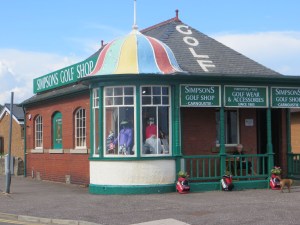
Simpsons Golf Shop…one of the kitchy treasures in town
Tell the women and the kids to enjoy the day walking the quaint fishing town of Carnoustie and make sure they visit Simpsons Golf Shop across the street, they will have a much more delightful day than you have had.
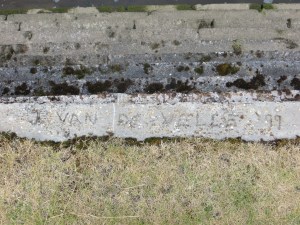
The Frenchman’s epitaph etched over his watery grave
The place is infamously known as the graveyard of Jean van de Velde’s Open Championship dreams. His nightmare finish on the 18th is commemorated by an inscription of his name on the top of the burn wall where he arrogantly tried to play one of the silliest recovery shots in major championship history. I don’t see you rolling up your pants legs and playing anything standing in the water on the last hole but I am pretty sure that once you are sitting in Calder’s Bar with an Irn-Bru in your hand there will be many wounds to salve from your walk around these links.
Carnoustie, Scotland
Architect: Allan Robertson, Old Tom Morris, James Braid (1840)
Tee Par Rating Slope Yardage
White 72 75 144 6948
Yellow 70 74 142 6595
Red 72 72 132 6144
If you would like a printable PDF of this posting including yardage book quality hole-by-hole descriptions of how to play the course click the moegolf logo below.
As I saw images of Peyton Manning delivering his swan song to football this week and heard an interview with Jordan Spieth talking about his meteoric rise to the top in the world of golf I could not help being struck by the similarity in tone and content as they described their approach to their crafts.
Though obviously athletic looking and of considerable innate talent in their sports neither Peyton or Jordan would be the first one you picked out of a police line up early in their careers as the guy most likely to dominate their sport. They would not elicit that dominating persona even when interviewed, you would rather presume they would be second tier performers who would have successful but inglorious careers.
This is clearly not the case, the outside wrapping is a bad predictor to the richness of the present inside, and with both of these guys-at opposite ends of their Hall of Fame careers- there is something other than pure athletic talent that elevates them to the stature of superstar in their sports.
No question their dedication to physical training, development of their skill set, and study of others who have played the game before them have a lot to do with their success.
But from listening to them and peers who know them well it is assiduous development of a plan for playing the games and the confidence to stick to it no matter what happens that moves them up to the elite level of performers in their sport.
Peyton has displayed a willingness to sacrifice personal time his entire career to spend endless hours in the film room or the game plan conferences preparing himself and his team to play every game as if it was the most important one of the year. His wife is quoted as saying that going to the movies with Peyton during the height of his career meant sitting with popcorn in her lap going over the film of next week’s opponent. Down to changing up his verbal and hand signal audible commands from week to week to throw off the opposition, Peyton left no stone unturned in trying to find the little edge he needed to improve his team’s chances to win the next game.
Jordan is of similar ilk, even at the tender age of 22. You can hear it when he describes his approach in press conferences before and after tournaments, it is always what his “team” is accomplishing and how they all contribute to the success or failure in each week’s event. He is relentless in his preparation, studying the venue and the anticipated conditions ahead and building a plan of attack for success. If he has a late tee time on the weekends I am betting he is watching the broadcast of players with early times to see how the day’s playing conditions will affect the plan.
In an interview with Feherty this week Jordan discussed his victory in the U.S. Open in 2015 at the torture chamber on brown grass called Chambers Bay. Having played in similar conditions in missing the Match Play cut at the U.S. Amateur at Chambers Bay in 2010 as a teenager, Spieth said that he would never return to the place even if they held a U.S. Open there. The words of an impetuous youth!
Fast forward to 2016 coming off his first Major victory at Augusta in April Jordan knew what was ahead in June at Chambers and figured out a way to prepare for success. He said that when he and his team got there the weekend before they immediately recognized that negotiating the burnt out, rock solid greens they would be facing would be the key to being competitive. He and his coach Cameron McCormick spent days just working on speed control over the patchy putting surfaces, recognizing that matching speed to line was the crucial factor in avoiding comeback 12 footers at a U.S. Open.
When it came time for the rubber to meet the road Jordan stuck to their plan and focused on approach speed on all putts. Over the course of the tournament his putting was top quartile, 15th in total putts for the week at 126. After it was all done he said, “I did not have my best stuff ball striking and we really grinded over the 4 and 5 footers. That was the difference.” The key phrases are the “we” and “the 4 and 5 footers” which confirm the importance of preparation and sticking to a plan to have an advantage over the field.
At St. Andrews, a course where meticulous planning and tactical approach to playing the conditions of the day are paramount, Jordan was seeking the third leg of an historic march to the rare Grand Slam. In very difficult weather conditions all week Jordan got agonizingly close before a bogey-par finish on the Road Hole and through the Valley of Sin left him one shot short of the playoff for the Claret Jug. The grind over four days was indicative of his willingness to stick to the plan through thick and thin.
Stephen Curry as quarterback of the World Champions Dubs
Though these two are 17 years apart in age the receding hairline and furrowed brow would suggest the similarity of their mature mental approach to dominating their sports.
As Jordan’s speedboat heads out of port passing Peyton’s yacht on it’s way in, he might also note Stephen Curry on his left and Russell Wilson on his right who share a similar approach to success at this stage of their careers.
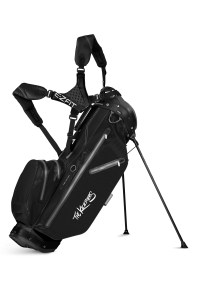
For those of us who play in all kinds of conditions, either at home or when we travel to places where the weather can be foul, the H2No Lite is Sun Mountain’s latest iteration of their awesome waterproof stand bag. Like it’s predecessors it is super light, totally waterproof, and perfect for walking or cart travel. The Ultra-Lite is the updated smaller sister in this walking bag and is still available (previously reviewed by moegolf back in 2013).
The H2No Lite uses the same technology as their rainwear with a light and durable fabric that is coated on both sides with 2000mm waterproof coating. The bag has the high quality YKK zippers with taped seams that keep the contents in the five pockets dry. It comes with a matching front zip rain hood made out of the same waterproof fabric.
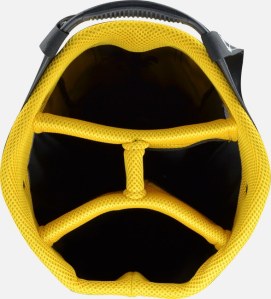
The bag weighs merely 5.6 lbs and has a molded top handle for ergonomic handling on the course and a sewn in bottom grab cuff for getting it in and out of the automotive boot. The padded 9-inch diameter 4-way top can easily handle your 14 implements with all the head covers and the sections have with full length dividers to keep the grips from tangling as you move your clubs in and out during the round.
The patented E-Z Fit dual strap system adjusts for a comfy fit and has the center hub which I find is much more stable as you load the bag on and off your shoulders during a walk. The straps are fully padded for your comfort. The kick stand is the rugged Sun Mountain version we are used to that activates when you put the bag down.
This version has five pockets that include a velour-lined valuables compartment that will keep your wallet and money clip dry in all conditions. I particularly like the two zip compartments on the spine of the bag so you can separate your golf balls from all the other on-course necessities like tees, poker chip ball markers, divot tools, pencils, and your cigar clipper.
It comes in five flashy color combos with the large H2No name emblazoned on the side. If you want the bag without the advertising you have to order the “non-stock” version directly from Sun Mountain. This is what I did so I could embellish the side with my custom embroidery. The Lite version sells for around $280 on the net-the Ultra-Lite will set you back about $250.
Having used the Sun Mountain Waterproof Series bags as my mainstay since 2013 I highly recommend them whether you are playing in Scotland, Bandon Dunes, or at your favorite neighborhood haunts. They are easy to handle, durable, and shed off all the elements the weather can throw at you.
It did not start out well for Adam Scott in the final round of the World Golf Championship at Doral making two double bogies in the first five holes. But as he did the previous week at Honda he showed veteran resilience and used laser sharp iron play and very steady putting to card seven birdies, four on the inward nine, on the way to his second clutch win in the last two weeks.
.
We saw alot of this gesture since he got to Florida
This win did not happen without a bit of good fortune but sometimes the golf gods are just looking down kindly on you on a Sunday. With his excellent play on the back side Adam had grinded his way to a one-shot lead over Bubba as he stood on the 18th tee looking at the formidable task of finding the fairway to protect his lead. The drive leaked into the right rough and his direct approach to a phone booth back left pin was blocked by a lone palm around six yards in front of him.
The competitive instincts of a veteran forbade Adam from laying up so he laced a long iron with a bit of fade out over the water trying to find the putting surface and set up a two-putt par. The little bit of rough made it hard to get the requisite fade spin on the shot that was struck purely and you could see the angst on his face as a watery grave looked imminent.
Divine intervention was required as the ball carried the hazard but hit the steep bank making it likely it would tumble back in for a rinse. Somehow the ball hung in the thick Bermuda grass within the hazard line leaving Adam a life line to make his par. To his credit Adam took advantage of the break and hit an elegant elevator shot off a severe stair climber stance to six feet and calmly rolled in the par putt for the win.
His approach to the last somehow avoids the tree and the water
.
Probably the equally intriguing story is Adam, a poster child for the anchored putter, overcoming years of balky putting with the broomstick to putt so proficiently with a conventional length unit. All the pundits said that guys who had learned to lean on the anchored style would struggle in making the transition.
Adam said in an interview last week that the USGA and R & A edict on banning anchoring may have been a blessing in disguise because it made him focus on his putting deficiencies and face his demons. If you saw the broadcast at Honda NBC did a slow-mo side-by-side of Adams stroke with the long putter and the conventional putter and it was truly amazing how identical his vital shoulder-to-grip-triangle was with the two putters throughout his stroke. It seems like a geometric impossibility to do so but Adam has reconciled how to translate a confident stroke with the long putter to his conventional implement., He made 18 of 18 putts inside 10 feet in the Sunday final round so it is working handily at the moment.
. Peace of mind on the short grass has made all the difference
.
Bottom line is that including a second at Riviera Adam has garnered over $3.3 million in the last three weeks jumping him to the top of the Fed Ex Leaderboard and inside the top 10 in the World Golf Rankings. He has found form in the fairways and on the greens just in time for the first string of Majors in 2016.
With Dave Clark on the bag Adam has gotten good direction
In spite of this success with his new caddie Dave Clark he will not be on the bag come The Masters. Adam is no dummy, he had previously arranged with Stevie Williams to interrupt his racing Mustangs on the stock car circuit in New Zealand for a week of bag work in April. Stevie is the ultimate “Majors” counselor, having been on the bag for 13 of 14 of Tiger’s Major wins. He also knows as much about Augusta greens as Clifford Roberts and carried for Adam when he won at Augusta in 2013. Makes sense to put the band back together.
George Thomas, an east coast native who cut his design teeth with others from the Philadelphia School of Design back in the teens, moved to the west coast in 1919 to establish a beachhead of quality designs in California in the full Golden Age tradition. With Bel-Air and Riviera already under his belt he took on the job of redesigning the two courses at Los Angeles Country Club at the request of their members. What he and his sidekick William Bell created with the North Course at LACC turned out to be the centerpiece of the George Thomas design portfolio in California.
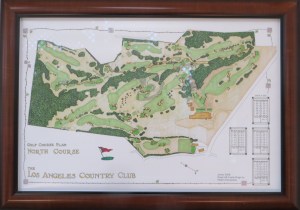
Over the next 80 plus years a combination of meddlesome board decisions and some nature-based changes mollified the character of the course to the point where it had lost it’s soul. In the early 00’s an initiative by some younger members sought out Hanse Design to propose a plan to restore the North Course to the original design. Gil Hanse, with the capable help of his longtime associate Jim Wagner and some historical perspective from Geoff Shackelford, put together an ambitious restoration plan to bring the course back to it’s original character and full grandeur. The board had the good sense to fully embrace the restoration plan and in 2009 a staged restoration began to take place.
Gil Hanse’s Master Plan for the LACC North Course restoration
The work included rediscovering and restoring the original Billy Bell bunkering, returning to their rightful homes greens that had been senselessly relocated, thinning out the 80 years of overgrowth of trees and related ground vegetation that had compromised the views on the course, and establishing throughout the course the influence of the dry wash that had given this course it’s distinct character.
There is so much talk these days about recapturing the look and playability of courses of the Golden Age of Golf Course Design and that is precisely what Hanse and Associaties have done at LACC. The fact that the USGA and R & A are bringing a Walker Cup to LACC in 2017 and the U.S. Open in 2023 would tell you that the restoration was a roaring success.
Built on hundreds of rolling acres of some of the most valuable urban real estate in America LACC sits in the middle of Beverly Hills in the shadow of apartment buildings, palatial homes, and commercial development. They have maintained a reasonable buffer for the most part-while on the property you feel relatively secluded from all that with a few notable exceptions. The ground itself is a wonderful hilly piece of property that presented interesting possibilities for Thomas and Bell for the routing of holes and placement of tees, hazards, and greens. The genius of the design is that they used the flow of the land, the dry wash, and nature’s assets to create holes that do not intrude on the environment, they look like they were always there.
You contend with the dry wash everywhere-here as a forced carry off the 3rd tee
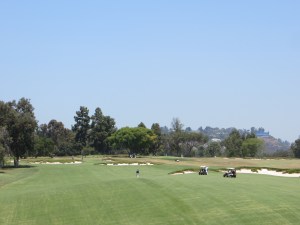
Stepping onto the first tee you take in the flavor of the course immediately. The grass platform for the teeing grounds are not distinct from the fairway in front of you. The vast continuum of short grass just melds into the course that is unfolding below your feet. The placement of the fairway and green side bunkers is very creative. They give clear direction to your strategic options off the tees and on approach. Many times you will realize that the movement of the pin 30 feet on the green can change both the preferred distance and angle of the approach you are trying to set up. This is why an investment in a good caddie is a must when you play LACC.
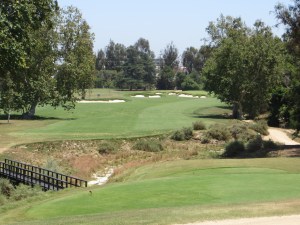
As you get out through the second and third holes the presence of the dry wash makes itself very apparent. Fortunately there is no water running through it and the fact that they do not seem to let it get overgrown means you can technically play from it without grounding your club. Having said that it is incumbent upon you to give the presence of the wash full consideration when weighing options of approach lines and club selection. Both of these holes will taunt you in terms of carry to reach the putting surface, especially if you are not in the fairway. First lesson to be learned at LACC is a bogie is an acceptable result when double or worse is possible taking on a shot that is just beyond your skill set.
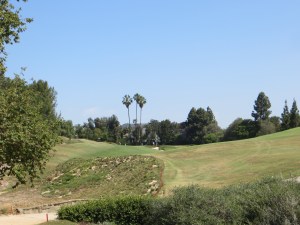
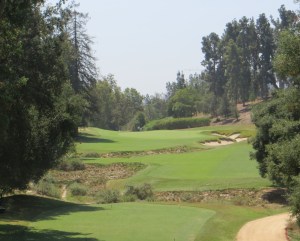
First postcard view of the day…from the tee on the Par 3 4th
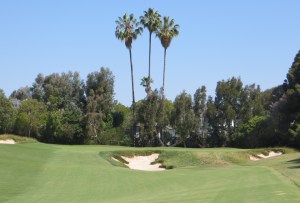
The par three fourth is one of the signature holes on the course-from it’s teeing ground the full splendor of LACC is apparent. Elevation change, wash, sand, even some exposed sand hills thrown in for good measure makes for a true Kodak moment. Once again Thomas gave you options that allow you to mitigate risk and protect your scorecard. Getting it close is a real risk/reward deal but hitting it to the fat part of the green should mean making par is very doable. If you forget what neighborhood you are in take a gander back up the hill from this green-that is Lionel Richie’s little bungalow looking down at you.
The neighbors are quiet, reserved guys like Lionel Richie and Hugh Hefner
In 1927 Thomas wrote a book called “Golf Architecture In America’ at about the same time he was doing this course where he talks about the notion of designing a course within a course. The idea was that holes could play to different strategy, even different par depending on how they set the tees and pins on a given day. As you will read in the link to the Hole-By-Hole Analysis below five through nine are all half par holes that speak to this notion-depending on set up and your degree of chutzpah they can be very different day-to-day.
. Course within a course…219 to 242 yards across the abyss…7th hole is a Par 3/4
Six is a “drivable” par four where you have to be certifiable to try to go for the green. Seven is a par three where laying up may be the best option depending on the wind influence. Eight is a truncated, switch back, shish-link of a five par that throws all strategic convention out the window and dares you to play with a sense of abandon. If you survive the tee shot on tourniquet approach to the par three ninth a double has turned into a three with one swing of the club. The only thing I will guarantee is that once you have played through this fungible part of the course you will have goose bumps or the sweats depending on how you fared.
Gynormous driving areas like the 10th still require precision decision making
The inward nine is even more dramatic and just as thrilling. The tenth shares fairway with the sixteenth, a characteristic you see repeated a number of times through the round. This gives the course the appearance of great width and allows you to see through to others holes as you play. It reinforces the seamless character mentioned with continuous tee boxes to the fairways and reinforced often by continuous short grass between greens and the next teeing round. Thomas is playing with your mind because in spite of the width presented there is always a favored area, usually 20 to 25 yards wide that you want to place your tee ball in to have a sporting chance of taking on the challenge of the hole.
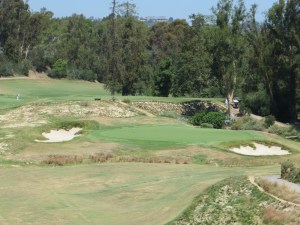
Reverse Redan….an uncomfortable approach down to the 11th green
The other postcard par three is the downhill eleventh. Here they reversed the classic Redan with an abruptly downhill tee shot that must be played off a side hill short left of the green to feed the ball onto a green that runs away to the right. Like most Redan holes, trying to take on the pin directly will likely put you in the nasty short side bunker or over the green with a thankless recovery shot at hand.
Green side bunkers are deep and nasty
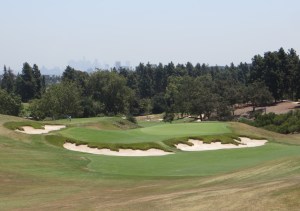
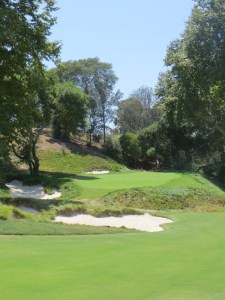
You cannot talk about LACC without paying homage to the Billy Bell Bunkers. They are deep, intimidating, thoughtfully placed, yet totally playable. The toothy edges and gnarly brow grass is what people notice but the steep faces tend to avoid plug lies and the playing condition of where you end up-both sand and slope-lends itself to a typical bunker shot swing as long as you are wisely willing to accept 25 feet for the first putt.
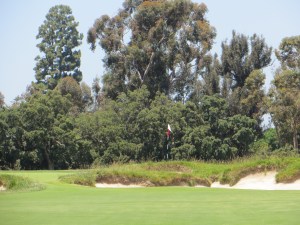
On many of the par fours Bell embedded a bunker in the center front of the approach creating a notched arrangement in the front of the green. This provides a pinable section on either side of the bunker but often one of those sides hangs perilously above nastiness you do not want to engage. More decisions….this course is all about making clear headed decisions. Jim Wagner, with the help of Geoff Shackelford, labored tirelessly to restore the sod walls on the bunkers to support the signature jagged look that Bell had originally built into these hazards.
The Billy Bell Bunkers will make you take pause on planning your approach line
The three par fives are all holes you can try to reach in two if you are very long and very disciplined. The fourteenth is one of my favorites because even as a three-shot hole the lay-up and approach are fraught with difficulty if you bite off more than you can chew. It looks so simple yet the slightest deviation in execution can mean severe consequences to your scorecard.
I have read elsewhere that the genius of George Thomas was his ability to create something special on a short hole with little topographical feature. He did this repeatedly at Riviera and the short approach and putt fifteenth is another gem. The slender, crescent shaped green orients to tightly fitting bunkers with just enough elevation to mask what should be a simple, short iron approach. The hole can be as short at 75 and as long as 135 but I guarantee you more people are shaking their heads side-to-side rather than up-and-down when they are walking to the sixteenth tee.
Every great entertainment experience has a memorable finish and on that score LACC will not disappoint. With the Nassau bet in the balance the last three holes will determine the winner based on judgment, execution, and a little bit of existential fate. The walk to the house encompasses three par fours where success comes from thoughtful drive position followed by flawless execution on approach leaving an uphill putt where you can threaten the hole.
Wow quotient is high from the elevated tee looking down the 17th fairway
If you find the fairway off the tee on the sixteenth the approach is a repeat of the tee shot into the reverse Redan arrangement you saw on the eleventh just off your left shoulder. From the tee on the seventeenth the full monte of LACC sits below your feet-the wash, layered bunkering, and a wide driving area with a very focal sweet spot. The second is one of the most articulate approach shots you will hit all day as the green is set on a diagonal to your aiming line behind a nasty bunker front left and no bail out salvation anywhere. The finish is a walk back up the subtle ramp you played down on the first with a driving area that makes the 18th at the Old Course look narrow. Once again the position of your tee ball is critical to getting an accessible angle at a green tightly ensconced by furry sand.
Driftwood trimmings work well with the rah-rah logo
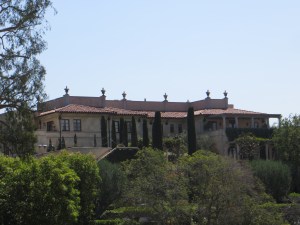
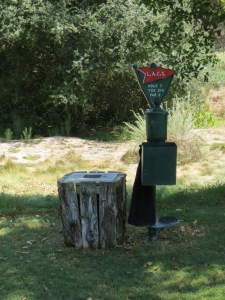
The ambiance of this place is traditional with a kitchy twist. The unusual pennant style of the LACC logo is everywhere on the course- on hole stanchions, tee markers, pins, practice green flags, scorecards, hats, and the shirt you will want to take home with you. This theme lends a youthful collegial feel to the facility that just seems to fit.
Bonus Coverage: #17 Alt the extra hole rediscovered in the restoration
Most important George Thomas created a course that is a graceful combination of raw nature and good, balanced design, a golf experience that will cling to your memory long after the walk is over.
Los Angeles, California
.
Designer: George Thomas (1927)
Tees Par Yardage Rating Slope
Black 70 7010 74.6 139
White 70 6466 72.4 135
Red 70 6089 70.2 131
Green 70 5610 67.7 122
If you would like a printable PDF of this posting including yardage book quality hole-by-hole descriptions of how to play the course click the moegolf logo below.
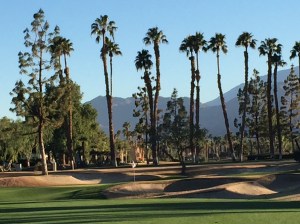
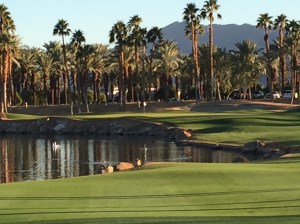
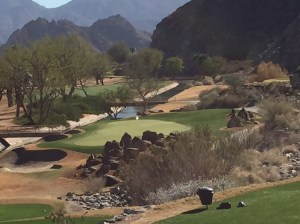
Built in the mid 1980’s as part of the PGA West lavish vacation home development, the Arnold Palmer Private course nestles at the foot of the scenic Santa Rosa Mountains. This is an array of wonderful visual holes that weave among manmade water hazards and manufactured rolling desert topography to present a onerous challenge emulating the TPC design tradition propagated by PGA Commissioner Dean Beman at that time.
The course has been a regular feature of the tour’s Bob Hope Desert Classic (and it’s later commercial iterations). You may remember it as the place where you saw David Duval shoot his remarkable 59 in the final round to win the 1999 event.
An oasis sculpted out of the desert for your recreation and enjoyment
Arnold was obviously keeping up with the Dye’s who created the neighboring the PGA West Stadium Course at the same time in following the TPC formula of cookie cutter driving areas, flanked by ominous water and deep bunkers, and tight green complexes with large undulating surfaces. It is not a track for the meek of heart or those who lack trajectory and spin in their game. For the pros the slope is an impossible 143 and mere mortals face a stiff 133 from the 6500 tees.
The approach on the drive and pitch 8th is anything but easy to negotiate
This course was designed to be taken on full bore. The only way to play it is Arnold’s way, roll up your shirtsleeves and be aggressive. The biggest challenge is in the four pars and not necessarily the longest ones. The par fives are relatively mundane and similar in design except the finishing hole which has some chutzpah (Duval hit driver, 5-iron to 8 feet and drained it for eagle to cap off his 59). The par threes have lots of visual interest but not that much bite. The front nine works clockwise away from the clubhouse to the north and back. The back nine mimics the pattern in a counterclockwise direction which means that given the day’s desert wind direction you should have the same difficulty factor on half the holes on each side.
One of Arnie’s many cape holes-water all the way up and a forced carry to boot
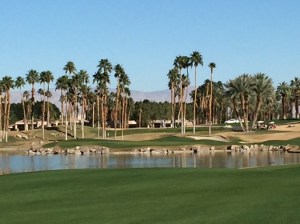
The real treachery is in the multitude of forced carry cape par fours strewn throughout the layout. Holes like 4, 7, 9, 10, 13, and 16 all use the same combination of harrowing water adjacent the full length of the hole with a tight green complex cordoned by water as well. When you get deep into the back nine you reach the Venetian section of the course from the 14th on where the canals haunt every shot and the only thing missing are the voices of gondoliers humming a sad tune if your shots get wayward right.
Part of the Venetian Stretch approach to the 16th must contend with the canal
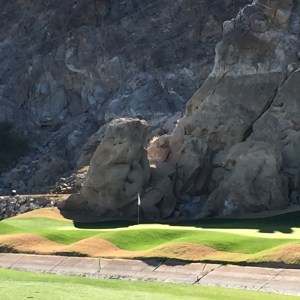
These final holes are spectacular to look at, set up against the foot of the mountains with towering sheer rock faces looking over your right shoulder on every swing. At least the short holes are short and it ends with a Par 5 so maybe you can find some redemption for your scorecard at the end.
Duval hit 5-iron to 8 feet and made eagle-the cherry on top of his 59 Sundae
This is a high end facility so the conditioning of the course-fairways and greens-is impeccable. They keep them on the pacey end of the Stimpmeter so you will have to mind your approach position to try to leave yourself uphill putts you can handle. Cavernous bunkers throughout are real hazards as are some of the grass mogul fields that abut many of the green complexes. As I have seen on other TPC style courses most of your recovery game is with a sand iron or a loft club.
This image of the Par 3 15th will cling to your memory long after the round is done
The rest of the facility is first class as well. They have a wonderful informal dining area that overlooks the staging area and sprawling natural grass practice grounds which you should take advantage of for a post game lunch and lick your wounds session.
Palm Desert, California
Designer: Arnold Palmer (1986)
Tees Par Yardage Rating Slope
Black 72 6950 74 143
Blue 72 6492 71.4 133
Bl/Wh 72 6217 70.3 129
White 72 5995 69.3 126
Red 72 5226 71.2 133
If you would like a printable PDF of this posting including yardage book quality hole-by-hole descriptions of how to play the course click the moegolf logo below.
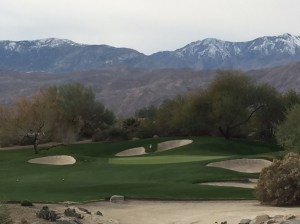
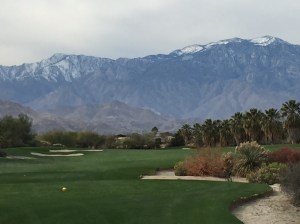
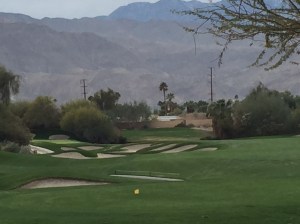
Mountain View is the demure younger sister of the feature Firecliff Course at Desert Willow. Designed by the same crew of Michael Hurdzan and Dana Fry with Tour Pro John Cook commiserating, it shares the look and feel of Firecliff with a more user friendly interface. It shares the stunning backdrop of the San Jacinto Mountains throughout the course and plenty of money was spent moving dirt to create interesting topography with desert flora plantings as accent.
No shortage of Kodak moments here
Mountain View was built to be the member’s everyday course, a kinder, gentler experience with less obvious danger and reverberations to the scorecard. The metric difference of 5 less in the slope from the 6500 yard Blue Tees speaks to this. There is simply more unfettered access to the preferred driving areas and the green complexes on approach and the severity of penalty for missing either is less significant. The small greens have somewhat milder undulations and are kept at a pace much less disarming than her more athletic sister.
Stone walls, palm trees, and desert flora accent throughout
Having said that this is not a course where you can play on auto pilot, it takes your full concentration to plot your way around. If I have any criticism at all it is that most of the holes are relatively straight, very few holes that turn dramatically to focus your attention to the A drive position off the tee. But even without elbows on the corners the green complexes still dictate a preferred drive position in the generous driving areas.
Generous driving areas but position matters into confined green complexes
The small size of the greens and the fact that many are raised from the fairway is the scorecard’s best defense. The front pins are particularly difficult because there is no advantage way to be short of these pins and have an uphill birdie opportunity. Your pitching recovery game will get a workout because you will miss greens so an adept short game is a must to scoring well. Much like Firecliff reading these greens is difficult with all the static of the mountain backdrop and the manufactured topography. If you have your Everything-Breaks-To-Indio compass on hand it can prove relevant on many of the reads.
The 16th you have to work your drive around this bunker constellation
This is a fun afternoon of golf, an opportunity working taking if you are in Palm Desert for long enough to play both courses at Desert Willow. I actually like it as a warm up round the day before taking on the full Firecliff challenge.
Palm Desert, California
.
Designer: Michael Hurdzan (1998)
Tees Par Yardage Rating Slope
Black 72 6913 73.4 130
Blue 72 6507 71.5 128
White 72 6128 69.8 126
Red 72 5040 69.6 126
If you would like a printable PDF of this posting including yardage book quality hole-by-hole descriptions of how to play the course click the moegolf logo below.
 They say that truth is so much more interesting than fiction. When a young American hero story turned into a full blown Shakespearian Tragedy over the back nine at Augusta on Sunday this adage was reiterated in spades.









 moegolf