Unknown's avatar

About moegolf

Moe is a narcotic golfer, father, and lover of golden retrievers, chocolate and well done fries. He plays the holes over in his head endlessly at night.

Bay Hill Charger Nine

Bay Hill Logo

One of the hidden gems at Bay Hill is the nine hole Charger Course.  Call it an intramural, warm-up, settle-the-bets, or happy-hour nine, but this is a well thought out strand of holes that replicates the challenges of the championship course and stands on it’s own as well as a quality test of your golfing skills.  Find a way to slip this one into the itinerary, your trip to Bay Hill is incomplete without the Charger experience.

.
Starts out simple enough with a shortish four par looking for about 220 off the tee straight down the pike.  As you stare at the green you think you are seeing double, which you in fact are since one and eight share a double green in Arnold’s apparent nod to this common sight at St. Andrews.  The green complex is typical of what you see throughout, tiny green raised up from the fairway tightly wedged in between collaring deep bunkers.  Aside from the size of the surface this is in full character with the big course.

.
The second is a cold splash of water to the face, a forced carry short par three to a sliver of a green draped across a shoulder of water and sand.  Pins on the left are pure suckers, aiming spot is center over the bunker to the crown point of the green. The technical theme continues with a hopscotch target par four where reason must prevail over temptation or you stand to send your match into arrears.  Something 200 to 220 at the aiming bunker though the fairway will bring your ball to rest left center and take the first water experience on the hole out of play.  The second is a short pitch into a clever green arrangement collared by sand left and the second water experience on the right.  Like the previous hole all pins call for a deep play to the center and putt back from there.  If you walk to the fourth tee one over or better you are in command of your game today.

.
The next par five is the least interesting offering of the nine.  This plays as a straight three-shotter into another tight green complex squeezed by sand.  The green is deep so it should contain an aggressive long club that successfully negotiates the narrow opening in the front of the green.

.
The par five that follows is  pure thrill ride and may be the pivotal decision making hole of your match.  A strong draw will follow the shape of the hole and leave you adjacent to the fairway bunkers that define the left corner of this dogleg.  From well above the target you are looking down at a stunning green complex.   A long kidney shaped green lies between  a hillside left and boulder trimmed water on the right.  This hole shares the distinctive wharf style look of the sixth from the championship course just to it’s left.  If you choose to take a poke at it on your second aim at the left edge of the green because the contour in front will feed the ball the right.  Taking on the flag directly will leave you a Flintstone lie in the rocks.  Even a lay up needs to favor the left edge of the fairway for a clean look up the angle of the green.  A good score here is great fodder for post round conversations in the bar.

.
The sixth is one of those innocuous looking par fours that will have you scratching you head walking off the green wondering what went awry if you don’t maintain focus.  Approach angle is important so hoist a hard one to right center and you leave a short club to a sand nestled green slightly above you.  This green is fairly long by Charger standards but there is a rise in he center that demands a full carry to the back pin positions. Two controlled shots and this is a routine par, anything wandering brings lots of possibilities to you scorecard.

.
If they had a postcard hole for this nine this next dramatic par three would be it.  Depending on the tee you play it can be a short pitch to stiff long club from a high tee to an appetizing green arrangement below.  Full forced carry over more boulders and water to a green stuffed into the foot of the slope behind. You have to play the back third of this green to hedge the carry and any putt back down to the pin will be a ripper.  If the wind is blowing at all the club selection is a Donald Trump crap shoot with a significant elevation change just complicating the formula.  Once you send you ball on it’s way just sit back, relax, and enjoy the IMAX view of what will result. This is as fine of a three par as there is on the property.

.
The run to the house is a pair of wonderful par fours that continue to emphasize line and distance control.  Tee ball on eight is semi-blind into a landing area above.  Right center off the tee gives the best attack angle into this green.  Double vision again prevails as you may remember that the eighth is a continuation of the first green bisected by a separating bunker.  The approach sets up for a soft draw working at the pin on the left.

.
The final hole shadows and replicates to some degree the ninth on the championship course.  As you will find on it’s big brother, you have to turn it over off this tee to follow the line of the hole.  The second is a long shot into a very deep green narrowed by shading bunkers on either side.  The green falls off gently back and right so you can use the ground to assist a low trundling shot to get to a back right pin.

.
When you finally settle in for the beer and Bay Chips at the bar with your buds or the wife, you will take great pleasure in replaying in your mind this bonus nine and the shots it required.

Orlando, Florida

Architect: Arnold Palmer
Tee              Par    Yardage    Rating     Slope
Blue             36       3085        35.2        125
Yellow          36       2867        34.1        115
White (L)      36       2278        33.8        118

If you would like a printable PDF of this posting including yardage book quality hole-by-hole descriptions of how to play the course click the moegolf logo below.

(Click to see the moegolf Bay Hill Championship Course review)

(Click to see the moegolf Bay Hill Short Game Area review)

(Click to see Bay Hill photos from the Postcard From Bay Hill)
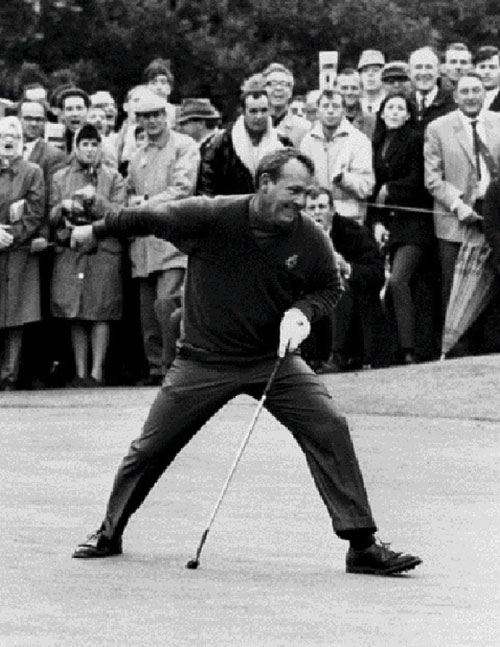
Arnie

(arnoldpalmer.com)

He is the most immeasurable of all golf champions.  But this is not entirely true because of all that he has won, or because of that mysterious fury with which he managed to rally himself.  It is partly because of the nobility he has brought to losing. And more than anything, it is true because of the pure, unmixed joy he has brought to trying.

Dan Jenkins

The Dogged Victims of Inexorable Fate

1990

Postcard From Bay Hill

Bay Hill Club and Lodge is known to most golf fans as the home of the Arnold Palmer Invitational by Mastercard that fills our TV screens in March of each year. It is actually one of the finest golf resorts in Florida, the product of the imagination and hard work of Arnold and Winnie Palmer. The low key presentation of this top shelf golf facility
is a reflection of Arnold’s passion for the game and Winnie’s attention to detail in every interaction with resort guest and residents.

Wall Of Fame

A stroll through these hallways is a walk through an Arnie Museum….this Wall of Fame has signed pictures of Arnie with friends of every generation including Ike, Gerald Ford, Dinah Shore, Ben Hogan, Jack, Phil, Bill Murray and countless others.

Keepers WaffleThen there is the comfort food…beside the waffle I recommend the Bay Hill Chips and garlic dip.

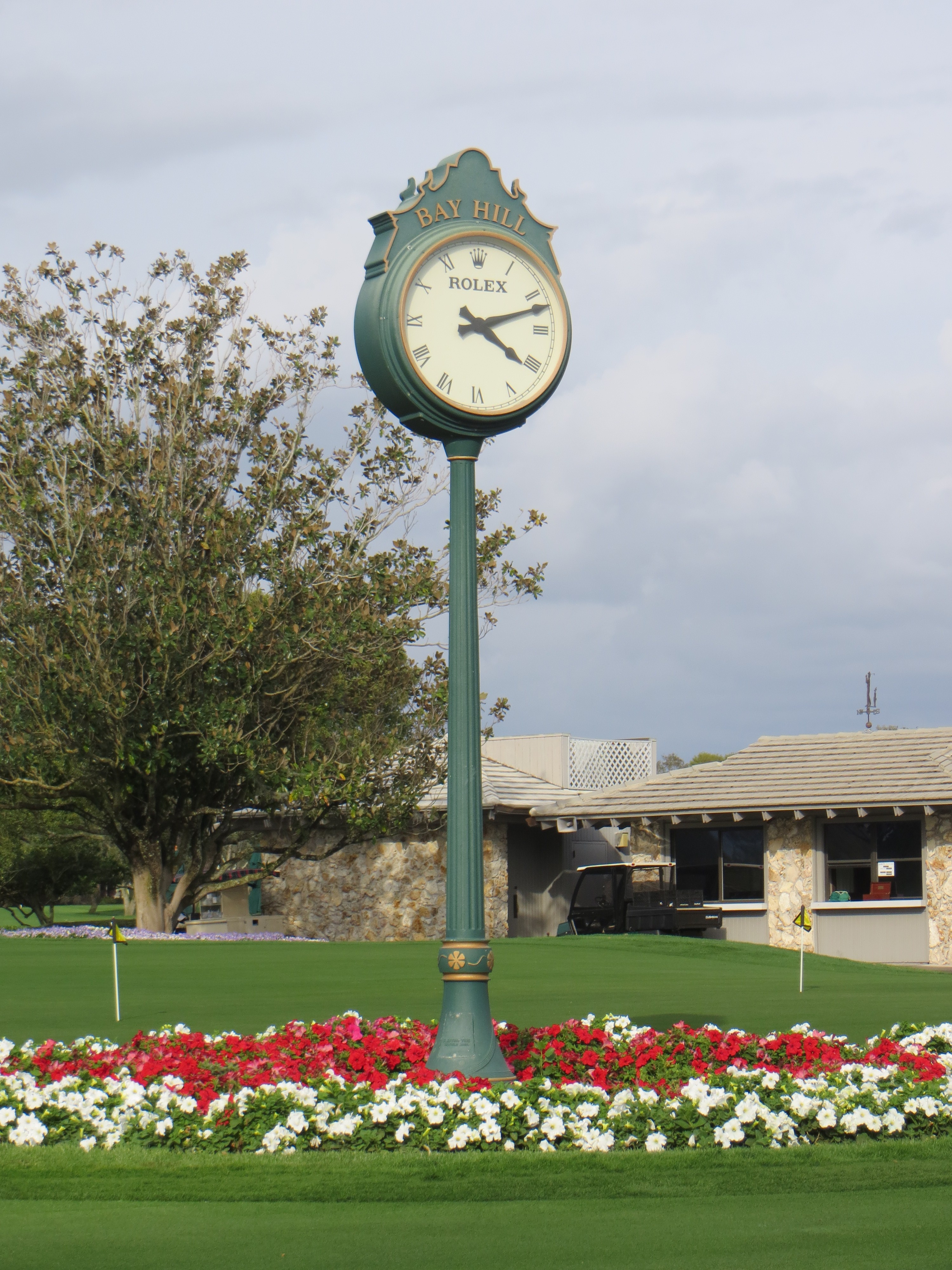
Clock 2The watch tower that overlooks the practice green, staging area, and starter’s hut.

Mens Locker Room 3

Old school….the Men’s Locker Room has a full bar, gin tables, and plenty of table space
to calculate the results. Shared lockers with Tiger or Ernie are an unexpected extra.

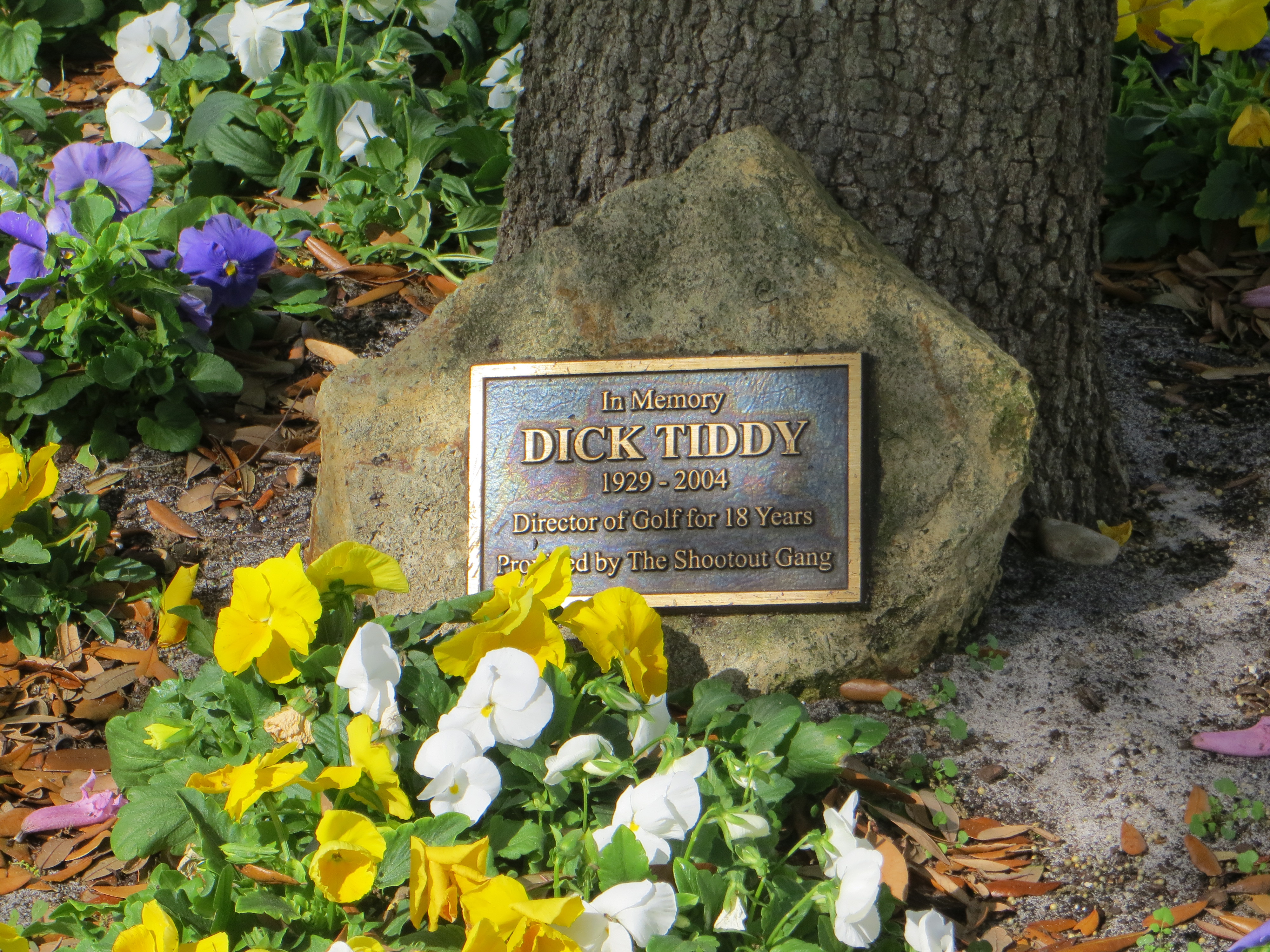
Dick TiddyThe Dick Tiddy Memorial Rock….commemorates his decades of service as the Director of Golf at Bay Hill..presented by The Shootout Gang.

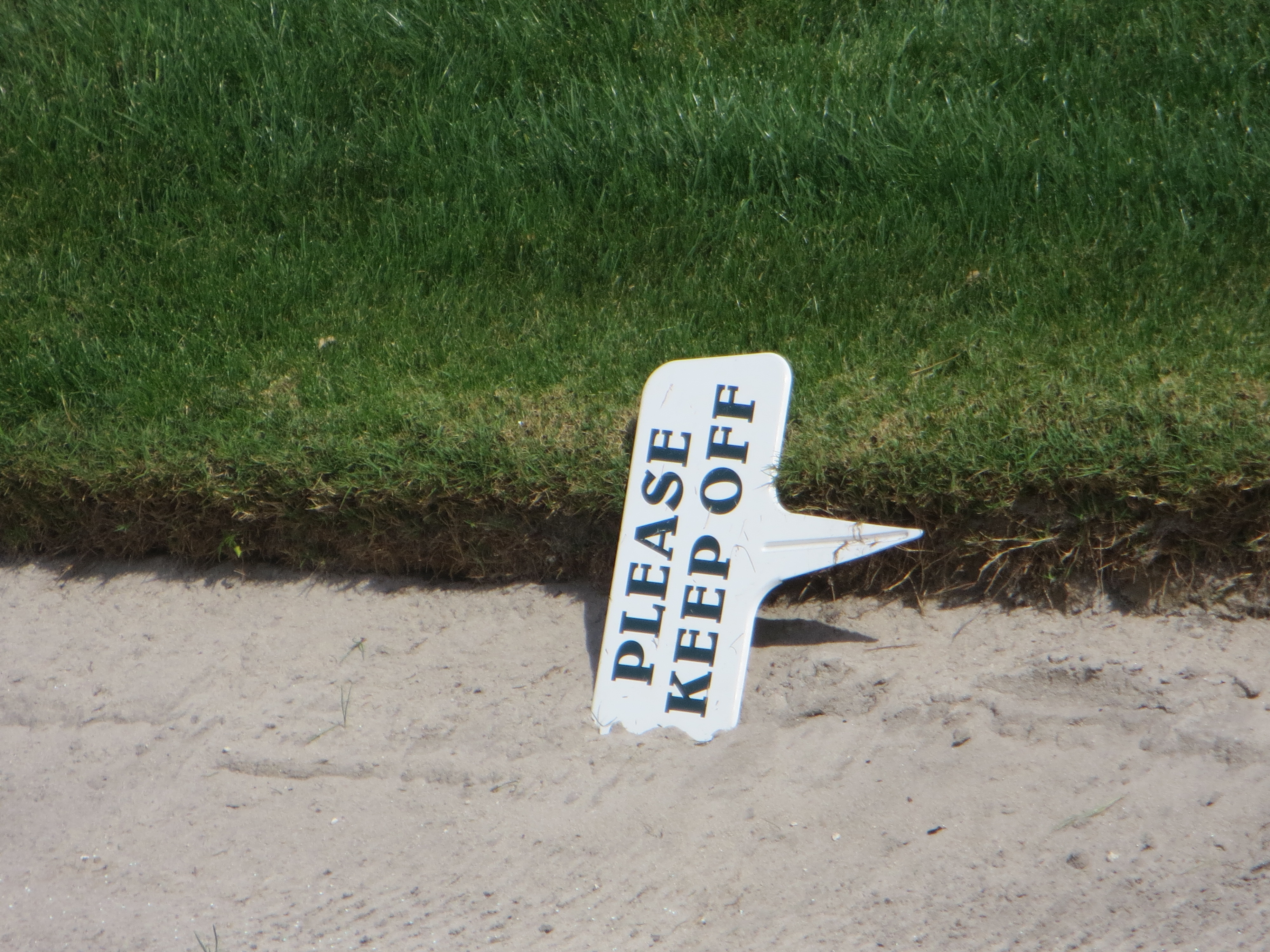
Please Keep Off 2Apparently not all paying customers know how to follow directions.

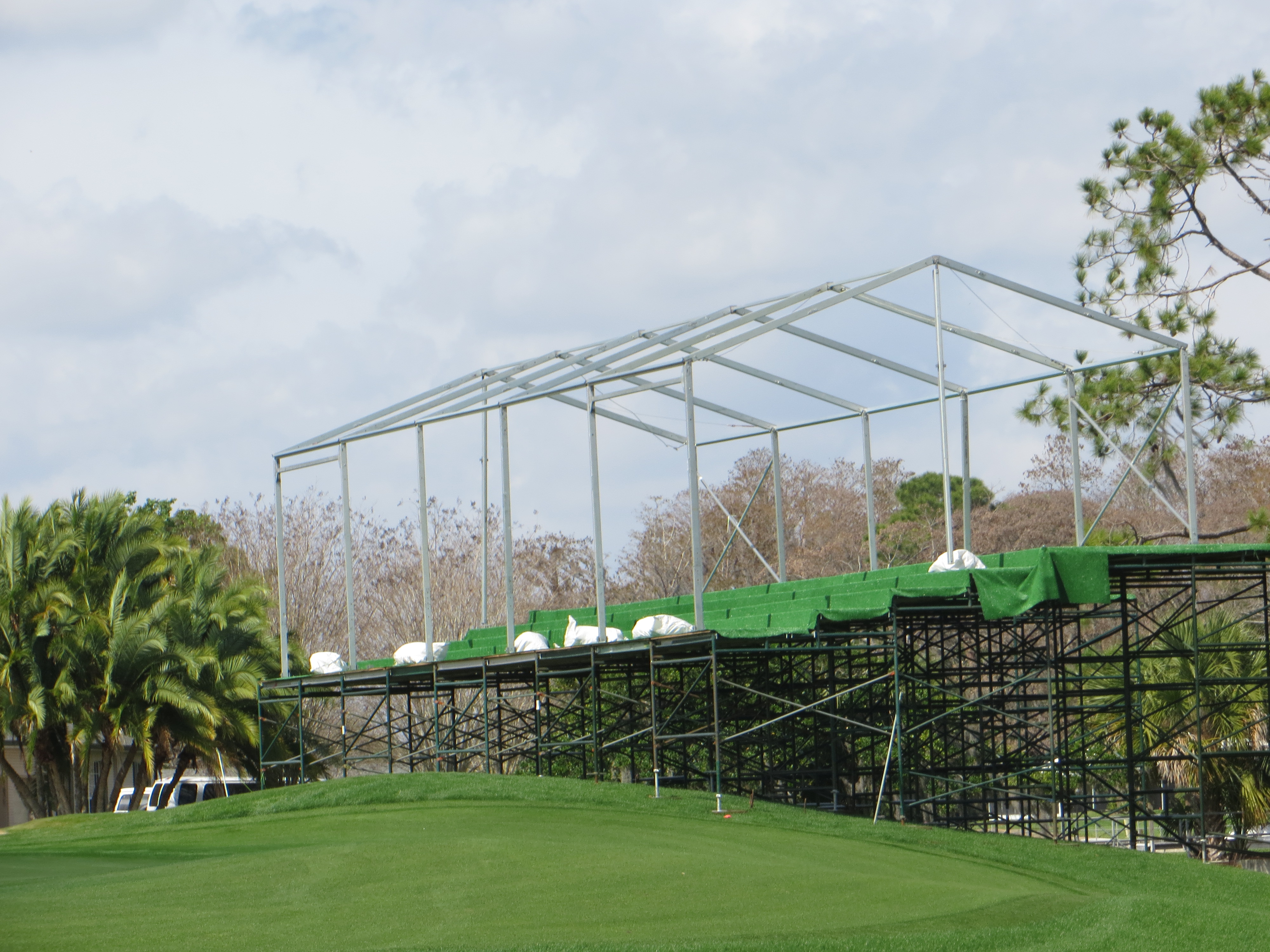
Grandstand 2The show is coming…..preparation is well underway to handle the patrons.

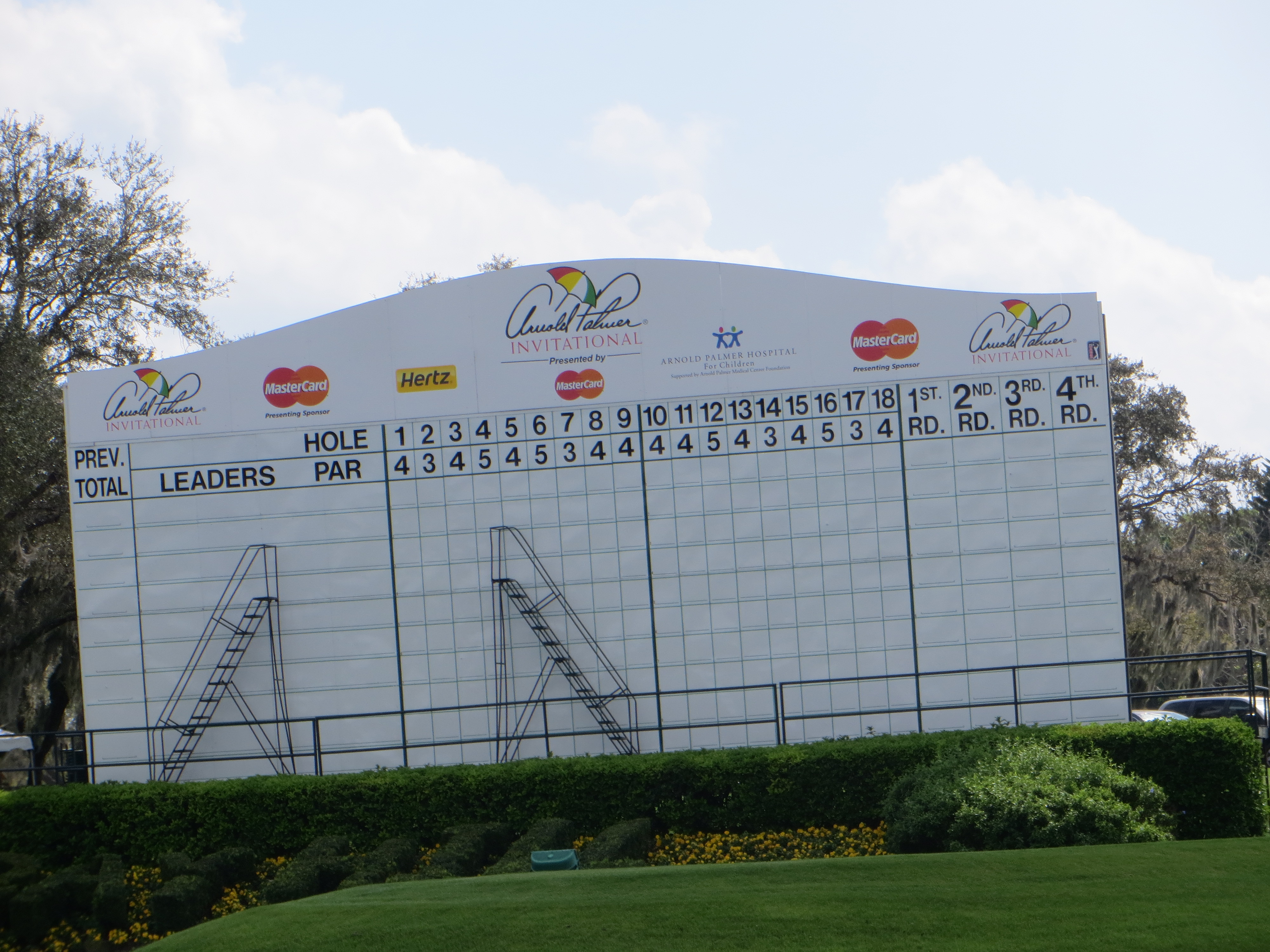
ScoreboardTrust me it will be straight by game time.

Magnolia 2Arnold thought of everything…here is a peek through the imported Magnolia hallway that frames 15th fairway.

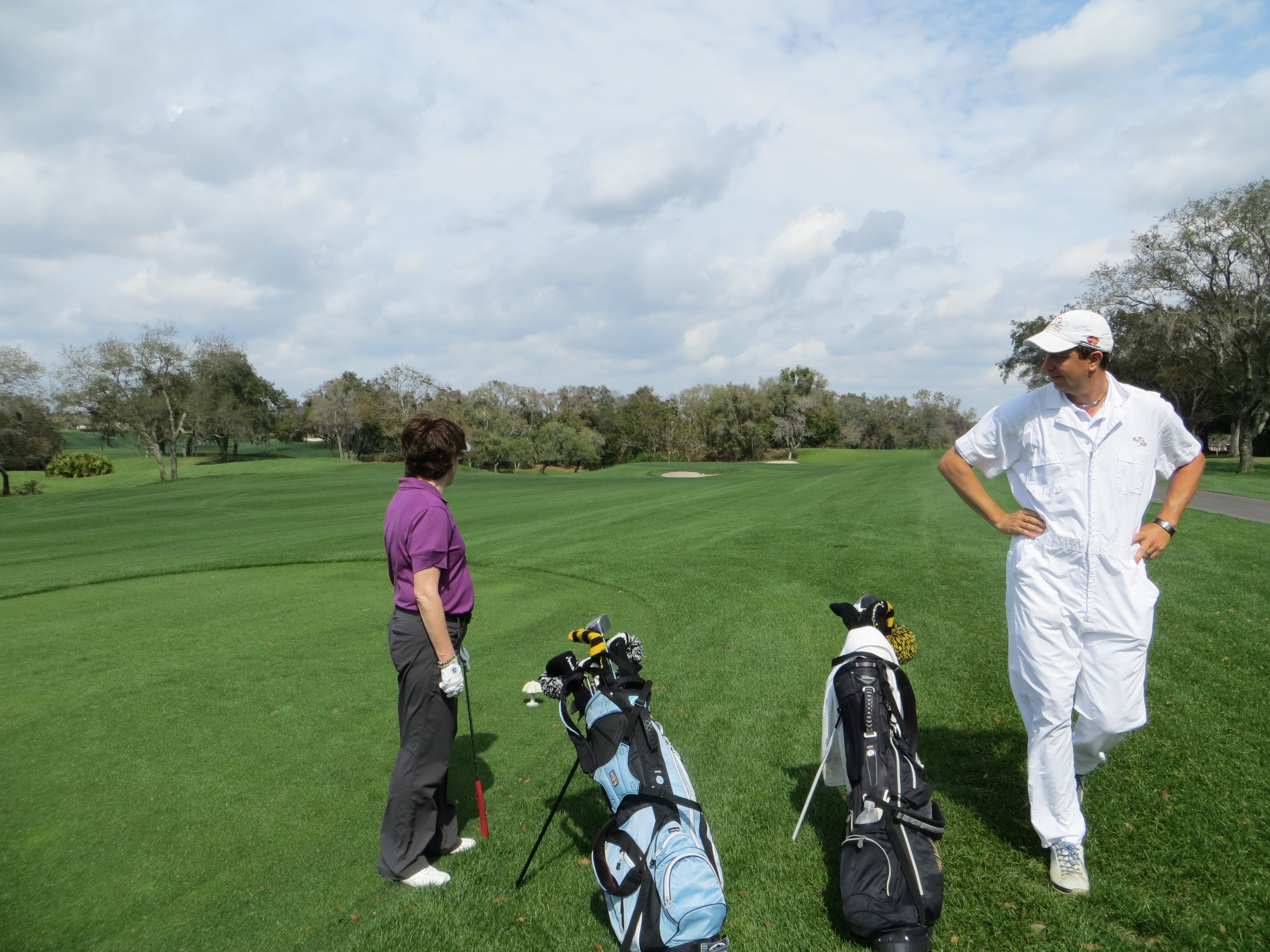
Kathy and TroyA Do-Si-Do between the archer and counsel in picking the right bow.

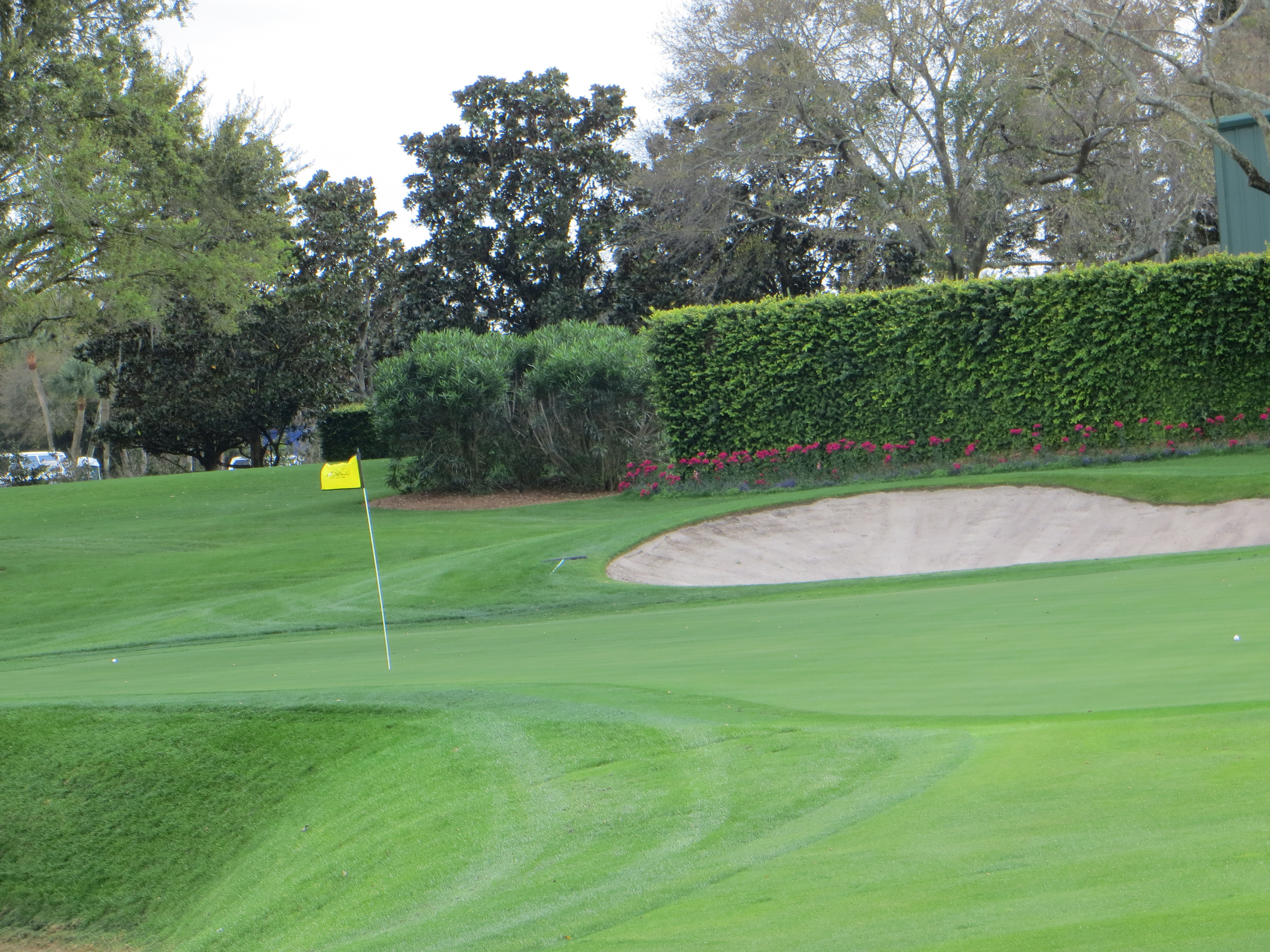
BH 2The target…..#2…..seems so docile but actually a daunting task with trouble lurking everywhere.

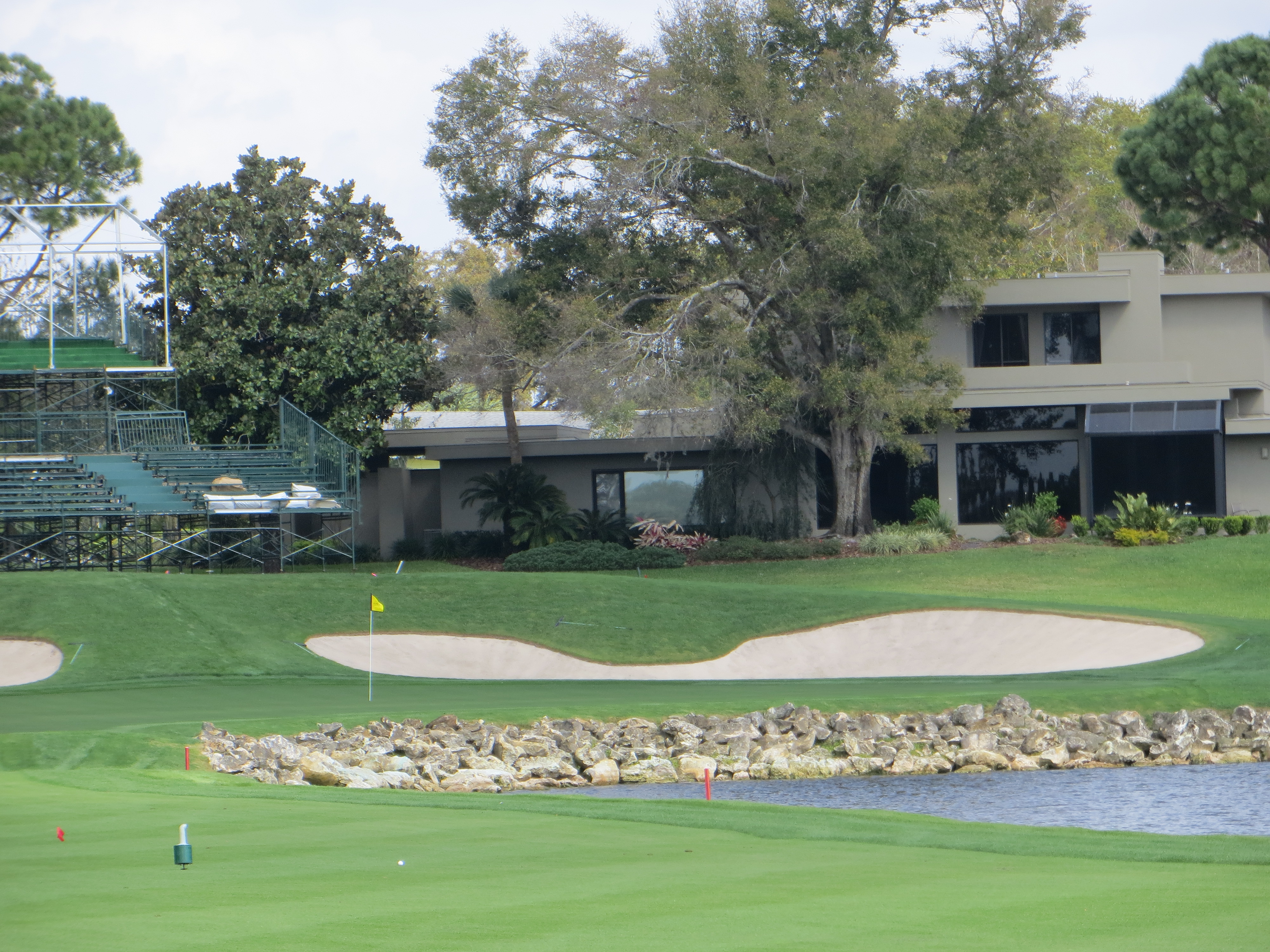
#8 with ballWind, water, hills, and sand make the approach to 8 a real challenge….take note of the white dimpled speck 25 feet left of the hole.

BH 18 2Robert Gamez’s 7-iron seared this image of the eighteenth in the viewing memory of the golfing public and Greg Norman in 1990.

Troy Kathy Moe 2The Little Lady and supporting cast…The Mish and Troy The Seer….apres game.

Bay Hill is a place where you can let your hair down, kick back, and enjoy golf the old fashioned way, one Arnold Palmer at a time.

February, 2013

(Click to read the full moegolf Bay Hill Course Review)

(Click to read the full moegolf Bay Hill Charger Nine Review)

(Click to read the moegolf Bay Hill Short Game Area Review)

A Double Take

ATTPebbleLogoAs the reigning FedEx Champion Brandt Snedeker really has nothing to prove to anyone.  Yet there are those in the pundit chairs that say that to be a truly great player he has to prove able to play with the lead and win from in front.  We know that he can win from behind, he did it last year at Torrey Pines when, a full half a dozen furlongs behind, he snuck up and swiped the trophy from Kyle Stanley who was having some trophy gripping issues down the stretch.

It is not like Sneds has been dogging it this year.  He leads the FedEx Cup and has $1.7 million in earnings including a 3rd at the Tournament of Champions at Kapalua, a 2nd at The Farmers Insurance at Torrey Pines, and a 2nd at the Waste Management in Phoenix.  And that’s in just four starts.

He began the day tied with the gangnam dance king James Hahn and quietly eagled the second hole to make a champion’s statement that the field needs to get on it’s horse if it  was going to chase him down.  Three more birdies ensued before an unfamiliar three-putt bogie on 9 to finish the front side in 32.

It is that pop putting stroke that makes Sneds a special player and he popped in birdie putts of 25 feet on 10 and 15 feet on 11 to build himself a four shot cushion heading for home. Pretty much on cruise control the rest of the way he made one more birdie for good measure at 17 and a par on 18 for 65.  It sealed a comfortable two shot win at 19-under par and validated his new parking place as the #4 player in the World Golf Rankings.

Not that he needed something else to concern himself but Sneds and his fellow Vanderbilt patron Toby Wilt were in the hunt for the Pro-Am prize on Sunday as well. Their connection is deep in that Wilt played football at Vandy and created the athletic scholarship that facilitated Snedeker attendance at Vanderbilt.  In the end both guys missed putts on the last hole and they had to settle for a first place tie at 31-under in the Pro-Am competition.  It was two for the price of one for Sneds today.

Now the only thing missing from his resume is that major championship.  For Snedeker the ultimate would be the Green Jacket and he was very close to that in 2008 before a heart breaking final round.  Considering the fact that he hit close to 80% of the fairways, 80% of the greens, and putted like Crenshaw this week it might just be the U.S. Open at Merion that bests suits his game.  Opie wins the Open…..has a nice ring to it.

February, 2012

(Click to read a wonderful Mike Bamberger article on the Snedeker developmental years)

Fantasy Backyard

If you are a narcotic golfer than the attached video of the back yard of Short Game Guru Dave Pelz from the “Million Dollar Rooms Series” is going to make you drool. We are not talking about driving range nets and chipping baskets here. We are talking a real scale full-featured short game practice facility with accurate replicas of some of the most iconic green complexes in golf.

In his yard you can play pitches, chips, flops, sand shots, three-wood chips, bladed sand irons….the works. Best part is that the surfaces play and respond like the real deal…..and he does not have to mow one blade of grass.

If you had this outside your sliding doors you too could be a contender!

Million Dollar Rooms Series

Dave Pelz’s Backyard

January, 2012

Thumbs Up!

More than anyone of his generation Phil Mickelson has come to exemplify the competitive and personal demeanor of the King, Arnold Palmer.  Whether it Phil’s swashbuckling willingness to take on any risk/reward shot, his penchant for coming from back in the pack with a scintillating charge, or his connection with the burgeoning crowd thing.   He even freely proliferates Arnie’s signature thumbs gesture to any man, woman, or child with whom he can make eye contact.

Playing in front of a quasi home crowd at the Waste Management Phoenix Open this week, Phil was driving it in play, sticking it close, making the putts, and smiling on all burners as he scorched TPC Scottsdale with a 28-under total on his way to his 41st PGA Tour win.  The adoration meter was in the red zone all week as the locals cheered him to his record sixth win in the Valley of the Sun.

Only a full Seabiscuit lip-out on the final putt on Thursday kept Phil from a folkloric 59 in the first round.  On day two he needed par on 18 to set the tour record for low 36-hole score ever on tour only to find the water off the tee and make double.  By the end of day Saturday he was 24-under carding a 64 for a six shot lead over Brandt Snedeker.

It was a bit of a grind on Sunday with Sneds parlaying a 31 on the front side and catching Phil’s full attention.  Within four shots after a birdie on 6  Sneds threw down the gauntlet  sticking it to 10 feet on the par 3 seventh.   Phil delivered the required message with an over-hill, over-dale 55-foot putting effort that traveled across 20 feet of fringe before finding the bottom of the cup for birdie.  His five birdies on the day were good for a 67 and a four-shot margin at the end of the day.

Bones Mackay, Phil’s longtime wingman has seen it all over the years but he has never witnessed one man’s mastery of the three pars like he has this week. Phil had nine 2’s on the par threes for the week-on Thursday alone he had a total of 8 shots for the day on the short holes.  Now that is some kind of distance control with your irons.

The Waste Management is known for huge crowds (179,000 on Saturday alone) and raucous revelry in the coliseum atmosphere of the 16th hole and no one stirred them like their favorite son Phil when he stuck it to two feet on Saturday.

At the end of the day the biggest winner is the PGA Tour who, in the first five weeks of the 2013 season, has seen both Tiger and Phil dominate on their way to victory.  Seems to me there could be a bushel full of thumbs up come the Masters in April.

February, 2013

Dealing With Rory

It was a record setting blockbuster deal when Rory McIlroy signed on with the Swoosh.  This will undoubtedly begin an ongoing tandem campaign with the other Nike show pony Mr. Eldrick Woods.  Up to now the details on the trail to forging his relationship with Nike have been sketchy but you can read in the attached SI article by Alan Shipnuck how Rory and his agent carefully navigated the waters before landing  him on this island oasis.

What may surprise you is how motivated and engaged Rory was in this process.  He takes the presentation of his image very seriously and found that Nike represented the right fit of young and cool he was after.  As Rory said in his typical self-deprecating fashion, “It always seemed  like a food fit to me.  Golf needs a younger and more athletic image and Nike has always had that.  I’m young enough.  I’m not sure I’m athletic enough.  But I’ll try”.

His agent Conor Ridge of Horizon Sports Management was determined to eliminate the clutter of logos that made Rory appear on TV broadcasts as “golf’s version of a NASCAR ride”.  Through a protracted series of agreements to meet Rory’s goal of a cleaner, more simple image presentation, Ridge has realigned Rory’s endorsements and delimited the ad real estate on Rory clothing.

The most interesting aspect of this article is Shipnuck’s description of the evolution of Rory’s relationship with the Nike equipment side.  Rory said he was “relieved to discover that among the club tweakers there were no spiky-haired hipsters or mad scientists…..I was blown away by the craftsmanship and attention to detail”.

In the end Nike’s craftsmen found Rory a quick study who, as the ultimate feel player, is apt to embrace changes that intrigue him and take the attitude of “let’s try it and see what happens”.  This is a far stretch from the conservative and controlling approach of the second stud in the barn.

The jury is out on how a drastic equipment change may affect Rory’s career trajectory but he does not seem all that concerned about it.  He says, “I don’t over think things.  I’m not going to get overwhelmed by changing my equipment.”  His father Gerry who knows him better than anyone has said , “Rory could win a major playing with a hockey stick and an orange.”  Maybe Rickey Fowler should take note of that.

Tiger has gracefully accepted the fact that an ad relationship with Rory allows Nike to bring him back from his wilderness journey that started after that fateful incident at Isleworth in 2009.  The first advertisement of the series (click here to view the first ad) has just the right amount of edginess and personality interest to set the table for the many more sequels that are cooking in The Oven.

(Click here to read Alan Shipnuck’s article on Rory’s Nike Deal)

Alan Shipnuck

SI/Golf.com

January, 2013

Bedlam Returns

To those who have played the 16th at TPC Scottsdale in the annual Waste Management Phoenix Open, it is like playing at the Red Sox post 2004 World Series riot inside of Fenway during the game.  No cars will be turned over and torched but you could light the breath of 80% of those in attendance.  There is nothing like it anywhere else on the PGA Tour.

Bo Van Pelt said that stepping out of the tunnel to the teeing area is the modern sports equivalent of stepping into the Roman Gladiator ring.  About 30,000 crazies with Caesar McCord giving the thumbs up or thumbs down.  All this hoopla for professionals hitting a knock-down 9-iron into a 162 yard par 3 that doesn’t even have a water hazard.

Over the years this hole has seen it’s share of The Good, The Bad, and The Ugly-Tiger’s Ace in 1997,  some really impaired synchronization of the wave, and Ian Poulter giving the crowd the one-finger salute after missing a short birdie putt.

Bedlam always prevails.  The guy with the “Quiet Please” paddle is about as relevant as Tiger’s body guard at a Sorority Mixer.

The Golf Channel

January, 2011

Game Improvement

Once again the USGA is on top over everything relevant to the preservation of the integrity of the game.  Bypassing lesser concerns about anchored putting, compliant ball aerodynamics, and nuclear ball speed off driver club faces, the USGA has introduced, after two years of exhaustive internal research and development, a new and improved version of the Stimpmeter.

The latest cutting edge version with the USGA logo (USGA/Jonathan Kolbe)

The latest cutting edge version with the USGA logo (USGA/Jonathan Kolbe)

I for one will sleep better at night knowing that the powers that be have addressed this pressing problem.  You can read about this exciting development in John Paul Newport’s Wall Street Journal article called “Ta-Da! Stimpmeter Makeover”.

The original was a wooden version introduced in 1935 by Massachusett’s amateur champion Edward Stimpson in response to concerns over the unfair green speeds at the U.S. Open at Oakmont that year.  Separately, there is an unsubstantiated rumor that Mrs. Stimpson volunteered in a Depression soup kitchen and was looking for a better stirring implement for getting the lumps out of the morning oatmeal.

It was not until 1976  that Frank Thomas of the U.S.G.A. made the next big move changing the Stimpmeter from wood to aluminum and it became the standard device for measuring green speeds at U.S. Opens starting that year in Atlanta.  Within two years green superintendents around the country had adopted it for tweaking their putting surfaces and it has become a critical tool for bragging rights at high-end private facilities all over the country.

Fast forward another 34 years and the USGA brain trust correctly decided that enough was enough and made two critical improvements to sustain it’s relevance for generations to come.  First, they updated the color from drab green to a “dazzling USGA blue”.  Second, they added a second “starting hole” to accommodate measurements on greens that don’t have the required 10-12 foot flat run out for the original device.  This is a condition on many older severely undulating greens and the steep and segmented greens that are often the gift of wrath from designers today.

As a course superintendent you can order one of these from the USGA for only $110 (or 3 easy payments of $36.66).  If you act now the USGA will generously double your order sending you a second Stimpmeter for the back nine ABSOLUTELY FREE (just pay shipping and handling for the second device).

For a limited time, as an additional bonus, you will also get a 6 oz can of their “Green Renew” biodegradable green paint that cures pesky brown spots on closely mowed greens in seconds.  It comes in three different shades for Bent, Poa Annua, and Tifeagle Bermuda putting surfaces (please specify preferred color with order).

For those who share the “innate nerdiness” of USGA staff and you can review their instructional video below on the proper use of a Stimpmeter.  WARNING: This video is rated PG and is not appropriate for those without fossilized frontal lobes.

(Click here to see the Official USGA Training Video on Proper Use of the new Stimpmeter)

I only hope that the USGA has, in keeping with the trend of responsible and patriotic vendors, insisted that the current models are being “assembled in the U.S.A.”

(Click here to read John Paul Newport’s WSJ article “Ta-Da! Stimpmeter Makeover”)

John Paul Newport

The Wall Street Journal

January, 2013

Tiger’s Swing-Version 4.0

The three total makeovers of his golf swing that Tiger Woods, the greatest player of his generation, has done over the last two decades have defied logic to all in the know about the professional game.  Yet, as you can read in this article by Scott Eden in ESPN The Magazine called “Stroke of Madness”, the athleticism that Tiger was born with has allowed him to venture where few golfers have gone before.  The motivation for this madness, according to Tiger, is “only two players have ever truly owned their swings: Moe Norman and Ben Hogan.  I want to own mine”.

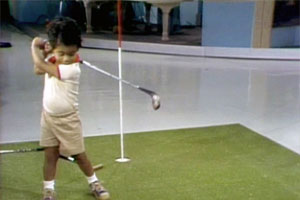
Blame the flaw on Earl at age 3 Tiger fights getting "stuck".

Blame the flaw on Earl at age 3 Tiger fights getting “stuck” (Mike Douglas Show 1978)

In 1997 after having won three U.S. Amateurs, five tour events (including a major), and being ranked #2 in the world, Tiger and Butch Harmon set about tearing down and rebuilding his golf swing to eliminate a flaw, getting stuck on the downswing, that Tiger had successfully managed from his earliest days of swinging a golf club.  In 1999 he claimed to his teacher that he “got it” and went on a tear of professional wins, including four majors in a row, that stunned the golfing world and vindicated his decision to mess with his swing. Butch, when asked at this point if there was anything Tiger should change replied, “The only thing I’d change right now if I were Tiger is the route I took to the bank”.

Yet in 2004 Tiger’s perfectionist mind was unsettled again in search of a motivating challenge and true ownership of his swing.  Version 3.0 was fashioned over the next five years under the watchful eye of Hank Haney as he rounded and flattened his swing, laying the club off at the top in an effort to improve his driving accuracy and eliminate his age old problem of getting stuck on the downswing.  Another impressive run of victories followed, and since the Haney swing change, he had won 31 more tour events, including 6 more majors and held the #1 spot on the World Golf Rankings for what seemed like an eternity.

By 2010 inject a knee reconstruction and incalculable mental baggage from the fallout of the fire hydrant incident in 2009 and Tiger was playing the worst golf of his professional career and searching once again for a swing makeover to take him back to the pinnacle of the professional game.  The unlikely choice to help him get there was the heady Canadian instructor Sean Foley, who preached a wonky version of the Stack & Tilt method.  This may have been the most radical change yet for Tiger and it clearly brought about the most vitriolic criticism.  Tiger was now preaching the value of TrackMan technology and it’s resultant data to corroborate improvements in spin rates, ball speeds, swing angles, and resultant trajectory from his latest technique.  A feel player most of his life he seemed to have traveled to the dark side accepting these “numbers” as the true metric of the state of his game.

The jury is still out on Version 4.0 as Tiger has made steady improvement the last two years but inconsistency in short iron distance control and putting in the big events have denied him from adding to his major victory totals in pursuit of the ultimate record, Jack’s 18 career major wins.

In this article, Eden concludes that Tiger’s quest is not over.  He says the flaw appeared for Tiger at age 3 in “the earliest footage of Tiger Woods’ earliest swing, a Zapruder film for golfing Nerds” from The Mike Douglas Show.  It still haunts him to this day.  Because of the obsessive nature of his perfectionist personality, Tiger seems destined to hounding a swing flaw he could “spend his entire career striving to erase”.

(Click to read Scott Eden’s “Stroke of Madness” from ESPN The Magazine)  

Scott Eden

ESPN The Magazine

February, 2013

———————————————————————————————

You can also view some great time phase photographs of Tiger’s swing development from 1992 to 2011 by viewing the moegolf posting called “Time Phase Tiger” based on a Golf Digest article from 2011.

(Click to see “Time Phase Tiger” from moegolf.net)