Youthful Wisdom

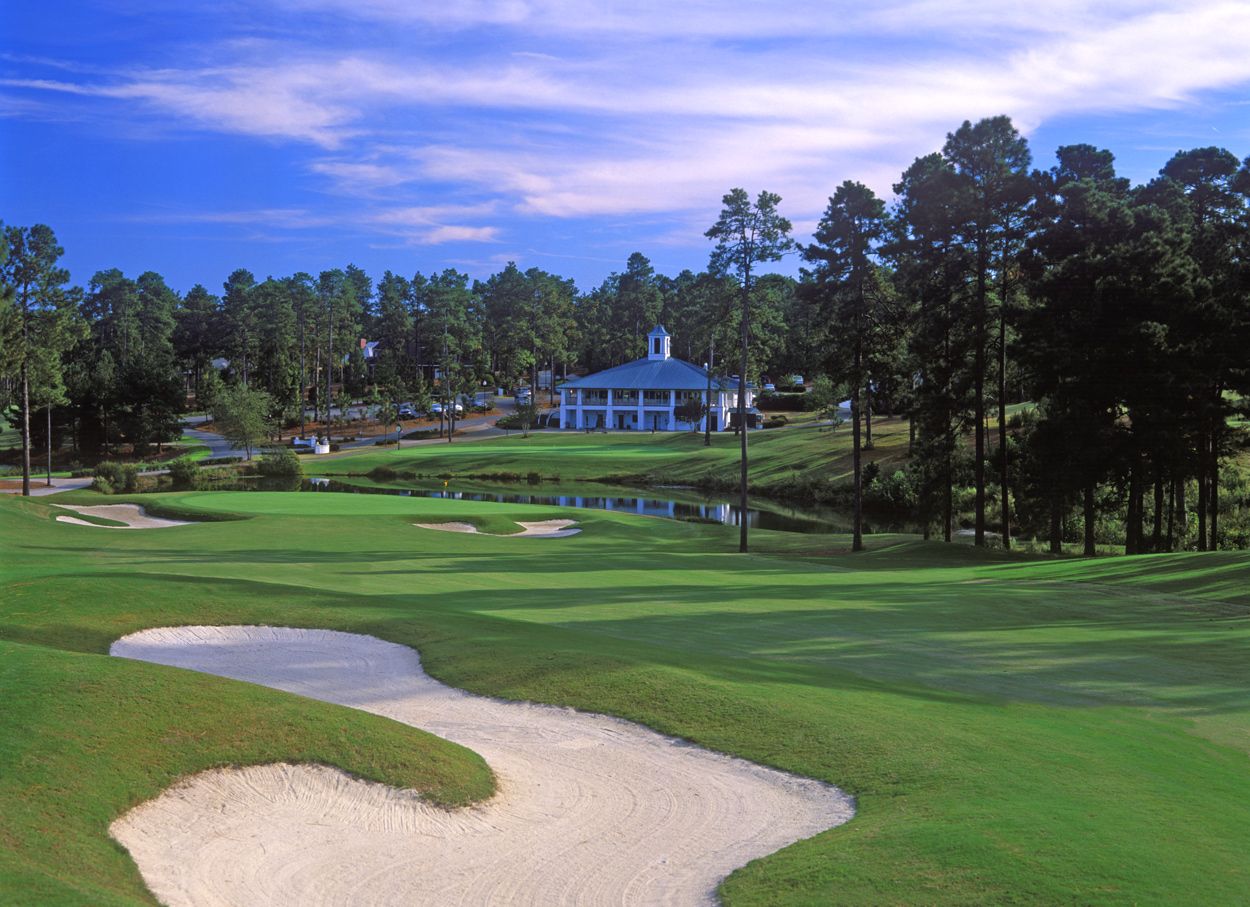
On a placid day on the west coast of Ireland, the wind was only going 25 mph steady, we were playing the Connemara Golf Club with a couple of 19 year olds as caddies.  As usual, good players, golf smart, very funny.

Five times in the first seven holes I seemed to ignore the obvious effect wind has on your putting when playing a links course and left very good efforts staring in the front door of the hole.  On the eighth hole I did it again, leaving a 25 footer at 24 feet 9 inches.

At that point, John, the college educated one on a golf scholarship at the University of Rhode Island, scratches his chin and says to me quite wryly, “Moe, there is a saying shared among the older caddies, ‘It is a rare day that the hole ever moves closer to your ball’ ”.

Nuff said.

John

Summer, 2002

Laurel Valley Memorabilia

National Fourball 1970 (golfartgallery.com)

From the collection on the walls of the Laurel Valley Golf Club you will find this classic shot of Arnie and Jack as pards in the National Four Ball in 1970.  Get the feeling these guys were intense competitors even as partners?  Arnie’s fingerprints are all over this club-it was his summer hangout through most of his career.

U.S. Ryder Cup Team 1975 (rydercup.com)

This is a period piece for sure-U.S. Ryder Cup Team from the 1975 competition at Laurel Valley Golf Club.  The team includes Jack, Hale Irwin, Lee Trevino, Arnie, Bob Murphy, Raymond Floyd, Billy Casper, Tom Weiskopf, and a very young Johnny Miller.  There is so much tradition just oozing around this place.

Click on photos to get an enlarged view of the image

Arnie and The Guys

And who can resist the photo opp with The King that is adjacent to the first tee box.

(Click here to see full review of the Laurel Valley Golf Club)

September, 2011

Laurel Valley Golf Club

A golf course with a long and rich tradition that belies it’s mere 50 years of existence.  Most of us remember this as the place Dave Marr won the PGA and associate it with Arnold Palmer as his adopted summer home course when back in Pennsylvania.  The members will tell you that it is Palmer’s aura that is most responsible for the reputation of this place-after it was built in 1959 under the watchful eye of Dick Wilson it was Arnold who went to the PGA and told them this would be an appropriate place to host their championship.  It has built on that reputation hosting the National Four Ball championship in the 1970, the National Team Championship in 1971 and 1972, the Ryder Cup in 1975,  significant events from the Pennsylvania-Ohio-West Virginia region, the U.S. Senior Open in 1989, and the Senior PGA in 2005.

When you walk the hallways of this demure clubhouse, the pictures and memorabilia make you fully aware how seriously the members take the rich history and tradition of this place.  There are paintings and photos everywhere full of bouquets of pink sport jackets-an unusual touch for a macho corporate hangout.  Don’t miss the photo library on the walls around the informal bar-there is a classic shot of an intense Arnie and Jack as playing partners in the National Four Ball back around 1970. The locker room is very classy-old wood lockers bearing name plates of PGA and Champion’s Tour players.  This place just has a very traditional good old boy feel to it.

(Click here to see a few of the gems from the Laurel Valley photo gallery).

View across the first tee (pga.com)

The club was originally built as a business man’s club for corporate parties and events during a face-lifting renaissance in Pittsburgh in the late 1950’s.  The club is only open from May through October-it completely shuts the doors for the late fall and winter-a business model that seems hard to sustain without considerable annual member backing.  It is a golf facility only-food service to support the golf and events and some cottages to house out of town guests.  The lay of the buildings to the rest of the property was very well thought out-there are sitting areas providing views of the property and surroundings that are truly spectacular.

The course is built on a 260 acre tract of land in the foothills of the Laurel Ridge and Chestnut Ridge mountains. It does not have much topographical feature in it’s tactical play, though the visual back drops can be dramatic.  The design has a Florida feel to it with abundant sand and water, Dick Wilson wended the course through the low grounds deploying massive fairway bunkering and adjacent water hazards to keep the player’s attention.  Fifty years of tree growth have cloistered the holes considerably, but recent renovation has brought back the more open playability as it was originally intended.

Tough tee shot on #10 (golfcoursegurus.com)

One thing that can certainly be said about this is that the course can play very long from the two back tee markers.  At the 6600 yardage of the white tees it is an ample test for most mortals-the additional yardage can make for some excruciatingly long par fours.  Like most courses of this style driving accuracy is key to decent scoring opportunities.  Playing from the fairway bunkers or tough angles in the rough is a sure prescription for bogies and worse.  For the most part the water is manageable but there will be times during the day when your judgment for carry will be called into play and more often than not bravery is not the sensible route.

Full majesty coming down #18 (pga.com)

There are many interesting individual holes on the course-the par threes in particular have lots of nuance and subtlety to them.  Not too many “wow” holes but some of the scenic backdrops will catch your attention.  What really elevates this to championship caliber are the greens-they are very swift with ample undulation that seems to shrink the accessible opening on most of the cups.  Very few putts go directly up the walkway and into the front door-you will be using diversionary tactics all day to find the bottom of these cups.  The caddies are excellent here and you need one if only to tell you where you can leave the approaches into these greens.  The pitching and chipping are particularly difficult because some of the swiftest approaches are not obvious to an inexperienced eye.

Ligonier, Pennsylvania

Architect: Dick Wilson (1959)

Tees             Par       Rating    Slope    Yardage
Blue             72          75.7       148        7327
Black           72          74.1       138        6982
White           72          72.8       135        6606
Green          72          70.1       130        5899
Red             72          73.5       127        5548

(Click to see complete Laurel Valley hole-by-hole descriptions)

FootJoy TechSof Sport Socks

As men are apt to do, I made the mistake of going to the golf course yesterday and forgetting to bring a pair of socks.  Desperate to avoid cultivating fungus in my Freddies I went into the golf shop seeking an emergency pair of sport socks for the day’s walk.  In perusing the selection available I found a pair of FootJoy TechSof Sport socks that had an inordinate amount of “engineered characteristics” on the packaging, but proved to be a pure joy to my feet.

These things sell for around $10 a pair but I have to say that for those who walk all the time and worry about foot comfort, these are worth the investment.  They come in black and white and fit shoe sizes 7 to 12.

The promo copy brags the following:

-Breathable mesh inserts strategically positioned to boost ventilation
-Lycra/spandex for excellent fit, stretch, and recovery
-Dri-Lex to lift moisture and vapor off the skin keeping your socks dry
-Targeted cushioning in toe and heel areas for comfort
-Reinforced heel for added support and cushioning
-Enclosed Comfort Seam toe for advanced comfort and fit

And to my amazement all of this is true.  The mesh along the top seems to wick the heat and moisture away from your foot.  I am usually a big cotton advocate when it comes to socks and these have no cotton content but are as cool as any all cotton sport sock I have ever worn.  The lycra/spandex means the sock fits snuggly and does not ride up or down your shoe.  The cushioning in the toe and heel add noticeable comfort and definitely reduce foot fatigue during the course of the day.

Besides looking incredibly cool they had to mark the two socks “left” and “right” so you would not put them on the wrong foot and destroy the designed engineering effect.  For those of you with two left feet, these are not for you.

Apparently these come in a crew sock with similar characteristics in black, navy, and beige for about the same price.  If you spend all day on your feet these are probably worth a try as a casual day sock as well.

September, 2011

Saucon Valley-Old Course

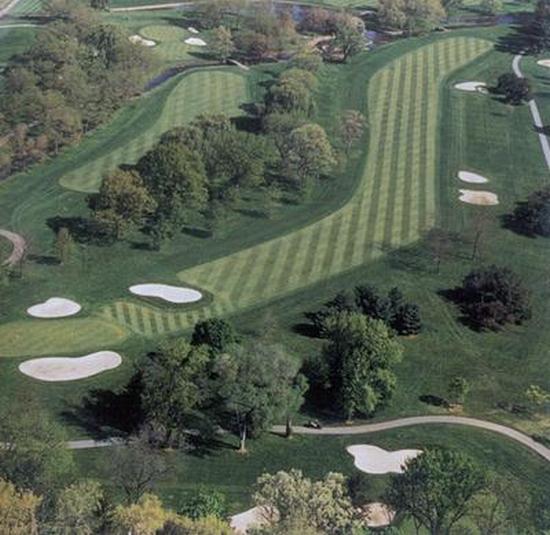
Saucon Valley was created as a playground for the wealthy steel guys in the Lehigh Valley section of northeast Pennsylvania.  The Old Course is an elegant simple layout designed by British Architect Herbert Strong known for designing courses with little disruption to the land.   As a result the course meanders across rolling hills framed by vintage old trees and it looks like it just belongs in the natural surroundings.  This course has held six USGA national championships  a U.S. Amateur, Senior Amateur, two Senior Opens, and two Women’s Opens as well as innumerable regional and local events of importance.

Sahara #6 Par Five

This facility has 54 holes of championship golf, as well as short course for developing players and seniors.  A primo golf facility with a long and storied tradition you cannot help but be overwhelmed by the golf pedigree of this place.  Walking the locker room or the halls of the clubhouse there are lists and lists of the rosters of championships contested here and plenty of other memorabilia that makes this feel like an ad hoc golf museum.  They even have a luxurious 13 room guest house which accommodates guests at the club in a comfortable informal way.

This course is not a beast but it is a stiff challenge that will test all of your skills. To me the bunkering is the most obvious distinguishing characteristic.  It is free form-no real patterns to the bunker placements but they are placed in places in the driving areas and the green constellations that make successful play a matter of good strategy and precise execution.  The bunkers are very deep-even in the fairways-so there are times you must relent and play a shot that will not get you to the green or at the flagstick.

Turtle #11 Par 3

The greens are very unusual-wide variety of shapes and sizes with plenty of segmentation and slope to keep you honest in your approach shots and approach putts.  If they speed them up to 12 on the stimp you are in for a handful.

I just loved the flow of the course.  Both nines start out with expansive visual holes that are extremely inviting and are then followed by short technical holes that will demand focus and execution.  The stretch from nine to fourteen looks very forgiving on the card but you will be challenged big time through this stretch not to make any unforced errors.  Fifteen through seventeen are all long and strong  so there is no relief to the end.  The finishing hole will grow on you-especially if you make a par-it is short but very demanding-any wayward play on this hole will do damage to your scorecard.

(All photos from sauconvalleycc.org website)

Bethlehem, Pennsylvania

Architect: Herbert Strong (1922)

Tees               Par          Rating         Slope        Yardage

Blue                 71            73.1            138            6800

White               71            70.7            135            6337

(Click to see complete Saucon Valley Old Course hole-by-hole descriptions)

Saucon Valley-Grace Course

Zig-Zag Opening Hole Par 5

This was the second course built at Saucon, just after World War II, when it was decided that eighteen holes were not enough for the growing membership.  William Gordon worked for a number of eminent architects and had a hand in Seminole, Maidstone, and Garden City Golf Club.  This was a family affair, he did the course with his son David. The course is named for Eugene Gifford Grace who found the club and was a very strong influence in the development of Saucon Valley for over four decades.

Number 10 Par 5

The course was laid out around the perimeter of the Old Course but it does not share much of the same topographical character.   To me, it is a bit of Florida layout with trees.  The basic topography is flat as a pancake but the Gordons did some real creative work with the green areas and it is anything but boring-a very nice walk indeed.  Overall conditioning of the course is excellent, bent fairways and who knows what greens.  As of 2010, the greens are worn out and in need of redoing, but a full renovation of this 18 is due when they finish the work on the Weyhill Course in the spring of 2011.

Challenging finishing Par 4

The course is plenty of challenge from the White tees at 6302 but it is probably playable from the Blues as well.  The general nature of the course is that it is expansive to the eye but the real playing areas are much more confined.  You have to be careful off the tee or you will end up with lots of fairways missed two steps off the cut with some difficult shots from there.  Honestly this course is a pleasure, you get challenged without getting run over and good play is rewarded.  Enjoy the walk.

(All photos from sauconvalleycc.org website)

Bethlehem, Pennsylvania

Architect: William and David Gordon (1958)

Tee                  Par          Rating        Slope        Yardage

Blue                 72            72.4            136            6684

White               72            70.8            133            6302

(Click to see complete Saucon Valley Grace Course hole-by-hole descriptions)

A Tradition Like No Other

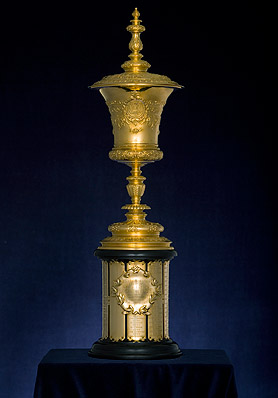
The Havemeyer Cup (John Mummert/USGA)

In the world of competitive sport there are very few things that have not changed precipitously over the last 100 years, but the U. S. Amateur Championship is one of them.  It is played with the same traditions, rules, and formats that governed it back at the turn of the last century when it was first recognized as one of the most coveted prizes in the world of men’s golf. Traditionally it is 36 holes of stroke play qualifying to identify the top 64 amateurs in the world followed by a grueling match play format with six matches over five days ending with a 36 hole marathon final match to determine the finest amateur in the world.   There was a brief spell from 1965 to 1972 when the U.S. Amateur was entirely a stroke play event, but fortunately the U.S.G.A. came to it’s senses and went back to the traditional format.

What intrigues most of us about this tournament is that they are playing a format that is familiar to all of us-it is the same format most of us play every Saturday with our regular group-mano-a-mano match play.  In some regards this is more forgiving than medal play-a blow up hole costs you only one hole, not the entire round.  But if we consider that the U.S.G.A. hosts this event on the most difficult and revered courses in the land and tweaks the course, as they do with the U.S. Open, to challenge every aspect of the competitor’s games, we realize that someone has to have great skill, great composure, a bit of luck, and a truck load of determination to prevail in this championship.

Most of the great’s of the game have won this championship-Bobby Jones won it five times, Jerome Travers four times, Tiger Woods three times in a row, and eight guys have won it twice in consecutive years.   The Havemeyer Cup bears the name of famous men connected to the game in so many ways-Charles Blair McDonald, Francis Ouimet, William Fownes, Harvie Ward, Arnold Palmer, Deane Beman, Jack Nicklaus, Nathanial Crosby, Jay Sigel, Scott Verplank, Phil Mickelson,  and Matt Kuchar just to name a few.  The youngest winner was Danny Lee at age 18 in 2008 and the oldest winner was Jack Westland at age 47 in 1952. There have been many winners who are not house hold golf names or even had distinguished pro or amateur careers.  But for one week these men had the best judgement, the most veracity, and probably the hottest putter in the game because it takes all of that and more to prevail marathon test like this.

Maybe equally interesting to the competitors are the venues on which this championship is held.  The U.S.G.A. has always sought to hold it on courses with the history and credentials worthy of testing the best amateurs of their time.  Many of them are famous courses like Pinehurst, Hazeltine, Merion, Olympic Club, Winged Foot, Cherry Hills, and Muirfield Village.  But the U.S.G.A. has also used the event to showcase lesser known gems or new courses like Canterbury, Plainfield C.C., Newport C.C., The Honors Course and Pumpkin Ridge.

In recent years, under the leadership of David Fay and Mike Davis, the U.S.G.A. has gone out of it’s way to identify some creative new venues that are clearly out of the mainstream of American course architecture.  Peter Uihlein beat David Chung in a gripping final in 2010 on Robert Trent Jones Jr.’s Chambers Bay links course on Puget Sound outside of Tacoma, Washington.  They introduced American golf viewership to the fact that brown is the new green.  This course, built in an old gravel mine, features the stark treeless terrain with holes meandering up and down sand hills providing the players with the steepest challenges of controlling where their golf balls sought to wander.  As they are apt to do, the U.S.G.A. used the amateur as a test case for this venue and they were so pleased with what they saw the U.S. Open will be held there in 2015.

2011 featured another pilot project, the championship was contested on a relatively new  Hurzdan/Fry/Whitten track called Erin Hills in southern Wisconsin. For all that has been said about Whistling Straits looking like an authentic Irish links course, this one looks more like Royal County Down than anything I have seen in America.  Mike Davis called it Shinnecock Hills on steriods.  It was built on a piece of ground outside of Milwaukee that was left by a receding glacier about 10,000 years ago with an array of sand and gravel mounding and a topography of such varied amplitude that it just seems like a piece of linksland in the middle of farm country.  The designers moved a minimal amount of dirt to create a course that is viscerally exciting and totally unique for the American golf scene.  As Paul Daley said in his book on Golf Architecture, “The enthusiasm and appreciation of Erin Hills has run from lavish praise to near malicious slander, so some controversy will always be part of it’s heritage”.

The entire course is fescue grass-fairways and roughs-and it can be made to play hard and fast as a result.  The length of the holes on the scorecard mean nothing because the combination of the abrupt topography and firm fairways makes the most difficult challenge picking the right club and predicting the roll out of shots on these fairways and approaches.  It takes a particularly cerebral approach and extraordinary tactical judgement to figure out how to manage your ball and be successful on this course.

Kelly Kraft and Patrick Cantlay playing the final 36 hole match was like watching Chinese water torture on grass.  This is a course where there is no such thing as finding a comfort level-there is a train wreck around every sand dune and many of them are blind shots so you can’t see them coming.  Kraft, the eventual winner, was cruising along 4 up in the match near the end of the first 18 and he took a triple bogey eight on the 18th hole.  Six holes later the match was all square and it was a nail biter the rest of the way.  The match turned on the drivable par 4 15th when Cantlay, the number one ranked amateur in the world, with a one lead after a marvelous birdie on the previous hole, decided to lay up from the tee with an 8 iron-yes an 8 iron.  He misjudged the elevation change and the bounce on the fairway leaving his tee shot up against the six foot face of one nasty fairway bunker from where he did not stand a chance to recover.  He went into bogey-bogey slide from which he never recovered.   The pros will play this place in a medal play format at the 2017 U.S. Open.  If the wind blows that week all bets are off on the winning score.

It is drama like this, man to man on a tormenting battlefield that makes this event so unique and memorable.  Woods coming back from the oblivion to beat Trip Kuehne at TPC Sawgrass, Nathanial Crosby’s emotional overtime win at The Olympic Club, and Jeff Quinney beating James Driscoll in three extra holes the next day at Baltusrol in 2000.  These are the type of scenarios play out almost every year at the U.S. Amateur it is just that the names are changed to protect the innocent.  Winning this event may not lead to fame and fortune but having this trophy on your mantel for a year with all those names on it under yours has to lead to a boat load of big fish stories that will last a life time.

August, 2011
Barclays Storming

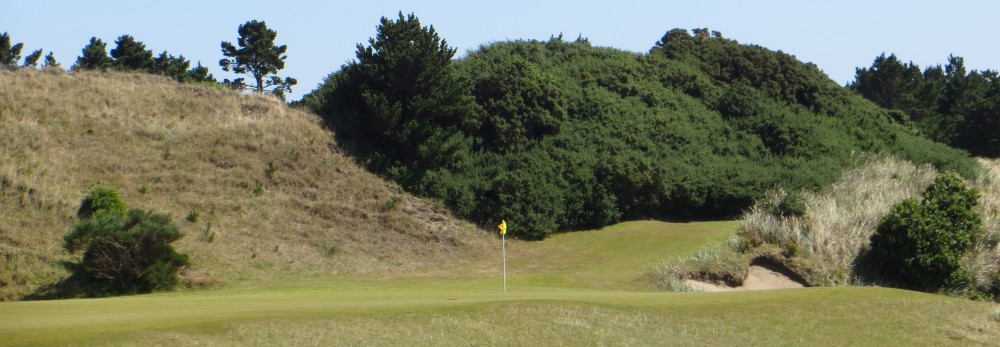
What is it with these banks and financial service companies, these days it seems they all have a sky full of black clouds following them around.  So it is this weekend with Hurricane Irene threatening the entire eastern seaboard with a meteorological Blitzkrieg.   PGA Tour officials have wisely decided to shorten to 54 holes the first leg of the post season playoffs, The Barclays Championship (the Barclay’s logo actually has a bit of a Luftwaffe look to it doesn’t it).

Need I remind you that the last time Barclays sponsored a golf tournament, The Barclays Scottish Open in July, Scotland was hit with three months of rain in three hours. It turned the Castle Stuart Links course into the MGM set of Moses crossing the Dead Sea.

With a rain softened course playing like a picnic outing of lawn darts we are seeing scoring in the first two rounds that is off the charts.  Last year’s winner, Matt Kuchar, is already 14-under trying to pull off a two-peat in this event on the Par 71 Donald Ross course at Plainfield Country Club in Edison, N.J.  The tee times for the third and final round are off both sides between 7 am and 8:50 am in an attempt to get the full 18 in and fold up the circus tents before the bad stuff hits.  So if you turn the broadcast on in the afternoon you can expect the “Taped Earlier” overlay in the top left corner of the flat screen.

The interesting thing about this development is that anyone at 8-under or better can shoot a round in the low 60s and have a chance of stealing the first event of the 2011 playoff series.  This includes a whole bunch of familiar faces who have had mediocre seasons so far this year like Dustin Johnson, Vijay Singh, Justin Rose, Padraig Harrington, Aaron Baddeley, William McGirt (Who?), Sergio Garcia, and Camilo Villegas.

For these guys a win here would change everything-it would add about a million-four to their money market account and shove them to the top of the FedEx Kup race.  Not bad for a mediocre season.

What can I say, these PGA guys really understand marketing.  They are like alchemists when it comes to manufacturing TV ratings.

August, 2011

Smelling The Roses

And how beautiful the vacated links at dawn, when the dew gleams untrodden beneath the pendant flags and the long shadows lie quite on the green; when no caddie intrudes upon the still and silent lawns, and you stroll from hole to hole and drink in the beauties of a land to which you know you will be all too blind when the sun mounts high and you toss for the honour!

Arnold Haultain

The Mystery of Golf (1908)

If The Earth Moved On You

We had a little 5.9 denture rattler yesterday in the Washington area and the question was posed that if you happened to be standing over a four footer at the time the earthquake hit and your ball moved would you have to move it back and take the one stroke penalty.

I posit to you how the Brits dealt with “extraordinary circumstances” back in WWII for the answer to this question.

(Click here to see the Golf Rules During the Battle of Britain)

August, 2011