The golfer has always to be under restraint….[like] that under which a trotting or pacing horse must labour to hold an artificial gait although his every urge is to run like blazes.
Bobby Jones
The golfer has always to be under restraint….[like] that under which a trotting or pacing horse must labour to hold an artificial gait although his every urge is to run like blazes.
Bobby Jones
The main reason for the lure of golf has to do with a unique brand of companionship possible only to a psychological type that unites the little boy aching to be king with the sensible adult who knows he’ll never make it.
.
By providing every man with the visible proof that his partner is a failing show-off, golf reinforces one fo the great joys of friendship; it is all the more delicious for being secret, since the etiquette of golf requires that you keep it to yourself.
.
For the golfer compresses into a few hours all the emotions he spreads over the rest of his life: hope, envy, betrayal, self-discipline, self-deceit, the Holy Grail in view, the Grail smartly whipped out of sight.
.
You’re away, partner.
Alistair Cooke
Golf-The Marvelous Mania (2007)
Are apt to say….for a straight drive “We’re rait down the meddle” for the first slice “You’re way awf in the gorse”.
.
Scottish caddies, like nurses, alternate between the first person plural and the second person singular as a handy method of distributing praise and blame.
Alistair Cooke
Golf-The Marvelous Mania (2007)
Golf development at Sea Island has a long history, it began in 1926 when Howard Coffin bought Sea Island and the Kings Retreat Plantation with the thought of creating a vacation retreat for the wealthy. The sight of one of the regular tour stops in the wraparound season, pros with strong resumes like Zach Johnson, DL III, and Kooch have taken up residence at Sea Island because of the idyllic setting and the family friendly atmosphere.
The original Seaside Course was the combined work of the front nine by Walter Travis, a reputed champion of the day, and back nine by Harry Colt and Charles Alison one of the most accomplished designing duos of the Golden Age. Colt and Alison collaborative work included contributions at Pine Valley, Sunningdale, Muirfield, and Royal Portrush among others. The back nine they created still stands as the centerpiece of the Sea Island Golf Club. In 1999 Tom Fazio was brought in to update the course and he combined the Colt/Alison nine with holes from the Marshside course created by Joe Lee in 1973 to assemble the Seaside Course we play today.
Click on any photo to view an enhanced version of the image
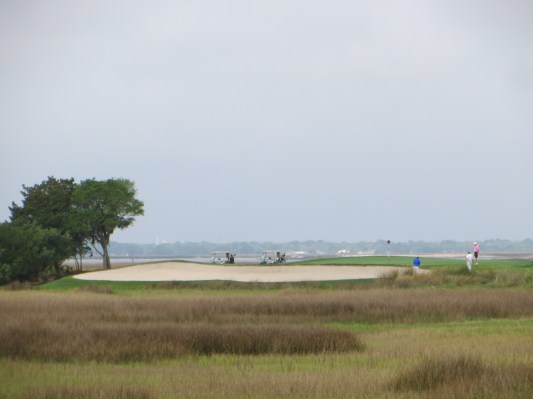
Despite it’s name the sea does not really come into play but the course does present a unique test of trajectory control and shot shape. Though not playing through tree lined corridors the challenge is similar to what you get at the Harbour Town Links in Hilton Head, influenced by the marshy surrounds and the ever present wind. The outward nine stretches out in a counterclockwise direction around the marsh and the inward nine takes the opposite path around marsh and sandy scrub. The holes cover all four directions on the compass so you are going to negotiate the wind in every conceivable direction through the day. The low hilly terrain combined with sweeping bunkers and sprawling tightly mowed green surrounds gives you a sense that successful play is often negotiated close to the ground.
The front nine starts simply enough with plenty of elbow room but step on to the tee at the second and the scale of the day’s challenge becomes readily apparent. Marsh grass left and water up the right all the way make drive position tactical to try to challenge a tricky cape style green complex set the water to the right. What follows is the first of the four stunning three pars you will encounter through the day. Pay close attention to the pin of the day relative to the lone bunker in front-it is important to be below the hole on your second shot on all the par threes.
The dogleg left par four fourth is a look you will see repeated all day-tight fairway and approach areas flanked by the marsh and sand with an endless horizon beyond the green-it can be very intimidating to your scorecard if you do not stay focused on the preferred lines of play. With the reverse setup on the equally technical fifth it is apparent that moving the ball both ways is a requirement if you are to position yourself favorably off the tees and into these challenging green complexes. Maybe the best scoring opportunity of the round is from five through nine but that does not mean these holes are easy-danger lurks wherever you see marsh grass or the glint of water.
After a banana and a power drink at the halfway house the true challenge begins on the inward half. The tenth appears simple enough to the eye but there is no room for wayward dispersion in either direction off the tee. The green is stepped and possibly obscured from your approach line so make sure you have enough club in hand to get to the correct tier. After a difficult par four in the same direction a long par three turns back 180 degrees playing into a undulating putting surface with little frame of reference. Beware of the false front left and it’s proximity to the marsh-a timid approach with too much draw can get sucked back into the hazard.
From here to the house the course presents one unique challenge after the other. The thirteenth is the #2 handicap hole with marsh left, sand right and another endless look to a green set against the horizon. My favorite hole of the day is next as you stand on the tee trying to discern a fairway landing area hovering against the horizon. You have to hang something no longer than 250 yards between the aiming post and the right corner of the fairway and trust it will feed forward to the left end of the fairway inside of 150 yards. The shot into the green sitting perched up on the hill surrounded by marsh left and behind and terrarium on the right is the Harbour Town challenge without the tall trees.
Two good scoring opportunities on the hopscotch technical holes at fifteen and sixteen where you either stay within the chalked boxes or you get to start over with two shots rung on the register. This brings you to a very underrated and difficult finish. The par three seventeenth can be as short as 150 yards but the diagonal set of this very long and shallow green behind two gaping bunkers makes it likely that you will be pitching back toward the hole trying to save your par.
The finishing hole is an intimidating sight requiring a long and straight tee shot into a narrowing landing area between bunkers to set up a long approach into a very tight green complex. If you are out of position off this tee a lay up to 85 yards right of the hazard is the intelligent option. Even with a short club in your hand from there getting it below the hole on the steeply ramped pinched putting surface is a major challenge. A couple of dropped shots on these last two is more the norm than the exception.
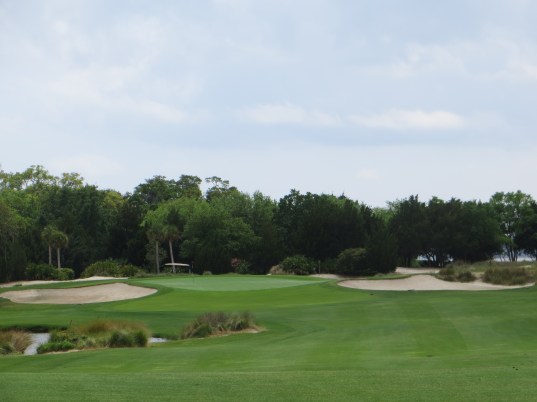
There is something classic about the way you have to work yourself around this course as well as the entire presentation of the facility. From the eclectic décor of the Lodge Hotel that houses the golf shop and the fine eating facilities right down to the signature wicker basket flag sticks that just seem right bobbing in the sea breezes, take the time to soak in the full golf experience when you are here. Sea Island is a first class golf resort with a first class track in the Seaside Course.
St. Simons Island, Georgia
Designer: Harry Colt/Charles Alison (1928), Joe Lee (1973), Tom Fazio (1999)
Tees Par Yardage Rating Slope
Blue 70 6657 72.6 139
Green 70 6323 71.1 135
White 70 5980 69.4 132
Gold 70 4978 69.1 123
(Click to see the complete hole-by-hole review of the Seaside Course)
(Click to see more information about the Sea Island Resort)
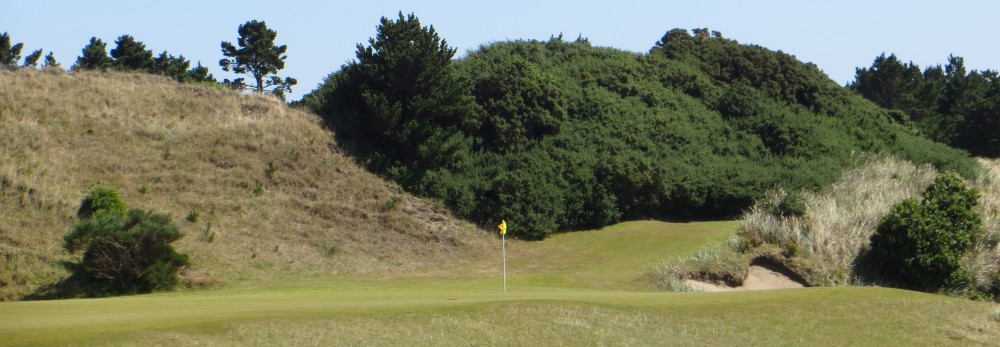
This quote from Ian Andrew, an accomplished Canadian golf course architect, reflects the Golden Age of Golf design philosophy that he brings to his current new designs and restorations. It is why players of all capabilities find courses from the hands of Raynor, Ross, Tillinghast, Macdonald, and other sages from this age infinitely fascinating and playable.
“I believe in playing freedoms. I think you should have a choice between challenging yourself and playing for fun.
For the elite player, along the ideal lines of play, there must be strategic slopes and hazards that complicate the direct line. The more challenging the recovery shot, the more strategically important the hazard. This in turn must be counterbalanced by offering up a reward for successfully challenging the hazard. This will compel the elite player to actively flirt with disaster in order to score. That type of course is very exciting to play.
In contrast the average player requires the additional room to safely play away from danger. They can avoid the worst of the pitfalls and enjoy tacking their way across the property. They will be able to make a few pars for fun, but not enough to reward them for their passive approach.
And this is where the greatness in this approach lies. As players begin to show more skill and competence, this style of architecture will encourage them to take on more risk to shoot lower scores. And this is where the dance begins …
They will flirt ever closer to the key hazards to gain better positions. But as soon as they find the hazard and begin to lose strokes they will play far away from trouble the next time out. But they can’t score from the outside line and so the dance will begin all over again, ever closer to the key hazards … that’s the golf I believe in.”
Ian Andrew
As you can read in this book review by Jaime Diaz of the recent biography of the caddie days of Steve Williams the book has been generally panned by the reviewing pundits as a sensationalist hanging out of Tiger Woods dirty laundry.
But Diaz does not agree with this assessment and he feels that when the reader looks beyond the few charged quotes being used by the publishers to market the book Williams actually gives a fairly balanced account of his experiences with the players he has worked for, the most famous of whom was Tiger Woods. Diaz says of Williams, “For all his gruffness, he’s intelligent, insightful, frank, and on his subject, extremely knowing. On balance, he’s given us an important golf book”.
Jaime Diaz is the most insightful golf writer of his generation and having read the book I see where he is coming from. The book is a detailed compilation of Steve Williams’s interpretation of incidents and relationships with Tiger and others that we may not have previously understood for lack of transparency. But I think Diaz overstates how important the book is as a contribution to our golf knowledge.
This is your basic “lift and tell” book which sounds like a transcript of Williams talking into a dictaphone at his kitchen table. The writing is very mundane it takes an effort to keep reading and honestly Williams is not that interesting of a subject to write about. Williams is a smart guy, successful sportsman, and very capable caddie, no doubt he influenced the careers of a number of great players in a positive way, including Eldrick. But like many others before and after him, Williams was also a lacky for Tiger and Steinberg doing their bidding to protect the brand.
What I got more than anything from this read is how sterile a character Tiger is. He was a trained automaton by his father and pretty much guided awkwardly through all his personal foibles by his agent and his handlers. Tiger’s attitude toward the other pros, the fans, and the people whose efforts benefited his career lacks any humility or personal sensibility.
Tiger has never been, and still remains, not his own man. For all the money and fame he just lacks the simplest interactive social skills to treat people with honesty and integrity. I blame this on his upbringing which clearly emphasized it is always about winning and nothing else.
If there is any contribution from this book for me it is Williams accounting of Tiger behaviors while they were together that confirm Tiger’s lack of personality. To anyone who has watched the Tiger drama unfold over the last twenty plus years this was always pretty obvious. So I do not share with Diaz that this book is a significant add to the public knowledge and, IMHO, it may not even be a wise use of four to six hours of your reading time.
Steve Williams (2015)
The rules of golf are full of nuance but it is still a rare moment when the tour players and even the officials are not fully aware of the impact of a ruling. Leave it to Lefty to unearth one of the most obscure rules and it’s odd impact at a high profile event as he and his partner Zach Johnson actually managed effectively lose two holes at one time in their four ball match in the President’s Cup.
Two guys you would expect to know the rules
Embed from Getty Images.
The “One Ball” rule is a common one that is present at most Tour competitions-it dictates that a player cannot change the make or model of his ball between holes in a competition. Since it was not in effect for the foursomes matches Phil incorrectly assumed it was not in play for the best ball matches as well.
Wrong!
He changed to a longer distance Callaway ball on the Par 5 7th only to find out down the fairway he was in violation of the One Ball and would be assessed a one hole “match adjustment penalty” when the hole was done. The bigger mess was that neither Phil nor the tournament official on hand realized that Phil was not required to pick up his ball and drop out of the hole. He could still play out the hole in an attempt to support his pard possibly win the hole and offset the match adjustment penalty.
By the time they realized their mistake in advising him to pick up his ball the tournament officials could not let him replay the shots and Zach lost the hole so they effectively went from even to two-down on one hole in the match.
If you think about it a “match adjustment penalty” like this could effectively make a dormy go away. Imagine if they had been dormy and two up with two to play on the 17th tee and made this bone head mistake. Losing the hole with the match adjustment would have rendered the dormy moot and they could have lost the match on the last hole.
Just another immutable circumstance that can be subject to override by a lurking phrase in the rules of golf.
(Click here for a Golf Digest explanation of their conudrum)
October, 2015
The Mountain Course at La Quinta is a challenging and visual creation from Pete Dye’s TPC Sawgrass period. It bears similarities to the stadium course in Ponte Vedra in that there is plenty of visual intimidation, especially in the green complexes, yet Pete gives you a fair line of play on every hole as long as you have the discipline to follow it. This is a positional driving course, you must plan carefully from each tee to pick specific lines that will give you advantage angles into the green arrangements and the pin of the day.
Click on any photo to get an enhanced version of the image
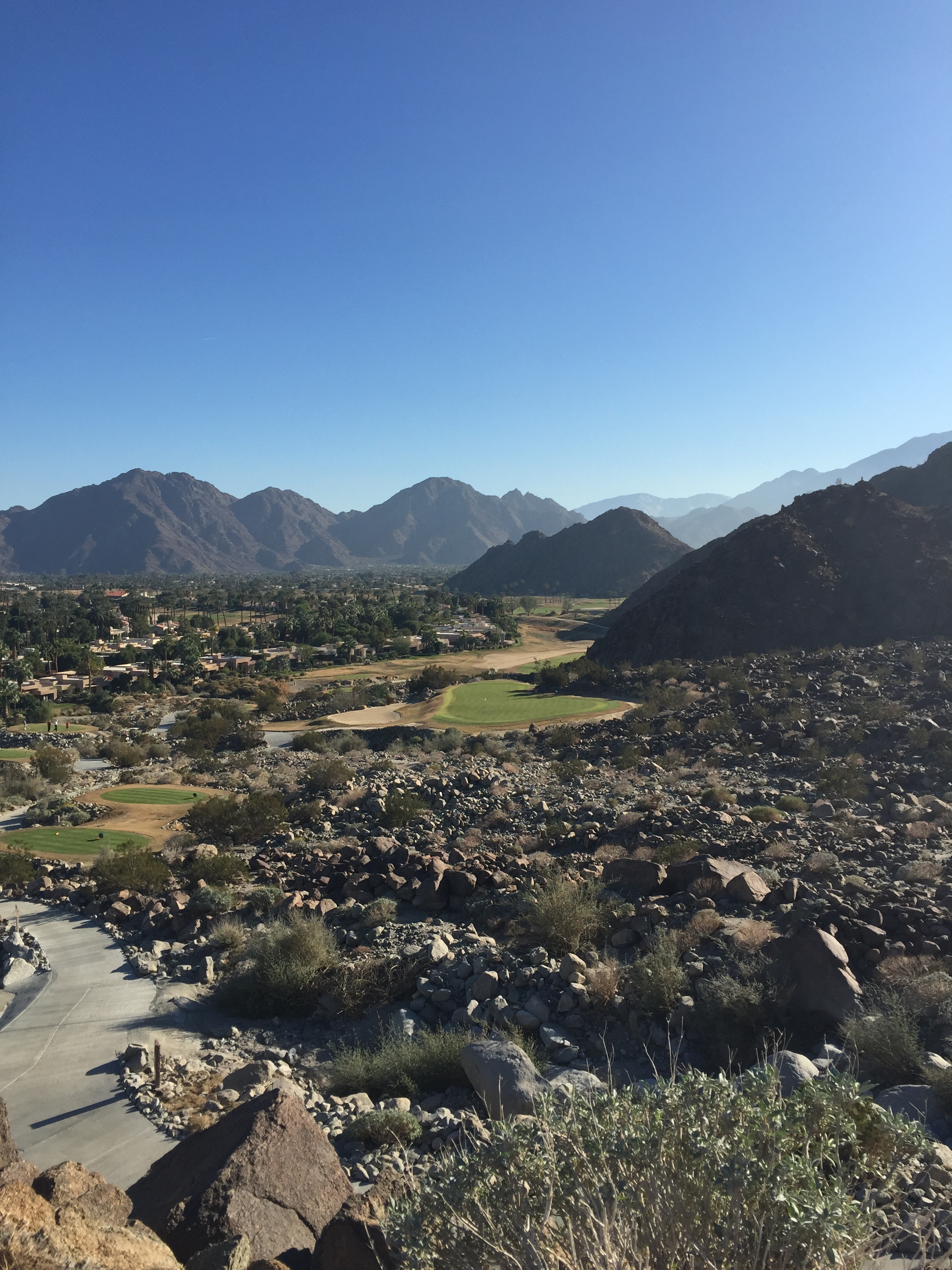
The course is carved into the base of the Santa Rosa Mountains in Palm Desert and looks like the Hollywood set for MASH. You fully expect to see Hawkeye and Trapper John standing next to you on the practice ground. There are many Kodak moments of the holes set against the breathtaking mountains so you have to make sure you don’t let your mind wander to often from the task at hand.
As you see at Sawgrass the bunkers are ever present, over 100 bunkers and waste areas, with a large splash of water as well, confine the driving areas throughout that make finding your proper drive position a challenge. The truth is the sand is very playable and it is more about intimidating the player while they are choosing their flight lines than punishing them terribly for missing them. The water is the punitive element to mind and is actually in play every time it presents itself.
Like most Pete Dye courses, the green complexes are what separates this course from the ordinary. Every green seems to pop up from the fairway with carve outs of grassy hollows and bunkers that make elevated approaches with spin the shot of the day. When you miss a green it takes real pitching imagination and agility to deal with the abrupt elevation change to the surface as well as the swoops and swerves you ball engages once it gets on the green.
At 6300 yards from the White Tees there is plenty of challenge for the average bear. Only two par fours are over 400 yards from these tees, but the elevation changes into the greens make many shots a club or so more on the approach. Even with a mid-iron or hybrid in hand the tight green targets give you plenty of opportunity to show off your recovery game.
The front side has a very cool sequence. It begins with a neat finesse hole that sets the tone for day-controlled driver and precise approach play into s kitchy green complex. Your heart rate quickens on the second hole, a testing par 3 with a harrowing water feature that can wreck your scorecard early in the round. Plenty of scoring opportunity from 4 through 7 with a couple of imaginative par fives in this stretch. The finishing holes on the outward nine are very gamey, especially the 9th which wears the #1 Handicap Hole moniker with great pride.
The inward nine starts with a series of holes right out of TPC Sawgrass-three turning Par 4s with waste area containment on one side and some nastiness on the other. These are the only holes that make you feel like this course is in a gated community…..a very high end gated community at that. There are some jaw dropping second homes that look more like villas than vacation condos. After an innocuous three par 13th you turn the corner to the 14th tee and voila you are in Tolkein Hobbit Land for the next four holes.
This is by far and away the coolest part of the course with the imaginative holes routing in a tranquil valley between the majestic mountains. You just expect a large booming Yul Brynner voice to emanate from between the peaks warning you that you are entering a region of peril. These four Dye holes bear out such a warning but they are eminently playable if you keep your wits about you and do not try anything outside of your skill set.
It is worth taking a moment when you get to the Par 3 sixteenth and hike up to the perch which holds the back tee. You could swear you can see all the way to the Joshua Tree Forest from there, it is a grand view of the vast expanse of the desert and the Santa Rosa Mountain Range beyond. A more detailed account of this creation is provided in the Hole-By-Hole description below.
When you are done tallying the score take time to schmooze around the clubhouse on the hill. The interior architecture is on a grand scale with high exposed wooden rafters giving it a homey feeling of a lodge- it makes you want to set a spell. While enjoying some good food and libation in the grill room the tall glass windows afford you a stunning view of the practice area and the course.
This place is a must stop on any visit to Palm Desert. Pete did a marvelous job putting together a tactical course that will tease and please you every time you play it.
La Quinta, California
Designer: Pete Dye (1985)
Tees Par Yardage Rating Slope
Black 72 6732 72.9 135
White 72 6300 70.9 129
Gold 72 5330 71.4 126
(Click for the complete course description of the La Quinta Resort Mountain Course)
For more photos click to review Postcard from La Quinta Resort Mountain Course
Ron Jaworski is known to most of us as the ever present quarterback pundit on ESPN football shows….the guy who breaks down tape every week to explain why some quarterbacks have QB Ratings in the 70’s and 80’s and and why others spent too much of their Sunday prone on the stadium turf.
Broadcasting gig included being the color guy on MNF from 2007-2011
Embed from Getty Images.
We might also remember he got his broadcasting gig based on a very successful 17-year NFL career where he once held the NFL record for consecutive starts by a quarterback at 116. He has since been surpassed in this regard by a bunch of no name NFL players that include Brett Farve, Peyton and Eli Manning, and Phillip Rivers.
9 years with the Eagles included a Super Bowl XV appearance in January 1981
Embed from Getty Images.
Bottom line is that Ron Jaworski has always been an over-achiever in anything he has pursued and this is because he focuses on the basics and outworks his adversaries.
Little known to most of us one of those pursuits has been the very successful enterprise of owning and managing golf courses under the moniker of Ron Jaworski Golf. In this current iteration he has five courses in his stables in the New Jersey and Pennsylvania area.
In this article for Sports Illustrated by Dan Greene you can read about his chain of profitable Jaworski Golf Courses.
This is not a high end “Donald” collection of posh golf courses but, rather like Jaws, a amalgamation of efficiently run modest golf facilities that put an emphasis on playability, affordability, atmosphere, and quick pace of play. These are not courses done by pedigree golf architects aimed at business executives and wealthy individuals. Rather they cater to average Joe and Jill who are interested in good golf value not golf hype.
As Jaws proudly points out in the article and accompanying video in an era when golf courses are going out of business at an alarming rate his courses pull in annual six-figure profits. He does this by employing economies of scale to his business in the bulk purchase of everything from fertilizer to food. His course maintenance staff often works across a number of facilities allowing him to operate at much lower overheads than single operator owners. He emphasizes his marketing of the courses to the masses, including women and children who are often ignored by higher end facilities.
An ad on his website for “Girls Golf Outings”
The Jaworski Golf Card gets you a $10 greens fee at all of his courses
You see Ron is a man with a plan. If you go to the Ron Jaworski Golf website you will find this document called “Driving Business-Ron Jaworski Golf”. It is a detailed business plan for running this successful golf operation. The attention to detail….the X’s and O’s…..pours off of every page. There is a reason this man’s golf operation is successful and growing and this and his other business exploits have attracted the investment interest of a slew sports and entertainment celebs and Wall Street investors.
His annual Celebrity Golf Challenge in AC attracts all kinds of stars
Embed from Getty Images.
In a time where golf has been characterized by some as an atrophying industry because a five hour time commitment and exorbitant greens fees can put it out of reach of most people we should be reminded that the greatest percentage of the 27 million people who played golf in the United States last year did not do it at a snobby private country club or posh resort facility.
Ron Jaworski understands that and he has employed a golf business plan providing these players a well presented, no frills golf experience at an affordable price with a tasty meal waiting for them in his bustling 19th hole sports bar after the round . Success is in minding all in the details just like it has been in his playing and broadcasting careers.
Dan Greene
Sports Illustrated
September 2015
The original Elkridge Club was established in the late 1800’s as a golf and hunting club in what was probably the wealthy developing side of Baltimore. It’s membership grew to 400 and in 1925 they acquired more land to meet their growing need and sought the guidance of Seth Raynor to build the course you see today.
As recently as 2003 the club hired Brian Silva an architect who has a reputation for doing work on Seth Raynor courses to do a total renovation of the course and bring it back to Seth Raynor’s original design. To those who have played them, The Washington Golf Club in Arlington and Bedford Springs Golf Resort in Pennsylvania this will have a familiar look and feel.
To say this is an old style course is a major understatement-it is a period piece. Suffice it to say that there are design features in this course that you would never see created today. Rectangular shaped putting surfaces, super dramatic uphill driving carries, greens with almost arbitrary undulations, three steps between green and the next tee, fairway bunkering that seems random, and hole sequencing that has all to do with the god delivered shape of the property.
With modern green construction this becomes a throw back golf experience with today’s gratifications. The words “fair” and “unfair” have no place in this design-it is just “wow” or “you must be kidding”. Leave your modern ego at home and just put on a pair of plus fours and bring out the hickory shaft mentality-this is quite an experience to the sophisticated golf historian.
The length of the course-especially the differential between Blue and Black Tees-is almost deluding. The course is so tightly ensconced by the trees that “towardness” is the only thing that matters here. You have to hit it Freddie Funk straight and have Justin Leonard restraint for over-reaching on any particular challenge. One bounce on the wrong side of a ridge will change your fate on an individual hole dramatically.
For the most part the holes do not have severe turns in them-they all look right in front of you off the teeing ground. But the overhanging old hardwoods and the steep drop-offs mean you have to be very directive in your line of play.
Greens are terrific. Very smooth-reasonably fast-especially downhill and down grain. But if you can play your approaches and pitches beneath the hole you can be pretty aggressive into the hole.
The Elkridge Club experience is something out of a different time and it reminds us that golf courses were not always designed for those who think hitting it long is what it is all about. The shots you hit in a round at Elkridge will remind you how important creativity and finesse can be in an enjoyable round of golf.
Baltimore, Maryland
Architect: Seth Raynor (1927)
.
Tee Par Rating Slope Yardage
Black 71 70.9 124 6465
Blue 71 69.7 122 6194
(Click to see the complete hole-by-hole description of The Elkridge Club)