Tiger Is His Own Man

As I have watched the saga of Tiger Woods unfold for twenty years the question continually occurs to me, who is actually making the decisions, who is really responsible for running the Tiger show?

John Feinstein, in this Golf Digest article “No One Tells Tiger Woods What To Do” excerpted from a new book, says that his experiences with the man leave no doubt in his mind that the buck stops with Tiger….period.

As you will read Feinstein has a history of confrontations with Team Tiger over the years. Starting early on he was critical of the well publicized controlling influence of Earl Woods on Tiger’s early development.  He took Tiger to task in his articles a number of times for public behavior he considered unprofessional.  Things like canceling appearances at tour events where he was granted sponsors exemptions, declining an invitation from President Clinton to appear in a tribute event to the late Jackie Robinson, or trying to control access of the media to players at tour events.  None of this criticsm sat well with Tiger Woods or his handlers.

With so many people benefiting from the rising Tiger star, tour sponsors, fellow players, and even the media, it was rare to hear anyone articulate criticism of Tiger and his public behavior.  Truth is, Feinstein was consistently right in what he was saying and the public conversation would have been much more balanced if more writers had done the same.

Feinstein was confronted on this by members of Team Tiger to no avail and eventually had a number of conversations with the man himself on a series of incendiary subjects.  As usual, Feinstein did not hold his tongue and faced up to these challenges without hesitation.

In a conversation with Tiger on the core subject of Earl’s influence he said:

“I really don’t think your dad is different from any other pushy, grab-the-bucks father,” I said, “except for one thing: You’re his son. So, I give him some credit for your genes because you’re smart enough and tough enough to deal with everything he’s pushed on you and still be a great player. Most kids aren’t that way. I think you’ve succeeded in spite of your father, not because of your father.”

Throughout the article Feinstein cites incidents of public behavior that grabbed the golf headlines where the decision that created them consistently points back to the controlling influence of Tiger himself.  He leaves little doubt that Tiger is his own man and that, or better or for worse, Tiger has been the guy responsible for shaping his public image.  Pull up a comfortable chair, take a read, and decide for yourself.

 (Click here to read John Feinstein’s Golf Digest article on Tiger Woods)

John Feinstein

December, 2011

His Writing Is The Cure

“Tim, thank you very much.  When you rattled off that list of credits, you left out my cure for polio, but I’ll excuse you for that.  You got all those other things in there.”

Dan Jenkins response to Tim Finchem’s introduction and announcement that he would be only the fifth golf writer in history to be inducted into the Golf Hall of Fame.

Jenkins then concluded with:

“Thanks to all those people that called in with having nothing better to do.  I can’t wait until May 7th when you put some (indiscernible) on my shoulder and give me a saber.”

(Click here to read Bill Fields Golf Digest article “Honoring a Prose Pro”)

December, 2011

Aussie Days At Night

If you did not get enough of the Australian Sandbelt from the President’s Cup then your golf fix for this week is some late night quality time with the remote viewing of Golf Channel’s broadcast of the JBWere Australian Masters beginning at 8:30 EST Wednesday.  The third leg of the potential Greg Chalmer’s Slam is taking place at the Victoria Golf Club where he will be trying to add to his startling wins in the Australian Open and Australian PGA the past few months.

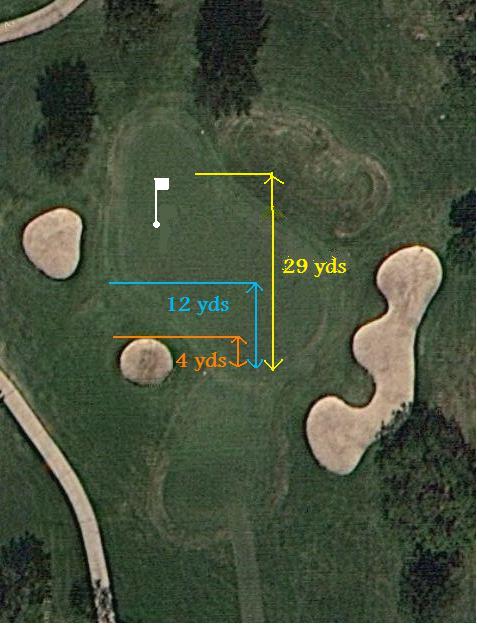
Victoria's Spectacular Par 3 14th at 156 yards (www.geoffshackerford.com)

The field includes the world number one, Luke Donald along with your household collection of Australian pros like Geoff Ogilvy, Robert Allenby, John Senden, Rod Pampling, and James Nitties.  The quality of play should be high as these guys have shown they know how to negotiate the rugged playing conditions and warp speed greens presented by these links style courses.

Geoff Shackelford reveals in a wonderful Viewmaster review of this third gem of the Australian Sandbelt courses that Victoria Golf Club has many of the same characteristics as  her more famous sisters at Royal Melbourne or Kingston Heath.  Mike Clayton, who has done renovations on many of the Australia’s finest layouts, has brought this one back to life removing trees and restoring the sandy areas that give these courses their distinctive charm.  Shackelford describes in great detail a course with “green complexes that offer a mix of extreme and subdued surfaces, with the par 3’s standing out as some of the most intriguing on the course”.

Imaginative Short Par 4 15th at 315 yards (www.geoffshackelford.com)

There could be some lingering verbal mud wrestling between Geoff Ogilvy and Robert Allenby resulting from their Spat Down Under after the Presidents Cup and be prepared to strain to understand the always entertaining golf terminology of the Aussie golf commentators.  This should be four nights of splendid golf from down under.

(Click here to read Geoff Shackelford’s review of Victoria Golf Club)

Geoff Shackelford

http://www.GeoffShackelford.com

December, 2011
Choosing The Right Stick

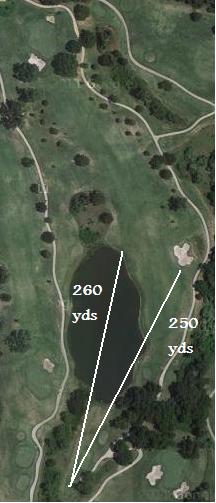
In this two-part post on Secret In The Dirt.com, Timothy Goynes describes the proper way to choose the right stick off the tee and into the green.  Most people’s response to this would be, “Well this is not rocket science is it?”.

They would be right.  But it is astonishing how many players fail to consider honestly a tactical plan for choosing the right stick in these situations.  This is not dependent on caliber or talent-all player’s scores benefit from having a good intention for every shot they hit.  The mantra he wants all players to consider every time they choose the proper club is “Safe Line, Aggressive Swing”.

(Timothy Goynes-SecretInTheDirt.com)

As Tim Goynes describes in Part 1-Choosing The Right Stick-Off The Tee, most people will viscerally grab their driver on almost every driving hole without taking into consideration where is the trouble and where they want their drive to end up.  Being honest with yourself, something most golfers are not very good at, is essential in deciding whether to go over, play short, or play away from the trouble on any given drive.

Much of what you will read in this part seems elemental but, after being schooled in macho driving tactics by the weekend golf broadcast, smart people often lose their minds and continue to drive the ball with reckless abandon.  The result is they have no chance to put the next shot on the green and have a reasonable chance to make a par or better.

(Click here to read Choosing The Right Stick-Off The Tee)

In Part 2-Choosing The Right Stick-Into The Green, Goynes emphasizes what we should already know-golf is a game of specific targeting.   Considering all the parameters of where you are targeting is essential to hitting greens and giving yourself chances to make a good score.

(Timothy Goynes-SecretInTheDirt.com)

As he says in this part, it is not only knowing distances to the center of the green that matters, you need to know the distance to cover the front of the green, fly any trouble between you and the flag, and not to go too long as to bring in problems behind the green.  It is not distance to the flag you must determine but distance to where you want the ball to land to give you an aggressive putt at the hole.

Further he points out that is not only how far you have to go that will determine the proper club choice but it is the lie you are hitting it from, the topography of that lie, and any outside factors like wind, temperature, firmness of the turf, and precipitation as well.

Figuring how those factors will affect your shot based on your golf aptitudes is essential to consistently putting the ball where you want it to make good scores.

(Click here to read Choosing The Right Stick-Into The Green)

None of this is rocket science, but considering the intelligence level of most of the guys who play this game, it is amazing how smart people consistently fail to consider what is in their best interest in choosing the right stick on any given shot.

Timothy Goynes

Secret In The Dirt.Com

December, 2011

Spat Down Under

As Randall Mell reports in this Golf Channel article a spat has broken out between Robert Allenby and Geoff Ogilvy over Allenby’s perceived notion that his poor performance in the Presidents Cup a few weeks ago was apparently the fault of his partners.

He virtually threw Geoff Ogilvy (as well as Retief Goosen and Y.E. Yang) under the proverbial bus complaining that at least three times Ogilvy put him in the woods off the tee in the Saturday Foursomes.  Sounds like sour grapes to me….coming from a guy who has a history of ungracious behavior when things don’t go his way on the golf course.

Fellow Australian Pro Golfer Paul Gow, who played for many years next to Allenby on the PGA Tour said in reaction to Allenby’s latest comments, “I have said it before… I think he acts like a five-year-old when he plays golf. He has to understand he plays golf for a living. He was in a team environment and to throw out those comments was really immature.”

The two almost came to fisticuffs on Sunday night at the Australian PGA when Allenby, who had just tanked in a playoff with Greg Chalmers for the title, confronted Ogilvy at his table at the post event celebration.  Apparently he actually challenged Ogilvy to step outside to the parking lot settle it.  Sounds to me like the man has a monopoly on sour grapes.

From what I have seen of Allenby the last few years it is his putter he should be throwing under the bus, along with any number of iterations of his putting stroke, since that has let him down way more than his teammates from these biennial events.

(Click here to read Randall Mell’s Article about the Allenby-Ogilvy Spat)

Randall Mell

November, 2011

Laid A Stymie

I recently stumbled over the image of a scorecard from 1936 that had a curious thing printed on the bottom edge of the card. It was a six inch line with an arrow pointing away on each end and it said “stymie measure”. Scratching my head I could not recollect anything from memory that referred to a stymie measurement. To me a stymie was a condition in golf, before my appearance on this earth, when an opponent’s ball in a match play game stood between your ball and the hole and you simply had to play over or around it on your next shot. This chanced the possibility that you might knock their ball into the hole during that effort, effectively holing out for them.

Further research revealed that six inches was always an important incremental measurement when it came to a stymie in golf. The stymie was actually in the original 13 rules of golf drawn up in 1744 by the Honourable Company of Edinburgh Golfers. It said that the only time you could lift a ball after teeing off was if two balls were touching or you lifted it out of the hole. In 1775 the rule was amended, a ball obstructing your way that was within six inches of your ball could be marked and lifted. So a ball in your way had to be more than six inches from your ball to comprise a stymie condition. Thus the stymie measurement on the card.

From 1926 Copy of Rules of Golf (Found at http://www.leaderboard.com)

About 150 years later, in America where stroke play was the norm there was little tolerance for the penalty being laid a stymie could inflict on your scorecard. After unsuccessfully trying to convince the R & A in the 1930’s to abolish the stymie, the USGA in 1938 unilaterally altered it’s rules to allow any ball positioned within six inches of the hole to be marked and lifted if it interfered with another ball. Voila, a new use for the stymie measurement on the card.

Finally, in 1952, as a birthday present to the coming baby boomers, the R & A succumbed to the pressure and both ruling bodies eliminated the stymie entirely.

February, 2011

Media Attention

Yani Tseng gets it.  Much like her predecessors Annika and Lorena as the most dominant force in women’s golf and unlike previous #1’s on the male side of professional golf, Yani seems to get the fact that nurturing a relationship with her fan base and the media who serve as a conduit to them will serve to enhance her popularity and her fortunes as a result.

She has worked diligently on her English so she can handle those interviews and press conferences that come with winning TV golf tournaments.  To those of us who watch her on TV, she smiles all the time, even in the heat of competition, so you actually believe she is enjoying herself.  At the events, she connects with her fans and the tournament sponsors as if it were a pleasure and not just an occupational duty.

This past week she went above and beyond the call by hosting a dinner for the LPGA Communications staff and the national print and broadcast media folks.  This was not some staged sit down affair at a local Marriott but an intimate backyard barbeque at her Lake Nona home.   Holding court for the media in the rec room of your house is probably unprecedented but feeding and entertaining them is off the charts.  By the way, this was held the night before the season ending $1.5 million CME Group Titleholder’s event, a gathering of this year’s tournament winners.  First prize is $500K, so it is not like Yani did not have anything else on her mind at the time.

As the attached article by Beth Ann Baldy attests, those in attendance found out what they already know about Yani, she is engaging, self-deprecating, and just fun to be around.  She doesn’t take herself too seriously or put herself on a pedestal above her peers.

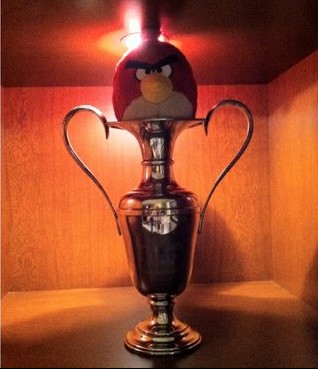
Angry Bird In Kraft-Nabisco 2010 Trophy (Beth Ann Baldy)

Witness this photo of her “Angry Bird in Kraft-Nabisco Still Life”-she was not pleased with letting a two-peat slip away, shooting 74 in the last round of this year’s Kraft-Nabisco.  She even regaled the crowd with an impromptu Harry Potter costume when the evening’s conversation got to theme parks.

In an age where dominant sports figures seem determined to build black box  walls around their personal lives, it is refreshing to see the number one player in lady’s golf so graciously connect with the people who help communicate her image to those of us who watch and support her success.  The LPGA is fortunate to have another grounded ambassador to lead their sport.

(Click here to read GolfWeek’s Article About Yani Tseng’s Party)

Beth Ann Baldy

November, 2011

Time Phase Tiger

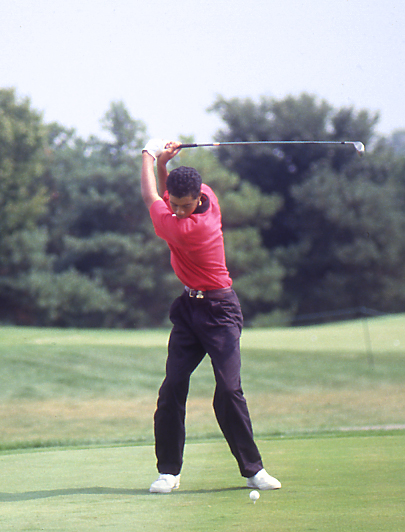
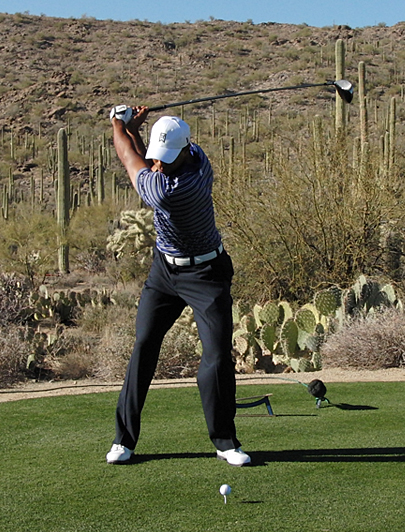
There is so much conversation about how much Tiger’s swing has changed over the years and from these photos of his swing from 1992 to 2011 you can certainly see the evolution of the Tiger Swing for yourself.

(Circa 1992-The Original)

(2011 Sean Foley move)


Jaime Diaz interviewed all five of the instructors who have worked with Tiger over the last 20 years to put together an article for Golf Digest in April of 2011.   What may be most interesting here are the comments of the instructors as to how much of a challenge it was to work with Tiger.

Butch Harmon: “ I agreed with Tiger about the flaws, but I wanted to do it a piece at a time.  He wanted to do it all at once.”………”When he drove the ball in the fairway, he was nearly unbeatable.  That’s what I kept trying to drive into him.  But it didn’t take.”

Hank Haney:  “I think it’s fair to say that Butch had a better body to work with than I did. With me, he started looking more like a linebacker than a golfer.”…..”He was convinced that his golf swing was doing the damage to his knee.  Everything had to revolve around saving his knee.”

What is clear to me is that Tiger is obsessed with continuing to retool his swing to “get better”.  This may be his most significant flaw, his insistence on needing to remake what was already a juried piece of athletic art.

Tiger: “I’ve always taken risks to try to become a better golfer, and that’s one of the things that has gotten me this far”.

Take a look at this time phase presentation of Tiger’s swing and decide for yourself.

(Click here to see Golf Digest’s pictorial review of Tiger’s Swings)

Photos by J.D. Cuban and Stephen Szurlej

Jaime Diaz

April 2011

Tiger Tsuris

You can count me firmly in the camp of  “I really don’t care” when it comes to the burning question  “Will Eldrick ever get back to his dominant form?” So when it comes to another article about this I tend to simply to do the iPad swipe gesture and go to the next screen.

In this case though I think the opinion represented in the attached article has credibility because it is coming from Nick Faldo who, even though he can be somewhat pompous at times, usually takes the practical point of view on questions of controversy.  This interview with Sir Nick by Randall Mell, a writer for the Golf Channel, confirms what I have always thought about this question, it has more moving parts than a yoga teacher on muscle relaxers and there is no predicting if Tiger will ever land on his feet.

Faldo’s main point is that since all this went down, for Tiger there is really nothing in his life that is as it was before the incident.  He says, “Almost everything has changed, from the physical to the technical, the emotional side as well, everything seems different, so I think he’s still got a lot to contend with.”  Further he points out that for a star athlete to be dominant as Tiger was you need locked in concentration for practice and purpose.  In light such drastic changes, “quality of concentration goes. Your ability to totally engross yourself in practice for a day, that changes quite dramatically.”

On the question of whether he can win the additional five major’s it will take to surpass Jack’s record Nick says, “If this were just a golfing slump for two years . . . but it isn’t. He’s had a mental and emotional slump, and a physical one, too, because his body’s broken down, and a lot of that has to do with the pressures and the mind.”

The real factors like Tiger’s age, worn out body, questionable swing changes, tattered personal life, young family, and a major lack of self esteem just add more debris to the pile Tiger is sorting through. Add to this the fact that Earl sheltered him so much in his formative years that Tiger lacks many of the basic instincts for coping with adversity and taking personal accountability for fashioning a resolution for his problems.

I think what Faldo is correctly concluding is that it really becomes a more global question of whether Tiger can get control of his life again.  A semblance of his old golf game can only come after all that gets sorted it.

(Click here to read Randall Mell’s Faldo interview on Tiger Woods)

Randall Mell

November, 2011

Rule Changes: Don’t Say They Didn’t Tell You!!

The USGA and R & A announced last week the publication of new unified rules for 2012 to 2015. This is a result of an exhaustive four year process and review and modification of the 34 playing rules of golf by the two organizations.

Besides a couple of rules changes this is the first time there will be one uniform set of rules world wide-the only difference will be the language in which they are written. You might want to bone up on your Scottish.

Of the rules changes there are really only three that will likely affect you.

First, they changed the rule involving a ball moving once a player has addressed it. They added a key exception exonerating a player from penalty if their ball moves after address when it is known or virtually certain that the player did not cause the ball to move. Most obvious example we have seen is a wind gust moving the ball after address. The change in the rule is that the player does not have to take a penalty and return the ball to it’s original position. Now they simply wait until the ball stops moving and play it from the new location with no penalty. This should speed up play since many times players take extra time to be cautious when putting their ball on a windy day.

Second, if a ball is in a hazard (bunker, water hazard, etc) a player can now smooth sand or soil at any time in the hazard, including before playing from the hazard, provided it is for the sole purpose of caring for the course. They cannot do this if it will improve their lie, area of intended stance, or swing/line of play. This change should facilitate players raking other areas of the bunkers while waiting for their turn to play.

Third, a person is now deemed to have addressed their ball if they put their club in front or behind their ball, regardless of whether they have taken a stance. Since players have widely variant address processes this makes the determination of address more consistent.

They also exempted hole-in-one prizes from the stipulated prize limits for amateurs. This will make all those charitable organizations who have outings happy. Take dead aim!!

(Click here to see the full GolfWeek article on these rule changes)

October, 2011