Unknown's avatar

About moegolf

Moe is a narcotic golfer, father, and lover of golden retrievers, chocolate and well done fries. He plays the holes over in his head endlessly at night.

Sand and Golf: How Terrain Shapes The Game

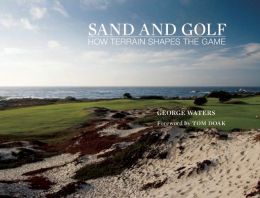
Sand and GolfPlaying on the links at Royal Dornoch or Pacific Dunes or The Old Course you cannot help but understand that there is is a different type of golf you are asked to play.   Links golf is played closer to the ground, emphasizing finesse and position,  thoughtful approach and recovery.   This style of golf in unique both in strategy and shot implementation.  The lure of links golf is infectious to those who have experienced it and explains why so many of us will travel to obscure destinations to experience it again and again.  The subtle question that almost never occurs to us when we are playing links golf is how much does the sandy soil itself account for the character of these courses and the style of play they dictate.

To George Waters, a course architect with plenty of credential from working on sandy soil terrain, this seemed a subject worth addressing in a book.  He has worked on the construction or renovation of some of the best sandy soil courses in the world including Barnbougle Dunes in Australia, Sebonack in Long Island, The Renaissance Club in Scotland, and Pinehurst #2 in North Carolina.   He spent considerable time working at Royal Dornoch as well as studying courses in the Sand Belt of Australia, Bandon Dunes in Oregon, the Sand Hills of Nebraska, and links courses throughout the British Isles.

His photographs and the accompanying text convey how the sandy soil and the topography that has evolved with it provide an opportunity for architects to create these sand based links, wonderful compilations of features provided by the great greenskeeper in the sky and some thoughtful contributions of their own.   With a unique set of elements   “designers let terrain shape the game rather than the other way around…. the key is to give players room to adjust their strategy to the conditions and their style of play.   This puts a premium on analysis and problem solving, making golf more a thinking game.”

Water’s asserts that sandy soil gives these architects the optimal conditions for creative design.  The rapidly draining turf allows them to maintain firm and fast conditions almost all the time.  The natural depressions in fairways and greens can be employed in the design since they will not collect water creating troublesome soggy areas.  Hearty long stemmed fescue and bent grasses thrive in this soil and can be kept closely cropped to allow for consistent firm and fast conditions.

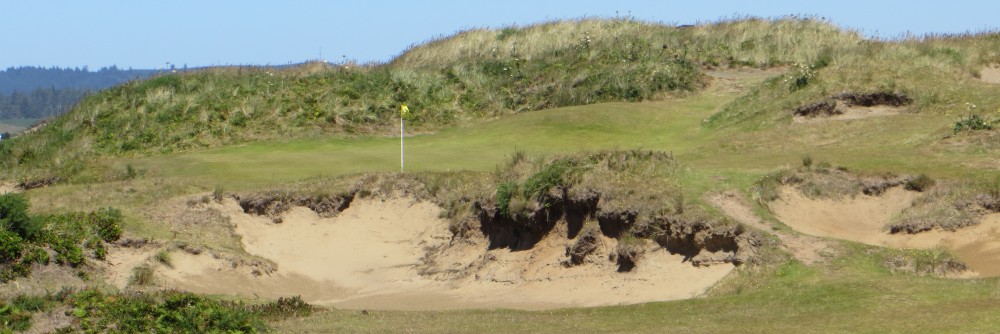
Nature’s evolutionary effect on the sand based topography creates an array of natural hazards the designer only needs to compose rather than create.  Fierce and penal blow out bunkers are only a scratch of the surface away which allows more arbitrary location of the fairway bunkers.  Existing grassy mounds and protrusions can be employed in the lines of play to force strategic choices that need to be carefully considered but depending on the day’s wind direction and intensity.  Native grasses and low growth plantings can be used to shore up these natural hazards further erosion and give these hazards an aged, seamless character “blurring the edges between golf and nature”.

These same native grasses create rough that is imposing but playable, “the perfect balance between penalty and recovery”.  With the exception of the prickly dense gorse bushes that impose their presence on some sandy soil courses, recovery shots from the rough require a calculated assessment to determine just how much recovery is plausible on the next shot.   Approach and recovery play a pivotal role on this type of course.  “On well designed sandy courses, the interplay between firm conditions and clever architecture places approach and recovery shots among the highlights of any round.”

Playing these courses we come to quickly understand that the irregular natural terrain and the ever present wind dictate a more grounded style of play.  Mildly articulated washboard roll outs or heaving tempests of hummocks and hollows can lead to existential shot results. A strategy of play to minimize their effect must be respected.  But these same topographical irregularities are an ally in controlling the pace of a ground approach to firm, contoured, and wind swept greens that may not abide an airborne approach.

He talks at length about the green complexes on sandy soil courses being in sync with the topography.  “Fairways relate to approaches, and approaches to greens, with continuity that is nearly impossible to achieve on other types of terrain.”   Table top greens, greens with shoulder pads, punch bowl greens, greens with sweeping contours, and greens that just seem to be a natural extension of the fairway all are possible on this sandy soil base.  With the challenge these complexes present green speeds do not have to be pushed to the maximum to challenge even the best players-this makes the course more playable and fun for players of all ability.

Waters concludes, “It is much easier to design and maintain a golf course in harmony with a sandy environment.  On a forested site, comprised of heavy soils and replete with ponds and bogs, a golf course is more an installation in the landscape than a natural part of it.”  The character of sandy soil courses “illustrate the advantages of valuing fun and playability above difficulty and perfect conditions, as well as the benefits that come with accepting some natural imperfection.”

If books like “Scotland-Where Golf Is Great”, “Emerald Gems-Links of Ireland”,  “Links Golf” by Paul Daley and “Grounds For Golf” already adorn your personal golf library, “Sand and Golf” will find a comfortable spot right beside them.

Sand and Golf: How Terrain Shapes The Game

George Waters (2013)

January, 2014

moerate3

Torrey Pines Derby

FarmersInsuranceOpen-logoThe only thing missing on Saturday at Torrey Pines South during the Farmers Insurance Open was the USGA logo on all the banners.  The narrowed fairways, long rough, and firm greens of a U.S. Open setup were all present and gave the guys fits.  Average score on Saturday was a about 75.  The number one player in the world, who owns this track, shot 79 and missed the third round cut for the first time in his career.  This was an all-you-can-eat buffet of humble pie if I have ever seen one.

Apparently the shrill voices of the media powers did not go unheeded-they wanted to make sure that Sunday was not a demolition derby broadcast.  As such the set up on Sunday was much more forgiving-a little water on the greens and fewer Clark Kent phone booth pin positions suddenly made for a sporting afternoon at Torrey Downs.  By the time the last group reached the fifth tee 19 guys were within three shots of the lead.

It might take a racing form to keep track of all thoroughbreds with a chance in this race.

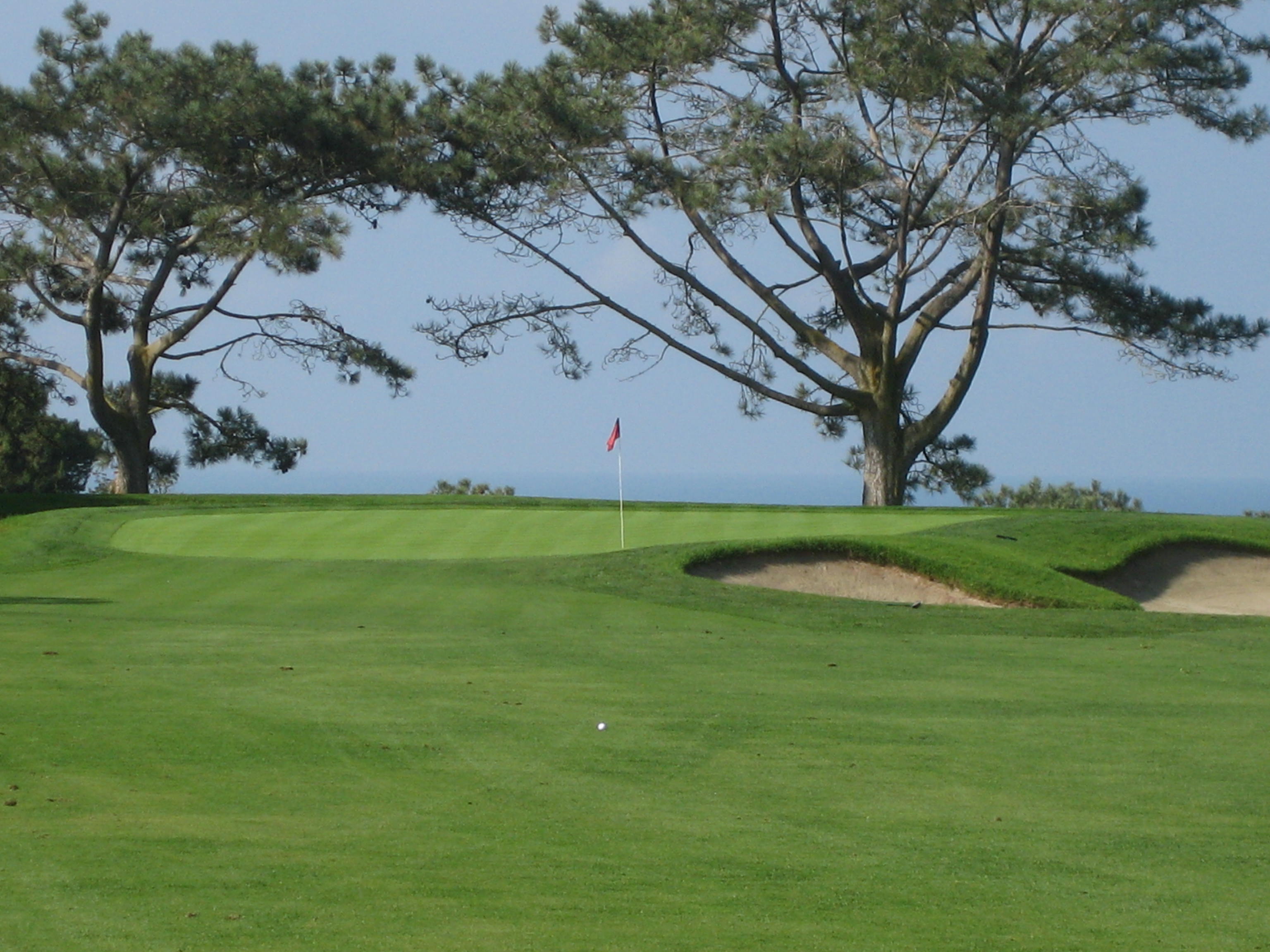
The sheer beauty of Torrey's 1st hole belies the difficult test that lies ahead.

The sheer beauty of Torrey’s 1st hole belies the difficult test that lies ahead.

Charley Hoffman wasn’t happy with the 75 he shot on Saturday that included four bogies on the South Course.  He went out after yesterday’s round for some secluded work on his game with his Trackman and said he found something and ought to be in contention on Sunday.

His opening nine was five-under including a hole-in-one on the postcard third and three other birdies getting him to seven-under and within one of the lead.  Guess that technology did have something to share.  A bogey on ten and Charley went into a par stall over the next seven looking like one of those hang gliders just hovering a couple out of the reach of the lead. His birdie on 18 was too little too late as he would finish at seven-under.

Many guys got to hanging about the lead before their draft abandoned them.

Many guys got to hanging about the lead before their draft abandoned them.

Trevor Immelman threw two birdies and an eagle on the board in his first eight to reach seven-under as well.  But he bobbled badly on the ninth taking four shots from in front of the green to make a bogey and stall his momentum.  Two more bogies on 10 and 12 pretty much put his hopes under the posies.  But this is a major champion and three birdies over the next four holes percolated him back within one of the lead.

Even the old nags liked their chances.  K.J. Choi starting the day at two-under bogied the first and then ran off seven birdies over the next 14 holes to grab a share of the lead at eight-under.  He was the first to post eight-under so it was whittle and wait for another couple of hours for K.J.

The youngsters were to be heard, Spiething in tongues, as Jordan continued to talk to his ball trying to coax some birdies and make a run at his second PGA Tour win.  But for every step there was a misstep and so it was just another Sunday schooling for him. Jason Day, the talented 26 year-old Australian, was knocking on the door the entire day. After an opening bogie, he made five birdies to grab a share of the lead at eight-under on the fourteenth.  His bogie-birdie finish would mean that the best he would do was grab a whittling chair next to K.J.

The bombers always do well over the 7600 plus yards of Torrey Pines, the longest layout they play all year on the PGA Tour.  Gary Woodland, Marc Leishman, and Scott Stallings hit it as far as anyone out there and all have first hand experience with the trophy presentations at tour events.

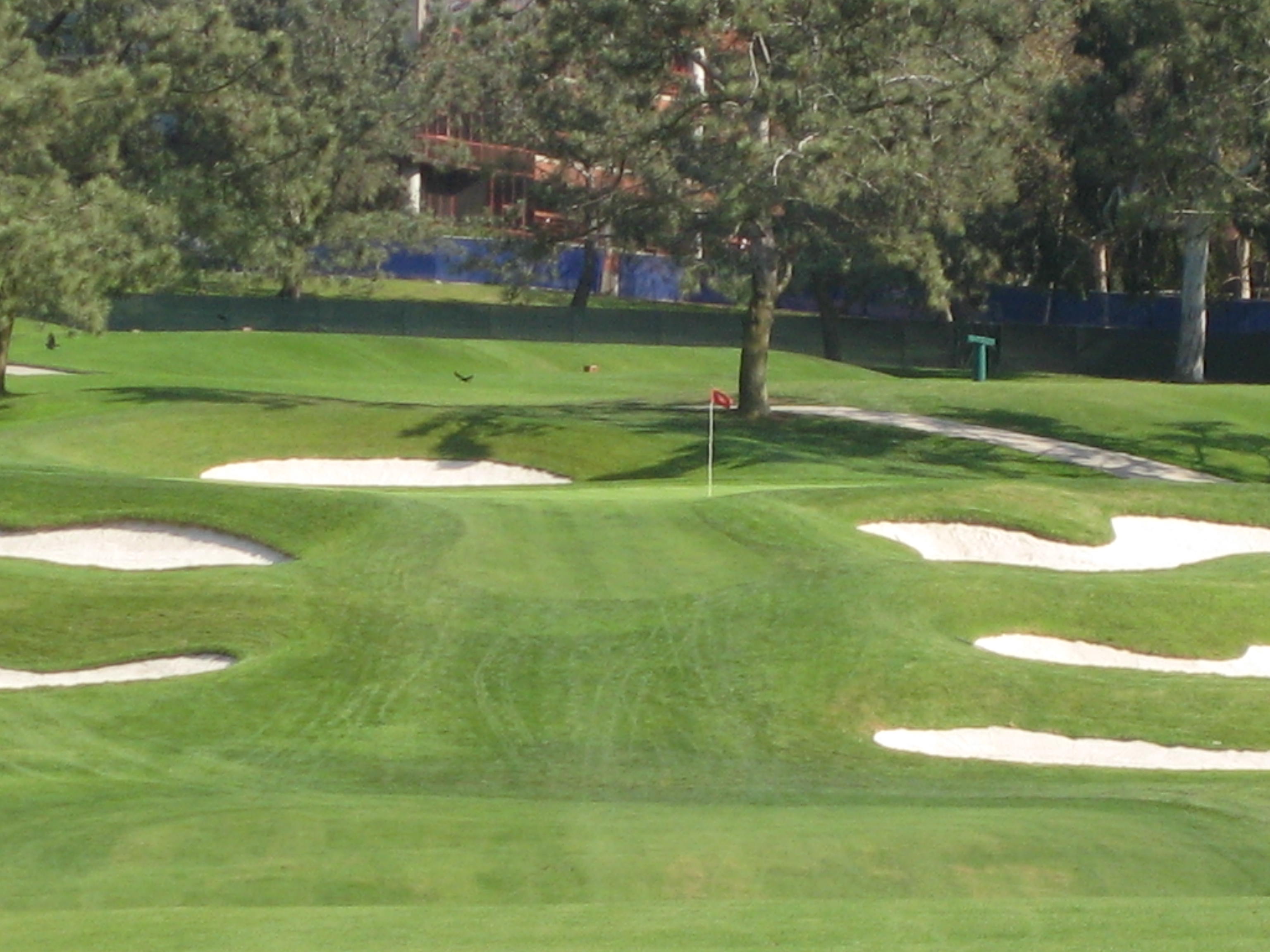
The five-par 13th was one of the few good scoring opportunities on the inward nine.

The five-par 13th was one of the few good scoring opportunities on the inward nine.

Woodland had towardness problems, only hitting 3 greens in his first thirteen holes but used a reconstructed short game and a stable full of one putts to stay on par.  Leishman by contrast hit half the fairways but used his strength to find 75% of the greens and remain in the chase.  Stallings made six birdies through fourteen holes and was the first one to reach nine-under and momentarily interrupt the whittling.

There were others-La Jolla native Pat Perez,  Canadian Graham DeLaet,  young Ryo Ishikawa, and Will MacKenzie-the leaderboard permutations seemed endless.

Plenty of jockeying remained to be done down the difficult home stretch at Torrey.  Hitting the fairways and making key putts was going to decide this….it was only a question of how many noses were going to be in the photo finish image.

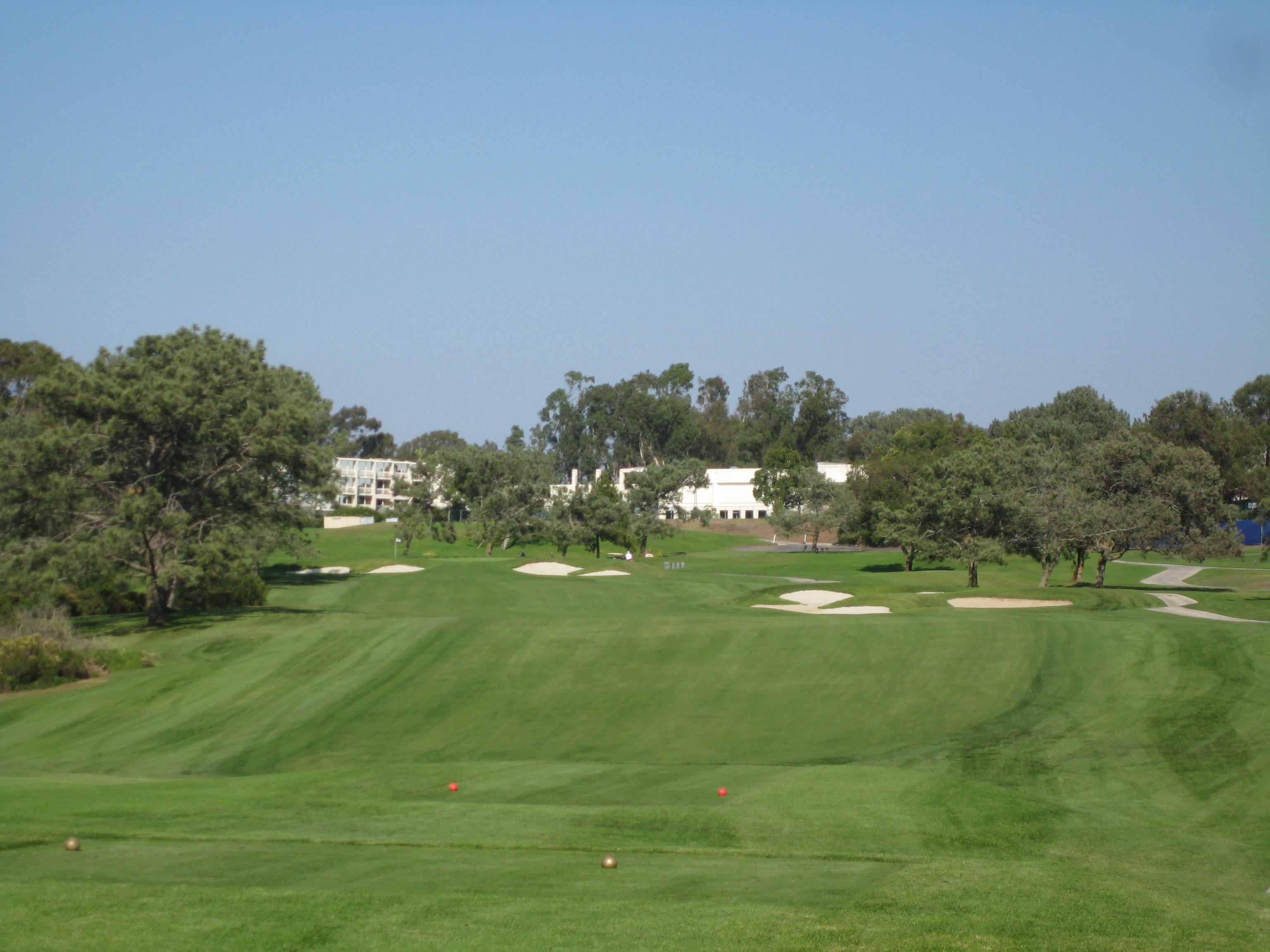
The 17th was a long iron-short iron but it took no prisoners today.

The 17th was a long iron-short iron but among the leaders it took no prisoners today.

When the dust settled it was just one.  Scott Stallings made a bogie on sixteen but redeemed himself on the par 5 eighteenth hitting the fairway and hoisting a long iron across the pond to safety by just a yard.  Two confident putts for birdie and his nine-under total held off the five other show ponies at eight-under.

Quite a finish this proved to be one exhausting afternoon of spectating.

January 2014

Clean Up In Aisle 2

Golf is a game of blows and weapons.  In order that the game continue, we must make amends for every single act of destruction.  In a golf club everyone knows the player who does not replace his divot.  One can guess how he leads the rest of his life.

.
Michael Murphy
Golf In The Kingdom

On The Line

Abu Dhabi HSBC LogoThe question is when will Rory regain his form and possibly momentum to challenge Tiger as the number one player in the world.  His play at this week’s Abu Dhabi HSBC Championship, the opening event on the European Tour schedule, would indicate that he is closer than others think.  The old Rory was on display all week swinging with good balance and showing precise direction and distance control throughout the bag.

Mcilroy’s game was on but his lack of rules knowledge cost him big time

Embed from Getty Images

But Rory’s chance at winning this championship was seriously derailed by an unforced error on the second hole in round three resulting in a two-stroke penalty after the round.  This was a mistake that just should not have occurred-he violated a well known rule that he learned from the earliest days of his junior career.  His drive into the left rough on Saturday ended up on the marked spectator crossing path which afforded him free relief clear of the path.  After he dropped his ball without penalty he failed to notice that his foot was on the white line demarcation of the path.  By rule his stance after the drop must be clear of the marked area to constitute full relief, failing to do so and playing the shot results in a two-stroke penalty.

Being apprised of the violation at the end of his round Rory and a tour official went back to the scene of the crime and recognized from the position of his divot relative to the path line that he had indeed violated the rule of total relief.   His 68 became a 70 before he signed his card and all of a sudden instead of tied for the lead he was a pursuer two shots back.

It had to seem like deja vu all over again for Rory. Two years earlier he missed by one making the sudden death playoff for this championship incurring a two-shot penalty in round two for brushing away sand on his line while his ball was not on the putting surface. Seems like a one-on-one rules retreat with Slugger White might be a good investment of his time.

His play on Sunday was solid, driving the ball well and hitting his approach irons with precision as he had done all week.  But his putting was not sharp and he edged a number of good birdie opportunities down the back nine never closing the gap on the leaders.  The final round 68 once again left him one behind and a bridesmaid.  Rory took some solace in the fact that without the penalty he played the four rounds in less strokes than everyone else and his competitive game seems to have returned.

Phil Mickelson had an important role in the evolving drama.  After a couple of indifferent rounds Phil barely made the half way cut, making the $2 million appearance fee he supposedly got for making this trip half way around the world seem a bit generous.  But Phil The Thrill played lights out on Saturday shooting 63 with 9 birdies, 1 eagle, and low 20‘s in putts. Jumping up 40 plus spots on the leader board his 11-under total was just one off the lead and earned him a spot in the final group on Sunday.

The plot thickened because Phil did what Phil always does.  After three birdies in the first eleven holes on Sunday, he had the lead in hand when he stepped on the tee at the thirteenth.  He proceeded to deposit a wayward drive under a prickly bush well left of the travelled playing area.  Turning down the option of an unplayable and a one stroke penalty, Phil flipped over a long iron and tried to punch it out right handed into the adjacent sandy waste area.  The ball clipped the pricklies and the resultant double hit on the face of the iron cost him another shot and left him in the bush.  He now had to relent, take the unplayable, and ended up with a messy triple bogey seven dropping him three from the lead with five to play.

Once again Phil rose from the ashes, making birdies on two of the next three, closing quickly in the rear view of the leader in the group ahead.  A drive and a fairway metal set up a potential eagle on the last that would have forced a playoff but the long putt from just east of Qatar never threatened the hole and his final round 69 left Phil tied for second with Rory the Golden Boy.

Pablo Larrazabal had the last exclamation point for this championship win

Embed from Getty Images

The real story was the 30-year old Spaniard Pablo Larrazabal who outgrinded them all.  With  a 5-under 67 on Sunday he ignored the glare of two of golf’s luminaries on the way to a 14-under winning total.  Only one bogie on the front side Pablo showed an adept short game on the inward half saving important pars to keep abreast of Rory and Mickey.  It was a pair of clutch birdies on 11 and 13 that gave him the lead and a two-putt birdie on the last resulted in a full Seve fist pump, an exclamation point to his third win on the European Tour.

Larrazabal was honest in the post game interview saying of the ten-footer he made for birdie on the last “Thank God it went in, because I would not be here if I had to go to a playoff with Phil and Rory.”   With it all on the line it was Pablo who outplayed Rory and Phrantic Phil and, for now at least, is the front runner in the 2014 Race To Dubai.

January, 2014

Getting The Right Thing To Do Done

This posting by Stephen Meyer on Top Sales Dog called “A Tale of Three Golfers” is an interesting account of one man’s persistent effort to get three famous golfers to do the right thing and help him provide a life long friend with a commemorative gift of some special times they spent together.

Andy Abrams decided that it would be a really cool 50th birthday present for his friend Rich if he could get Lee Trevino, David Graham, and Justin Rose, the three guys who have won the U.S. Open at Merion in the last four decades, to sign a commemorative poster since the two friends had seen Lee win his Open at Merion when they were just 8 years old and then Graham win his Open at Merion ten years later.  Andy was there this past June to watch Rose pursue his first major victory at Merion as well.

Considering that all three of these guys have a reputation as being very approachable it probably did not seem to Andy like such a tall order to get them to participate in his idea.
Heck they should jump at the chance to help two friends who were there at their moments of major glory commemorate the event.  If they were in fact “players of the people” it would just be the right thing to do.

Not so fast….as you will read it took old school persistence and proven sales tactics to pull this off.  Despite the effort required I am sure Andy is glad he did not settle for giving Rich a hat.

(Click to read Stephen Meyer’s “A Tale of Three Golfers”)

Stephen J. Meyer
Top Sales Dog
RapidLearningInstitute.com
January 2014

(Special thanks to moegolf friend Jim Doane for sharing this article)

Jordan Speaks

Kapalua LogoIf you watched the Tournament of Champions broadcast from Kapalua over the weekend and were listening closely you heard Jordan Spieth constantly talking.  Strategy conversations with his caddie, last minute instructions to his ball in flight, and admonishments to himself once the ball touched down.  Based on his second place finish against a number of major winners I think all within earshot should take note and listen.

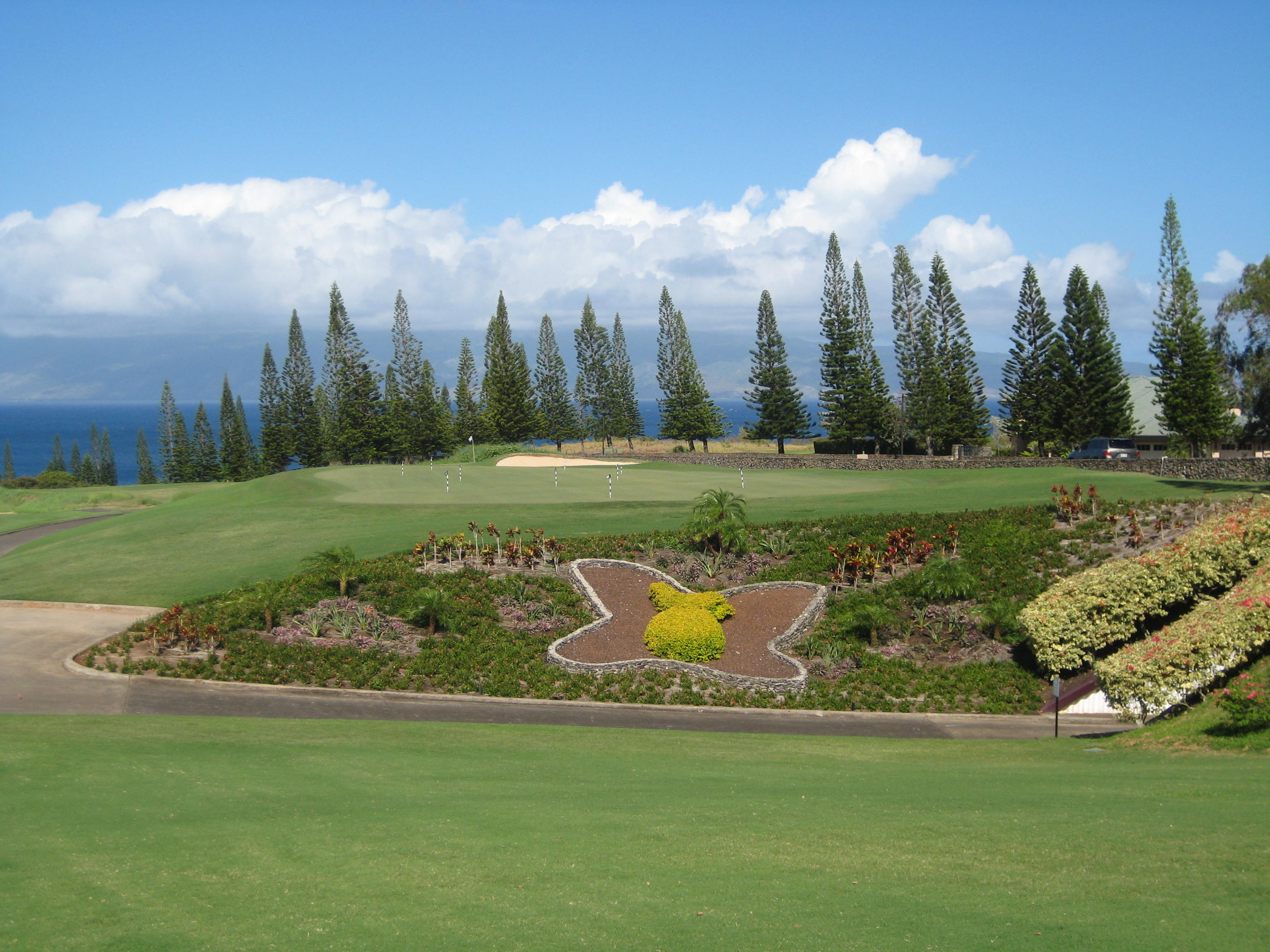
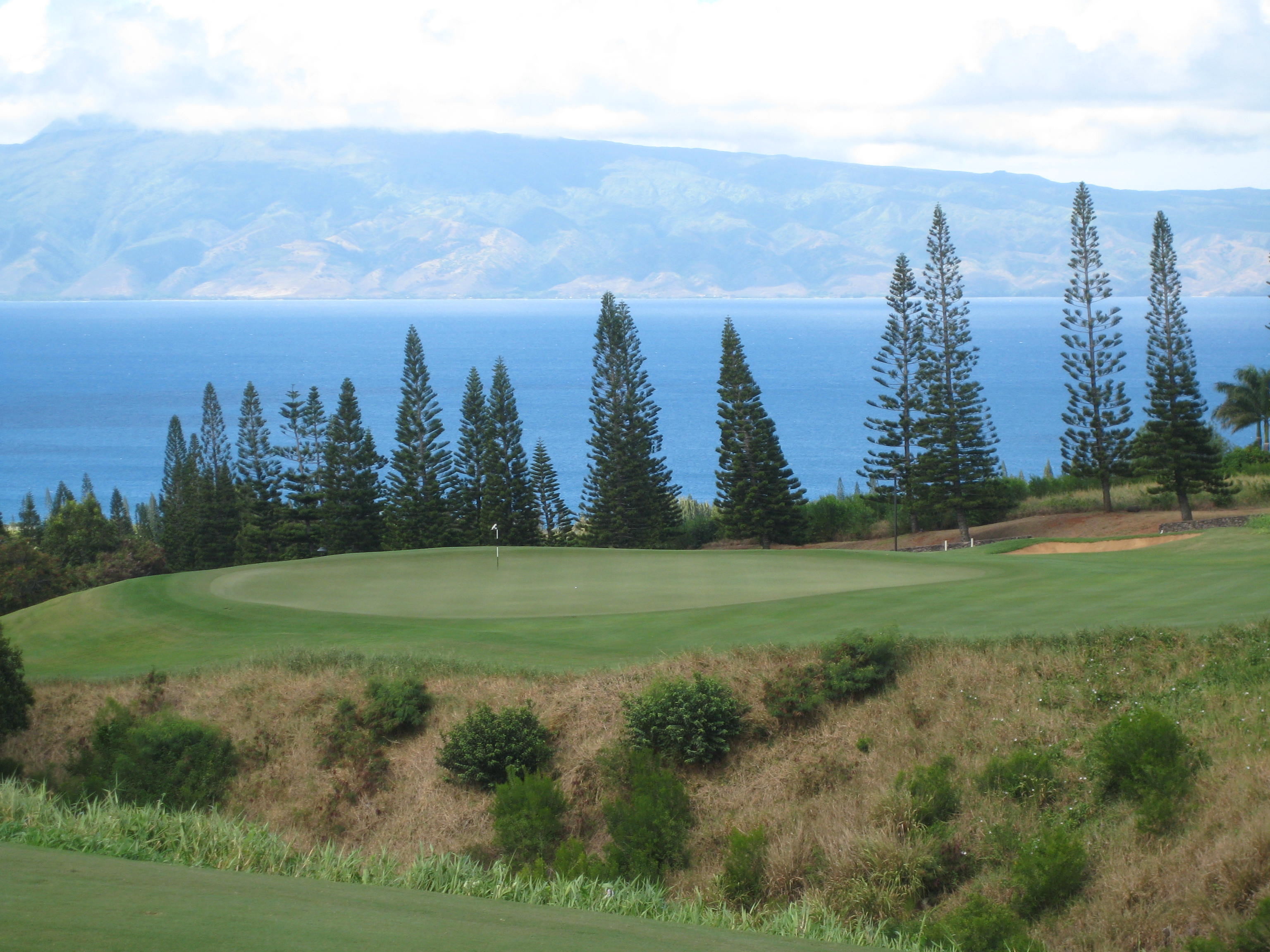
The Kapalua Plantation Course is scenic but presents real strategic challenges.

The Kapalua Plantation Course venue for the Tournament of Champions is drop dead gorgeous.

As a 20-year old in his second year on the tour Jordan Spieth is the most promising and refreshing story on the tour.  The route that he has taken in the last 12 months is nothing short of astonishing.  From no PGA status and an 810th world ranking in December of 2012 he has notched a tour win, full tour exemption,  President’s Cup appearance, 17th place in the World Golf Rankings, and almost $4.6 million in official winnings.  Not bad for someone who cannot legally drink in many states in our union.

The coolest part about all this is that Jordan does not cut the figure or have the technical golf swing of a can’t miss prodigy.  Rather he has a huge competitive will, full confidence in the competence of his home grown golf swing, and a golf IQ in the top quartile.  This combination has led to a very steep and consistent trajectory of improvement that has all his peers, even the old grizzled veterans, taking notice.

At age 17 he played in his first PGA Tour event at the Byron Nelson in his home town of Dallas.  He had the audacity to make the cut (almost missing his prom as a result) and finish tied for 16th.  He won the U.S. Junior Am in 2009 and 2011 joining Tiger Woods as the only other multiple winner of this prestigious championship.

In 2011 he was the second ranked player on the U.S. Walker Cup team that included current tour pros Harris English, Peter Uihlein, Russell Henley, and Patrick Cantlay.  He had good success halving his foursome’s match and winning two singles matches against the first and third ranked player on the G. B. & I team.  In his freshman year on the University of Texas Longhorn golf team he won three NCAA events, led his team in scoring average, and helped them win the NCAA Championship.

Consistency in performance has been the hallmark of his career so no one should be surprised at his meteoric rise through the PGA ranks in 2013.

After some fits and starts Jordan won enough money in the first quarter to earn Special Temporary Member status.  Working on unlimited sponsor exemptions he steadily gathered acorns until his breakthrough win at the John Deere Classic (formerly known as the Steve Stricker Open) in a three-way sudden death playoff.  He barged his way into this playoff holing out from the greenside bunker on 18 and went on to beat Zach Johnson and David Hearn to win the trophy and a large pile of acorns.

At age 19 he became the first teenager in 82 years to win a PGA event.  This win gave him full status, eligibility for the FedEx pot, and a spot in the next three majors.

Later in the summer at the Wyndham Championship he waged another dramatic charge on Sunday to get into a playoff with another young whippersnapper, Chris Reed.  Reed hit the side hill, obscured flight, pine straw recovery shot of the year on the playoff hole setting up the winning birdie and denying Spieth his second tour win.

Jordan played admirably in the FedEx Playoffs shooting a final round 62 at the Deutsche Bank Championship in Boston in the presence of Phil The Thrill.  A supporting call from Phil to Captain Couples was enough to make him a captain’s pick on the Presidents Cup Team.

Real risk and reward on 17..Spieth was 9 under on the last five holes through the week.

Real risk and reward on 17……Spieth was 9 under on the last five holes through the week.

In this past week’s Tournament of Champions Jordan once again proved unfazed by the company he was keeping.  Playing a very technical golf course for the first time with major winners Zach Johnson, Jason Dufner, Webb Simpson, and Adam Scott all in the mix, his steady head earned him a piece of the lead going into the final round.  Only a par stall on the final nine kept him out of another playoff with the eventual winner Zach Johnson.

What you see in this guy is maturity beyond his years and a remarkable presence of mind when the tournament is on the line.  His chatter makes it clear that he is caught up in the moment but the clarity of his decisions and his ability to execute shots when it matters separates him from the other young hotshots.

At the end of 2013 he was 10th on the PGA Money List, 22nd in the World Golf Rankings,
9th in Scoring Average, 7th in the FedEx Cup Standings, and 8th in Back Nine Scoring.  That last number kind of tells it all about this kid.  When the finish line is in sight he knows how to sustain his momentum and challenge for the trophy.

My bet is his banter extends to some post game interviews at the Majors this year.  He may just win one of them at age 20 and surprise the hell out of all of us.

January 2014

Lone Star

babe zaharias

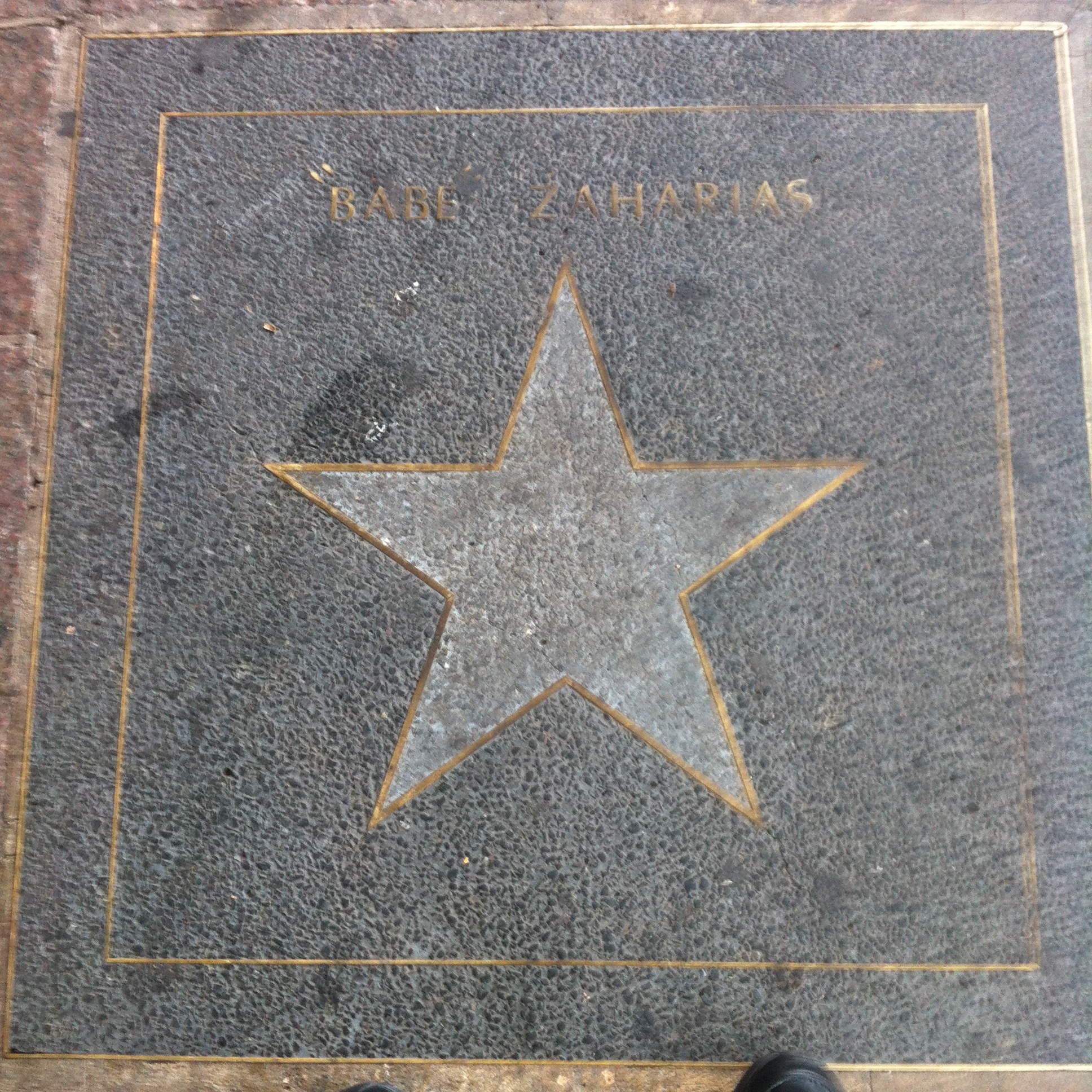
We found this Babe Zaharias commemorative sidewalk star along with Joan Crawford and other favorite sons and daughters of Texas in front of the Old Pecan St. Café in Austin.

Babe is acknowledged as one of the greatest female athletes ever having won two gold medals in the 1932 Los Angeles Olympics before taking up golf and becoming one of the games most dominant players, male or female, of the next two decades.

She won 41 times on the LPGA circuit with 10 major championships including the U. S. Open three times. She succumbed to colon cancer at the age of 45 in 1956 winning her last two LPGA events that year after surgery.

Grantland Rice once said of Babe:  “She is beyond all belief until you see her perform…Then you finally understand you are looking at the most flawless section of muscle harmony, of complete and physical coordination the world of sport has ever seen.”

High praise from someone who had intimate knowledge of the accomplishments of Jim Thorpe, Babe Ruth, and Bobby Jones.

Babe Zaharias’s star still flickers on this obscure corner in south Texas not far from where she was born.

Babe Zaharias

The Old Pecan St. Café

Austin, Texas