Unknown's avatar

About moegolf

Moe is a narcotic golfer, father, and lover of golden retrievers, chocolate and well done fries. He plays the holes over in his head endlessly at night.

Silver Spoons

The weekly dispersal of huge sums of money to young people who have been programmed since prepuberty to hit golf balls is, by and large, an uninteresting medium of entertainment except that it has, by bad example, tended to make our game a painfully slow one.

Frank Hannigan

The Golf Journal (1974)

A Win For Every Man

Arnold Palmer Invitational LogoArnie’s event is in the unenviable position of being three weeks before the Rite of Spring celebration at Augusta and as a result is absent of the presence of a number of the big names in the game who have opted out of this invitational to fit their preference in managing schedules before a major.  From the top ten in the World Golf Rankings Jason Day, Fabulous Phil,  Rory, and Dustin Johnson have all taken a pass and Tiger’s aching back kept him from defending his crown in this championship.

Adam and Company seemed in total control.

Embed from Getty Images

With a chance to take over the number one spot in the world, Adam Scott led out of the gate with his opening day 62.  A touch of the flu slowed him down starting Friday, his lead atrophied each day and he teed it up with just a three-shot lead going into the final round on Sunday.  A sluggish start with a bogie on the first and a water ball off the tee on the difficult third and his lead was down to two.

Observing that the last four winners of this event have decimated the par fives, Adam’s ticket has been attacking them all week.  He has been going for five pars in two 75% of the time and playing them 11-under through the first three rounds.  That is 7 strokes gained on the field average of 4-under on the fives through 54 holes.  He righted the ship with this same approach making birdie on the par 5 4th with a clever up and down from just off the green.

Scott falls victim to the steep sandy faces on #7.

Embed from Getty Images

One of the difficult features at Bay Hill are the tall sandy faces on the green side bunkers which have a tendency to plug  high approaches rather than deflecting them back into the flat bottom of the bunker.  On the 7th this fate befell Adam when he floated his approach into the face of the right bunker on the par three.  The resulting bogie shrunk his lead to just one.

One of his pursuers, Matt Every made a “roadie” on nine to join Jason Kokrak at 12-under just one back.  After hitting his driver into the trees that line the left side of this dogleg left his ball trundled precariously up the right edge of the cart path, the left edge of the path is OB, and the golf gods ushered it safely in play clear of the tree line leaving Every with a short iron in his hand.  A dexterous approach and a confident roll he made for a three out of a five or worse.

Matt followed that with a lovely cross town birdie putt to a Clark Kent cup placement on the  short tenth to join Adam in the lead at 13-under.  An up and down birdie on the par five 12th and Every had the lead all by himself.  Failing to convert his own birdie on the 12th, Adam was looking at the back of the leader’s hat for the first time all week.

No hold back in this Every man……

Embed from Getty Images

The short par four 13th hosts a sucker pin just over the rocks and water that front this fortress green complex.  Though the 30-year old has yet to win on the Tour, Every showed nerveless aplomb hoisting his approach to flag high and then buried another 20-footer to extend his lead to two.

This was not your prototypical every man in contention.  No one should be that surprised at his performance-he has won over $7 million since 2008 on  Web Dot Com and PGA Tours.  With an average of five top tens each of the last three years he has had a good run this season, ranked 7th in Shots Gained Putting and 10th in Scoring Average on tour.

The tension seemed to affect reigning the Master’s champion more than Every.   The air came out of his iron shot into the Par 3 on 14 leaving him short of the putting surface and he failed to get up and down to expand the gap to three.  A creative up and down from the bottom of a steep shaved bank short side on  the 15th kept Adam in touch.

The angst grew in Adam’s putting stroke through the day.

Embed from Getty Images

The last three at Bay Hill make a very nervy finish where just about anything can happen. It begins with a reachable par five eagle opportunity but the diagonally set pond in front makes six a possibility as well.  The hardest three par on the course follows and the last is one of the truly dramatic finishing holes on Tour.

After an Every unforced error on the par five led to bogie, Scott failed to turn the opportunistic two-shot swing when he missed an uphill four-footer for birdie and had to settle for par.  Dodging that bullet only a fat flagstick stopped Every from holing his bunker shot on 17 so the lead remained at two.

Matt’s pitch on 17 seemed destined for the tin but was denied.

Embed from Getty Images

With the Good Adam and the Bad Adam having a Yalta conference debate between his ears, Scott bogied 17 from another errant tee shot and it was all over for him.  His playing partner Keegan Bradley, who had been treading water all day, managed to birdie 16 and 17 to keep a bit scare in the heart of the leader.

Placing his tee ball five steps right of the Robert Gamez plaque at 172 Every would only need a par to have The King hand him the trophy.  But too much adrenaline and his approach ends up in the juicy cabbage over the green.  The failed up and down provided an opening and now Keegan was a birdie away from a playoff.

Keegan had a similar drive right of Gamez and put his approach in the center of the green.  At 25-feet he was staring down a similar down hill left-to-right line to two of Tiger’s fist pump winning putts on this green.   As Johnny Miller said, if Keegan makes this one who knows what the kind of body gyrations could ensue.  The putt slithered by on the high side and with a deep sigh Every had his first win on the big stage.

Matt with Danielle, Liam, and the Hardware

Embed from Getty Images

As seems to be the weekly result this year, we have yet another previously unheralded contender for the Georgia Green Jacket in a couple of weeks.

March, 2014

FlightScope

The most significant change in a decade in high level golf instruction and expert golf club fitting is at hand in the proliferation of sophisticated 3-D ball flight and club measuring equipment. Henri Johnson, a South African electronic engineer developed the Flightscope 3D doppler golf radar in 2001 followed by Trackman in 2003 and it fast became the expensive standard of this type of technology in the golf industry.  Having money and reason to use it, equipment manufacturers embraced it first as a way of doing statistical research for development of new products.
For ball, shaft, and club head testing this data proved invaluable.

For ball, shaft, and club head testing this data proved invaluable.

More recently the high end teaching professionals adopted this technology as a major game improvement tool in working with their touring pros.  They have become so popular that you see these $25,000 devices being pulled out as often as iPhones on practice ranges each week on the PGA Tour.  Sean Foley has been quoted as saying he doesn’t need video feedback anymore from his clients, an email with the latest Trackman numbers is sufficient for him to monitor and council the likes of Justin Rose from afar.

An impressive array of statistics on ball flight.

An impressive array of statistics on ball action and flight are now available.

Flightscope has introduced a less expensive version at about $13 K that uses 3-D Doppler Radar tracking technology to do much the same thing.  At about half the cost it brings this sophisticated capability into the wheelhouse of country clubs, club fitters, and independent teaching professionals.  They even have a personal model for about $2,500 which will make it’s way very shortly into the homes and offices of well heeled single-digit players.

The output of these systems is a blend of raw swing and ball flight data, graphic depictions of swing motions and ball flight, and live swing video.  This puts in the hands of qualified teachers support information that can take to a new level teaching instruction and, more importantly, student comprehension.
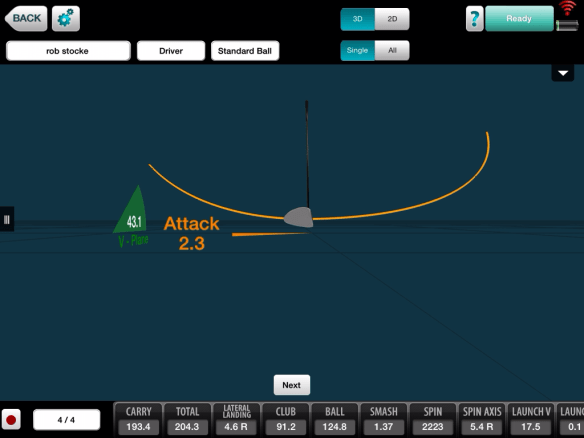
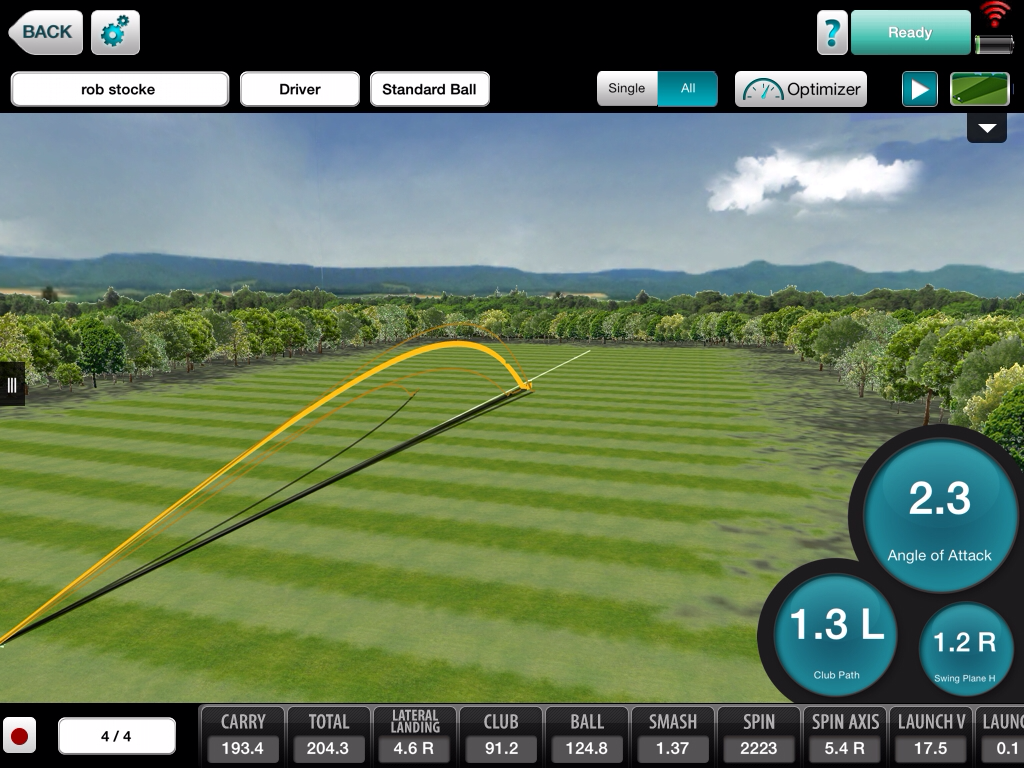
3-D depiction of your swing path confirms the teacher's diagnosis.

3-D depiction of your swing path confirms the teacher’s diagnosis.

I recently had the opportunity to experience a Flightscope session with Rob Stocke, the director of instruction at the Golf Club of Georgia, whose strong aptitude for integrating this technology into our lesson made me a believer.  In about 30 minutes I confess I was awed by the efficacy of the feedback this system provided in comprehending and applying the changes to my grizzled old swing that he was suggesting.

The Flightscope provides what seems like a couple of dozen stats on every swing and ball flight.  Carry distance, total distance, lateral dispersion, club head speed, ball speed, smash factor, spin rate, spin axis, launch angle, decent angle, height, hang time, roll out, etc…..etc….etc.  And in my session all of this in the comfort of an temperature control  bay hitting into a net.

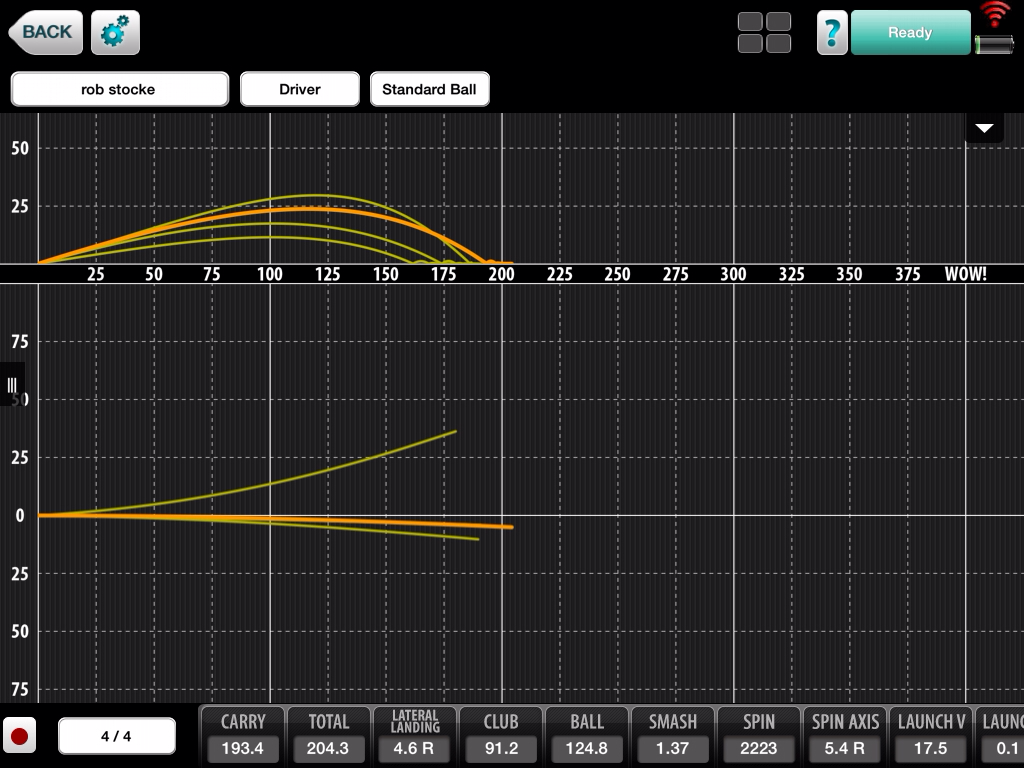
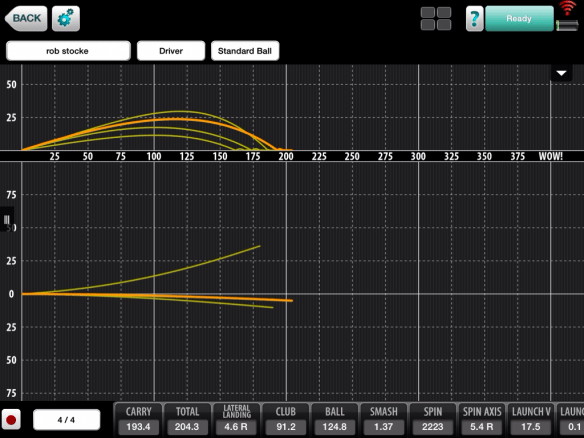
Ball flight shape and dispersion from the target line is great feedback for the student.

Ball flight shape and dispersion from the target line with numbers to explain it.

It generated graphic depictions of dynamic loft, face angle at impact, 3-D swing path, ball flight, flight dispersion, and other cool stuff to support the numeric data.  It even let Rob integrate real time video to tie it all together.  Used in the proper way by a discerning teaching professional this was anything but overload to the student (me) it was tremendously elucidating.
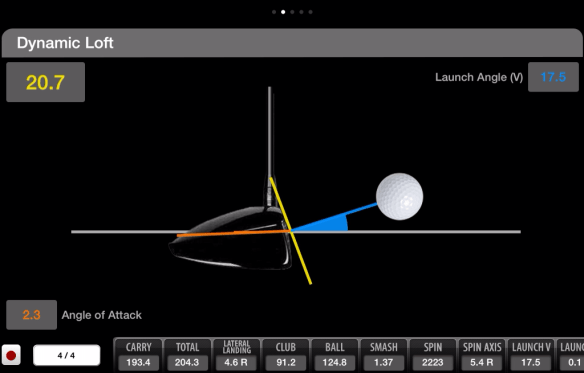
Dynamic loft-the combination of your club head and angle of attack.

Widen the stance, more weight to the right. more Dynamic Loft at impact, greater ball carry.

In your typical lesson, even if you are a veteran of these affairs, the teacher diagnoses a problem, suggests some minor swing alterations to address it, and you proceed to hit a gross of shots trying to ingrain the changes into your old grey mare swing.  It usually goes like this.

Student:  Hits the shot

Teaching Guru:  How did that one feel?

Student:  That was better.

Teaching Guru:  Yeah, it looked much better….could you feel that difference in your swing path?

Student:  Sure

Student: Hits another shot

A half hour to an hour later the student may have gotten it, or maybe thinks they have internalized it, but is not real confident that it is actually a part of their new swing mojo.

The difference I found with this supporting technology was that after a number of swings we could look at the layered numbers, graphic images, and the video and see the effect of the change in real time.
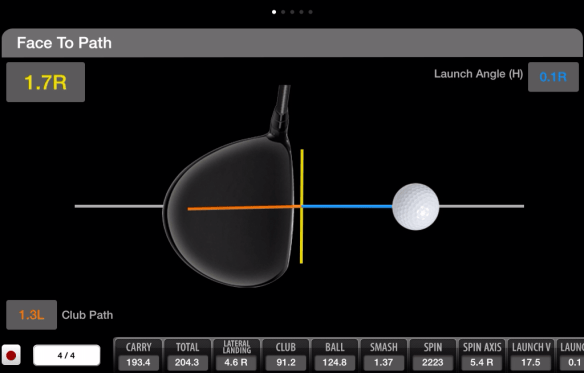
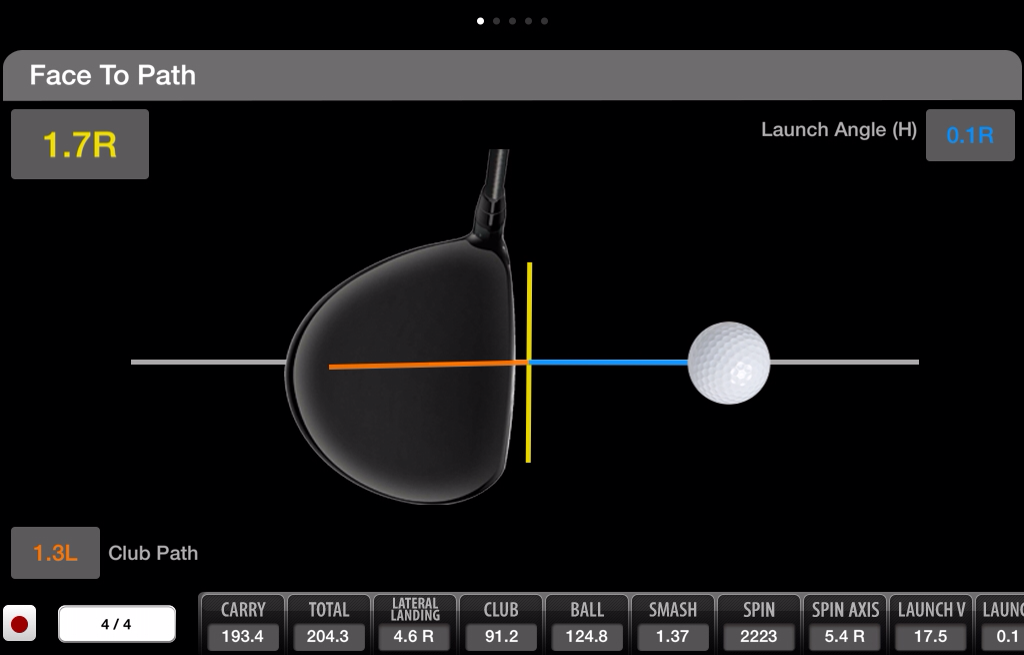
The face angle at impact was open-with this image no refuting that.

The face angle at impact was open send the shot to the right-with this image no arguing the point.

If the swing adjustment was to fix an impact face angle causing a hook, the graphic image of the face angle at impact, the launch horizontal number, and the video depicting my wrists and shaft angle at impact made the improvement on each shot irrefutable.
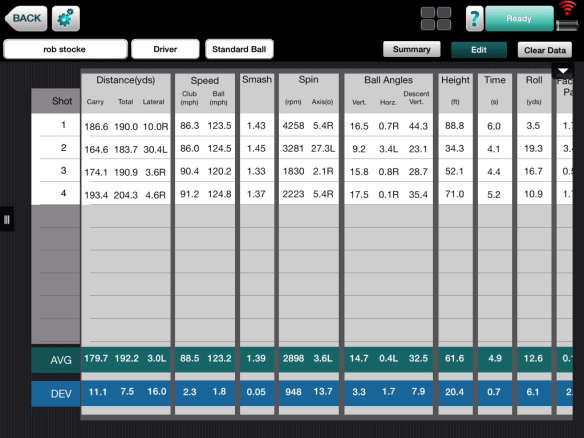
Layered data of subsequent swings shows a pattern of improvement in key numbers.

Layered data of subsequent swings shows a pattern of improvement in key numbers.

This is science!  My confidence in the efficacy of the suggested fix became assertive in a matter of minutes.  By the end of the session I felt for sure I got it and I was taking it home with me.

This just scratches the surface on the capability of this technology.  The depictions of successive ball flight profiles, dispersions, and launch, decent trajectories, and swing path silhouettes  from shot to shot are almost déjà vu to the experienced range rat.  No launch monitor or computer video alone is giving you this kind of feedback.

Needless to say that for proper club fitting this type of information in the hands of a qualified club fitting professional should make the match of player, swing, and equipment a shitach made in heaven, or at least the upper atmosphere.

I dare say that within two years there is not a credible teaching professional or club fitter worth their salt who won’t be using this type of technology to help their clients.  It behooves you to seek out the early adopters and get the benefit of this stuff sooner rather than later.

You may not be able to afford Butch Harmon but you might well be able to afford a guy with the technological tools to make it a much more Butch-like experience.

March, 2014

moerate4

24

WGC Cadillac-Trump DoralThe way things are going this year on the PGA Tour the only guy with an association to this number who has not been in contention is Kiefer Sutherland.

At this week’s WGC Trump Championship it is soon to be 24 year-old Patrick Reed leading by two going into the final day at the vastly improved, better than ever before, able to leap tall buildings in a single bound, Trump Doral Blue Monster.   Patrick has won twice on the tour, with another six top tens, in the last 12 months and cashed in just under $4 million for his efforts.  Currently 44th in the World Ranking and rising.

Embed from Getty Images

Last week it was 24 year-old Russell Henley putting the smooch on the crystal at the Honda Classic, he outlasted another 1989 phenom Rory McIlroy in a four-way playoff at PGA National.  He too has won twice in the last year, with four other top tens, and added about $3.2 million to his bank accounts along the way.  Currently 46th in the World Rankings.

Embed from Getty Images

The week before at the WGC Match Play it was the Australian Jason Day and Frenchman Victor Dubuisson, who together average about twenty four and a half, playing an awe inspiring five-hole playoff to decide that championship in 23 holes.  Fourth in the World Golf Rankings, Day is an old man at 26 with two tour wins and close to $16 million in winnings on the PGA Tour since he toddled on the scene as an 18 year-old.  Dubuisson, looking like Johnny Depp (who the wife insists is forever 24), has won the Turkish Open, took second in the WGC Match Play, third in DP European World Championship, and fifth in the Volvo Golf Champions racking up about two million  euros in the last six months in European Tour events.

Embed from Getty Images

Harris English, also 24, won at St. Jude and Mayakoba in the last year along with 13 other top ten finishes.  Winning close to $6 million over that period he is currently 3rd in the FedEx Cup standings.  This 24 year-old looks like a lock for an American Ryder Cup Team position.

Embed from Getty Images

Better equipment, rigorous fitness, stiff competition at a very early age, and absolutely no sense of awe of their elders on the PGA Tour has these young guys feeling their oats and winning repeatedly before the age of 25.

24 image
It is obvious, these young guys do know Jack…….who happens to be returning to Fox on May 5th for a ninth iteration….24: Live Another Day.….

March, 2014

Handicap Primer

Here is a shock for you, men in Great Britain and Ireland in the 19th century loved to bet on anything- horses, archery, parlor games, and, of course, golf.  To make the golf competitions workable they had to come up with a method for leveling the field between players of different ability so creating a course handicap became important to facilitating the wagers.

There first effort  in the mid-1800’s was to take the average of a man’s lowest three scores of the year at their home course and subtract it from the scratch score for the course to create a handicap.  This was fine at the home course but it did not travel well to away games where the courses were not of similar caliber.

The next iteration came from an unlikely source the Ladies Golf Union.  In the 1890s these adventurous women assigned a course rating to member courses to create a calibrated standard for the comparison to the average scores.  This actually worked quite well in establishing a handicap system that was reliable from club to club.

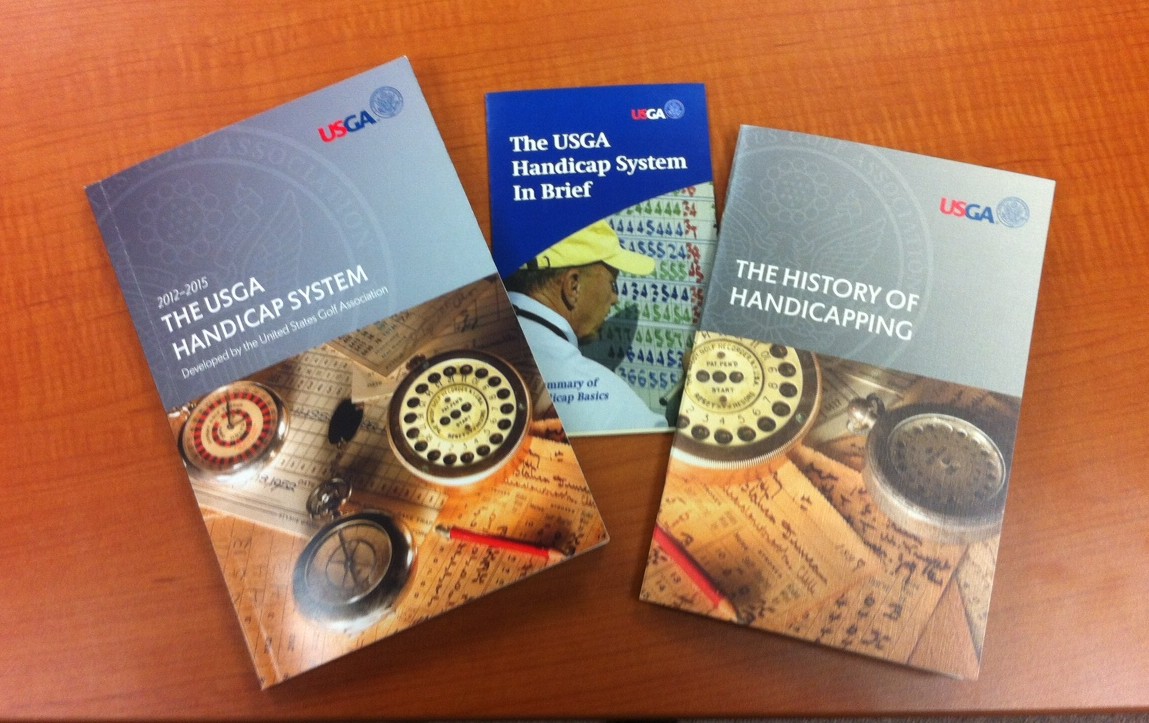
The required reading materials from a USGA Handicap Seminar

The mind numbing required reading materials from a USGA Handicap Seminar

When the game sauntered across the Atlantic it did not take much time for the blue blazers at the newly formed USGA to put their arms around this establishing a similar approach.  At first the USGA let each course establish it own course rating but it became evident in a hurry that this led to farcical results.  So they too created an objective method of issuing official course ratings.  Now they had a way to create objective handicaps that would be mobile enough to support inter-club competitions.   By using the three best scores of the year the first principle of handicapping was also clear-it would measure potential not playing ability.

As it further evolved it became evident that using only three scores a year favored the better player who could more reliably play to such a narrow sample of potential.  So they began computing it from larger subsets of the scoring records of players and eventually landed on the sample of 10 best of the last 20 scores.   They threw in the caveat of a “Bonus for Excellence” by using a multiplier of 96% to determine a player’s final handicap index.  This was to reward the better golfers a slight edge in head to head competitions with high handicappers.

The last piece of the puzzle was the implementation of Equitable Stroke Control (ESC) in 1974 which created a variegated method for maximum score on a hole based on the player’s Course Handicap.  This helped to smooth the curve on scores being posted by individual players.

It is worth noting that the word “Par” never appears in the discussions of handicaps or their calculations.  Rather the USGA created two ratings to support the handicap system.

The first is the Course Rating which is a baseline objective calculation of a course’s difficulty to a scratch player-it does not address how the course would be played by an average player. A course rater goes through the course simulating the positions off the tee of a scratch golfer (average 250 yards out) and takes into consideration factors of difficulty they face from hazards and objects they must traverse to play each hole.  By compiling these scoring factors they come up with a course rating for the relative difficulty of the course to a scratch player.  This Course Rating is established for every tee length.

In the mid-1970’s the USGA introduced a second rating through the new Slope System aimed at determining the relative difficulty of playing a course to the bogey golfer rather than the scratch golfer.   Once again they use the driving distance of a player with about a 20 handicap and determined the scoring effect of hazards and objects they face in playing out the hole.  This is called the Bogey Rating for the course.  The Slope Rating measures how steep the rise is between the Course Rating and the Bogey Rating on the course-the steeper the rise the higher the Slope Rating.  The Slope Rating is intended to show the relative difficulty of the course for a non-scratch player from each tee.

Here is the basic math.

Calculating a Player’s Handicap Index:

-Take the top 10 adjusted gross scores (after ESC)  of the last 20 for a player

-Subtract the Course Rating from each score to get a Handicap Differential

-Average these 10 differentials and multiply by 96% to get players Handicap Index

Calculating a Player’s Course Handicap:

-Multiply the player’s Handicap Index by the Slope Rating for the tees being played and divide this by 113 to get their Course Handicap for this tee.

Note: This is a measure of potential and should only be achieved about 20-25% of the time.

Using Course Handicaps in Competitions:

-If all competitors are playing the same tees the relative value of their Course Handicaps determine how many strokes adjustment needed to be applied to their medal scores.  If they are playing match play the difference between their Course Handicaps is given as a competitive adjustment to the player with the higher handicap.

-If competitors are playing from different tees the USGA stipulates an adjustment must be made to the Course Handicap of the players for the advantage of playing the forward tees.

Player A playing from a Blue Tee with a Course Rating of 70 whose Course Handicap is 10 from those tees will have a potential Target Score of 80 for the day.

Player B from the Gold Tee with a Course Rating of 66 whose Course Handicap is 9 has a potential Target Score of 75.

Player B playing from the shorter tee length it calculates to a 5 shot advantage in the potential score for the day.

The USGA says that the competitors must adjust their Course Handicaps by this additional factor equal to the difference between the Course Rating of the two tee lengths to make it a fair competition (in this case 4).  The Course Handicap of the player from the longer tee can be increased by this factor or the Course Handicap of the player at the shorter tee can be reduced.

In developing this Handicap System the presumption on the part of the USGA is that all players try as hard as they can on every hole in a posted round and that they will post all the rounds that can be posted.

The reality is that personal integrity is the only guarantee of accurate score postings.  In spite of the valiant efforts of Handicap Committees at clubs nationwide, the inaccuracy of Sand Bagger and Vanity handicaps will haunt competitions from now until doomsday.

If you yearn to delve into the nuances of the USGA Handicap system in more detail visit the website of former USGA Senior Director of Handicaps, Dean Knuth  (Pope of the Slope).  Dean is the walking and talking authority on all things handicap and his site is quite readable.

February, 2014

Trumped Up

With The Donald’s recent $20 million bargain basement acquisition of the posh Doonbeg Golf Resort in Ireland, soon to be renamed Trump International Golf Links Ireland, he has added another jewel to the Trump golf portfolio in major markets of the world.  He covered The Big Apple last fall when he completed the $200 million Giuliani/Bloomberg NYC construction boondoggle and took over management of a links course on a Bronx landfill to be called, what a surprise, Trump Links at Ferry Point.  The redesigned Trump National Doral will host the WGC Cadillac Championship in Miami in a couple of weeks.

The Donald with architect Gil Hanse…as always little doubt who’s in charge here

Embed from Getty Images

Which leads one to ponder what is left…..Cypress Point…..Royal Melbourne?  Well, as you can read in this entertaining piece  from GlobalGolf Postings,  Mike Cullity imagines that the next acquisition would be Augusta National.  A vivid imagination it is as he depicts the post tournament ceremony at the 78th masters…..very funny….not all that far fetched given The Donald’s M.O.

Cullity may need an addendum for what will be needed to replace the Eisenhower Tree for which the members of Augusta National are sitting Shiva since it’s demise last week in the Georgia Polar Vortex.  I am sure Trump’s replacement will be the biggest and most virile Loblolly Pine tree ever seen.

(Click and giggle at Mike Cullity’s “Dreaming of Donald Trump”)

Mike Cullity
GlobalGolf Postings

February, 2014

Trusting It

Northern Trust LogoThe leaderboard of this week’s Northern Trust Open looks more like the roster of the Witness Protection Program than a glamour PGA Tour event.  A.W.O.L. are Woods, Scott, Stentson, McIlroy, Mickelson, and much of the rest of the top 20 on the World Golf Rankings.  Going into the Sunday finish unfamiliar names like Will McGirt, Sang-Moon Bae, Cameron Tringale, and Charlie Beljan are dominating the first page.

Seemed like everyone and his cousin were in the mix come Sunday

Embed from Getty Images

This is kind of a shame since Riviera Golf Club, a George C. Thomas original and the host club of this event for almost a century, is one of the coolest venues the troupe plays all year.  The guys who love the place will tell you this is a player’s course.  It requires imaginative strategy from tee to green and flawless recovery execution to prevail here.  Adding one’s name to the list of past winners like Hogan, Nelson, Palmer, Mickelson, Elkington, Couples, and Faldo is a real career feather in the cap.

With the help of a four month drought drying out the greens and a couple of high tech Transformer rolling machines working the fairways this course is playing hard and fast like a major venue, which it has been on three occasions.  The normally soft and spongy Kikuyu grass has proved bouncy instead and it has facilitated seismic moves up and down this leader board for the less brawny hitters that usually suffer here.

The guys don’t see many classic tracks like this that require so much forethought off the tee and into the green.  Reachable par fives on 1, 11, and 17, brawny par fours that can be three-shotters, especially if the drive is wayward off the tee, and a gut wrenching driveable 315-yard par 4 10th which rewards and punishes with equal discrimination.

The genius of Thomas’s design is that the pin position on any given day can require an entirely different optimal approach line.  Add to that amazing green complexes which can leave an array of unforgiving short side recovery shots from the sticky, strangling Kikuyu.  Experience and humble deference to the challenges will help avoid the evil decree to the scorecard and maybe determine the winner at the end of the day.

In the early going a couple of Master’s winners, Charl Schwartzel and Bubba Watson have rocketed up the leaderboard with five birdies each in the first eight holes.  With 10 guys within 4 of the lead at the midway point this looks like full-impact bumper cars around the back nine.

The glare proves to much for the witness protection crew as they slither out of the limelight and it comes down to names more familiar down the back stretch.  After his promising first nine, Jordan Spieth makes three bogies on the back derails his chances.  Schwartzel bogies 13 and 15 with a South African sandy for birdie in between on 14 finishing fourth.  Brian Harman’s bogie and bounce back birdie sequence on 10 and 11 keeps him in touch a couple back but there is no magic after that.  Dustin Johnson birdies 11 and 15  to close within one but fails to birdie the reachable par 5 17th and comes up one shy.

Bubba among his people stares down his drive on the revered 18th at Riviera

Embed from Getty Images

Bubba Watson chasing his first win since the 2012 Masters birdies 11 to reach 14-under and then slips General Lee into cruise control.  He centers a couple of knee-knocker 10-foot par putts on 12 and 13 to maintain spacing and makes conventional pars over the next four.  What’s left for Bubba is to negotiate the Eucalyptus trees protecting the angle on the difficult finishing hole, find the narrow green in the greek amphitheater, and make a par-no small task at Riviera.

Bubba cooly smoothes a knock down driver about 290 down the sprinker line, a short club to 15 feet, and one putt for 64 and all the Skittles.

Wow, 64-64 at Hogan’s Alley on the weekend with no bogies….now that is trusting it.

February, 2014

George C. Thomas Seance

Riviera Country Club LogoThis week the PGA Tour will put on display once again the gem George Thomas created in 1926 at Riviera Country Club.  The course remains remarkably unaltered and is one of the favorite courses for guys who appreciate the genius of the classic designs from the Golden Age of Golf Course architecture.  Hale Irwin says there are no two holes that are remotely alike and loves the challenge that demands thoughtful tactical play to resolve Thomas’s strategic puzzle.

For more insight into the mind of it’s creator you can read the attached “interview” that Geoff Shackelford did with George C. Thomas (born Philadelphia October, 1873-died Beverly Hills February, 1932) for Golf Club Atlas in September, 2001.  As a course architect and author Shackelford is uniquely qualified to ask the questions and provided the authentic answers since he has written a history of Riviera (1996) and a biography on George Thomas (1997).

In the interview Shackelford reveals George Thomas’s philosophy of design, his relationship with his long time construction associate Bill Bell, his opinion on the developing “ball problem”, and even his reaction to the disastrous changes that have been made to two of his most famous designs Bel-Air and Los Angeles Country Club.

His central theme in all his designs are captured in this quote regarding what features of Riviera have helped fend off the advantages of new technology.

“The element of thought. Each hole was designed with ‘an intelligent purpose’ as my old pal Max Behr used to say. Giving the players options and tempting situations keeps them a bit off balance, even with the equipment they have today. The ability of players to understand the simple strategy of a hole is undoubted, but too often they play blindly and do not consider their best line of attack.”

Shackelford is one of the most knowledgable architectural writers of our time and this interview is an insightful look into the mind of one of the storied course architects of the Golden Age.

(Click to read Geoff Shackelford’s posthumous interview with George C. Thomas)

Geoff Shackelford
GolfClubAtlas
September, 2001