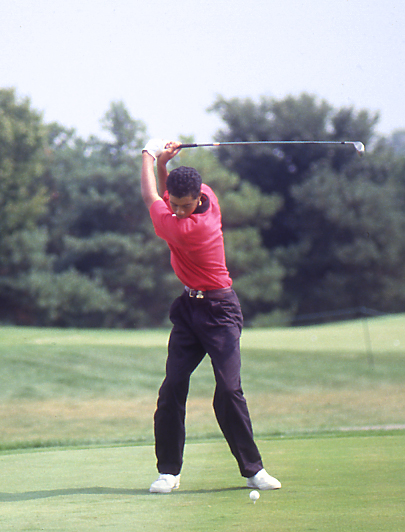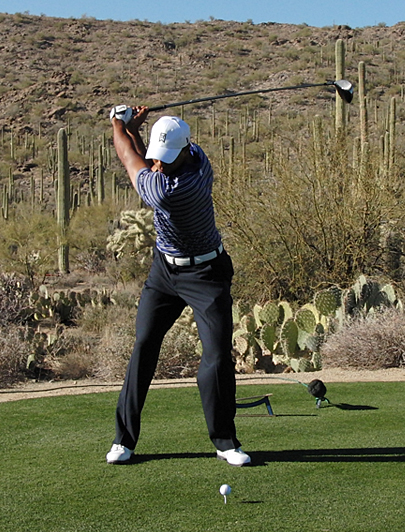
There is so much conversation about how much Tiger’s swing has changed over the years and from these photos of his swing from 1992 to 2011 you can certainly see the evolution of the Tiger Swing for yourself.
(Circa 1992-The Original)
(2011 Sean Foley move)
Jaime Diaz interviewed all five of the instructors who have worked with Tiger over the last 20 years to put together an article for Golf Digest in April of 2011. What may be most interesting here are the comments of the instructors as to how much of a challenge it was to work with Tiger.
Butch Harmon: “ I agreed with Tiger about the flaws, but I wanted to do it a piece at a time. He wanted to do it all at once.”………”When he drove the ball in the fairway, he was nearly unbeatable. That’s what I kept trying to drive into him. But it didn’t take.”
Hank Haney: “I think it’s fair to say that Butch had a better body to work with than I did. With me, he started looking more like a linebacker than a golfer.”…..”He was convinced that his golf swing was doing the damage to his knee. Everything had to revolve around saving his knee.”
What is clear to me is that Tiger is obsessed with continuing to retool his swing to “get better”. This may be his most significant flaw, his insistence on needing to remake what was already a juried piece of athletic art.
Tiger: “I’ve always taken risks to try to become a better golfer, and that’s one of the things that has gotten me this far”.
Take a look at this time phase presentation of Tiger’s swing and decide for yourself.
You know someone who travels with his buddies on golf trips and collects course memorabilia? Maybe he has already has a drawer full of golf pencils, ball markers, scorecards, or logo balls from all the places he has played. Well if you do know this guy, then here is the ideal thing for him to strut his golf travels in an artful way.
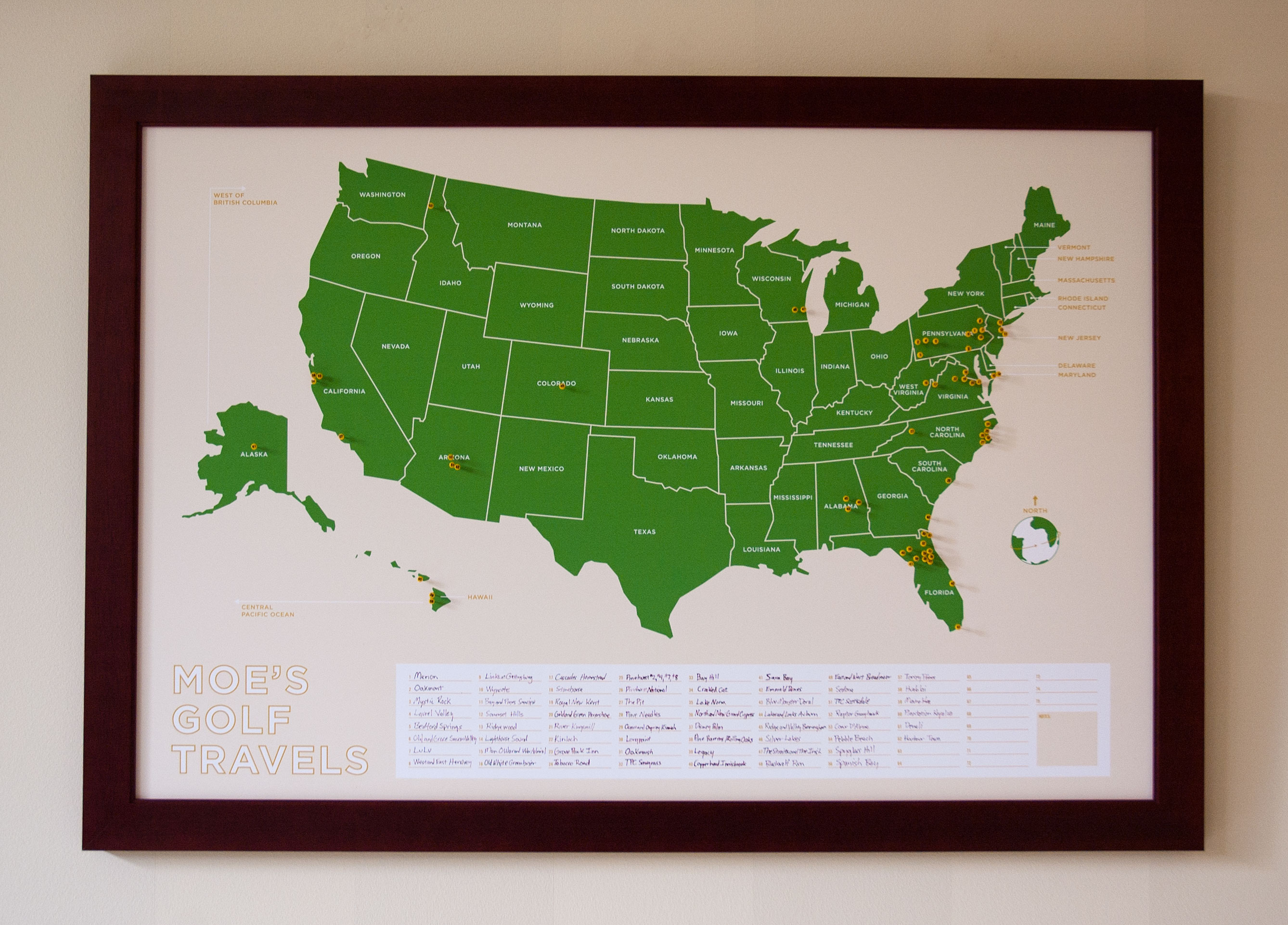
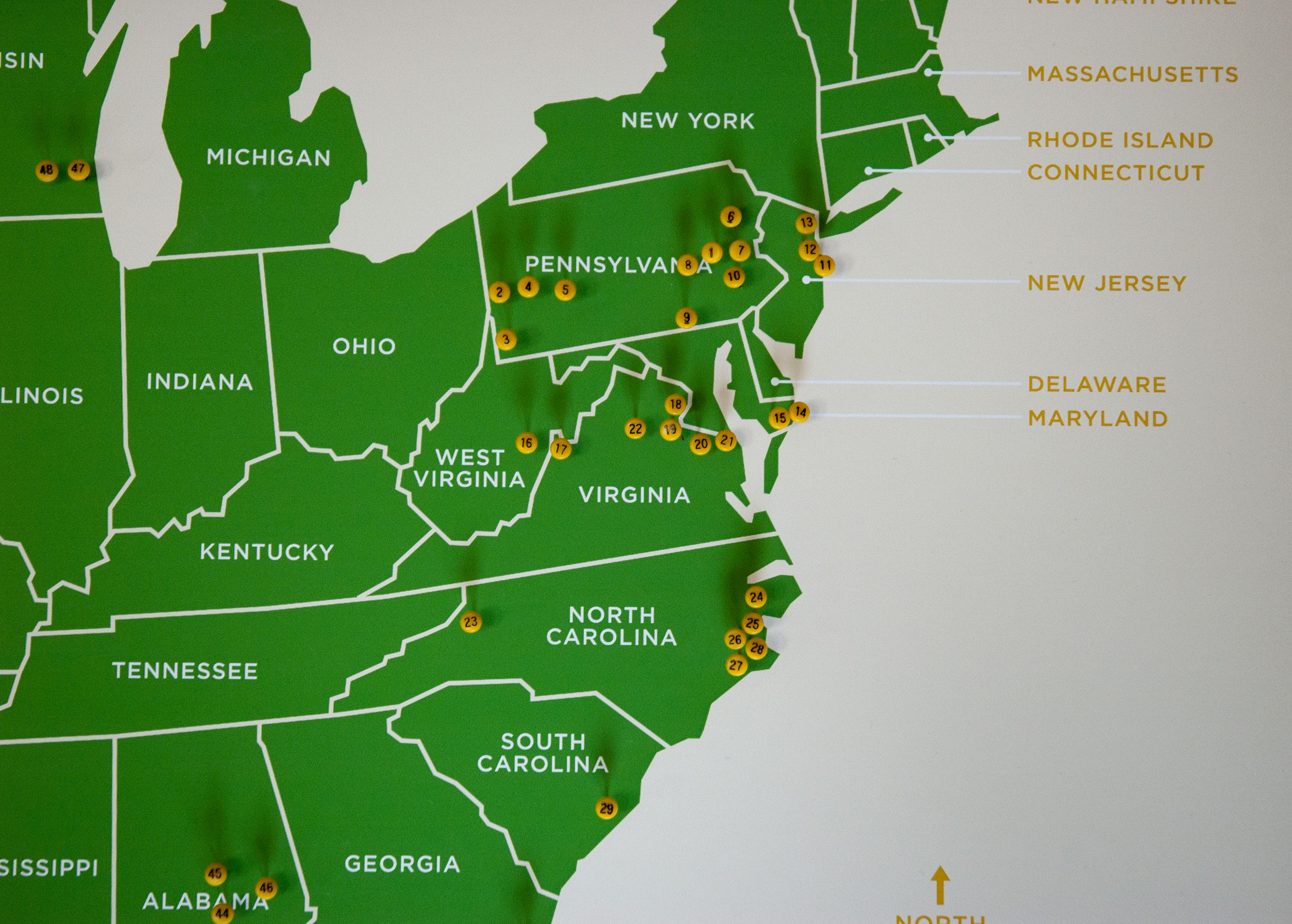
Melangerie NYC has come up with the personalized golf travel map that can adorn an office or study wall next to all those family heirloom pictures of rafting, ski, or safari trips. This 36” x 24” digital matte print of the U.S. can document all the phenomenal courses he has played.
The map and background are customized to colors your choice. Name it what you like (say “Steve’s Golf Adventures”) and it can be mounted on foam core and be tastefully framed.
The map comes with your choice of color matched numbered push pins and an area on the bottom to write in up to 75 corresponding golf destinations. Plot the pins with his golf destinations, like one of those war maps showing the Normandy invasion, and he has an artful bit of bragging rights for all his friends to see.
Makes a great stocking stuffer, a commemorative birthday present, or just something you think you deserve to have for yourself. It is an affordable golf investment that will chart golf memories for years to come.
How many times have you called your doctor’s office with a follow up question and wonder why it takes two days for him to get back to you with an answer? Well, this article by Ian Frazier in The New Yorker Magazine may have the answer.
The clue is in a quote from the article.
“So, going over the results and the X-rays—and I kind of hate to tell you this straight out in a message on an answering machine, but—well, Mr. Singer, your condition appears to be very, very serious, possibly terminal. So that’s the bad news. The good news is, you would not believe the day I just had. I am playing the best golf of my life.”
I will let you read the rest on your own……prepare to giggle.
As Rory proved to us with his runaway win at the U.S. Open following his personal debacle at The Masters this year, at the highest level of competition, it is the guy with something to prove that you have to worry about.
So after being shunned as a captain’s pick for the U.S. President’s Cup team, Keegan Bradley goes out the first two days in the WGC HSBC Champions event and shoots 9 under par to be two strokes off the lead at the halfway point against on of the elite fields of the year. He actually had the lead at 10 under through the first eight holes yesterday when he stumbled and made his first bogey of the tournament. He was on cruise control the rest of the way and is well positioned to make a run for his first WGC title come Sunday.
This is no small accomplishment for a young player categorized by many as the next great American hope. To travel half way around the world, deal with sleep deprivation and no comfort food, and be competitive against the top players in the sport is a tall order. Bradley seems focused and determined to prove to himself that he belongs and maybe to Captain Couples that a mistake was made in leaving him off the American President’s Cup squad.
I am reasonably sure that Freddie’s decision was less his own and more that of the Australian sponsors and the network with the TV rights for this event. Rightly so, Couples more high profile pick will mean longer lines at the gate and a bushel of ticks in the TV audience rating. Commerce trumps reason once again!
You can count me firmly in the camp of “I really don’t care” when it comes to the burning question “Will Eldrick ever get back to his dominant form?” So when it comes to another article about this I tend to simply to do the iPad swipe gesture and go to the next screen.
In this case though I think the opinion represented in the attached article has credibility because it is coming from Nick Faldo who, even though he can be somewhat pompous at times, usually takes the practical point of view on questions of controversy. This interview with Sir Nick by Randall Mell, a writer for the Golf Channel, confirms what I have always thought about this question, it has more moving parts than a yoga teacher on muscle relaxers and there is no predicting if Tiger will ever land on his feet.
Faldo’s main point is that since all this went down, for Tiger there is really nothing in his life that is as it was before the incident. He says, “Almost everything has changed, from the physical to the technical, the emotional side as well, everything seems different, so I think he’s still got a lot to contend with.” Further he points out that for a star athlete to be dominant as Tiger was you need locked in concentration for practice and purpose. In light such drastic changes, “quality of concentration goes. Your ability to totally engross yourself in practice for a day, that changes quite dramatically.”
On the question of whether he can win the additional five major’s it will take to surpass Jack’s record Nick says, “If this were just a golfing slump for two years . . . but it isn’t. He’s had a mental and emotional slump, and a physical one, too, because his body’s broken down, and a lot of that has to do with the pressures and the mind.”
The real factors like Tiger’s age, worn out body, questionable swing changes, tattered personal life, young family, and a major lack of self esteem just add more debris to the pile Tiger is sorting through. Add to this the fact that Earl sheltered him so much in his formative years that Tiger lacks many of the basic instincts for coping with adversity and taking personal accountability for fashioning a resolution for his problems.
I think what Faldo is correctly concluding is that it really becomes a more global question of whether Tiger can get control of his life again. A semblance of his old golf game can only come after all that gets sorted it.
The USGA and R & A announced last week the publication of new unified rules for 2012 to 2015. This is a result of an exhaustive four year process and review and modification of the 34 playing rules of golf by the two organizations.
Besides a couple of rules changes this is the first time there will be one uniform set of rules world wide-the only difference will be the language in which they are written. You might want to bone up on your Scottish.
Of the rules changes there are really only three that will likely affect you.
First, they changed the rule involving a ball moving once a player has addressed it. They added a key exception exonerating a player from penalty if their ball moves after address when it is known or virtually certain that the player did not cause the ball to move. Most obvious example we have seen is a wind gust moving the ball after address. The change in the rule is that the player does not have to take a penalty and return the ball to it’s original position. Now they simply wait until the ball stops moving and play it from the new location with no penalty. This should speed up play since many times players take extra time to be cautious when putting their ball on a windy day.
Second, if a ball is in a hazard (bunker, water hazard, etc) a player can now smooth sand or soil at any time in the hazard, including before playing from the hazard, provided it is for the sole purpose of caring for the course. They cannot do this if it will improve their lie, area of intended stance, or swing/line of play. This change should facilitate players raking other areas of the bunkers while waiting for their turn to play.
Third, a person is now deemed to have addressed their ball if they put their club in front or behind their ball, regardless of whether they have taken a stance. Since players have widely variant address processes this makes the determination of address more consistent.
They also exempted hole-in-one prizes from the stipulated prize limits for amateurs. This will make all those charitable organizations who have outings happy. Take dead aim!!
It was very early in their partnership that Bill Coore and Ben Crenshaw took on the task of designing a golf course on the rugged hillside terrain overlooking Kapalua Bay. I am convinced they needed a sherpa guide and a couple of llamas to stake out the tees and greens for their creation. What resulted was something unique, a golf course that yo-yos you up and down some of the steepest terrain you have ever negotiated without carabiners and a climber’s harness.
It is a exhilarating anti-gravitational golf experience that calls for creativity and a lot of letting go to be successful. The routing is very creative with holes working straight down and straight up the fall line of the property. The predominant wind direction was taken into account as well and together this makes the printed yardage on each hole almost inconsequential to the length the holes actually play. You can count on a 20 + breeze almost all the time which means links rules prevail, you have to control your trajectory throughout the round and taking the wind into account on your putting is essential.
The wild card factor is something I call “ground sheer”, it is the seemingly arbitrary amount of side roll out you get that will take balls to places you could never have anticipated. With this excessive side slip and a cross wind in the same direction and you need to aim into the next time zone just to get the ball into the part of the hole you can play from.
The one good thing is they made most of the fairway landing areas like Augusta, there is ample room to maneuver your tee ball to maximize your distance and still stay on the short grass. The bunkering throughout the course is very visually creative and all of them have a tactical purpose. In some cases they are baiting you to try to reach too far but more often it is just a way of forcing you to pick a good line and execute a shot to get there.
The greens are very large and often very long, which, with links rules in place, is a positive factor for managing the ball to the flag position on the downwind holes. The other architectural factor you have to heed is the segmentation and the prevailing slope of each green. You cannot simply pick a club based on a calculated approach yardage, you have to think of the shape of the shot and how it will respond on the green once it lands. Getting close to the flag is often a diversionary play, hitting it off a side bank to have it end up in the right section of the green.
The visuals on this course are in the category of Pebble Beach. Many times it is downright distracting standing on the tee looking at the back drop and then trying to focus on the target at hand. An unbelievable job was done presenting holes that boldly brandish the beauty of this unique piece of property. The versatility of this layout is that some of the most interesting views are back up the hole you just played. Bring a camera, there is a scrapbook of memories to take home with you.
Dropping Of The Table-Number 1
Click on any photo to see an enhanced view of the image
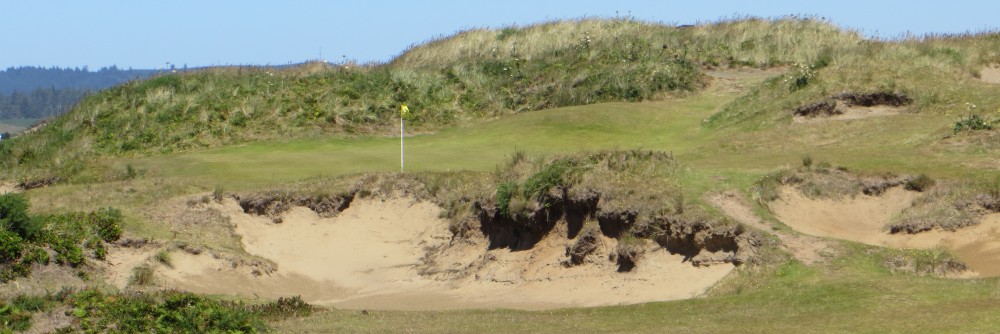
The round opens up with a hole that sets the tone for the day, a stunning downhill 440 yard par four. You drive to right center and then the ball just disappears over the hill where you can have as little as 120 into the green. The next three holes work there way back up the hill, yardage is not a factor on any of them, but positioned play is absolutely vital to getting your scorecard off to a good start. Five is a par five that has all the visual flavor you could ask for in a full round of golf. This is typical of a hole where the look baits you to try things you should not consider, showing restraint is rewarded. When you look at the sixth hole across the environmental divide as you are playing number five you may scratch your head trying to figure out what the hell these guys had going on in their head when they designed the next hole. Standing on the sixth tee of this 380 yard par four the enigma only grows. There is a huge mound containing a huge bunker sitting in the middle of the driving area. As you can see in the picture the back side of this looks like the replica of an Inca holy temple. What you cannot see is that a bold driving line between the bunker and the right abyss will feed the ball into the power slot and take the ball to foot of grandmother’s house. When you end up pulling your tee ball left of the bunker because of your subconscious defensive nature you will have to use two clubs less and the ground sheer of the back side of Machu Picchu to feed down to the green. This is where creativity and trust will serve you well.
Across The Abyss Number 8 Par Three
Your scorecard on the front will be saved or doomed by how you negotiate the next three holes. Seven is a 465 yard par four playing straight down the fall line. Picking a good line on both shots and letting gravity do it’s thing will be rewarded. Eight is a no nonsense dartboard par three across the vegetation wilderness. The exposure of the ball flight to the wind makes finding this green a real chore. Nine is almost unplayable by mere mortals, you have to hit three high quality shots into a strong headwind to an uphill target. The green complex is so difficult that even good shots can be repelled so be prepared to turn the other cheek and accept your fate on this hole.
Downwind/Downhill Par 3 Number 11
The weakest aspect to the course is the first five holes on the back side. All five are short and extremely technical holes with maximum ground sheer and probably the most exposed wind conditions of the day. The big hitters will be very uncomfortable in this section of the course muttering under their breath phrases like “unfair” and “are you kidding me”. I share their concern because the concentration of holes like this in a run seems to derail the “cut it loose” feeling from the opening nine.
Artistic Green Complex Number 15
The finish is outstanding, a series of fun holes the thoughts of which you will carry with you well past the end of the day. You cannot help but notice the guard rails that occupy the right side of the driving area on fifteen-this is a strong statement to the ground sheer right on this hole. The visual of the green complex while as stand over your second shot is very disarming. Playing the next two very demanding shots and giving yourself a birdie chance is quite gratifying. Sixteen is just another one unlike anything you have played already today. You have a decision to make as to which side of the split fairway you want to play from-that decision will change the approach shot considerably. If you have watched the annual PGA Tournament of Champions played here each January you are familiar with these two finishing holes as the most severe downhill holes they play all year. The first of the two falls below your feet like bungee cord jump waiting to happen. Elevating the ball down the center the ball will disappear from sight and just keep rolling until it reaches the bottom of the hill about 300 yards away. The second is a real beauty across the trouble to a green clinging precariously to the hill above you. Managing the roll out of this shot is trick-the contour of this green will be kind to the right shape and trajectory of approach.
Hanging Chad-Number 17 Green
This final hole so often determines the winner of the PGA event each year-the pros can make anything from 3 to 7 and you will be amazed you have the same proposition facing you. You aim your drive at the clubhouse right of the fairway and, to your amazement, when the free fall of your ball and the ensuing roll out is done you are pinned to the left edge of the fairway almost at the bottom of the hill. The downhill second shot is within reach of the putting surface but you must aim well right of the green and let gravity do it’s thing again.
Final Approach to #18 from around 235
If you are not on, the ensuing pitch is like trying to stop your ball on the hood of a Mini Cooper, it will take full creativity and use of the ground to pull this off. The coolest part is that if you play this hole well you did it in front of everyone lunching in the clubhouse grill overlooking the entire hole. You can just feel the appreciative applause. These last two holes are an adrenaline rush like you have never experienced before on a golf course.
Maui, Hawaii
Designers: Bill Coore and Ben Crenshaw (1991)
Tees Par Yardage Rating Slope
Championship 73 7263 74.9 138
Regular 73 6547 71.7 130
If you would like a printable PDF of this posting including yardage book quality hole-by-hole descriptions of how to play the course click the moegolf logo below.
We recently played the Plantation Course at Kapalua which hosts the Tournament of Champions in January, the PGA Tour’s first event of the year. For those Golf Channel addicts who are golf deprived in January it is a ritual for us to take in the vicarious thrill of watching the 30 winners of last year’s tour events play this magnificent course in Maui.
The protagonists-Moe is the taller one by virtue of the curb.
Owned by the Ritz-Carlton this place pulls out all the stops when it comes to presentation.
The hallway of champions is owned by Aussie Stuart Appleby who has a three-peat in this event.
Bill Coore and Ben Crenshaw designed this majestic course with it’s breathtaking vistas above Kapalua Bay.
Click on any photo to see an enhanced view of the image
You get looks like this on Number 7 tumbling down toward Kapalua Bay with the remote island of Molokai in the background.
Some holes are beyond description like this view of the back side of the replica Mucha Picchu burial mound that feeds down to the 6th green.
Kathy was up for the challenge across the environmental abyss on the par 3 8th where she hit it to 4 feet and made birdie.
To say the elevation changes here are severe is an understatement. Where else do you see guard rails running up the side of the fairway.
The wind always blows big time. But as you can see here on the par 4 12th the golf gods smiled on both of our approach shots and we made birdie-par as a result.
As you would imagine in such a place there are some modest homes overlooking the course. This little bungalow on the high ground above #16 even has it’s own practice green in the back yard.
Number 18 is an iconic finishing hole with a 150 foot drop from tee to green.