Loose Lips

They say that as we get older we lose our conversational filter and share thoughts with others more freely than we would have in our youth.  So it is in a mythical conversation between Byron Nelson, Sam Snead, and Ben Hogan during “magic hour” overlooking the 18th green from the veranda at Vahalla.

In a piece commemorating the 100th anniversary of the birthday of three giants of the game, Mark Frost, our generation’s most talented golf historian, shares with us their intimate thoughts on the condition of today’s game.  He captures the individual persona’s of these iconic figures eavesdropping on their  19th hole banter covering everything from how they used to walk five miles to school through the snow with holes in their shoes to the lack of defining personalities on tour to the effect of technology on the game today.

“The ball’s more jacked up than a Cuban cocktail,” says Sam. “They drive it with thunder sticks the size of toasters and can dial in distances with five different wedges like they’re firing a mortar. And these courses they play get more manicures than a Las Vegas hooker.”

They even weigh in on the fire hydrant incident and the likeliness that it’s protagonist can ever regain his position on the top of the heap.

Cleverly written this piece will make you laugh and contemplate in equal measure.  As only Mark Frost can, he brings refreshing historical perspective to the way we view the game today.

(Click to read Mark Frost’s “Drinks In Vahalla”)

Golf Digest Canada

April 2011

A Golfer’s Education

After reading the outer jacket of this book and realizing that Darren Kilfara, a junior at Harvard,  had succeeded in staging the ultimate golfer’s year abroad at the University of St. Andrews, all I could do was administer myself a dope-slap and mutter to myself, why didn’t I think of that?  Of course at 54 years of age that was water under the dam.  The only thing left to do was experience it vicariously by reading his travelogue memoir of youthful golf discovery.

What unfolds is an articulate and perceptive tale of his discovery of the charm of Scotland, golf in Scotland, and links golf in particular.  Along the way he realizes there are American golf biases, like religious commitment to the scorecard and pencil, that he needs to abandon, as well as unexpected subjects that need intellectual attention, like course architecture, if he is going to come away from this immersion process with a fuller understanding of the game of golf.

The book chronicles golf courses you are familiar with and one’s that you should become familiar with.  His student life sketches a refreshing ground level view of life in Scotland.  Through his experiences he jettisons his engrained perceptions of what golf is about and embraces the mysterious rapture of links golf  it’s unique challenges.  He comes to learn why those who play links golf think it builds character and enforces humility teaching us to cope with the challenges of our lives with a more realistic perspective.

Of Golf in Scotland:

“Many people still walk from their homes to the first tees, especially at linksland courses near town…you cannot be too low on the social ladder to play golf in Scotland.…The golf club is a fundamental component of the Scottish community at large.”

“In Scotland “putting” is a recreational activity in it’s own right.  Virtually every city, town, and village has at least one putting green available for public use.”

Of the Beauty of Scotland:

“A breeze whistled softly across the gorse, tugging gently at the sleeves of my jacket.  The dying embers of autumn  flickered in the darkly proud gorse, in wispy fields of soft beige and muted green….. The stillness, the ethereal peace of the moment overwhelmed me.  The earth itself reposed in contentment: miles of tiny, pimpled dunes beyond …..mirrored my goose bumps….beckoning me away.  In the near silence I stood: alone, yet not alone.”

Of Links Golf:

“I loved the way the conditions challenged my imagination…..I loved the strategic impositions of the wind, and the obligation to attack on even the most difficult downwind holes for fear of losing ground on the upwind ones.”

“In the wind the truth of score becomes subjective….The Scots have a solution…Match Play.  On windy days there are three options:  stay inside, forget about par, or measure your progress against a friend and neighbor instead of counting strokes”

Of  Scottish Courses:

“Cruden Bay is a flawed work, some of it’s holes downright weird.   But the composition as a whole was incontestably dramatic, unceasingly moving, and, at times, breathtakingly beautiful.”

“Machrihanish also possessed a staggering repertoire of memorable holes; at each of the first eight holes I glimpsed a different vision of links nirvana.”

“That’s how (Royal) Dornoch works.  Strategically speaking, it lulls the golfer to sleep.  Dornoch is never penal, and average golfers will be buoyed by the absence of visible hazards.  But every hole has an optimal angle of approach.”

“The Old Course certainly grows on you: round by round you absorb it’s intricacies.  And sooner or later, you find yourself playing left and creating doglegs because you want to, not because you’ve been told to, an important collaboration between pride and intellect that can yield decisive results on your scorecard.”

Even a Ferris Bueller Episode:

Describing an inebriated session of “Street Golf” in downtown St. Andrews with a couple of undergrads,  “We’re just underway…tee off at the University Library a short time ago.  The hole is a vodka bottle in Miss Scarlet’s room which is on the fourth floor of New Hall.”

This book is readable and engaging-you will enjoy it for it’s insight, a strong dose of Scottish golf history, and some college self-deprecating moments you can probably relate to.  For those traveling to Scotland to play golf it is a great primer, for those who have been there already it has it’s scrapbook moments.

(For additional background click to read a Golf Atlas interview with the author)

A Golfer’s Education

Darren Kilfara (2001)

Improv

Once again the theater of the final round of the Masters did not disappoint, there were so many stories going on at the same time it took a white board to keep up with all the possibilities down the back nine.  What stood out for me is what the pundits always say,  the pin positions and contours of Augusta National reward creativity and imagination when coupled with clear decision making and precise execution.  In other words, improvisation with a purpose.

No one improvises better on every shot he plays than the winner, Bubba Watson.  A throwback to the old days of shafts that bent and wound balls with lots of spin, Bubba intentionally curves the ball more than any player out there.  The ultimate feel player he craftily wields that pink shaft on his Ping driver manipulating his hands and wrists to create the curve he sees in his minds eye for the shot at hand.  His philosophy is simple, “If I have a swing, I have a shot.”

The shot he played on the second playoff hole may be one of the ultimate golf improv bits we will ever witness.  He was hitting off of the pine straw, out of a hallway of pines from 155 yards with no sight line to the green.  He had to curve it a good 40 yards just to get it toward the target and managed to snuggle one in there about 20 feet below the hole to set up the winning par.  This was like looking over Michelangelo’s shoulder as he dabbed just the right amount of paint to a cherub’s cheek on the curved Sistine Chapel ceiling from his back.

The day was full of improvisational wizardry.  The Sunday pin on the 14th hole alone required a misdirectional approach that many of the players used to set up a crucial birdie in a charge at the lead.  Two timely holes in one on sixteen-Adam Scott and Bo Van Pelt-were the source of thunderous cheers pretty early in the proceedings.

But the most incredible existential result of the day had to be the tremor created by Louie Oosthuizen’s albatross double eagle on the 2nd hole that propelled him to the top of the leader board.  From a good 260 out he lashed a long iron down the hill that landed on the front of the green and then rolled a half acre or so up the green, banked hard right, and sought out the hole as if the ball had eyes.

The most amazing thing to me is that neither Oosthuizen or Bubba, who witnessed this feat first hand, let it change their approach to playing the next 16 holes.  What transpired after that was just some of the most competent competitive play by band of leaders that you can ever imagine.

In the end, when the key putts did not drop for Padrig, Phil,  Hanson, or Westwood or when an errant swing on 16 derailed Kootch, it just seemed that Bubba and Oosthuizen were feeding off of each other’s calm and making all the key shot that mattered to get to a playoff.

The first playoff hole was riveting as both guys thumped it well up the fairway, granted Bubba’s thump was about 30 yards longer than Louie’s, and put the ball on the makeable side of the hole into the 18th green.  The two birdie putts missed by a total of two inches and sent them to the 10th for one more go.  After Bubba side swiped the Pink Lady and sent his drive careening into Sherwood Forest Louie need to just stub one down the center and give himself a good look at the green.

Here Louie blinked-hitting it wild right as well he caught a tree and ended up a good 250 from the hole on the edge of the right rough.   Failing to reach the green on his second gave Bubba Wizardry the opening, and I use that term facetiously, to work his magic.

It may seem hard to live with this result for Oosthuizen, but he played a mench of a final round in a major.  It will be just for him to wonder how it wasn’t his day after the folkloric shot on two seemed to destine his name for a cubicle in the Champion’s Locker Room.

April, 2012

Being Phil

In the old days when you heard the pundits invoke this phrase it was usually because Phil Mickelson was trying some hair-brained escape artist shot which was destined to go awry and kill his chances of winning a tournament.  He just seemed to have an irrepressible urge to pull off the most risk laden play when something more conservative would have served his interest.

But now “Being Phil” has taken on an entirely different connotation, it is the rare display of a superstar stepping off of the pedestal to say or do what is right rather than what is in his self interest.  This is a refreshing sight in a time where most of the famous from the entertainment world seem incapable of seeing beyond their own reflection and taking in their larger image in the world around them.

Two mentions from Tom Boswell’s Washington Post column “Masters 2012-Peter Hanson And Phil Mickelson Have Inspired Each Other” reflect how, as a result of so much personal experience, good and bad, Phil Mickelson has become comfortable with himself and his responsibility to practice behavior we can aspire to.

In spite of having a one shot lead, Peter Hanson is the underdog, the dark horse going into the final round.  His inexperience in the pressure cooker of the final group on the final day of a major would make him easy prey for a fellow competitor to diminish or simply ignore.  Yet Mickelson spoke with respect and admiration for what Hanson has done so far in earning his way into the final group on Sunday.

As Boswell says, “MIckelson…..was equally impressed with the show Hanson provided in front of him. Phil said, ‘Watching him hole putts on 15 from the fringe, on 17.  On 18 he knocks it to a couple of feet.  He just played phenomenally.  It’s very difficult to try to follow those kinds of birdies when you’re watching it right in front of you’.”

Phil knows he has the advantage of fame and competitive reputation on his side but he feels no obligation to take advantage and assert it on his adversary.  By resisting this temptation, he elevates the game of golf to a standard of sportsmanship most other athletic competitions seem incapable of displaying.

Phil also has a reverential respect for the greats of the game who paved the path before him and have provided him with the opportunity for personal fame and fortune.

“On Thursday, Arnold Palmer, Gary Player, and Jack Nicklaus hit the ceremonial first-group tee shots a 7:40 a.m. That day, Mickelson’s tee time was the very last group of the day, a full six hours later.  Yet Phil was there to shake the hands of the Big Three..a gesture that surprised and touched all three, especially since no other famous current stars showed up.”

This is the same respect that Phil carries for the multitude of fans that support him and provide the financial feedbag from which all the pros feed so voraciously.  Unlike most of the guys out there, Phil exchanges high fives with fans along the walkways between holes, makes eye contact with strangers who seek out his attention, and even provides an engaging hug to a more familiar acquaintance.

There are those who have questioned his judgment in playing the game early in his career but it is hard to ignore how this same guy has embraced with dignity and respect the competitive atmosphere in which he works.

As Boswell concludes, “Much that once seemed like Phil schmaltz when he was young and bumptious now seems mature, genuine and generous.”

April, 2012

Augusta Serenade

There is nothing more fun than watching old folks sing a song from their youth.  Watching Freddie shoot 67 at Augusta National today to take the second round lead of the Masters at 5 under par is about as fun as it gets.  He sure looked like he was having a good time singing that tune.

In his Los Angeles Times article today Bill Dwyre says, “With a golf club in his hands, Couples is 52 going on 30………In senior citizen centers all over the country, they were high-fiving each other with walking sticks and demanding extra warm milk”.

Augusta National brings out the best in Freddie’s game it always has.  He made the cut there about a bazillion times in a row and won the Green Jacket in 1992.  As Dwyre points out, Freddie has earned well over $2 million walking among these azalea bushes.

If you doubt that he can win this thing just note the spring in his Eccos and the magic in his putting stafff.  In his own words, “Can I win? I believe I can, yes”.

If it was cool to see Jack win the Masters in 1986 at 45 years old, how awesome would it be if Freddie pulled off the same at age 52?  Adrenaline meet nostalgia.  Freddie is seven years younger but this has that misty feel of Watson at Turnberry in 2009.  We just hope that father time doesn’t pay Freddie a rude visit between now and the final hike up 18 on Sunday.

Any way you look at it, there will be legions of Grecian Formula fans rooting for Freddie to keep hope alive for another two days.  Freddie in a Green Jacket when the Fat Lady Sings……that would be cool indeed.

(Click to read Bill Dwyre’s “Putting, Not Puttering, Couples Shares Masters Lead”)

Bill Dwyre

Los Angeles Times

April, 2012
moegolf on Facebook

We are happy to add a social media component to the moegolf network with the addition of Moegolf on Facebook.

This will allow us to post some additional stuff that comes across our radar screen that does not appear on the moegolf website. Same approach-just interesting tidbits of golf content that we find out in the world-wide interweb.

We will also post links back to our regular content on the moegolf.net website for those who choose Facebook as their primary link to our world.

You can get to Moegolf on Facebook through the Facebook icon on the right column of the moegolf.net website or use this link to get there directly:

http://www.facebook.com/moegolf.net?bookmark_t=page

Augusta’s First Perch

For an amateur who has had the privilege to play The Masters their experience at this revered place began in “The Crow’s Nest”, a secluded living space in the upper reaches of the Augusta National clubhouse.  Many of those amateurs return to play again, many of them become winners of the coveted Green Jacket.  But for all of them, the first Masters memories they have are of this cloistered living space and times of discovery shared with other young men they lived with that week in Georgia.

.

Dave Kindred’s wonderful Golf Digest article “Boys To Men” describes the experience of living Masters week as an amateur in the Crow’s Nest at Augusta National.  Through stories told by the young players who carry first images of the place indelibly etched in their minds, he reveals what a rite of passage it is for a player to unveil the mysteries that surround the hallowed place that Bobby Jones built.

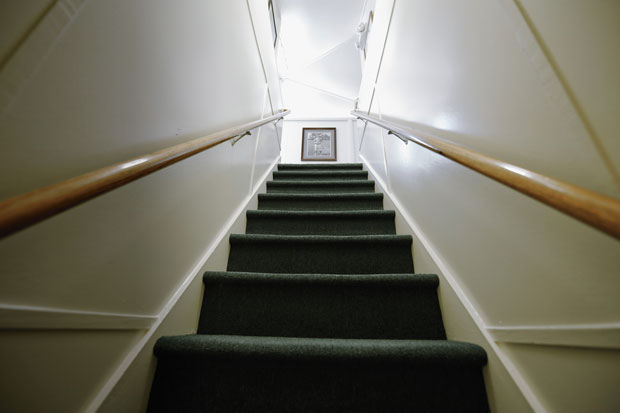
Stairway to heaven? (Don Furore golfdigest.com)

The challenge begins with finding the Crow’s Nest.  There are no signs, no directions offered to where it is-just that it is on top of the clubhouse above the second floor.  They eventually discover through a door on the second floor marked TELEPHONE, down a hall, another innocuous looking door that when opened reveals a carpeted stairway that looks like it is ascending to heaven.  Appropriately there is a portrait of Bobby Jones himself staring down at them from above at the top of the stairway.

.

The rooms are simple but somewhat surreal.  Kindred says, “If not a dorm room–the place whispers rather than shouts–it might be your grandmother’s place: quiet, cozy, immaculate. Its ancient timbers are painted a white as pure as that of the robes, fringed bedspreads and bathroom ceramics. Sunlight falls in from the high cupola’s four sets of windows. The room is all shining whites and Masters greens.”

.

These are stories of 20 year olds who are living a childhood dream of playing in a major tournament and the last thing they were thinking about was decorum and rules.  Indiscretion has them climbing on to the roof in their skivvies to check the morning weather or walking into prohibited places like the Champions locker room or hastily trying to make it to their tee time and nearly running down Gene Sarazen or Byron Nelson in the hallway or staying out so late that they have to clandestinely climb the fence to get back on the property.

.

The black and whites on the wall make you realize this is a place of great history.  “Lloyd Mangrum signs autographs for wounded soldiers. Gene Sarazen and Byron Nelson walk to the sixth green. Lean and hungry, his arms a blacksmith’s, Arnold Palmer stands in a fairway, young, strong and alive.”

.

It is like sleeping in a museum  with voices of the past  whispering from the rafters. This article is a scrapbook of the compiled memories of greats like Nicklaus, Watson, and Crenshaw and lesser greats like Billy Andrade, David Chung, and Don Cherry.  Recollections of youthful fascination and discovery provide a unique perspective on the eve of the annual ritual we call The Masters.

.

(Click to read Dave Kindred’s Golf Digest article ‘Boys to Men’)

.

Dave Kindred

Golf Digest April, 2012

Virginia Artistry-A Talk With Lester George

In the attached interview with Golf Atlas, Lester George discusses his approach and philosophy to course design.  It is an insightful conversation with an accomplished course architect who you ought to get to know.

Lester George is not one of the names that generally comes to people’s lips when they talk about the architects of this era, at least not yet.  Given the quality of work that he has done since 1991 on the eastern seaboard and beyond in renovation, restoration, and new course design, the recognition he deserves as one of the best course designers in the region is not that far away.

As this extensive interview reveals, he is a bit of an old school type architect, knowledgeable and respectful of the approach to strategic design and classic style holes of the greats of the Golden Era of course design.  His recent restoration of C.B. MacDonald and Seth Raynor’s Old White Course at the Greenbrier (circa 1914) is a good example of this.  He labored studiously over old renderings and aerial photos of the course, rolled back changes made by others over the years, removed tree growth that had compromised the original design, and brought back to life the living and breathing intention of these two classic designers.  The PGA Tour has embraced this classic course as the host of the Greenbrier Classic.

My first experience with one of his designs was when I had the opportunity to play the Kinloch Golf Club outside Richmond.    Lester did this course with the advice and assistance of one of the great Virginia amateurs, Vinnie Giles.  Their collaborations revealed in great detail shed light on one of Lester’s strongest attributes, his ability to recognize reasoned advice, process it,  and turn it into design results.

Which way today-Kinloch #2 (worldgolfatlas.com)

One of the most interesting aspects to the design at Kinloch are the number of holes with alternative playing routes.  Number 2, 4, 9, 11, and 15 all have two distinctly different playing lines you can take on the hole.  As Lester says of playing the second hole  “Many things factor into the way I approach the second, including the tee I am on, the wind, the hole location, and the way I am playing”.   The concentration of this many strategically variant holes on the same course demands full focus on thoughtful course management.

(Click to read the moegolf Kinloch Golf Club review)

A more recent addition to his resume is startlingly bold design of Ballyhack Golf Club in Roanoke, Virginia.  Built in the tradition of Scottish highland courses, it has dramatic flow and some of the fiercest bunkering you can imagine.  Lester’s description of the process of bringing this course to life is testimony to his dedication to bringing out the ground what his mind’s eye perceives.  The Ballyhack Virtual Course Tour from their website will take your breath away.

Ballhack #9-this is no where to end up (worldgolfatlas.com)

Take the time to read this wonderful interview with a relatively unknown course designer.  Once you are familiar with him,  I am sure you will be seeking out opportunities to see his work first hand.

(Click to read the Golf Atlas interview with Lester George)

Feature Interview

Golf Atlas Website

2011

I’m an IBMer

Ginni Rometty is the new CEO of IBM and one of the main architects of the reinvention of this old line technology giant. Under her influence IBM has embraced cloud technology as the centerpiece of their product and service offerings and , as a result,  their company shares are at the highest valuation in their history.

As their new ad campaign boasts this makes her the #1 IBMer in a lot of ways.  She is entitled to all the spoils that go with responsibility she has embraced, including a membership in one of the most exclusive all boys fraternities in the country, Augusta National Golf Club.

Augusta National has a history of extending membership to the chief executive of IBM, one of the main sponsors of The Masters each year, as well as the top executives of other fortune 500 companies like Coke, GE, Rockwell, and more.  As Sally Jenkins points out in this Washington Post article, “Inherited money doesn’t get you into Augusta, nor does status or reputation alone.  The best way to become a member is to shark your way to the top of a large American Company…..Rometty earned her way into a winner’s circle that is genderless.  Her defining characteristic is not that she’s a woman but that she has a talent for corporate victory”.

By process alone it seems that Augusta National has an opportunity to put into it’s rear view mirror past criticism of it’s penchant for male only membership.  Most important, they can do this on their own terms and not “at the point of a bayonet” as Hootie Johnson characterized it back in 2002 when women’s rights advocate Martha Burk tried to force it on them through her unsuccessful parking lot demonstrations down the street from the club entrance.

Seems to me that if the membership committee of Augusta National really means what it has said in the past, women will eventually be members of this austere club, this is their opportunity to pull it off seamlessly, without fanfare, and for a reason that fits with their policies.  As Sally concludes, “If Rometty does slip on a (green) blazer, it will be quietly, for the simple reason that, in business, she plays from the tips”.

(Click to read Sally Jenkins article about Augusta National and Ginni Rometty)

Sally Jenkins

Washington Post

March, 2012

Kraft Nabisco Recipe

You have to think the one with all the ingredients to win this week’s first LPGA Tour major is Yani Tseng.  She has won three of her first five LPGA events in 2012 and missed a playoff in both of the other by a smidge.  She is number one in the world by a solar system having won 35 titles world wide in her young career.

At age 23 she is already plying her way into the LPGA Hall of Fame with five majors to her credit, including a win here in 2010, and ten other LPGA wins.  She has a scoring title and two player of the year awards in just five years on tour.   A combination of one more major and two more LPGA wins and she will reach the mark to qualify for the LPGA Hall of Fame.

The entire top 50 in the world will be at Mission Hills so there are plenty of quality players who could throw some chalk in Yani’s batter.  Na Yeon Choi, the #2 player in the world, Suzann Pettersen, a fierce competitor and probably the best athlete on the tour, Stacy Lewis, the defending champ, Ai Miyazato,  whose knee socks are always in a final group, and South Korea’s Jiyai Shin bulldog tough with a major and 8 LPGA wins to her credit.

Yani displayed her displeasure at not repeating in 2011 (Beth Ann Baldy)

Having said all that this tournament, with a winning score often double digits under par and a reachable par five finishing hole, has sported some real drama and been the break through major for a number rising stars.  Stacy Lewis won her first major here with a steely final round performance in 2011, Brittany Lincicome eagled the final hole in 2009 to grab the title, and feisty Morgan Pressel had the game to win in 2007.

But if you are looking for an American to break through I think it is going to have to been one of the young-ins.  Lexi Thompson is only 17 and will be playing in her first major as a pro and she has the length to humble this course.  Jessica Korda at 19 won the Women’s Australian Open at the iconic Royal Melbourne in February, and Michelle Wie, having finished her studies at Stanford, says she is ready to put full attention to reaching all that potential we have been discussing for the last 8 years.

In the end someone will have to work Yani Tseng over with a rolling pin to grab this trophy because with twelve wins last year and five already by April she has a head of steam that is going to be hard to staunch.  Unlike Annika before her, Yani is no maven in the kitchen, but I think when it comes to finding the winning recipe for this Kraft Nabisco she has pantry shelves of experience that make her the master chef.

March, 2012