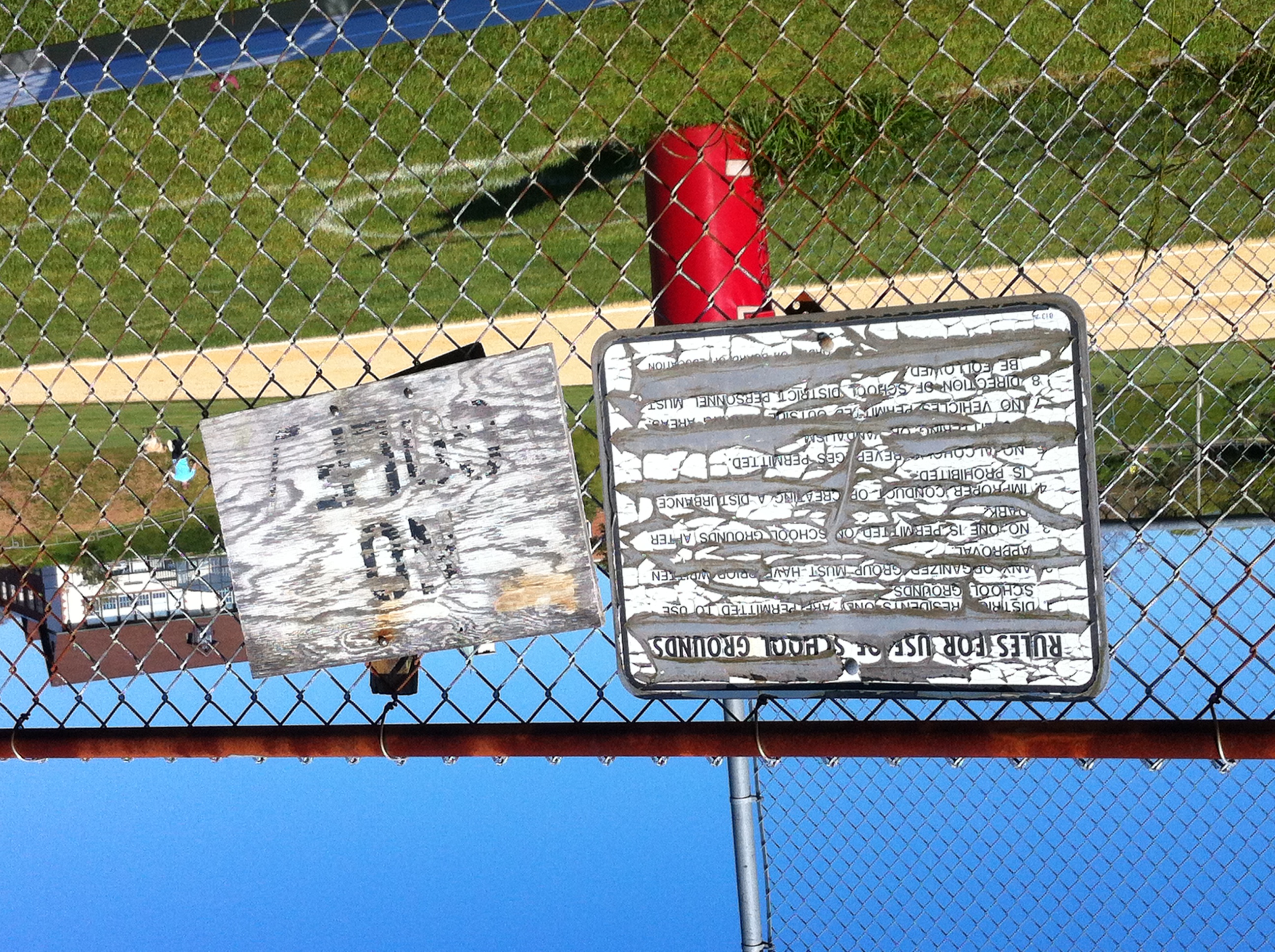
Apparently the end is near……
Montauk, NY
May, 2012
Apparently the end is near……
Montauk, NY
May, 2012
A physicist can describe the perfect golf swing and write it down in scientific language, but the smart golfer doesn’t read it. The smart golfer gives it to his opponent to contemplate.
Fran Pirozollo, Sports Psychologist
May, 2012
Winners see what they want. Losers see what they don’t want……. (Golf is) hitting an object to a defined target area with the least amount of effort and an alert attitude of indifference.
Moe Norman
As related by Lorne Rubenstein
Moe & Me (2012)
On the PGA Tour there is a definite changing of the guard going on and the good news is the new guys are not wearing Cue-Tip hats. For the first time in a long time it seems that all the hay that is being made out there is not from guys with foreign passports but by young or up-and-coming Americans.
Of the 20 sanctioned PGA Tour events in 2012, 17 of them have been won by Americans. Only 30 year-old Hunter “Wrap Arounds” Mahan has two wins. Other winners include guys with real game and engaging personalities like Brandt “Opie” Snedekar, John “?” Huh, Bubba “Are You Kidding” Watson, Ricky “Orange Futures” Fowler, and Matt “The Cheshire Cat” Kucher.
The freshest face of them all has to be Kootch, he is no newbie but his real talent finally seems to be jelling in his young 30’s. Characterized as an ATM by Johnny Miller, he has been the most consistent performer on the American scene for a good three years now. His Cool Hand Luke performance at The Players confirms that this man has the demeanor and the game to win on the biggest stages.
Kootch was always considered a “can’t miss” from when he won the U.S. Amateur at Cog Hill in 1997 and backed it up the next spring with two great rounds at The Masters with defending champ Tiger Woods and a tie for 14th at the U.S. Open at the Olympic Club. But it took a trip through all three of Dante’s levels over his 12 years as a pro, including a retreat stint on the Nationwide Tour, to find his ballast and his game. With the Open returning to Olympic this June and his ability to turn his drive in either direction to work against those side sloped fairways, Kootch has to be the favorite going in.
Let’s not forget that this is also a family man with sensible values. He approaches his game with an ever present smile and sufficient humility acknowledging how lucky he is to be making a living doing the thing he loves to do. Match that with competitive confidence and an ability to let all bad things slide off his back and you have something unique in the golf world today-a role model for your kids.
Then there is the Tropicana spokesman on tour, 23 year-old Ricky Fowler. As Eddie Murphy used to say about orange futures, “Feelin Good, Louis!”. Ricky is certainly feelin’ good about his game and his rapid ascension as a potential rival to that other 23 year-old Irish phenom.
What we have seen the last two weeks with his win at Quail Hollow and his riveting runner-up place performance at The Players is possibly the most charismatic American package of raw talent and competitive verve since Arnold Palmer. The swing, the sashay, the entire citrus package is original as well as commercially and competitively viable.
Throw Bubba and his transcendent performance at Augusta into this mix and you have to say that American golf has a new gulf stream blowing. Davis Love III has to be licking his Ryder Cup Chops right now working the Excel spreadsheet on potentials for his squad a Medinah this fall.
May, 2012
“He’s got the jockey whip and is laying it on these couple of days. I’ve got my leather underwear on.”
J.J. Henry on his looper Mark Brooks, former PGA Champion, handling his bag for the week at the 2012 Players Championship.
Geoff Shackelford.com
May, 2012
 As the first iteration of Dean Beman’s stadium course concept and the permanent home of The Players Championship, Pete Dye put together a course that would challenge the best players in the world and create iconic images in the minds of golf fans. The original design was impossibly difficult and somewhat controversial, but a bottomless well of tour money has allowed them to continuously tinker and improve the layout and get much more unanimous professional approval as a result. The reconstruction of the fairways and greens in the last decade plus the introduction of Sub-Air technology under the putting surfaces allow the tour to prepare this course as hard and fast as they desire.
Dye’s hazards do not discriminate on whom they inflicted scoring damage
Make no mistake about it, there is nothing timid about this course. Pete has a garage full of intimidation factors in his design repetoire and he dipped into that reserve generously in putting this together. Massive waste bunkers, huge mounding to mask landing areas, plumes of sage grass, and water galore amassed together make for a house of horrors to the average player. Truth is the intimidation is more psychological than real so the trick is to look beyond the surface veneer and focus on a playable line to each hole which he graciously provides. The combination of intelligent decision making and unwavering focus on a playable line can make for an enjoyable day.
Looking at the winners of The Players over 30 years you will see the unexpected names like Calvin Peete, Mark McCumber, Tom Kite, Lee Janzen, Justin Leonard, Fred Funk, and K. J. Choi. Look at runners up and you have Larry Mize, Mike Reid, Jeff Sluman, Glen Day, Jay Haas, and Scott Verplank. Occasionally a name guy like Eldrick Woods or Philip Alfred Mickelson has seen success here.The common denominator is accurate driving and competent putting on fast greens.
Tiger has a few of these in his trophy room
Embed from Getty ImagesAnything out of the fairway off the tee increases the challenge of hitting greens by a factor of 1.5 and the score goes up accordingly. This is target golf with serious penalty for missing your intended shot lines. The fast greens are very segmented and steeply sloped so regularly putting from outside the section that has the flag will have similar deleterious impact on your scoring.
As is recommended by the yardage book, pick a tee marker that is appropriate for you skill level. If your average drive is 235 or less play white, 235 to 250 play blended blue/white, over 250 play blue. Don’t consider the back tee unless you have your name embroidered on your golf bag. The key is to have the driving areas reasonably within your range so you can actually enjoy the challenging approaches into the greens.
At 220 yards plus the Par Three 8th has bedeviled it’s share of scorecards
Embed from Getty ImagesThe sequence of the golf challenge is carefully architected. Both sides start a bit easier with scoring opportunities early, but ratchet up considerably around the fourth hole. The last three holes on both the front and the back make keeping a score in tact a whole lot of work. The eighth hole is a brutal par 3 7/8ths and the ninth can eat your lunch six ways to Sunday. Better than the finish at any of regular tour stops, sixteen, seventeen, and eighteen collectively present opportunity for glory or disaster in equal measure. This is target golf at it’s most extreme.
Personally I think the par 5 sixteenth is one of the coolest holes out there. For the long hitting pros going for the green in two is a must but there is a huge penalty for bailing out left to avoid the harrowing water that encroaches on the right. Any wind at all makes this huge green very elusive.
Sergio has experienced the thrill of victory and the agony of defeat at the 17th
Embed from Getty ImagesNothing more need be said about the iconic island green at 17, you have witnessed a boatload of heartache and misery in HD watching the broadcasts over the years. The eighteenth is as hard a par to make as you could ever imagine. Missing your approach into the grassy moguls right of the green can lead to a downright embarrassing sequence of recovery attempts.
In the last renovation they built a clubhouse that is worthy of being the home of the PGA Tour. You will find an endless offering of tour memorabilia to add to your study. The locker rooms, eating facilities, and practice areas are something to experience as well.
Playing the course that so adequately bevils the top 50 in the world each year is definitely a thrill. Just play it at a reasonable yardage and don’t beat yourself up if Pete and Alice have their way with your scorecard.
Ponte Verde, Florida
Architect: Pete Dye (1980)
Tees Par Yardage Rating Slope
Blue 72 6661 73.9 146
White 72 6103 70.9 137
(Click here to review TPC Sawgrass hole-by-hole descriptions)
When it comes to American golf writers there is little doubt that, as Bing Crosby said, Herbert Warren Wind was the dean of them all. In this article by Furman Bisher for Sports Illustrated he talks of Wind’s personal relationship with Bobby Jones and his special connection to the The Masters.
There is a stateliness to the fabric of The Masters. Much of it has been the result eloquent descriptive writings of people like Wind who seared dramatic images into our memory banks of the golf contested at Augusta.
Bisher knew Herbert Warren Wind rather well, “He and I were, in our prime, course walkers, and there we came to know each better than we would have otherwise. We followed the game wherever our inkling took us, and there was no more inviting venue than Augusta National when the Masters was in play.”
Bisher pays the highest tribute to Wind when he says, “When one writer writes of another writer, such as Herbert Warren Wind, modesty comes easily. Envy is a professional response, and so it is that when I read Herb’s handiwork on golf, and golf at the Masters, I have read golf in its truest form.”
(Click to read Furman Bisher’s article “Gospel Truth”)
Furman Bisher
Sports Illustrated
April, 2011
_______________________________________________________
Furman Bisher, a columnist for the Atlanta Constitution, has been a “Masters Storyteller” as well, covering the event for 62 consecutive years with insightful prose until his passing in March of 2012.
In this tribute article in Sports Illustrated by Gary Van Sickle you can read a wonderful excerpt from a book Bisher wrote called “Augusta Revisited: An Intimate View”. It describes the atmosphere once the tournament is over and the award presentations are done. A delightful description of the remorse we feel when something eagerly anticipated and thoroughly enjoyed is over.
Reading this is a wonderful tribute to another gifted American writer who has entertained and educated us for over a half century with his writings on golf. For all those who follow golf his voice will be greatly missed.
(Click to read Gary Van Sickle’s article “The Long Goodbye”)
Gary Van Sickle
Sports Illustrated
April, 2012
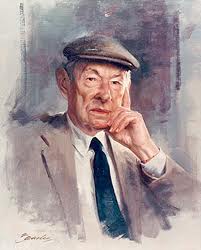
Herbert Warren Wind (usgamuseum.com)
Ever wish you could sneak into the study of a great writer and rummage through their desk to see just where all that genius comes from. Better yet, how about getting to read some personal letters from major celebrities and stars in the game they wrote so eloquently about. Well here is your chance.
Golf Digest recently published this short piece called “Treasured Links: Letters To Herbert Warren Wind” which are original letters written to him from people like Bobby Jones, Gene Sarazen, Ben Hogan, Jack Nicklaus, Bing Crosby, Arthur Schlesinger, and others.
Herbert Warren Wind wrote about golf and other sports for The New Yorker
and Sports Illustrated for over 50 years, His famous books include co-authoring Hogan’s “Five Lessons: Modern Fundamentals of Golf” and “Following Through-Writings On Golf” a collection of his writings about everything from The President’s Putter Competition to his first sight of the Links at Ballybunion.
There are some whimsical ones from fellow writers like George Plimpton and P.G. Woodhouse as well as a number of solemn letters from Byron Nelson and Gene Sarazen. My favorite is the one from Bing Crosby thanking him for a wood shafted putter Wind had sent him as a present and giving Wind his thoughts about the U.S. Open coming to Pebble Beach for the first time in 1972.
Revealed in these short letters is evidence of his connection with all the central characters of golf over it’s developmental years. These relationships helped fashion and enhance the intimacy of his writing. This was another time when the relationships of writers and protagonists were shaped by mutual conciliation not confrontation.
Unfortunately, with just 13 of these letters, your stay in his study is too short, There must have been a sound in the hallway that sent you scurrying back out the window.
(Click to read Golf Digest’s presentation of “Letters to Herbert Warren Wind”)
Golf Digest
May, 2012
Much like an investor in a hedge fund to whom the Black Box strategy of investing and the 2% administrator/20% shared profit fees make them wonder whose interest is really being served in this investment, the average golf fan scratches his head when he tries to make sense of the list of the 50 top players in the world as determined by the Official World Golf Rankings (OWGR).
As you can read in this Golf World article by Mike Stachura there is a built in set of biases that make the Official World Golf Rankings anything but objective. The points are pre-weighted based on a tournament’s subjectively judged and assigned importance by the gurus of the OWGR. As he says in the article this approach is, “making a methodology based on a pre-weighting of those tours open to charges of randomness and even political favoritism”.
The system was created by Mark McCormack, the original super agent who ran IMG and his agenda was clearly to promote the game through the players from his camp. Of his effort McCormack said it is the “answer to the grill room question. I have it all now, the gall, the system and the conviction and am prepared to defend this first statistical presentation of who is the best, regardless of where they play, how much money they win, what their stroke averages are, and all normal ways of judging golfers”. Now that sounds objective to me.
The system became “official” when it was embraced by the five major tours in 1997 and it’s methods have been tweaked regularly to make it more credible. But the statistical methodology is still secretive and subject to the same biases so obscure players playing in obscure events benefit from higher rankings than guys who are much more household names to regular golf fans. In effect the OWGR’s real purpose seems to be as “an effective marketing tool for global golf”.
This article discusses a proposal from two Ivy League professors, Mark Broadie and Richard Rendleman who would like to see the rankings based on more standard statistical models. They argue their approach would remove the biases and present a more understandable and credible ranking of the best players in the world. Considering how important a top 50 ranking is to a player’s income flow this would be a welcome change to the tour players.
A more objective approach to the OWGR would put it’s purpose back to answering the simple grill room question and put the marketing of global golf back in the hands of the Madison Avenue crew where it belongs.
(Click to read Mike Stachura’s article “An Outside The Box Proposal”)
Mike Stachura
Golf World
April, 2012
If you want a little less sophisticated but equally intriguing approach to resolving the problems of the current Official World Gold Rankings read this article on J.S. Elliot’s Fantasy Golf Report website.
He would like to see the rankings be based solely on the head-to-head play of the best players in the world so it is all about their performance at the Majors, the World Golf Championships, and The Players Championship. There is logic to this approach because most fans would agree that surviving the pressure cooker created by these events is the appropriate measure of who is the best player in the world.
(Click to read Fantasy Golf Report’s “FGR World Rankings)
J.S. Elliot
Fantasy Golf Report
April, 2012
Phil Mickelson has a way of connecting with people that brings back memories of Arnie in his heyday. But, more importantly, Phil and Amy Mickelson have quietly devoted themselves to causes and individuals in the community who need their support.
As you can read in this article by Alan Shipnuck for Golf.Com, the list of folks that have seen their lives improved by the Mickelson’s humble devotion to philanthropy is a long one indeed. Many of the causes are very visible-the Mickelson ExxonMobil Teachers Academy that helps train math and science teachers every summer or their Start Smart program that provides kids from low income school districts in San Diego with school supplies and clothing each fall.
Many others are off the radar entirely, like Phil’s relationship with David Finn, a young man who suffers from a mitochondrial disorder that keeps him wheel chair bound and makes communication with others very difficult. Phil connected with David during a practice round at the 2005 PGA at Baltusrol by greeting him and handing him an autographed golf glove. When Phil won his second breakthrough major a few days later, he had the presence of mind and concern to ask David if he would like to have a photo taken with Phil and The Wanamaker Trophy. This was an act of dignity and humility that says all you need to know about Phil.
Maybe the most interesting fact to glean from Shipnuck’s article is that Phil and Amy’s foundation is funded solely by them. Unlike many other celebrities, their foundation does not solicit money from others. The causes this foundation supports are the beneficiaries of their personal philanthropic grace.
There are many other touching and revealing stories in this article. It is evident that Phil and Amy’s impact on the world reaches far beyond the fame he has made for himself in the world of golf.
(Click to read Alan Shipnuck’s article about Phil Mickelson’s philanthropy)
Alan Shipnuck
Golf.com
May, 2012
Photo-John Munson-Newark Star-Ledger
 moegolf