Whiskey Creek Golf Club

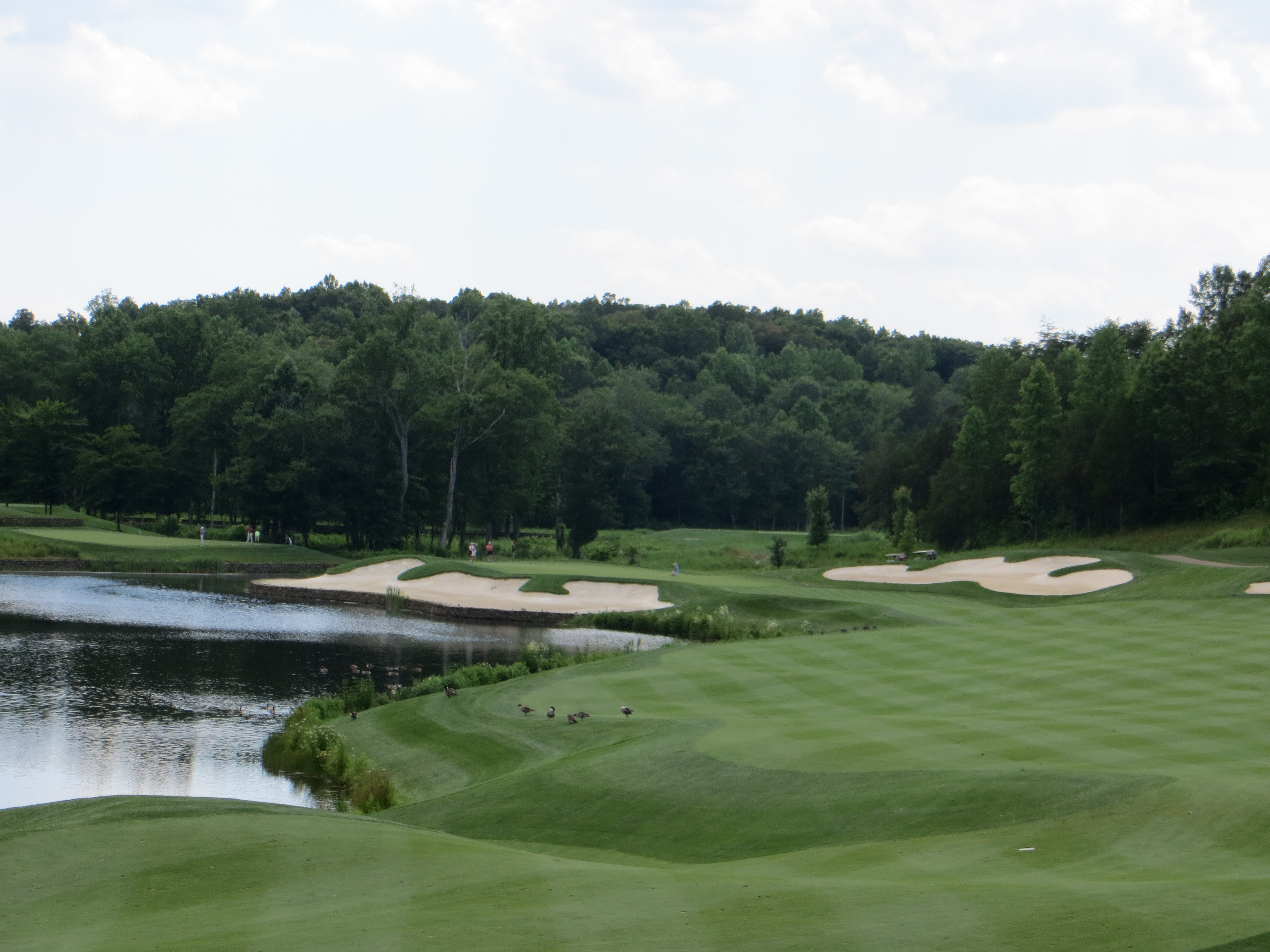
At the height of the golf course construction boom in the late 90’s there were high end daily fee courses being built all around the Washington, D.C. area.  Of all those introduced Whiskey Creek, a collaborative design of J. Michael Poellot and Ernie Els, was probably at the top of that heap.  Considerable intellectual and financial capital went into the design and construction of this course on a beautiful piece of  rolling farmland in rural Maryland.  My bet is that the two of them were awe struck by the natural vistas they found on their first visit to the property.  Just looking up at the farm houses on the hills it very obvious how natural and stunning their green constellations could look if they routed this thoughtfully.

Skeleton of a 19th Century stone house is your aiming device on 18

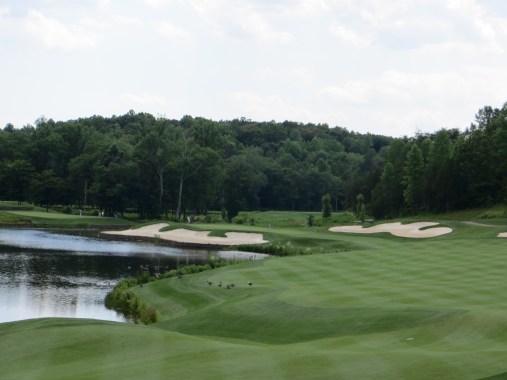
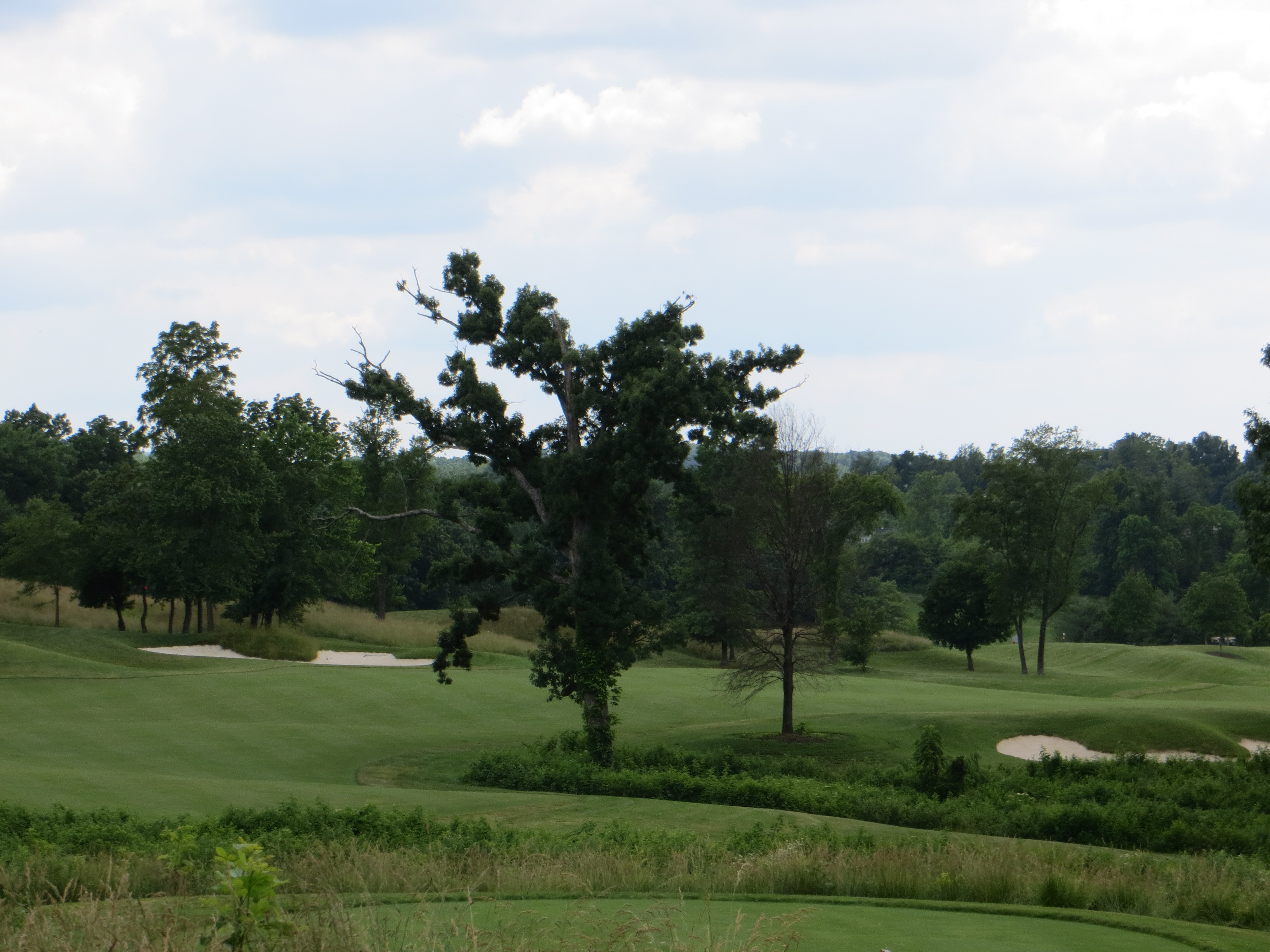
The result speaks for itself, an artistically designed course with a wide array of holes sporting traditional tactical design features.  No trumped up hazards or artificial challenges-unless you consider a 19th century stone farmhouse in the middle of the 18th fairway artificial.  I consider it artistic license and it actually makes the hole tactically interesting.  There is generous use of stone and boulders throughout the course to accent the natural presentation of the holes.  A sensible use of the natural flow of the topography was employed integrating environmental hazards and water-enough to be challenging without being excessive or punitive.

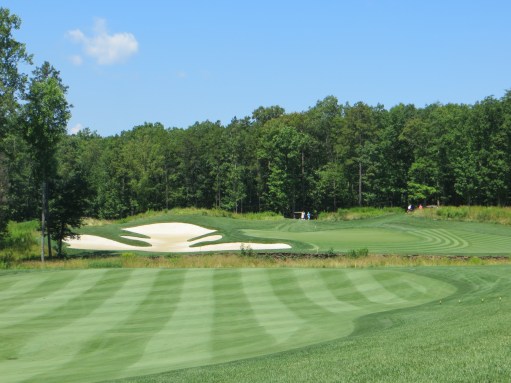
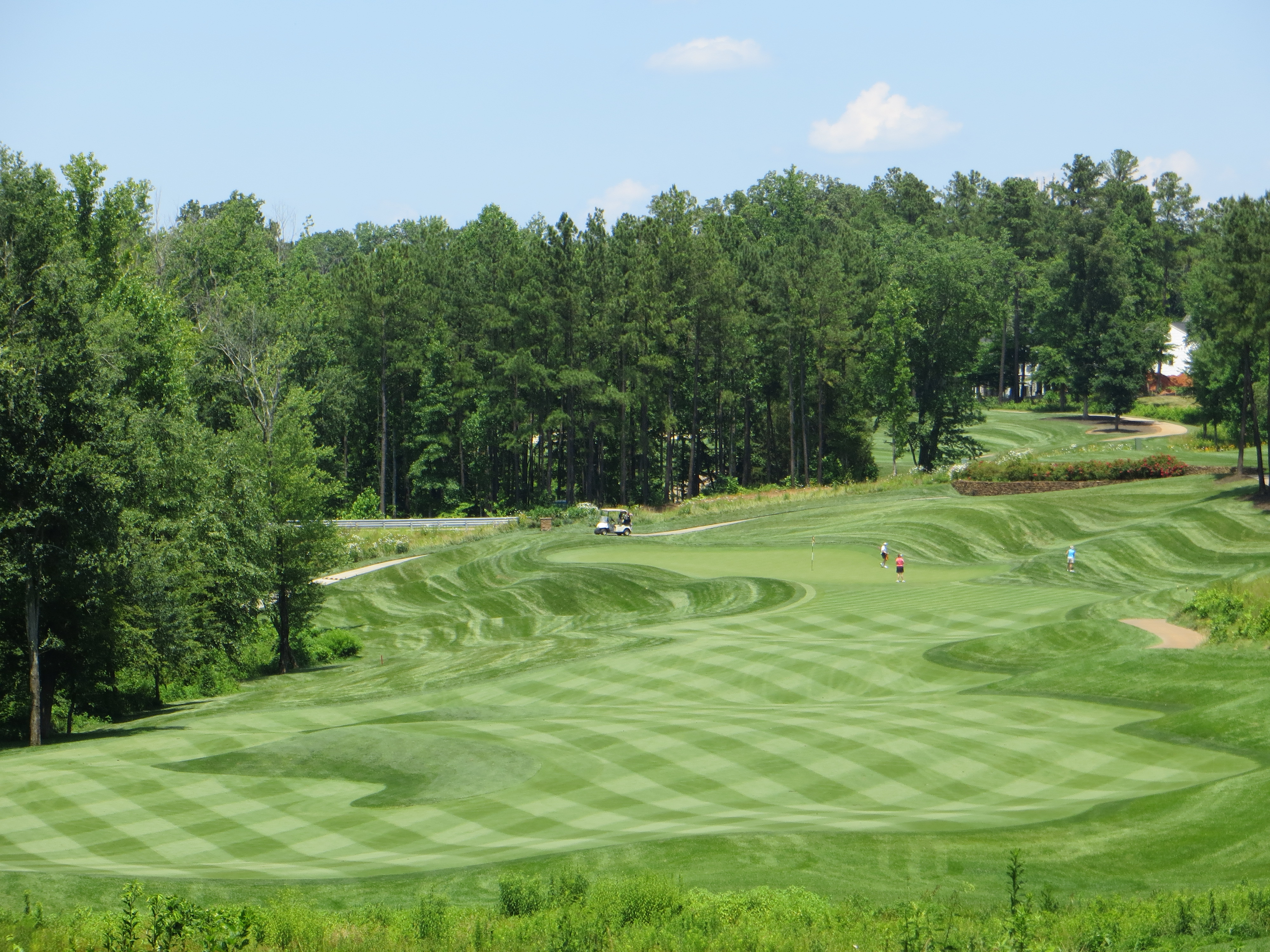
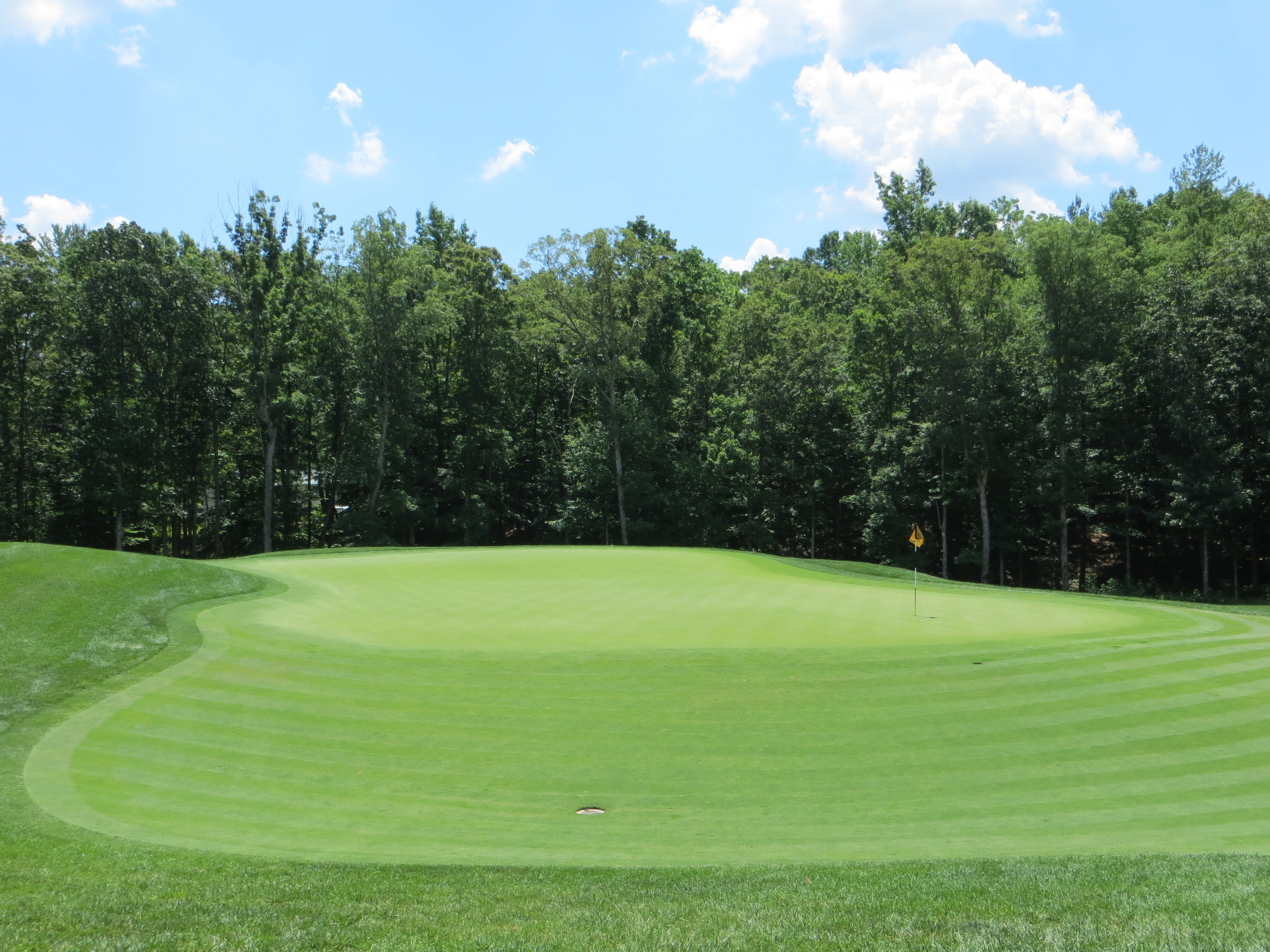
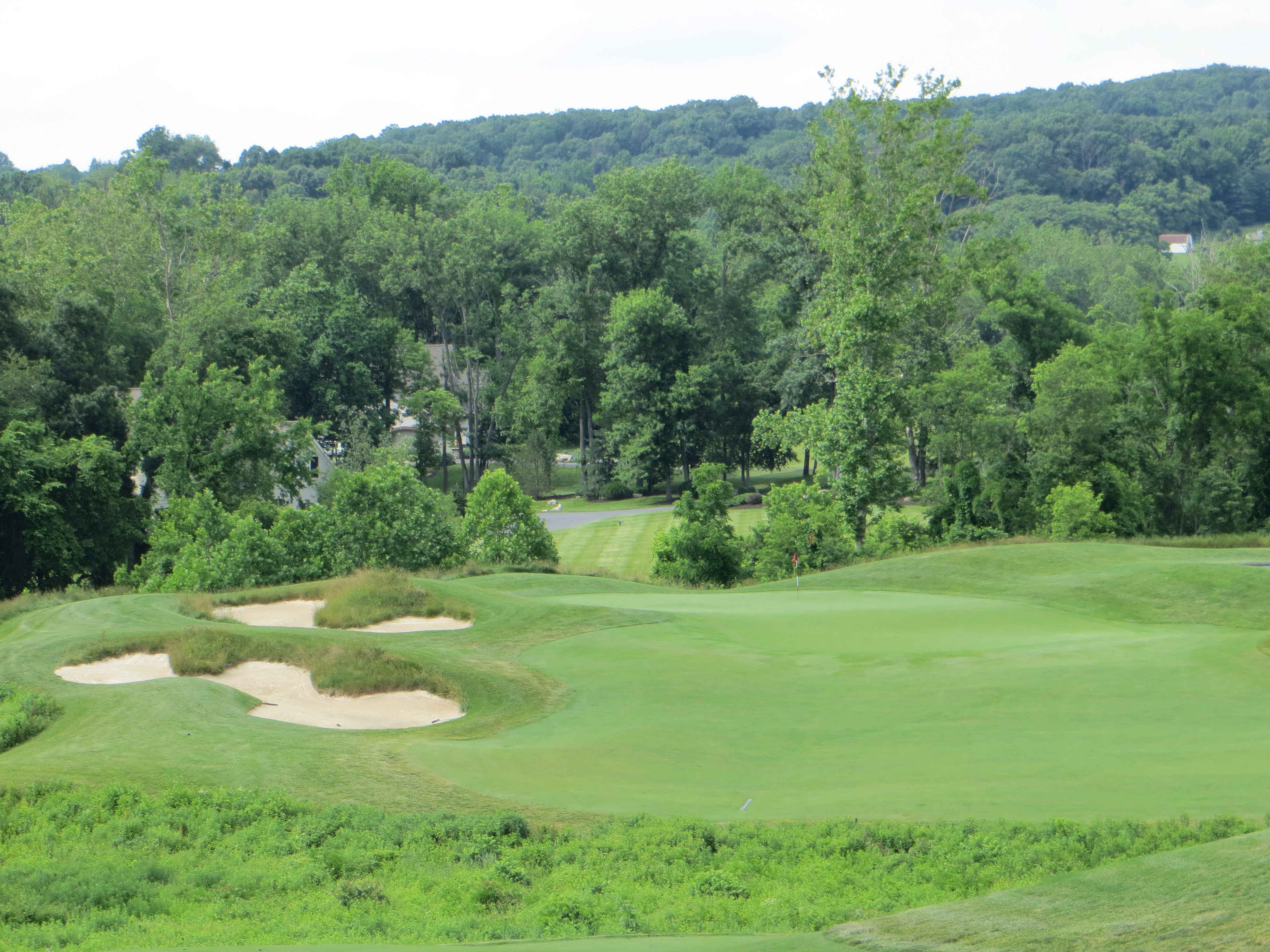
The greens are large flowing surfaces with lots of facet-you really have to focus on the way the green sits to the fairway approach area to figure how to get it in the right portion of the green.  In some ways the green sets have a bit of that Irish/Scottish feel to them-big undulating oceans of green that wave mysteriously among the hills.   Most of the greens are approachable without carrying the bunkers and many are actually inviting to bump and run-especially when the pins are in the front.  The fairway and  greenside are similar to the greens-large deep rambling pits stuck into the hillsides and below the putting surfaces.

Visual green settings like this at #18 require tactics and precision

Being successful here is about taking the time on each tee to plot a reasonable series of shots based on the wind and pin positions of the day.  Sticking to that plan and not trying to overwhelm the challenges with brute strength will reward your scorecard accordingly. Most of the holes you can get a good look at what is in front of you, but many of the putting surfaces are masked from the approach area.  As Ernie says in the yardage book, big wide driving areas were provided on most holes but position is still important to get the best angle of approach to the greens.  In planning your approach consider everything-the entry openings to the green, the diagonal the green sits to the approach line, the prevailing banking of the green, and the relative punitive payment for missing on the short side of the flag position.  Sometimes a uphill pitch and a putt are a better formula to making par than hitting the green in regulation above the flag and having an unmanageable putt down the slope.

The yardage of the course is deceiving-it may be the shortest 6500 yards you will ever see.  Most of the long par 4’s and the par fives are downhill so they play considerably shorter than the yardage.  Many of the shots look much longer than they really are-you have to trust the available yardages and pick the right club accordingly.

Framed driving area on the tempting downhill Par 5 9th.

The front nine is an interesting ride-plenty of challenge but not overwhelming.  The fourth hole is a wonderful uphill par five that scales the terrain to an alcove green set among natural boulder outcroppings.  The next hole is a vertigo par four that tumbles down the hill like the final plunge on the log flume ride at Hershey Park.  The last two holes on the outward nine are terrific-a swerving par four working down the hill adjacent to number four followed by a tantalizing downhill par five that will tempt you to reach for something extra to end the side with a birdie.

Carry across the abyss on the Par 4 12th is a harrowing challenge

Once you have the dog at the turn the challenge ratchets up.  This side begins with a  technical hole that will give you heartburn if you are not careful.   Eleven is the postcard signature for Whiskey Creek just a thing of beauty that will make your heart race.  Starting at the twelfth the challenge heightens considerably with three visually intimidating par fours.  These next three are mostly about position off the tee and then resolve on the second into very tight green arrangements.  Sixteen through eighteen provide three distinctly different challenges in one of the most unusual finishes you will play in this area.  You could just as easily play these three holes two under or six over-it is about managing risk through intelligent decision making.

The fortress green setting at the Par 5 16th

The clubhouse is a simple wood frame construct that fits into the country theme of the property.  A high beamed ceiling and great visibility of nine and eighteen in the grill/lounge area makes for a comfortable atmosphere for watching  the action on the course or on Golf Channel with a hearty sandwich and an adult beverage in hand.  Food is strong bar food-tasty and satisfying.

What I like most about Whiskey Creek is that for a daily fee course they have figured out a way to meet the maintenance budget with appropriate funds to keep the place in top condition.  The fairways are always lush and the greens smooth with pace-more like a country club than a fee course.  Kudos to Kemper Sports who operate and manage this fine facility.

Ijamsville, Maryland

Architect: J. Michael Poellot, Ernie Els (2000)

Tee                  Yardage          Par     Rating     Slope

Blue                 6525               72        72.1        136

White              5979                72        69.3        129

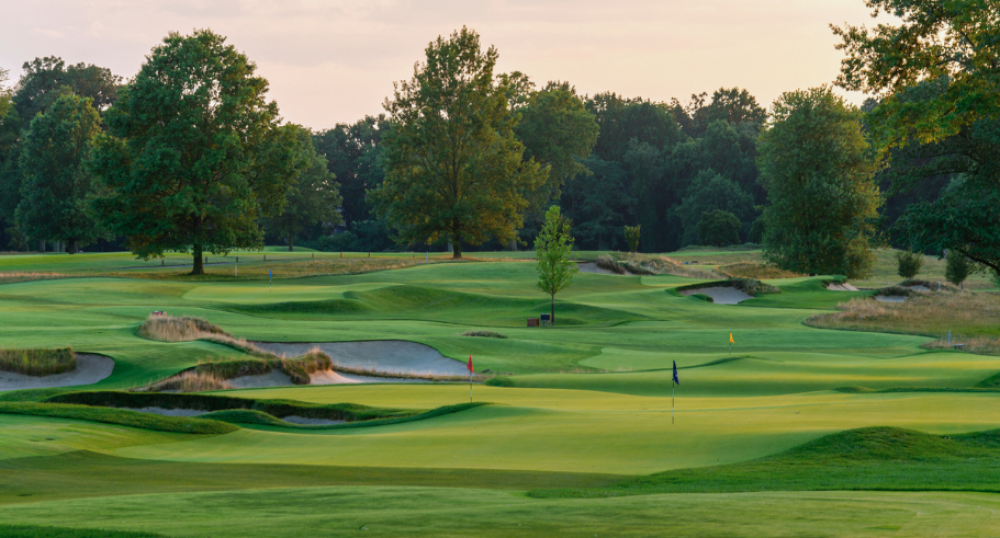
If you would like a printable PDF of this posting including yardage book quality hole-by-hole descriptions of how to play the course click the moegolf logo below.


 

Major Roulette

Nine of the last nine majors have been won by first time winners.  Does this mean these premier events have become a game of chance or is this a testimony to the depth of young talent with mature competitive instincts that now pervades the game of golf?

Webb Simpson put on an unflappable 68-68 performance the last two days showing patience and resolve on Sunday after bogeying two of the first five holes.  Four birdies over the next five followed by eight straight pars proved that, at 26 years old, he has what it takes to win on a U.S. Open course setup.

As you can read in John Garrity’s SI article attached, the USGA was determined to reclaim the U.S. Open’s spot as the toughest test in the game after last year’s scoring mishap at Congressional.  So the real winner this weekend was the USGA whose head croupier Mike Davis set up a stern but fair test that would examine all the golfing skills of the greatest players in the game.

One fairway bunker, no water hazards, 7100 yards, yet no one was winning this one without great risk-reward judgment, the ability to move the ball in both directions on demand, and a willingness to accept the odd bad break and move on.

As to bad breaks, how about the Cypress tree on the 5th hole swallowing Lee Westood’s errant drive that did the same to Lee Janzen 14 years ago.  This time the tree failed to regurgitate the ball and the double bogey that ensued banished Lee once again to the land of no majors.

Best story of the week has to be 17-year old Beau Hossler’s continued presence on the top side of the leader board in a major championship.  He too had a bogey skein in the first five holes but managed to make three more birdies before finally falling victim to the pressure on the back nine.  His attitude and his bunker play was that of a grizzled veteran not a high school junior.  Somehow I don’t think he will be looking at those high school matches with the same reverence.

In the end the guy who could handle the USGA’s enormous pressure cooker prevailed.  Simpson’s up and down for par from a knotty lie next to the eighteenth green showed remarkable aplomb in the face of a career defining challenge.

(Click to Read John Garrity’s “Golf’s Toughest Test” from SI.com)

John Garrity

Sports Illustrated.com

June, 2012

Beau Knows

I know this is a stretch but allow me to fantasize for a moment and imagine what it would mean if a 17-year old was to win the 2012 U.S. Open at The Olympic Club.  This could be an accomplishment equal to “The Greatest Game Ever Played” 99 years later.  That day an unknown amateur, Francis Ouimet, at age 20, beat the renowned British professionals Harry Vardon and Ted Ray in a playoff to take the U.S. Open at Brookline and put American Golf on the radar scene for the first time.

Beau Hossler has proven over these last few days that he has the game and demeanor to compete at the top level at a very tender age but to actually win the big one while still in his teens is just inconceivable.  As to his name appearing atop the leader board on Friday for a couple of holes he said, “I was pretty excited about it, but then again I had another 40 holes …..you’ve got a long way to go, and you can’t get too wrapped up in where you’re at.”

.

On Saturday his goal remained, as it had been when he missed the cut in the U.S. Open at age 16 at Congressional last year, to be low amateur.  Then he did the unthinkable-shot even par 70, making bounce back birdies 4 times after making a bogey on this harrowing track, to maintain his position at 3 over within four shots of two former U.S. Open winners Jim Furyk and Graeme McDowell.

.

As a 17-year old maybe there is a bit of precociousness in his attitude but his goal has now changed because he actually believes he can win this golf tournament.  I know this is unlikely but if he somehow can continue this out of body experience he has been going through for three days and post a two under 68 on Sunday, it might just be good enough to earn Beau a Monday playoff date against a couple of seasoned professionals for this title.

How cool would that be.  Cooler than free dry cleaning-the one perk from this Open experience that Hossler thought was “pretty sweet”.

I don’t know about you but if Beau gets through the juggernaut first nine holes on Sunday within striking distance of the leaders I will hanging on his every swing continuing to imagine the unthinkable.

My bet is Mark Frost, who made a movie about Ouimet’s startling accomplishment in 1913 at Brookline, will be having similar thoughts.  I am pretty sure that Beau has seen the movie a few times and is very familiar with the storyline.

June, 2012

Cat On A Hot Tin Roof

After last year’s scoring orgy at the U.S. Open at Congressional Mike Davis of the USGA was not going to have any more of that this year in “golf’s toughest test” at The Olympic Club.  A course so angular that keeping it on the fairway is like try to land a dimpled marshmallow on a tilted snare drum treated with talcum powder, the dry and windy conditions of San Francisco have made it even harder and faster driving the players to delirium.

The three guys with the thickest paw pads are Tiger, Furyk, and Toms who have somehow managed to scratch out a one under par score through the first two rounds.  Tiger has showed great control, finding a way to hit 75% of the fairways and 70% of the greens.  Toms has had only 56 putts over the two days that is four less than the other leaders.  Furyk has managed to hit 75% of the greens in regulation despite hitting less than half of the fairways.

The scoring carnage has been well distributed.  Nick Watney and Justin Rose backed up opening 69’s with a pair of 75’s.  Mickelson and Zach Johnson shot 76 and 77 on day one and just managed to squeak in under the +8 cut line to play the weekend.  Significant others who will be watching the last two rounds from the comfort of their family room couches include defending champ Rory McIlroy and the world’s number one Luke Donald.

Patience and a short memory seem to be the key once again at the U.S. Open.  A good recovery game around these tiny greens does not hurt either.  Furyk set the bar in the morning round with a gritty 69 to post one under.  Tiger had what looked to be a glorious approach into the short par five 17th that held it’s steam a nano second too long only to sneak off the back right of the green and then tumble down one of Mike Davis’s shaved banks to nestle among the Cypress trees about 50 yards below the green.  He played away from the flag with a deft pitch and managed to salvage par and his momentum.  Toms showed superb iron play down the back nine with two birdies and no bogies to catch the big cat.

With scores in the sixties few and far between the weekend will be about limiting fender benders and making combackers for par from 10 feet.  Betting against Tiger when he has the 36 hole lead in a major is a losing proposition but, besides the two major winners who are currently tied with him, there is Graeme McDowell only two back and he has a history of grabbing the tiger by it’s tail.  This demolition derby should make for some entertaining reality TV this weekend.

June, 2012

Justice Served?

In this autobiographical piece published in Golf Digest you can read an amazing story of Valentino Dixon using his talent for art and his discovery of the serenity of golf course images as a way to help reconcile the time he is spending incarcerated in the Attica New York Correctional Facility.

Considering that he has never played a round of golf in his life, his understanding and interpretation of the peace we all find in the natural surroundings of the game we love is astounding.  An artist must find a subject to interpret and how, from the lonely trappings of a 6 x 10 foot cell, he has landed on golf landscapes as his inspiration is hard to fathom.

His explanation of what his artistic expression means to him in keeping a perspective and hope about righting his situation is moving.  If Bob Dylan played golf he would certainly have written a song about Valentino.  But that is to trivialize his situation and he deserves better than that.

Whether you believe his assertion of innocence or not, you can understand how art has been a vehicle to his survival and that is a testimony to human perseverance on it’s own.

(Click to read Valentino Dixon’s “Drawings From Prison”)

Valentino Dixon

with Max Adler

Golf Digest

July, 2012

True Test Turns To Jest

The USGA setup for the U.S. Open is intended to be a stern test of golf that will challenge the best players in the world to the limit of their ability.  But many times the setup gurus have crossed the line and turned testing golf into Tom Foolery.

Leader Payne Stewart anxiously watches his existential fate unfold (Stephen Szurlej)

This article by Ron Whitten from Golf Digest recounts the last time the Open was held at The Olympic Club and the fiasco of the pin placement on the 18th green that Friday in 1998.  It has taken 14 years for this prestigious event to return to Olympic and much of that hesitation can be accounted for by what happened that Friday afternoon.

Ron Meeks, whose set up of the course that year earned him the moniker of “Marquis de Sod”, admitted “We all make mistakes with course setup….I have never set up a championship where I haven’t made multiple mistakes.  Mother Nature sometimes fools you, or you sometimes don’t anticipate certain things.”  Maybe they are just trying too hard.

There have been many other such incidents over the years, most vivid to my memory is the debacle at Shinnecock Hills in 2004.  Who can forget what the seventh green looked like, devoid of a blade of live grass because of the stress of water deprivation, as pro after pro simply watched in disbelief as their balls trundled off the back of that par three.  It will have taken 14 years to get over that experience as The Open is not scheduled to return to Shinneccock Hills again until 2018.

Take a moment to read this article and view the embedded video of an interview the next day at Olympic in 1998 with David Fay the USGA Executive Director.  It reveals how precarious it can become when the USGA tries to push the limits of fairness in trying to fulfill their desire to create a true test of golf.

(Click to read Ron Whitten’s “Testing The Limits of Fairness”)

Ron Whitten

Golf Digest

June, 2012

Pine Valley Photo Ops

Recent trip to the hallowed grounds of Pine Valley caught a few lighter moments on film.

The Motley Crew-Bob, Moe, Ken, and Gui

Zen station….

Basic instructions and a place to sit and contemplate what is required

Iconic halfway house….

Gatorade or something stronger if you need it

Click on any photo to get an enhanced view of the image

There are green places to play from and brown ones to avoid……

Negotiating Hell's Half Acre-an intimidating layup on #7

Negotiating Hell’s Half Acre-an intimidating layup on your second at #7

Variety….two greens on the 9th….greenskeeper will choose for you…

The green of the day will determine which side to place your drive

The green of the day will determine which side to place your drive on the Par 4 9th

From the tee number 10 looks fairly tame butt…………

The large transition bunker is the least of your problems here

The large transition bunker is the least of your problems here

The infamous Devil’s ________ awaits…

Just before the proctology exam

The procedure….

A full Roto-Rooter

Rarely a level stance awaits when you get to your approach position…

The 11th is an easy par 4 except when your drive settles on the left

A little green hide and seek on the Par 4 11th

Forced carries are a staple….off of tees and into greens

Some elevation change

You have to hit your drive perfectly on 17 to get this look

Searching for home….

Magellan Moe points the way

Position off the tee….chutzpah into the green is required…

The final traverse

The final traverse will bury the dreams of the meek


Pine Valley

June, 2012

Divine Intervention?

One last shared memory for Tim and Winn that only golf could bring (photo by Will Galloway)

Golf has always provided a valuable venue for the development of a father/son relationship.  It offers a unique opportunity to share the joys and disappointments that the game can throw at us-a great learning opportunity on how to deal with challenges in our day to day lives.

This story by John Strege in Golf World magazine documents one of those cherished moments with a very poignant twist.   Winn Galloway, like many young boys, was introduced to golf by his dad Tim as a wee tot and the two of them shared Winn’s developing love for the game through his high school years.

On a family vacation that took them down the California coast they made there way to Pebble Beach where they had the opportunity for a brief visit to the famed Pebble Beach Golf Links.  The two of them decided that some day they would play this storied links together as the ultimate father/son golf experience.

Fast forward a decade and Tim is diagnosed with thyroid cancer and began a valiant battle against the disease that would eventually take his life.  Winn decided they needed one last golf memory that “we could talk about for a long time, and if he passed away, a memory I could hold on to”.

With his health declining quickly and his ability to play the golf course rapidly disappearing Winn arranged for a swan song round at Pebble to create this father/son memory.   As we all know, a golf course can provide a wonderful canvas for documenting a shared experience.

As you will read, Winn gave his Dad the finest Father’s Day present he could ever imagine-a true Pebble Beach memory.

(Click to read John Strege’s heartening article “A Day To Remember”)

John Strege

Golfworld

June, 2012

Take That Jack!

Jack Nicklaus has always been the singular motivation in Tiger’s career ever since he was a wee cub.   Going into this week he needed only one more win to tie Jack for second on the all time PGA Tour wins list.  So, as Tiger is apt to do, he added a little exclamation point when got his 73rd PGA Tour victory by making birdies on three of the last four to shoot a five under 67 and win “Jack’s Tournament” at The Memorial.

The exclamation point was the shot of the day or, as Nicklaus said afterward, a shot that should be at the top of Sportcenter’s Ten Best for the next month.  After making his third two-putt birdie of the day on the par five 15th, Tiger missed the green on the par 3 16th 50 feet from the hole in the heavy grass long and right leaving himself an impossible up and down to keep his run on track.   With the green sloping drastically away from him to the water behind, getting or keeping it on the green was a task-leaving a makeable par putt seemed highly unlikely.

So Tiger did what only Tiger can do-with the tournament on the line he hoisted a full Otis Elevator into the air and landed it on the only six inch square piece of green that would avail him a save and watched the ball languish it’s way down to the hole and drop in.  We haven’t seen pitching drama like this since his Nike hanging chad on the 16th at Augusta in 2005.  After that roar the field did not stand a chance.

The ensuing adulation was not restricted to the regular fans.  Nicklaus, sitting in the broadcast booth said it was “the most unbelievable, gutsy shot I’ve ever seen”.

A routine stinger iron to the center of the fairway on 18 and a crafted 9 iron draw off the back side wall of the green to ten feet led to the final birdie to nail his 73rd PGA Tour win and tie his childhood idol.

Tiger likes winning in front of golf immortals-he clearly feels at home in their presence.  He won Arnie’s tournament at Bay Hill earlier this year for the seventh time and now he has won Jack’s tournament for the fifth time.  In fact this is the fourth time he has won both Arnie and Jack’s tournaments in the same year.  Today’s performance was another clarion call announcing that Tiger belongs amongst them.

June, 2012