A Golfer’s Education

After reading the outer jacket of this book and realizing that Darren Kilfara, a junior at Harvard,  had succeeded in staging the ultimate golfer’s year abroad at the University of St. Andrews, all I could do was administer myself a dope-slap and mutter to myself, why didn’t I think of that?  Of course at 54 years of age that was water under the dam.  The only thing left to do was experience it vicariously by reading his travelogue memoir of youthful golf discovery.

What unfolds is an articulate and perceptive tale of his discovery of the charm of Scotland, golf in Scotland, and links golf in particular.  Along the way he realizes there are American golf biases, like religious commitment to the scorecard and pencil, that he needs to abandon, as well as unexpected subjects that need intellectual attention, like course architecture, if he is going to come away from this immersion process with a fuller understanding of the game of golf.

The book chronicles golf courses you are familiar with and one’s that you should become familiar with.  His student life sketches a refreshing ground level view of life in Scotland.  Through his experiences he jettisons his engrained perceptions of what golf is about and embraces the mysterious rapture of links golf  it’s unique challenges.  He comes to learn why those who play links golf think it builds character and enforces humility teaching us to cope with the challenges of our lives with a more realistic perspective.

Of Golf in Scotland:

“Many people still walk from their homes to the first tees, especially at linksland courses near town…you cannot be too low on the social ladder to play golf in Scotland.…The golf club is a fundamental component of the Scottish community at large.”

“In Scotland “putting” is a recreational activity in it’s own right.  Virtually every city, town, and village has at least one putting green available for public use.”

Of the Beauty of Scotland:

“A breeze whistled softly across the gorse, tugging gently at the sleeves of my jacket.  The dying embers of autumn  flickered in the darkly proud gorse, in wispy fields of soft beige and muted green….. The stillness, the ethereal peace of the moment overwhelmed me.  The earth itself reposed in contentment: miles of tiny, pimpled dunes beyond …..mirrored my goose bumps….beckoning me away.  In the near silence I stood: alone, yet not alone.”

Of Links Golf:

“I loved the way the conditions challenged my imagination…..I loved the strategic impositions of the wind, and the obligation to attack on even the most difficult downwind holes for fear of losing ground on the upwind ones.”

“In the wind the truth of score becomes subjective….The Scots have a solution…Match Play.  On windy days there are three options:  stay inside, forget about par, or measure your progress against a friend and neighbor instead of counting strokes”

Of  Scottish Courses:

“Cruden Bay is a flawed work, some of it’s holes downright weird.   But the composition as a whole was incontestably dramatic, unceasingly moving, and, at times, breathtakingly beautiful.”

“Machrihanish also possessed a staggering repertoire of memorable holes; at each of the first eight holes I glimpsed a different vision of links nirvana.”

“That’s how (Royal) Dornoch works.  Strategically speaking, it lulls the golfer to sleep.  Dornoch is never penal, and average golfers will be buoyed by the absence of visible hazards.  But every hole has an optimal angle of approach.”

“The Old Course certainly grows on you: round by round you absorb it’s intricacies.  And sooner or later, you find yourself playing left and creating doglegs because you want to, not because you’ve been told to, an important collaboration between pride and intellect that can yield decisive results on your scorecard.”

Even a Ferris Bueller Episode:

Describing an inebriated session of “Street Golf” in downtown St. Andrews with a couple of undergrads,  “We’re just underway…tee off at the University Library a short time ago.  The hole is a vodka bottle in Miss Scarlet’s room which is on the fourth floor of New Hall.”

This book is readable and engaging-you will enjoy it for it’s insight, a strong dose of Scottish golf history, and some college self-deprecating moments you can probably relate to.  For those traveling to Scotland to play golf it is a great primer, for those who have been there already it has it’s scrapbook moments.

(For additional background click to read a Golf Atlas interview with the author)

A Golfer’s Education

Darren Kilfara (2001)

Zen Golf: Mastering The Mental Game

Don’t let the title scare you, no need to assume the lotus position and repeat incantations as part of your pre-shot routine.  What is presented in this book by Joseph Parent, a PGA Coach and Buddhist instructor, is a pragmatic approach to managing the mental aspect of your game to get out of your own way and let your golf skills provide you with the best chance for success on the golf course.

A good pre-shot routine is essential to getting consistency out of your intended shots but the mental aspect of that routine is the part many players seem to ignore.  We have all experienced how being impulsive, indecisive, and anticipating a bad result can wreck all the good intentions of our plan.  The question is how do you clear your mind, achieve focus on your intent, and play each shot within the moment to delimit the effect anxiety and fear can have on your results.

How do you deal with the negative thoughts that creep into your head that can predispose you to a bad outcome? His suggestion is that all thoughts going through your head are like traffic on a busy street, you cannot control them coming into the picture so you should not try to control them by forcing them out.  He says, “Simply let them come up and go by, neither inviting them to stay nor trying to get rid of them.”  The key is to allow ”last time I was here I  hit in that nasty bunker” to come and go and to let stay “left center ten feet left of the pin with an uphill putt”.  It is a simple process of mental sifting.

A corollary principle is cultivating “unconditional confidence” in your intentions.  This means not being overly judgmental based on your performance at any point during a round.  We cannot expect to hit every shot perfectly and we must be able to handle the result no matter what occurs.  With unconditional confidence “instead of assuming something (mechanical) is wrong ….and trying to fix it, we reflect on what may have interfered with our intention on that shot.  This approach makes it possible to quickly turn things around and play well again.”

His central thesis in this book is a mental management process he calls the PAR Approach-a way of thinking that focuses on Preparation, Action, and Response to Result.

Preparation requires clarity-a vivid image of the shot intended, commitment-being free of doubt and hesitation of intent, and composure-being focused and poised as you prepare for a shot.  Together these three elements give you total confidence in the intended outcome of your shot.

Action is about developing, honing, and trusting a process of swinging the club that turns over control from your thinking mind to your intuitive mind.  Trying to guide your swing with swing thoughts and principles has to be left on the practice ground. When you are on the course you have to trust a process you have developed that works.  As he says, “take care of the process and the results will take care of themselves”.

Response to Results is probably the most overlooked aspect of managing your mind on the golf course.  Most of us have a tendency to focus on the negative part of our results and vocalize the flaws to ourselves.  His advice is “the best responses are those that reinforce successes and help you learn from mistakes without getting down on yourself”.  We need to take the time to appreciate a good shot and focus on how well we executed what we planned.  He says, “reinforcing good shots with positive feelings….a minimum of emotional distress around poor shots….and refraining from beating yourself up, those ways of responding to results give you the best chance of success.”

I am sure a thoughtful reading of this book will help your performance on the golf course.  It will also increase the pleasure you get from playing the game by giving you a more reasonable perspective on expectation and evaluation of performance.

The proper view this book encourages is that  “our self worth as a human being doesn’t depend on how well or poorly we strike a golf ball.  We see our nature and our abilities as basically good and the difficulties we encounter as temporary experiences.”

These are words to live by and words to play by.

Zen Golf
Dr. Joseph Parent (2002)

The Dogged Victims of Inexorable Fate

It is easy to have a Dan Jenkins section in your personal library since he has been a prolific sports/golf writer for over a half a century.  He has put out countless entertaining books-both fiction and non-fiction-written in his Texas wise-guy cynical and satirical style. The writing is always observant, to the point, and almost merciless in a kind of arms length critical view.

This particular collection of sixteen short pieces was published in 1970 and it covers the full range of golf matters of the time. Unlike today where the writers have to beg for interviews, Dan Jenkins lived with the protagonists week-to-week-traveling, playing cards, drinking beers, and sharing stories. As a result, there was a level of trust and confidence developed between them that offered a clear window into the hearts and minds of the players of the day. In reading this you feel you are getting an insider’s perspective on the development of the game in a golden era.

The name of the book comes from a Bobby Jones quote on the topic of competitive pressures in golf-whether for a championship or a Sunday Nassau.  Jones once wrote,
“On the golf course, a man may be the dogged victim of inexorable fate, be struck down by an appalling stroke of tragedy, become the hero of unbelievable melodrama, or the clown in a sidesplitting comedy-any of these within a few hours, and all without having to bury a corpse or repair a tangled personality”.  Jenkin’s writings bears out how human drama defines the game as guys try to excel at an individual sport that will expose every weakness in technique or resolve in a remorseless competition.

I have recently re-read this book and I found that the subject matter he writes about seems timeless-municipal golf, slow play, head cases, television, majors, the greatest to ever play the game.  The issues today are the same as they were in the 1960’s, the names have just changed to protect the innocent.

There is a wonderful chapter about a regular on the tour who you barely know about-George Low.  He was a journeyman pro in the 30’s and 40’s who realized with the proper balance of schmoozing and familiarity he could make a life for himself without lifting a club.  As Jenkins says, “He was America’s guest, underground comedian, consultant…….a man who conquered the two hardest things in life-how to putt better than anyone ever and how to live lavishly without an income”.  He was a fixture on the veranda at every tour stop, tour watering hole, and putting green.  His prowess with the flatstick and a quick joke made him welcome fixture on the tour for thirty years.

In the chapter called “Wide Open” he describes a tournament with venues of aristocratic reverence, offering a title which guarantees wealth and fame for life, but that could be won by just about anybody or a nobody.  For example, Lee Trevino, “a laughing tub of echiladas in bright red socks with a caddy-hustler’s game” or Orville Moody, “who had a name like … a drag strip mechanic and who didn’t even have a hometown to be poor from.  Just fourteen years of Fort Hoods and Koreas”.

My personal favorite is his piece on Dave Marr “The Pro of 52nd Street”.  Dave Marr was Texas born and bread-pure Banlon in Argyle socks.  In an otherwise undistinguished journeyman’s career he won a major, the PGA at Laurel Valley, and parlayed it into a life- long corporate outing full of networking with the stars and the champions of industry.  You see this charming, likeable, self-deprecating guy realized what Frank Sinatra knew, if you can play NYC you can play anywhere.  So he moved to New York, traded the argyle socks for double breasted blazers and Gucci belts, and adopted the New York lifestyle as his own.   Doing his thing in the bistros and bars he developed life long friendships with celebrities that made him someone to hang with.   In spite of regularly finishing twenty-third or worse, the income flowed from endless corporate outings and a broadcast gig based on his popularity among his peers and an insider knowledge of the game.

The book ends with “The Doggedest Victim” about his good buddy Arnold Palmer.  Jenkin’s personal account of Palmer’s historic and folkloric come from behind victory at Cherrry Hills in the 1960 U.S. Open characterizes the entire book.  In Palmer’s ascent to “the most immeasurable of all golf champions” Jenkin’s characterizes him as the “doggedest victim of us all”.

Dan Jenkins will be inducted into the Golf Hall of Fame in May of 2012, only the fifth golf writer to be so honored and the first to be inducted while he was living.

(Click here to read a typical Jenkin’s reaction to his induction)

As one of the most prolific golf writers in history, his body of work clearly qualifies him for this long overdue honorarium.

Do yourself a favor, the next time you are on the Barnes and Noble web site and need another $10 item to get you over the $25 minimum for Free Shipping buy yourself a copy of “The Dogged Victims of Inexorable Fate”.  It will be a welcome addition on your nightstand or next to your thrown and provide you plenty of laughs and expand your knowledge of the history of the game.

The Dogged Victims of Inexorable Fate

Dan Jenkins  (1970)

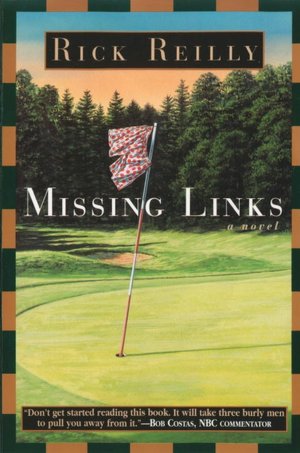
Missing Links

Entertainment….pure entertainment.

Those of us who have read Sports Illustrated most of our adult lives had a habit of picking up the current issue and immediately turning to the back page to read Rick Reilly’s column.  Rick had a way of turning a phrase on the pressing sports issues of the day like no one in the business.  Cynical, funny, insightful and always entertaining.

In his book, Missing Links, Reilly spins a hilarious tale of a bunch of middle-class slackers in Boston who “wasted their youth” playing and gambling every day at “possibly the worst golf course in America”, a place he called Ponkaquoque Municipal Course and Deli.  The food was bad, but the golf course was worse.

“It was one of the great mysteries of life why grown men would actually arrive at 4 a.m. to put their little golf balls in a rusty old pipe…and then go back and sleep in their cars, just to play a golf course at eight that would have a hard time making Best of Chernobyl”.

The gambling tales of the Chops who played at Ponky are what makes this worth reading.  Among others they include:

Hoover- He really sucked

Thud- The almost human hearse driver for The Peaceful Rest  Mortuary

Crowbar- He was constantly prying himself into any situation

Two-Down- Never lost-as he said “Bets don’t start until I’m two down”.

Stick- The story’s protagonist

Dannie- Old female chop, baseball hat, baggie sweaters but “a cotton         eyed Arkansas accent…with a twelve-car-pileup body and a little nose that could’ve hardly made a dent in a cream pie”.

They bet on anything and made up the games as they went along.  “Reversals” in which your opponent could tee up your ball, turn around, and hit it as far in the opposite direction as he could.  “Alohas” where you double everything on 18.  “Murphys” where once every 9 holes your opponent could pick up your ball and place it anywhere within two club lengths of where it lays.  “It is very discouraging , indeed, to be just about to hit the bejesus out of your drive and than have somebody holler, “Murphy” and walk over and deposit your ball in a ball washer”.

Now Ponky sat adjacent to The Mayflower Club which was “only the finest, snootiest, private, white, sperm-dollar country club on the eastern seaboard”.  It was full of blue blood members with numerals in their names who drove Bentleys and Jaguars into “a kind of green-and-blue Protestant Paradise”.

Which gets us to “The Bet”.

You see The Bet is what really changed it all at Ponky turned the place upside-down and shook out all of the loose change.  It came about when three of the Chops-Two-Down, Dannie, and Stick- decided the ultimate challenge would be to see who could be first person to finagle their way into play the Mayflower Club.  $1,000 a man, winner take all.  Clearly this was to be a no-holds barred, anything goes competition and what unfolds is a series of tales of intrigue and woe as the three of them seek to capture the ultimate Ponky Prize.

Once you start reading this book you won’t be able to put it down, except to catch your breath between sessions of uncontrollable laughter.  It is Rick Reilly at his best…..frat house humor…..pure entertainment.

Missing Links

Rick Reilly (1996)

Classic Golf

Walter Iooss is one of the most celebrated sports photographers in history.  As their senior sports photographer he has contributed over 300 Sports Illustrated covers to the magazine over his illustrious 40 year career.

This book is a compilation of over 200 black and white and color images that catalog the personalities of the greatest players in golf in the modern era.  In an arena where shutter clicks are verboten during a player’s swing, Iooss somehow stealthly captured the swings of the greatest players in the game in full action.

Hogan, Palmer, Venturi, Chi-Chi, Nicklaus, Trevino, Watson, Miller, Crenshaw, and Tiger-they are all here and so many more.  The common denominator is images of players-their swings, their personas, their unfiltered emotions.  In these photos Iooss captures the drama of the moment as well as the nature of the man in the heat of competition.   With his personal collection, Iooss should have his own room in the USGA museum in Far Hills, New Jersey.

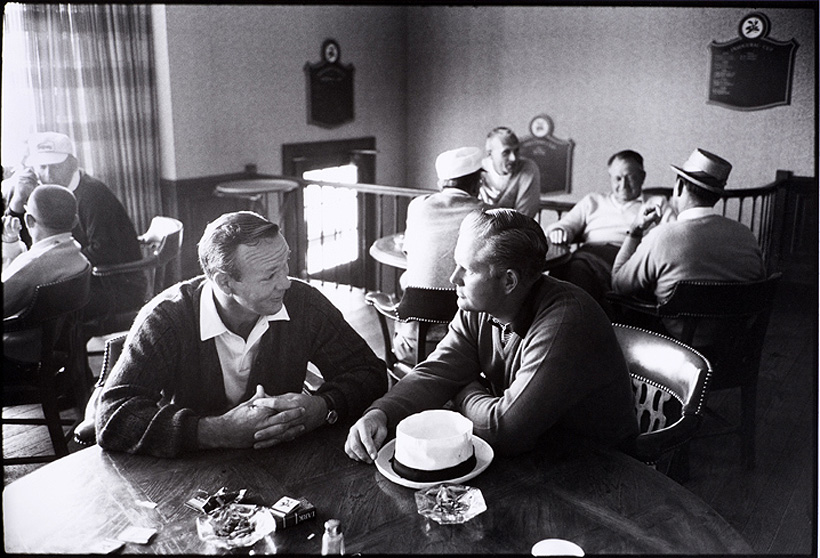
Arnie and Jack   Ligonier, Pa 1965   (walteriooss.com)

As you look through this book you cannot help but shake your head, time and time again, saying to yourself, “I remember that picture, I remember that look”.  It is like a personal bit of time travel for those of us who have religiously followed the game for so long.

Dan Jenkins said, “In this splendid book, Walter Iooss makes the sport of golf look as colorful and thrilling as it actually was in the second half of the twentieth century”.

If you can find this book you should add it to the stack under the coffee table in your family room.  You will find yourself picking it up regularly for another joyous walk down memory lane.

(Click here to review Walter Iooss’s Golf Portfolio on walteriooss.com)

Classic Golf-The Photographs of Walter Iooss Jr.

Walter Iooss (2004)

Emerald Gems-Links of Ireland

Laurence Lambrecht is one of the most accomplished golf photographers out there and this book is a seminal work on fine collection of links courses in the Emerald Isle.  A coffee table book the size of your coffee table features images and descriptives of every one of the 47 links courses in Ireland.

The book organizes the courses by geographic sections of the country so you can get a good sense of proximity of each of the links offerings around the country.  Every course has a number of stunning photographs as well as an erudite descriptive of the course by a knowledgeable expert familiar with the course.  These supporting text entries are from the hands of people like Pat Ruddy, David Feherty, David Davies, Ivan Morris, and others and they really embrace and enhance the presentation of each course.

Besides being a nostalgic display book for your family room that you can thumb through from time to time, this would serve as a travel resource on links golf in Ireland.  This book along with James Finegan’s “Emerald Fairways and Foam-Flecked Seas” is all you need to plan a memorable golf trip with your buddies to Ireland.

You can buy the book from Larry Lambrecht’s website for around $90.  He also has a fine collection of related prints, calendars and note cards to choose from.

(Click to go to Larry Lambrecht’s website)

Emerald Gems-The Links of Ireland

Laurence Lambrecht  (2002)