Waterloo

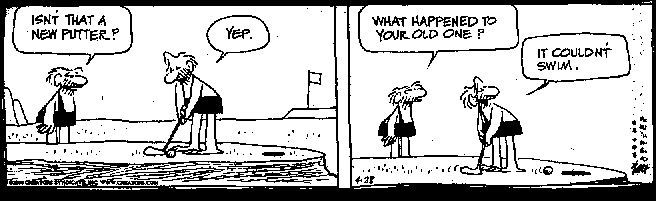
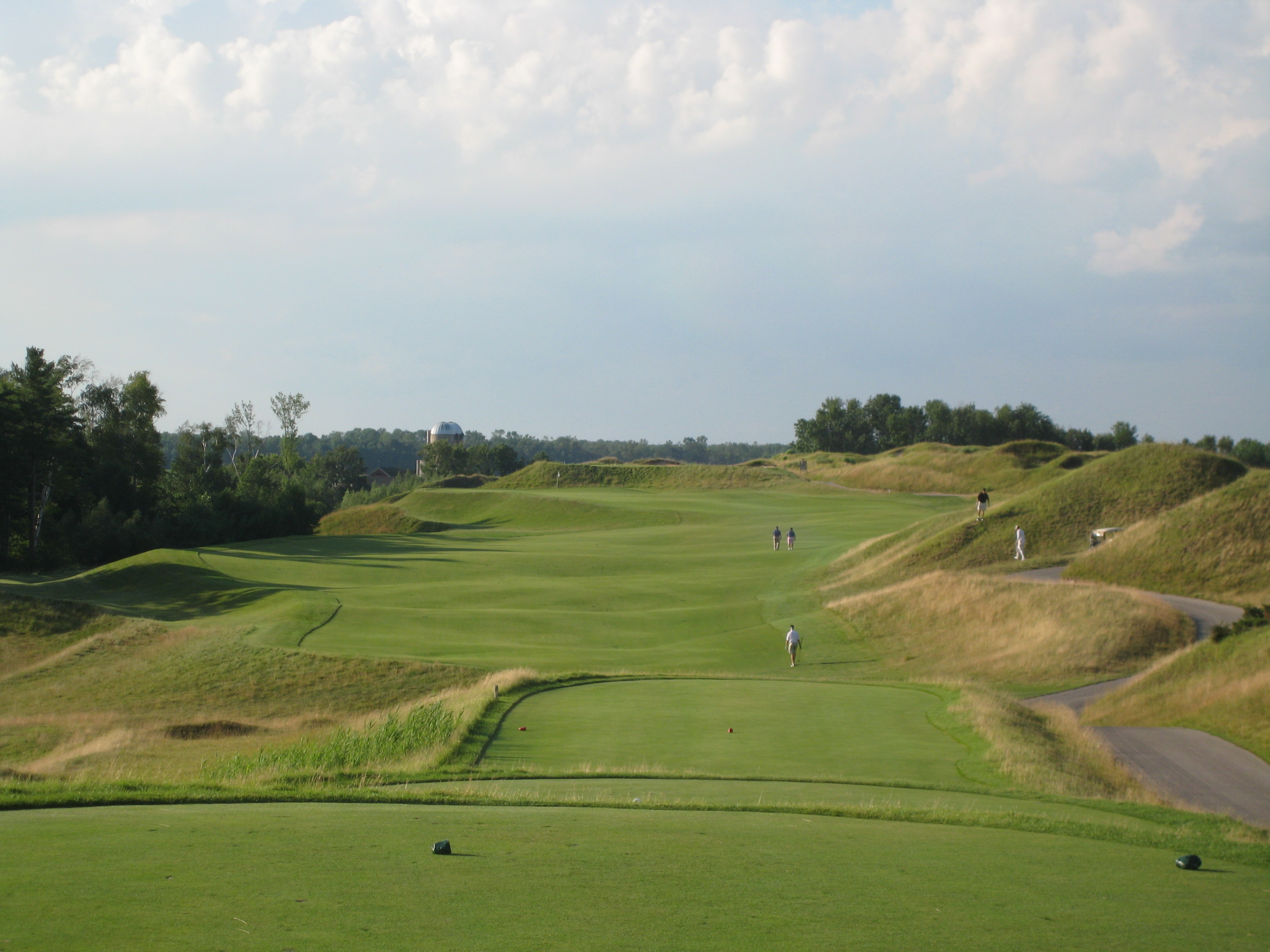
Napoleon would have felt right at home today at the Atlanta Athletic Club for the second round of the PGA Championship. The 18th hole in particular was taking no prisoners. In the last hour and a half of the day Adam Scott, Angel Cabrera, Nick Whatney, Phil Mickelson, Matteo Manassero, and Gary Woodland (twice) all saw their momentum drown in a watery grave on their approach shots into the final green.

David Feherty asked the question of the day, doesn’t the PGA think that the final hole of their most important tournament of the year should actually be playable by the best players in the world. This one clearly is not. It wasn’t about the wind, it wasn’t about the pin, it was just that the driving area was so confined the players could not find the courage to hit a driver far enough up the hole to give themselves a manageable shot at the green. As hard as the hole was in 2001 when David Toms chose to lay up on his second shot and rely on a wedge to get up and down to beat Mickelson in the PGA it has clearly been ratcheted up a notch in Rees Jones’s latest upgrade of the course for this year’s event. Tom’s strategy may the play du jour for the next two days if guys are in the hunt.

Maybe the real secret today was being fortunate enough to play the back nine first because Dufner and Bradley, the current leaders, both played the front as their inward nine and seemed able to close out their rounds without blunting their momentum. They will not have that opportunity tomorrow and will have to face the terror of fifteen through eighteen with the full pressure of trying to hold the lead in a major. Climbing over the battle casualties in front of them could be a huge mental challenge in that stretch.

August 2011

Play It As It Lies

Tom Doak at St. Andrews      (www.renaissancegolf.com)

As Tom Doak points out in this article about his approach to golf course design, the rules of the game state that a player must play the ball as it lies.

He would argue the same thing should apply to course architects-they should seek out the natural features of the land to decide how to design a particular hole and not add artificial elements simply to make a  hole more challenging or visual.

He asserts that the best golf course architects out there “route as many holes as possible whose main features already exist in the landscape, and accent their strategies without overkilling the number of hazards.”  The object should be to create holes that challenge a shotmaker to use his judgment to help him succeed not to overwhelm him with a challenge that has only one solution.

Too many designers get carried away with creating artificial challenges instead of studying all the facets of a hole site-topography, vegetation, prevailing wind direction, and the like to choreograph existing conditions to present a challenge that will require the proper combination judgement and shot execution.  The best part is that these holes look like they are a product of the natural environment not of the architect’s far fetched imagination.

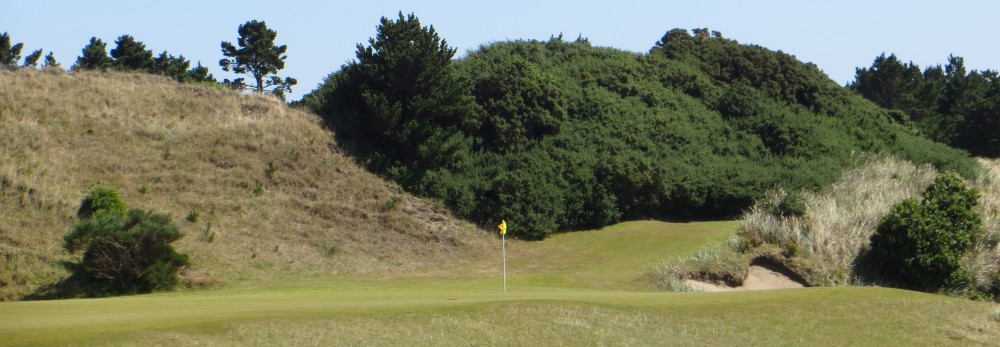
Those who have seen or played Tom Doak designs like Beechtree Golf Club (of blessed memory) in Aberdeen, Md, Old Macdonald in Bandon Dunes, Atlantic City Country Club, Cape Kidnappers in New Zealand, or Ballyneal Golf Club in Colorado understand that Doak has created very dramatic and very challenging courses that have a visual appeal and character that look like a natural product of their surroundings.

In an age where name architects seem to be more concerned with expressing their vast ego in their designs or simply creating inordinate challenges to emasculate the best players, there is something to be said for this minimalist approach to course design.

(Click here to read Tom Doak’s article The Minimalist Manifesto)

Tom Doak

http://www.renaissancegolf.com

Who Is Waldo?

Sally Jenkins appropriately poses the question, has Tiger lost his identity in trying to overhaul his game and his image?  And exactly what is he finding in this personal search and what are we finding out about him?

To us he remains insulated, overly analytic, and has “the same old glacial arrogance”.  Add to that, he looks bewildered, uncomfortable, rudderless, and basically without a clue.

To Tiger, what does he see? We don’t know. But, if you accept Sally’s reasoning in this article, the answers cannot be pleasing him if he has any sense at all of reality.

(Click here to read Sally Jenkin’s article on Tiger Woods)

Sally Jenkins

Washington Post

August, 2011

Mystic Rock-Nemacolin

This Pete Dye creation is another addition to the death defying style courses that the man likes to create.  It reminds me very much of Bulle Rock which is of the same vintage.  Sweeping panoramic holes with big intimidation factors but really only moderate challenge when you strip away the veneer if you play at an appropriate tee length.  If you choose to play further back do so at your own peril since the difficulty notches up considerably.

This place was the home of the PGA Tour’s 84 Lumber Classic for a number of years and they did substantial renovation and redesign in 2004/2005 to meet the challenge and conditioning requirements of the tour.  The black tees measure a whopping 7550 yards with a slope of 152-if you do not have your name embroidered on your bag you have no business playing back there.

Tranquil 10th Green Par 4 (www.caddybytes.com)

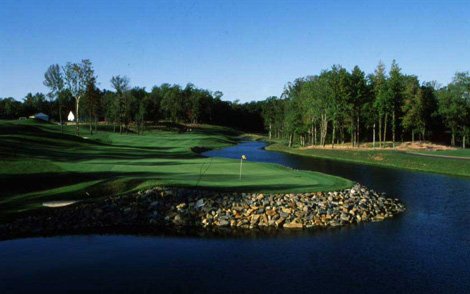
The basic lay of the course is very characteristic of its surroundings-rolling terrain with dramatic vistas and more rocks then you can imagine in any stone quarry.  The rocks accent the water hazards-the forced carries, the tee boxes-even the outhouses.  The stone budget alone would have built most courses in the sixties.

Signature Boulders 16th Hole Par 5 (www.caddybytes.com)

The green arrangements are really challenging.  Most involve a dramatic approach but all have bail out areas and alternate routes for the player not up for that challenge.  Lots of undulations, a few buried pacaderms, and, though some of the greens are in the 50 yard long range, you never get much depth to shoot at so you have to pay attention to the approach angles.

Tough Carry into 12th Par 3 (www.caddybytes.com)

The driving is the most challenging aspect of the course.  Wayward ones pay the ultimate price-re-teeing-but even the one that is slightly off line will make the approach to the green considerably more difficult.  You must pay attention to the hazards in the driving areas-if you have the nerve to play adjacent to them you will have a much easier approach at the flag.  At 6300 you do not need to jack them long-normal drives will leave you medium to short irons.  But the green sets will make you concentrate on those approach shots because there are some huge bunkers, swales, and even an occasional hazard you do not want to visit if par is your goal.

Farmington, Pennsylvania

Architect: Pete Dye-1997

Tees    Par   Rating    Slope    Yardage

Blue     72     73.8       138         6791

White   72     71.6       137         6313

(Click to see complete Mystic Rock hole-by-hole descriptions)

The Last Laugh

In the aftermath of Adam Scott’s impressive win in the WGC Bridgestone Invitational at Firestone CBS did the rarest of things, they decided to interview the winning caddy.  So Stevie Williams had a microphone in front of him and a world wide audience to which to crow that of the 140+ wins he has had as a caddie, 13 of them majors with Tiger Woods, “this is the most satisfying win I have ever had, there’s no two ways about it”.

His guy played flawlessly today with four birdies on the back side posting the low score of the final round and there is little doubt that Stevie was the elixir that kept Scott relaxed and focused helping him hold off a horde of young talent nipping at his heels.  Williams is one of the most accomplished caddies in the modern era, having worked successfully with Greg Norman, Raymond Floyd, and Mr. Woods and deserves a good deal of credit for helping Scott get to the finish line with the championship in hand.

While Scott was blistering the field with 21 birdies and only 4 bogies over four days, Tiger only broke par the first day and had 11 bogies and 2 doubles on the way to a mundane T-37 in the event, a full 18 shots behind Scott’s winning score of 17 under.  Tiger’s driving accuracy was 76th in the field of 76 and his putts per round stat was T43rd-not the winning combination he was looking for in his first competitive appearance in three months.

But I doubt that it was his role in Scott’s competitive revival that Stevie was referring to as the source of his satisfaction today.  He was clearly taking great pleasure in thumbing his nose at his former employer as if to say to Tiger, that hill you have to climb is going to be much steeper without me by your side.

The $140,000 share Stevie gets from this win will certainly make the steak taste very savory tonight, but I think it is the just desserts delivered to Tiger’s table that will sustain that sly grin on Stevie’s face for a good long while.

August, 2011

The Many Ways Golf Beats Politics

Living in Washington where the “raising debt ceiling story” has unfolded like a serial version of Greek tragedy in our daily local news, we can appreciate the perspective of this article in the Wall Street Journal by John Paul Newport.  Listening to the daily bickering and grandstanding by our elected officials makes you want to put them in the center arena with the lions and work out their issues like real men.  Or maybe a proper game of golf with impeachment for the losers would be appropriate.

Anyway, enjoy John’s article on why “from compromise to optimism, the course offers a respite from factions and committees”.

(Click here to read John Paul Newport’s Article in the WSJ)

John Paul Newport

Wall Street Journal

August, 2011

Golf Camaraderie

We share a golf match, which is part hike, part contest, part demonstration, and part lesson. The good will induced by the perilous joint venture leads to a mutual solicitude: advice and praise are offered to an opponent as freely as to a partner.  The trend of golfing rules and custom…….is toward elaborate niceness; we repress our coughs while others are swinging, we join in the hopeless hunt for another’s lost ball, and on the green we avoid stepping in another’s putting lines in a veritable Morris dance of exaggerated courtesy.  Our behavior is better here than elsewhere, because we are happier there than elsewhere. Golf camaraderie, like that of astronauts and Antarctic explorers, is based on a common experience of transcendence; fat or thin, scratch or duffer, we have been somewhere together where non-golfers never go.

John Updike

The Camaraderie of Golf-I

Golf Dreams-Writings On Golf

Golf As Theatre

The inexhaustible competitive charm of golf lies in its handicap strokes, whereby all players are theoretically equalized and an underdog can become, with a small shift of fortunes, a top dog.  Drama is a key word, for golf is, within the arena of the foursome, not only a war but theatre; each player has a golf persona, a predictable character, which the hazards of play subject to unpredictable shifts of fate by turns hilarious, thrilling, heroic, and pathetic.  We are actors and audience in swift alternation; our love of one another is the love that enthralled spectators bear toward performers, heightened by the circumstance that the spotlight visits everyone, as the honor falls.

John Updike

The Camaraderie of Golf-II

Golf Dreams-Writings on Golf

He’s Baaaaaaack!!!

Steve Williams that is.

Yup the man who stewarded Tiger to seven victories at Firestone since 1999 sprinkled a little magic dust on his new man Adam Scott who shot a scintillating 62 today to grab the first round lead at the WGC-Bridgestone Invitational. Scott threw down 8 birdies, including 5 on the back side, coming in with just 30 shots on the inward nine. He hit 83 percent of the greens and used only 25 putts with that garden hoe he calls a putter. Clearly Steve Williams is creating positive vibes for his new man.

Steve’s ex-boss could only manage a mundane 68 and is wallowing in anonymity in a tie for 18th at the moment. Guess he did not have his “A” Game today. Driving accuracy was his Achilles heel once again only hitting 36% of the fairways (T-73rd in that category). 27 putts with his old Cameron flat stick is not bad, but he obviously has to put it in play and hit it closer to the hole if he wants to prove that he still owns this track.

I sense that Steve Williams is doing some snickering in the parking lot. If this could somehow hold up through Sunday he might just break out into a full blown guffaw.

August, 2011

Bulle Rock

A typical Pete Dye design-full of visual intimidation and grandeur-he toys with and soothes your mind at the same time.  Your scorecard is likely to reflect the former rather than the later because the golf challenge, even if you pick the right tee length, is very robust.  Much like he did at Mystic Rock around the same time, Pete used the rolling terrain to showcase beautiful hole layouts-there is so much eye candy here you will think you are in the NECCO factory.  The ticket is high but you really get your money’s worth on all levels.

The short game practice facility was an original extra at its time-still remains one of the highlights of the experience for me.  The clubhouse is nice without being grand, the golf shop has plenty of Bulle Rock memorabilia for you to sample, and the grill room has a very fine array of all American comfort food for you to enjoy.
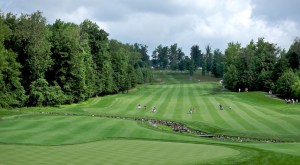
Number 2 Par 5 (Scott Serio/EclipseSportswire.com)

The composition of this course, much like the composition of a fine piece of music,  is where the artistry lies for me-the sequence and flow of the holes is very engaging.  Though the longer hitters may gripe because of the number of shortish four pars, Pete gives your scorecard a building sense of pressure because those short holes are frought with danger if you do not pick your challenges carefully.  With the exception of a bit of a logistical hiccup in the placement of the short par three third-you can feel this course naturally roll out in front of you-every really big challenge is followed by a bit of a letup on the pedal-but more challenges await in short order.  The sequential buildup on each side ends with a very memorable hole where the player needs to get a second wind to keep his scorecard in tact.
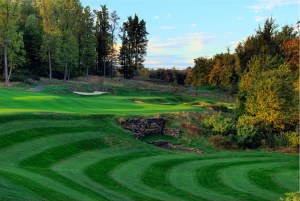
Number 13 Par 4 (www.rollinggreens.com)

As is usually the case with Dye courses, the biggest intimidations are usually not the biggest challenges, the devil is in the nuances so pay close attention to the nature of the landing areas off the tee and the access points and configurations of the greens.  The green surfaces have gentle but significant slopes-very speedy and the grain will accentuate or attenuate the pace of all putts.

Because of the topography this is a brutal walk-some serious cardiac episodes lie between green and tee.  The lack of any tree cover in the playing area from tee to green means that when the sun is out you will get the full brunt of its fever-be prepared to drink, towel, and seek some refuge under the cart cover.

Anna Nordqvist LPGA Champion 2009 (Scott Serio/EclipseSportswire.com)

The LPGA Championship has been played here a number of times over the years and the list of champions verifies the pedigree of this course.  Winners have included Annika Sorenstam, Se Ri Pak, Suzanne Pettersen, Yani Tseng, and Anna Nordqvist.
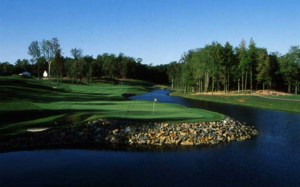
Stunning Finishing Hole Par 4 (www.golfdigest.com)

Pete rarely disappoints when they pay him and Alice the big fee and they did not disappoint here.  It is really just a matter of whether you experience more “Wows” than “Whews” here-there should be a boatload of both of them.

Aberdeen, Maryland

Architect: Pete Dye-1998

Tees            Par   Rating    Slope     Yardage

Gold            72     74.2        142        6843

Blue            72      72          138        6360

White          72     70.6        135        6047

(Click to see complete Bulle Rock hole-by-hole descriptions)