Bellagio Bogey

Golf club vendors have become like truck manufacturers in trumpeting their products in commercials with preposterous trumped up circumstantial demonstrations.

Callaway started running this commercial recently for their RAZR Fit Driver that shows the European Tour’s driving gorilla Alvaro Quiros hitting this new driver across the Bellagio Fountains in Vegas at a neon-ensconced target that shares the same six-sided outline as the Callaway logo in the commercial. Seems clear to me that the point is this adjustable fit capability will allow him to carry the ball 310 yards across the fountain and hit the target.

Besides having Quiros make final “adjustments” to the driver head and then address the ball with a cocky smirk, the producers emphasize the ball flight with the timed arc of the Bellagio fountain plumes. Of course the commercial ends with a light show and raucous crowd revelry.

Only problem is that if you watch this thing closely the ball misses the target wide left with a kerplunk into the water…………just like a misjudged hook on Sunday at the 18th at Sawgrass. Seeing this result does not convince me that “all other adjustable fit drivers will simply have to adjust”.

(Click here to see the Callaway RAZR Fit Driver Bellagio demonstration)

While I am on this soapbox let me say that all the golf equipment manufacturers are selling us a bill of goods with these adjustable fit drivers. The inference that optimal club fitting is a DIY project for a typical consumer is intellectually bankrupt.

The only way you can be properly fit with one of these adjustable fit clubs is with the assistance of a professional club fitter and a launch monitor. Once they get the loft angle, face openness, and head weighting settings right for your swing speed and path you would have to be crazy to tinker with it on your own. Further, since probably the most important factor in the proper fitting of your driver is the shaft itself, the manufacturer would have to sell you the adjustable fit club with a wrench and three replacement shafts for the same price.

This adjustable fit capability will help your club fitter fine tune your driver for you but this feature is not going to do you any good once you take the club out of the shop.

February, 2012

Taking Center Stage

As you will read in this wonderful article by Ron Sirak from Golf World this past week, Sophie Gustafson may have slain the most important dragon in her career this past fall when she stood in front of a microphone to do an interview with Val Skinner before the Solheim Cup.

Sophie has been an accomplished player on both sides of the Atlantic for a long time.  She has 28 pro victories to her credit, 5 on the LPGA Tour and 14 on the Ladies European Tour.  She has 13-12-6 record in that competitive furnace called The Solheim Cup and was a perfect 4-0 as one of the heroes at Killeen Castle as the Europeans won the cup this past fall.  (Click here to see the review Europe’s Solheim Triumph)

For all her accomplishments she has been an enigma to the golfing public for her lack of  public profile considering all her success.  But there was a good reason for that since Sophie has had to struggle with a debilitating stutter her entire life.  As Sirak says, “Gustafson has been unable to share her personality because of a stutter so severe one sentence rarely follows another without hitting a stop sign”.

With the same tenacity that she has always shown on the golf course Gustafson decided this fall to take her greatest fear head on and release herself from the shackles that this condition has bound her with her entire life.  The interview was a watershed moment for her in many ways.  Besides casting aside her own demons she was surprised at the public response she got from others who have family members with this condition.  One parent wrote that their child who stutters “now has a sports hero they can relate to”.  I think she now sees this as an opportunity, instead of a curse, an opportunity to set an example and make a difference in the lives of others.

Gustafson is an accomplished athlete but she is also a bright, intelligent, and outspoken advocate for the ladies’ game.  This article touches a cord about how hard it can be for even the most gifted athletes to deal with the challenges that life can pose for any of us.

(Click here to read Ron Sirak’s “From Stage Fright To Stage Presence”)

Sophie wrote an elucidating article of her own for Sports Illustrated in March 2012 a month before she is slated to accept the annual Ben Hogan Award at a ceremonial dinner before The Masters.

(Click here to read Sophie’s SI Article “Speaking Up”)

Ron Sirak

Golf World/Golf Digest

January, 2012

The PGA Trunk Show 2012

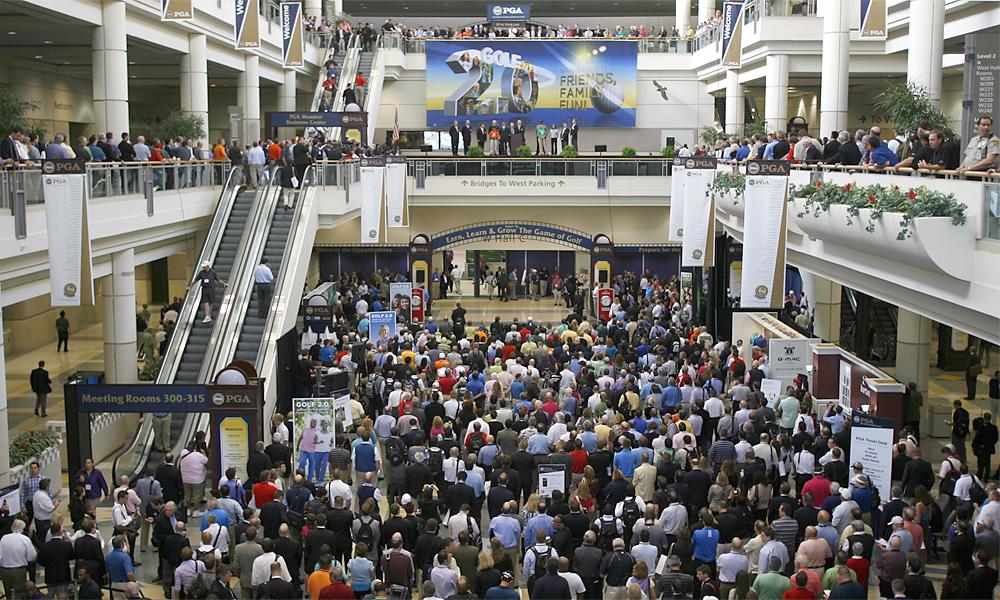
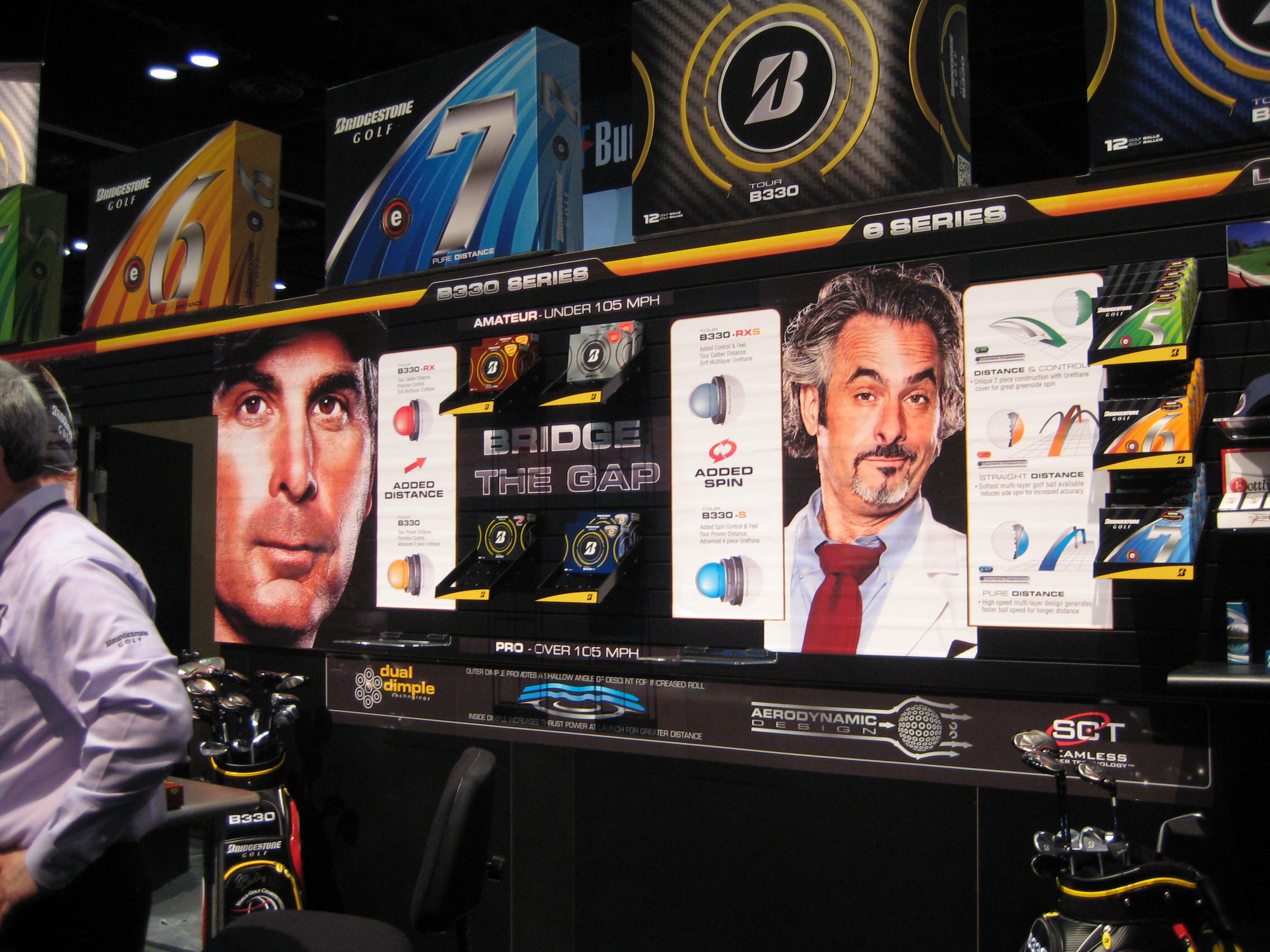
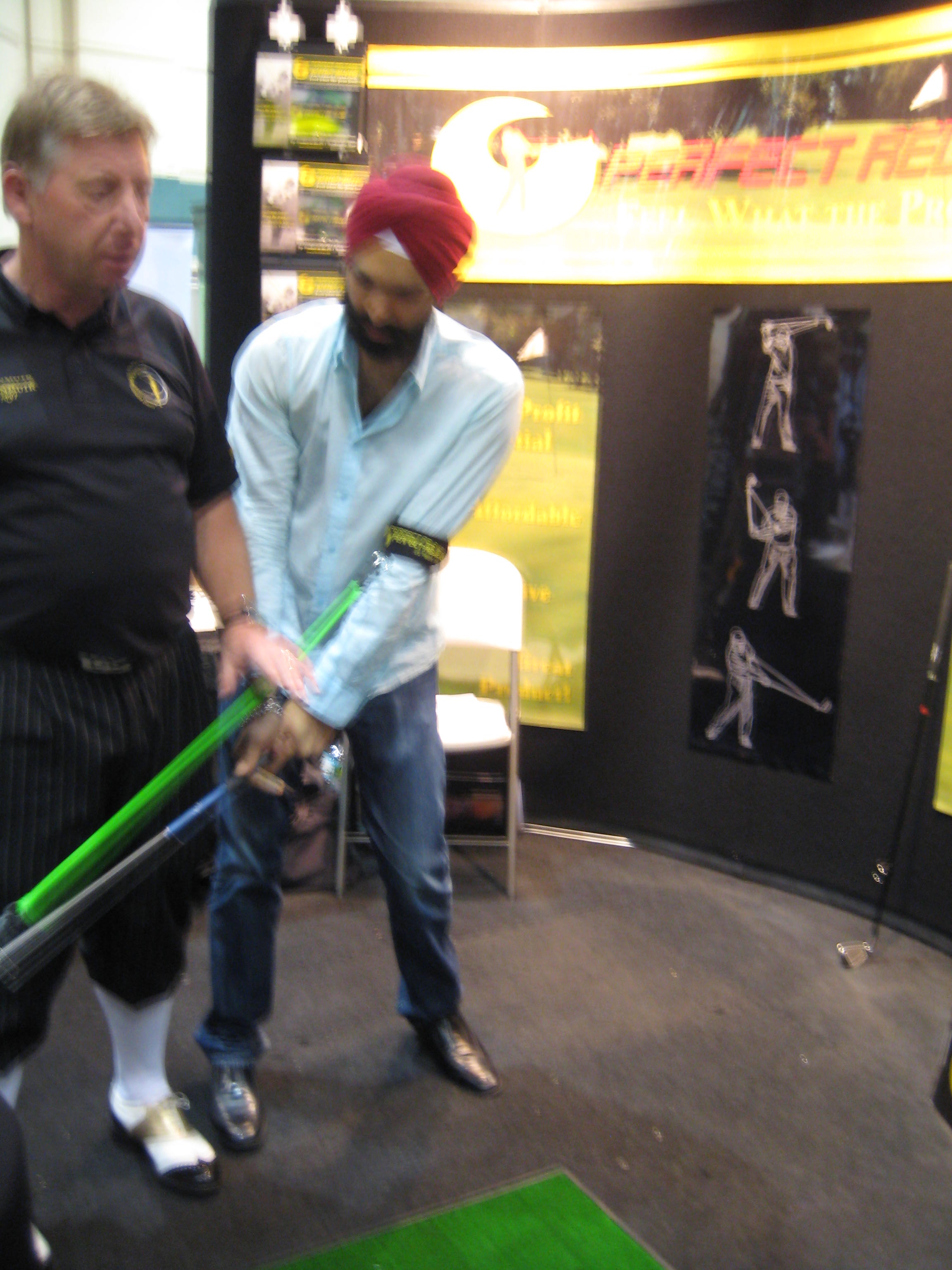
Walking the aisles of the Orlando convention center for the annual PGA Merchandise Show is like shopping the market in the Old City of Jerusalem as a Westfields Mall.  There are over 1000 exhibitors hawking their services and wares to more than 40,000 visitors over three days.  It is golf sensory overload with over 100,000 square feet of clubs, balls, shoes, fashions, accessories, gizmos, awards and memorabilia, carts, training aids, energy supplements and putting gurus.  If it is about golf it is represented here.  Enjoy some of the sights and scenes from this year’s show.

The crowds were ebbing from the opening on Thursday morning.

All the “majors” were showing their latest and greatest .

Every infomercial and outing item had a hawker.

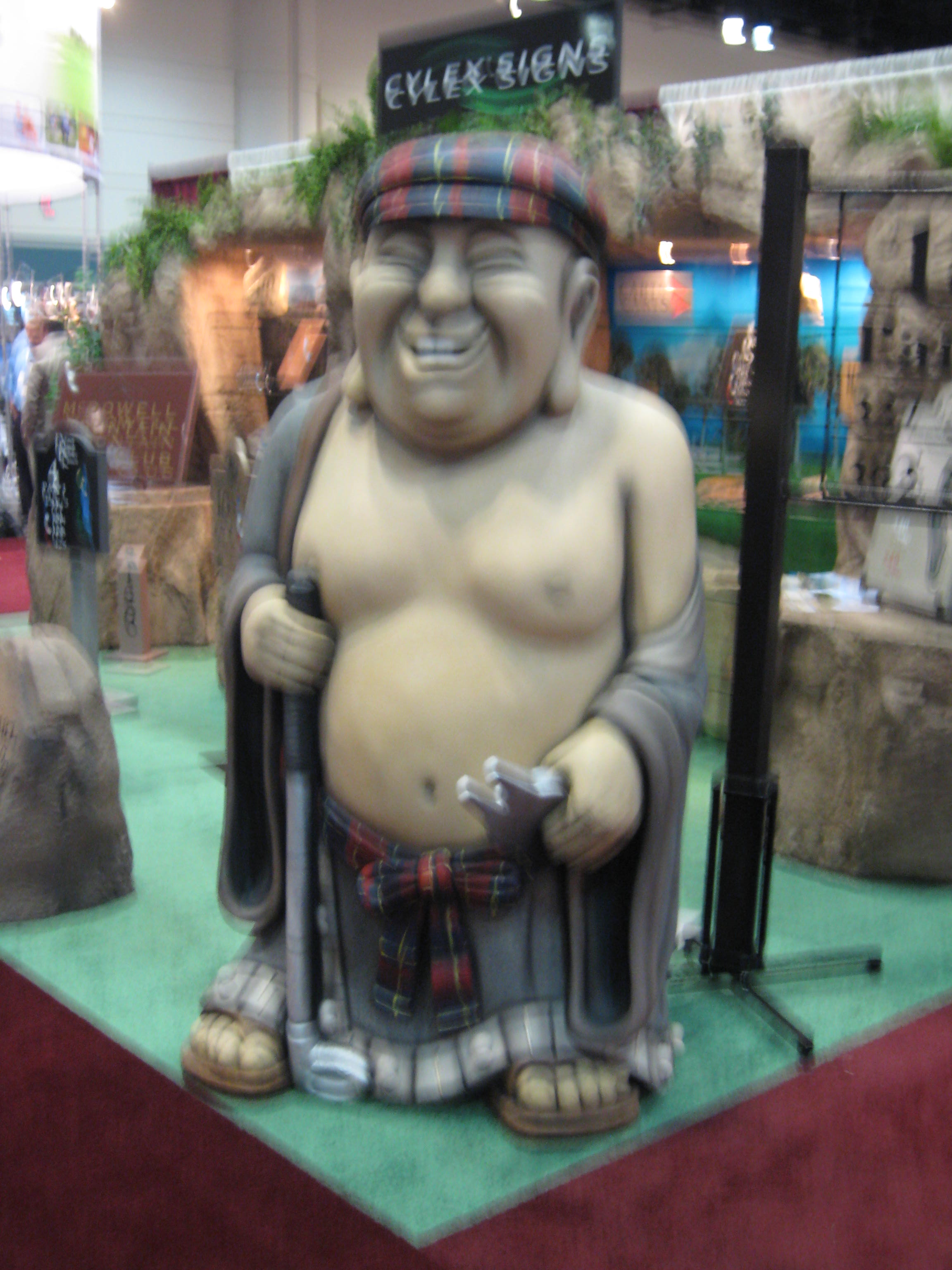
Strange lawn art and monuments had their place.

Vehicles for driving, pushing, or pulling were there.

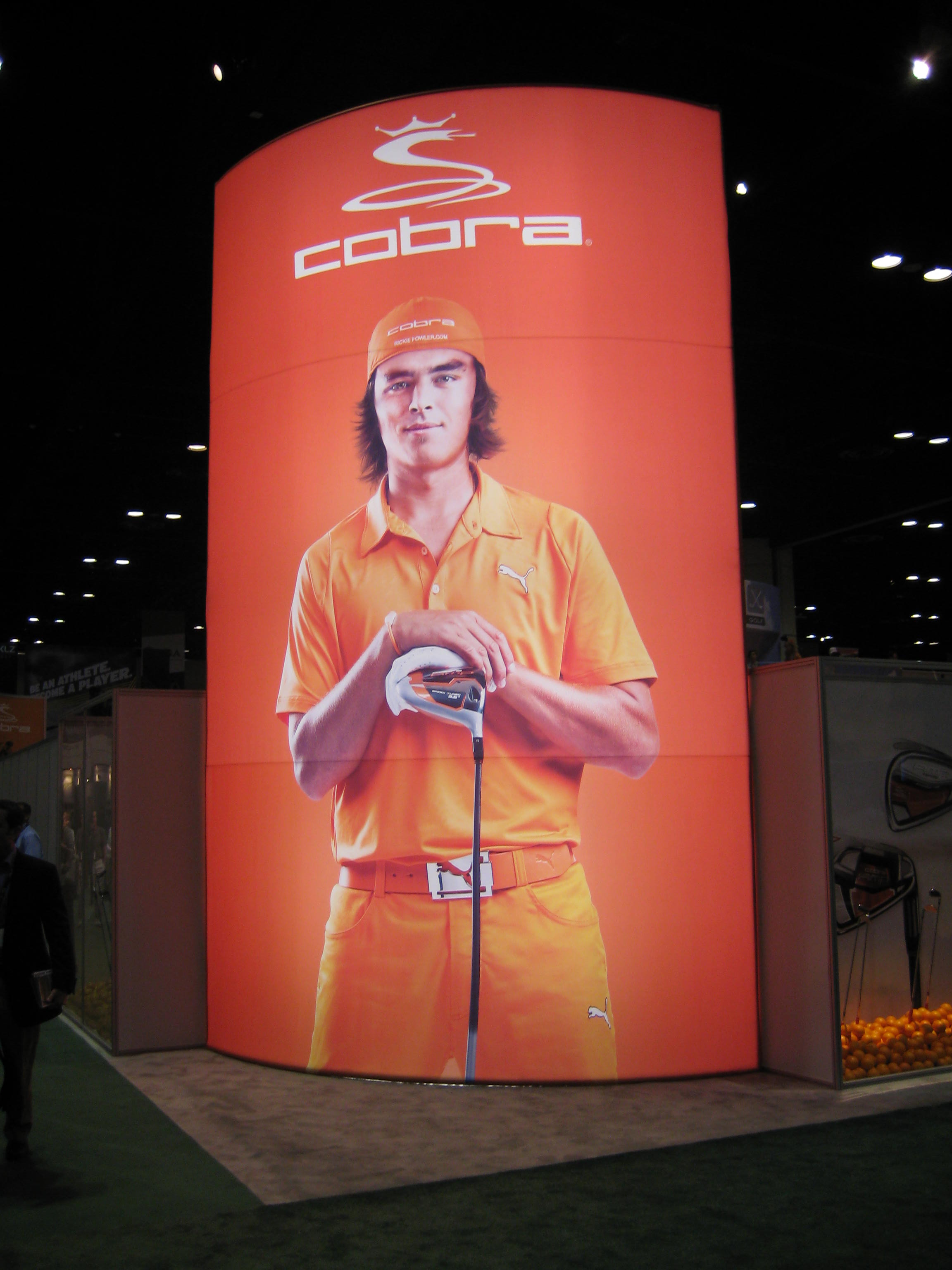
Some of the spokesman were bigger than life.

Others were on the wall or in the house earning their royalties.

There are swing aids to fix any ill.

And swing simulators as well.

Men’s and women’s fashion and accessories galore.

Even some un-traditional/traditional fashions were available.

Shoes….miles of aisles of shoes.

In the end this show is about creating a product buzz.  Whether it was Lexi Thompson pounding out 300 yard drives with her Cobra driver at demo day, droves of people gobbling up Adidas and True Linkswear walking shoes at a bargain price,  or folks waiting endlessly in line for a couple of swings of the new Taylor Made Rocketballz three wood-it is about gaping at, grabbing, and groping the latest and the greatest products in the golf world today.  Golf is a game for consumers and this is where all the consumption takes its lead.

(First two photos by David Walberg/SI)

January, 2012

Even On A Bad Day

At the end of our round we return to the clubhouse, flushed with healthy exercise, with a full and particular knowledge of the bunkers of the course, but with the proud consciousness………. that we have faithfully replaced every divot.

Bernard Darwin

Portrait of a High Handicap Golfer

Hanging Over La Jolla

The View From Above (expandingknowledge.com)

There is something delightfully playful about the colorful silks of the hang gliders that will be suspended over Torrey Pines at this week’s Farmer’s Insurance Open in La Jolla, California.  These characters look like they are really having a good time as they take in the stunning vistas, beautiful sunshine, and an aerial view of some of the top players in the world plying their craft.

Tiger, who has won at this place more times than we can count, will be skipping the event to pad his money market account with a three million dollar appearance for playing in the Abu Dhabi HSBC Championship in the Arab Emirates this weekend.  But the other favorite son of San Diego, Phil Mickelson, will be on hand along with Ernie Els, Justin Rose, Dustin Johnson, Nick Whatney, Rickie Fowler and a host of others as the PGA West Coast Swing shifts into second gear.

Maybe the most interesting story this weekend is the return of J.B. Holmes to the tour after brain surgery this fall to correct a Chiari Malformation that was impinging on his spinal cord resulting in dizziness, headaches and problems with balance and coordination. He actually went through two surgeries and a length convalescence but is about 85% which means he still hits it about 15 yards past most of the gorillas on the tour.  This man has moxie and his return will be a welcome sight to all of the fans who watch the tour regularly.

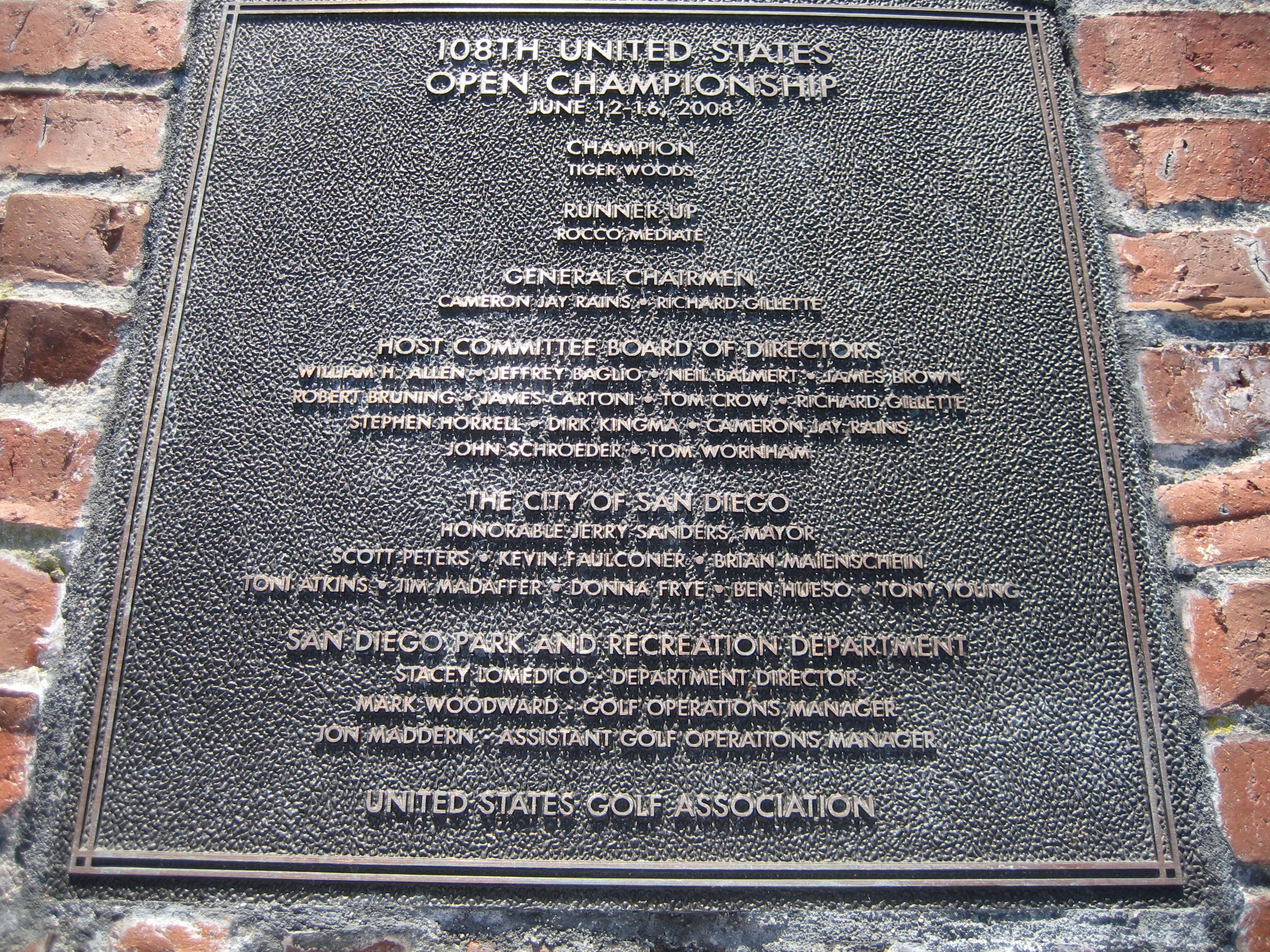
Rocco will be back at the site of his famous duel with you-know-who in the 2008 U.S. Open at Torrey Pines.  His form has been sketchy since his last win in 2010 at The Frys.com Open, but you know he will be chatty and entertaining as he basks once again in the glory of his effort in that Monday playoff for our national championship.

The 18th At Torrey Pines South (whosyourcaddie.net)

Don’t miss the sights, flights, and sounds of another garden spot in California.  TV coverage is on Golf Channel Thursday and Friday afternoon and CBS over the weekend from 3 to 6 pm EST.

January, 2012

The Dogged Victims of Inexorable Fate

It is easy to have a Dan Jenkins section in your personal library since he has been a prolific sports/golf writer for over a half a century.  He has put out countless entertaining books-both fiction and non-fiction-written in his Texas wise-guy cynical and satirical style. The writing is always observant, to the point, and almost merciless in a kind of arms length critical view.

This particular collection of sixteen short pieces was published in 1970 and it covers the full range of golf matters of the time. Unlike today where the writers have to beg for interviews, Dan Jenkins lived with the protagonists week-to-week-traveling, playing cards, drinking beers, and sharing stories. As a result, there was a level of trust and confidence developed between them that offered a clear window into the hearts and minds of the players of the day. In reading this you feel you are getting an insider’s perspective on the development of the game in a golden era.

The name of the book comes from a Bobby Jones quote on the topic of competitive pressures in golf-whether for a championship or a Sunday Nassau.  Jones once wrote,
“On the golf course, a man may be the dogged victim of inexorable fate, be struck down by an appalling stroke of tragedy, become the hero of unbelievable melodrama, or the clown in a sidesplitting comedy-any of these within a few hours, and all without having to bury a corpse or repair a tangled personality”.  Jenkin’s writings bears out how human drama defines the game as guys try to excel at an individual sport that will expose every weakness in technique or resolve in a remorseless competition.

I have recently re-read this book and I found that the subject matter he writes about seems timeless-municipal golf, slow play, head cases, television, majors, the greatest to ever play the game.  The issues today are the same as they were in the 1960’s, the names have just changed to protect the innocent.

There is a wonderful chapter about a regular on the tour who you barely know about-George Low.  He was a journeyman pro in the 30’s and 40’s who realized with the proper balance of schmoozing and familiarity he could make a life for himself without lifting a club.  As Jenkins says, “He was America’s guest, underground comedian, consultant…….a man who conquered the two hardest things in life-how to putt better than anyone ever and how to live lavishly without an income”.  He was a fixture on the veranda at every tour stop, tour watering hole, and putting green.  His prowess with the flatstick and a quick joke made him welcome fixture on the tour for thirty years.

In the chapter called “Wide Open” he describes a tournament with venues of aristocratic reverence, offering a title which guarantees wealth and fame for life, but that could be won by just about anybody or a nobody.  For example, Lee Trevino, “a laughing tub of echiladas in bright red socks with a caddy-hustler’s game” or Orville Moody, “who had a name like … a drag strip mechanic and who didn’t even have a hometown to be poor from.  Just fourteen years of Fort Hoods and Koreas”.

My personal favorite is his piece on Dave Marr “The Pro of 52nd Street”.  Dave Marr was Texas born and bread-pure Banlon in Argyle socks.  In an otherwise undistinguished journeyman’s career he won a major, the PGA at Laurel Valley, and parlayed it into a life- long corporate outing full of networking with the stars and the champions of industry.  You see this charming, likeable, self-deprecating guy realized what Frank Sinatra knew, if you can play NYC you can play anywhere.  So he moved to New York, traded the argyle socks for double breasted blazers and Gucci belts, and adopted the New York lifestyle as his own.   Doing his thing in the bistros and bars he developed life long friendships with celebrities that made him someone to hang with.   In spite of regularly finishing twenty-third or worse, the income flowed from endless corporate outings and a broadcast gig based on his popularity among his peers and an insider knowledge of the game.

The book ends with “The Doggedest Victim” about his good buddy Arnold Palmer.  Jenkin’s personal account of Palmer’s historic and folkloric come from behind victory at Cherrry Hills in the 1960 U.S. Open characterizes the entire book.  In Palmer’s ascent to “the most immeasurable of all golf champions” Jenkin’s characterizes him as the “doggedest victim of us all”.

Dan Jenkins will be inducted into the Golf Hall of Fame in May of 2012, only the fifth golf writer to be so honored and the first to be inducted while he was living.

(Click here to read a typical Jenkin’s reaction to his induction)

As one of the most prolific golf writers in history, his body of work clearly qualifies him for this long overdue honorarium.

Do yourself a favor, the next time you are on the Barnes and Noble web site and need another $10 item to get you over the $25 minimum for Free Shipping buy yourself a copy of “The Dogged Victims of Inexorable Fate”.  It will be a welcome addition on your nightstand or next to your thrown and provide you plenty of laughs and expand your knowledge of the history of the game.

The Dogged Victims of Inexorable Fate

Dan Jenkins  (1970)

The Phantom Limb

In his book,  “The Man Who Mistook His Wife For A Hat” , the neurologist Oliver Sacks talks about the ability of people who have lost a limb to compensate for it by subconsciously imagining the phantom limb is still there.  Witness a real life rendition of this theory by taking a few minutes to watch this inspirational video called “Manuel De Los Santos” produced and directed by Peter Montgomery.

Teeing it up on the 18th at St. Andrews (sportsdoinggood.com)

Manuel De Los Santos grew up in the Dominican Republic and, like so many young athletes his age, hoped to pursue his dream to be a professional baseball player.  Talented and driven he was on his way to doing that with the Toronto Blue Jays in 2003 but his plans were sidetracked by a terrible motorcycle accident where he lost his left leg above his knee.

Following the accident he moved to France where he and his wife happened to see the film “The Legend of Bagger Vance” and it’s moving content inspired Manuel to take up golf.  As you will see in this film, he is an extraordinary athlete and through endless hours of hard work has dedicated himself to being a top caliber golfer.  He routinely hits his driver 300 yards, has a short game to die for, and now plays to a three-handicap and competes in tournaments around the world.

Besides the inspirational aspect to his accomplishments, this man has one hell of a golf swing.  If you look at the video, from the waist up his mechanics are pretty amazing.  He rotates his torso around the inside of his right leg, just like they say in all the instructional videos, and at the top of his swing he fires his left hip first to drop the club perfectly into the power plane on the way down.  From behind you can see he has the perfect balance of a skilled player and uncoils to a full finish with his chest facing the target on the follow through.  As he says in the video, when he gets to the golf course he finds his second leg, it is like it was never gone.  This is the phantom limb theory in action, his left side does not know what is missing and his swing mechanics are just wonderful.

Maybe the best part of the video is his quote that golf brought a smile back to his life.  It has done so for so many of us who use golf as a way to manage the stresses in our daily lives.  Manuel’s attitude and accomplishments are something to behold.  It reminds us that the highest hurdles we perceive in our lives are often self-created and it is up to us to figure out a way to deal with them and put them in our rear view mirror.

(Click here to see this Manuel De Los Santos inspirational video)


Manuel De Los Santos

Produced/Directed By Peter Montgomery (2009)

The Apostles Return

Mitsubishi Championship LogoMai Tais at check-in, breakfast on the beach, metronomic turquoise blue surf, and seas of stunning black lava…..there is a reason the wives of Champion Tour players won’t let their husbands miss the Tournament of Champions event that begins the season at the Hualalai Golf Course of the Four Seasons Resort on the Big Island in Hawaii.  It is no exaggeration to say that this place is like tranquility in a bottle.

The Champions Tour  (a.k.a. The Apostle Tour) begins the year-long Charles Schwab Cup competition every year with the Mitsubishi Electric Championship.  The limited field event includes all the Champions Tour winners from the last two years as well as the guys who won Senior majors the last five years.

The field is stocked with Hall of Fame faces you rooted for the last 30 years including John Cook, Tom Lehman, Apostle Player of the Year and the Charles Schwab Cup winner, Freddie Couples, the ageless Tom Watson, Bernard Langer, and so many more.  The Golf Channel broadcast is in prime time Friday, Saturday, and Sunday so there is no reason to miss this.

The Hualalai Golf Course is a spectacular Nicklaus design on the Kona Coast of the Big Island in Hawaii.  The course was dug out of the black lava landscape created by centuries of volcanic eruptions.   The scenic vistas on this course alone are worth the price of admission.  Nicklaus used the natural up and down flow of the land to route a very interesting layout of holes lined on both sides with acres of black lava that give it a distinctive character you will not forget.

Number 18 is an opportunistic finishing hole for someone with nerve

Number 18 is an opportunistic finishing hole for someone with nerve

At 6600 yards the course is not a killer-past winners have been 20-under or better over three days.  Being a resort course, Nicklaus provided wide driving areas and generous access to the green settings.  But there is plenty to contend with if the wind is up and you don’t control the trajectory of your ball.  Balls forced to wander by the wind that end up on the lava are treated harshly-you would need a sherpa guide to retrieve the ball.  The putting in particular is a real challenge when you have a three-flap wind buffeting your pant legs.

(Click here to read the Moegolf review of the Hualalai Golf Course)

Pure serenity…everywhere you look….

The real attraction for these players and their families is the Four Seasons Resort itself.  This is a seven-star resort on a scale of five.  Of all the Four Seasons Resorts I have ever been to this is by far the nicest and that is saying a lot.  The accommodations, dining, pool, beaches, health club, and golf course are as fine as you will see anywhere in Hawaii.  But the best part is that this is all presented in an informal atmosphere without pretension.  The people who work there are genuinely engaging, gracious, and concerned about your every care during your stay.

It is worth watching this weekend just for the David Marr post-round interviews from the greenside couch.  No matter their score, these guys will be stress free from their week in this small piece of paradise.

(Photos from http://www.fourseasons.com)

January, 2013

Putting It On A Peg

Of the golf paraphernalia we use each day, the most taken for granted piece of equipment is our wooden golf tee.  It lacks the technological wizardry and the marketing hype but it serves us faithfully eighteen times a round.  Made me wonder where it came from and why it has not changed very much over time.

If you go back to the black and white images of the late 1800’s and early 1900’s you will notice a box of wet sand next to the teeing grounds.  The players would take a scoop of the stuff and mold a little tee-pee on the ground from which to launch their gutta percha.  The consistency of this support had to be questionable since most of the guys had trouble bending down in those waistcoats and wool britches.

Vintage Golf Tees from 1892 to 1922 (brinkster.com)

It is not like there were not great minds working on this dilemma.  As you can see in this image a number of guys came up with some innovative man-made teeing platforms to consider.  In fact at least two of these have a current iteration that you can buy from an infomercial for three easy payments, and, if you act now, double your order for free if you just pay the additional shipping.   The problem was these guys lacked enterprising minds and they could not figure out how to widely market their product to generate any income.

Around 1920 a dentist and frustrated hacker from New Jersey named Dr. William Lowell, who clearly was not making enough from producing wood bridges for his patients, decided to go after this fledgling market big time.  He introduced his wooden peg version, The Reddy Tee, which he patented in 1925 and struck a deal with Spalding Company to produce.  The concave platform cradled the ball to hold it in place without wobbling and the red paint gave it a recognizable look.

Dr, Lowell's Reddy Tee 1925 (golf.about.com)

The real challenge was how to market this to the growing populace in America who became infatuated with golf in the Francis Ouimet-Bobby Jones golden era.   Other than major amateur events most people saw their golf through exhibition matches that were put on by the professionals of the day.  There was no one more visible or popular in this platform than the ultimate showman himself Walter Hagen.

Lowell’s marketing genius was to sign Hagen for the outrageous sum of $1,500 to use his tees on exhibition tours in the United States and England.  Hagen handed out hundreds of bags of them at his exhibitions and before long spectators were scrambling to collect them as souvenirs,  It worked like a charm because the Reddy Tee started showing up in pro shops all over the country.  Imitation is the highest form of flattery and knock offs of these tees started coming out of the woodwork, literally.

You might wonder why the tees are not still red today since that was one of Lowell’s basic marketing features.  It turns out they had a humidity issue.  Mark Frost, in his book “The Grand Slam” explains that “The first time Hagen went out with a pocket full in humid conditions he saw a stream of crimson running down his tailored plus fours and thought he had been shot.  Not about to turn his back on the endorsement money, Walter took to carrying a spare Reddy behind his ear”.

It is funny that with all the technological changes in balls, clubs, bags, and everything else we use on the golf course, the tee we use today is pretty much the same one Dr. Lowell patented in 1925-just smidge taller to accommodate those 450cc driver heads. Pure genius knows no substitute.

January, 2012