
Emerald Dunes

This golf course is a quiet jewel in the middle of the east coast “strip” of Florida it stands out as one of the best tracks I have played in this region.   They spared no expense in presenting first class practice facilities, superb design esthetics, wonderful conditioning, and great support features.  It took guts and vision to put this much into a public course and my hat is off to the developer.

Stunning views begin on the first tee

The practice facilities are top shelf-as good as you will find anywhere.  The double sided driving range has over 8 acres of grass hitting surface in the same 419 Bermuda Grass found on the course.  There are five target greens flanked with bunkers as well as a practice fairway bunker adjacent to the main teeing ground. Fazio developed a separate short game area adjacent to the clubhouse.  It has a 9500 practice putting green as well as bunkered practice pitching greens with Ultradwarf Bermuda built to full USGA spec just like the course.  There is even a 19th hole par three that can be played from 85 to 135 yards.  This area alone is worth the price of admission.

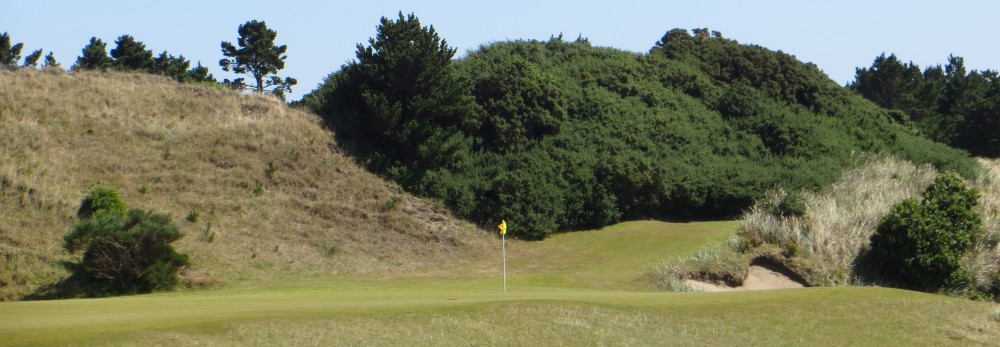
Par 3 4th is a bouquet of visual elements

As with most Florida courses Tom Fazio has generously appointed this one with water-it is in play on 15 out of 18 holes- and sand-there are over 100 bunkers- but it is not so punitive as to be unplayable.  As Tom is apt to do he often buffers the water with long sand hazards to keep you in play-though not out of trouble-and keep up the pace of play.  The strategy required on every hole is not evident at first blush.  There is plenty of visual misdirection going on so you need to take in the information in the yardage book or the deluxe on board computer and think your way around this course.

Short Par 5 11th requires serious tactical consideration

An enormous amount of attention, and money, was spent on the presentation of the holes.  Earth was moved to create visual and tactical interest and the plumes of sage grass, floral plantings, and stonework throughout enhance the beauty of the holes creating holes that will grab your attention.  This is not your typical Florida experience it has a very natural dunes style felling about it.

Approach shot to 17 green can be precarious

The conditioning of the course is superb-lush fairways and some of the best rolling firm greens I have played in Florida.  They even paint the top inside edge of the hole cut to match the cup itself-very professional.  You will have to really pay attention to speed on these greens or you will end up with lots of eight and ten footers coming back.

View from atop the 18th tee is as mesmerizing as the first

This course is worth going out of your way to play if you can arrange it.  A great test of golf and a wonderful visual experience as well.  Fazio was at his best when he did the design work here.

(All photos from Emerald Dunes website http://www.edgclub.com)

West Palm Beach, Florida

Architect: Tom Fazio, 1989

Tees       Par   Rating    Slope    Yardage
Green     72     72          132         6507
White      72     70.1       125         6062

(Click here to review Emerald Dunes hole-by-hole descriptions)

Heir Apparent

As the media is apt to do these days, they are anxious to crown the next greatest player in the world and it has been apparent for a while that young Rory McIlroy was most likely to fit that bill.  After a major disappointment in the final round of The Masters last year, Rory, at the tender age of 22, came back to lap the field and win his first major by eight shots at Congressional at U.S. Open in June. With a crowd of Europeans at the top of their games challenging Luke Donald’s hold on the top position, it just seemed like a matter of time until Rory broke free from the pack and claimed the #1 spot in the World Golf Rankings.

His play the last 8 months has been phenomenal as he has methodically built his resume as one of the most competitive forces in the game of golf.  On the European Tour in 2011 he had 2 wins, 2 seconds, 3 thirds, and 12 top tens out of 19 events winning over 4 million Euros and finished second in their Order of Merit. In his last 11 events he has been fifth or better 10 times.  Last week at the World Golf Championships Accenture Match Play he won a heart stopping match against his British rival Lee Westwood in the semis before losing in the final to Hunter Mahan and missing his chance to claim the world number one.

With this week’s Honda Classic he once again had the opportunity to claim that top spot if he could pull off a win against a tough field on one of the most penal courses they play all year.  His play all week was on form and he came into the final round with a two shot lead and a simple mission-make pars and make someone come from behind and catch him.

As is only fitting it was Tiger Woods who made the noise, coming from miles back in the final round shooting an 8-under 62 with a statement birdie-eagle finish to post 10 under and become the leader in the clubhouse.  When the Tiger roar subsided, McIlroy stood on the 14th tee with a two shot lead facing a formidable five hole stretch which includes the fabled “Bear Trap” that has doused the dreams of many would-be champions over the years.

Rory played the final five holes with the patience and resolve of a seasoned veteran getting up and down for par three times from more than a bit of bother.  His short game has been his salvation all week, leading the field in scrambling at 83% with 20 out of 24 up and downs when he has missed the green.  Today in particular he did not miss a single putt inside of 10 feet.  A routine par on the last hole gave him a two-shot victory at 12 under par and moved him to the top spot in the World Golf Rankings.

The next two months include a World Golf Championship at Doral, Arnie’s Event at Bay Hill, The Masters, Jack’s Memorial Tournament, and The Players Championship against all the top players in the game.  Rory will have his work cut out for him trying to consolidate his grip on the top spot.   Given his resolve and performance since last April’s Master’s meltdown I think there is a good chance he will weather that storm.

March, 2012

Sara Bay Country Club

Donald Ross only built two golf courses in this region of Florida and this one is a real gem worth seeking out.  Donald Ross once said, “A course that continually offers problems – one with fight in it, if you please – is the one that keeps players keen for the game.” Like a tough little terrier Sara Bay has some fight in her.  The original course was restored and updated over the last two decades by Brian Silva an expert on Ross designs who gave it a lovely new polish with full respect for the original design.

Created in 1926 as the centerpiece of  the Whitfield Estates one of Florida’s first golf course communities, Ross gave it all the design features that Ross courses are known for.  The greens throughout have the full measure of the distinctive precipice design that we know from Pinehurst #2.  The fall offs on most greens are on at least three sides which puts an enormous premium on a player’s decisive intent when pitching and chipping.

Signature Crowned Greens Ross Is Known For

Mature growth trees give the holes tactical framing throughout.  Fairway bunkers are done in constellations-but always on one side of the fairway-generally the premium drive location is just off the bunkers.  Greenside bunkering is very selective but severe-the long holes have free access in front-the shorter ones have hurdles, but in all cases there is a tactical way to play around them if you choose.  The greens are very difficult by virtue of the crowning, but what makes it even more challenging is that the surfaces are awesome pure-probably 11 on the stimpmeter on a daily basis.  Grain direction on every green is crucial because it will determine the relative speed and direction of every putt.  One thing to note is that the two par fives on both sides are in the last three holes so your best scoring opportunities are late in each side.

Driving Areas Well Defined By Creative Bunkering

The club itself has a quiet humility about it.  There is no glitz here at all.  The clubhouse is understated except for the extraordinary vintage pictures in the lobby of Jones, Hagan, Zaharias, Tommy Armour, and others.  The course itself is very simple in it’s presentation.  Short yardage driving range-nothing more than a 160 club-makes for lots of finesse practice time.  Pitching area is a cart ride away off the first hole.  No hole identification markers other than the yardage plate on each tee-so you have to pay attention to the course map to know where you are going.  Everyone from the pro to the starter is a low key understated type who just has a confidence in the quality of this place and why people ought to play it.

Rich History Of The Club On Display In The Clubhouse

This is a private club so you will need to arrange to play it through your club professional.  If you are in the Sarasota areas it is well worth the effort to seek this out-it is a great walk and a distinctive Ross experience.  Playing these greens will be an afternoon to remember all to itself.

(All images from http://www.sarabaycc.org)

Sarasota, Florida

Architect:  Donald Ross (1926)
Brian Silva (restored 1991/2006)

Tees          Par    Yardage    Rating    Slope
Blue          72       7021        73.8        136
White        72       6414        71.0        125

(Click here to review Sara Bay hole-by-hole descriptions)

Zen Golf: Mastering The Mental Game

Don’t let the title scare you, no need to assume the lotus position and repeat incantations as part of your pre-shot routine.  What is presented in this book by Joseph Parent, a PGA Coach and Buddhist instructor, is a pragmatic approach to managing the mental aspect of your game to get out of your own way and let your golf skills provide you with the best chance for success on the golf course.

A good pre-shot routine is essential to getting consistency out of your intended shots but the mental aspect of that routine is the part many players seem to ignore.  We have all experienced how being impulsive, indecisive, and anticipating a bad result can wreck all the good intentions of our plan.  The question is how do you clear your mind, achieve focus on your intent, and play each shot within the moment to delimit the effect anxiety and fear can have on your results.

How do you deal with the negative thoughts that creep into your head that can predispose you to a bad outcome? His suggestion is that all thoughts going through your head are like traffic on a busy street, you cannot control them coming into the picture so you should not try to control them by forcing them out.  He says, “Simply let them come up and go by, neither inviting them to stay nor trying to get rid of them.”  The key is to allow ”last time I was here I  hit in that nasty bunker” to come and go and to let stay “left center ten feet left of the pin with an uphill putt”.  It is a simple process of mental sifting.

A corollary principle is cultivating “unconditional confidence” in your intentions.  This means not being overly judgmental based on your performance at any point during a round.  We cannot expect to hit every shot perfectly and we must be able to handle the result no matter what occurs.  With unconditional confidence “instead of assuming something (mechanical) is wrong ….and trying to fix it, we reflect on what may have interfered with our intention on that shot.  This approach makes it possible to quickly turn things around and play well again.”

His central thesis in this book is a mental management process he calls the PAR Approach-a way of thinking that focuses on Preparation, Action, and Response to Result.

Preparation requires clarity-a vivid image of the shot intended, commitment-being free of doubt and hesitation of intent, and composure-being focused and poised as you prepare for a shot.  Together these three elements give you total confidence in the intended outcome of your shot.

Action is about developing, honing, and trusting a process of swinging the club that turns over control from your thinking mind to your intuitive mind.  Trying to guide your swing with swing thoughts and principles has to be left on the practice ground. When you are on the course you have to trust a process you have developed that works.  As he says, “take care of the process and the results will take care of themselves”.

Response to Results is probably the most overlooked aspect of managing your mind on the golf course.  Most of us have a tendency to focus on the negative part of our results and vocalize the flaws to ourselves.  His advice is “the best responses are those that reinforce successes and help you learn from mistakes without getting down on yourself”.  We need to take the time to appreciate a good shot and focus on how well we executed what we planned.  He says, “reinforcing good shots with positive feelings….a minimum of emotional distress around poor shots….and refraining from beating yourself up, those ways of responding to results give you the best chance of success.”

I am sure a thoughtful reading of this book will help your performance on the golf course.  It will also increase the pleasure you get from playing the game by giving you a more reasonable perspective on expectation and evaluation of performance.

The proper view this book encourages is that  “our self worth as a human being doesn’t depend on how well or poorly we strike a golf ball.  We see our nature and our abilities as basically good and the difficulties we encounter as temporary experiences.”

These are words to live by and words to play by.

Zen Golf
Dr. Joseph Parent (2002)

Huh?

In spite of the clamor over Hunter Mahan winning the Accenture Match Play and breaking the choke hold of the monkey on his back or Rory flirting with cosmic history of being #1 in the world at age 22, the real Cinderella story of the weekend was 21 year-old rookie John Huh completing his meteoric rise from nowhere by winning the Mayakoba Golf Classic in a eight hole playoff with tour veteran Robert Allenby. He shot an 8-under par 63 to come from seven shots back to make the playoff and then outlasted Allenby making 8 pars in the playoff.

Huh is an unknown entity out there. Born in NYC in 1990, the same year Allenby started his professional golf career, he moved with his parents back to Korea for 12 years. The family came back to the states and eventually settled in California where John devoted his early teenage years to the game he loved. Not following the typical development path, John did not play in very many prestigious amateur events, did not play any college golf, but decided to turn professional in 2008. For three years he toiled on the Korean Tour honing his skills and winning the 2010 Shinhan Donghae Open. He played the OneAsia Tour as well and finished 46th and 15th in their Order of Merit in 2010 and 2011 respectively. Last fall Huh went to the PGA Tour Qualifying School as a relative unknown and surprised everyone finishing 27th to earn his playing privileges on the PGA Tour for 2012.

What is most startling about this rookie debut is his instant success despite having never played in a PGA sanctioned event before. In 2012 he has played in five events, made every cut, finished top ten twice-6th at the Farmers Insurance and 12th the next week at Phoenix, and now won in his fifth start. At Torrey Pines Gary McCord called him “John Question Mark” as in “Who is this guy?”. He now has over $1.4 million in winnings and all of this without a glass slipper.

A top ten in a major or The Players in May and this story takes on Jeremy Lin proportion.

At this point I would say he is a “shoe-in” for Rookie of the Year.

February, 2012

Misinformation

As you can read in John Paul Newport’s Wall Street Journal article “Golf’s Biggest Delusions”, perception and reality in this game can be miles apart.  The nine things he alludes to that people talk about all the time are just not true.

So the next time one of your buddies tells you to keep your head down or that golfers overseas always play in under three hours or that it is all about length on the PGA Tour you can tell them where to put that old husband’s tale.

(Click here to read John Paul Newport’s Golf’s Biggest Delusions)

John Paul Newport

Wall Street Journal

February, 2012

Spittin’ Image

I am pretty sure Keegan Bradley got a text from Ponte Vedra late Sunday afternoon summoning him to the principal’s office.   After watching Keegan repeatedly drool on his Tommy Hilfiger shirt over the last nine holes Tim Finchem had to be concerned about stemming the rash of young players projecting lugies during PGA broadcasts.  This is a sport where they have shoved the chain smokers into a closet forcing them to hide their butts in their palms while on camera.

Keegan is bad enough with his shpilkus pre-shot routine-it brings back bad memories of Sergio’s 47-Waggle days.  But the spitting is downright gross.  Either they need to outfit Keegan with a Hilfiger drool bib and a spittoon on his golf bag or get him to learn to do his business behind a tree before he picks his club.  If the young kids pick up on this there won’t be a dry place for the Canadian Geese poop on the fairways of courses in the northeast.

Other than that the Northern Trust Open at Riviera was Survivor Pacific Palisades in Soft Spikes.  Following the horde of contenders on the back nine was like watching the hockey coaches try to tip toe to the bench in their leather loafers after the Zamboni Machine has done it’s due diligence between periods.  The chilly temperatures, encroaching gum trees, and some seriously punitive George Thomas bunkers left a pile of dazed guys lying flat on their backs staring up at the bottom of the Jumbo-Tron.

In the end it was Mickelson and Bradley’s improbable birdies on eighteen-there were only eight all day on the finishing hole and two of them came in this last group-that forced a playoff with the Fed Ex Cup Champ Bill Haas.  The playoff was decided on the short and treacherous tenth hole when all three players, knowing it was going to take a three to end the drama, tried to drive it on the green but put themselves in some serious bother.  Haas went for the croquet up and down pitching away from the hole and then buried a side-slinging 43-footer for the birdie and the win.

Finchem has to be pleased with the Sunday drama his sport has provided these last few weeks, but I think he will be considering adding the Emily Post Handbook to the welcome pack for the players next year.

February, 2012

Muni Respect

The first time I visited a Municipal Course, I was astounded by the fury of the battle……
The gameness and concentration of those golfers was as fine a test of sportsmanship as I ever saw.  Everyone who aspires to concentration should play such a course.  These was no nonsense as “Please move your shadow off the line of my putt” or “Stand still while I play this shot”….It was an endurance contest, and it was played with perfect indifference to outside influence.

George C. Thomas
Architect of Riviera Country Club
Golf Architecture in America (1927)

Their Love Of The Game

In celebration of Valentine’s Day, Rich Lerner did a wonderful piece on the Golf Channel from Cupid’s golf haven, Pebble Beach, called “A Valentine For The Game of Golf”.   It opened with a Dr. Suess quote, who once said of love, “You know you’re in love when you can’t fall asleep because reality is finally better than your dreams”.

To which Lerner adds, “Golfers get that”.

This testimonial piece was a compilation of responses from players and celebrities on what they love about the game of golf.  There were a whole bunch of the little boy growing up with the game in their responses.  Their answers were wide ranging and thoughtful getting to the heart of why they are smitten by the game.

At the end Lerner concludes,  “It is much more than a game….it is a love of a lifetime”.

Got that right.

February 14, 2012

Note: Unfortunately the GC content life cycle of this piece has passed and it is no longer available for viewing…..our loss.