Lytham On The Midway

Royal Lytham is a patch of emerald polka-dotted with bunkers in a prison of red brick.  You wouldn’t know it is a links unless someone from the Royal and Ancient assured you of it, for the course is more than a mile from the sea.

It is the only British Open course that is not within sight of any water, which leads to the theory that in Lytham’s case, a links is any golf course built on land reclaimed from the penny arcades.

Dan Jenkins

Seen on geoffshackelford.com

July, 2012

Defending The Links

The courses…..in the United States have architectural and maintenance tools unavailable at links courses: trees; man-made water hazards; irrigation and overseeding for uniformly thick rough; amped green speeds……

Rota courses have the basics: distance; direction of play, primarily off the tee; ground shaping, such as ridges and hollows; cutting heights, particularly around greens; bunkers; and the occasional prayer for rain to make the fescue pop and wind to fortify the challenge.

Brett Avery

Hollowed Ground
Golf World
July, 2012

Church Pews

The name of the Lord is invoked many more times on a Sunday on a golf course than it is in church.  It’s His fault really.  I firmly believe the game was invented by the Irish and given to the Scots as a joke, and they took it too seriously.

David Feherty

Golf World
Lipouts
July, 2012

Getting Links Ready

The Scottish Open, returning to the links course at Castle Stuart for the second time, is a major preparation for next week’s Open Championship at Royal Lytham and St. Anne’s.  Unlike last year’s event which was played in a rare Scottish typhoon requiring full snorkel gear and a wet suit, it looks like it will be more normal Scottish weather will prevail for this year’s event.

(Click here to see the startling images of last year’s tidal event)

Luke Donald, last year’s winner in the 54 hole event, leads a field of top players from around the world who will use this for an Open tune-up.  Phil Mickelson, Padrig Harrington, Ernie Els, Martin Kaymer, and Louis Oosthuizen are among those major winners in the field this week.

Padrig speaks for many of them when he said, “I like to play links golf before the Open…It’s a distinctly different form of golf than what we regularly get…..there is no substitute for playing competitive links golf.”

Castle Stuart is one of the few new links golf courses opened in Scotland recently.  It is the handiwork of the accomplished Gil Hanse, an American designer of all things, who recently won the designer derby and got tapped to design the course in  Brazil that will host the introduction of golf to the Olympics in 2016.  Castle Stuart got strong reviews from those professionals who slogged through the event last year.  Hopefully drier, firmer conditions will give everyone a chance to play it as it was designed.

After the first round it looks like the wind was not blowing.  Francesco Molinari torched the course with a 10 under par 62 to take the lead by three.  Luke Donald and Martin Kaymer both shot 5 under 67’s and are in a tie for 12th.  Good scores abounded-it looks like it will take under par to make the half way cut this year.  Mickelson is at plus 1 after his first round so he will have work to do to make the weekend play.

Knowing how chameleon the weather can be on the links of Scotland it is anybody’s guess what the Scottish golf gods will have in store for the players over the next three days.

July, 2012

Horses For Courses

An overused phrase on the PGA Tour but totally applicable when Steve Stricker plays the John Deere Classic at TPC Deere Run.  He has won this event the last three years and if he wins it again this year I think they may just have to change it to the Sticker Invitational.

Last year he won the event in electrifying fashion on the last hole extricating himself from a brutal stance in a fairway bunker and then making a bomb putt from off the green for the winning birdie.

(Click here to see read the moegolf account and see a video of his amazing shot)

In Thursday’s opening round Stricker did not disappoint.  After shooting lackluster par on the front nine he answered with 30 on the back including four birdies and an eagle on #14, jarring a wedge from 80 yards out.  His 65 positioned him nicely a couple of furlongs back of Troy Matteson who shot a sizzling 61 out of the gate.  I like Stricker’s position coming around the first turn.

July, 2012

Musket Ridge Golf Club

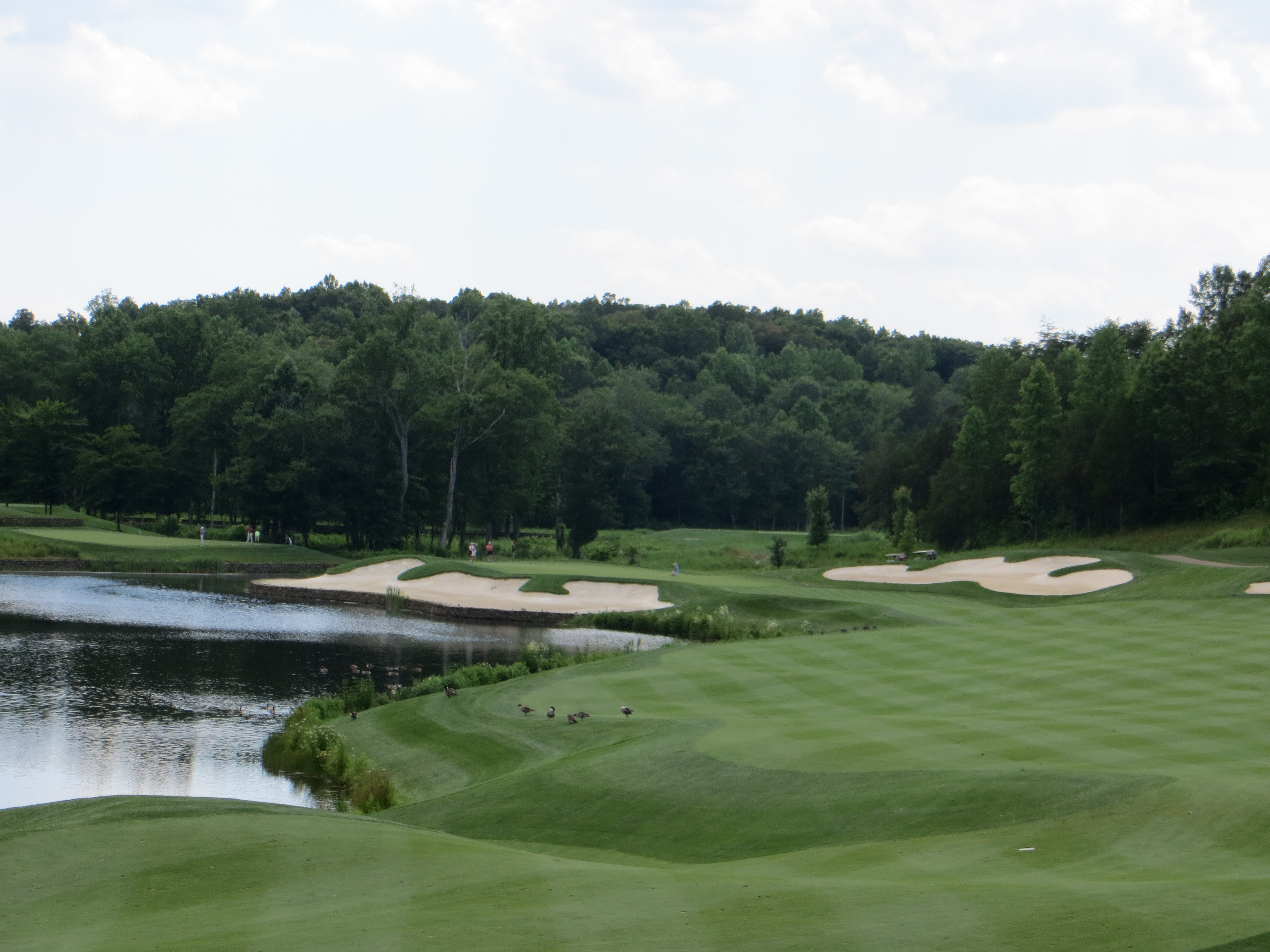
Set in the terrain of the foothills of the Shenandoah Mountains this is a hilly course with dramatic up and down holes and stunning vistas all around. The golf course is in the same neighborhood as Arthur Hill’s Maryland National to which it tends to regularly be compared.  In my estimation Musket Ridge is hands down more fun and interesting.   What differentiates it from Maryland National is that it is a consistent strong design without any trickery.  Balance of long and short holes is right, par threes have good variety, and the teeth of the course are the in finish on both sides.

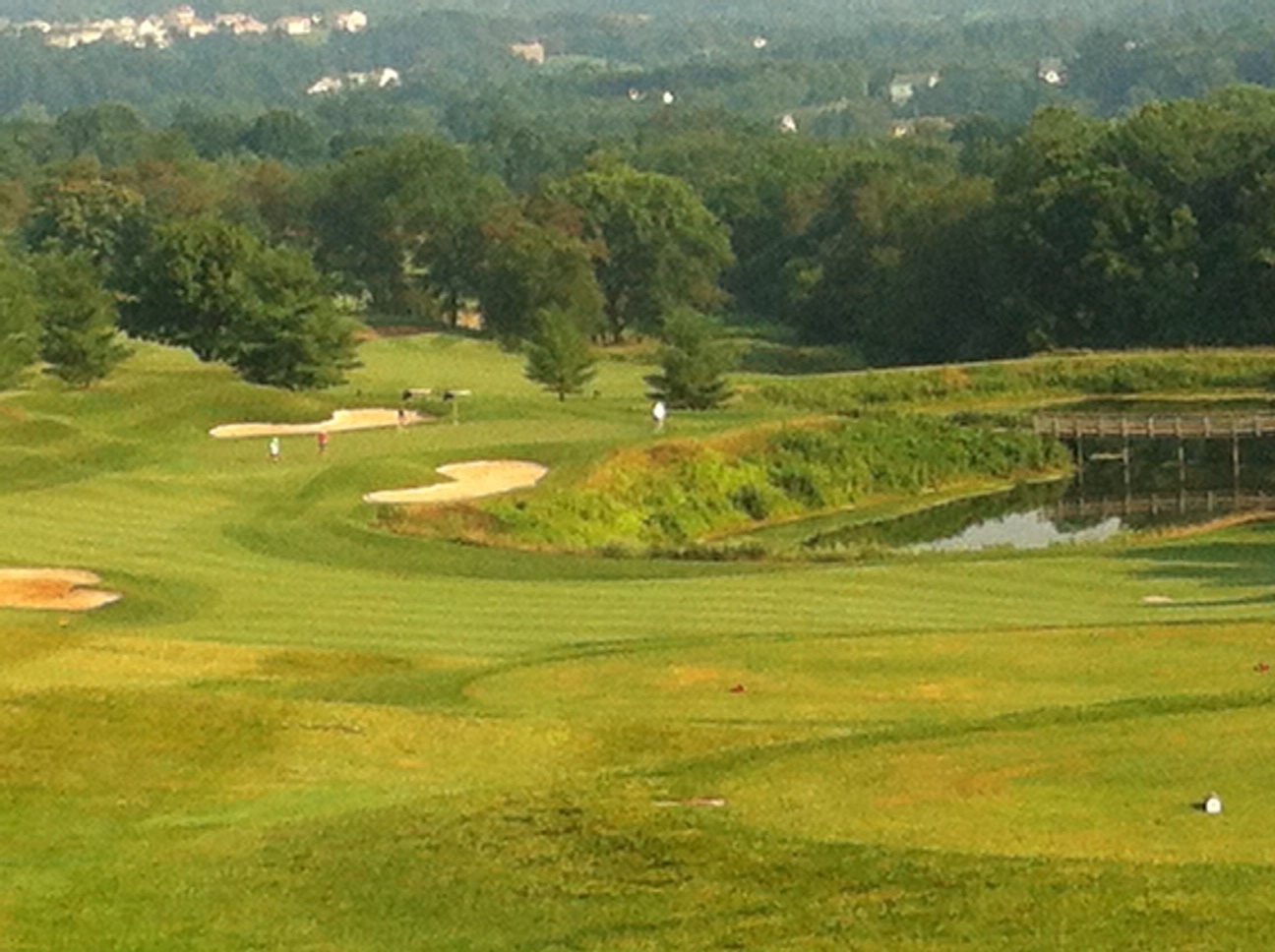
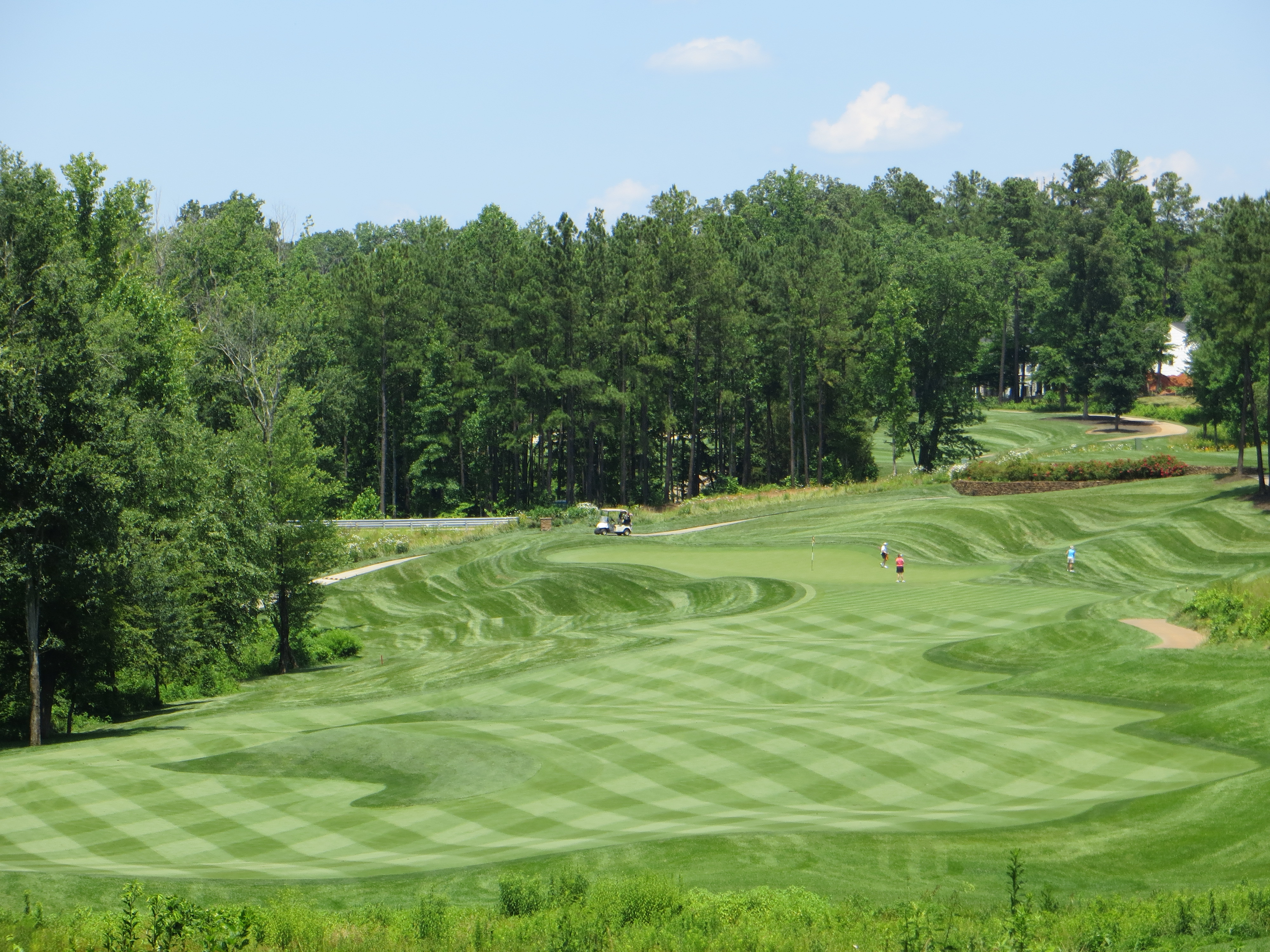
Playing Musket Ridge, the first thing one comes away with is the beauty of the settings that surround the course.  There are so many holes where you stand on the tee looking at the hole ahead and your eye just gets drawn to something five miles in the distance.  At times it can be distracting because the mind starts wandering and the scale of the task at hand gets dwarfed by the panoramic view that is consuming your attention.

From the first tee the scenic beauty of this region is revealed

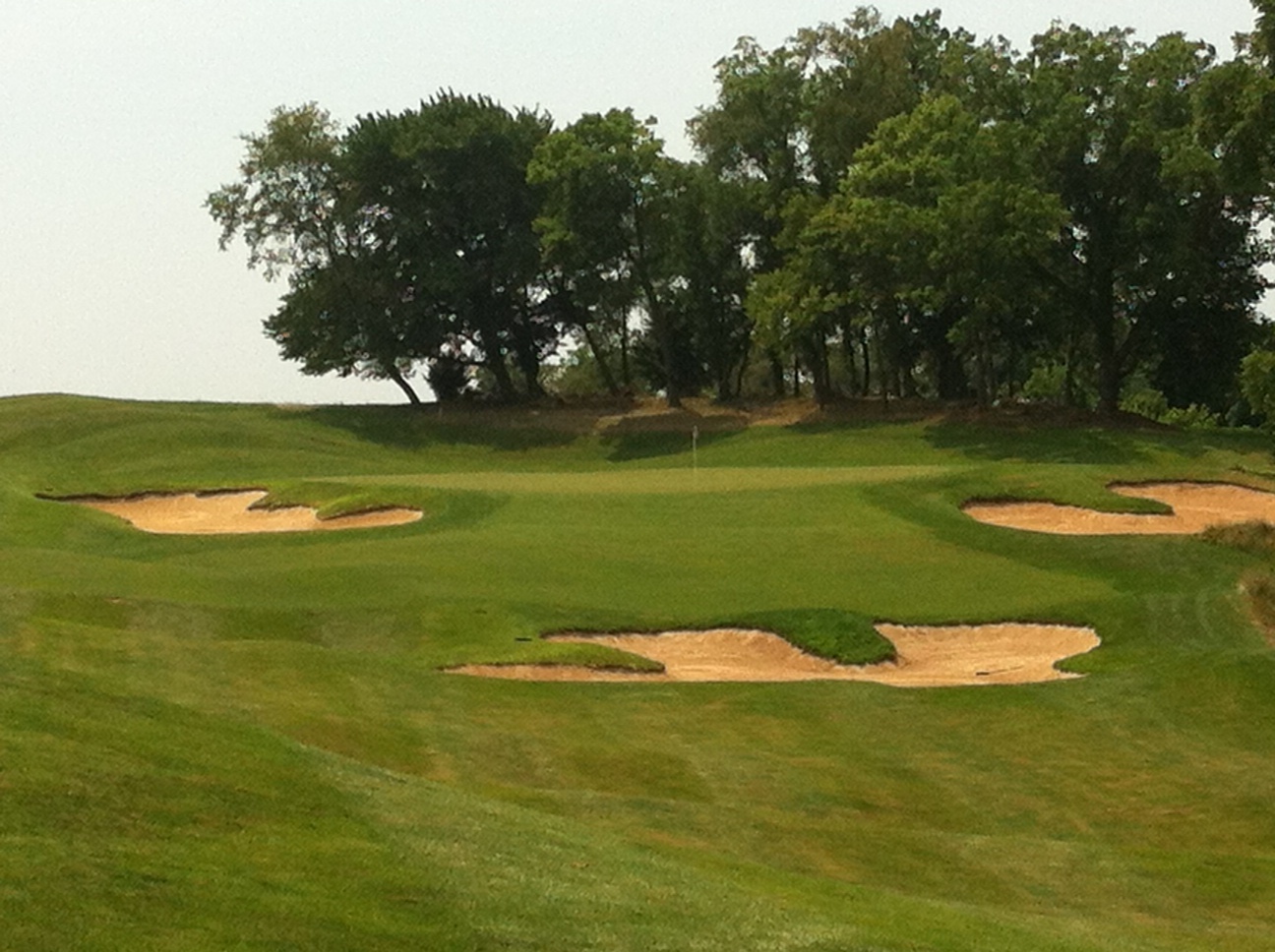
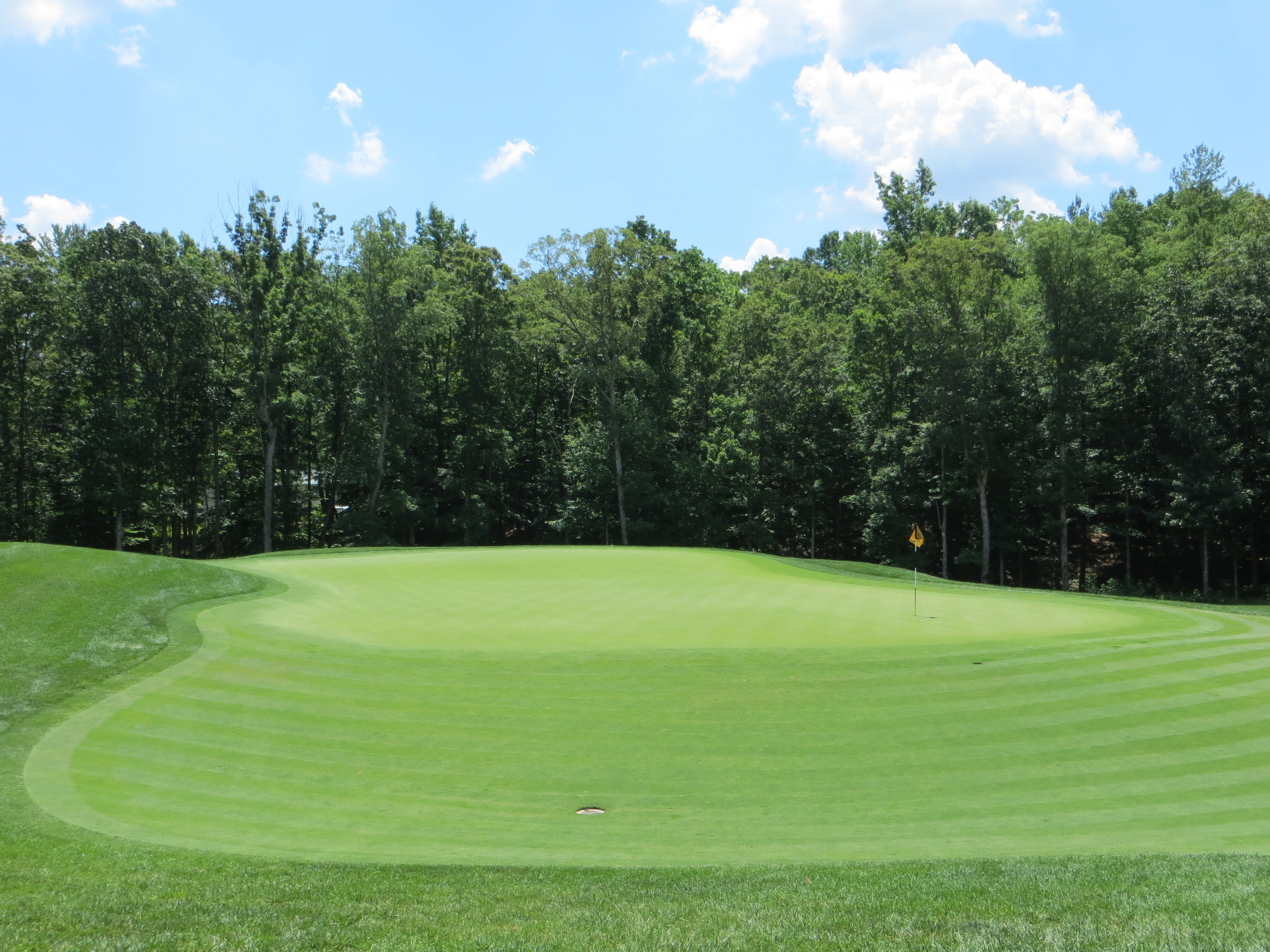
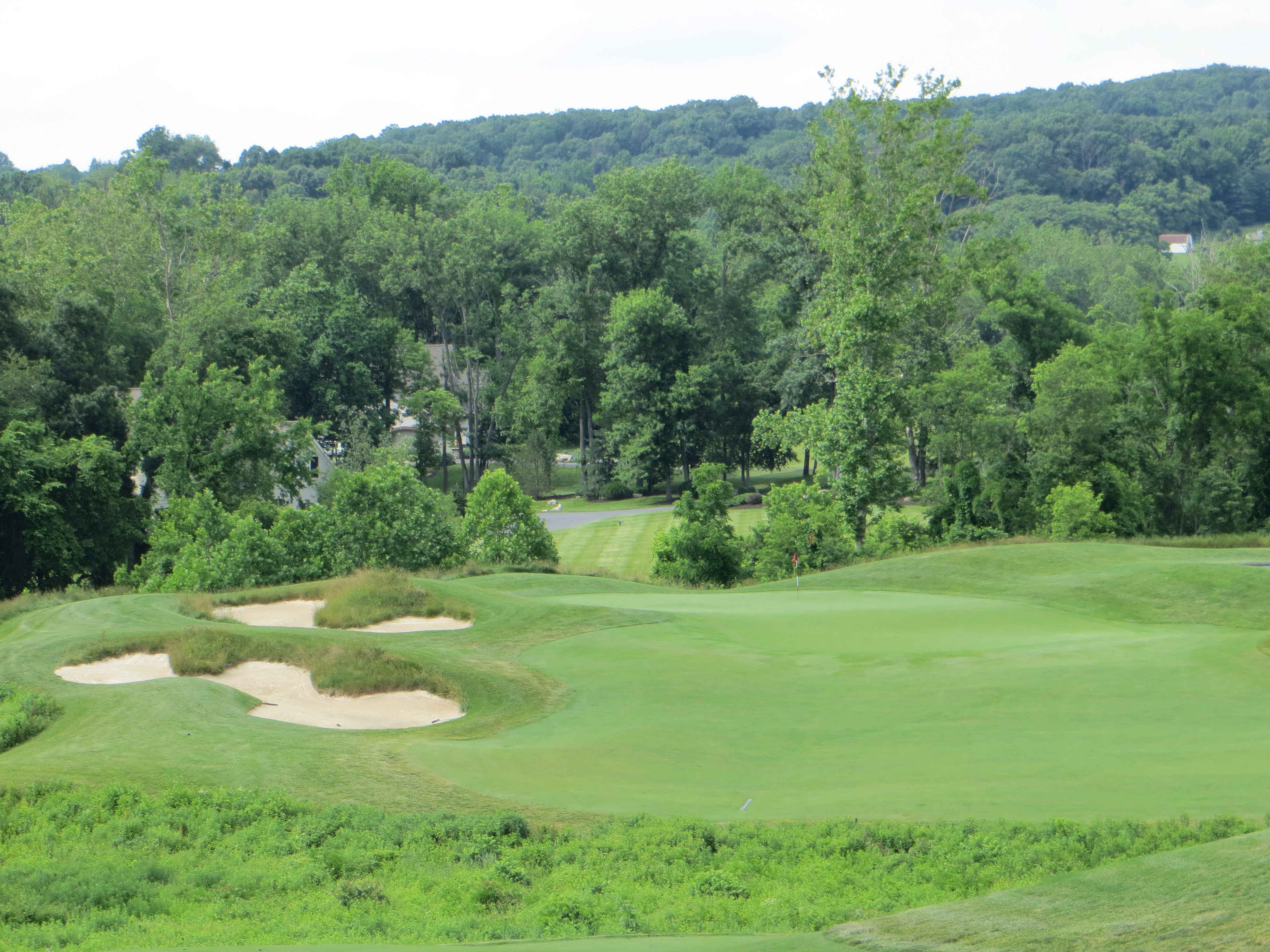
The second characteristic worth noting is the quality of the greens.  Pretty generous in size the greens are big without being sprawling.  Unlike so many new courses these days these are not tricked up with buried pachyderms or absurd segmentation.  Occasionally multiple tiers appear but it is selective and makes sense when it is used.  The bunkering around the greens is strategically positioned and can be punitive so you must respect their proximity when picking your approach lines.  To my experience, the quality and maintenance of the putting surfaces has been top notch.  They can be speedy when cut low but most of the time they run at a comfortable speed for recreational play.

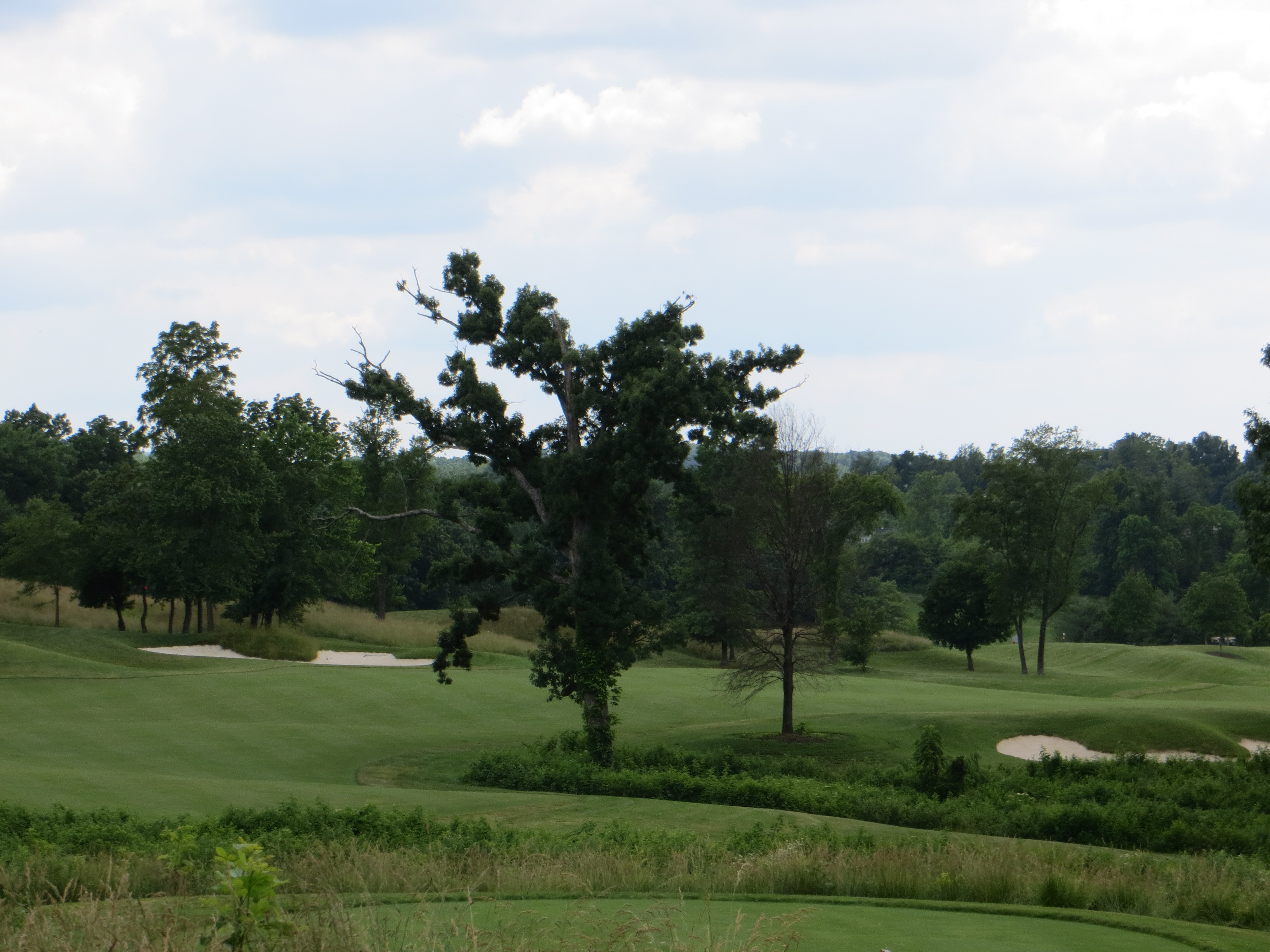
Lastly it is noticeable the way the holes are routed across the hills.  Most holes traverse the fall line of the hills so there is a stacked effect to the arrangement of the holes.  The designer uses ridges along the side to define and contain each hole and give you relatively level ground to play from.  But the influence of the prevailing slope of the property will influence the movement of your ball on the ground.  Wandering  beyond those ridges puts your ball in the jeopardy.  To accentuate the look they have let the grass on these side hills grow to three feet plus so you have to keep your ball within the parameters of the playing area or you will pay a price.

A little floral embellishment on #17 and this could be a postcard

The variety of the holes is astounding.  No two holes look remotely alike.  There is a great mix of long and short four pars-ones you think you can drive the green and a number where a solid drive still leaves you the full measure of a fairway metal to reach the green.   The front and back both start with scenic holes that tumble below your feet and set a tone for the drama of the day.  Strength of both sides is in the last four holes where if you lose your focus you will lose control of your scorecard.  The challenge from the Blue Tees is more than enough for the mere mortal-play at this distance and you will get your money’s worth.

Even though you rarely hear Joe Lee’s name mentioned among top designers, he has been around a long time and done wonderful work.  He spent most of his career being the junior co-designer with Dick Wilson building courses like Cog Hill #4, Laurel Valley, La Costa, and the Blue Monster at Doral.  But in the last 20 years until his passing in 2003, he has done lots of work on his own that stands to its own distinction.

A book was written by Ron Whitten on Joe Lee’s work in which Lee is quoted as saying of his design philosophy,   “I start with the premise that golf should be enjoyable, not a chore. Golfers want a challenge, but they want a fair one. An architect cannot put a foot on the golfer’s neck and keep it there all day.”   His philosophy of design is evident in this layout-it is a challenge, but an enjoyable challenge.  One cannot help but walk away shaking their head about what could have been, soon to be followed by the nagging sirens calling them back for another go at it.

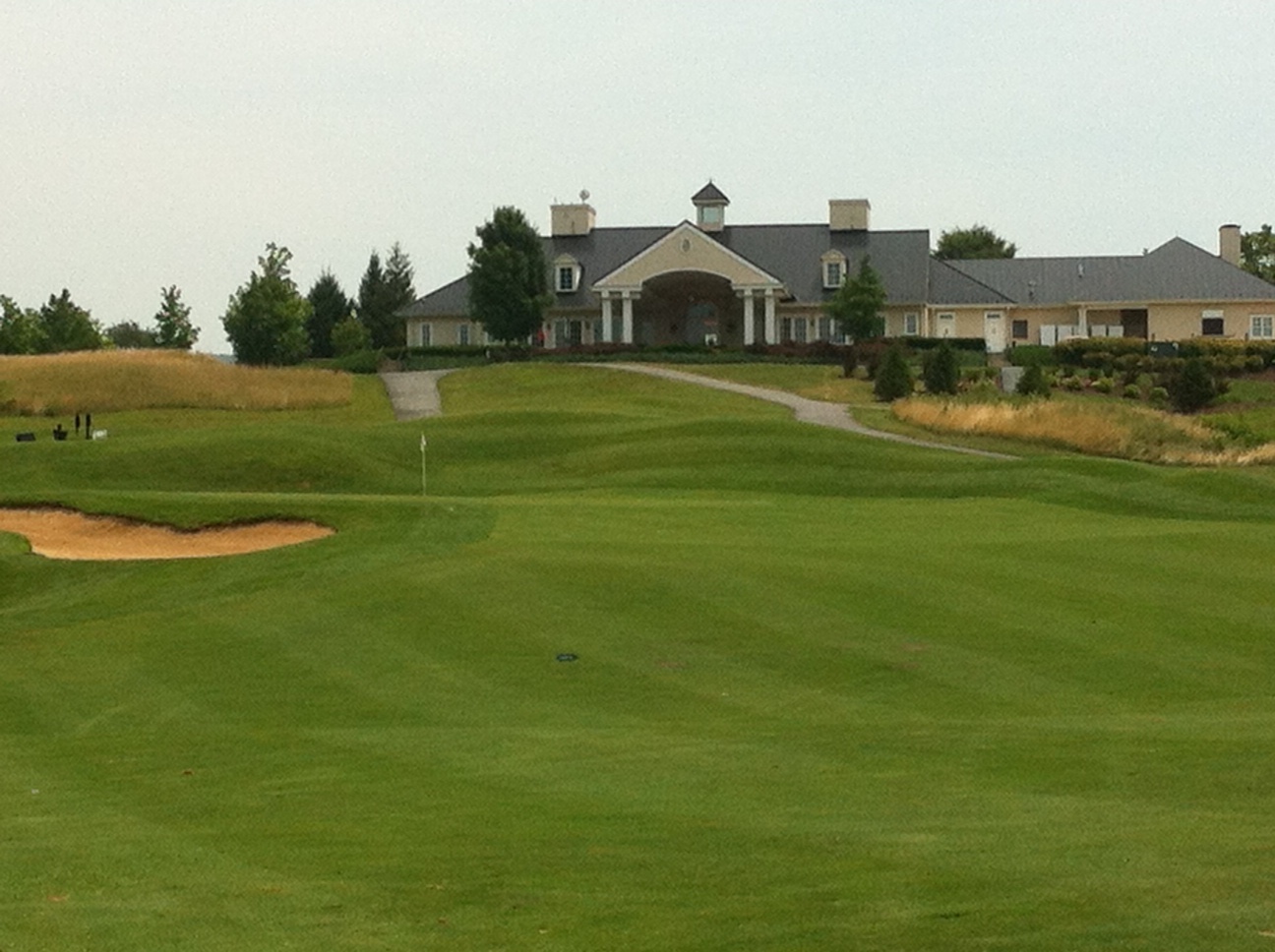
The look up 18 captures the balanced majesty of this place

Take the time when you are done to enjoy the food service in the grill room.  It is an intimate room with a great view of the finishing holes on both sides.  Food is quite good and makes for a nice accent to a wonderful golfing day.

Myersville, Maryland

Architect: Joe Lee (2002)

Tees                 Par        Rating               Slope       Yardage

Gray                 72            73                    140            6902

Blue                 72            71.1                 130            6416

White               72            68.9                 123            5884

(Click here to review Musket Ridge hole-by-hole descriptions)

Field of Dreams

The last time the U.S. Women’s Open was played on the Blackwolf Run courses in Kohler the participants felt about as welcome as General Custer’s troops at Little Big Horn.  The compilation of Pete Dye’s River and Meadow Valley courses took no prisoners even though some of the best in the game were very willing to surrender.  The score that got to the Monday playoff in 1998 was 6 over par-that remains the highest 72 hole score of a winner in a women’s major in 36 years.

If you have ever played the River Course at Blackwolf Run you can understand how stern a test this was for these women.  Windy conditions, deep rough, and humongous undulating greens made for high anxiety for the best players in the world.  Among the 40 rounds of those finishing in the top ten that year only two rounds were shot in the sixties.  On that final day only one person in the top ten shot par and there were two 76’s and a 78 in that group-one of those 76’s was by Se Ri Pak who made it to the playoff.

Randall Mell relates an anecdote in a Golf Channel article that characterizes the difficulty the course presented that week.  Meg Mallon made a quintuple bogey nine on the opening hole the first day and never recovered.  She said that Pete Dye came up to her at a dinner function there and said, “Meg, if I would have taken a 9 on the first hole I would have shot myself.”  Her response was “Actually Pete, I was thinking about shooting you!”

The two unlikely protagonists who survived the brutal test to get to a playoff were a pair of 20-year-olds.  Se Ri Pak was a rising star, a rookie professional who had won the LPGA Championship in May two months earlier.  Jenny Chuasiriporn was an amateur and a junior at Duke, a pretty unheralded entity going into the Open.  Only one amateur in history had ever won this championship.   Who can forget the look on her face when she made that 40 foot double breaker on the 72nd hole to force the 18 hole playoff.

Jenny took the lead early making birdie on 3 of the first 5 holes.  But reality roosted on the sixth and she made a triple bogey.  It was nip and tuck the rest of the way and tied going into the very challenging finishing hole from the River Course.  Se Ri blinked hitting a snorgle hook into the hazard adjacent to the fairway on 18.  What followed was one of the most riveting and ethereal moments in U.S. Women’s Open history.

Se Ri walked up and saw that her ball was in the hazard but it was not in the water-it was perched precariously on the side bank and was theoretically playable.  With Jenny on the fringe in regulation Si Re decided, against the advice of her caddie, that her only chance was to go shin deep in the water and try to extricate her ball from the hazard without a penalty.  The thousands present held their collective breath knowing just about anything could happen on this swing.  She managed to get the blade of her wedge on the ball and advance it clear of the hazard short of the green.

It turned out this shot helped her salvage the tying bogey on the hole and sent them back to the 10th tee for sudden death to decide the championship.  It took two more holes before Se Ri made about a 15 footer for birdie to finally end the Cinderella story of an amateur winning the U.S. Open.  In many ways that shot, the drama that it entailed, and the riveting playoff that ensued put the U.S. Women’s Open back on the radar screen of golf fans all over the world.

This victory by Pak opened the floodgates of possibilities for Korean born women to make it on the LPGA Tour.  Se Ri went on to a Hall of Fame career winning 25 LPGA events including 5 majors and this win stoked the imagination of a generation of young Korean women who have followed her to success on the women’s tour.  In this year’s return to Blackwolf Run the U.S. Open will have over 25 Korean women in the competition.  Korean women have won three of the last four U.S. Opens and currently 10 of the top 25 ranked players in the world are from Korea.

The experience jettisoned Jenny Chuasiriporn into the limelight of women’s golf  but she never reached the same level of success in her professional golf career.   She quickly concluded she needed to walk away from golf and decided to pursue a career in an equally daunting profession.  She went back to grad school and got her master’s degree as a nurse practitioner.  Jenny now works in a cardiac intensive care unit helping people with post-surgery problems, chronic disease, and end-of-life care.  For her that magical weekend 14 years ago is just a pleasant, distant memory. She is content that she has found her calling and through her profession of choice can really “make a difference in people’s lives”.

The two 20-year-olds who created the drama that unfolded that weekend went decidedly different ways but together the perseverance they displayed altered forever the perceptions and aspirations of the women who will compete this week for the U.S. Open title at Blackwolf Run.

July, 2012

Hidden Creek Golf Club

Bill Coore was asked by a wealthy New Jersey real estate developer, Roger Hansen, to create distinctive golf course on 750 acres of sandy rolling pine barren woodlands he acquired outside of Atlantic City.  He had in mind a golf club in the Pine Valley tradition-a private haven where wealthy people with presence in this area could entertain their friends and colleagues with the highest standard of golf, food, and accommodations in a casual environment without pretense.
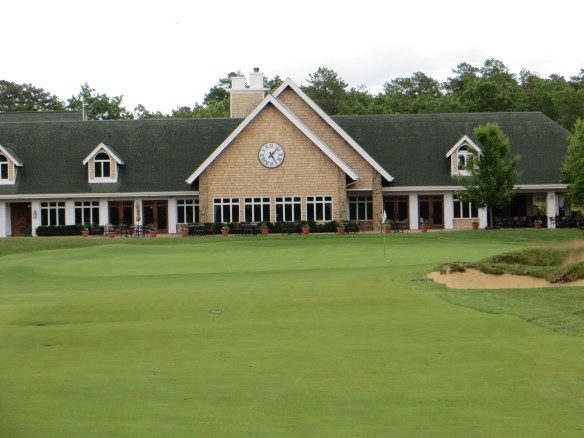
The understated look of the back of the clubhouse coming down #9

Click on any photo for an enhanced view of the image

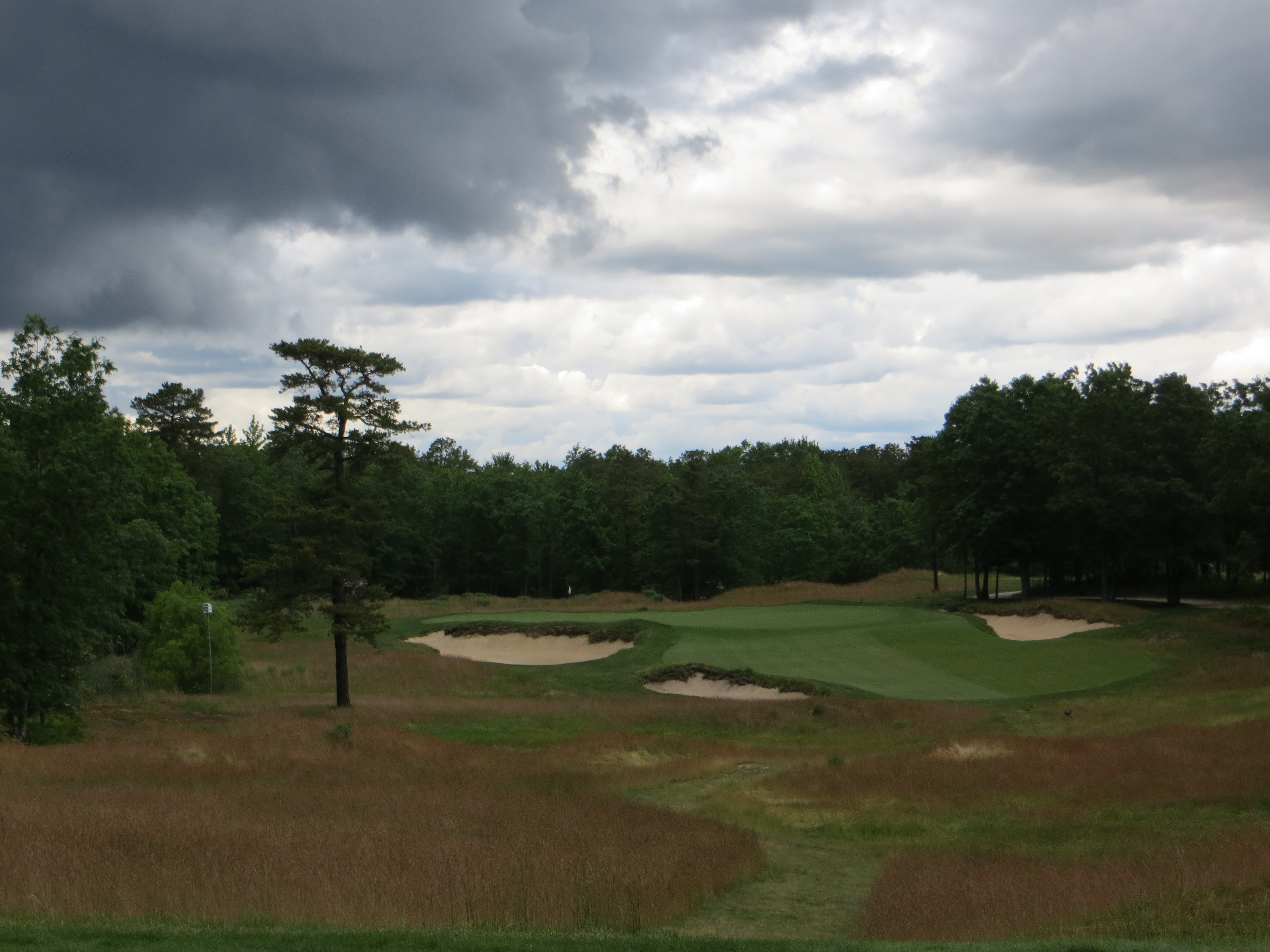
Coore spent a considerable amount of time walking the ground before a contract was prepared and determined it offered an opportunity to create rustic walking course with a character unique to this region.  There was enough elevation change in the property to make holes with distinct topological interest and plenty of natural vegetation to provide the look and feel of an old English heathland course.

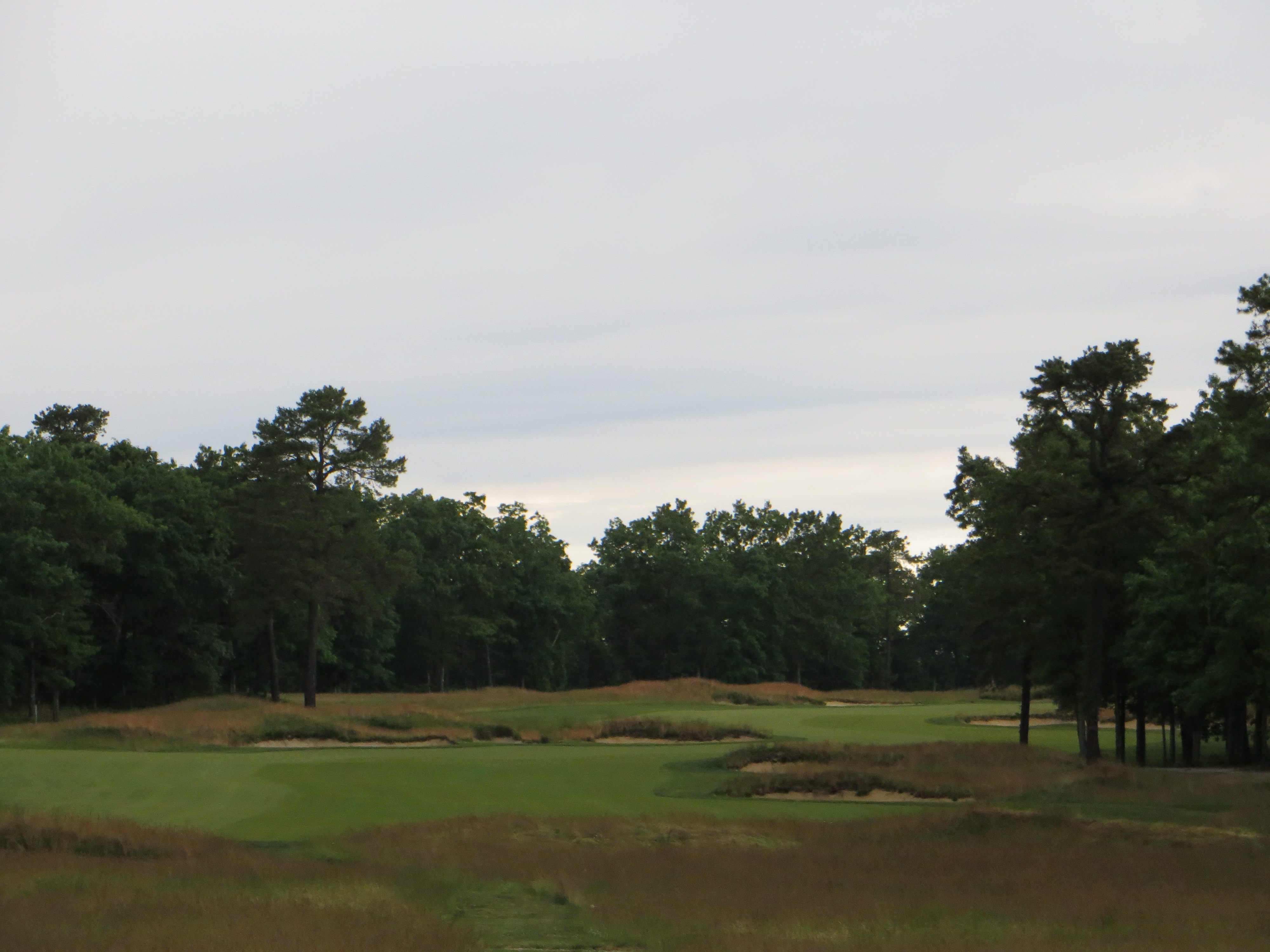
The natural look brings to mind the heathland courses outside of London

What he came up with was an old style walking course, short walks from greens to tees, that clings to the upland part of the property.  With a minimal amount of dirt being moved, it would have the raw and natural looking hazards of mounding, deep bunkers, and long fescue grasses you might see at a course like Sunningdale outside of London.  There would be no paved cart paths, no houses interrupting the landscape, just natural delight as far as the eye can see.  Coore said of the project,  “The Hidden Creek site required very little alteration to the landscape.  The holes lay on the ground pretty much the way we found it.”

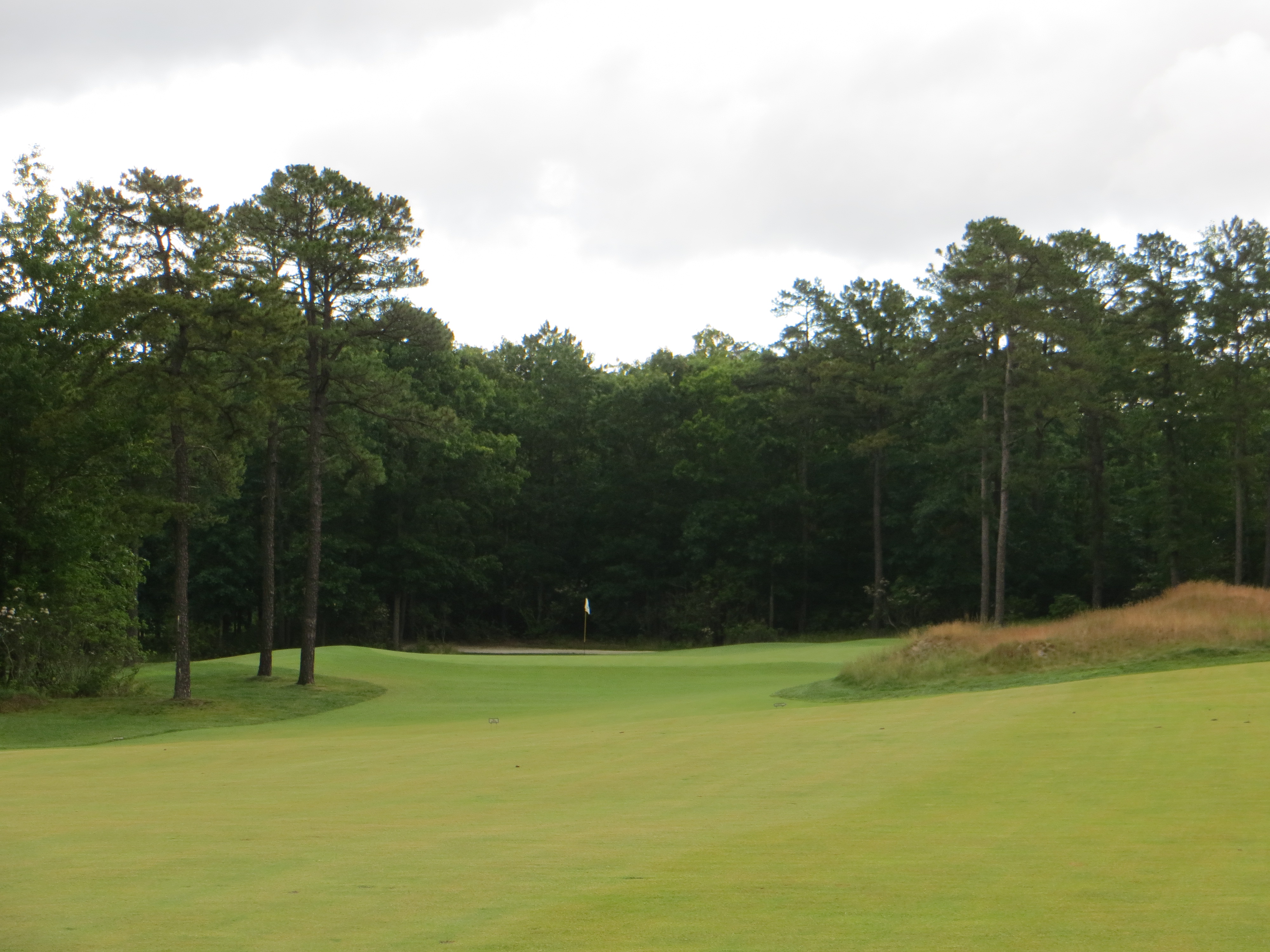
Coore and Crenshaw embrace the old style principles of great designers of the golden age providing plenty of  room to play the course and generous access to the greens.  There may be ferocious bunkering on one side of a fairway or green but you will rarely see both sides cordoned by trouble.  This makes the play much more enjoyable for the recreational player who does not want to take on the macho challenge.  Like many of the great courses of that period, playing this course well is about thoughtful tactical intention with adept execution of the shots required.
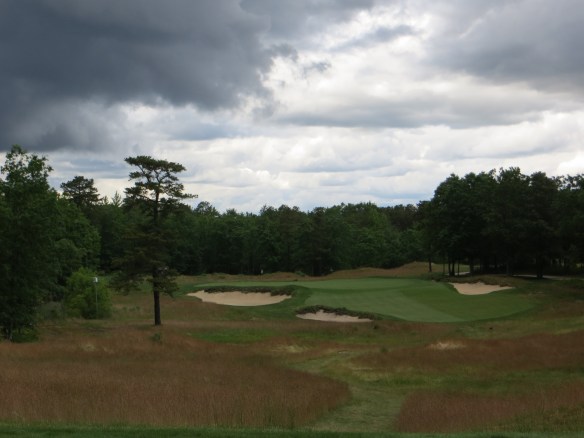
Large setbacks provide a beautiful backdrop for a stunning view like the Par 3 #4

They created big set backs for the holes from the existing trees-this makes for an enhanced canvas on which to present the holes.  Lush bent fairways throughout set against gold fescue grasses make for a beautiful presentation.  The most distinctive characteristic is the seemingly random mounding and bunkering that provide most of the hazards.  There is no water in play on the course-they did not route any of the holes through the wetlands that take up almost half of the property.  The randomness of the placement of the hazards defies the symmetrical look of so many modern designers and it makes the playing lines infinitely more interesting to discern as you plan your shots.

There are over 100 bunkers on the course and they often have eyebrows of natural long fescue reminiscent of Royal County Down-this makes them very intimidating looking from afar as well as difficult from which to extricate yourself if you are too close to the front of the bunkers.  Pay particular attention to the relative position of the hazards to the landing areas and greens.  With some optical trickery they can seem more imposing than they really are-there is often more wiggle room in the formula than meets the eye.
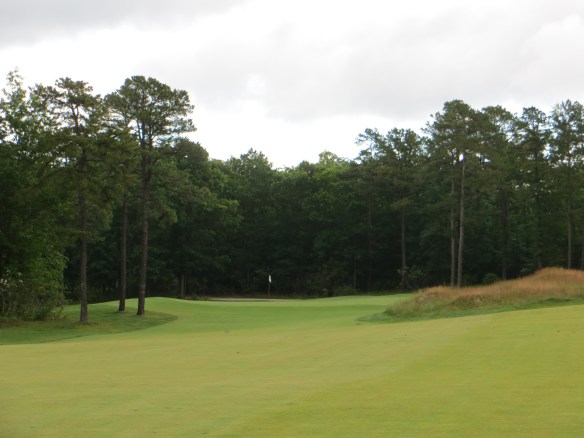
You can see on #5 the minimalist presentation with a tactical emphasis

I found the mystery of the greens particularly intriguing.  These are big, sprawling oceans of green with pitch and undulations that will confound you both on your approach shots and your putting.  Local advice is essential until your personal knowledge of the greens is up to speed. These guys have real genius giving you plenty of room to approach but giving you little room to approach successfully.  You can hit what seems like a wonderful shot that seems to randomly separate from the hole against all your intentions.  The greens roll very nicely and have lots of speed, especially down hill.  This is not really a set of greens that call for a nickel defense but you have to be careful when the speed conditions of a particular putt are at the optimum.

This 110 yard short pitch and putt on #11 is anything but a push over

What is an architectural accomplishment of no small order, given that the property itself does not have inherent dramatic topography, is no two holes on the course look remotely similar.  You cannot anticipate what is coming next because there is no pattern to the sequence or the hole designs.  The sequencing of the holes is brilliant, you might have a monstrously long par four followed by a short pitch par three or a reachable par five.  This keeps the player off balance because the challenges vary dramatically from hole to hole.

The entire facility is top notch.  The locker room, eating facility, and practice facilities are as good as any high end club you will visit.  Like you would see at Pine Valley or Caves Valley they built very nice lodge to accommodate out of town guests in for a multi-day visit to the club.  You are going to need an invite to get here but if you can find one you will not be disappointed in what they have created.

Egg Harbour Township, NJ

Architects:  Bill Coore/Ben Crenshaw (2002)

Tee                         Par    Yardage    Rating      Slope
Championship        71      7023         73.5         136
Member                 71      6562         71.6         131
Forward                 72      5486         72.3         127

(Click here to review Hidden Creek hole-by-hole descriptions)
Boss Hoss

Remember Beau Hossler, the upstart 17-year-old would captured the imagination of young and old with his composure at the U.S. Open at Olympic a few weeks ago.  Well he is back in the limelight again playing in the A T & T National at Congressional this week.  On a course that has been set up to Open standards- narrow fairways, long rough, hard greens, and stimps in the upper quartile- his even par 71 on day one was good enough for a T-20 with some established names like Angel Cabrera, Jason Day, and J.B. Holmes.

His Bossness even outplayed the host, one Eldrick Woods, who struggled with his driving, short game, and putting before carding a very sloppy one over 72.  Of course it was not operator error but the conditions according to Woods.  On his Oh-fer in sand saves he said, “My 60 (degree wedge) is not designed for this type of sand…there’s so much sand in these bunkers”.  Not sure what his explanation was for a flubbed chip that looked like the work of a Pro-Am partner.  The 50% in fairways hit and mediocre putting were what really held him back.

Beau on the other hand was T-3 in the field in driving distance at 321 yards-granted the hot air and fast fairways were conducive to long carry and roll out.  He hit 64 percent of the fairways and was 13th in the most important stat of all, strokes gained putting for the day.

Hossler played Congressional as a 16-year-old last year at the U.S. Open so he is not unfamiliar with this setup.  He confirms that there is some retribution in this setup for last year’s scoring orgy.  “These have got to be the fastest greens I’ve every putted on”  he said, “I don’t know, maybe the same speed as Olympic but these have a lot more pitch to them, so get on the wrong side of the hole an you’ve got no chance”.

To everyone’s amazement Beau once again has a chance playing with the big boys this week on a very difficult track.  He is drawing crowds, signing autographs, and piquing the imagination of golf junkies once again.  I would not be surprised to see him for some extended coverage on TV come Sunday.  He just seems to have a comfort level in the spotlight uncommon at such a young age.

Bea is a breath of fresh air in an atmosphere that seems laden with a plethora of the hot variety.

June, 2012