Some use statistics as a drunken man uses lamp posts, for support rather than for illumination.
Andrew Lang
Scottish novelist/folklorist
Some use statistics as a drunken man uses lamp posts, for support rather than for illumination.
Andrew Lang
Scottish novelist/folklorist
 George Thomas, an east coast native who cut his design teeth with others from the Philadelphia School of Design back in the teens, moved to the west coast in 1919 to establish a beachhead of quality designs in California in the full Golden Age tradition. With Bel-Air and Riviera already under his belt he took on the job of redesigning the two courses at Los Angeles Country Club at the request of their members. What he and his sidekick William Bell created with the North Course at LACC turned out to be the centerpiece of the George Thomas design portfolio in California.
Over the next 80 plus years a combination of meddlesome board decisions and some nature-based changes mollified the character of the course to the point where it had lost it’s soul. In the early 00’s an initiative by some younger members sought out Hanse Design to propose a plan to restore the North Course to the original design. Gil Hanse, with the capable help of his longtime associate Jim Wagner and some historical perspective from Geoff Shackelford, put together an ambitious restoration plan to bring the course back to it’s original character and full grandeur. The board had the good sense to fully embrace the restoration plan and in 2009 a staged restoration began to take place.
Gil Hanse’s Master Plan for the LACC North Course restoration
 The work included rediscovering and restoring the original Billy Bell bunkering, returning to their rightful homes greens that had been senselessly relocated, thinning out the 80 years of overgrowth of trees and related ground vegetation that had compromised the views on the course, and establishing throughout the course the influence of the dry wash that had given this course it’s distinct character.
There is so much talk these days about recapturing the look and playability of courses of the Golden Age of Golf Course Design and that is precisely what Hanse and Associaties have done at LACC. The fact that the USGA and R & A are bringing a Walker Cup to LACC in 2017 and the U.S. Open in 2023 would tell you that the restoration was a roaring success.
Built on hundreds of rolling acres of some of the most valuable urban real estate in America LACC sits in the middle of Beverly Hills in the shadow of apartment buildings, palatial homes, and commercial development. They have maintained a reasonable buffer for the most part-while on the property you feel relatively secluded from all that with a few notable exceptions. The ground itself is a wonderful hilly piece of property that presented interesting possibilities for Thomas and Bell for the routing of holes and placement of tees, hazards, and greens. The genius of the design is that they used the flow of the land, the dry wash, and nature’s assets to create holes that do not intrude on the environment, they look like they were always there.
You contend with the dry wash everywhere-here as a forced carry off the 3rd tee
 Stepping onto the first tee you take in the flavor of the course immediately. The grass platform for the teeing grounds are not distinct from the fairway in front of you. The vast continuum of short grass just melds into the course that is unfolding below your feet. The placement of the fairway and green side bunkers is very creative. They give clear direction to your strategic options off the tees and on approach. Many times you will realize that the movement of the pin 30 feet on the green can change both the preferred distance and angle of the approach you are trying to set up. This is why an investment in a good caddie is a must when you play LACC.
As you get out through the second and third holes the presence of the dry wash makes itself very apparent. Fortunately there is no water running through it and the fact that they do not seem to let it get overgrown means you can technically play from it without grounding your club. Having said that it is incumbent upon you to give the presence of the wash full consideration when weighing options of approach lines and club selection. Both of these holes will taunt you in terms of carry to reach the putting surface, especially if you are not in the fairway. First lesson to be learned at LACC is a bogie is an acceptable result when double or worse is possible taking on a shot that is just beyond your skill set.
First postcard view of the day…from the tee on the Par 3 4th
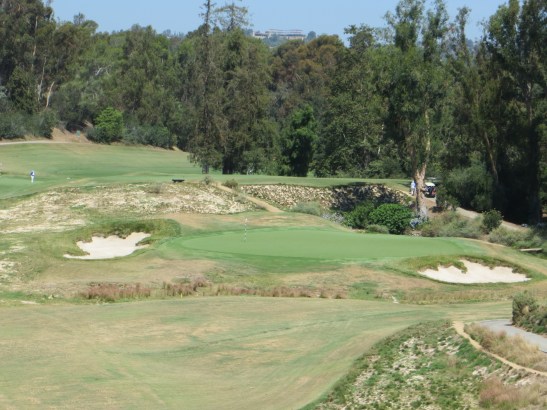 The par three fourth is one of the signature holes on the course-from it’s teeing ground the full splendor of LACC is apparent. Elevation change, wash, sand, even some exposed sand hills thrown in for good measure makes for a true Kodak moment. Once again Thomas gave you options that allow you to mitigate risk and protect your scorecard. Getting it close is a real risk/reward deal but hitting it to the fat part of the green should mean making par is very doable. If you forget what neighborhood you are in take a gander back up the hill from this green-that is Lionel Richie’s little bungalow looking down at you.
The neighbors are quiet, reserved guys like Lionel Richie and Hugh Hefner
 In 1927 Thomas wrote a book called “Golf Architecture In America’ at about the same time he was doing this course where he talks about the notion of designing a course within a course. The idea was that holes could play to different strategy, even different par depending on how they set the tees and pins on a given day. As you will read in the link to the Hole-By-Hole Analysis below five through nine are all half par holes that speak to this notion-depending on set up and your degree of chutzpah they can be very different day-to-day.
.
Course within a course…219 to 242 yards across the abyss…7th hole is a Par 3/4
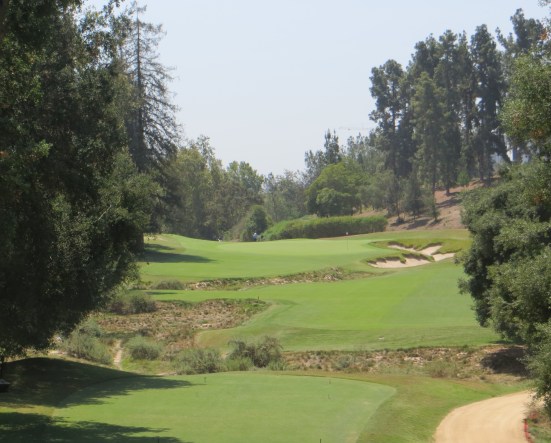 Six is a “drivable” par four where you have to be certifiable to try to go for the green. Seven is a par three where laying up may be the best option depending on the wind influence. Eight is a truncated, switch back, shish-link of a five par that throws all strategic convention out the window and dares you to play with a sense of abandon. If you survive the tee shot on tourniquet approach to the par three ninth a double has turned into a three with one swing of the club. The only thing I will guarantee is that once you have played through this fungible part of the course you will have goose bumps or the sweats depending on how you fared.
Gynormous driving areas like the 10th still require precision decision making
 The inward nine is even more dramatic and just as thrilling. The tenth shares fairway with the sixteenth, a characteristic you see repeated a number of times through the round. This gives the course the appearance of great width and allows you to see through to others holes as you play. It reinforces the seamless character mentioned with continuous tee boxes to the fairways and reinforced often by continuous short grass between greens and the next teeing round. Thomas is playing with your mind because in spite of the width presented there is always a favored area, usually 20 to 25 yards wide that you want to place your tee ball in to have a sporting chance of taking on the challenge of the hole.
Reverse Redan….an uncomfortable approach down to the 11th green
 The other postcard par three is the downhill eleventh. Here they reversed the classic Redan with an abruptly downhill tee shot that must be played off a side hill short left of the green to feed the ball onto a green that runs away to the right. Like most Redan holes, trying to take on the pin directly will likely put you in the nasty short side bunker or over the green with a thankless recovery shot at hand.
Green side bunkers are deep and nasty
 You cannot talk about LACC without paying homage to the Billy Bell Bunkers. They are deep, intimidating, thoughtfully placed, yet totally playable. The toothy edges and gnarly brow grass is what people notice but the steep faces tend to avoid plug lies and the playing condition of where you end up-both sand and slope-lends itself to a typical bunker shot swing as long as you are wisely willing to accept 25 feet for the first putt.
On many of the par fours Bell embedded a bunker in the center front of the approach creating a notched arrangement in the front of the green. This provides a pinable section on either side of the bunker but often one of those sides hangs perilously above nastiness you do not want to engage. More decisions….this course is all about making clear headed decisions. Jim Wagner, with the help of Geoff Shackelford, labored tirelessly to restore the sod walls on the bunkers to support the signature jagged look that Bell had originally built into these hazards.
The Billy Bell Bunkers will make you take pause on planning your approach line
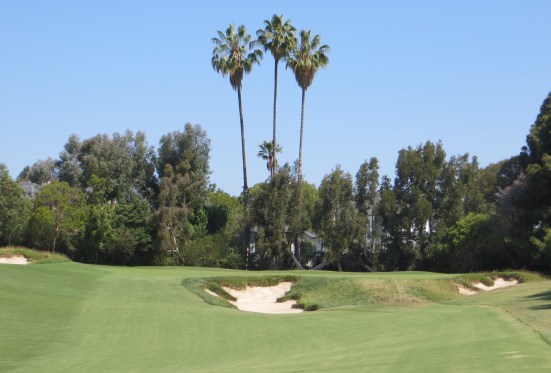 The three par fives are all holes you can try to reach in two if you are very long and very disciplined. The fourteenth is one of my favorites because even as a three-shot hole the lay-up and approach are fraught with difficulty if you bite off more than you can chew. It looks so simple yet the slightest deviation in execution can mean severe consequences to your scorecard.
I have read elsewhere that the genius of George Thomas was his ability to create something special on a short hole with little topographical feature. He did this repeatedly at Riviera and the short approach and putt fifteenth is another gem. The slender, crescent shaped green orients to tightly fitting bunkers with just enough elevation to mask what should be a simple, short iron approach. The hole can be as short at 75 and as long as 135 but I guarantee you more people are shaking their heads side-to-side rather than up-and-down when they are walking to the sixteenth tee.
Every great entertainment experience has a memorable finish and on that score LACC will not disappoint. With the Nassau bet in the balance the last three holes will determine the winner based on judgment, execution, and a little bit of existential fate. The walk to the house encompasses three par fours where success comes from thoughtful drive position followed by flawless execution on approach leaving an uphill putt where you can threaten the hole.
Wow quotient is high from the elevated tee looking down the 17th fairway
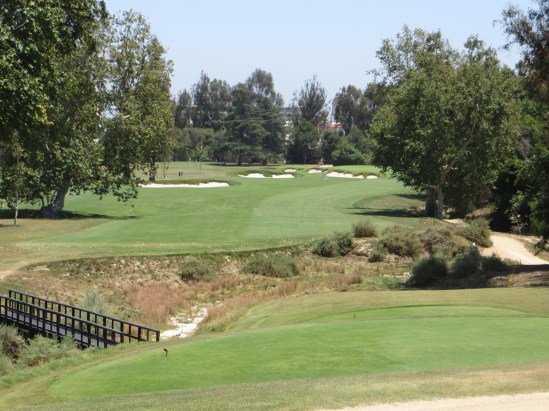 If you find the fairway off the tee on the sixteenth the approach is a repeat of the tee shot into the reverse Redan arrangement you saw on the eleventh just off your left shoulder. From the tee on the seventeenth the full monte of LACC sits below your feet-the wash, layered bunkering, and a wide driving area with a very focal sweet spot. The second is one of the most articulate approach shots you will hit all day as the green is set on a diagonal to your aiming line behind a nasty bunker front left and no bail out salvation anywhere. The finish is a walk back up the subtle ramp you played down on the first with a driving area that makes the 18th at the Old Course look narrow. Once again the position of your tee ball is critical to getting an accessible angle at a green tightly ensconced by furry sand.
Driftwood trimmings work well with the rah-rah logo
 The ambiance of this place is traditional with a kitchy twist. The unusual pennant style of the LACC logo is everywhere on the course- on hole stanchions, tee markers, pins, practice green flags, scorecards, hats, and the shirt you will want to take home with you. This theme lends a youthful collegial feel to the facility that just seems to fit.
Bonus Coverage: #17 Alt the extra hole rediscovered in the restoration
 Most important George Thomas created a course that is a graceful combination of raw nature and good, balanced design, a golf experience that will cling to your memory long after the walk is over.
Los Angeles, California
.
Designer: George Thomas (1927)
Tees Par Yardage Rating Slope
Black 70 7010 74.6 139
White 70 6466 72.4 135
Red 70 6089 70.2 131
Green 70 5610 67.7 122
(Click to read the Hole-By-Hole Analysis of Los Angeles Country Club-North Course)
 Built in the mid 1980’s as part of the PGA West lavish vacation home development, the Arnold Palmer Private course nestles at the foot of the scenic Santa Rosa Mountains. This is an array of wonderful visual holes that weave among manmade water hazards and manufactured rolling desert topography to present a onerous challenge emulating the TPC design tradition propagated by PGA Commissioner Dean Beman at that time.
The course has been a regular feature of the tour’s Bob Hope Desert Classic (and it’s later commercial iterations). You may remember it as the place where you saw David Duval shoot his remarkable 59 in the final round to win the 1999 event.
An oasis sculpted out of the desert for your recreation and enjoyment
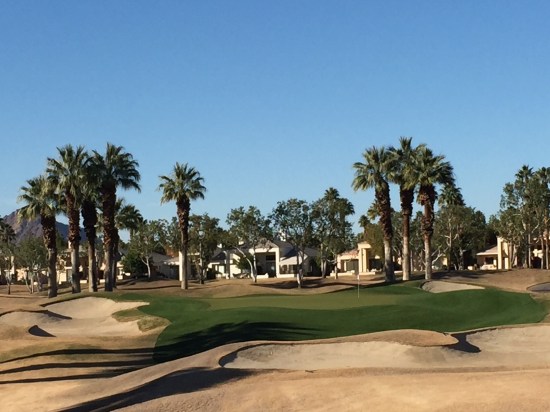
Arnold was obviously keeping up with the Dye’s who created the neighboring the PGA West Stadium Course at the same time in following the TPC formula of cookie cutter driving areas, flanked by ominous water and deep bunkers, and tight green complexes with large undulating surfaces. It is not a track for the meek of heart or those who lack trajectory and spin in their game. For the pros the slope is an impossible 143 and mere mortals face a stiff 133 from the 6500 tees.
The approach on the drive and pitch 8th is anything but easy to negotiate
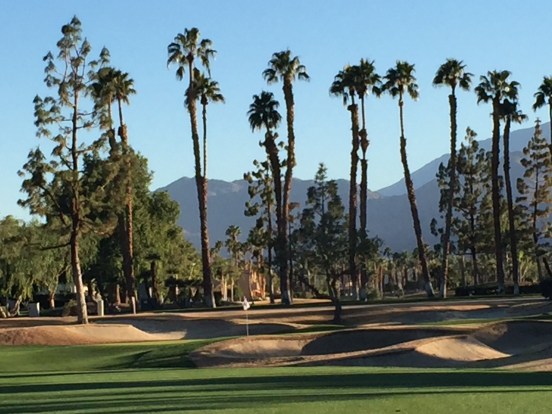
This course was designed to be taken on full bore. The only way to play it is Arnold’s way, roll up your shirtsleeves and be aggressive. The biggest challenge is in the four pars and not necessarily the longest ones. The par fives are relatively mundane and similar in design except the finishing hole which has some chutzpah (Duval hit driver, 5-iron to 8 feet and drained it for eagle to cap off his 59). The par threes have lots of visual interest but not that much bite. The front nine works clockwise away from the clubhouse to the north and back. The back nine mimics the pattern in a counterclockwise direction which means that given the day’s desert wind direction you should have the same difficulty factor on half the holes on each side.
One of Arnie’s many cape holes-water all the way up and a forced carry to boot
 The real treachery is in the multitude of forced carry cape par fours strewn throughout the layout. Holes like 4, 7, 9, 10, 13, and 16 all use the same combination of harrowing water adjacent the full length of the hole with a tight green complex cordoned by water as well. When you get deep into the back nine you reach the Venetian section of the course from the 14th on where the canals haunt every shot and the only thing missing are the voices of gondoliers humming a sad tune if your shots get wayward right.
Part of the Venetian Stretch approach to the 16th must contend with the canal

These final holes are spectacular to look at, set up against the foot of the mountains with towering sheer rock faces looking over your right shoulder on every swing. At least the short holes are short and it ends with a Par 5 so maybe you can find some redemption for your scorecard at the end.
Duval hit 5-iron to 8 feet and made eagle-the cherry on top of his 59 Sundae
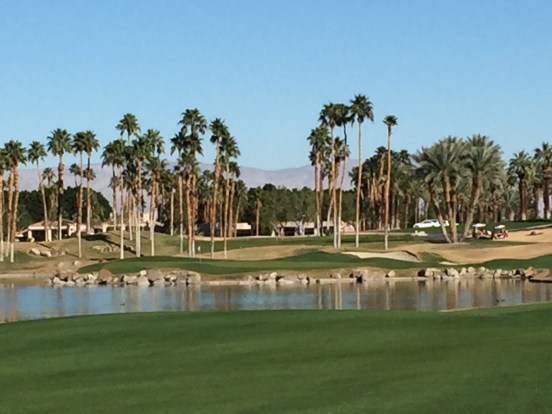 This is a high end facility so the conditioning of the course-fairways and greens-is impeccable. They keep them on the pacey end of the Stimpmeter so you will have to mind your approach position to try to leave yourself uphill putts you can handle. Cavernous bunkers throughout are real hazards as are some of the grass mogul fields that abut many of the green complexes. As I have seen on other TPC style courses most of your recovery game is with a sand iron or a loft club.
This image of the Par 3 15th will cling to your memory long after the round is done
 The rest of the facility is first class as well. They have a wonderful informal dining area that overlooks the staging area and sprawling natural grass practice grounds which you should take advantage of for a post game lunch and lick your wounds session.
Palm Desert, California
Designer: Arnold Palmer (1986)
Tees Par Yardage Rating Slope
Black 72 6950 74 143
Blue 72 6492 71.4 133
Bl/Wh 72 6217 70.3 129
White 72 5995 69.3 126
Red 72 5226 71.2 133
(Click to see the full hole-by-hole review of the Arnold Palmer Private Course)
To see more photos: Click to check out our Postcard From PGA West
 Mountain View is the demure younger sister of the feature Firecliff Course at Desert Willow. Designed by the same crew of Michael Hurdzan and Dana Fry with Tour Pro John Cook commiserating, it shares the look and feel of Firecliff with a more user friendly interface. It shares the stunning backdrop of the San Jacinto Mountains throughout the course and plenty of money was spent moving dirt to create interesting topography with desert flora plantings as accent.
No shortage of Kodak moments here

Mountain View was built to be the member’s everyday course, a kinder, gentler experience with less obvious danger and reverberations to the scorecard. The metric difference of 5 less in the slope from the 6500 yard Blue Tees speaks to this. There is simply more unfettered access to the preferred driving areas and the green complexes on approach and the severity of penalty for missing either is less significant. The small greens have somewhat milder undulations and are kept at a pace much less disarming than her more athletic sister.
Stone walls, palm trees, and desert flora accent throughout
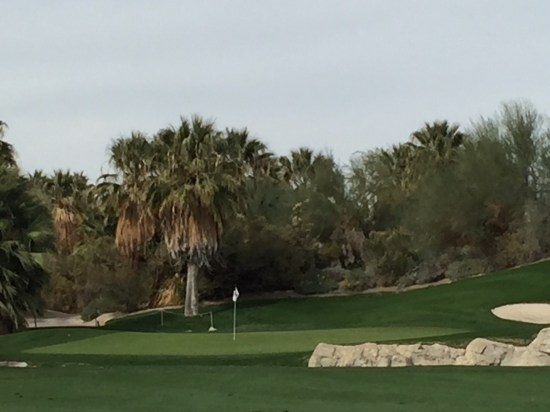 Having said that this is not a course where you can play on auto pilot, it takes your full concentration to plot your way around. If I have any criticism at all it is that most of the holes are relatively straight, very few holes that turn dramatically to focus your attention to the A drive position off the tee. But even without elbows on the corners the green complexes still dictate a preferred drive position in the generous driving areas.
Generous driving areas but position matters into confined green complexes
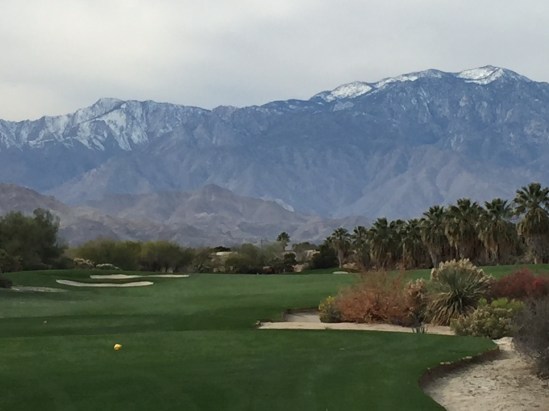 The small size of the greens and the fact that many are raised from the fairway is the scorecard’s best defense. The front pins are particularly difficult because there is no advantage way to be short of these pins and have an uphill birdie opportunity. Your pitching recovery game will get a workout because you will miss greens so an adept short game is a must to scoring well. Much like Firecliff reading these greens is difficult with all the static of the mountain backdrop and the manufactured topography. If you have your Everything-Breaks-To-Indio compass on hand it can prove relevant on many of the reads.
The 16th you have to work your drive around this bunker constellation
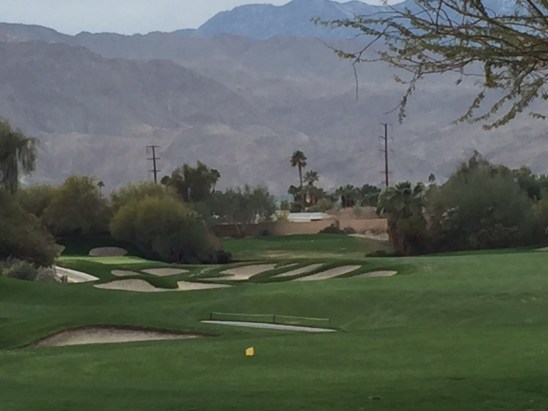
This is a fun afternoon of golf, an opportunity working taking if you are in Palm Desert for long enough to play both courses at Desert Willow. I actually like it as a warm up round the day before taking on the full Firecliff challenge.
Palm Desert, California
.
Designer: Michael Hurdzan (1998)
Tees Par Yardage Rating Slope
Black 72 6913 73.4 130
Blue 72 6507 71.5 128
White 72 6128 69.8 126
Red 72 5040 69.6 126
(Click here to review the Desert Willow-Mountain View Course hole-by-hole descriptions)
(Click to read the review of the sister Desert Willow-Firecliff Course)
 We had the pleasure of experiencing the hospitality of the folks at the Arnold Palmer Private Course at PGA West in Palm Desert on a glorious January day. Lots of sun, temps in the 70’s, perfect course conditions, and a bagful of giggles with friends.
.
The Day Starts Here
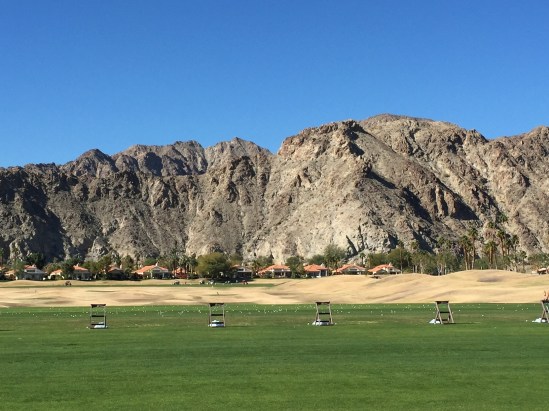 Some Pimped Out Street Ready Wheels
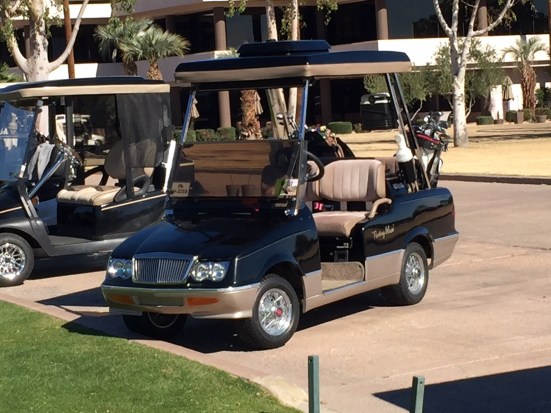 AC, Upholstered Seats, Kona Lei, and a Recognizable Hood Mount

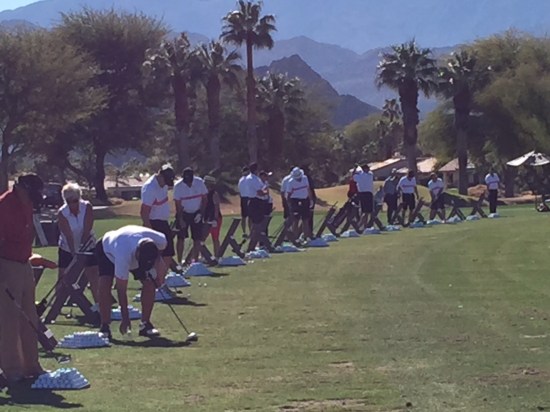
Thursday Guys League…Lots of Trash Talkin’……
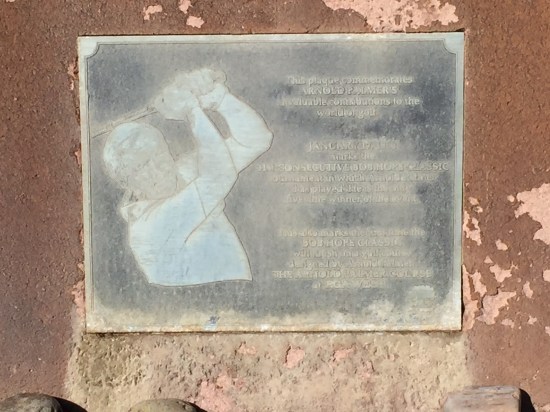
Testimonial Plaque To A Fading Memory Of The King
Scale Defined By The Surrounding Topography
 Peek Between The Goal Posts Down The Eighth Fairway
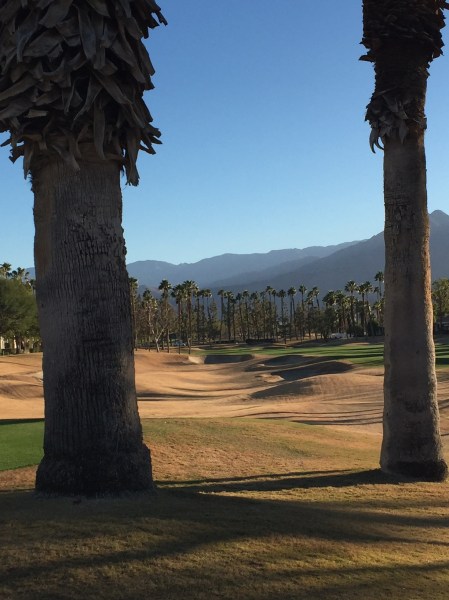
Even The Trim Comes From Hills
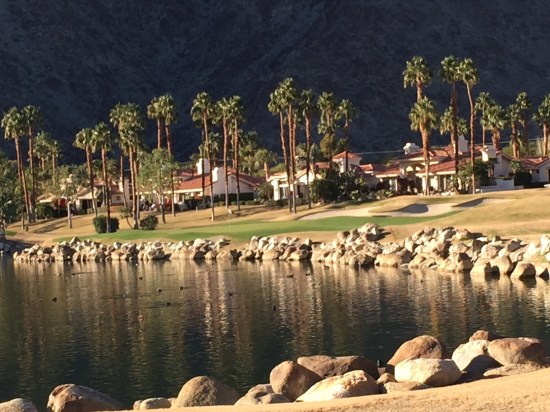
Water, Sand, and Tropical Palms Frame The Ninth
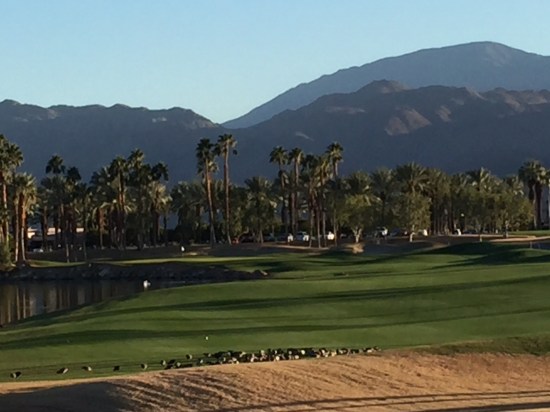 Surviving Sand In A Cloud Of Dust
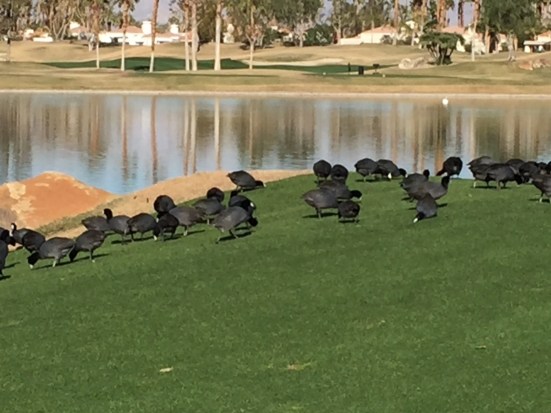
 Fowl Play
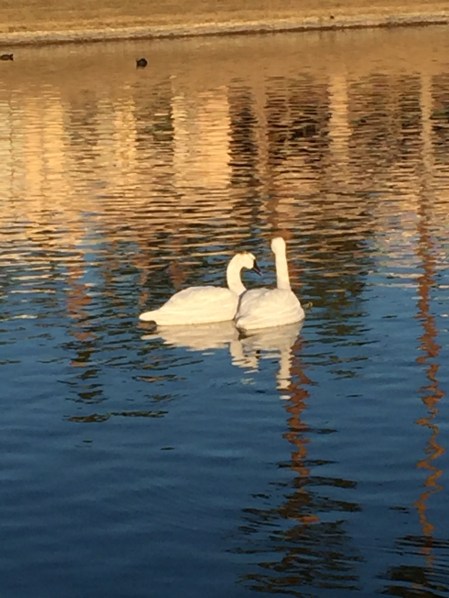
 Courtin’
 Big Horn Country…Looking Down At Fifteen
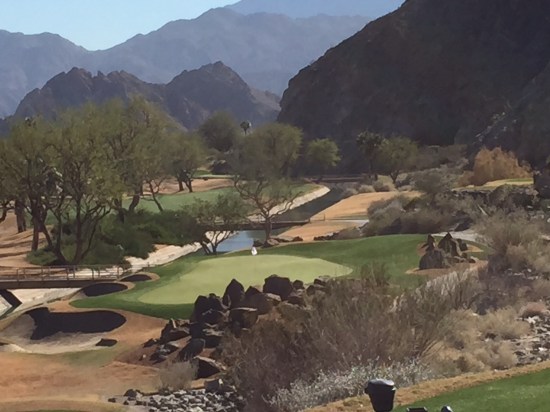 Jerry Garcia Peace Sign Rock Lords Over The Sixteenth Green

The Equestrian Final Hurdle At The Home Hole
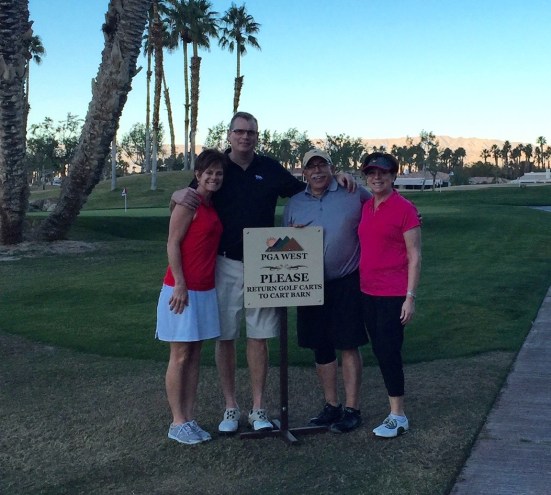
 Just Hangin’ Out-Brenda, Carl, Moe, & Kathy
January, 2016
(Click to see the full Course Review of the Arnold Palmer Private Course)
 Spike Lee once said it about MJ in an Air Jordan ad and maybe the same can be said about Rickie Fowler after he won the HSBC Golf Championship in Abu Dhabi this weekend in his new High Top Pumas. Winning for the fourth time in nine months against top ranked fields, including The Players, The Scottish Open, and the Deutsche Bank Championship in the Fed Ex Playoffs, Rickie broke fashion molds once again and a few personal glass ceilings as he makes a case for being considered the fourth of the new Big Three.
No one else would have the chutzpah to wear these…..
Abu Dhabi’s deep pockets and appearance fees guarantee a solid field every year. Four of the top six players in the World Golf Rankings were not only there but finished in the top six at the end of the day on Sunday-the royal family got their money’s worth. At some time over the four days Henrik Stenson, Jordan Spieth, and Rory McIlroy were in and around the lead so the cream did rise to the top. But it was Fowler who added the final froth when he shot 65 on Saturday to take the lead and then stared down all pursuers on Sunday posting a fine 69 to finish 16-under to take home the flashy Falcon Trophy.
Rickie has a bit of a Ray Floyd stare that has his peers taking notice
Fowler started his day with a couple of birdies then seemed in cruise control with the lead until he had a double bogey hiccup on the Par 3 7th to squander his advantage. But he had a very unlikely bounce back eagle to regain his position at 15-under on the following hole when he holed from the sand at about 50 paces.
The long bunker shot….hardest play in the game….Rickie made it look easy….
Making eight pars in a row he had a two shot cushion most of the back nine. But Henrik Stenson, Rory McIlroy, and Thomas Pieters would not go away. Stenson birdied three of the last four to take the club house lead at 14-under. Rory had been playing with indifference through the front nine. But then Rory did what Rory does, he kicked it into gear and shot 31 on the inward half with a spine tingling eagle on the final hole to tie Stenson at 14-under.
The gauntlet went down when the crowd eruption from Rory’s eagle reached the Par 4 17th green where Fowler was sizing up his third shot just off the putting surface. As we saw at The Players Rickie saves his best for last and responded to the challenge by chipping it in for birdie to extend his lead again to two at 16-under.
Thomas Pieters, a young phenom who has won twice in the last year on the European Tour, was playing along side Rickie in the final group. He made four birdies through the 13th hole to get to 14-under but seemed to stall. After Rickie’s heroics on 17 his only chance was an eagle on the last as Rory had done. A solid drive and an elegant fairway metal to about 25 feet kept hope alive for a playoff but his eagle putt deflected off the force field of the cup and he settled for a birdie and second alone at 15-under.
.
Rickie and his new pet-the hosting Shiek and his closest pursuer look on
As Spieth did the previous week winning against a solid field at the Tournament of Champions in Kapalua, Rickie dominated the five pars at 9-under par. His solid approach play and putting led to 19 birdies and 1 eagle on his way to his winning tally at 16-under par. If he can win a major or an Olympic Gold Medal in the next seven months Jordan, Rory, and Jason will have to make some room for Rickie’s trend setting look in the photo ops of the Big Whatever.
They may not be available on-line yet but I guarantee those Puma High Tops will be displayed prominently at the Puma/Cobra booth at this week’s annual PGA Merchandise Show in Orlando. The lines will be long at the show, this is a look the millennials can put their arms around.
January, 2016
 You will not hear Jordan Spieth say it but I think the world number one is taking a page out of the Golden State/Steph Curry follow-up year motivation script when he implies that there is still something to prove this year.
When asked about his approach to the Hyundai Tournament of Champions at Kapalua he said, “Continue what we were doing last year. That’s the way I’ll keep on thinking about it”. Note that in the most individual sport in the world Jordan insists on speaking in the first person plural.
The man is coachable…whether he needs it or not..
Embed from Getty Images.
Spieth knows that everyone will be measuring this year’s performance against the career year he posted last year-two majors, five wins, a tour championship, a FedEx Cup, and $20 plus million in tournament winnings. At age 22 this will be an awfully high bar he has set but given his team’s focus and attention to detail it behooves all of us to just sit back and enjoy their enthusiastic approach to taking it on.
Sky’s the limit and it looks bluer than blue for Jordan
Against a strong contingent that included all of the Golf World Ranking Top Ten except Rory, Henrik, and Justin, Spieth torched the Plantation Course to the tune of 30-under par beating the field by 8 furlongs (or a mile by my calculation). Ravaging the par fives to the tune of 16-under for the week he just kept his eyes in front of him and never looked back at the competition furiously chasing his wake.
In the midst of the back nine on Sunday, with a five-shot lead his conversation with counsel picking his club into the 13th from an awkward angle in the left rough was typically aggressive-he thought he needed one more birdie to insure the victory. He settled for par but birdies on 15, 16, and 18 applied plenty of whipped cream to the championship sundae.
You can set your watch…we will be seeing this image again and again this year
Next stop is the appearance money mart at the HSBC in Abu Dhabi where McIlroy, Stenson, Fowler, and the rest of the WGR Gang will have to fashion a response. Trust me, they know Jordan’s 2015 was no fluke and it is going to take a group effort to keep him from winning 24 in a row.
January, 2016
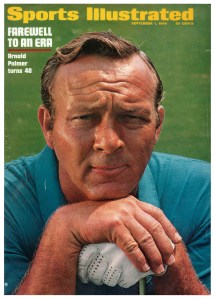 Leave it to the capable hands of the legendary sports writer Dan Jenkins to capture a cameo image of the most telegenic golf champion of our time as he turned the first fateful age corner of his career. This jewel of an article from the annals of the SI Vault, “Thanks For The Memories”, written in September of 1969, reminds us of the unique relationships between sports writers and the heroes of sport in the day. Dan’s intimate familiarity with a star and a major event has all but been lost in our era of media overload.
Jenkins cuts right to the chase in recognizing Arnie’s meteoric rise to fame and fortune for what it was-a timely nexus of his competitive drive, good nature, humility, and access to the first world wide web-color television.
“He was a nice guy, of all things. He was honestly and naturally gracious, un-temperamental, talkative, helpful and advising, unselfish of his time, marvelously good-humored; he had a special feeling for golf’s history and he was honored by its traditions.”
The anecdotal perspective of Palmer’s stunning win at the U.S. Open in 1960 sounds like it is being told from a bar stool at Toots Shor’s…which it probably was about twenty times over the previous ten years. Jenkins puts you in the moment like no other writer can and you feel like Arnie is talking to you inside the ropes on the fifth tee when he incredulously says, “Fancy seeing you here…..Who’s winning the Open?”.
Palmer did so much for the pro tour in his first 10 years and for the state of the game over the next 46. Whether it was designing courses with Ed Seay, bringing the Bay Hill Golf Resort to full flourish, stewarding the Senior Tour, or creating the Golf Channel, Arnie has left his indelible fingerprints on the positive growth of the game for six decades.
Jenkins says, “He has become, they say, something more than life-size, something immeasurable in champions….. If this is true, it is not because of what he has won but rather because of the pure, unmixed joy he brought to trying.”
You will enjoy this flashback moment captured by Dan Jenkins for SI celebrating Arnie’s 40th birthday year.
(Click to read Dan Jenkin’s article about Arnie “Thanks For The Memories”)
SI Vault
Dan Jenkins (1969)
First, then, the toenails in old age grow almost as fast as the ears and the nose. There is nothing you can do about them but you can spend a minute or two trimming the toenails.
Next, swallow a couple of Bufferin against the old back injury. Next, a swift application of some mild anaesthetic for the bothersome scar tissue from that old haemorrhoidectomy.
Don’t forget the Tums, Bisodol or simply a packet of sodium bicarbonate as precaution against indigestion.
Clean the spectacles. Rub a little resin on the last three fingers of the left hand.
.
Stand up straight-think of Raquel Welch (on second thoughts, don’t think of Raquel Welch).
Comb the hair smoothly and think of the swing of Dave Marr. Walk very slowly, masterfully, to the first tee. Put on the cap bought in Edinburgh and think of Hogan.
.
Stand up straight.
Alistair Cooke
Golf-The Marvelous Mania (2007)
“Almost all golfers’ critiques revolve around the look and playing characteristics of the bunkers and often fail to notice the quality of all the other elements that make up a golf course. A great set of greens are far more important than great bunkers but everyone is drawn to evaluating a course by the bunkers since they are far easier to judge and far more obvious to the eye.”
In his treatise “A Complete Look At Bunkering” Ian Andrew points out that there is no subject that leads to a contentious discussion at the bar of the 19th Hole than the perceived fairness or unfairness of the bunkering of the course just played.
The Road Hole Bunker….the most infamous of them all…
Embed from Getty Images.
His view is that most of this contention is misguided because the modern player and influential board member have embraced the notion that even the hazards need to be fair for all players. This ignores that the basic purpose of the bunker as a “recoverable hazard” is to penalize the bad decision making or execution of the player trying to pursue the most advantageous strategic playing line of the hole.
The fact that almost every famous course designer, from MacKenzie to Coore and Crenshaw, is quoted therein with a similar view of the purpose and value of well placed sand bunkers as a strategic hazard pretty much says it all.
As Max Behr once said, “The golfer wants the most direct line he can find to the hole, while the architect uses bunkers and other hazards to create risk and reward options that suggest the ideal line for the player, or the line of charm.” Forcing players to consider strategic choices and making the proper execution of these options a necessity to avoiding deleterious effects on their scoring outcome is the main purpose of these hazards. Without that the game would be a boring four-hour stroll in the park.
Ian Andrew thoroughly delves into the aspects of bunkering in the modern game including depth, fairness, psychology, strategy, and aesthetics. He even covers why the trend of golf committees and tour decision makers demanding better maintenance of these hazards is actually undermining their purpose and making the game less interesting.
Ian concludes that, “It’s the one architectural element that creates contrast as it acts the counterpoint to all the other harmonious elements of a golf course. It’s the feature that clearly distinguishes one course visually from others. When exceptionally well used bunkers can take the most pedestrian piece of ground and leave the player with a complex puzzle to solve. “
Do yourself a favor, get a Vente Arnold Palmer, pull up a chair, and take the time to read this fascinating study on the subject of proper bunkering. It may defuse some of your own criticism or that of your buddies the next time they elicit the misguided comment that the “bunkering is unfair”.
(Click to read Ian Andrew’s article ‘A Complete Look At Bunkering’)
A Complete Look At Bunkering
Ian Andrew (2015)
 moegolf