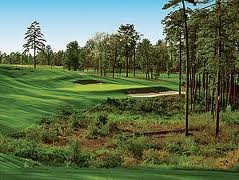
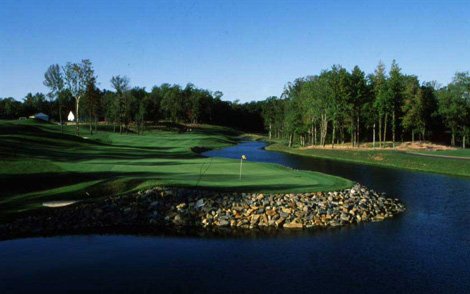
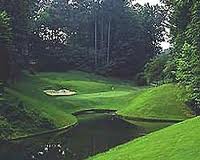
Pinehurst No. 2

Pinehurst is one of the true meccas of golf in America and Donald Ross’s Pinehurst #2 is the signature hood mount for this place.  He stands as one of the most heralded American golf course architects of his time and this course is the one all point to when they try to characterize the style of course design Ross ascribed to.  Having played a number of his courses I can only agree that in this one he seemed to best orchestrate the subtle brilliance he brought to golf course design.  The course is playable, challenging, and thought provoking-what more can you ask for in an afternoon’s walk.

Both men’s and women’s national championship will be contested at #2 in 2014

Embed from Getty Images

The main facility here is also a treasure-take the time to walk the hallways and peruse the memorabilia hanging throughout.  Over the last century there have been countless men’s and women’s championships played on Pinehurst #2-the North/South Amateurs, North/South Opens, PGA Championship, Ryder Cup,  Tour Championship, and the U.S. Amateurs to name a few.  The greatest players in play the game have won here and the plaques in the hallway outside the Donald Ross grill include names like Francis Ouimet, Walter Hagen, Ben Hogan, Sam Snead, Jack Nicklaus, Davis Love III, Curtis Strange, Glenna Collett Vare, Dorothy Campbell Hurd, Louise Suggs, Babe Zaharias, Hollis Stacy and Morgan Pressel.

Payne’s gesture in 1999 has been immortalized in bronze

Embed from Getty Images

The course has recently hosted two men’s U.S. Open’s with great resolve-the iconic victory by Payne Stewart in 1999 and the Michael Campbell’s win in 2005-the winning scores were one under and even par respectively.  Both the men’s and women’s U.S. Open will be played on this course in 2014 in a rare major doubleheader.  In preparation for that event they hired Ben Crenshaw’s design team and have spent considerable dollars bringing back the original Donald Ross character of sand and scrub rough throughout course that had been replaced by thick Bermuda rough for the previous majors.  This reversion gives the course a more signature look and probably plays just as difficult for most of us.

There is no rough to speak of but being out of the fairway is no bargain

Embed from Getty Images

When it comes to the course itself, probably the most distinctive thing I can say is that the course is  really lacks any visual distinction.  Other than the crowned greens that everybody talks about, it is just another pine needle haven in the sandhills of North Carolina.  There are very few holes that visually stand out-in fact, in thinking back over the round, it is often difficult to sort the holes out from one another in your mind.  There is only one water hazard on the course and it is barely in play and very little out of bounds that is close to the playing area.  You are likely to play the entire round with the same ball but it is likely to take plenty it’s share of verbal abuse.

The brilliance of this layout is it’s stunning subtlety.  It never threatens you with overt disaster but rather lulls you into submission like those Sirens whose voices seem so sweet but always lead you to dire consequences you never expected.  If you do not pay attention to every detail-heed every piece of advice in the yardage book or from the caddies knowledge base you will continually pay the price and be dope slapping yourself all the way around this place.

The dogleg left Par 4 5th ends with a signature fall off green complex

Embed from Getty Images

You do get the full measure of the Donald Ross formula here-once he completed the original in 1907 he spent much of the next 50 years tinkering with it so it truly represents his tactical thinking in course architecture.  The driving areas adequate but not overly generous-usually flanked by fairway bunkers you want to avoid or that combination of tall pines and sand and scrub rough.  Positioning off the tee is critical-on almost every hole there is a position from which playing the shot into the green is much easier.  Being macho will get you nowhere out here-being tactical will derive rewards.

All of nature’s elements are in play at the the Par 5 16th

Embed from Getty Images

The green complexes are what really hold people’s attention-raised turtle back greens with falloff shoulders tightly guarded by deep bunkering or grassy hollows below the putting surface.  What makes this so unusual is that the green contours and shouldering really decrease the target area of the green considerably so you approach shots have to be very precise to stay on the putting surface.  If you miss the green, that is when the real fun begins.  One overall suggestion is leave the L-club in the trunk.  Most of your affective plays around the green will be made with lower loft clubs keeping the ball close to the ground.  Be open minded to the shots you hit around the greens because you will be amazed how creative thinking can get you much better results than the obvious one third in the air-two thirds on the ground formula.  It will take a few holes to get used to this approach but by the middle of the round you should get it and you will find your percentages of up and downs improve as a result.  When you get back home and pull off one of these shots in front of friends you can brag that it was just a piece of memorabilia you brought back from Pinehurst #2.

The Par 3 17th has not changed very much….it didn’t need to…

Embed from Getty Images

This is a course that must be walked to be totally appreciated-plus the caddie’s insight will make the course much more playable.  It is well worth the premium to take this one in on the ground.  Once you have played this you may not remember the details of the holes but you will never forget the Pinehurst #2 experience.  Once Donald Ross gets into you head and he never leaves.

Pinehurst, North Carolina

Architect: Donald Ross (1907)

Tees     Par    Yardage    Rating    Slope

Blue      72       6767         73.1       133

White    72      6298          70.9       126

(Click to see complete Pinehurst No. 2 hole-by-hole descriptions)
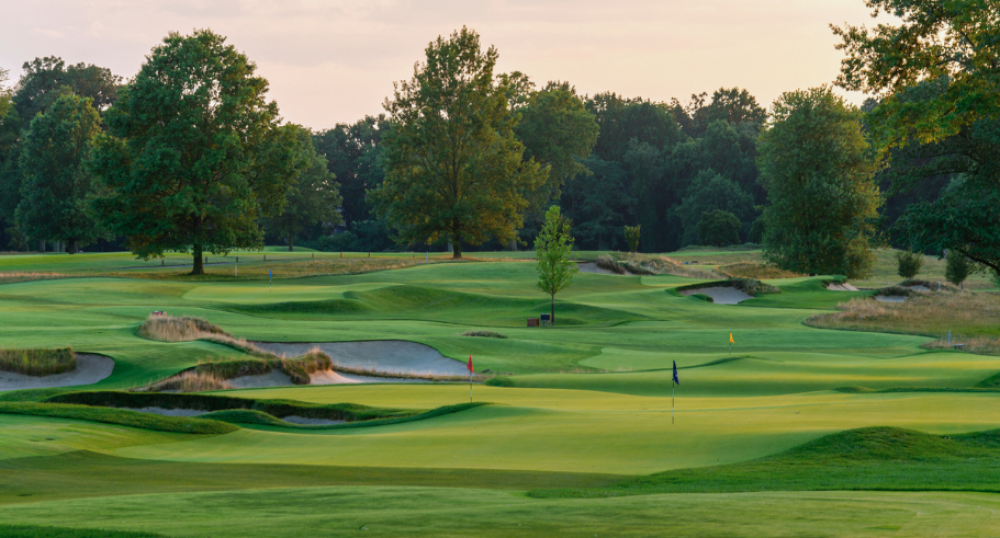
Pinehurst No. 7

Rees Jones added another classic Carolina through the pines course to the Pinehurst family on one of the most rugged pieces of land on the property.  The course has an almost mountainous feel to it with many holes playing down off the tee to a landing area and up to the green on the approach.    The hilly terrain makes the yardage on the scorecard deceiving since many holes play a club and a half more up to the greens.  At a slope of 140 from 6800 yards it is in my estimation the hardest of the numbered courses here at the Mecca of American golf-just seems like avoiding the high score on individual holes is very difficult.

Number 1 Handicap Hole #2 Par 4 (www.pinehurst.com)

Many huge pines that seem to attract any wayward shot-anything off the fairway seems to find the trees and there are few par saves available from the needles.  Therefore, it is a very exacting driving course-first four holes in particular are very tight.  Knowing the Carolina pine needle shot is very important-use the fairway bunker swing-little leg motion-contact ball before needles.  Driving in play and good putting are integral to a decent score.

Number 7 Par 4 (www.reesjonesinc.com)

The place is not over-bunkered, the trees present plenty of hazard on their own, but the bunkers there are have exotic shapes and sizes designed to visually intimidate.  The greens are large, influenced by grain, rolling, and segmented with lots of slant in them.  There is a big premium for keeping your approach shots below the hole.    Most of the greens are set up on hills or plateaus so you have many high soft shots to stay on the putting surfaces.

Picturesque Finish Par 5 (www.reesjonesinc.com)

Nature note-they have a special breed of fox squirrels here-looks like Zorro and eats anything.  Plenty of playground room for them.

Pinehurst, North Carolina

Architect: Rees Jones (1986)

Tees            Yardage          Rating            Slope

Blue              6819              73.7               140

White           6216               71.6               132

(Click to see complete Pinehurst No. 7 hole-by-hole descriptions)

Pinehurst No. 8

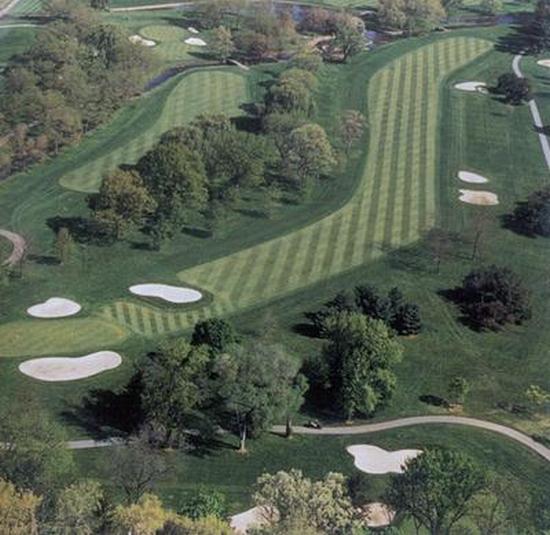
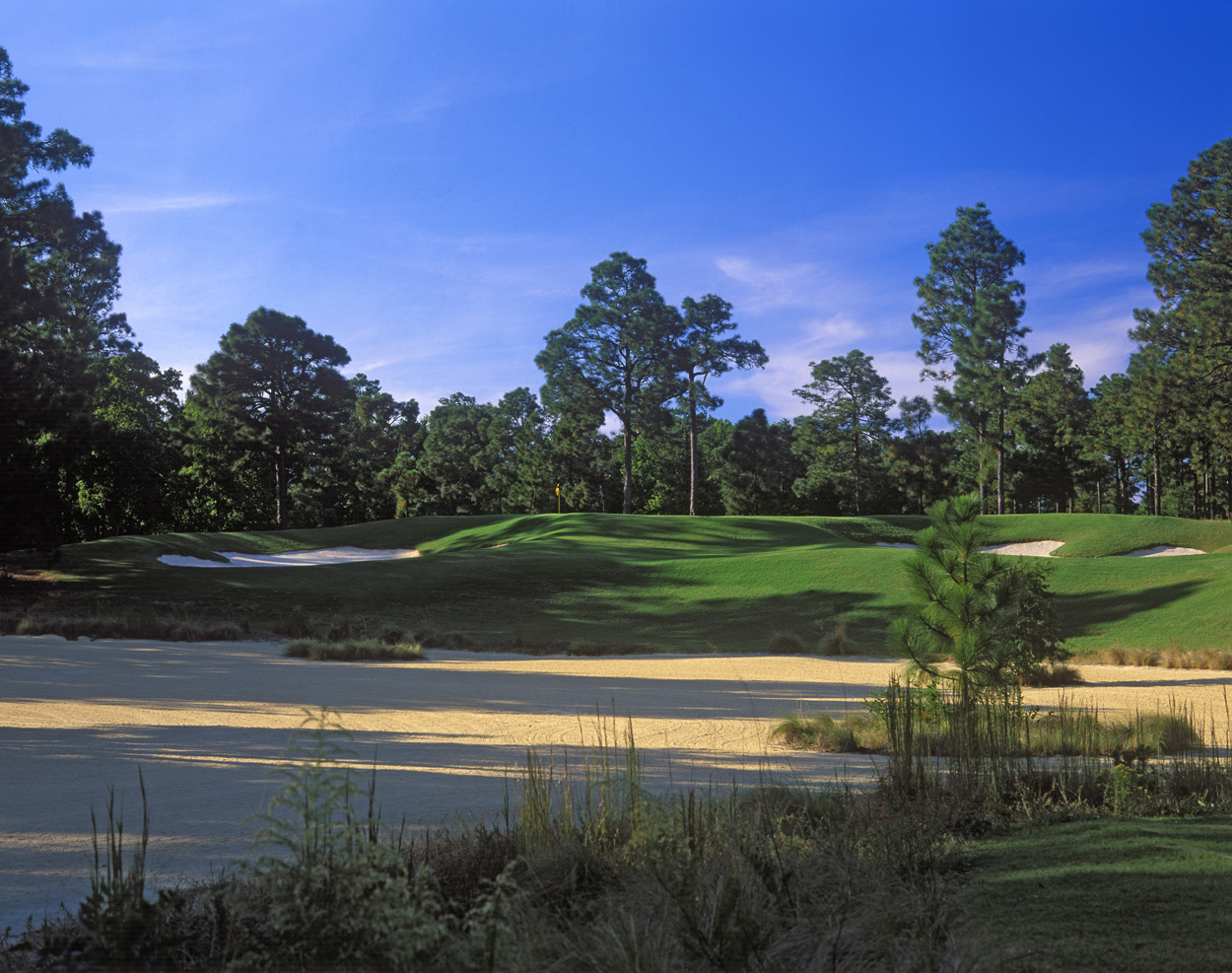
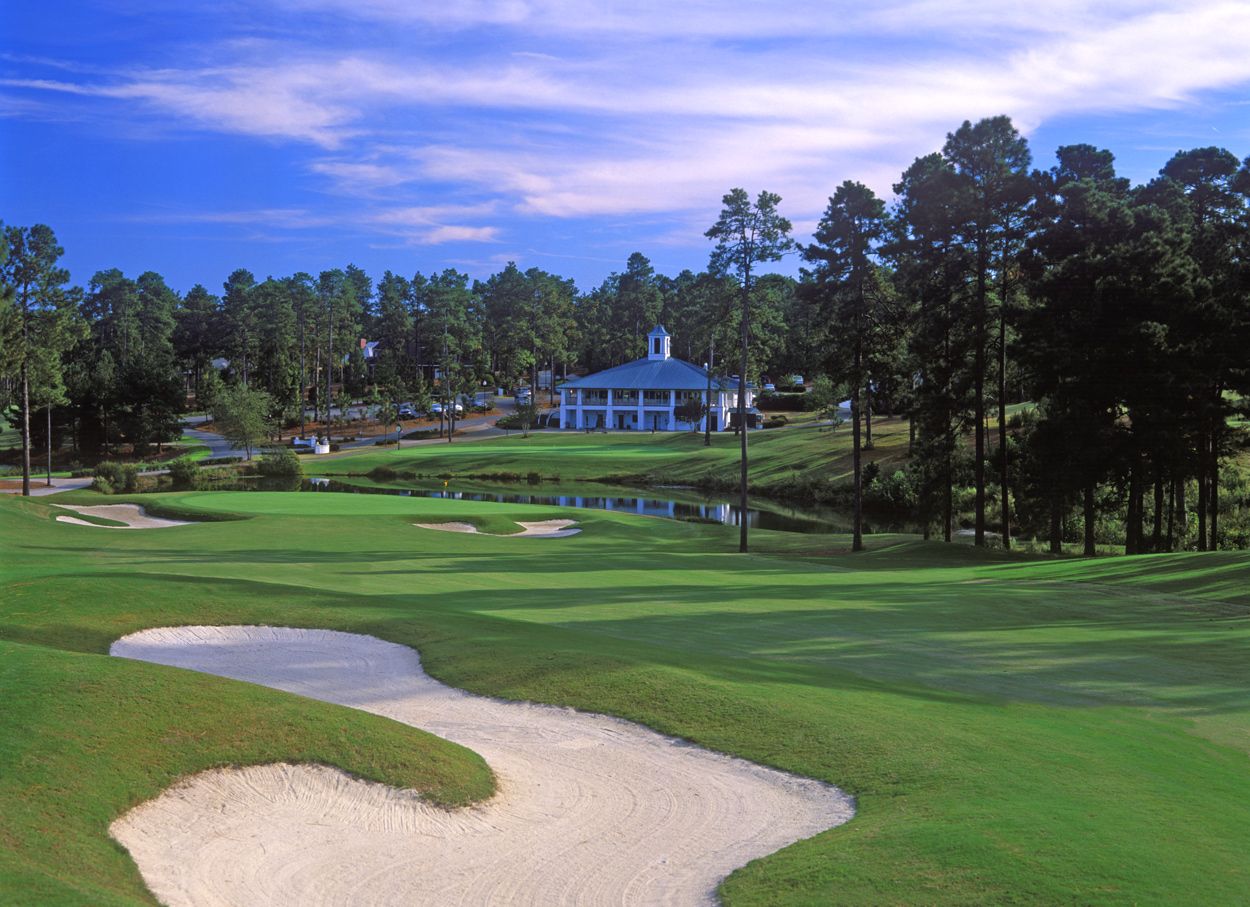
There was quite a bit of anticipation when Fazio, a North Carolina favorite son,  got the nod to build his first course in Pinehurst to honor the Centennial Celebration of this golfing mecca.  The course he designed easily met all those expectations.  It is a spectacular but playable course meandering up and down through the tall pine trees and fresh water marshes.  The course is panoramic-many sweeping downhill holes where you can clearly see all the challenges in front of you.  Big segmented greens with good speed and  breaks that will challenge your judgment as well as your execution.  This is a thinking man’s golf course-approaching each hole with the right forethought can make a big difference on the scorecard.

Bunkering is plentiful but it is not overdone.  Most greens are accessible from one angle on the front-so pay attention to position your ball properly for the most advantageous approach.  The landing areas are always more generous than they appear-he often uses the change in elevation to mask the landing areas from view but if you look carefully at the yardage book you will see that he gives you plenty of room to play to.  The greens have significant slope-many fall off to one side or the other.  The shots into the greens need to take this into account to get your ball close enough for birdie opportunities.

Visual Par Three #8  (golf.com)

The course starts out kindly enough with a sweeping downhill dogleg left that reminds me of the first at Spyglass Hill.  The pace remains tepid for the next few holes until you reach the fourth which is a massive dogleg left par four which will change your mindset for the day.  What follows the rest of the front side are a series of very technical holes that demand you control your roll out to avoid the adjacent trouble.  The ninth is the angry sister of the fourth which it parallels in the opposite direction-big dogleg right with an uphill approach into a difficult green.

The back side starts quietly but from 11 through 13 you play a series of very difficult holes in an area where they turned a sand pit into a visually intimidating series of hazards.  From here in the challenge rachets up considerably.  The fourteenth is your classic warf style hole with water from tee to green on the left and a putting surface that seems to be hanging precariously above the water.

Around The Marsh #14 and 15    (www.pinehurst.com)

The last three holes work up and down the hillside that leads to the clubhouse.  In all cases you are tempted to hit it farther than you need to-like the ending of the front side it is all about controlling your ball flight and positioning.  The finishing hole brings you up the hill to rediscover the view of the clubhouse perched atop the hill.  The cool one that is waiting for you in the bar will be eagerly anticipated.

Final Stretch Begins #16    (theduncanlist.com)

He designed this to be a walking course-the greens and tees are in close proximity.  Make sure you arrange for a caddie ahead of time-the experience is enhanced considerably taking this one in from ground level with some local advice.

Pinehurst, North Carolina

Architect: Tom Fazio (1996)

Tees       Par     Yardage       Rating      Slope

Blue       72        6698              72.3       133

White     72        6302              70.2       130

(Click to see complete Pinehurst No. 8 hole-by-hole descriptions)

Oakmont Country Club

Opening Hole Par 4 (golf.com)

Much like Merion, Oakmont is a total golf experience-the club house, the golf shop, the operations of the golf facility, the caddies, the whole nine yards are steeped with rich tradition oozing from every nook and cranny.  It is not just the impressive pictures of past champions who have won here like Jones, Sarazen, Snead, Hogan, Nicklaus, Miller, Els, Cabrera, Sheehan, and Creamer-it is not even the overwhelming appearance of the handwritten scoresheets from those events (little known trivia is that Calvin Peete finished fifth the year Larry Nelson won his U.S. Open here).  It is the whole aura of the place, creakie floors, un-airconditioned locker rooms, the porches wrapping the clubhouse and looking out over the golf course, all of it makes this an authentic relic that cannot be replicated.  When you go here you just have to take the time to meander around and take it in-breath some musty air-look closely at the wood lockers that have been there since the depression-talk to the help-they know the traditions and are glad to share.

#3 Pews Par 4 (whosyourcaddie.net)

From the golf design side, Henry Fownes clearly accomplished his goal of making this one of the hardest tests of golf in the country.  The large furrow marks in the bunkers are gone, but the lightening fast, undulating putting surfaces are there, the dense rough and the occasional heather field are there, the 160+ bunkers are there and in play throughout,  the hilly terrain that takes a shot hit without confidence to places you would rather not know is there.  The overall balance of an extremely difficult, fair test of golf is what you get.  The modern equipment may give you the extra distance to shorten some of the long holes, but truthfully the test is in tactics and execution not in distance.  Look at the list of winners-Melnyk, Nelson, Mahaffey, Sarazen-these were not men with prodigious length but men who hit it in play and can play around the greens.  The secret to Oakmont is hitting it in the fairway off the tee and pitching and putting to save pars from below the hole.

From the blue tees, length very seldom seems to be a factor.  Angle of attack or approach seems to always be a factor.  The driving areas are visually expansive but are always confined by bunkering usually on two sides.  You get none of the cloistered feeling of trees encroaching the playing area.  There are plenty of big old trees but most are just background.  Beside the bunkering plentitude, the greenside bunkers are very severe.  With a sixty degree you can get out of all of them but getting close will be a challenge.

#5 Testing Par 4 (GolfPublisher.com)

You cannot think of Oakmont without trembling at the thought of the warp speed of the greens.  Stimpmeter measurements aside they are just flat out fast.  I have heard criticism that the greens are too undulating considering how fast they are maintained and this is something I agree with.  But it is a characteristic of the course and you just have to accept it.  As troublesome as the downhill putts are I think the real challenge is hitting the uphill putts hard enough.  On all courses with fast greens the differential in absolute speed between a downhill and uphill putt is way greater than on a course with slow greens and this differential will drive you batty.  You just want to smack yourself upside the head with your Odyssey every time you leave an uphill putt short-and you will do it all day.

Besides keeping your drives out of the rough, and this is a must to have any chance for pars, I think effective pitching and chipping is where the scoring is at.  Again the fast greens will carry shots without conviction off to the aprons and you must be able to up and down from there to make pars you thought you deserved.

Storied finishing hole at Oakmont (courtesy of Alan Levine/Lowl Productions)

When you are done here you will likely feel beaten but not unfairly beaten just beaten because of lack of tactical conviction or shot execution.  Like the Gold Course at the Golden Horseshoe this is a course to play again and again-it will tantalize you and occasionally treat you kindly, more often than not you will walk away shaking your head at what could have been.  But then again that is the lure isn’t it.

Oakmont, Pennsylvania

Architect: Henry C. Fownes (1903)

Tees                           Par           Yards          Rating        Slope

Championship            71            7255            77.5            147

Blue                            71            6436            74               134

(Click to see complete Oakmont hole-by-hole descriptions)

Mystic Rock-Nemacolin

This Pete Dye creation is another addition to the death defying style courses that the man likes to create.  It reminds me very much of Bulle Rock which is of the same vintage.  Sweeping panoramic holes with big intimidation factors but really only moderate challenge when you strip away the veneer if you play at an appropriate tee length.  If you choose to play further back do so at your own peril since the difficulty notches up considerably.

This place was the home of the PGA Tour’s 84 Lumber Classic for a number of years and they did substantial renovation and redesign in 2004/2005 to meet the challenge and conditioning requirements of the tour.  The black tees measure a whopping 7550 yards with a slope of 152-if you do not have your name embroidered on your bag you have no business playing back there.

Tranquil 10th Green Par 4 (www.caddybytes.com)

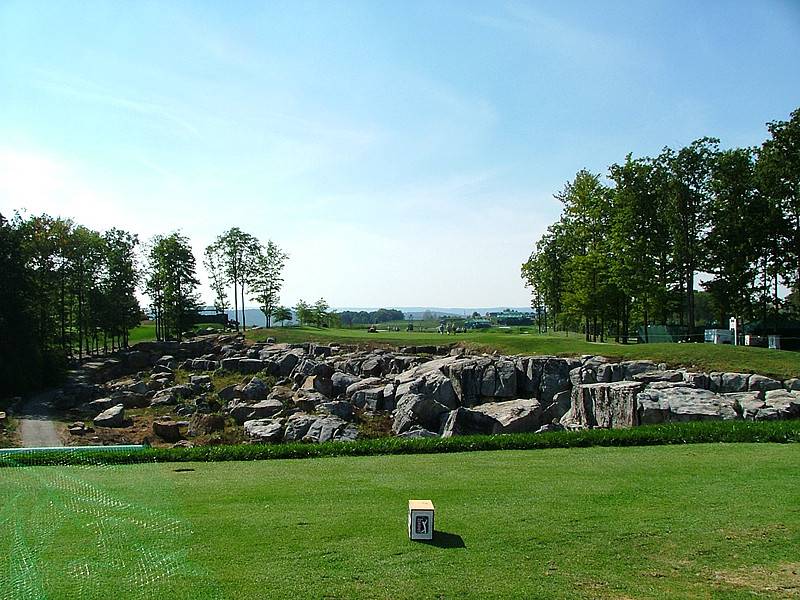
The basic lay of the course is very characteristic of its surroundings-rolling terrain with dramatic vistas and more rocks then you can imagine in any stone quarry.  The rocks accent the water hazards-the forced carries, the tee boxes-even the outhouses.  The stone budget alone would have built most courses in the sixties.

Signature Boulders 16th Hole Par 5 (www.caddybytes.com)

The green arrangements are really challenging.  Most involve a dramatic approach but all have bail out areas and alternate routes for the player not up for that challenge.  Lots of undulations, a few buried pacaderms, and, though some of the greens are in the 50 yard long range, you never get much depth to shoot at so you have to pay attention to the approach angles.

Tough Carry into 12th Par 3 (www.caddybytes.com)

The driving is the most challenging aspect of the course.  Wayward ones pay the ultimate price-re-teeing-but even the one that is slightly off line will make the approach to the green considerably more difficult.  You must pay attention to the hazards in the driving areas-if you have the nerve to play adjacent to them you will have a much easier approach at the flag.  At 6300 you do not need to jack them long-normal drives will leave you medium to short irons.  But the green sets will make you concentrate on those approach shots because there are some huge bunkers, swales, and even an occasional hazard you do not want to visit if par is your goal.

Farmington, Pennsylvania

Architect: Pete Dye-1997

Tees    Par   Rating    Slope    Yardage

Blue     72     73.8       138         6791

White   72     71.6       137         6313

(Click to see complete Mystic Rock hole-by-hole descriptions)

Bulle Rock

A typical Pete Dye design-full of visual intimidation and grandeur-he toys with and soothes your mind at the same time.  Your scorecard is likely to reflect the former rather than the later because the golf challenge, even if you pick the right tee length, is very robust.  Much like he did at Mystic Rock around the same time, Pete used the rolling terrain to showcase beautiful hole layouts-there is so much eye candy here you will think you are in the NECCO factory.  The ticket is high but you really get your money’s worth on all levels.

The short game practice facility was an original extra at its time-still remains one of the highlights of the experience for me.  The clubhouse is nice without being grand, the golf shop has plenty of Bulle Rock memorabilia for you to sample, and the grill room has a very fine array of all American comfort food for you to enjoy.

Number 2 Par 5 (Scott Serio/EclipseSportswire.com)

The composition of this course, much like the composition of a fine piece of music,  is where the artistry lies for me-the sequence and flow of the holes is very engaging.  Though the longer hitters may gripe because of the number of shortish four pars, Pete gives your scorecard a building sense of pressure because those short holes are frought with danger if you do not pick your challenges carefully.  With the exception of a bit of a logistical hiccup in the placement of the short par three third-you can feel this course naturally roll out in front of you-every really big challenge is followed by a bit of a letup on the pedal-but more challenges await in short order.  The sequential buildup on each side ends with a very memorable hole where the player needs to get a second wind to keep his scorecard in tact.

Number 13 Par 4 (www.rollinggreens.com)

As is usually the case with Dye courses, the biggest intimidations are usually not the biggest challenges, the devil is in the nuances so pay close attention to the nature of the landing areas off the tee and the access points and configurations of the greens.  The green surfaces have gentle but significant slopes-very speedy and the grain will accentuate or attenuate the pace of all putts.

Because of the topography this is a brutal walk-some serious cardiac episodes lie between green and tee.  The lack of any tree cover in the playing area from tee to green means that when the sun is out you will get the full brunt of its fever-be prepared to drink, towel, and seek some refuge under the cart cover.

Anna Nordqvist LPGA Champion 2009 (Scott Serio/EclipseSportswire.com)

The LPGA Championship has been played here a number of times over the years and the list of champions verifies the pedigree of this course.  Winners have included Annika Sorenstam, Se Ri Pak, Suzanne Pettersen, Yani Tseng, and Anna Nordqvist.

Stunning Finishing Hole Par 4 (www.golfdigest.com)

Pete rarely disappoints when they pay him and Alice the big fee and they did not disappoint here.  It is really just a matter of whether you experience more “Wows” than “Whews” here-there should be a boatload of both of them.

Aberdeen, Maryland

Architect: Pete Dye-1998

Tees            Par   Rating    Slope     Yardage

Gold            72     74.2        142        6843

Blue            72      72          138        6360

White          72     70.6        135        6047

(Click to see complete Bulle Rock hole-by-hole descriptions)

The Golden Horseshoe-Gold Course

Of the Jones Sr. courses that I have played the Golden Horseshoe remains, in my estimation, one of the finest courses he ever designed.  It was built in the 1960’s in a hilly wooded area that surrounds a a natural canal basin-the finished course is a product of it’s surroundings.  It bears similarity to Spyglass Hill which was built in the same time frame, a course that the pros consider one of the most difficult courses they play all year.  Much like Spyglass this course was carved out of a densely wooded area-tall trees ensconce every hole and give the course that distinctive cathedral-like feeling.  Much like Spyglass the holes meander up and down seriously hilly terrain presenting the player with the challenge of evaluating elevation change on almost every shot.  Throw in a little wind and the tunnel effect caused by the tall trees and you have a difficult mental challenge in club selection on every shot.

Esthetically this is one beautiful golf course.  There are more maintenance people per player than you will see anywhere.  Every flower and blade of grass is manicured to perfection-it is presented to please the eye and it will not disappoint.  This is a mother of a piece of terrain to walk so you will actually be glad to be riding in a cart most of the way.

Number 2 Par Five 476 yards     (reesjonesinc.com)

As is characteristic of most of the Jones Sr. courses you see long tees to allow multiple tee lengths, oddly shaped-segmented greens that never give you much target to shoot at, and well placed fairway bunkers that force you to play dexterously for the best line into each green.  The greens are very undulating and segmented which puts a premium on getting your ball to the correct tier and further pressures you to get the correct driving position for an advantage angle at the flag position of the day.  The only characteristic missing from most of the Jones Sr. courses I have played are the large sprawling amoeba-like bunkers with which he loves to intimidate players-but the green side bunkers are deep and well positioned to swallow a shot without conviction so you will end up with sand between your toes before the day is over.

In spite of the fact that the overall yardage does not seem intimidating it is a driving course-long drives on the right line are requisite to scoring well here.  The trees and bunkers clearly define the driving lines-you must hit them if you are to have a bats chance of hitting these segmented greens.  Concentration and correct club selection on the tee box is very important.  Mindlessly blasting your driver on every hole will lead to lots of troubles and doubles on your scorecard.  Which brings to mind one of the cardinal rules of The Shoe-if you hit it in the trees take the most direct and shortest route out.  Anything bold or macho will be punished by Trent’s ghost-there is very little air in these trees.

Number Three Par 3 174 yards (golfzoo.com)

As is the case with most great courses you have to be intelligently aggressive to score well here.  When you have the right angle to a flag or the putt from the correct side of the hole you have to go for it.  On a course like this you have to put some cash in the account when you have a chance because there will be debits coming due on some of the harder holes during the day.  The middle holes require you to score well because the beginning and the end will not offer you much opportunity other than survival.  The par three holes are easily the most difficult scoring holes on the course.  All four are nested around the basin in the middle of the property with serious elevation change and always a smattering of wind.  To murk your decision making further three of these holes have at least three tee positions they can use so the club selection can change two clubs from one day to the next.  These are four of the most challenging and breathtaking par threes you will ever play on one course.  The last five holes are the hardest run of the day-one of the toughest finishes if you are clinging to a good score.  Only the last four at Avenel or the last five at TPC Sawgrass come close.  It is especially difficult to face this challenge late in the round when you are tired.

Number Sixteen Par 3 159 yards (reesjonesinc.com)

I have played this course a dozen times and I still find every round I play here full of intrigue and delight.  It is the type of course I think you could play every day and never get sick of it-the facets of the architecture-the beauty of the surroundings make it a real treat time after time.  There is no course I have played in the states-except Pebble, Pinehurst 2, Merion, and Oakmont-that has left a more indelible mark on my golf psyche.  Touche Mr. Jones!

Williamsburg, Virginia

Designer: Robert Trent Jones, Sr (1963)

Tees            Par          Yardage            Rating              Slope

Blue            71            6522                 72.4                 135

White           71            6248                 70.7                 129

(Click to see complete Gold Course hole-by-hole descriptions)

Golden Horseshoe-Green Course

In an effort to create a two-course facility that would be able to handle large convention groups, the Golden Horseshoe hired Rees Jones, son of Robert Trent Jones Sr.,  in 1991 to build a complement to the heralded Gold Course at The Shoe.  What he created in no way resembles Trent’s classic masterpiece.  This is a contemporary styled wooded course winding through tall beech, oak, and pines and more gentle rolling terrain than it’s sister where they moved lots of earth to get the shaping they were looking for.  The most distinguishing characteristic is enveloping mounding-every hole over 200 yards long seems to have a wall of mounds on both sides that contain the area of play and keep balls from chasing into the woods.  I am convinced the owners said to Rees we don’t want 30 handicappers out here for six hour rounds looking for their Pinnacles in the woods.  The mounding around the greens is wild as well but here at least it leads to some creative pitch saves when you miss the greens.

The sequencing of the holes is interesting-you start with four par fours without great distinction.  You don’t see a three par until 7.  At that point the character of the course changes dramatically and you have to start paying attention.  The middle six are actually the meat of the course for me.    There are three par threes from seven to eleven and not another par five until fifteen when you will see two in the last four holes.  The last three are very technical holes-shortish par four, long par three, and an interesting par five to finish.  The main criticism I have is that the holes tend to be pretty straight, only two real doglegs in the bunch, and many of the holes start to appear alike though the green set mounding and sculpting make them play differently.

This is by no means an easy course-the rating and slope from the Blue Tees is actually higher than the Gold but I think the difference is that less blowup holes are lurking here than across the campus.  The zoysia grass fairways also make it play even longer and the side mounding also leads to lots of side hill approach shots into the greens.  Don’t always reach for the driver there are holes where position trumps length and the well place three wood or hybrid will be the better choice of driving club.  The green shapes themselves are very varied and interesting and you have to ignore the straightness of the fairways and think carefully about approach angle relative to pin position to get good scoring opportunities.

Number Nine Par 3 176 yards (reesjonesinc.com)

The par threes are easily the most interesting holes out here-all feature elevation change and unusual green complexes with varied pin positions, difficult sculpting and undulations, and nice variety in length.  The water in play on the course is only on #11 and the drive on #18 so the chance for the triple bogey threat is only if you double pump a tee ball into the trees and that is hard to do over the side walls.

Finishing Hole Par 5 512 yards (reesjonesinc.com)

Keep your head about you-concentrate on the driving lines and you will enjoy this day.  This is a fun course-sporty and interesting-and a great complement to the challenges of his father’s track.

Williamsburg, Virginia

Designer: Rees Jones (1991)

Tees              Par          Yardage            Rating              Slope

Blue              72            6722                 73.6                 138

White            72            6244                 70.7                 129

(Click to see complete Green Course hole-by-hole descriptions)
Whistling Straits-Irish Course

The Irish at Whistling Straits sits close to Lake Michigan with the Straits course between itself and the shores of the lake.  As a result it lacks the links style character of the Straits,  it does not have the vast wild look set among the rugged dunes areas strewn with hundreds of small bunkers and natural grasses.   Rather it is a cute sister with a unique personality of it’s own.  Pete and Alice Dye sculpted the land to create a very original blend holes that share the influence of the Lake Michigan winds in a more parkland setting.  There is a bigness to the scale of this course-the engineering feat and tactical drama they created  easily equals that of the Straits it just does it in a slightly more demure way.

Pure Dye Art 11th Hole-Par 3

The Irish has a more manicured look with smooth edges and curves.  Much like Pete’s work at TPC Sawgrass there are more defined water hazards and vast manicured waste bunkers here that create distinct target areas collared by strife.   The pressure is constant from the very first hole to make precise tactical decisions and execute specific shots.  Mistakes translate into scorecard cash register ringing, so you are going to have to be on your game to protect your score from disasters.  Once you have been through the course the first time, I think the shot lines are much less psychologically intimidating since you are better aware of the bordering parameters.  Over the long haul your scores should be improve as a result.

5th Hole-Par 5 (www.americanclubresort.com)

Every Dye course I have played has the “startle factor” and this one is no exception.  You stand on the tee of many of the holes and think “Wow!” usually followed by “Oy Vey!”.  He just has a way of laying holes out that are so splendid to the eye with the flow of the fairway, demarcation of the hazards, and uniqueness of the green complex presentation.  At the same time you cannot help but feel intimidated by what he is apparently asking you to do.  But, as with TPC Sawgrass, if you keep your wits about you,  I think there is a fair and conservative line you can choose on every hole that is not an unreasonable challenge.  Playing to your handicap is very doable on this course.

Hanging Plateaus- 12th Hole-Par 4

The three pars lack the stunning beauty of those on the Straits because they do not have the cliff hanging green sets against the lake backdrop.  But the four pars more than make up for this drama through a very clever use of segmentation of the landing areas and sharp turns in the doglegs.  Greens are very large, segmented, and have plenty of pitch and roll to them so you have to be very articulate in your approach shots to avoid lots of three putt drama.  The biggest factor to your scoring will be the wind effect off the lake in conjunction with the large waste bunkers and water hazards adjacent to the driving areas.  There are a number of partial forced carries you have to calibrate properly to minimize your risk.  It is the cumulative effect of having to deal with this hole after hole that will wear on you.

Finishing Fortress-18th Hole ( http://www.americanclubresort.com)

This is a wonderful golfing challenge dressed up with splendid visuals.  In the end the Irish will not assault your scorecard as directly as the Straits, but the net result is likely to be the same-a feeling of exhausted accomplishment after a day of sensory overload.

Kohler, Wisconsin

Architect: Pete Dye (2004)

Tees                         Par        Rating         Slope         Yardage

Black                        72           75.6            146            7201

Blue                         72            73.5            141            6750

Green                      72            72.0            137            6366

Red                         72            70.0            126            5109

(Click to see complete Irish Course hole-by-hole descriptions)

Whistling Straits-Straits Course

Whistling Straits LogoThe Kohler/Whistling Straits resort is something to behold, it has first class accommodations, great food, wonderful service, and four, count em, four Pete Dye golf courses. But the thing that put this place on the map is The Straits course which has already hosted two PGA Championships, a U.S. Senior Open, and will be the host of another PGA in 2015 and the Ryder Cup in 2020.

There are two things that are startling about The Straits. First it is essentially a links style course in the middle of America and second, everything you see that makes this a links style course, except for the ocean sized Lake Michigan over your shoulder, was manufactured by man. The not so startling fact is that Pete Dye had the audacity to conceive and pull off the first two.

The fact that he was convinced he could create a links style layout from scratch with office building sized sand dunes, massive waste areas peppered with endless bunkers, and acres and acres of native links type grasses on what was essentially a pancake flat piece of lakeside ground, formerly an air force target range, is beyond audacious-it was almost egotistical. But Pete has never suffered for lack of self confidence and damned if he did not pull it off. He even has the signature sheep wandering the course to make it feel like you are playing an old links course in rural Ireland.

They may be cute but they will mooch your peanut butter crackers.

Besides the engineering feat of importing and placing about 8,000 truckloads of dirt from Indiana to sculpt the land, Pete had to conceive of a routing to expose as many of the holes as possible to the lake winds to create the real look and feel of links golf in Wisconsin. It is a figure eight routing with the front nine going south along the lake shore and then looping back upon itself to catch more shoreline on the way back in. The back side does the same thing going north along the shoreline and looping back for more shore on the way back to the clubhouse. This puts 8 of the 18 holes with direct interface to the lake and another six within eye view. The influence of the wind off the lake can be profound and since the holes go in both directions on both sides you rarely get but a couple of holes in a row with the same wind effect.

The quiet tranquility of Number 2 is beguiling.

Pete did his homework and integrated many of the important strategic links characteristics so that the course can be challenge no matter the wind direction and you have a chance to be successful as well. As with most links courses these greens are very long which allows the greens staff to place the pin on the front when the wind is in your face or in the back when the wind is helping-this will make it easier for you to use the green surface to manage your shot into the green. Most of the 500 bunkers are well out of the playing area but the positioning of ones in the driving areas, layup areas, and greensides are staggered so that there always seem to be tactical bunkers in play no matter the prevailing wind.

There is open access at the front of most greens to give you the bump and run option if a lower approach shot is in order. The only failing is the turf is not as firm as you expect on a links course so sometimes those bump and runs will bump and check. Most significantly, the towering dunes and massive waste areas adjacent to the fairways and greens create visual intimidation that make TPC Sawgrass look tame. This psychological collateral can be very significant if you let yourself get too fearful of playing the right shot.

Seventh Hole Par 3 is pure intimidation.

The par threes on this course are all stunners-forced carries over huge waste areas to precipice greens with the backdrop of the lake behind. This lack of topological backdrop can make frame of reference of the shots hard to discern. The wind influence on the three pars is at it’s max because they are the most exposed holes on the course. There are a number of serpentine par fours where Pete used the large dunes to obscure your vision of the target-this is especially true if you hit your drive on the wrong line on the doglegs. The way he wends these holes through the dunes and sets the green complexes against massive backdrops and falloffs creates that links feeling of risk and reward on almost every shot. It takes some moxie to play this course successfully.

The harsh reality of Number 17 will challenge you.

The greens are massive and have lots of slope and tiering. In many cases being on the wrong section of the green is like not being on the green at all. You have to resist playing to the safe side on many of these holes otherwise you will be three putting all day long. Green speeds are affected by slope and grain, but wind is not to be forgotten because it can accentuate the curve and speed of a putt drastically.

Quite the finishing hole

The caddies here are top notch-they are truly professional caddies who understand the course and the tactics for playing it successfully. Heed what they say and ask lots of questions-you need to hit every shot with full confidence out here if you want to play to your handicap.

Don’t forget where you are-I recommend the kilbasa at the turn with some kraut-it is almost indigenous to the region.

Kohler, Wisconsin

Architect: Pete Dye (2004)

Tees     Par     Rating     Slope     Yardage

Black    72       76.7       151        7362

Blue     72       74.2        144        6909

Green  72       71.9         137       6459

Red     72       66.9         125       5396

(Click to see complete Straits Course hole-by-hole descriptions)