
Moray Golf Club

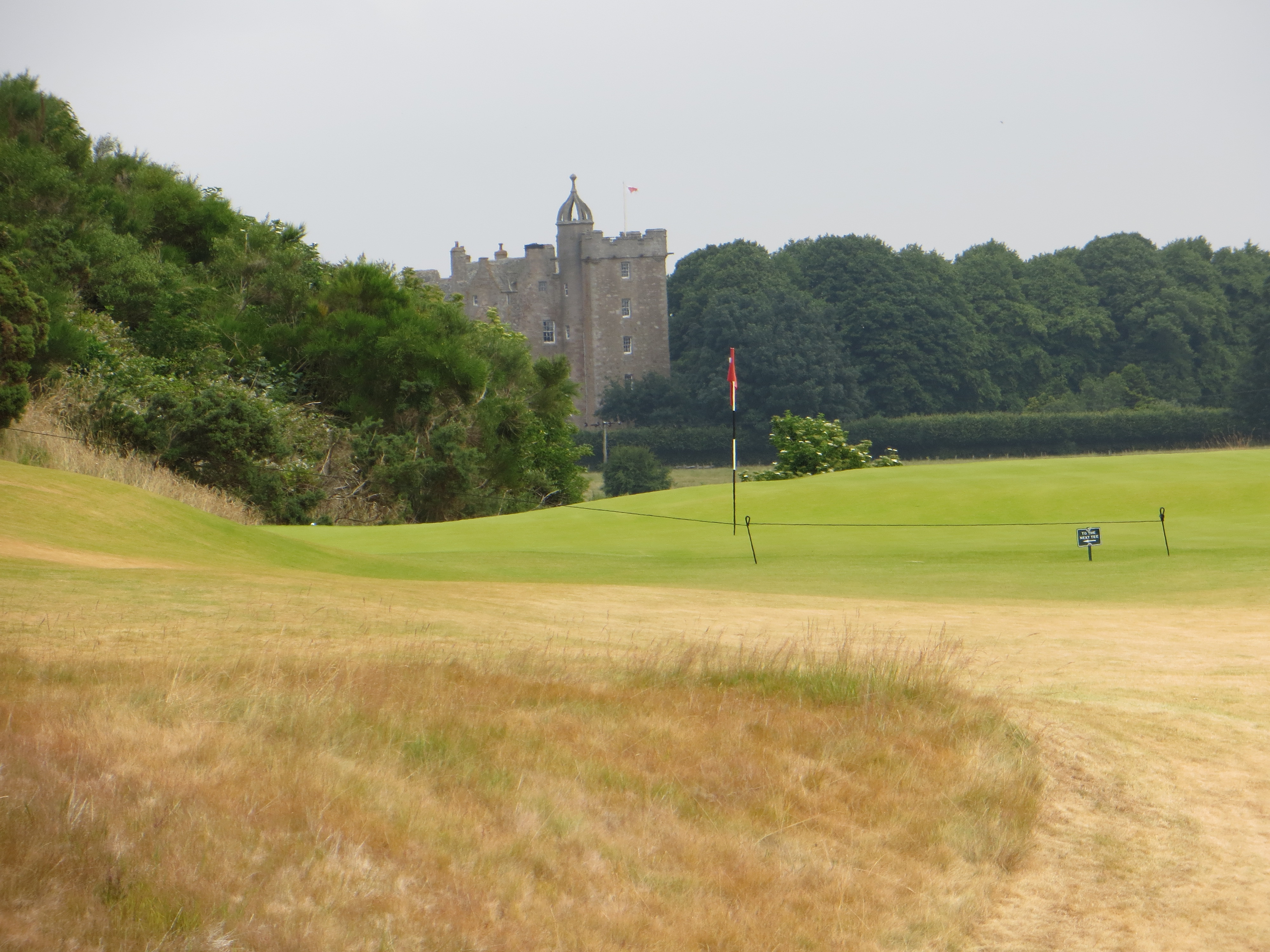
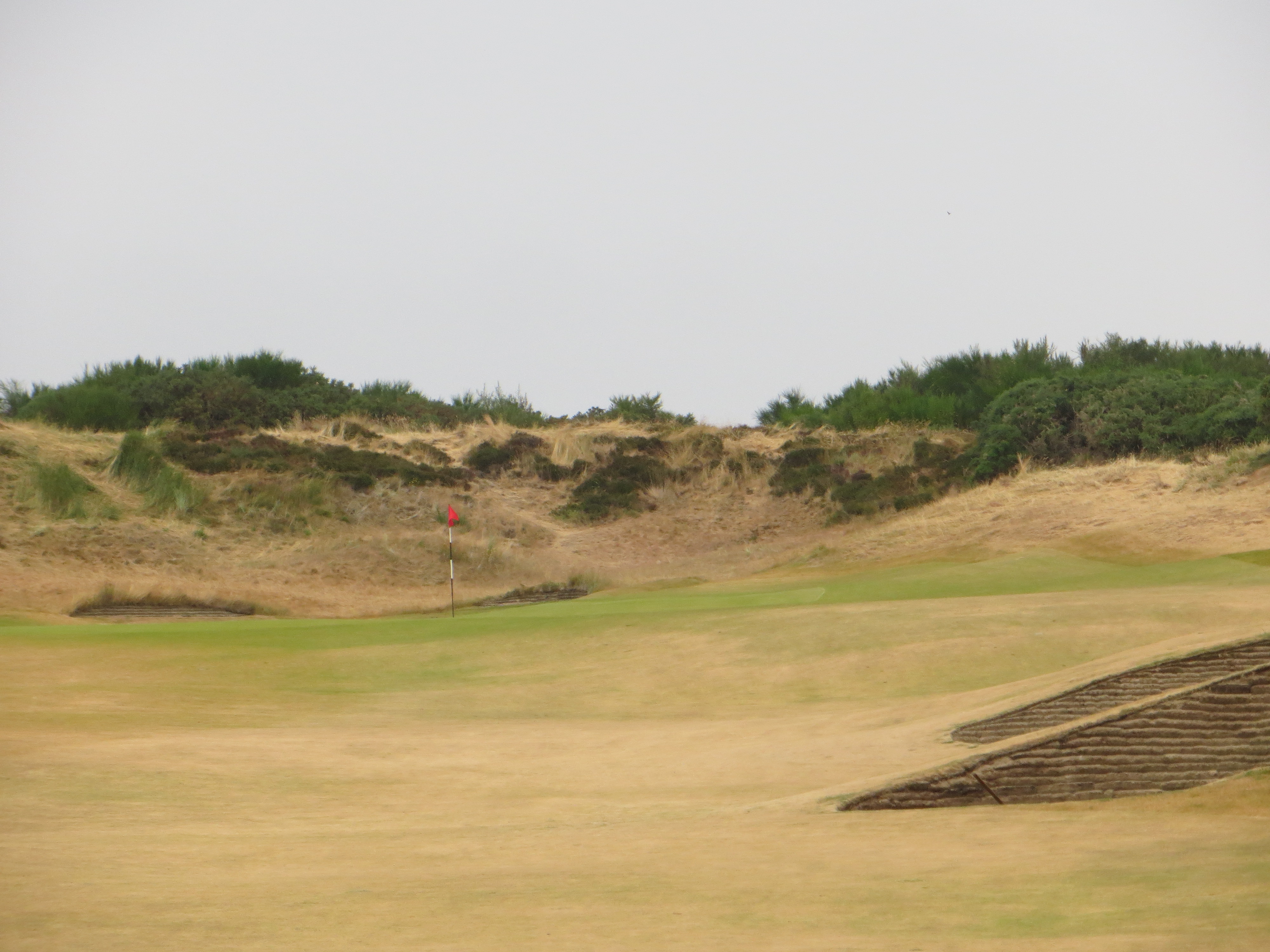
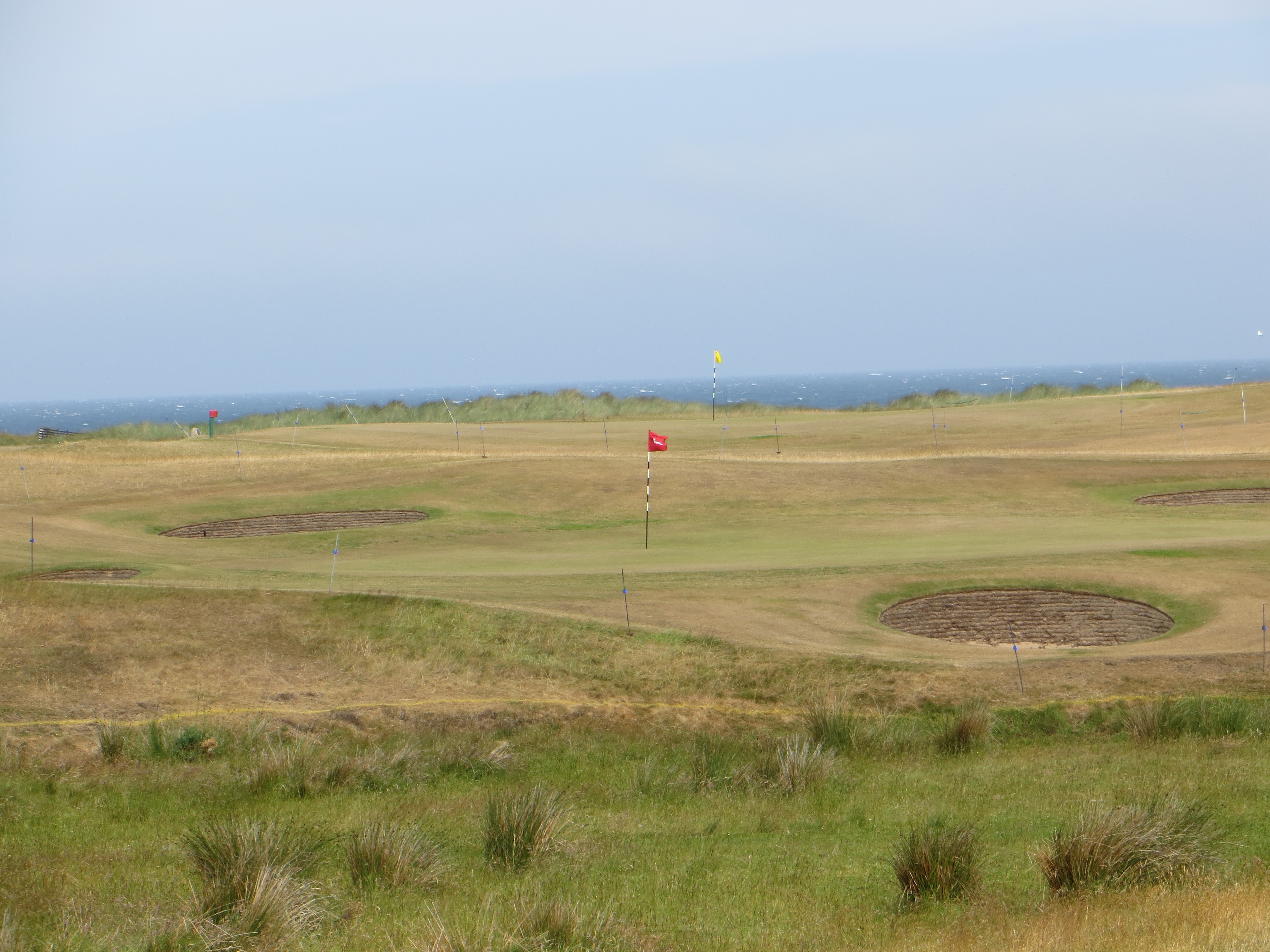
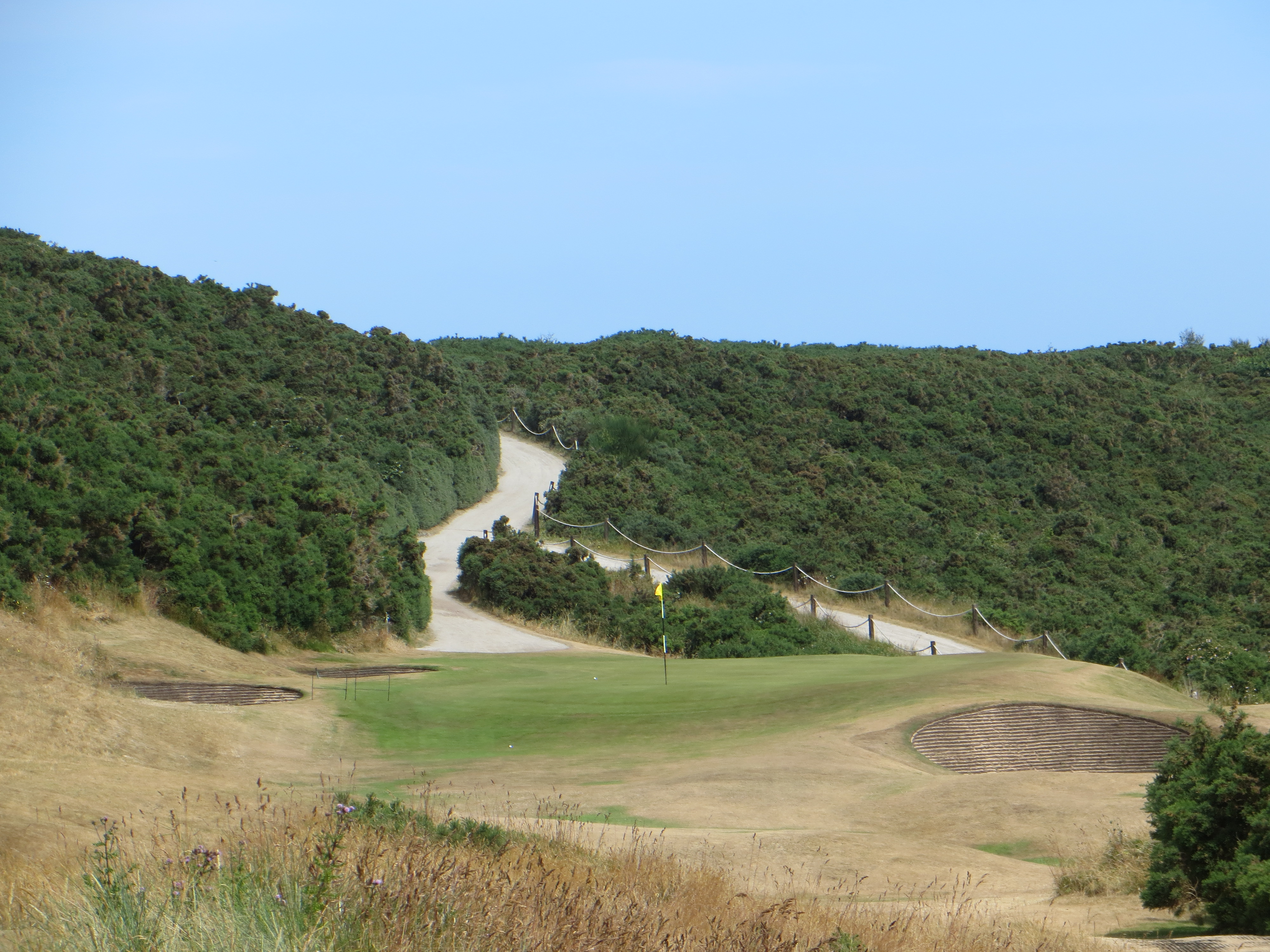
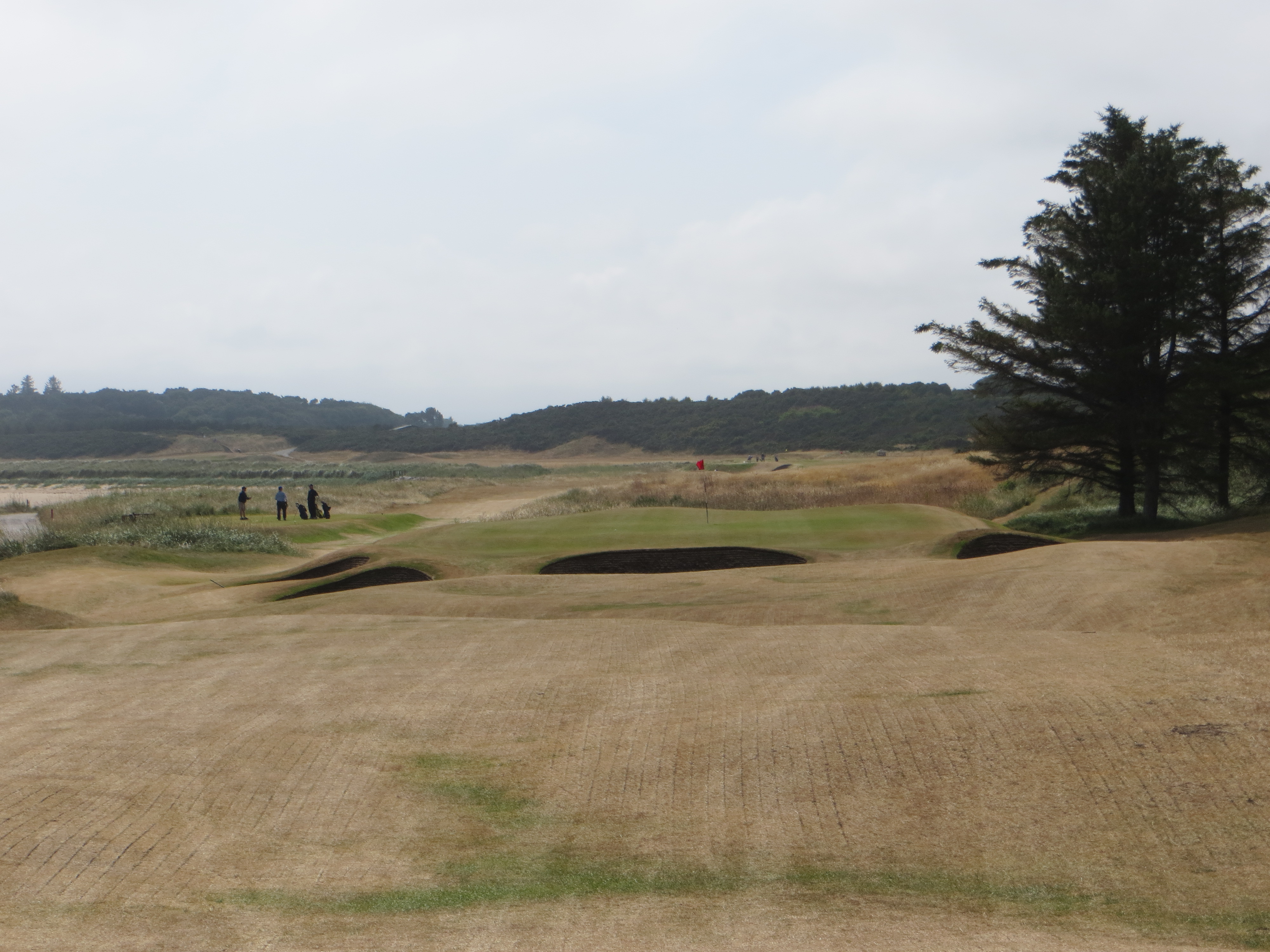
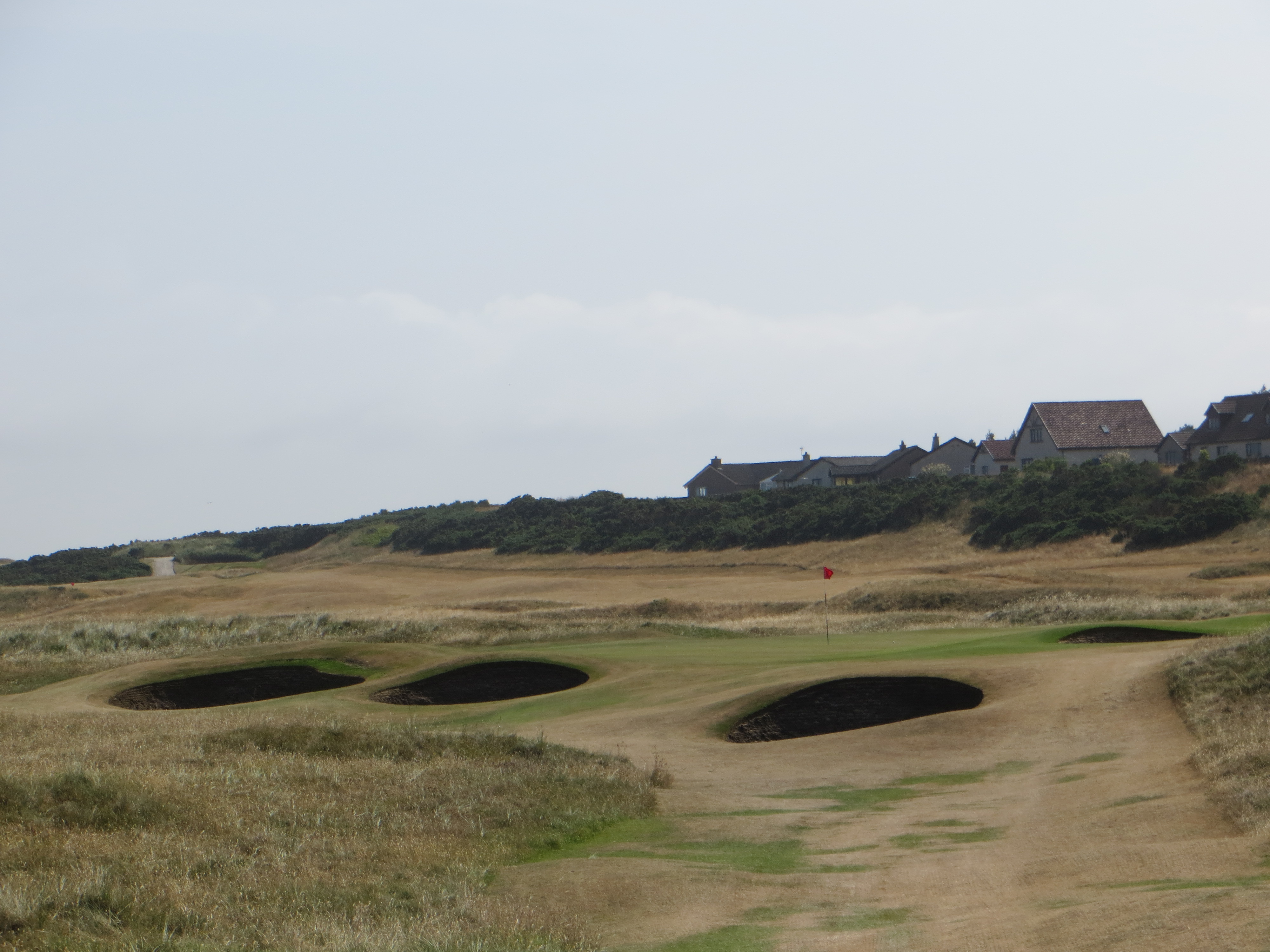
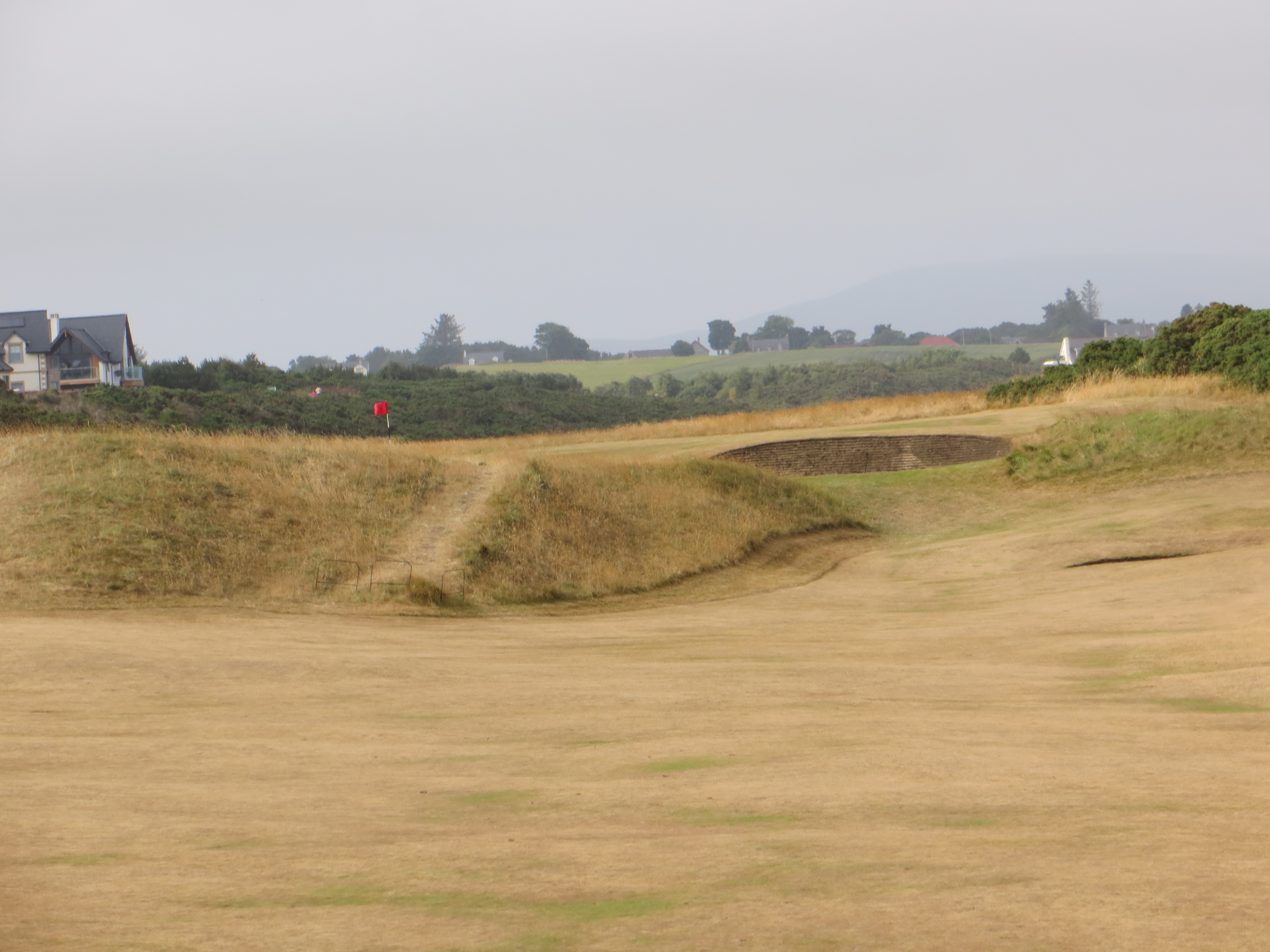
Moray Golf Club LogoThe old course at Moray Golf Club is a quaint Old Tom Morris original featuring deep revetted bunkers, undulating gorse confined fairways, and smooth flowing putting surfaces.  This is not going to be on anyone’s “A” list of must courses to play in Scotland but, in my humble opinion, it is a destination worth seeking out if you are traveling along the northern coast of Scotland.  It is the proud asset of this small seaside community of Lossiemouth.

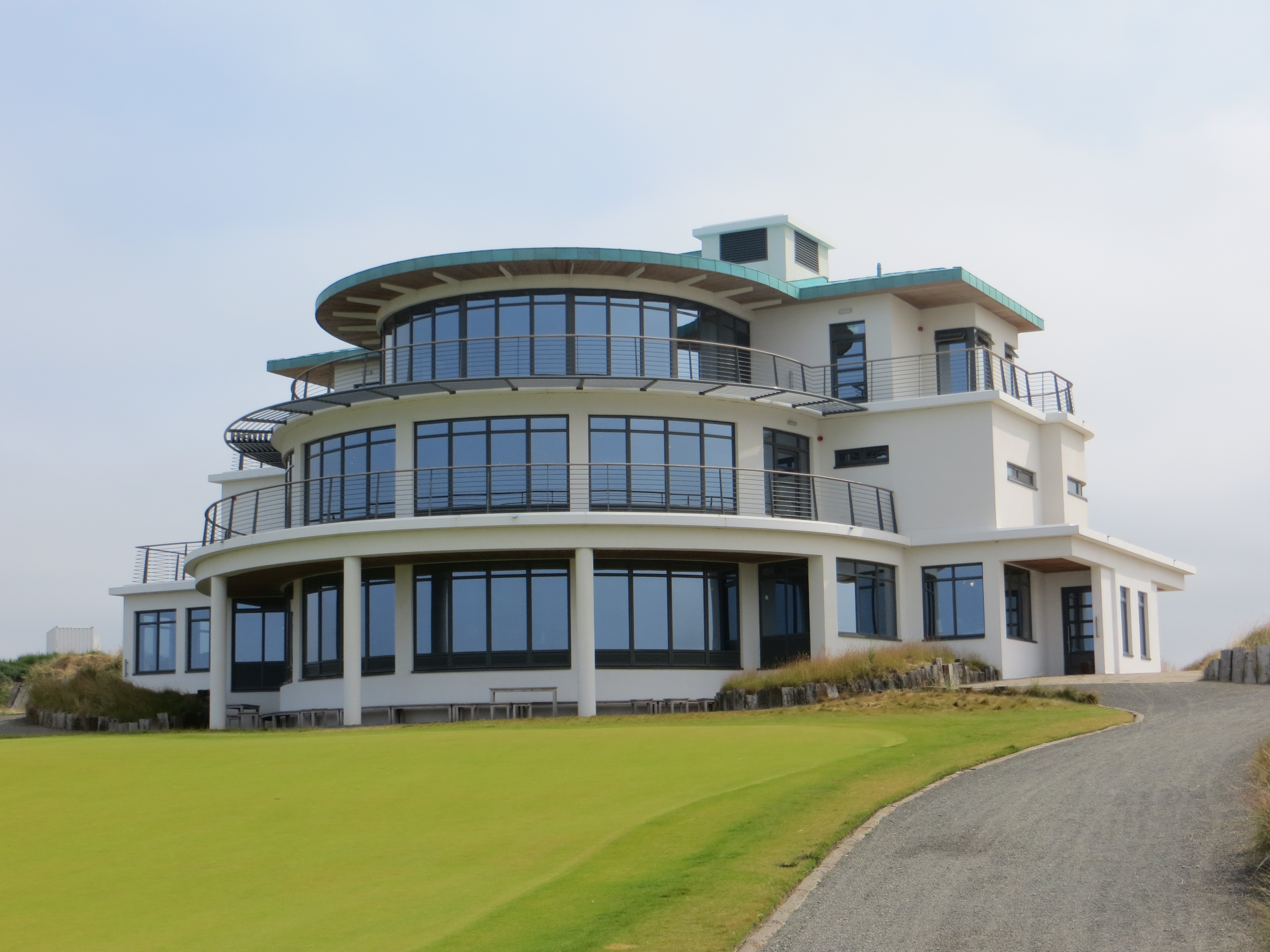
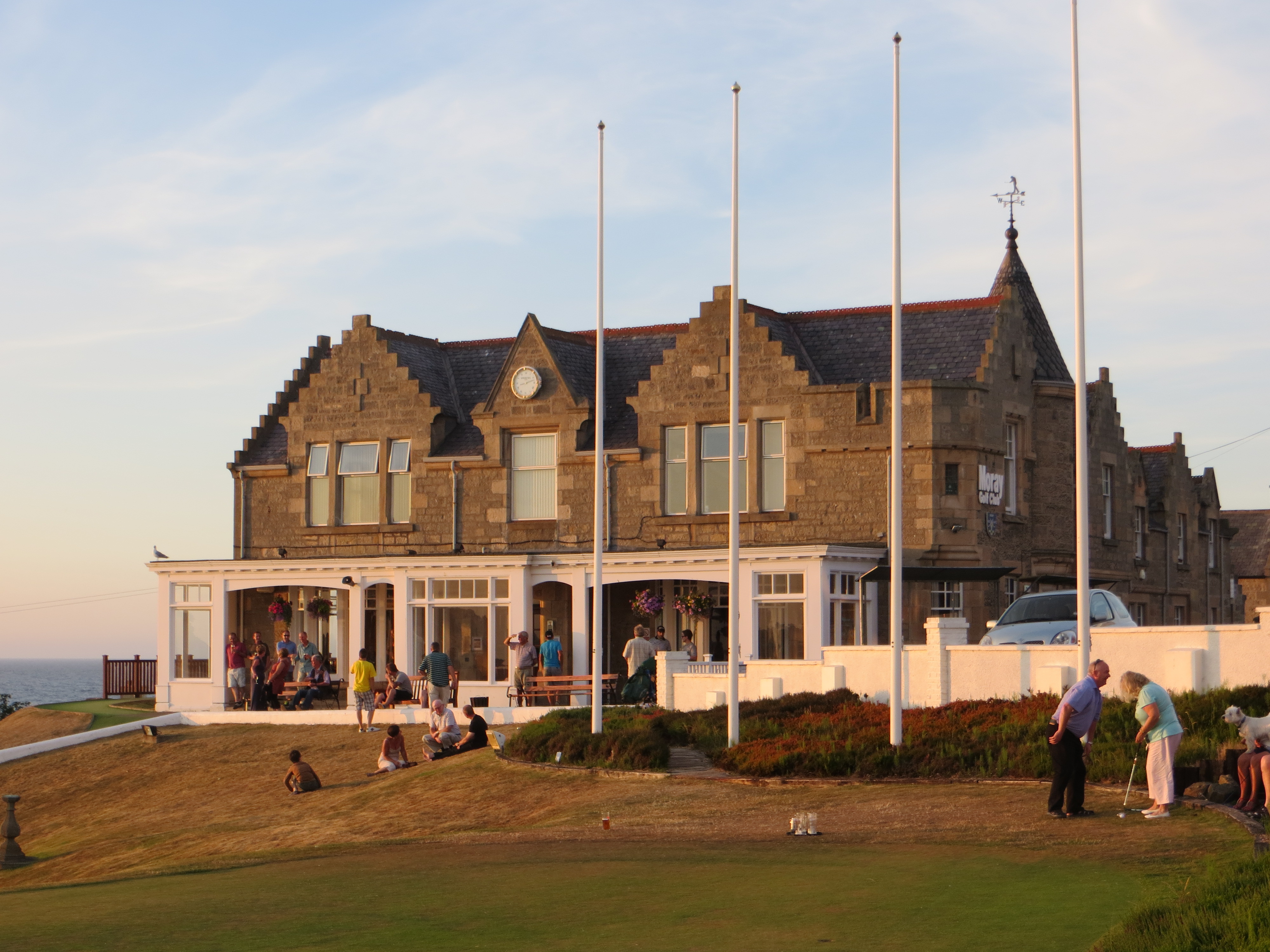
The clubhouse displays a dignified stature sitting atop a hill overlooking the finishing hole and seaside links land below.  Five flagpoles and a commemorative sundial stand proudly above the practice putting green and some terraced hills creating a perfect amphitheater setting for those enjoying happy hour at the clubhouse bar.  As you finish your game you will undoubtedly get some cheers and jeers from related interested parties.

The clubhouse on the hill is a focal point from which you can see it all.

The clubhouse on the hill is a focal point from which you can see it all.

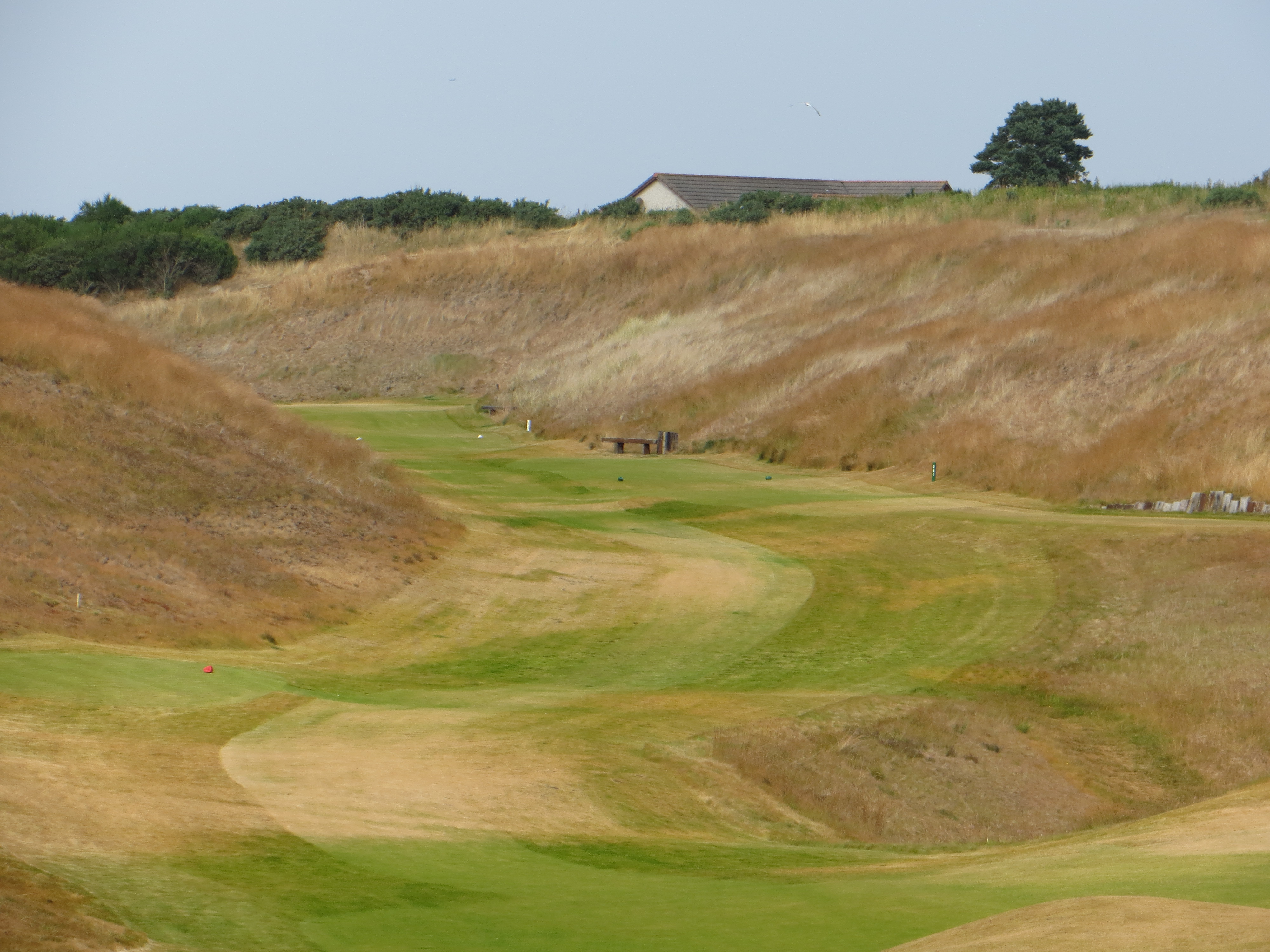
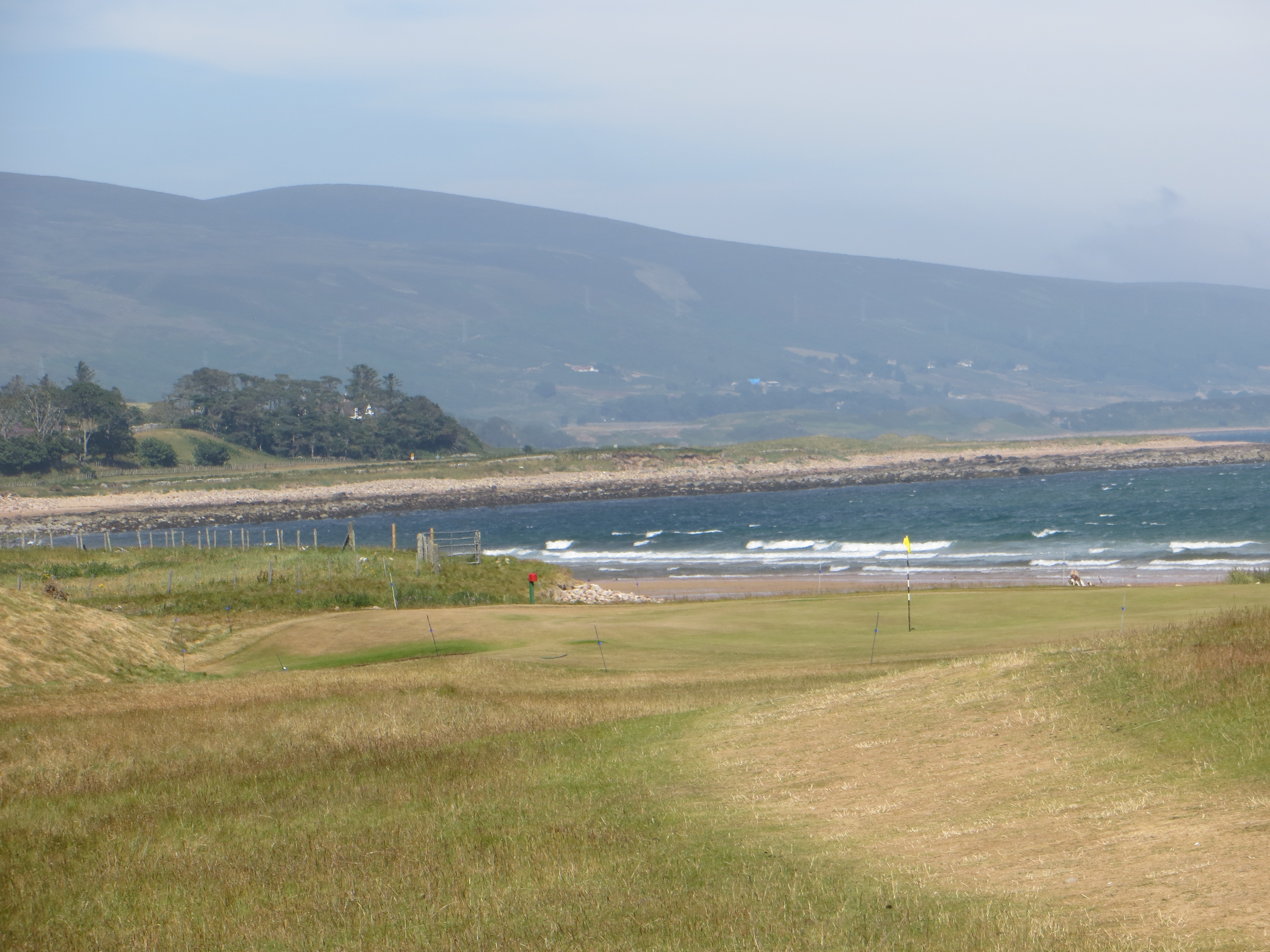
With seven par fours of 400 yards or more, only two par fives at 2 and 17, and a par of 71 there are long stretches of challenging golf without relief and this is plenty of course to chew on for the average bear.  The apparent flatness of the terrain, there are very few high dunes except Mt. Lebanon adjacent to the first and last holes, is a bit of a sucker punch because Old Tom found plenty of humps and hollows in the seaside terrain to create fairways and green complexes that impart serious movement as your ball is seeking it’s targets.  The holes are very tightly packed in and there really is not much other than fairway and gorse so any significant wandering off the playing line can mean unplayable circumstances.

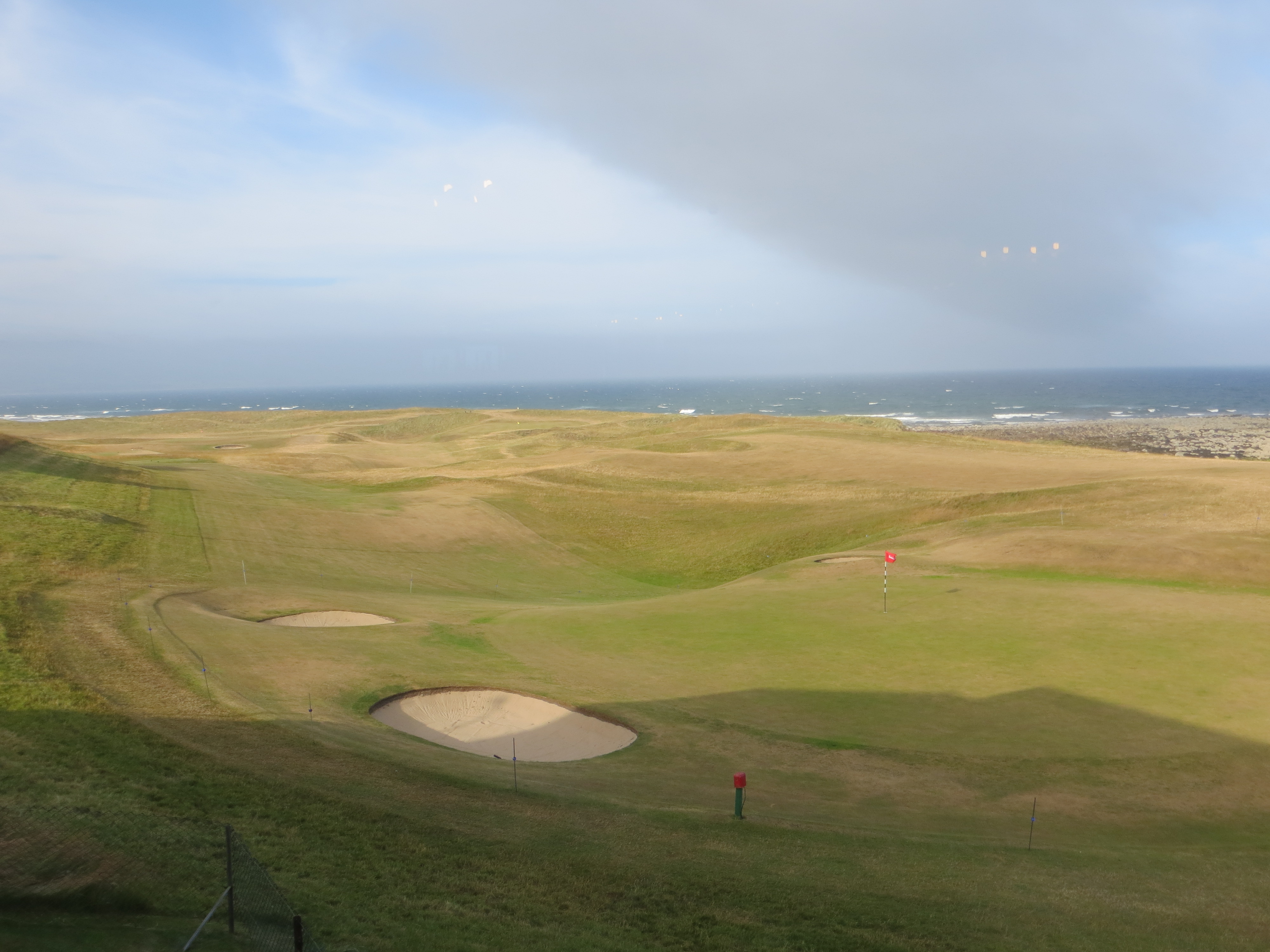
The links features you see here make for some entertaining shot making.

The links features you see here make for some entertaining shot making.
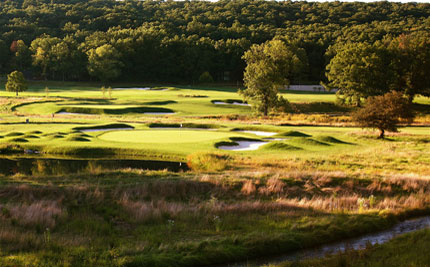
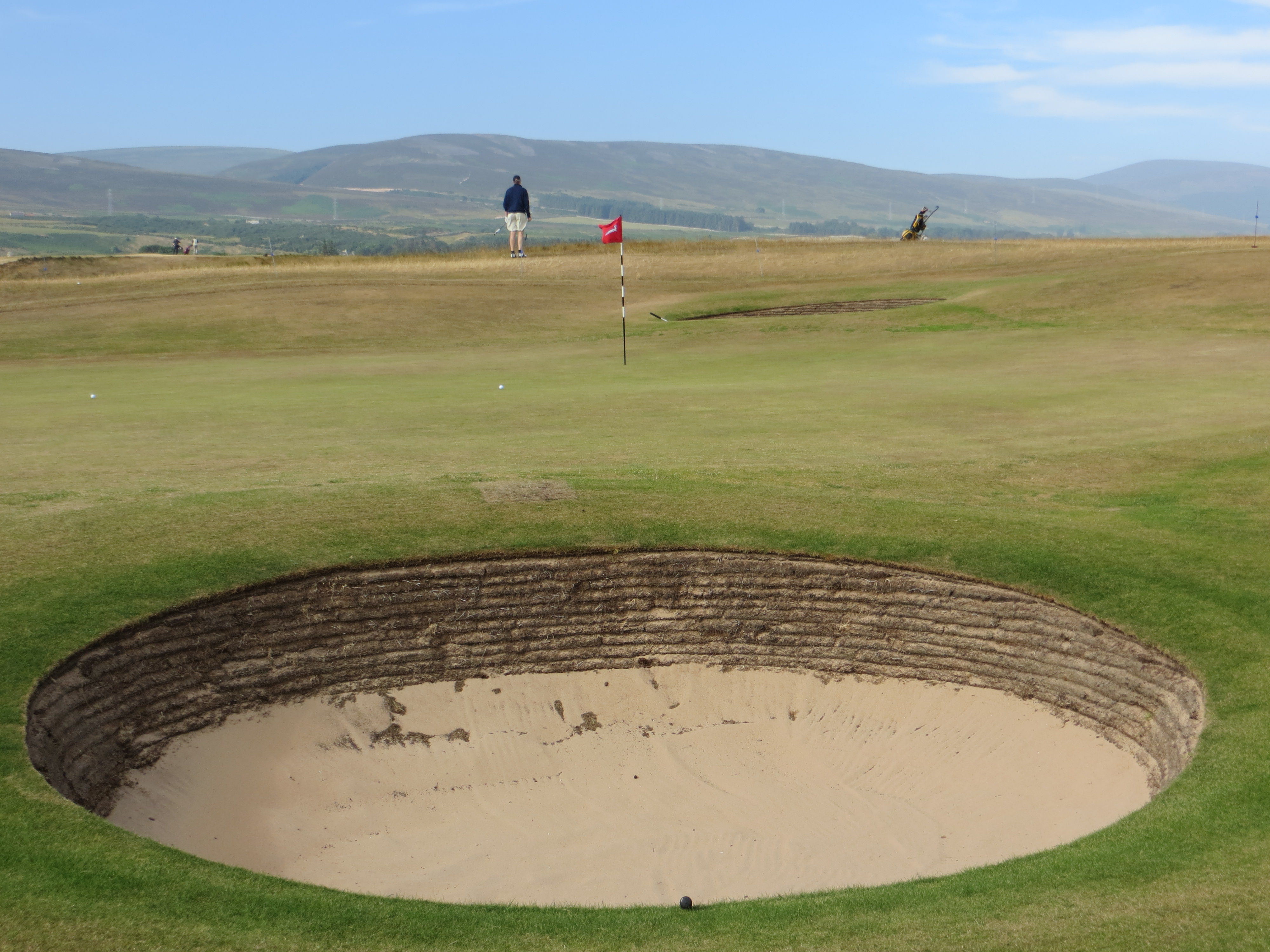
The holes themselves are a wonderful collection of links offerings and you will encounter all the characteristics of washboard fairways, intrusive burns, nasty revetted bunkers, and raised greens with arbitrary runoffs.  Controlling the sideways movement of your ball is the key and enlisting the help of the given terrain is the best way to do this.

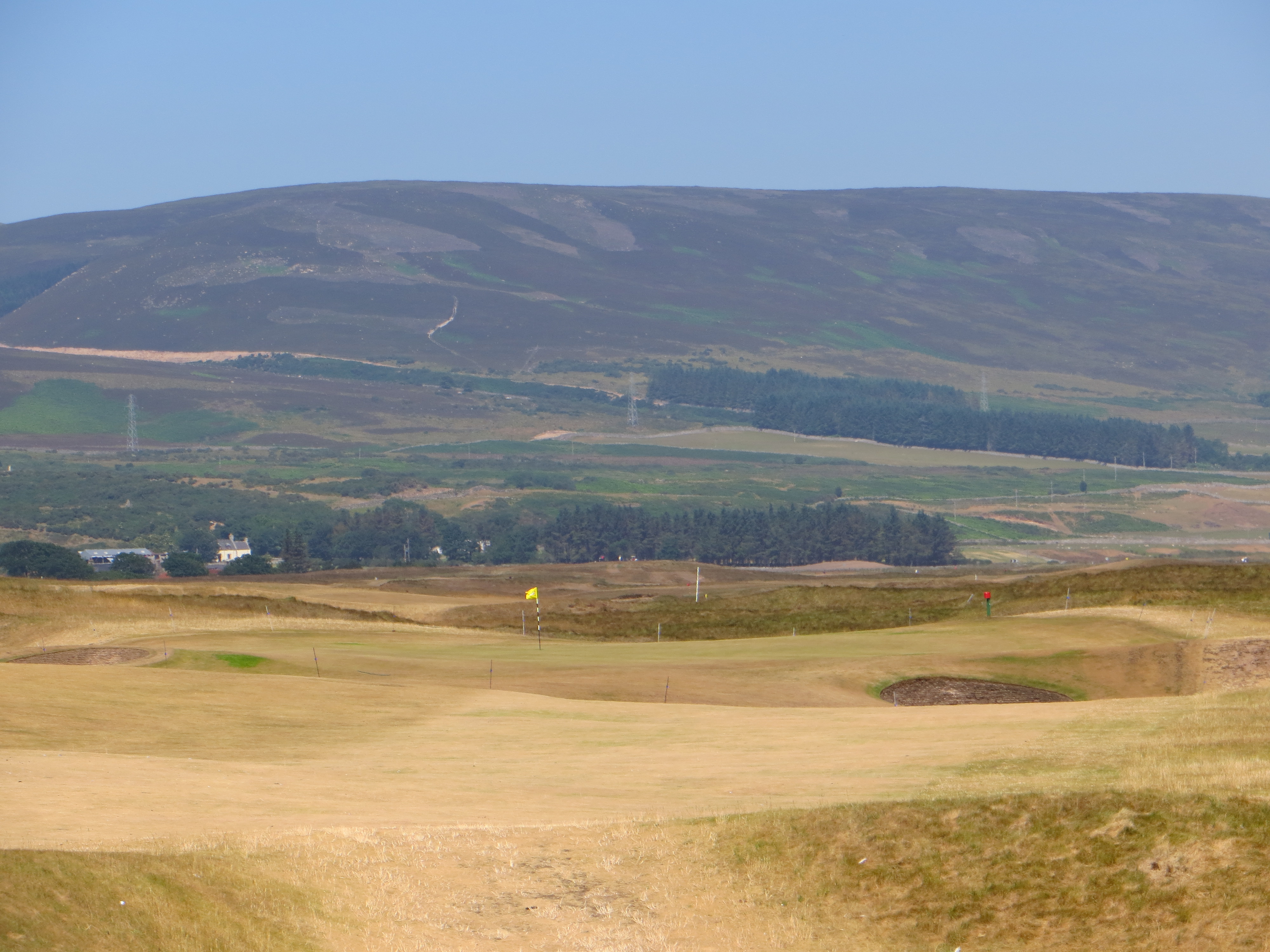
Parched like a trisquit controlling roll out into the 12th takes imagination.

Parched like a triscuit controlling roll out into the 12th took imagination.

When we played the course they had been experiencing a prolonged hot and dry summer so the course played as hard and fast as the playground out back of P.S. 84 in the Bronx.  The lack of any high obstacles means that any wind experienced at Moray will have full force since there is little in the way to obstruct it.  The parched conditions coupled with a stiff 25 mile an hour wind made it a real chess match to anticipate the roll out on even the shortest approach shots.  We would have been lost without the valued advice of a couple of caddies who knew the lay of the land.

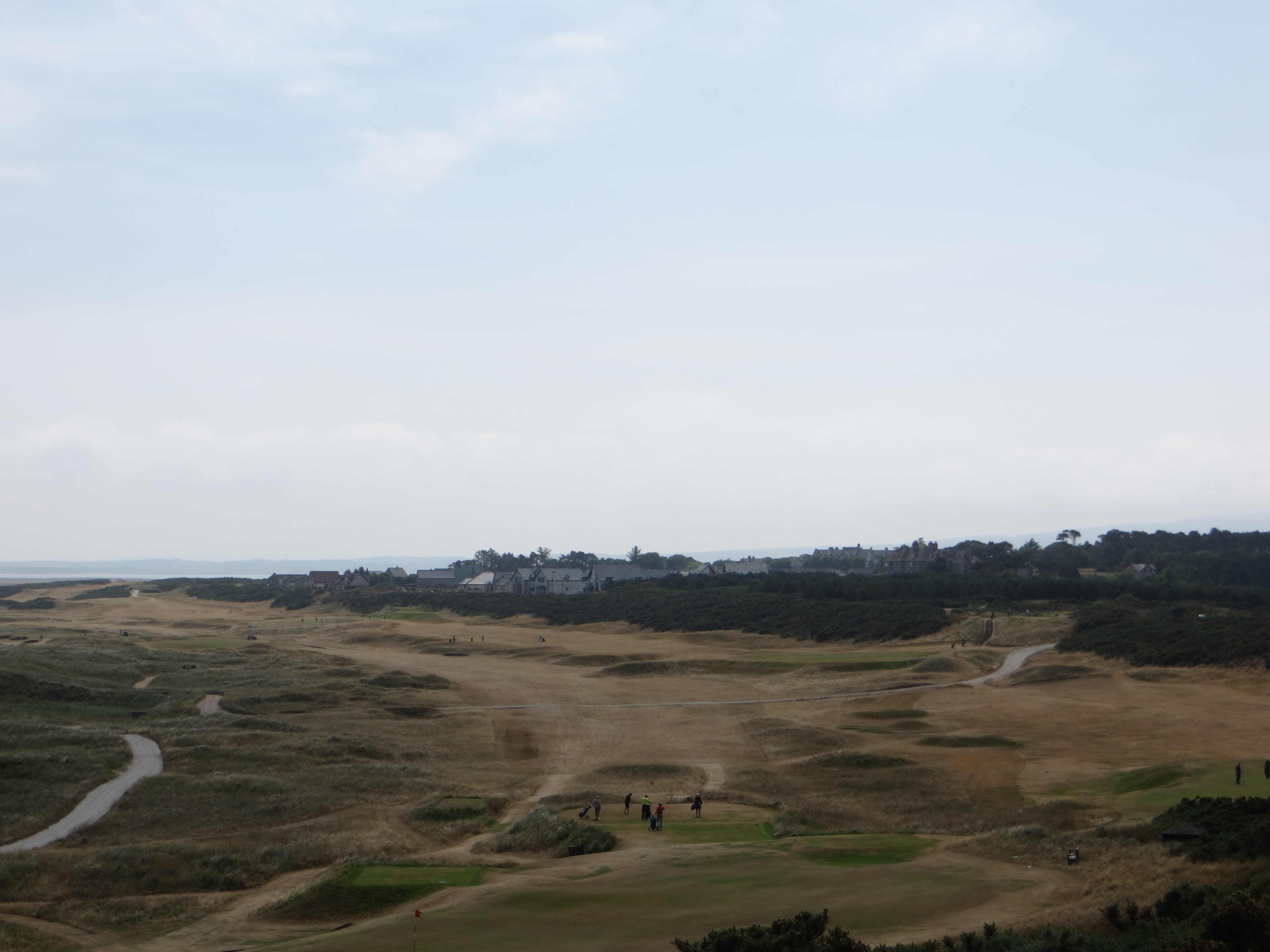
This finishing hole setting is something that will cling to you.

This finishing hole setting is something that will cling to you.

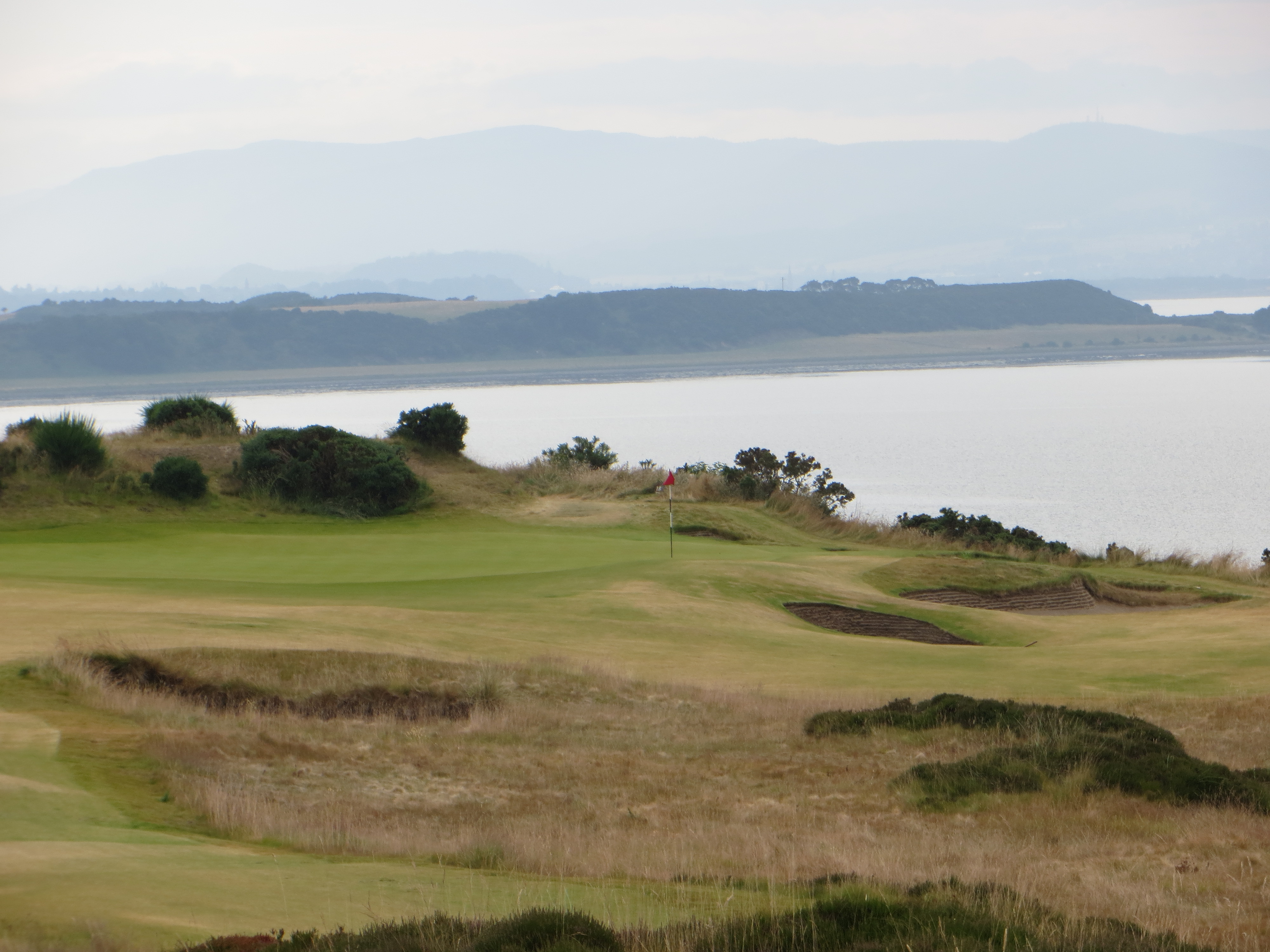
There are not a whole lot of memorable holes on the course but I will say the last five will get your attention.  It is a strong finish that begins at the par four fourteenth that gets it’s name from it’s bearing toward the sea.  On a clear day the green is majestically framed by the sea and a lighthouse in the distance.  The par three that follows is a clever and deceptive hide-n-seek hole that calls for strong visualization off the tee.  A strong par four and a funky par five bring you to the signature hole to end your day.  This long par four may be one of the strongest finishing holes in all of Scotland.  The second shot into a plateau green complex set into the hill below the club house packed with revelers is a real adrenaline rush.  A perfect finish for a very enjoyable day of links golf.

A beautiful sunset puts a perfect accent on the day.

A beautiful sunset puts a perfect accent on the day.

Something you will notice early on is that the course sits adjacent to a Royal Air Force base next door.  You may have to ignore the screaming jet engines from fighter bombers on training runs, so don’t say you were not warned.  At least there are a number of wind socks visible over the fence to help you figure the wind and the landing light poles for the runways that appear like cactus gardens throughout the property can give you some convenient aiming lines.

Lossiemouth, Scotland

Architect:  Old Tom Morris

Tees        Par    Yardage    Rating
White        71     6572          73

(Click here to review the complete Moray Golf Club hole-by-hole descriptions)

Royal Dornoch Golf Club

Royal Dornoch LogoRoyal Dornoch holds the distinction, behind the Old Course at St. Andrews, as the second most famous links venue in Scotland.  Golf in some form has been played in this Scottish Highland neighborhood for over 400 years.  Rumor has it that the local clergy from the Dornoch Cathedral sanctioned playing the game in it’s early years and ushered in the first period of growth in this region.  The current iteration was laid out by Old Tom Morris in 1886 about 10 years after the club was officially formed.   It sponsored many distinguished competitions throughout the early 1900’s and in the 1940’s, with the acquisition of additional ground on the north end, allowed for extension of the holes on that end and the redesign of the final six holes that we play today.

The natural terraced routing flows below the gorse laden dune wall.

The natural terraced routing flows out and in below the gorse dune wall.

Click on any photo to get a higher resolution view of the image

There were many hands in this development but honestly it seems like nature and the big force are most responsible for what you will experience here.  Once you get into the heart of the course, as James Finegan says, “there is a strong sensation of heading toward land’s end.  The remoteness is total.  We feel we may….penetrate the very wilds…on this journey over ancient landscape where so little is owed to the hand of man.

John Sutherland guided the affairs of the Dornoch Club for 60 years starting in 1883.  A fine player in his own right, a knowledgeable contributing course designer, and a journalist is credited helping refine the original design and spreading the word about Dornoch among industrialists and people of influence in the United Kingdom at the turn of the century.

Andrew Carnegie, the rich American entrepreneur, bought the castle at Skibo down the road in 1900 and took up an interest in golf.  He became Vice President of the club in 1901 and his involvement brought notoriety and interest that helped proliferate the knowledge of Dornoch among his colleagues.

Finally, Donald Ross who later became one of the premier course designers in America in the Golden Age, and his brother Alec, a talented professional who won the U.S. Open in 1907, were born and raised in Dornoch before emigrating to the United States at the turn of the century.  Resultant fame of these two favorite sons added to the mystique of this place and fueled the continued growth of it’s rich golf lore.

Royal Dornoch is a course that makes you use every arrow in your quiver and then some you did not know you had.  It is not a brute but with only two par fives the long par fours will wear on you.  Throughout you will see plateau greens with sharp and shaven fall offs where low running approach shots are often called for.  The scuttling putt or rolling fairway metal up the steep slope on a green side elevation play can be very effective as well.

            The course is routed out and in on a narrow strip of sandy links land that sits between a tall, gorse covered dune wall and the beach on parallel shelves, the front eight on the higher shelf at the foot of the dune with the inward ten running lateral to the beach on a slightly lower shelf.  Unlike some out and in routings like the Old Course the tiered shelving provides distinct playing areas for the parallel holes.  You will not all that often find yourself playing out of another fairway by intention or just chance.

            The daily wind speed and direction are the most important playing parameters at Dornoch because they will change your teeing club selection and preferred lines into the greens dramatically.  Be discerning in picking your tees to play from so that you have a chance to enjoy your round each day.  Prevailing wind is downwind the first eight and upwind coming home which makes the back side a much tougher scoring challenge.  Having played it the opposite I can tell you that controlling your distances downwind on the back 11 is no piece of cake.

Seemingly innocuous Par 4 starts your round but beware.

Seemingly innocuous Par 4 starts your round but beware harm is lurking.

            After a somewhat meek opening hole, the holes from two through six make as tough a start as anything you will every play.  Your total focus is required right out of the gate if you scorecard stands a chance of not being in tatters by the time you hit the high ground.  The dune wall on the left smothered in gorse dominates your view on the early holes and forces your mind to want to play safely to the right but you have to resist that temptation since the ground pitches right toward the sea and there is plenty of sand and furry mound trouble waiting below the fairways.

The sixth is the doorstep to the transition to balcony level.

The sixth is the doorstep to the balcony level.

            After putting out on the sixth you have a Machu Picchu hike up a steep dune to a balcony above the links to play the next two holes.  The view off the back of the seventh tee is a Kodak moment you do not want to miss,  a spectacular visual of what you have already played and what will come in the second have of the inward side.  Playing the next two holes along the ridge will give you maximum effect of the day’s wind.  Plummeting back to the floor on the second shot on eight can provide a vertigo moment.

Atop the ridge on 8 you see where the course turns back on the next tee.

Atop the ridge on 8 you see green, beach and 9th tee turning for home.

The ninth turns you back in the direction of the house so your wind direction will change 180 as will your attitude of how to play the rest of the way.  Keep in mind as you play in this direction the beach on your left is kindly considered a lateral hazard so if you should turn your Titleist into fish food you can play next to where you cross the line to the beach with a single stroke toll payment.  The trail along this lower shelf is vintage links golf with rumpled fairways and creative green complexes that will require creativity and precise shot execution to be successful.

Short 10th can be a bear into the wind or a unruly cub with out it.

Short 10th can be a bear into the wind or a unruly cub with out it.

From ten to thirteen you get two really short par threes and a par five that could give you a chance for some scorecard triage.  But the four par in between is a survival moment.

The Par 3 13th is about controlling your ball in the fierce cross winds.

The Par 3 13th is about controlling your ball in the fierce cross winds.

From fourteen to the house just grab a hold of your bootstraps and pull hard, staying atop the steed the rest of the way is a major effort in this stretch of holes.  There is a symbiotic relationship between the lay of these holes and the land that is just exquisite.  The designers just needed to discover the inherent lines of play and let the land dictate the challenge.  Throw a little wind into the batter and this is a recipe for a sequence of some of the greatest golf holes you will ever play.

The 17th would make George Crump proud as it is a bit of Pine Valley.

A bit of Pine Valley the 17th would make George Crump smile broadly.

            When you are done make sure to take the time amble through the clubhouse and sit in the grill for a refreshing one so you can take in the enormous cache of memorabilia that hangs on the walls throughout.  The Carnegie Silver Plate upstairs is one of the most impressive looking trophies I have ever seen.  If it is late in the day and the sun is setting  over the golf course below, listen carefully, you will swear the walls are whispering and sharing the secrets of Dornoch with you.

The clubhouse is a museum of Dornoch lore.

The clubhouse is a museum of Dornoch memorabilia and lore.

(Note: I would like to acknowledge a useful resource I purchased in the Royal Dornoch pro shop called “Experience Royal Dornoch” by Richard Goodale.  This is a unique book with wonderful topographical photos and descriptive text of every hole which was invaluable in reconstructing and clarifying my impressions of the course in preparing this review.  You can buy it through their website at http://www.royaldornochproshop.co.uk/shop/prodtype.asp?strPageHistory=compare&CAT_ID=60 for about 20 pounds sterling.  Not sure if the shipping will be prohibitive. )

Sutherland, Scotland

Architect:  Old Tom Morris, John Sutherland (1886)

Tees                 Par       Yardage          Rating             Slope

Blue                  70          6711                74                  139

White                70         6626                73                  137

Yellow               70         6265                71                   135

(Click here to review the complete Royal Dornoch Golf Club hole-by-hole descriptions)

For more pictures click to review Northern Scotland-Day 3: Royal Dornoch Golf Club

Merion Golf and Cricket Club

Merion LogoIn 1914 the members of the Merion Golf and Cricket Club tapped one of their premier players, Hugh Wilson, with the responsibility of creating a championship golf course on a mere 110 acres of hilly ground outside of Philadelphia.  This was no small task considering he had no previous experience in course design.  He took a trip to England to study the construction of the great courses of the British Isles and came back inspired that his first stab at golf design could be a success.

           With the invaluable help of a young William Flynn as his lead construction man, later one of the most prolific designers of this Golden Age of course design, the two of them created one of the memorable tracks one will ever play.   Except for Pine Valley, Oakmont, and Pebble Beach, there are no other examples of such quality design by an individual on his first try. 

Merion has a certain mysterious quality about it that kind of creeps into your mind long after you have left the course. The sequence of holes defies any obvious pattern which gives you a sense of arbitrary fate as you work your way through the course.  There are no distance markers on the course either on the tees or in the fairways-no indications of pin positions.  Fortunately, there are a group of the most knowledgeable caddies you will find anywhere, and they know the distance from every blade of grass on the course and the break on every putt down to the most subtle nuance.

This is a course that asks you to show great patience, to wait for the opportunities as they occur.  You cannot force a good score, you must knead one out of the layout with great patience and adept shot execution.  There are very few tricky holes, all the challenges are quite obvious, but they are also quite real.  If you try to bite off more than you can chew you will likely choke on the effort.  Carefully pick and choose your challenges and when you set your mind to taking one, do not waffle on that decision-you must play every shot with great confidence or the course will eat you up.

With both five pars in the first four holes you find yourself searching for rest holes the last three hours of your day.  You are going to be rudely disappointed because even the shortest par fours, and there are a plethora of them, do not provide you with obvious scoring opportunities.  You can have short irons and wedges in your hands for second shots all through the first thirteen holes but it better be from the fairway and you better keep those approaches beneath the flag sticks.  The last five holes are as harsh of a finish as you can imagine.  It is full prevent defense of your scorecard the rest of the way to the clubhouse.

The most obvious characteristic of this course is the impeccable quality of the putting surfaces.  The greens are the finest I have ever seen, very fast, very true with lots of pitch and yaw.  The condition of the course is equally impeccable-it looks like a fine manicured yard everywhere you look.  Another signature characteristic is the severe bunkering-the bunkers are deep and often strewn with wild sage grass.  The best strategy is to stay out of the sand entirely and when you get in one take the most conservative path to exiting it.

The full Merion experience begins when you get out of your car and ends after a refreshing post game shower.  There is a special hamish relationship between the members and their long standing employees that run the place.  An informal atmosphere exists without much of the pomp and circumstance typical of an old line club.  The floors are uneven and creaky and there is a bit of a musty odor pervades the place-it feels like a comfortable visit to your grandma’s place when you were a kid.  The members themselves take great pride in the tradition and care of this place.  Try to take a mulligan off the first tee and they will show you the door.  My host was walking the fairways bending over to pull offending weeds from the turf-a bit of greens keeping vigilantism.

          The signature of Merion are the wicker baskets atop the flag sticks.  Makes it tough to get a wind reading on the green from the fairway.  Unsubstantiated rumor says that Hugh Flynn, on his pre-design trip to the review the great courses of Britain, saw shepherds tending their flocks with long staffs with hollow wicker baskets on top where they would stash their lunches to keep them away from prying animals.  He thought that was a cool look and came back to the states with this notion for unique flag sticks.  With the help of local artisans he had them made and patented and today they are guarded as treasure, taken in every night at the end of play to insure no one comes hunting for souvenirs.

          Playing this course is much more than a simple round of golf, it is a golfing experience.  The place is steeped with tradition and memories of golf’s greatest players making great shots in major championships.  You cannot help but get caught up in the ghosts of championships past.  Take in all this ambiance as you stroll these fairways and enjoy the special character of this hallowed place.

Philadelphia, Pennsylvania

Designer: Hugh Wilson (1914)

Tees          Yards   Par    Rating Slope

Blue           6482    70      73.5     149

Middle        6103    70      71.6     144

(Click to read hole-by-hole descriptions of Merion Golf and Cricket Club)

Pelican Hill-Ocean South

Pelican Hill LogoThe Ocean South is the first of two stunning seaside offerings Tom Fazio did at the Pelican Hills resort overlooking the Pacific at Newport Beach.  Pelican Hills is a grand resort done in the 16th Century Palladiam architectural style of Northern Italy.  Everything about it is large scale, top shelf, with great attention to detail.  The golf facilities share all three of those characteristics.

From the moment you drive up it is obvious that everything about this place-the front entrance, clubhouse, golf shop, and restaurant speaks of a high end private club.  They spared no expense in developing the property.   Hell, the on-course bathroom facilities are probably in the $1.2 million dollar range.  This would be a lovely course to walk and appreciate the dramatic ocean views but  the golf course is built on a severity of the terrain with long walks from greens to tees that takes away any consideration of walking.  The carts are even outfitted with performance seats with side cushions to make sure you stay in place on some of the billy goat turns.  The only disappointing feature is that the practice facilities-range, short game area, and practice putting greens-are really not up to the standard of the rest of the place.

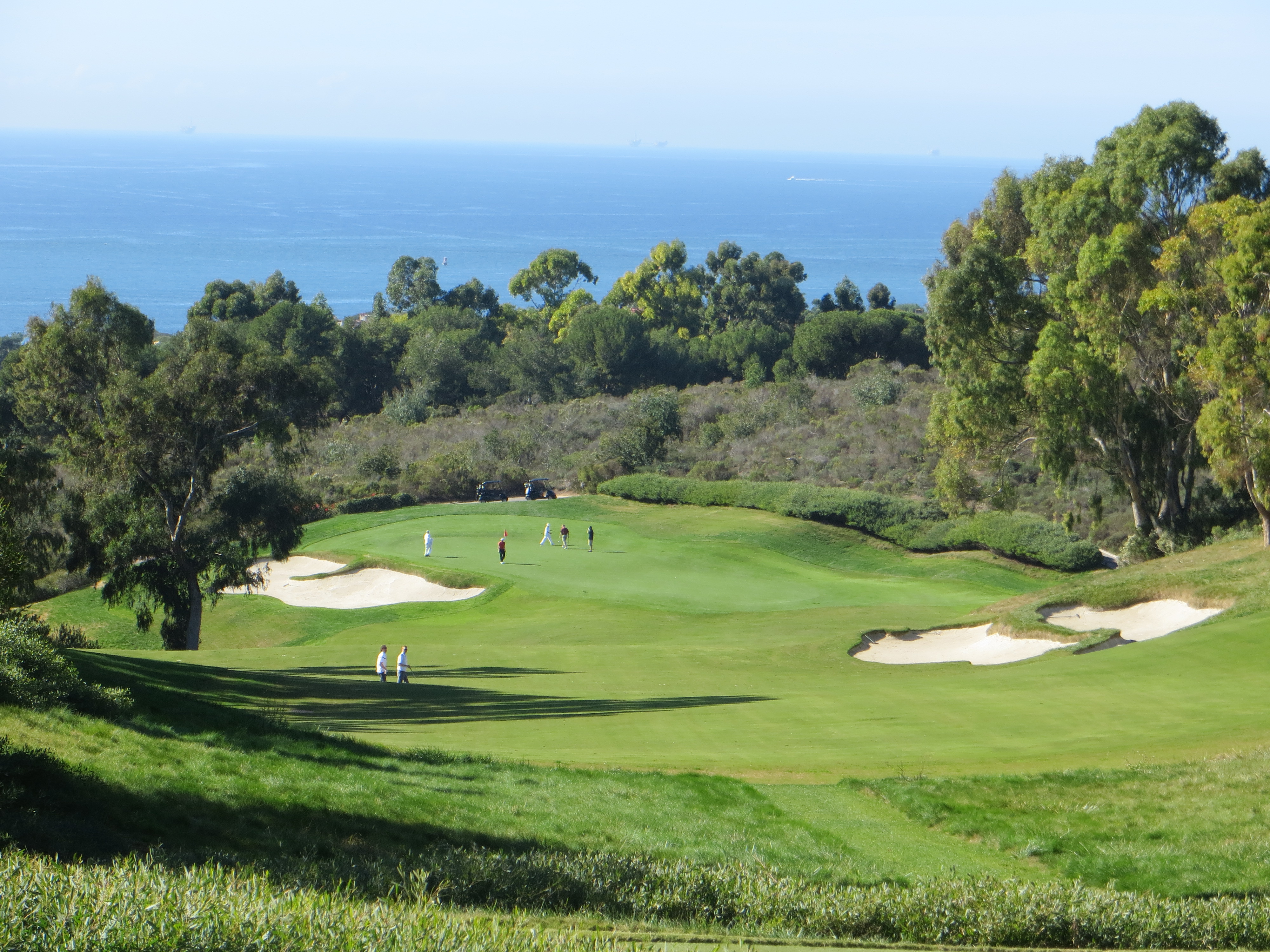
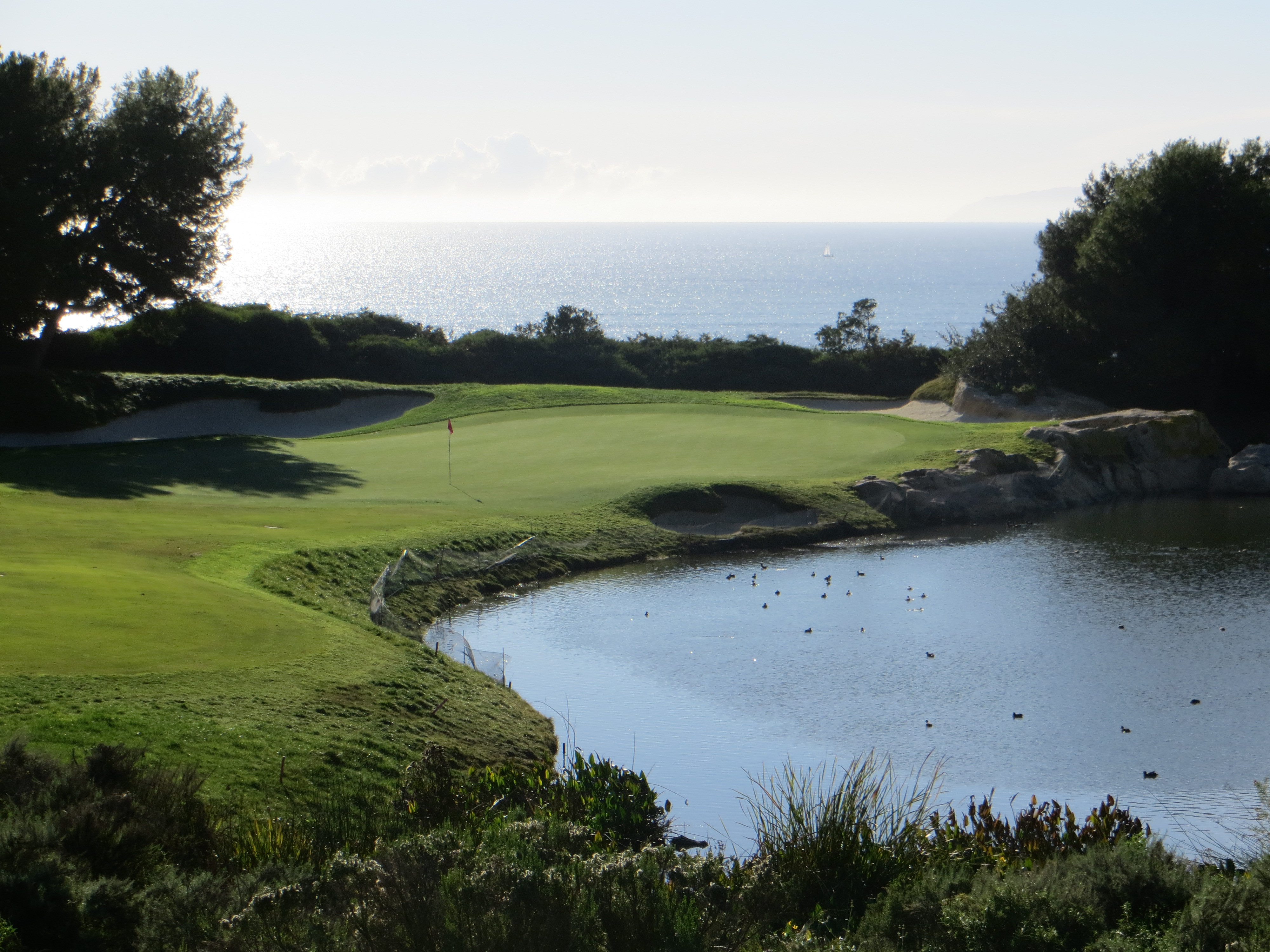
Try not to be distracted by the jaw dropping beauty of the opening hole.

Try not to be distracted by the jaw dropping beauty of the opening hole.

First impressions matter.  Once you drive down the path from the staging area you  cross the most expensive cart bridge on the planet and pull up next to the first tee box to watch the world unfold beneath your feet.  The grandeur of this impression should not be lost on you because it will be repeated throughout your four and half hour tour of this course.  From the high perch you have a sense of vertigo as you try to maintain your balance looking down a tree lined 400 yard log flume that spills to a green resting on a grass ledge above the ocean below.  The question crosses your mind as you prepare to alight your drive, is this ball ever going to stop rolling and will I be able to play from where it comes to rest.  Keeping your ball in front of you through the day is a must because the wayward shots have a way of becoming unplayable.

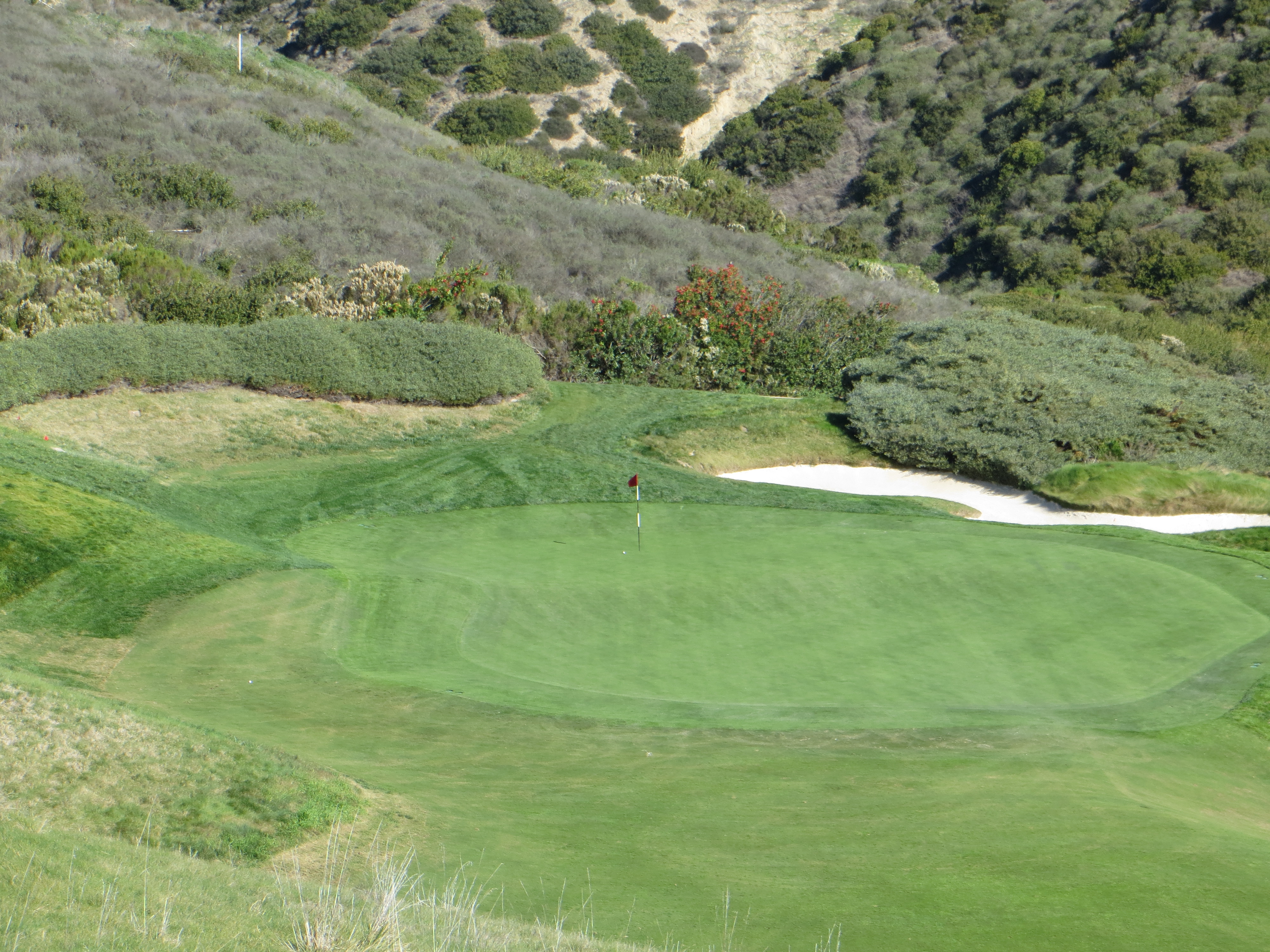
Par 3 4th-the first look down into the gorge at a majestic green setting.

Par 3 4th-the first look down into the gorge at a majestic green setting.

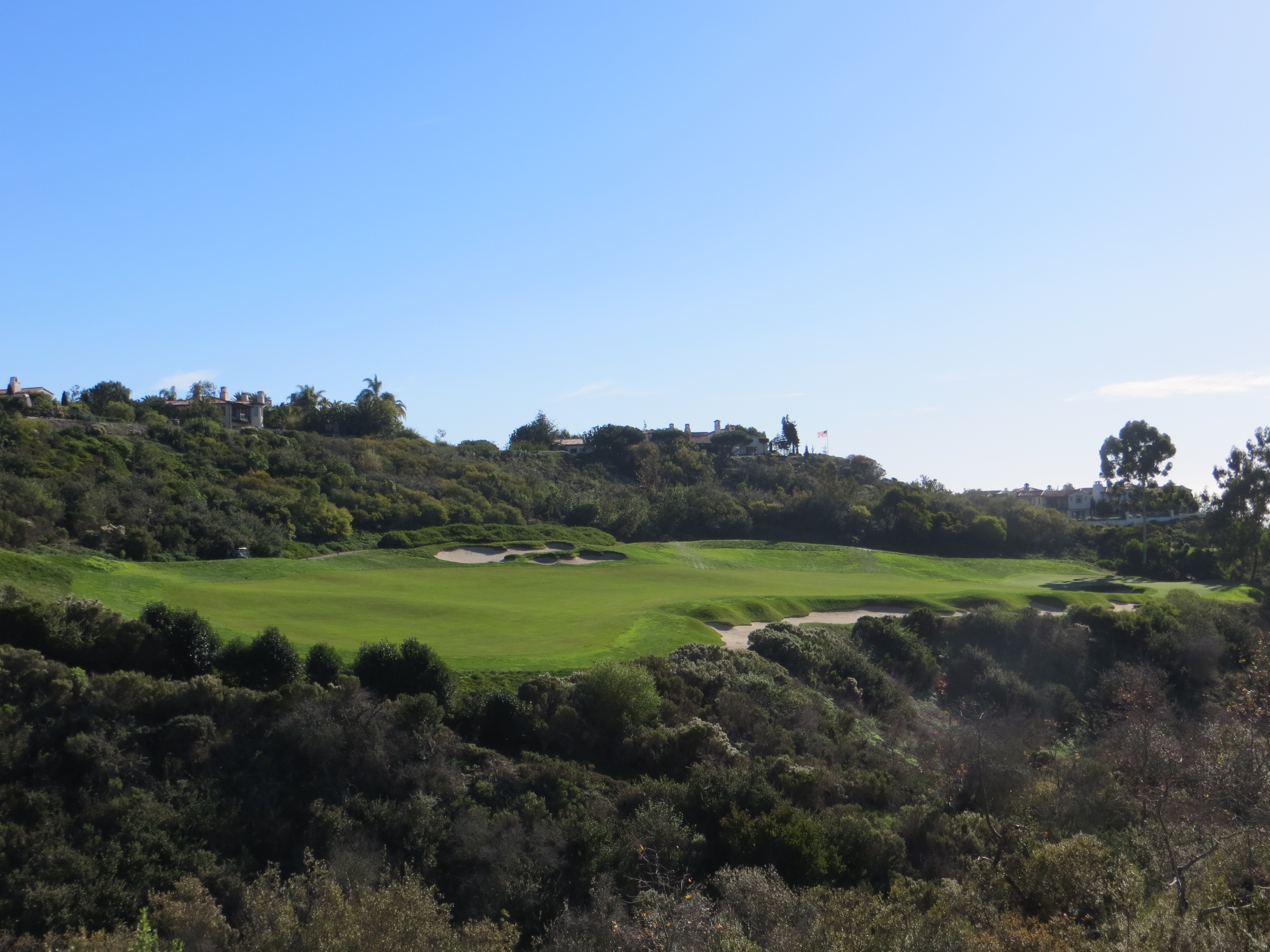
After the free fall on the first Tom marches you right back up the hill from which you came and you will get to the environmental gorge clusters that dominate the center of the property.  After a dramatic two story downhill approach to the par 3 fourth green, you are staring to your right across an environmental abyss that would feel right at home at Kapalua on Maui.  Your play on the fifth is across and adjacent too this intimidating haven for rocks, scrub, and critters that will make your knees chatter.  Having the focus to pick targets and make unfettered swings is a requisite in this version of target golf.  When your ball does start to wander just let the fear of the result go and bask in the wonderful beauty of the terrain that just ate your Titleist.

The full length of this hole on the 5th hangs precariously above the snake sanctuary.

The full length of this hole on the 5th hangs precariously above the snake sanctuary.

Skirting the gorges for a few holes you step out of your cart onto the secluded seventh tee.   This hole is ensconced by trees, water, sand, and some serious boulders creating a surreal sense of tranquility as you ponder the articulate task at hand.  The ensuing short ride to the eighth tee will take you by some troll caves on the left amongst the boulders and a look across Walden Pond to the landing area in the eighth fairway.  It is almost like you should have brought your sketch pad or a writing tablet instead of 14 clubs, there is something genuinely mesmerizing about the atmosphere created in this corner of the course.

Fazio used the artists full palette of features on the par 3 7th.

Fazio used the artists full palette of features on the par 3 7th.

Working your way out of the deep topographical divides over the next three holes allows you to catch your breath and prepare yourself for the pure sensory drama of the seaside holes ahead after the turn.  Make sure to charge your camera battery before the round because you could fill an entire flash card with stunning images over these three holes.

Sand is the major concern on the 11th-first of the seaside holes.

Sand is the major concern on the 11th-first of the seaside holes.

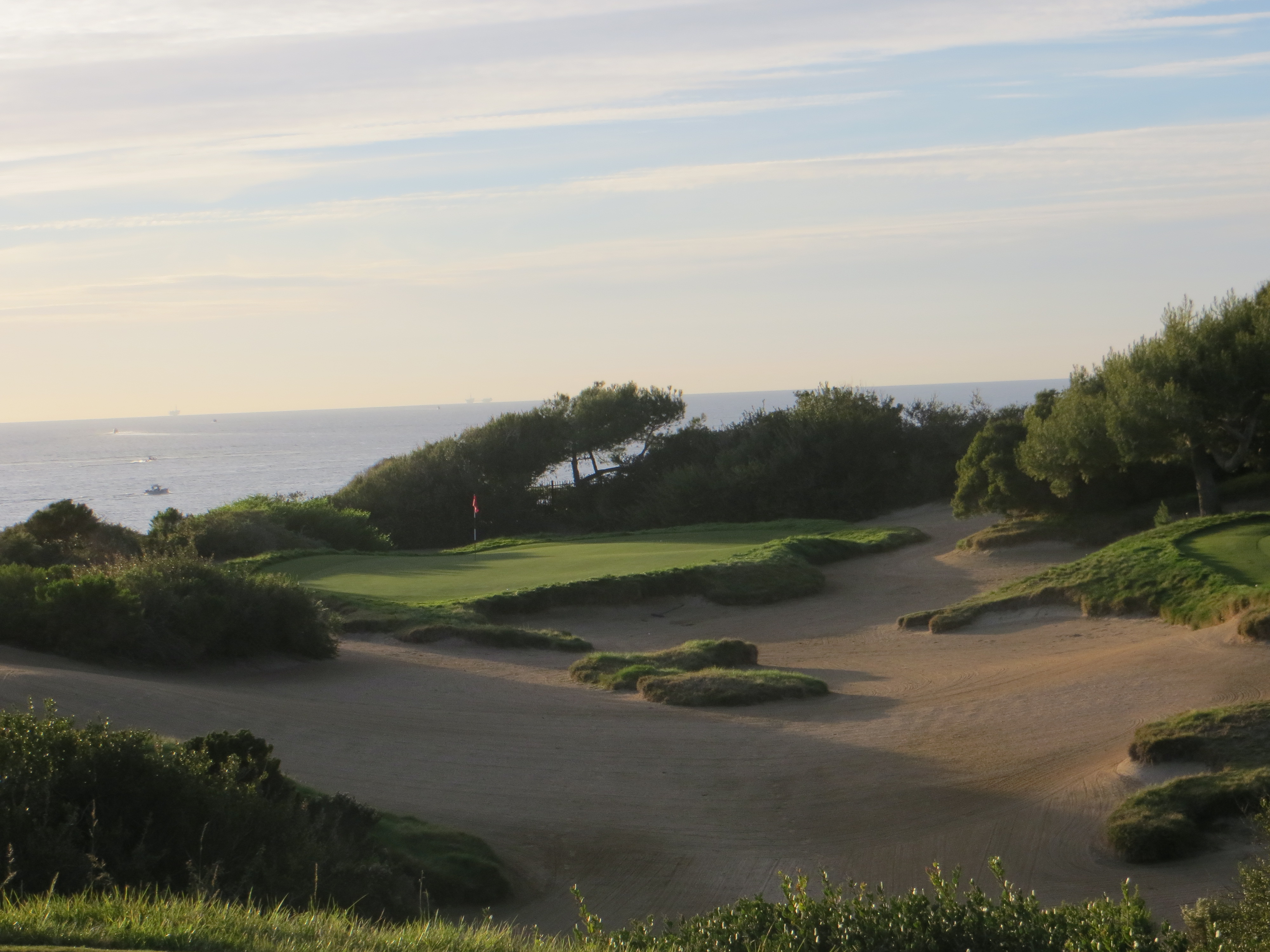
Baywatch begins on number 11 with a downhill march to the beach.  Unlike on number one this time it is literally to the beach as the sand and rock outcroppings that frame this green complex will bring to mind Lawrence of Arabia.  The approach shot into this green is one of the scariest shots you hit all day-anything missed to the right will be painful series of recovery attempts from Ramal’s abyss.

Elevation change is the least of your worries on the Par 3 12th.

Elevation change is the least of your worries on the Par 3 12th.

The next two holes are a unique tandem of consecutive seaside par threes.  This is not like at Cypress Point or Bandon Dunes, not near as punitive, but the holes pack visual drama that will be the postcard images you remember in bed tonight.  The first is a carry over a large piece of the Sahara to a long and narrow green hanging precariously above some nasty sand pits.  The ocean backdrop makes it difficult to frame the target so you have to trust your yardage and give the wind a bit of respect in picking your club.  Serious tilt from back to front in this one so being on the green is no guarantee of making a par.

The small back left green on #13 is an elusive target into a prevailing wind.

The small back left green on #13 is an elusive target into a prevailing wind.

As I mention in the detailed descriptive of the course below Tom was of two minds when he looked at the ground for this next hole so rather than decide which he liked better he created a short pitch three par with two green settings.  The one on the left is the more dramatic and wind affected-the tiny green surface makes that task all the more forbearing.  Take a moment to walk off the back of the left green to catch a glimpse of the jagged California coast line that is a Kodak moment for sure.

After the breathtaking seaside romp, the transition par five that comes next will give you a chance to regain your balance before your return to the gorges and a very demanding set of finishing holes.  Fifteen is quite unusual, a hole that would feel right at home in the rocky terrain of Eniscronne Golf Club in the north of Ireland. You drive wide left to a precipice landing area respectful of a furry wilderness that shadows the right side of the hole just beyond the corner of the dogleg.  Your approach has no margin for error as the narrow sliver of a green hangs off a Jai Alai wall on the left and the wilderness preserve on the right. Two well placed shots and two putts would be extremely gratifying as you head to the sixteenth tee.

Infinity edge looking Par 3 16th with only the Pacific Ocean as a backdrop

The last of the three pars is drop dead gorgeous especially if you playing it late in the day into the setting sun over the Pacific.  It calls for a full hybrid or fairway metal across the gorge to a green set on the edge of the horizon.  The mound above the green on the left has a tree that stands sentry overlooking the green.  This vista has the Monterey look of Carmel Bay to it.

Approach into the roller coaster Par 5 17th..from 150 out this is a totally blind shot

After a very rigorous three-shot par five on seventeen the finishing hole is a potpourri of everything you have seen today.  Needing a par here to win the back nine is a tall order.  This is a double hop scotch affair where you drive away from the line to the green to a grassy plateau across the ever present gorges.  The second is either a lay up to a landing area left and short of the putting surface or a bold carry over more oblivion to a long green set on a diagonal into a ledge above the grassy canyon.  Pitching up the length of the green from the lay up area is a doable up and down.  If you figure out how to save your par here that après Guiness will go down smoothly when you are done.

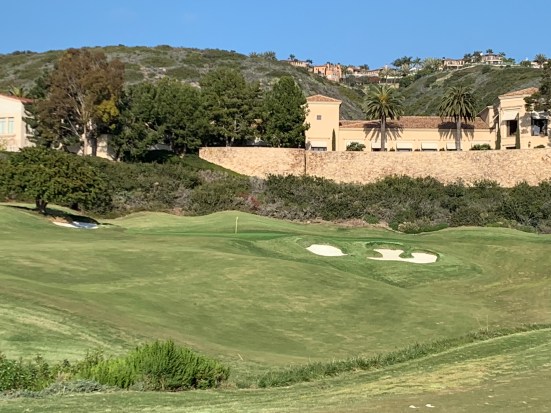
The last 175 yards of the finishing Par 4 to a green that sits majestically below the palacial hotel building

This course is a pure southern California experience-perfect weather, stunning vistas, and unique gorge laden terrain for making memorable golf holes.  Much like Pebble Beach this a place where the golf seems almost secondary, four hours of riding up and down these hillsides will leave you with a strong sense of why so many people want to settle in this part of the country.

Newport Beach, California

Architect: Tom Fazio (1991)

Tees        Par    Yardage         Rating      Slope
Black      70        6580             71.9        134
Blue        70        6323             70.5        131
White      70        5929             69.1        126
Yellow     70        4723             68.2        119

(Click to see the complete hole-by-hole review of the Pelican Hill-Ocean South Course)

(Click to see more photos from Postcard From Pelican Hill-Ocean South)

Bay Hill Charger Nine

Bay Hill LogoOne of the hidden gems at Bay Hill is the nine hole Charger Course.  Call it an intramural, warm-up, settle-the-bets, or happy-hour nine, but this is a well thought out strand of holes that replicates the challenges of the championship course and stands on it’s own as well as a quality test of your golfing skills.  Find a way to slip this one into the itinerary, your trip to Bay Hill is incomplete without the Charger experience.

.
Starts out simple enough with a shortish four par looking for about 220 off the tee straight down the pike.  As you stare at the green you think you are seeing double, which you in fact are since one and eight share a double green in Arnold’s apparent nod to this common sight at St. Andrews.  The green complex is typical of what you see throughout, tiny green raised up from the fairway tightly wedged in between collaring deep bunkers.  Aside from the size of the surface this is in full character with the big course.

.
The second is a cold splash of water to the face, a forced carry short par three to a sliver of a green draped across a shoulder of water and sand.  Pins on the left are pure suckers, aiming spot is center over the bunker to the crown point of the green. The technical theme continues with a hopscotch target par four where reason must prevail over temptation or you stand to send your match into arrears.  Something 200 to 220 at the aiming bunker though the fairway will bring your ball to rest left center and take the first water experience on the hole out of play.  The second is a short pitch into a clever green arrangement collared by sand left and the second water experience on the right.  Like the previous hole all pins call for a deep play to the center and putt back from there.  If you walk to the fourth tee one over or better you are in command of your game today.

.
The next par five is the least interesting offering of the nine.  This plays as a straight three-shotter into another tight green complex squeezed by sand.  The green is deep so it should contain an aggressive long club that successfully negotiates the narrow opening in the front of the green.

.
The par five that follows is  pure thrill ride and may be the pivotal decision making hole of your match.  A strong draw will follow the shape of the hole and leave you adjacent to the fairway bunkers that define the left corner of this dogleg.  From well above the target you are looking down at a stunning green complex.   A long kidney shaped green lies between  a hillside left and boulder trimmed water on the right.  This hole shares the distinctive wharf style look of the sixth from the championship course just to it’s left.  If you choose to take a poke at it on your second aim at the left edge of the green because the contour in front will feed the ball the right.  Taking on the flag directly will leave you a Flintstone lie in the rocks.  Even a lay up needs to favor the left edge of the fairway for a clean look up the angle of the green.  A good score here is great fodder for post round conversations in the bar.

.
The sixth is one of those innocuous looking par fours that will have you scratching you head walking off the green wondering what went awry if you don’t maintain focus.  Approach angle is important so hoist a hard one to right center and you leave a short club to a sand nestled green slightly above you.  This green is fairly long by Charger standards but there is a rise in he center that demands a full carry to the back pin positions. Two controlled shots and this is a routine par, anything wandering brings lots of possibilities to you scorecard.

.
If they had a postcard hole for this nine this next dramatic par three would be it.  Depending on the tee you play it can be a short pitch to stiff long club from a high tee to an appetizing green arrangement below.  Full forced carry over more boulders and water to a green stuffed into the foot of the slope behind. You have to play the back third of this green to hedge the carry and any putt back down to the pin will be a ripper.  If the wind is blowing at all the club selection is a Donald Trump crap shoot with a significant elevation change just complicating the formula.  Once you send you ball on it’s way just sit back, relax, and enjoy the IMAX view of what will result. This is as fine of a three par as there is on the property.

.
The run to the house is a pair of wonderful par fours that continue to emphasize line and distance control.  Tee ball on eight is semi-blind into a landing area above.  Right center off the tee gives the best attack angle into this green.  Double vision again prevails as you may remember that the eighth is a continuation of the first green bisected by a separating bunker.  The approach sets up for a soft draw working at the pin on the left.

.
The final hole shadows and replicates to some degree the ninth on the championship course.  As you will find on it’s big brother, you have to turn it over off this tee to follow the line of the hole.  The second is a long shot into a very deep green narrowed by shading bunkers on either side.  The green falls off gently back and right so you can use the ground to assist a low trundling shot to get to a back right pin.

.
When you finally settle in for the beer and Bay Chips at the bar with your buds or the wife, you will take great pleasure in replaying in your mind this bonus nine and the shots it required.

Orlando, Florida

Architect: Arnold Palmer
Tee              Par    Yardage    Rating     Slope
Blue             36       3085        35.2        125
Yellow          36       2867        34.1        115
White (L)      36       2278        33.8        118

(Click for a printable version of this course review)

(Click to see the moegolf Bay Hill Championship Course review)

(Click to see the moegolf Bay Hill Short Game Area review)

(Click to see Bay Hill photos from the Postcard From Bay Hill)

The Ocean Course-Kiawah Island

Simply put this is Dante’s Inferno above ground.  Pete Dye has tried and succeeded in producing the most diabolical compilation of golf holes he could conceive with the sole purpose being to humiliate the pros and mere mortals alike.  It is safe to say that this course is truly unfair, almost unplayable, and just not alot of fun.  It would be better to buy the 1991 Ryder Cup tape on video and enjoy the train wrecks from the comfort of your own home.

Not so much a real test of golf-it is more like an inquisition-meant to break your spirit and mind and  bring you to your knees.  It amply achieves all of this by the fifth tee.  You will notice by the time you are done that all the people in front of you and behind you are trudging slowly like lemmings through the waste areas, head down, shoulders slumped, resigned to their sentence in this demonic golf hell.  This is not an experience for the faint of heart.

The course is routed in an S-hook shape which means the first four and last five holes are in the same wind direction and the middle nine are in the opposite direction.  The problem here is that if the middle nine are all upwind you will need a medvac helicopter by the fourteenth tee.  Since the entire track is totally exposed to the ocean you will get ferocious winds on days that are calm back at the condo.  Determining required distance and club selection are a major problem all day long.  You can get real tired of hitting your 3-wood 175 into the prevailing breeze.

Pete and Alice pulled out all the stops on this one.  You have your massive waste areas like TPC Sawgrass, your signature Dye railroad ties hardening the edges of the hazards, and Alice even raised the fairways on the inland leg of holes adjacent to the ocean to make sure you get the full brunt of the wind effect all day.  Much like his other “made to humiliate the pros” tracks at Sawgrass and PGA West, this one is pure punitive target golf.  Every tee shot or shot at a green is a forced carry or to a confined arrangement that has a penalty shot or an impossible recovery tied to your lack of success.  Some of the adjacent waste areas run the entire length of the hole-and most are from five to eight feet below the playing area-making your extrication from same seriously problematic.  Nothing is “kept” here-it is all raw and natural-that presents a beautiful esthetic background to enjoy if you were not in such physical and emotional agony.

Stunning beauty of the long awaited finish at 18 (pga.com)

I have great respect for Pete Dye as an innovative designer who successfully broke the mold of his predecessors Robert Trent Jones and Dick Wilson of designing long, boring heroic courses.  But Pete might have slipped over the edge on this one.  There are interesting tactical elements with risk/reward decisions attached but the ever presence of stiff Atlantic breezes make it far too punitive to enjoy.  As a result, it seems to me that he ended up with a course that is nothing but a scenic and perverse marketing ploy meant to attract the “grip it and rip it” crowd in the golf demographic.

Kiawah Island, South Carolina

Architect: Pete Dye (1991)

Tee                 Par     Rating     Slope    Yardage
Tournament    72       77.2        144       7356
Ocean            72       73.6        138       6779
Dye                72       72           134       6475

(Click here to review Ocean Course hole-by-hole descriptions)

Bedford Springs-Old Course

Established in the late 1800’s this place is a small scale version the old line rich man’s retreat, on the order of a Homestead or Greenbrier, full service food, accommodations, golf, spa, family recreation, and all. It has a much more casual presentation than those others but that may be a function of the new day more than anything else.  A very comfortable atmosphere-well managed-it makes for a perfect two-day getaway from the hub-bub of urban life.

Par 3 “Tiny Tim” even has the chocolate drop mounds (omnihotels.com)

The golf course is quirky but very interesting.  It is the result of the efforts of three architects over a thirty year period-and it has been recently updated in 2007 without changing the effective old style character of the links.  Spencer Oldham did the original 18 holes in 1895 featuring chocolate drop mounds, geometric S-curve bunkers, and donut bunkers.  In 1912 A.W. Tillinghast got his hands on it and scaled it back to a nine-hole course with his own architectural features.  In 1923 Donald Ross took it back to a full 18-hole track and you can see raised greens with lots of tiering, artistic bunkering constellations, and, most distinctively, a creative and strategic use of the Shober’s Run that meanders throughout the entire golf course.  The renovation work in 2007 was done by Forse Design Company of Pennsylvania who are known for doing period restoration and  renovation work throughout the US and Canada-they have recently had their hands in renovation work to the Broadmoor-East Course in Colorado and the Newport Country Club in Rhode Island-sites of  recent U.S. Senior Opens and U.S. Women’s Opens respectively.   They did a wonderful job retaining the characteristics of all three of these fine architects while making it a very playable and a challenging golf experience.

The entire course is in the flood plain of the Shober Spring Stream and sits nestled between the foothills on either side.  There is a good bit of meandering back and forth so the holes do not route in a typical outward and inward loop.  For a course set in the foothills there are not that many severe elevation changes on holes and you get surprisingly few side hill or billy goat stances during the round.   As with most old style courses the track does not sprawl-the next tee is a few steps from the last green and the round has a tidy-compact feel to it.  Green surfaces are totally updated-very quick-lots of pitch and undulation and oddly shaped which makes for really small targets from the fairway.  You will do some pitching and chipping to save pars.

The green speed is the course’s major defense considering the tiering and undulations you will face.  But at the same time these characteristics provide you with a good correction mechanism for your approach shots if you pay attention to green topography and use it accordingly.  Big hitters will be frustrated by the many times they cannot just haul off and hit as much as they can-position off the tee is extremely important to getting the best angle of attack into the greens.

The last characteristic worth noting is the balance of the types of holes and the sequencing.  Five Par 5’s, Five Par 3’s, and 8 Par 4’s (only one over 400 yards) means you are hitting lots of finesse shots through the day and the mix is pretty random.  There is a sequence from 2 to 6  where you play par 3, par 5, par 3, par 5, short par 4-other than the driver on the second par 3 you have no long shots for five holes.  From 9 through 14 you have a similar 5-3-4-4-5-3 run but in the midst of this one you have two of the longest holes you play all day.  My point is you have to be very mentally agile to play this course effectively-there is no natural rhythm to the course other than the constant sound of the babbling of the ever present Shober’s Run.

Bedford Springs, Pennsylvania

Architects: Spencer Oldham (1895), A.W. Tillinghast (1912), Donald Ross (1923), Forse Design (2007)

Tees                 Par            Rating            Slope            Yardage

Medal                72               73.4               140                6785

Ross                72               71.9               136                6446

Tillie                  72               69.3               130                6023

Oldham            72               69.8               122                5106

(Click here to review Bedford Springs hole-by-hole descriptions)

Musket Ridge Golf Club

Set in the terrain of the foothills of the Shenandoah Mountains this is a hilly course with dramatic up and down holes and stunning vistas all around. The golf course is in the same neighborhood as Arthur Hill’s Maryland National to which it tends to regularly be compared.  In my estimation Musket Ridge is hands down more fun and interesting.   What differentiates it from Maryland National is that it is a consistent strong design without any trickery.  Balance of long and short holes is right, par threes have good variety, and the teeth of the course are the in finish on both sides.

Playing Musket Ridge, the first thing one comes away with is the beauty of the settings that surround the course.  There are so many holes where you stand on the tee looking at the hole ahead and your eye just gets drawn to something five miles in the distance.  At times it can be distracting because the mind starts wandering and the scale of the task at hand gets dwarfed by the panoramic view that is consuming your attention.

From the first tee the scenic beauty of this region is revealed

The second characteristic worth noting is the quality of the greens.  Pretty generous in size the greens are big without being sprawling.  Unlike so many new courses these days these are not tricked up with buried pachyderms or absurd segmentation.  Occasionally multiple tiers appear but it is selective and makes sense when it is used.  The bunkering around the greens is strategically positioned and can be punitive so you must respect their proximity when picking your approach lines.  To my experience, the quality and maintenance of the putting surfaces has been top notch.  They can be speedy when cut low but most of the time they run at a comfortable speed for recreational play.

Lastly it is noticeable the way the holes are routed across the hills.  Most holes traverse the fall line of the hills so there is a stacked effect to the arrangement of the holes.  The designer uses ridges along the side to define and contain each hole and give you relatively level ground to play from.  But the influence of the prevailing slope of the property will influence the movement of your ball on the ground.  Wandering  beyond those ridges puts your ball in the jeopardy.  To accentuate the look they have let the grass on these side hills grow to three feet plus so you have to keep your ball within the parameters of the playing area or you will pay a price.

A little floral embellishment on #17 and this could be a postcard

The variety of the holes is astounding.  No two holes look remotely alike.  There is a great mix of long and short four pars-ones you think you can drive the green and a number where a solid drive still leaves you the full measure of a fairway metal to reach the green.   The front and back both start with scenic holes that tumble below your feet and set a tone for the drama of the day.  Strength of both sides is in the last four holes where if you lose your focus you will lose control of your scorecard.  The challenge from the Blue Tees is more than enough for the mere mortal-play at this distance and you will get your money’s worth.

Even though you rarely hear Joe Lee’s name mentioned among top designers, he has been around a long time and done wonderful work.  He spent most of his career being the junior co-designer with Dick Wilson building courses like Cog Hill #4, Laurel Valley, La Costa, and the Blue Monster at Doral.  But in the last 20 years until his passing in 2003, he has done lots of work on his own that stands to its own distinction.

A book was written by Ron Whitten on Joe Lee’s work in which Lee is quoted as saying of his design philosophy,   “I start with the premise that golf should be enjoyable, not a chore. Golfers want a challenge, but they want a fair one. An architect cannot put a foot on the golfer’s neck and keep it there all day.”   His philosophy of design is evident in this layout-it is a challenge, but an enjoyable challenge.  One cannot help but walk away shaking their head about what could have been, soon to be followed by the nagging sirens calling them back for another go at it.

The look up 18 captures the balanced majesty of this place

Take the time when you are done to enjoy the food service in the grill room.  It is an intimate room with a great view of the finishing holes on both sides.  Food is quite good and makes for a nice accent to a wonderful golfing day.

Myersville, Maryland

Architect: Joe Lee (2002)

Tees                 Par        Rating               Slope       Yardage

Gray                 72            73                    140            6902

Blue                 72            71.1                 130            6416

White               72            68.9                 123            5884

(Click here to review Musket Ridge hole-by-hole descriptions)

Hidden Creek Golf Club

Bill Coore was asked by a wealthy New Jersey real estate developer, Roger Hansen, to create distinctive golf course on 750 acres of sandy rolling pine barren woodlands he acquired outside of Atlantic City.  He had in mind a golf club in the Pine Valley tradition-a private haven where wealthy people with presence in this area could entertain their friends and colleagues with the highest standard of golf, food, and accommodations in a casual environment without pretense.

The understated look of the back of the clubhouse coming down #9

Click on any photo for an enhanced view of the image

Coore spent a considerable amount of time walking the ground before a contract was prepared and determined it offered an opportunity to create rustic walking course with a character unique to this region.  There was enough elevation change in the property to make holes with distinct topological interest and plenty of natural vegetation to provide the look and feel of an old English heathland course.

The natural look brings to mind the heathland courses outside of London

What he came up with was an old style walking course, short walks from greens to tees, that clings to the upland part of the property.  With a minimal amount of dirt being moved, it would have the raw and natural looking hazards of mounding, deep bunkers, and long fescue grasses you might see at a course like Sunningdale outside of London.  There would be no paved cart paths, no houses interrupting the landscape, just natural delight as far as the eye can see.  Coore said of the project,  “The Hidden Creek site required very little alteration to the landscape.  The holes lay on the ground pretty much the way we found it.”

Coore and Crenshaw embrace the old style principles of great designers of the golden age providing plenty of  room to play the course and generous access to the greens.  There may be ferocious bunkering on one side of a fairway or green but you will rarely see both sides cordoned by trouble.  This makes the play much more enjoyable for the recreational player who does not want to take on the macho challenge.  Like many of the great courses of that period, playing this course well is about thoughtful tactical intention with adept execution of the shots required.

Large setbacks provide a beautiful backdrop for a stunning view like the Par 3 #4

They created big set backs for the holes from the existing trees-this makes for an enhanced canvas on which to present the holes.  Lush bent fairways throughout set against gold fescue grasses make for a beautiful presentation.  The most distinctive characteristic is the seemingly random mounding and bunkering that provide most of the hazards.  There is no water in play on the course-they did not route any of the holes through the wetlands that take up almost half of the property.  The randomness of the placement of the hazards defies the symmetrical look of so many modern designers and it makes the playing lines infinitely more interesting to discern as you plan your shots.

There are over 100 bunkers on the course and they often have eyebrows of natural long fescue reminiscent of Royal County Down-this makes them very intimidating looking from afar as well as difficult from which to extricate yourself if you are too close to the front of the bunkers.  Pay particular attention to the relative position of the hazards to the landing areas and greens.  With some optical trickery they can seem more imposing than they really are-there is often more wiggle room in the formula than meets the eye.

You can see on #5 the minimalist presentation with a tactical emphasis

I found the mystery of the greens particularly intriguing.  These are big, sprawling oceans of green with pitch and undulations that will confound you both on your approach shots and your putting.  Local advice is essential until your personal knowledge of the greens is up to speed. These guys have real genius giving you plenty of room to approach but giving you little room to approach successfully.  You can hit what seems like a wonderful shot that seems to randomly separate from the hole against all your intentions.  The greens roll very nicely and have lots of speed, especially down hill.  This is not really a set of greens that call for a nickel defense but you have to be careful when the speed conditions of a particular putt are at the optimum.

This 110 yard short pitch and putt on #11 is anything but a push over

What is an architectural accomplishment of no small order, given that the property itself does not have inherent dramatic topography, is no two holes on the course look remotely similar.  You cannot anticipate what is coming next because there is no pattern to the sequence or the hole designs.  The sequencing of the holes is brilliant, you might have a monstrously long par four followed by a short pitch par three or a reachable par five.  This keeps the player off balance because the challenges vary dramatically from hole to hole.

The entire facility is top notch.  The locker room, eating facility, and practice facilities are as good as any high end club you will visit.  Like you would see at Pine Valley or Caves Valley they built very nice lodge to accommodate out of town guests in for a multi-day visit to the club.  You are going to need an invite to get here but if you can find one you will not be disappointed in what they have created.

Egg Harbour Township, NJ

Architects:  Bill Coore/Ben Crenshaw (2002)

Tee                         Par    Yardage    Rating      Slope
Championship        71      7023         73.5         136
Member                 71      6562         71.6         131
Forward                 72      5486         72.3         127

(Click here to review Hidden Creek hole-by-hole descriptions)

Spring Creek Golf Course

Spring Creek Golf Course was created to support a high end housing community about seventeen miles east of Charlottesville.  When it came on line the economic infarction of the time seems to have upset real estate sales, yet this course has design quality and integrity that should make it a success as a fee course until that trend turns around.  Ed Carton has considerable deputy experience with Tom Fazio and it shows in the presentation of this course.  Like his mentor this course is visually pleasing and seems to fit into the regional topography very comfortably.    The course has won some instant national recognition by the national golf magazines and has been favorably compared in reviews to the other jewel of Virginia, Lester George’s  very private Kinloch Golf Club outside of Richmond.  The difference is this place is totally accessible to the fee paying public.

For a residential community course this has a modern design characteristic rarely seen in these type of developments-generous hole setbacks from the residential lots.  The owner, Charles Kincannon, showed great discipline in allowing the design team to employ such setbacks which make the holes seem very comfortable in their surroundings without visual encroachment.  Given the dramatic topography on which this course is built that has resulted in holes of stunning visual stature as well as tactical uniqueness.

Creative use of the topography create visuals like the par 4 #14

The most obvious characteristic is the generous use of sand throughout the course.  This is an expensive design decision but, as you see on Fazio style courses, free form expansive bunkering is a visual accent that can be psychologically intimidating and provide tactical parameters that challenge the golfers as well.  My wife said on about the eighth hole, there must have been no sand left in Virginia Beach once this course opened for play.  Most interesting is that she played the entire 18 holes and was not in a single bunker-now that is good design.

The Alien Gingerbread Man bunker hunkers over # 3 green

Another unique characteristic for this region is the choice of bent grass for the fairways and tees.  Zoysia and Bermuda grasses are usually the choice when you get this far South but the bent works well and it displays beautifully when it is well maintained and manicured as it is out here.  There is also the clever use of indigenous rock accenting some of the low creeks, crossing bridges, and the high areas behind some greens.  Given the severity of the topography this stone softens many of  the visual transitions that were required.

Sprawling greens with undulations and fall offs that will challenge

The greens themselves may be the most unique part of this design.  They are vast, sprawling green surfaces with lots of facet and undulations.  The speed on these greens, especially down the slopes, can be disarming.  You need to play this course a number of times to understand the tactical requirement of your approach positions into these greens.  On many holes the greens have fall offs in more than one direction or insidious little donut depressions that feed to side pitching areas.  Knowing how to negotiate these and leave yourself an uphill putt you can play aggressively is the secret to scoring well.  The pro told me before I played  that the yardage on the card belies the difficulty that the rating and slope indicates.  The need to be able to approach these greens with a club you can control is critical so pick your tee length conservatively if you want to enjoy your day.

The front side starts with a wonderful challenging par four that will set the tone that ball control and accuracy are at a premium.  The next two holes, a very technical par five and a seemingly innocuous par four that is in fact the first handicap hole will serve to reiterate that notion.  From four to nine, with the exception of a bear of a challenge on six, the yardage will not overwhelm you but don’t be lulled into a sense of security, good planning and articulate shot execution will be rewarded.

Some pixie dust might help resolve the mysteries of #16

Once you turn to the inward nine the adrenaline rush will begin on the tenth tee.  This is an old classic style 90 degree dogleg right which means it is all about position off the tee followed by an aggressive uphill carry shot into a well guarded green.  The next three holes are very interesting technical holes that present your best scoring opportunity run of the day.  On the fourteenth tee you will witness the anti-gravitational moment  of being atop of the highest point of your favorite thrill ride.  Other than a reprieve on the short par three seventeenth from this point it is just one G-force experience after another that will exhaust your strength and test your resolve all the way to the house.  The eighteenth hole, a wild and wooly par five that is a hooker’s nightmare, is one of the most difficult holes you can face if you need a par to close out a match.  Just a terrific exclamation point for a course that has no shortage of thrills and spills.

The wharf green setting on #18 is a formidable challenge

If I have any criticism it is the array of par threes.  All four of them play within one club of each other so the yardage demand on the short holes does not vary much at all.  The four par threes are of distinct characters but they are probably the least interesting offerings of the day for me.

What sets this course apart for me is that, for an architect without a vast resume of his own courses to fall back on, Barton has succeeded in putting together 18 wonderful holes that work well together.  You would think in such an early effort there would be at least two or three holes that either did not fit in or just did not work.  Cannot say that about this place, every hole seems to fit the motif and there is not a single hole out there that will fail to stimulate your aesthetic and athletic sensibilities.  This place may seem out of the way but it is well worth the effort to seek it out and play it more than once.

Gordonsville, Virginia

Architect: Ed Carton (2006)

Tees                 Par            Yardage      Rating     Slope

Marble              72               6673           73.2        145

Onyx                72               6197           70.9        138

(Click here to review Spring Creek hole-by-hole descriptions)