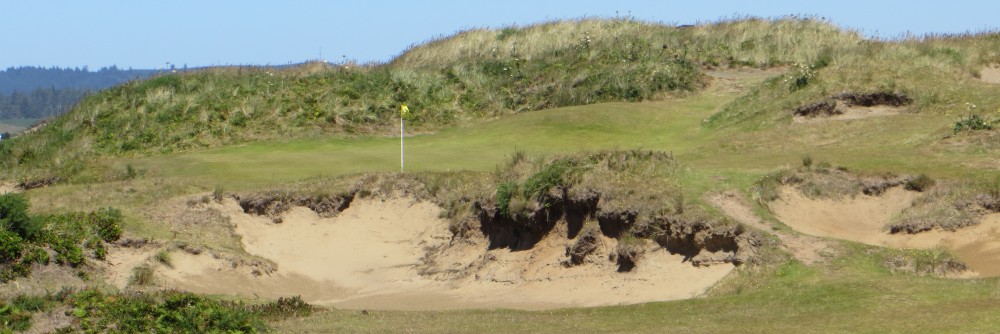
Laurel Valley Golf Club

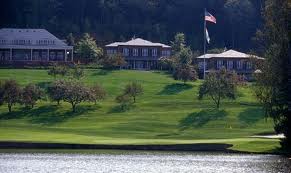
A golf course with a long and rich tradition that belies it’s mere 50 years of existence.  Most of us remember this as the place Dave Marr won the PGA and associate it with Arnold Palmer as his adopted summer home course when back in Pennsylvania.  The members will tell you that it is Palmer’s aura that is most responsible for the reputation of this place-after it was built in 1959 under the watchful eye of Dick Wilson it was Arnold who went to the PGA and told them this would be an appropriate place to host their championship.  It has built on that reputation hosting the National Four Ball championship in the 1970, the National Team Championship in 1971 and 1972, the Ryder Cup in 1975,  significant events from the Pennsylvania-Ohio-West Virginia region, the U.S. Senior Open in 1989, and the Senior PGA in 2005.

When you walk the hallways of this demure clubhouse, the pictures and memorabilia make you fully aware how seriously the members take the rich history and tradition of this place.  There are paintings and photos everywhere full of bouquets of pink sport jackets-an unusual touch for a macho corporate hangout.  Don’t miss the photo library on the walls around the informal bar-there is a classic shot of an intense Arnie and Jack as playing partners in the National Four Ball back around 1970. The locker room is very classy-old wood lockers bearing name plates of PGA and Champion’s Tour players.  This place just has a very traditional good old boy feel to it.

(Click here to see a few of the gems from the Laurel Valley photo gallery).

View across the first tee (pga.com)

The club was originally built as a business man’s club for corporate parties and events during a face-lifting renaissance in Pittsburgh in the late 1950’s.  The club is only open from May through October-it completely shuts the doors for the late fall and winter-a business model that seems hard to sustain without considerable annual member backing.  It is a golf facility only-food service to support the golf and events and some cottages to house out of town guests.  The lay of the buildings to the rest of the property was very well thought out-there are sitting areas providing views of the property and surroundings that are truly spectacular.

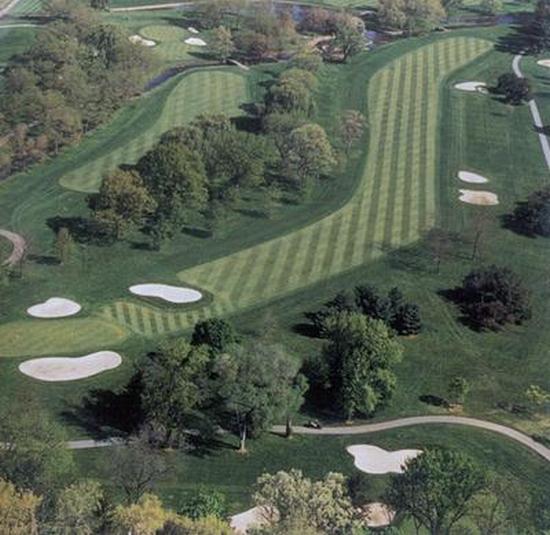
The course is built on a 260 acre tract of land in the foothills of the Laurel Ridge and Chestnut Ridge mountains. It does not have much topographical feature in it’s tactical play, though the visual back drops can be dramatic.  The design has a Florida feel to it with abundant sand and water, Dick Wilson wended the course through the low grounds deploying massive fairway bunkering and adjacent water hazards to keep the player’s attention.  Fifty years of tree growth have cloistered the holes considerably, but recent renovation has brought back the more open playability as it was originally intended.

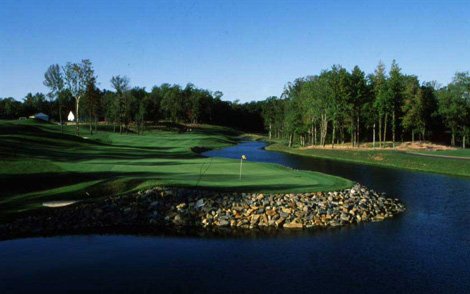
Tough tee shot on #10 (golfcoursegurus.com)

One thing that can certainly be said about this is that the course can play very long from the two back tee markers.  At the 6600 yardage of the white tees it is an ample test for most mortals-the additional yardage can make for some excruciatingly long par fours.  Like most courses of this style driving accuracy is key to decent scoring opportunities.  Playing from the fairway bunkers or tough angles in the rough is a sure prescription for bogies and worse.  For the most part the water is manageable but there will be times during the day when your judgment for carry will be called into play and more often than not bravery is not the sensible route.

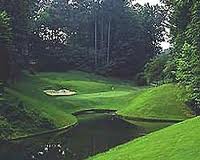
Full majesty coming down #18 (pga.com)

There are many interesting individual holes on the course-the par threes in particular have lots of nuance and subtlety to them.  Not too many “wow” holes but some of the scenic backdrops will catch your attention.  What really elevates this to championship caliber are the greens-they are very swift with ample undulation that seems to shrink the accessible opening on most of the cups.  Very few putts go directly up the walkway and into the front door-you will be using diversionary tactics all day to find the bottom of these cups.  The caddies are excellent here and you need one if only to tell you where you can leave the approaches into these greens.  The pitching and chipping are particularly difficult because some of the swiftest approaches are not obvious to an inexperienced eye.

Ligonier, Pennsylvania

Architect: Dick Wilson (1959)

Tees             Par       Rating    Slope    Yardage
Blue             72          75.7       148        7327
Black           72          74.1       138        6982
White           72          72.8       135        6606
Green          72          70.1       130        5899
Red             72          73.5       127        5548

(Click to see complete Laurel Valley hole-by-hole descriptions)

Saucon Valley-Old Course

Saucon Valley was created as a playground for the wealthy steel guys in the Lehigh Valley section of northeast Pennsylvania.  The Old Course is an elegant simple layout designed by British Architect Herbert Strong known for designing courses with little disruption to the land.   As a result the course meanders across rolling hills framed by vintage old trees and it looks like it just belongs in the natural surroundings.  This course has held six USGA national championships  a U.S. Amateur, Senior Amateur, two Senior Opens, and two Women’s Opens as well as innumerable regional and local events of importance.

Sahara #6 Par Five

This facility has 54 holes of championship golf, as well as short course for developing players and seniors.  A primo golf facility with a long and storied tradition you cannot help but be overwhelmed by the golf pedigree of this place.  Walking the locker room or the halls of the clubhouse there are lists and lists of the rosters of championships contested here and plenty of other memorabilia that makes this feel like an ad hoc golf museum.  They even have a luxurious 13 room guest house which accommodates guests at the club in a comfortable informal way.

This course is not a beast but it is a stiff challenge that will test all of your skills. To me the bunkering is the most obvious distinguishing characteristic.  It is free form-no real patterns to the bunker placements but they are placed in places in the driving areas and the green constellations that make successful play a matter of good strategy and precise execution.  The bunkers are very deep-even in the fairways-so there are times you must relent and play a shot that will not get you to the green or at the flagstick.

Turtle #11 Par 3

The greens are very unusual-wide variety of shapes and sizes with plenty of segmentation and slope to keep you honest in your approach shots and approach putts.  If they speed them up to 12 on the stimp you are in for a handful.

I just loved the flow of the course.  Both nines start out with expansive visual holes that are extremely inviting and are then followed by short technical holes that will demand focus and execution.  The stretch from nine to fourteen looks very forgiving on the card but you will be challenged big time through this stretch not to make any unforced errors.  Fifteen through seventeen are all long and strong  so there is no relief to the end.  The finishing hole will grow on you-especially if you make a par-it is short but very demanding-any wayward play on this hole will do damage to your scorecard.

(All photos from sauconvalleycc.org website)

Bethlehem, Pennsylvania

Architect: Herbert Strong (1922)

Tees               Par          Rating         Slope        Yardage

Blue                 71            73.1            138            6800

White               71            70.7            135            6337

(Click to see complete Saucon Valley Old Course hole-by-hole descriptions)

Saucon Valley-Grace Course

Zig-Zag Opening Hole Par 5

This was the second course built at Saucon, just after World War II, when it was decided that eighteen holes were not enough for the growing membership.  William Gordon worked for a number of eminent architects and had a hand in Seminole, Maidstone, and Garden City Golf Club.  This was a family affair, he did the course with his son David. The course is named for Eugene Gifford Grace who found the club and was a very strong influence in the development of Saucon Valley for over four decades.

Number 10 Par 5

The course was laid out around the perimeter of the Old Course but it does not share much of the same topographical character.   To me, it is a bit of Florida layout with trees.  The basic topography is flat as a pancake but the Gordons did some real creative work with the green areas and it is anything but boring-a very nice walk indeed.  Overall conditioning of the course is excellent, bent fairways and who knows what greens.  As of 2010, the greens are worn out and in need of redoing, but a full renovation of this 18 is due when they finish the work on the Weyhill Course in the spring of 2011.

Challenging finishing Par 4

The course is plenty of challenge from the White tees at 6302 but it is probably playable from the Blues as well.  The general nature of the course is that it is expansive to the eye but the real playing areas are much more confined.  You have to be careful off the tee or you will end up with lots of fairways missed two steps off the cut with some difficult shots from there.  Honestly this course is a pleasure, you get challenged without getting run over and good play is rewarded.  Enjoy the walk.

(All photos from sauconvalleycc.org website)

Bethlehem, Pennsylvania

Architect: William and David Gordon (1958)

Tee                  Par          Rating        Slope        Yardage

Blue                 72            72.4            136            6684

White               72            70.8            133            6302

(Click to see complete Saucon Valley Grace Course hole-by-hole descriptions)

Oakmont Country Club

Opening Hole Par 4 (golf.com)

Much like Merion, Oakmont is a total golf experience-the club house, the golf shop, the operations of the golf facility, the caddies, the whole nine yards are steeped with rich tradition oozing from every nook and cranny.  It is not just the impressive pictures of past champions who have won here like Jones, Sarazen, Snead, Hogan, Nicklaus, Miller, Els, Cabrera, Sheehan, and Creamer-it is not even the overwhelming appearance of the handwritten scoresheets from those events (little known trivia is that Calvin Peete finished fifth the year Larry Nelson won his U.S. Open here).  It is the whole aura of the place, creakie floors, un-airconditioned locker rooms, the porches wrapping the clubhouse and looking out over the golf course, all of it makes this an authentic relic that cannot be replicated.  When you go here you just have to take the time to meander around and take it in-breath some musty air-look closely at the wood lockers that have been there since the depression-talk to the help-they know the traditions and are glad to share.

#3 Pews Par 4 (whosyourcaddie.net)

From the golf design side, Henry Fownes clearly accomplished his goal of making this one of the hardest tests of golf in the country.  The large furrow marks in the bunkers are gone, but the lightening fast, undulating putting surfaces are there, the dense rough and the occasional heather field are there, the 160+ bunkers are there and in play throughout,  the hilly terrain that takes a shot hit without confidence to places you would rather not know is there.  The overall balance of an extremely difficult, fair test of golf is what you get.  The modern equipment may give you the extra distance to shorten some of the long holes, but truthfully the test is in tactics and execution not in distance.  Look at the list of winners-Melnyk, Nelson, Mahaffey, Sarazen-these were not men with prodigious length but men who hit it in play and can play around the greens.  The secret to Oakmont is hitting it in the fairway off the tee and pitching and putting to save pars from below the hole.

From the blue tees, length very seldom seems to be a factor.  Angle of attack or approach seems to always be a factor.  The driving areas are visually expansive but are always confined by bunkering usually on two sides.  You get none of the cloistered feeling of trees encroaching the playing area.  There are plenty of big old trees but most are just background.  Beside the bunkering plentitude, the greenside bunkers are very severe.  With a sixty degree you can get out of all of them but getting close will be a challenge.

#5 Testing Par 4 (GolfPublisher.com)

You cannot think of Oakmont without trembling at the thought of the warp speed of the greens.  Stimpmeter measurements aside they are just flat out fast.  I have heard criticism that the greens are too undulating considering how fast they are maintained and this is something I agree with.  But it is a characteristic of the course and you just have to accept it.  As troublesome as the downhill putts are I think the real challenge is hitting the uphill putts hard enough.  On all courses with fast greens the differential in absolute speed between a downhill and uphill putt is way greater than on a course with slow greens and this differential will drive you batty.  You just want to smack yourself upside the head with your Odyssey every time you leave an uphill putt short-and you will do it all day.

Besides keeping your drives out of the rough, and this is a must to have any chance for pars, I think effective pitching and chipping is where the scoring is at.  Again the fast greens will carry shots without conviction off to the aprons and you must be able to up and down from there to make pars you thought you deserved.

Storied finishing hole at Oakmont (courtesy of Alan Levine/Lowl Productions)

When you are done here you will likely feel beaten but not unfairly beaten just beaten because of lack of tactical conviction or shot execution.  Like the Gold Course at the Golden Horseshoe this is a course to play again and again-it will tantalize you and occasionally treat you kindly, more often than not you will walk away shaking your head at what could have been.  But then again that is the lure isn’t it.

Oakmont, Pennsylvania

Architect: Henry C. Fownes (1903)

Tees                           Par           Yards          Rating        Slope

Championship            71            7255            77.5            147

Blue                            71            6436            74               134

(Click to see complete Oakmont hole-by-hole descriptions)

Mystic Rock-Nemacolin

This Pete Dye creation is another addition to the death defying style courses that the man likes to create.  It reminds me very much of Bulle Rock which is of the same vintage.  Sweeping panoramic holes with big intimidation factors but really only moderate challenge when you strip away the veneer if you play at an appropriate tee length.  If you choose to play further back do so at your own peril since the difficulty notches up considerably.

This place was the home of the PGA Tour’s 84 Lumber Classic for a number of years and they did substantial renovation and redesign in 2004/2005 to meet the challenge and conditioning requirements of the tour.  The black tees measure a whopping 7550 yards with a slope of 152-if you do not have your name embroidered on your bag you have no business playing back there.

Tranquil 10th Green Par 4 (www.caddybytes.com)

The basic lay of the course is very characteristic of its surroundings-rolling terrain with dramatic vistas and more rocks then you can imagine in any stone quarry.  The rocks accent the water hazards-the forced carries, the tee boxes-even the outhouses.  The stone budget alone would have built most courses in the sixties.

Signature Boulders 16th Hole Par 5 (www.caddybytes.com)

The green arrangements are really challenging.  Most involve a dramatic approach but all have bail out areas and alternate routes for the player not up for that challenge.  Lots of undulations, a few buried pacaderms, and, though some of the greens are in the 50 yard long range, you never get much depth to shoot at so you have to pay attention to the approach angles.

Tough Carry into 12th Par 3 (www.caddybytes.com)

The driving is the most challenging aspect of the course.  Wayward ones pay the ultimate price-re-teeing-but even the one that is slightly off line will make the approach to the green considerably more difficult.  You must pay attention to the hazards in the driving areas-if you have the nerve to play adjacent to them you will have a much easier approach at the flag.  At 6300 you do not need to jack them long-normal drives will leave you medium to short irons.  But the green sets will make you concentrate on those approach shots because there are some huge bunkers, swales, and even an occasional hazard you do not want to visit if par is your goal.

Farmington, Pennsylvania

Architect: Pete Dye-1997

Tees    Par   Rating    Slope    Yardage

Blue     72     73.8       138         6791

White   72     71.6       137         6313

(Click to see complete Mystic Rock hole-by-hole descriptions)
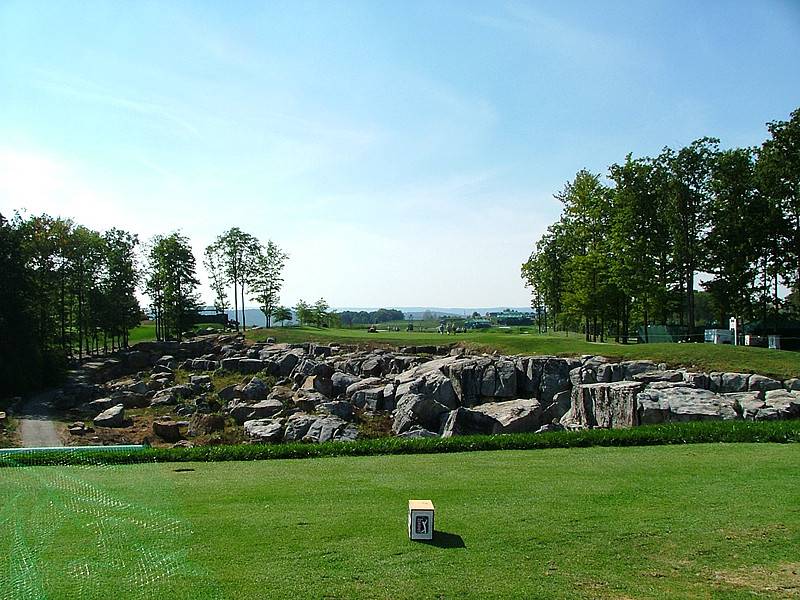
Bulle Rock

A typical Pete Dye design-full of visual intimidation and grandeur-he toys with and soothes your mind at the same time.  Your scorecard is likely to reflect the former rather than the later because the golf challenge, even if you pick the right tee length, is very robust.  Much like he did at Mystic Rock around the same time, Pete used the rolling terrain to showcase beautiful hole layouts-there is so much eye candy here you will think you are in the NECCO factory.  The ticket is high but you really get your money’s worth on all levels.

The short game practice facility was an original extra at its time-still remains one of the highlights of the experience for me.  The clubhouse is nice without being grand, the golf shop has plenty of Bulle Rock memorabilia for you to sample, and the grill room has a very fine array of all American comfort food for you to enjoy.

Number 2 Par 5 (Scott Serio/EclipseSportswire.com)

The composition of this course, much like the composition of a fine piece of music,  is where the artistry lies for me-the sequence and flow of the holes is very engaging.  Though the longer hitters may gripe because of the number of shortish four pars, Pete gives your scorecard a building sense of pressure because those short holes are frought with danger if you do not pick your challenges carefully.  With the exception of a bit of a logistical hiccup in the placement of the short par three third-you can feel this course naturally roll out in front of you-every really big challenge is followed by a bit of a letup on the pedal-but more challenges await in short order.  The sequential buildup on each side ends with a very memorable hole where the player needs to get a second wind to keep his scorecard in tact.

Number 13 Par 4 (www.rollinggreens.com)

As is usually the case with Dye courses, the biggest intimidations are usually not the biggest challenges, the devil is in the nuances so pay close attention to the nature of the landing areas off the tee and the access points and configurations of the greens.  The green surfaces have gentle but significant slopes-very speedy and the grain will accentuate or attenuate the pace of all putts.

Because of the topography this is a brutal walk-some serious cardiac episodes lie between green and tee.  The lack of any tree cover in the playing area from tee to green means that when the sun is out you will get the full brunt of its fever-be prepared to drink, towel, and seek some refuge under the cart cover.

Anna Nordqvist LPGA Champion 2009 (Scott Serio/EclipseSportswire.com)

The LPGA Championship has been played here a number of times over the years and the list of champions verifies the pedigree of this course.  Winners have included Annika Sorenstam, Se Ri Pak, Suzanne Pettersen, Yani Tseng, and Anna Nordqvist.

Stunning Finishing Hole Par 4 (www.golfdigest.com)

Pete rarely disappoints when they pay him and Alice the big fee and they did not disappoint here.  It is really just a matter of whether you experience more “Wows” than “Whews” here-there should be a boatload of both of them.

Aberdeen, Maryland

Architect: Pete Dye-1998

Tees            Par   Rating    Slope     Yardage

Gold            72     74.2        142        6843

Blue            72      72          138        6360

White          72     70.6        135        6047

(Click to see complete Bulle Rock hole-by-hole descriptions)

The Golden Horseshoe-Gold Course

Of the Jones Sr. courses that I have played the Golden Horseshoe remains, in my estimation, one of the finest courses he ever designed.  It was built in the 1960’s in a hilly wooded area that surrounds a a natural canal basin-the finished course is a product of it’s surroundings.  It bears similarity to Spyglass Hill which was built in the same time frame, a course that the pros consider one of the most difficult courses they play all year.  Much like Spyglass this course was carved out of a densely wooded area-tall trees ensconce every hole and give the course that distinctive cathedral-like feeling.  Much like Spyglass the holes meander up and down seriously hilly terrain presenting the player with the challenge of evaluating elevation change on almost every shot.  Throw in a little wind and the tunnel effect caused by the tall trees and you have a difficult mental challenge in club selection on every shot.

Esthetically this is one beautiful golf course.  There are more maintenance people per player than you will see anywhere.  Every flower and blade of grass is manicured to perfection-it is presented to please the eye and it will not disappoint.  This is a mother of a piece of terrain to walk so you will actually be glad to be riding in a cart most of the way.

Number 2 Par Five 476 yards     (reesjonesinc.com)

As is characteristic of most of the Jones Sr. courses you see long tees to allow multiple tee lengths, oddly shaped-segmented greens that never give you much target to shoot at, and well placed fairway bunkers that force you to play dexterously for the best line into each green.  The greens are very undulating and segmented which puts a premium on getting your ball to the correct tier and further pressures you to get the correct driving position for an advantage angle at the flag position of the day.  The only characteristic missing from most of the Jones Sr. courses I have played are the large sprawling amoeba-like bunkers with which he loves to intimidate players-but the green side bunkers are deep and well positioned to swallow a shot without conviction so you will end up with sand between your toes before the day is over.

In spite of the fact that the overall yardage does not seem intimidating it is a driving course-long drives on the right line are requisite to scoring well here.  The trees and bunkers clearly define the driving lines-you must hit them if you are to have a bats chance of hitting these segmented greens.  Concentration and correct club selection on the tee box is very important.  Mindlessly blasting your driver on every hole will lead to lots of troubles and doubles on your scorecard.  Which brings to mind one of the cardinal rules of The Shoe-if you hit it in the trees take the most direct and shortest route out.  Anything bold or macho will be punished by Trent’s ghost-there is very little air in these trees.

Number Three Par 3 174 yards (golfzoo.com)

As is the case with most great courses you have to be intelligently aggressive to score well here.  When you have the right angle to a flag or the putt from the correct side of the hole you have to go for it.  On a course like this you have to put some cash in the account when you have a chance because there will be debits coming due on some of the harder holes during the day.  The middle holes require you to score well because the beginning and the end will not offer you much opportunity other than survival.  The par three holes are easily the most difficult scoring holes on the course.  All four are nested around the basin in the middle of the property with serious elevation change and always a smattering of wind.  To murk your decision making further three of these holes have at least three tee positions they can use so the club selection can change two clubs from one day to the next.  These are four of the most challenging and breathtaking par threes you will ever play on one course.  The last five holes are the hardest run of the day-one of the toughest finishes if you are clinging to a good score.  Only the last four at Avenel or the last five at TPC Sawgrass come close.  It is especially difficult to face this challenge late in the round when you are tired.

Number Sixteen Par 3 159 yards (reesjonesinc.com)

I have played this course a dozen times and I still find every round I play here full of intrigue and delight.  It is the type of course I think you could play every day and never get sick of it-the facets of the architecture-the beauty of the surroundings make it a real treat time after time.  There is no course I have played in the states-except Pebble, Pinehurst 2, Merion, and Oakmont-that has left a more indelible mark on my golf psyche.  Touche Mr. Jones!

Williamsburg, Virginia

Designer: Robert Trent Jones, Sr (1963)

Tees            Par          Yardage            Rating              Slope

Blue            71            6522                 72.4                 135

White           71            6248                 70.7                 129

(Click to see complete Gold Course hole-by-hole descriptions)

Golden Horseshoe-Green Course

In an effort to create a two-course facility that would be able to handle large convention groups, the Golden Horseshoe hired Rees Jones, son of Robert Trent Jones Sr.,  in 1991 to build a complement to the heralded Gold Course at The Shoe.  What he created in no way resembles Trent’s classic masterpiece.  This is a contemporary styled wooded course winding through tall beech, oak, and pines and more gentle rolling terrain than it’s sister where they moved lots of earth to get the shaping they were looking for.  The most distinguishing characteristic is enveloping mounding-every hole over 200 yards long seems to have a wall of mounds on both sides that contain the area of play and keep balls from chasing into the woods.  I am convinced the owners said to Rees we don’t want 30 handicappers out here for six hour rounds looking for their Pinnacles in the woods.  The mounding around the greens is wild as well but here at least it leads to some creative pitch saves when you miss the greens.

The sequencing of the holes is interesting-you start with four par fours without great distinction.  You don’t see a three par until 7.  At that point the character of the course changes dramatically and you have to start paying attention.  The middle six are actually the meat of the course for me.    There are three par threes from seven to eleven and not another par five until fifteen when you will see two in the last four holes.  The last three are very technical holes-shortish par four, long par three, and an interesting par five to finish.  The main criticism I have is that the holes tend to be pretty straight, only two real doglegs in the bunch, and many of the holes start to appear alike though the green set mounding and sculpting make them play differently.

This is by no means an easy course-the rating and slope from the Blue Tees is actually higher than the Gold but I think the difference is that less blowup holes are lurking here than across the campus.  The zoysia grass fairways also make it play even longer and the side mounding also leads to lots of side hill approach shots into the greens.  Don’t always reach for the driver there are holes where position trumps length and the well place three wood or hybrid will be the better choice of driving club.  The green shapes themselves are very varied and interesting and you have to ignore the straightness of the fairways and think carefully about approach angle relative to pin position to get good scoring opportunities.

Number Nine Par 3 176 yards (reesjonesinc.com)

The par threes are easily the most interesting holes out here-all feature elevation change and unusual green complexes with varied pin positions, difficult sculpting and undulations, and nice variety in length.  The water in play on the course is only on #11 and the drive on #18 so the chance for the triple bogey threat is only if you double pump a tee ball into the trees and that is hard to do over the side walls.

Finishing Hole Par 5 512 yards (reesjonesinc.com)

Keep your head about you-concentrate on the driving lines and you will enjoy this day.  This is a fun course-sporty and interesting-and a great complement to the challenges of his father’s track.

Williamsburg, Virginia

Designer: Rees Jones (1991)

Tees              Par          Yardage            Rating              Slope

Blue              72            6722                 73.6                 138

White            72            6244                 70.7                 129

(Click to see complete Green Course hole-by-hole descriptions)

Somerset Hills Country Club

Somerset Hills represents the old and traditional with a discrete clubhouse and civilized and understated approach to everything. At Somerset Hills, they don’t have to try to impress, because they are the genuine article. The small clubhouse, pro shop and outdoor deck fit perfectly into the New Jersey small town landscape and have an aura that can’t be bought and only develops with age and a respect for the past. The course has a number of  perfectly manicured grass tennis courts, confirming its gentrified and genteel approach as a private club.  Even the halfway house is just some bottled drinks, ginger snaps, crackers with add your own cheddar cheese or peanut butter.  Pick up the yardage book-it is a collectible relic all to its own.

An appealing aspect of A.W. Tillinghast’s work is, strangely enough, the lack of identifying characteristics. The player would be hard pressed to tell that the same architect designed the courses at Winged Foot,  Baltusrol, San Francisco Golf Club, Bethpage (Black) and Somerset Hills. Think of the striking features of each: Winged Foot (West) with its length, raised, severe greens and deep bunkers; Baltusrol (Lower) with its low-profile look; San Francisco with its flashy bunkers stylishly spread at all sorts of angles in the broad fairways; Bethpage (Black) with its huge, sprawling scale and Somerset Hills with its terrific set of greens and its charming layout.  Tillinghast’s style (or lack thereof) is an indicator that, unlike many of today’s architects, Tillinghast was not hell-bent on leaving his ‘mark.’ He fit the course onto the available land without forcing his imprint onto the land.

Variety is the key to Somerset Hills- variety of terrain, variety of length of holes, variety of approach shots and variety of greens. With the fairly open front nine laid out on and around an old racetrack and the back nine through rolling wooded terrain with streams and a pond, one would think the course would have a Jekyll and Hyde character. However, the course flows well,  the par threes are perfectly balanced at 175, 220, 145 and 165 yards while the par fours have several big two-shotters (the 1st, 4th, 7th and 13th), several short ones (the 5th, 17th and 18th) and those very appealing ones in between.  Par fives may be the weakest holes but they are not without feature interest themselves.

These greens are unlike anything we see today-they are severe, almost random in their severity-full of odd humps and bumps and an occasional unplayable section.  To play well here a player must pay attention to the specifics of each green and know where to leave it and where not to leave it.  If the greens are carrying any speed the day you play them this goes double.

For the really discriminating golf mind this is a very special place to play.  It is just a delightful sequence of interesting golf challenges and it is totally playable even the first time out.  It is simple, unchanged from its original intent, just a bottled piece of the past.

Bernardsville, New Jersey

Architect: A.W. Tillinghast (1917)

Tees                Par         Yardage            Rating             Slope

Blue                 71            6659                72.2                 132

White               71            6235                70.1                 127

Red                  72            5643                73.8                 138

(Click to see complete Somerset Hills hole-by-hole descriptions)

Caves Valley Golf Club

When this course opened in the early 90’s, close to the same time Robert Trent Jones opened in Manassas, Virginia, it kind of got the short end of the stick for new, upscale private courses in our region. But in many ways I think it better than RTJ, it has less pomp, more character-both in facility and course, and it is an afternoon to remember, right from the bag drop to the final beer after the round.

The bag drop greets you with an atmosphere of understated confidence

 (Click on any picture to get an enhanced view of the image)

This place is clearly the vision of one man, it has a quaintness to it that cannot be ignored. All the buildings are low cottages in an rural English tradition creating an understated formal atmosphere that is appropriate for a private club catering to the wealthy and famous who would prefer to enjoy an anonymous afternoon without much fanfare. The locker room is small and has that comfortable sock feeling to it-offering liquid refreshment and some fresh fruit for the road.

Lunch on the veranda-before or after a round-is the height of civility

Lunch is served buffet style on the veranda of the clubhouse-great simple food that is a perfect fuel stop for the afternoon ahead. The golf shop is also small but homey, full of Ralph Lauren looking shirts, jackets, and the like all bearing the cool CV logo. Full grass practice areas are up to the standard you would expect at a place like this. The guys who man all stations, bag drop, caddie room, golf shop, and locker room are just your frat brother types who are there to make sure you have a great day.

The Par 3 eighth is as demanding as it is beautiful

The course itself is pure Tom Fazio-exhilarating to look at and a solid tactical challenge to play. It is a hilly piece of ground that wends its way through substantial woods that will define holes and create tactical considerations on their own. The length is not overwhelming if you pick the right tees to play from and if you want to enjoy yourself err on the shorter length the first time through.

Magnificent #12…just resplendent and about three stories down

The greens are wonderful, lots of pitch and yaw and very swift downhill and with the grain.  Caddies are wonderful and will help you deal with the mysteries of putting these greens. Overall conditioning if superb-they spend their money on keeping this top shelf.

Backyard grass practice facility with a Golf Learning Center to boot

Worth noting that in 2021 they did a substantial cosmetic makeover of the course in preparation for hosting one of the PGA Tour Playoff Events.  Grassed over vast areas of unkempt native grass to make it look clean for the TV presentation.  The bunkers seemed to swell almost 50% in size which makes them much more visually intimidating.  One physical change was to replace the super stern Par 4 #11 with a much tamer and more reasonable Par 5.

I recommend hanging around after you are done for an icy cold one on the veranda overlooking the expansive grass practice facility that cascades down the hill from the club house-this is pure serenity as defined by Webster.

Owings Mills, Maryland

Architect: Tom Fazio (1991)

Tees      Par      Rating       Slope       Yardage

Blue       72        73.0          137            6908

White     72        71.0          133            6117

(Click to see complete Caves Valley hole-by-hole descriptions)