Americans seem determined to calibrate everything in their lives, simply to be able to say that their whatever is better than the other guy’s whatever. In this spirit, have Stimpmeters made us so obsessive about fast greens that the game has suffered? Frank Hannigan, former head of the USGA thinks so…….and so do I.
This course is owned and operated by Pat Ruddy and his family and, as one of the premier modern architects in Ireland, Pat has created here his personal testimony to golf course architecture. If you know anything of the man, Pat is a bit obsessed with the a traditional spartan approach to course presentation-no yardage markers on the course, a yardage book without user friendly features, and actually twenty holes to play. When I asked his son who runs the golf shop about the “twenty holes” he simply said, the rest of the world will catch on eventually. He even provides a cursing stone next to the 10th fairway. In Katharine Dyson’s review of this course she explains that legend has it you can put a curse on a person or thing if you revolve the seven small stones on the top of the rock in a counter-clockwise direction. I am guessing an inordinate amount of these have been heaped upon our host.
The yardage book reveals Ruddy’s respect for links golf design. As he says, “The links have been designed to perpetuate and modernize the traditional values of links golf. The combination of rugged dunes, deep bunkers, sea breezes, and large undulating greens calls on the golf to display strength of character, an ability to think, and shotmaking skills.” The design makes generous use of “calculated deception aimed at inducing white knuckles on the club” in an effort to play with the golfer’s mind and impinge his effort to swing out and hit precise shots.
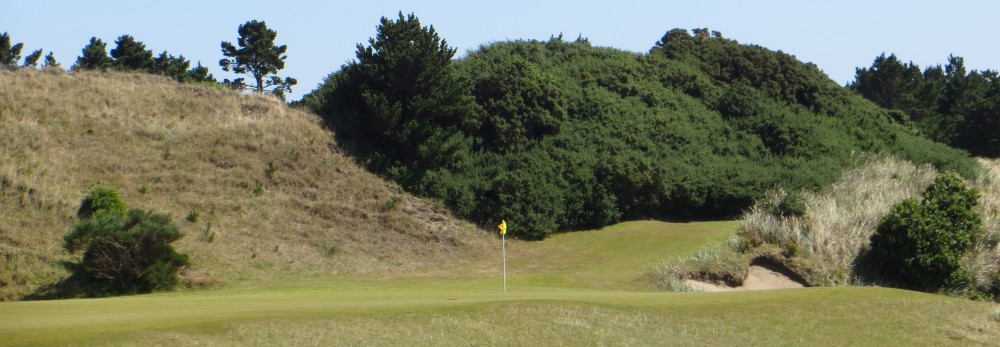
This is a knock your socks off track-very difficult-not for the faint of heart. Breathtaking vistas, cleverly placed bunkers, huge rolling greens, and the links type serpentine tracking along the coast built on true links land. Straight driving off the tee is essential to handle quite a bit of optical illusion created by the tall dunes and long corridor fairways. Proper fairway positioning is crucial to get the most advantageous angle and some very difficult green complexes.
Since over ten of the holes are in breeze shot of the Irish Sea the wind influence is significant. This leads to a couple of weather changes a round so be prepared for lots of dressing and undressing of your fair weather gear. The good news is that like most links courses there is open access to most of the greens. When the wind is up, and that is most of the time, the bump and run becomes a very effective method to getting your approaches close to the flag.
Sometime in the early 2000’s Pat must have intercepted a freight ship full of pressure treated railroad ties because the bunkers have more vertical sleepers than any Pete Dye course I have ever seen. I think Pat has fire extinguishers placed throughout the course in case a contagious sleeper fire should break out and threaten to burn down the course. This look of the vertical sleepers makes deep bunkers even more intimidating by articulating the potential pitfalls to the player from a long way out.
My favorite Pat Ruddy touch is on the scorecard where at the bottom next to the total score he has a huge oversized box which is simply labeled “What My Score Should Have Been”. It is clearly his testimony to the delusional nature of all golfers who love to tell big fish stories over a Guinness after the round.
As Renton Laws says in this short video, plodding around the east coast of Ireland you are likely to stumble on a diamond in the rough called “The European Club”-Pat Ruddy’s personal contribution to the rich trove of links courses on the Emerald Isle. As an accomplished international course architect, Pat is unique in more ways than you can imagine. His playful personality make his courses creative, challenging, and downright fun. Just check out the scorecard at the European Club-20 holes and a slightly larger box next to your total score for “What my score should have been”.
Somerset Hills represents the old and traditional with a discrete clubhouse and civilized and understated approach to everything. At Somerset Hills, they don’t have to try to impress, because they are the genuine article. The small clubhouse, pro shop and outdoor deck fit perfectly into the New Jersey small town landscape and have an aura that can’t be bought and only develops with age and a respect for the past. The course has a number of perfectly manicured grass tennis courts, confirming its gentrified and genteel approach as a private club. Even the halfway house is just some bottled drinks, ginger snaps, crackers with add your own cheddar cheese or peanut butter. Pick up the yardage book-it is a collectible relic all to its own.
An appealing aspect of A.W. Tillinghast’s work is, strangely enough, the lack of identifying characteristics. The player would be hard pressed to tell that the same architect designed the courses at Winged Foot, Baltusrol, San Francisco Golf Club, Bethpage (Black) and Somerset Hills. Think of the striking features of each: Winged Foot (West) with its length, raised, severe greens and deep bunkers; Baltusrol (Lower) with its low-profile look; San Francisco with its flashy bunkers stylishly spread at all sorts of angles in the broad fairways; Bethpage (Black) with its huge, sprawling scale and Somerset Hills with its terrific set of greens and its charming layout. Tillinghast’s style (or lack thereof) is an indicator that, unlike many of today’s architects, Tillinghast was not hell-bent on leaving his ‘mark.’ He fit the course onto the available land without forcing his imprint onto the land.
Variety is the key to Somerset Hills- variety of terrain, variety of length of holes, variety of approach shots and variety of greens. With the fairly open front nine laid out on and around an old racetrack and the back nine through rolling wooded terrain with streams and a pond, one would think the course would have a Jekyll and Hyde character. However, the course flows well, the par threes are perfectly balanced at 175, 220, 145 and 165 yards while the par fours have several big two-shotters (the 1st, 4th, 7th and 13th), several short ones (the 5th, 17th and 18th) and those very appealing ones in between. Par fives may be the weakest holes but they are not without feature interest themselves.
These greens are unlike anything we see today-they are severe, almost random in their severity-full of odd humps and bumps and an occasional unplayable section. To play well here a player must pay attention to the specifics of each green and know where to leave it and where not to leave it. If the greens are carrying any speed the day you play them this goes double.
For the really discriminating golf mind this is a very special place to play. It is just a delightful sequence of interesting golf challenges and it is totally playable even the first time out. It is simple, unchanged from its original intent, just a bottled piece of the past.
Bernardsville, New Jersey
Architect: A.W. Tillinghast (1917)
Tees Par Yardage Rating Slope
Blue 71 6659 72.2 132
White 71 6235 70.1 127
Red 72 5643 73.8 138
If you would like a printable PDF of this posting including yardage book quality hole-by-hole descriptions of how to play the course click the moegolf logo below.
This place is a real golf factory facility with two championship golf courses, a 360 degree grass driving area the size of Nebraska, and a golf shop that will make you feel like you are in Nordstroms. The place has hosted the final stage of the PGA Qualifying School a number of times. Coupled with how many pros and wanna-be pros living in the Orlando area you are going to see lots of sticks out there practicing and honing their games.
The fare is reasonable for a facility of this quality and the golf and related accommodations are very much what you would expect. The golf shop is humongous with every major line of apparel represented-if you cannot find something memorable to add to your wardrobe you are either blind or too picky.
This course is one of two that were designed by the team of Phil Ritson, Dave Harman, and Isao Aoki. They moved a lot of dirt to get the sculpting and landscaping they were after but the result is a course that is very challenging but totally playable. The variety of the holes is it’s strong suit. There are the typical Florida holes with adjacent water or environmental areas but there are even a few with an Irish lilt thrown in. The handicapping of the holes is very realistic-three of the five pars are the 16th, 17th, and 18th handicap holes and two of the par threes are the 4th and 5th handicap holes. They put real thought into which holes needed the handicap assistance rather than just looking at length to determine it.
If you look carefully at the GPS images of the holes the lines of play are fairly obvious. Most of the sculpted areas of the fairways are still fairway it is just that hitting from them is a less advantageous place to play from relative to the green. As with most good courses, driving the ball on the proper line and in the short grass is the best way to get aggressive places to play from. The greens are plenty large but segmentation and tiering require proper planning on the approach shots to avoid three putts.
The yardage book in the shop is major old school-hand drawn with lots of particulars. Problem is that it is virtually unreadable to a non-tour mortal so you are better off saving the $7 and just go with the provided GPS in the cart.
This is a very enjoyable afternoon of golf. As always, play from a tee length with hole distances that are comfortable for you. The challenge you seek is here at whatever length you choose to play at.
Winter Garden, Florida
Architect: Phil Ritson/Dave Harman/Isao Aoki (1997)
Tees Par Rating Slope Yardage
Green 72 73.7 132 6927
Blue 72 71.4 126 6432
White 72 68.8 122 6020
If you would like a printable PDF of this posting including yardage book quality hole-by-hole descriptions of how to play the course click the moegolf logo below.
This is a very amusing piece written for The New Yorker by Larry David of “Curb Your Enthusiasm” fame. Certainly a familiar process every one of us who has ever picked up a seven iron can relate to. Only question remains is the one my friend posed to me, “What stage are you in?”
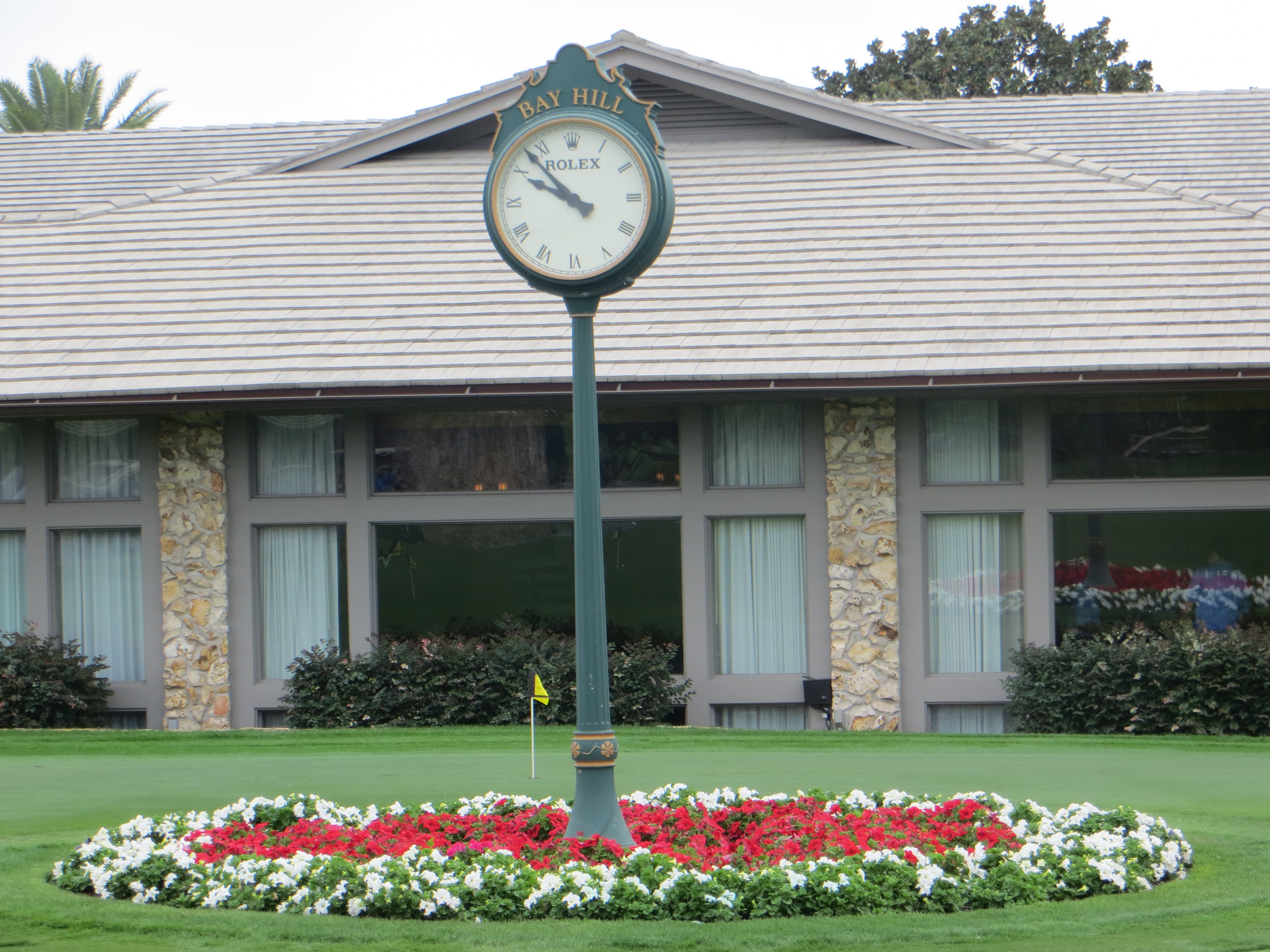
Bay Hill is synonymous with Arnold Palmer as his winter retreat and the host venue for the golf tournament that bears his name. The facility was built in the early 1960’s by a group of Nashville businessmen who hired Dick Wilson-one of the prominent architects of the day-to build a championship course in the middle of nowhere. Arnold came to the recently opened course in the mid-sixties to play an exhibition match with Jack Nicklaus and fell in love with the quality of the course as well as the reclusiveness of Orlando. In the early 1970’s through the connections of Mike McCormick and IMG, Arnold put together a group of investors to buy Bay Hill from the original Nashville businessmen who put it together.
Winnie and Arnie made sure all the players would not miss their tee times
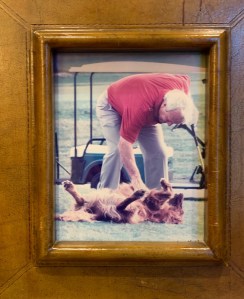
The rest was history as Arnold began to spend more and more time at Bay Hill with Winnie his wife and her Golden Retriever Riley and they put their personal stamp on every aspect of the operation.
Arnie and one of their Goldens
The casual character of this first class destination facility is clearly a reflection of their personalities and values. Arnold and Ed Seay have continually tweaked the course itself to keep it up to standards to challenge the PGA touring pros that play there every spring. Yet it remains totally playable to the large contingent of members and guests who play it every day.
(Click on any picture to get an enhanced view of the image)
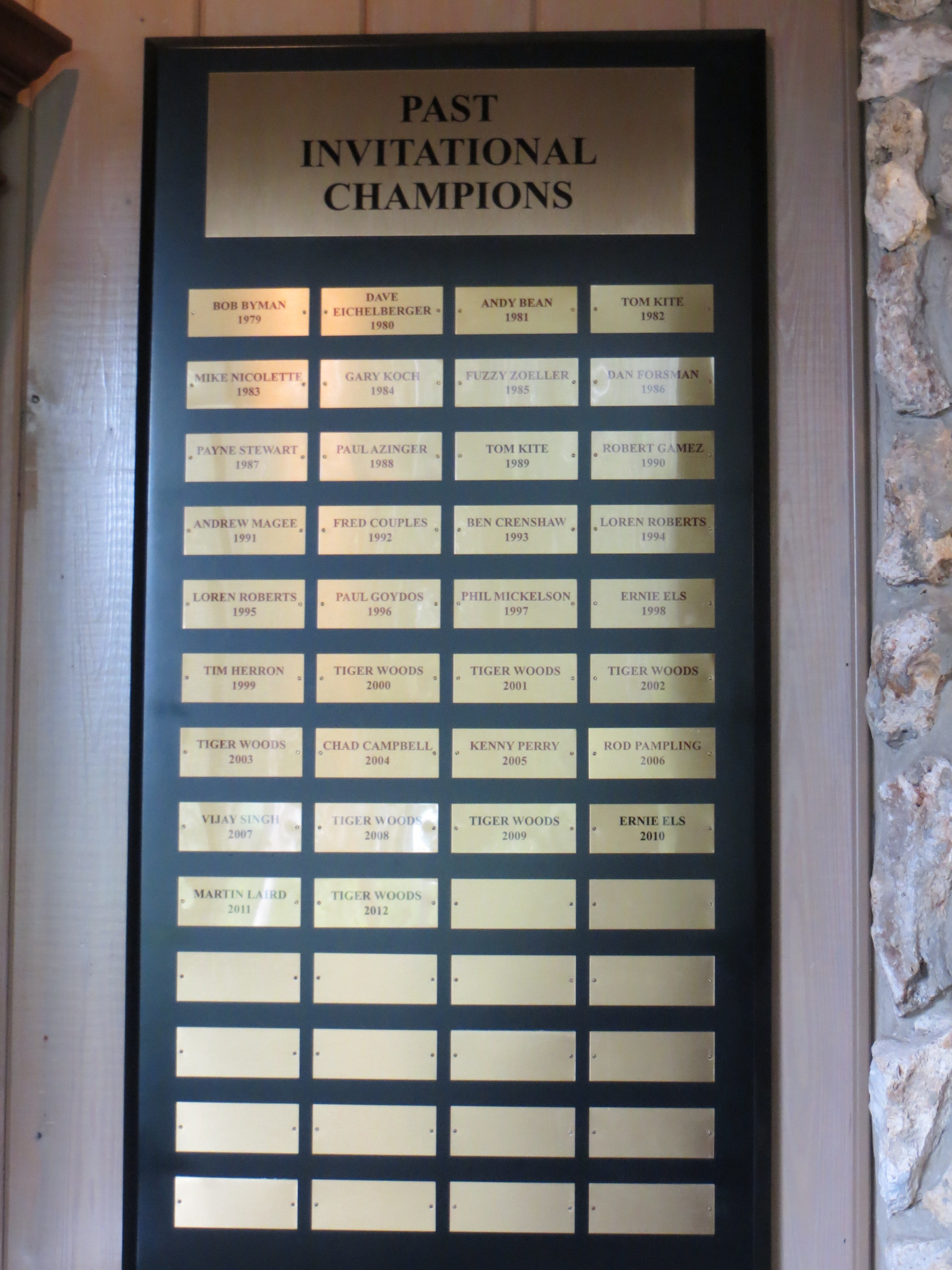
The first impression of the course is that it is not as macho as you would expect after seeing it year after year on TV. The who’s who of winners over the last 30 years shows an amazing diversity of players win here-from Andy Bean, Gary Koch, and Tom Kite to Freddie Couples, Phil Mickelson, and Tiger Woods (6 times).
Wharf arrangement on the Par 5 6th rewards tactical restraint and precise execution.
The course itself is not particularly brutish in length but it is technical enough to require really good management of ball flight and distance. The greens are quick and undulating so it takes tactical planning with approach shots and aptitude with the flat stick to score well.
The Par 4 8th is not long but it is very demanding..especially on the approach.
The topography is actually un-Florida-like so you have your share of up and down holes to deal with. The par fives are not particularly long-at least two are reachable if you crank your driver-and there are not really many stout par fours of 425 or longer. The shorter par fours are the most difficult to me-they all have a good measure of Arnold’s favorite risk-reward thinking to them. The overall variety of holes is it’s strongest suit-no two holes feel remotely alike. Fairway bunkers are sprawling but tactically placed.
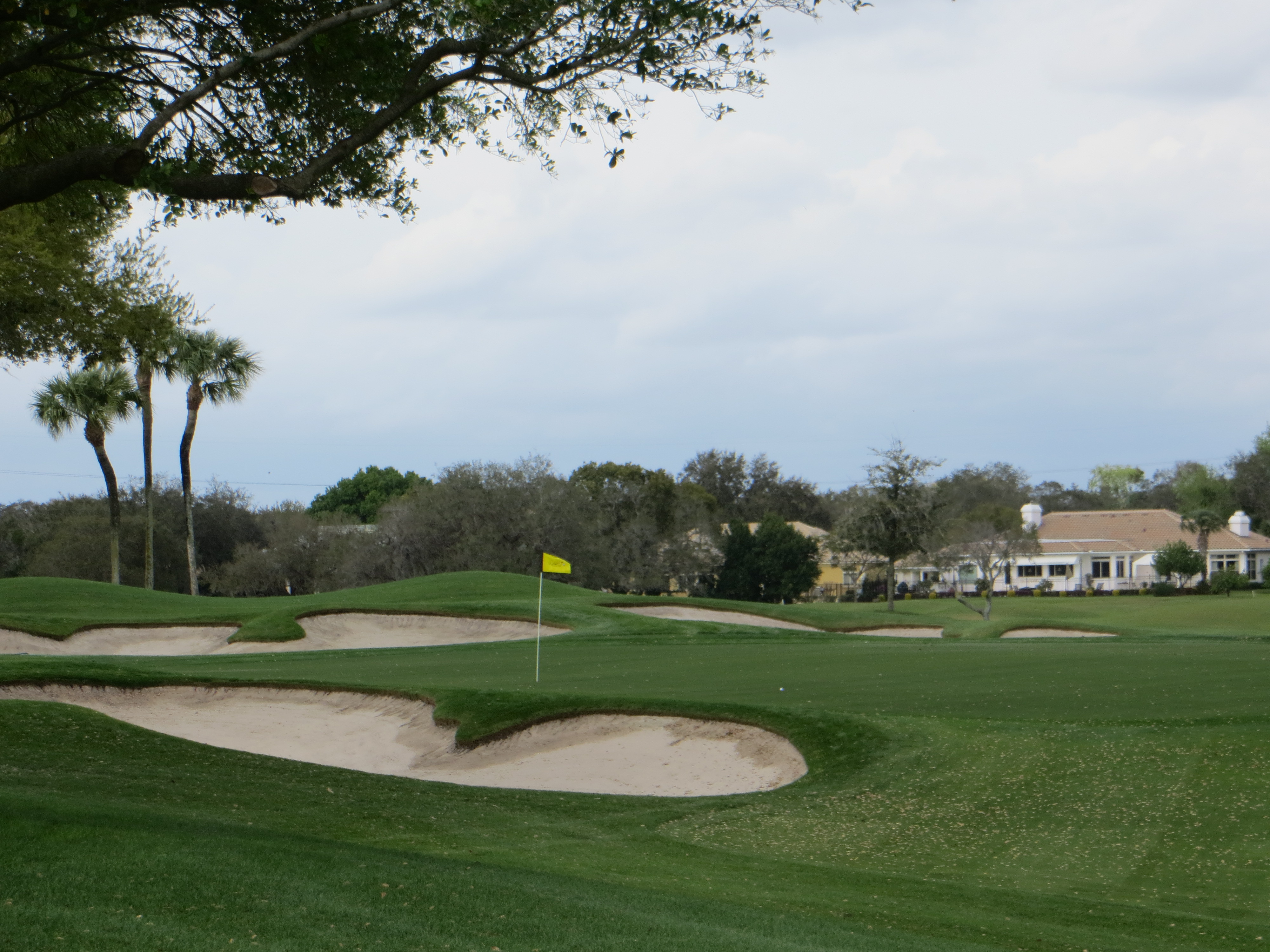
Bunkering on the Par 3 7th is, as Goldilocks would say, just right!
You cannot help but notice the artistry of the shaping and vistas of the bunkers-they are in the right places to make you think hard before taking the aggressive line on most holes. Greenside bunkering is not overdone but they are very steep sloped so you can get some very challenging exit paths, especially if you short side yourself on an approach miss.
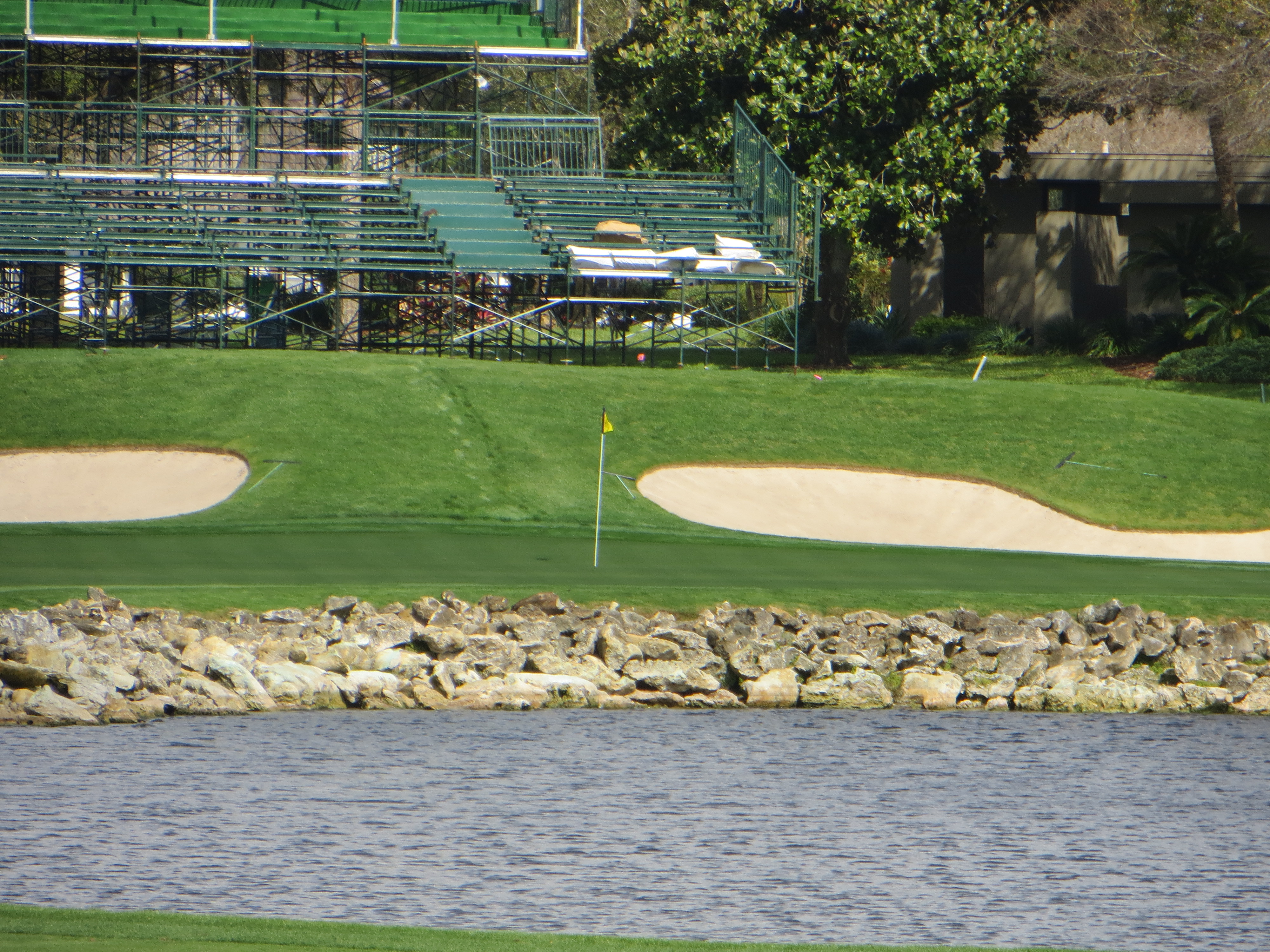
The iconic rock trim carry into 18 has made many a tour player take pause and reflect
This is clearly a course where knowing when to attack and when to back off make a real difference in your final score. Thoughtful aggressiveness is the mantra here. You have to go for it when the odds are in your favor because you need some low scores to balance the few paybacks you are likely to render through the day.
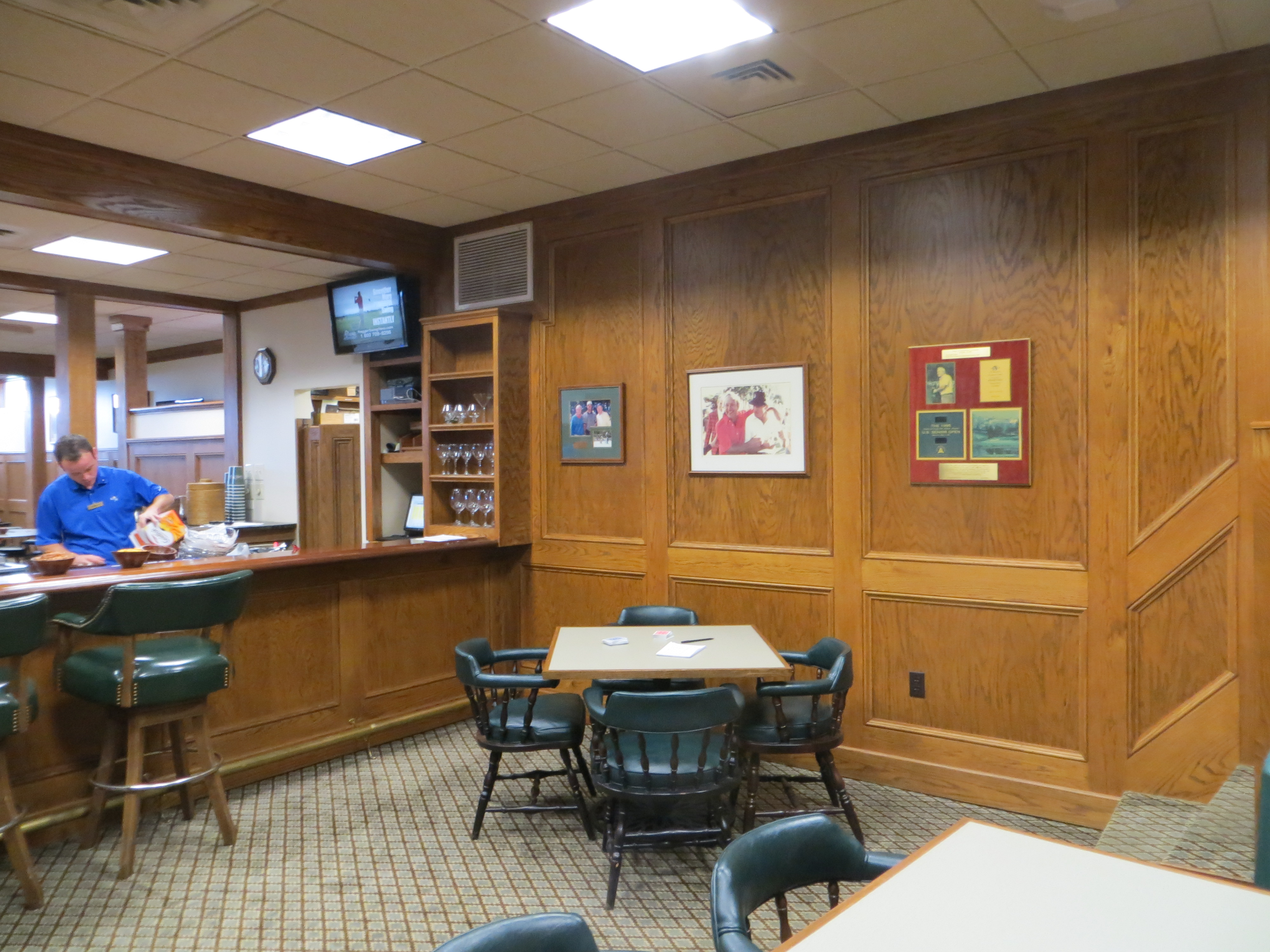
A locker room with showers, gin tables, memorabilia, and a bar..how old school!
Do not miss the men’s locker room-it is a throwback to the days before political correctness dominated our lives. It is a place for men to unwind after a round-have a drink, play some cards, and settle all the bets of the day. The memorabilia on the walls is enough to fill a museum.
Orlando, Florida
Architect: Dick Wilson (1963) Arnold Palmer/Ed Seay (since 1970)
Tees Par Rating Slope Yardage
Green 72 75.4 142 7381
Blue 72 73.7 139 6895
Yellow 72 71.6 134 6437
If you would like a printable PDF of this posting including yardage book quality hole-by-hole descriptions of how to play the course click the moegolf logo below.
There was a wonderful interview with the golf architecture website Golf Club Atlas back in 2000 with Mike Strantz. In the interview we get a sense of the artistic approach this man took to designing golf courses. To anyone who has played Royal New Kent, Stonehouse, Tobacco Road, or any of the other Strantz creations they know that if the man brought anything to his projects it was an open mind and an artistic eye-his courses never lack for visual stimulation and interest.
This interview gets into the men who influenced his approach to design and the philosophies he developed in doing his work. Very insightful, funny, and respectful at the same time. As the interview reveals, unlike most “successful” course architects, he only did one project at a time totally immersing himself in the task at hand. He would actually wander about a potential site with his sketchpad and pastels and create artistic renditions of the holes he was visualizing before he ever got to measuring and drawing plans.
Unfortunately, he died a few years ago from cancer at a very young age. We can only feel remorseful for what he never got a chance to create because, based on what we have seen, there would have been some very memorable additions to a body of work that is already replete vitality and originality.
We all know of Tiger’s appearance at an early age on Mike Douglas but he has nothing on Rory in this regard. Rory shows at a very early age-just after winning a the Under 10 World Championship-how to do the chores while practicing your craft. He has an entertainer’s stage presence and composure at a very early age.
Which clearly Erik Compton has plenty of coming from two back and outlasting weather delays and some fiesty competition to win the Nationwide Tour Mexican Open with eight birdies on the final day. Erik is a two-time heart transplant recipient so he has overcome adversities much bigger than the yips or a bad marriage. With this win and the $126,000 first prize, he is second on the earnings list and a shoe-in for earning his PGA Tour Card at the end of the year as one of the top 25 on the Nationwide Tour.
Don’t you want to give him a big virtual hug-this is a comeback story that I am sure Kevin Costner will consider making into a movie.







 moegolf