Art In Golf Architecture

It is evident in reading his philosophy of golf architecture that Max Behr might have been one of the early “Minimalist” proponents in his field.  In this piece he wrote in 1927 you can hear a voice that has reached architects like Tom Doak and Ben Crenshaw who are strong proponents of the minimalist approach to course design.  We may not all agree with Behr’s sentiments but he does express an argument worth considering as we try to evaluate the trend toward bigger and bolder artificial design elements over the last century.

The question he poses in this essay is a simple one,  “What, then, is art in golf architecture? What are the values we should seek, and the method we should adopt to arrive at them?”

For the most part Behr believed that the natural elements of the land should be the guiding force in design and that architects should resist the temptation of imposing their will upon what the topography presents just to make a personal statement.

“We forget that the playing of golf should be a delightful expression of freedom. Indeed, the perfect rhythmic coordination of the muscles to swing the club makes the golf stroke an art. And, being such, it is apt to induce an emotional state, under the stress of which human nature is not rational, and resents outspoken criticism. It follows that when the canvas of Nature over which the club-stroke must pass is filled with holes artificially designed to impede the golfer’s progress, these obvious man-made contraptions cause a violation of that sense of liberty he has every right to expect. This accounts for the checkered history of every artificial appearing golf course.”

“He must first feel before he thinks. He must perceive in the ground what might be, not conceive in his mind what must be.”

His criticism is that architects tend to become formula oriented in enforcing their will instead of letting them become an expression of the natural surroundings.  As a result they become complacent in a sense of their omnipotence and what we see is redundant and gaudy instead of a pleasing reflection of nature itself.

Remember he wrote this in 1927, he must be rolling over in his grave looking at the work of some of the high profile architects of the modern era.

He is not saying that the courses need to be simplistic just to respect the natural appearance of the topography, rather Behr would argue that some elements of design being used to make the game easier or more presentable easier are not appropriate either.

“Sand is now being used, not solely for its legitimate purpose as a hazard, but as a species of beacon to guide the player in estimating distance. Thus a crutch is thrown into the landscape upon which the eye of the golfer may lean, and the hazard of indefinite space, calling for intelligence to solve, is to that extent mitigated. And greens are now being purposely tilted toward play, collars and mounds are being placed around them to keep the ball from straying, and enfeebled skill rejoices. Loose from any responsibility to obey geological law, the architect continues to invent devices to coddle the golfer. It is this disregard for the laws of the medium that explains ‘freak’ architecture.”

The goal should be for the architect to strike a proper balance of ego and humility in creating something pleasing to the eye as well as challenging to play.  He can best achieve this by being respectful of natural elements of the land itself.

“It should now be apparent that true architecture can alone spring from observance of the laws accountable for the character of the earth’s surface. The forces of Nature must expend themselves in the design.”

(Click here to read the full article by Max Behr “Art in Golf Architecture”)

Max H. Behr

The American Golfer

August, 1927

The Apostle Tour

After watching a broadcast of what used to be referred to as The Senior Tour I have decided that with the proliferation of guys carrying staffs on the putting green we should almost expect Charlton Heston in sandals to be playing in the final group.  To me this calls for reconsideration of the product name.  The players are certainly weathered and grey enough to play the part.

If you look at the top 25 in any given week on this tour I bet 60% of the guys use something on the green longer that 35 inches or else have one of the many alternative putting grips or both.  The Claw, The Saw, The Split Handed, Cross Handed, or whatever you would call what Bernard does.  Hell, I saw a lefty today with right hand low.  Mind you, I am not saying this is a bad thing, but it certainly is changing the putting standard in the game.

If they ever outlawed these things you would not see Freddie Couples, Bernard Langer, Tom Kite, Mark O’Meara, Calc, Jeff Sluman, Nick Price or many of the other old household names playing anymore.  I think they would be down to Tom Watson and 46 no-names with club professional credentials.

While we are re-inventing this thing, I think the policy on The Apostle Tour is they only play biblical venues like Westchester, Inverness, Newport, Five Farms, Saucon Valley, Bellerive, Canterbury, Harding Park, and Merion.  At the distances these guys hit it these old venues would not suffer from same “technology effect” that has chased the regular tour away from them.  Besides, these are classic stages we associate with guys in their age group.

If last week’s PGA Championship is any indication, this gospel is starting to spread pretty rapidly.

August, 2011

Mr. Bond

(Photo By Everett Collection/Rex Features)

This image of the epic match in the film between Goldfinger (Gert Frobe) and James Bond (Sean Connery) remains stamped from my teenage memory as one of the first mentions of golf in popular media.  Mr. Bond catches Goldfinger cheating at the game and turns the tables of him with a clever use of the rules of golf.

Bond: “You play a Slazenger 1, don’t you?”

Goldfinger: “Yes, why?”

Bond: “This is a Slazenger 7.”

Bond shows Goldfinger his own golf ball.

Bond: “Here’s my Penfold Hearts. You must have played the wrong ball somewhere on the 18th fairway. We are playing strict rules, so I’m afraid you lose the hole and the match.”

It is interesting to learn from Sean Connery’s memoirs that his life-long passion for golf began as a result of this filming.

“I  never had a hankering to play golf, despite growing up in Scotland just down the road from Bruntsfield Links, which is one of the oldest golf courses in the world. It wasn’t until I was taught enough golf to look as though I could outwit the accomplished golfer Gert Frobe in Goldfinger that I got the bug. I began to take lessons on a course near Pinewood film studios and was immediately hooked on the game. Soon it would nearly take over my life. ”

Oliver Brown

August 2008

(www.telegraph.co.uk)

Pinehurst No. 2

Pinehurst is one of the true meccas of golf in America and Donald Ross’s Pinehurst #2 is the signature hood mount for this place.  He stands as one of the most heralded American golf course architects of his time and this course is the one all point to when they try to characterize the style of course design Ross ascribed to.  Having played a number of his courses I can only agree that in this one he seemed to best orchestrate the subtle brilliance he brought to golf course design.  The course is playable, challenging, and thought provoking-what more can you ask for in an afternoon’s walk.

Both men’s and women’s national championship will be contested at #2 in 2014

Embed from Getty Images

The main facility here is also a treasure-take the time to walk the hallways and peruse the memorabilia hanging throughout.  Over the last century there have been countless men’s and women’s championships played on Pinehurst #2-the North/South Amateurs, North/South Opens, PGA Championship, Ryder Cup,  Tour Championship, and the U.S. Amateurs to name a few.  The greatest players in play the game have won here and the plaques in the hallway outside the Donald Ross grill include names like Francis Ouimet, Walter Hagen, Ben Hogan, Sam Snead, Jack Nicklaus, Davis Love III, Curtis Strange, Glenna Collett Vare, Dorothy Campbell Hurd, Louise Suggs, Babe Zaharias, Hollis Stacy and Morgan Pressel.

Payne’s gesture in 1999 has been immortalized in bronze

Embed from Getty Images

The course has recently hosted two men’s U.S. Open’s with great resolve-the iconic victory by Payne Stewart in 1999 and the Michael Campbell’s win in 2005-the winning scores were one under and even par respectively.  Both the men’s and women’s U.S. Open will be played on this course in 2014 in a rare major doubleheader.  In preparation for that event they hired Ben Crenshaw’s design team and have spent considerable dollars bringing back the original Donald Ross character of sand and scrub rough throughout course that had been replaced by thick Bermuda rough for the previous majors.  This reversion gives the course a more signature look and probably plays just as difficult for most of us.

There is no rough to speak of but being out of the fairway is no bargain

Embed from Getty Images

When it comes to the course itself, probably the most distinctive thing I can say is that the course is  really lacks any visual distinction.  Other than the crowned greens that everybody talks about, it is just another pine needle haven in the sandhills of North Carolina.  There are very few holes that visually stand out-in fact, in thinking back over the round, it is often difficult to sort the holes out from one another in your mind.  There is only one water hazard on the course and it is barely in play and very little out of bounds that is close to the playing area.  You are likely to play the entire round with the same ball but it is likely to take plenty it’s share of verbal abuse.

The brilliance of this layout is it’s stunning subtlety.  It never threatens you with overt disaster but rather lulls you into submission like those Sirens whose voices seem so sweet but always lead you to dire consequences you never expected.  If you do not pay attention to every detail-heed every piece of advice in the yardage book or from the caddies knowledge base you will continually pay the price and be dope slapping yourself all the way around this place.

The dogleg left Par 4 5th ends with a signature fall off green complex

Embed from Getty Images

You do get the full measure of the Donald Ross formula here-once he completed the original in 1907 he spent much of the next 50 years tinkering with it so it truly represents his tactical thinking in course architecture.  The driving areas adequate but not overly generous-usually flanked by fairway bunkers you want to avoid or that combination of tall pines and sand and scrub rough.  Positioning off the tee is critical-on almost every hole there is a position from which playing the shot into the green is much easier.  Being macho will get you nowhere out here-being tactical will derive rewards.

All of nature’s elements are in play at the the Par 5 16th

Embed from Getty Images

The green complexes are what really hold people’s attention-raised turtle back greens with falloff shoulders tightly guarded by deep bunkering or grassy hollows below the putting surface.  What makes this so unusual is that the green contours and shouldering really decrease the target area of the green considerably so you approach shots have to be very precise to stay on the putting surface.  If you miss the green, that is when the real fun begins.  One overall suggestion is leave the L-club in the trunk.  Most of your affective plays around the green will be made with lower loft clubs keeping the ball close to the ground.  Be open minded to the shots you hit around the greens because you will be amazed how creative thinking can get you much better results than the obvious one third in the air-two thirds on the ground formula.  It will take a few holes to get used to this approach but by the middle of the round you should get it and you will find your percentages of up and downs improve as a result.  When you get back home and pull off one of these shots in front of friends you can brag that it was just a piece of memorabilia you brought back from Pinehurst #2.

The Par 3 17th has not changed very much….it didn’t need to…

Embed from Getty Images

This is a course that must be walked to be totally appreciated-plus the caddie’s insight will make the course much more playable.  It is well worth the premium to take this one in on the ground.  Once you have played this you may not remember the details of the holes but you will never forget the Pinehurst #2 experience.  Once Donald Ross gets into you head and he never leaves.

Pinehurst, North Carolina

Architect: Donald Ross (1907)

Tees     Par    Yardage    Rating    Slope

Blue      72       6767         73.1       133

White    72      6298          70.9       126

(Click to see complete Pinehurst No. 2 hole-by-hole descriptions)

Pinehurst No. 7

Rees Jones added another classic Carolina through the pines course to the Pinehurst family on one of the most rugged pieces of land on the property.  The course has an almost mountainous feel to it with many holes playing down off the tee to a landing area and up to the green on the approach.    The hilly terrain makes the yardage on the scorecard deceiving since many holes play a club and a half more up to the greens.  At a slope of 140 from 6800 yards it is in my estimation the hardest of the numbered courses here at the Mecca of American golf-just seems like avoiding the high score on individual holes is very difficult.

Number 1 Handicap Hole #2 Par 4 (www.pinehurst.com)

Many huge pines that seem to attract any wayward shot-anything off the fairway seems to find the trees and there are few par saves available from the needles.  Therefore, it is a very exacting driving course-first four holes in particular are very tight.  Knowing the Carolina pine needle shot is very important-use the fairway bunker swing-little leg motion-contact ball before needles.  Driving in play and good putting are integral to a decent score.

Number 7 Par 4 (www.reesjonesinc.com)

The place is not over-bunkered, the trees present plenty of hazard on their own, but the bunkers there are have exotic shapes and sizes designed to visually intimidate.  The greens are large, influenced by grain, rolling, and segmented with lots of slant in them.  There is a big premium for keeping your approach shots below the hole.    Most of the greens are set up on hills or plateaus so you have many high soft shots to stay on the putting surfaces.

Picturesque Finish Par 5 (www.reesjonesinc.com)

Nature note-they have a special breed of fox squirrels here-looks like Zorro and eats anything.  Plenty of playground room for them.

Pinehurst, North Carolina

Architect: Rees Jones (1986)

Tees            Yardage          Rating            Slope

Blue              6819              73.7               140

White           6216               71.6               132

(Click to see complete Pinehurst No. 7 hole-by-hole descriptions)

Pinehurst No. 8

There was quite a bit of anticipation when Fazio, a North Carolina favorite son,  got the nod to build his first course in Pinehurst to honor the Centennial Celebration of this golfing mecca.  The course he designed easily met all those expectations.  It is a spectacular but playable course meandering up and down through the tall pine trees and fresh water marshes.  The course is panoramic-many sweeping downhill holes where you can clearly see all the challenges in front of you.  Big segmented greens with good speed and  breaks that will challenge your judgment as well as your execution.  This is a thinking man’s golf course-approaching each hole with the right forethought can make a big difference on the scorecard.

Bunkering is plentiful but it is not overdone.  Most greens are accessible from one angle on the front-so pay attention to position your ball properly for the most advantageous approach.  The landing areas are always more generous than they appear-he often uses the change in elevation to mask the landing areas from view but if you look carefully at the yardage book you will see that he gives you plenty of room to play to.  The greens have significant slope-many fall off to one side or the other.  The shots into the greens need to take this into account to get your ball close enough for birdie opportunities.
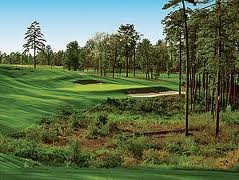
Visual Par Three #8  (golf.com)

The course starts out kindly enough with a sweeping downhill dogleg left that reminds me of the first at Spyglass Hill.  The pace remains tepid for the next few holes until you reach the fourth which is a massive dogleg left par four which will change your mindset for the day.  What follows the rest of the front side are a series of very technical holes that demand you control your roll out to avoid the adjacent trouble.  The ninth is the angry sister of the fourth which it parallels in the opposite direction-big dogleg right with an uphill approach into a difficult green.

The back side starts quietly but from 11 through 13 you play a series of very difficult holes in an area where they turned a sand pit into a visually intimidating series of hazards.  From here in the challenge rachets up considerably.  The fourteenth is your classic warf style hole with water from tee to green on the left and a putting surface that seems to be hanging precariously above the water.

Around The Marsh #14 and 15    (www.pinehurst.com)

The last three holes work up and down the hillside that leads to the clubhouse.  In all cases you are tempted to hit it farther than you need to-like the ending of the front side it is all about controlling your ball flight and positioning.  The finishing hole brings you up the hill to rediscover the view of the clubhouse perched atop the hill.  The cool one that is waiting for you in the bar will be eagerly anticipated.

Final Stretch Begins #16    (theduncanlist.com)

He designed this to be a walking course-the greens and tees are in close proximity.  Make sure you arrange for a caddie ahead of time-the experience is enhanced considerably taking this one in from ground level with some local advice.

Pinehurst, North Carolina

Architect: Tom Fazio (1996)

Tees       Par     Yardage       Rating      Slope

Blue       72        6698              72.3       133

White     72        6302              70.2       130

(Click to see complete Pinehurst No. 8 hole-by-hole descriptions)

Oakmont Country Club

Opening Hole Par 4 (golf.com)

Much like Merion, Oakmont is a total golf experience-the club house, the golf shop, the operations of the golf facility, the caddies, the whole nine yards are steeped with rich tradition oozing from every nook and cranny.  It is not just the impressive pictures of past champions who have won here like Jones, Sarazen, Snead, Hogan, Nicklaus, Miller, Els, Cabrera, Sheehan, and Creamer-it is not even the overwhelming appearance of the handwritten scoresheets from those events (little known trivia is that Calvin Peete finished fifth the year Larry Nelson won his U.S. Open here).  It is the whole aura of the place, creakie floors, un-airconditioned locker rooms, the porches wrapping the clubhouse and looking out over the golf course, all of it makes this an authentic relic that cannot be replicated.  When you go here you just have to take the time to meander around and take it in-breath some musty air-look closely at the wood lockers that have been there since the depression-talk to the help-they know the traditions and are glad to share.

#3 Pews Par 4 (whosyourcaddie.net)

From the golf design side, Henry Fownes clearly accomplished his goal of making this one of the hardest tests of golf in the country.  The large furrow marks in the bunkers are gone, but the lightening fast, undulating putting surfaces are there, the dense rough and the occasional heather field are there, the 160+ bunkers are there and in play throughout,  the hilly terrain that takes a shot hit without confidence to places you would rather not know is there.  The overall balance of an extremely difficult, fair test of golf is what you get.  The modern equipment may give you the extra distance to shorten some of the long holes, but truthfully the test is in tactics and execution not in distance.  Look at the list of winners-Melnyk, Nelson, Mahaffey, Sarazen-these were not men with prodigious length but men who hit it in play and can play around the greens.  The secret to Oakmont is hitting it in the fairway off the tee and pitching and putting to save pars from below the hole.

From the blue tees, length very seldom seems to be a factor.  Angle of attack or approach seems to always be a factor.  The driving areas are visually expansive but are always confined by bunkering usually on two sides.  You get none of the cloistered feeling of trees encroaching the playing area.  There are plenty of big old trees but most are just background.  Beside the bunkering plentitude, the greenside bunkers are very severe.  With a sixty degree you can get out of all of them but getting close will be a challenge.

#5 Testing Par 4 (GolfPublisher.com)

You cannot think of Oakmont without trembling at the thought of the warp speed of the greens.  Stimpmeter measurements aside they are just flat out fast.  I have heard criticism that the greens are too undulating considering how fast they are maintained and this is something I agree with.  But it is a characteristic of the course and you just have to accept it.  As troublesome as the downhill putts are I think the real challenge is hitting the uphill putts hard enough.  On all courses with fast greens the differential in absolute speed between a downhill and uphill putt is way greater than on a course with slow greens and this differential will drive you batty.  You just want to smack yourself upside the head with your Odyssey every time you leave an uphill putt short-and you will do it all day.

Besides keeping your drives out of the rough, and this is a must to have any chance for pars, I think effective pitching and chipping is where the scoring is at.  Again the fast greens will carry shots without conviction off to the aprons and you must be able to up and down from there to make pars you thought you deserved.

Storied finishing hole at Oakmont (courtesy of Alan Levine/Lowl Productions)

When you are done here you will likely feel beaten but not unfairly beaten just beaten because of lack of tactical conviction or shot execution.  Like the Gold Course at the Golden Horseshoe this is a course to play again and again-it will tantalize you and occasionally treat you kindly, more often than not you will walk away shaking your head at what could have been.  But then again that is the lure isn’t it.

Oakmont, Pennsylvania

Architect: Henry C. Fownes (1903)

Tees                           Par           Yards          Rating        Slope

Championship            71            7255            77.5            147

Blue                            71            6436            74               134

(Click to see complete Oakmont hole-by-hole descriptions)
The Eyes Have It

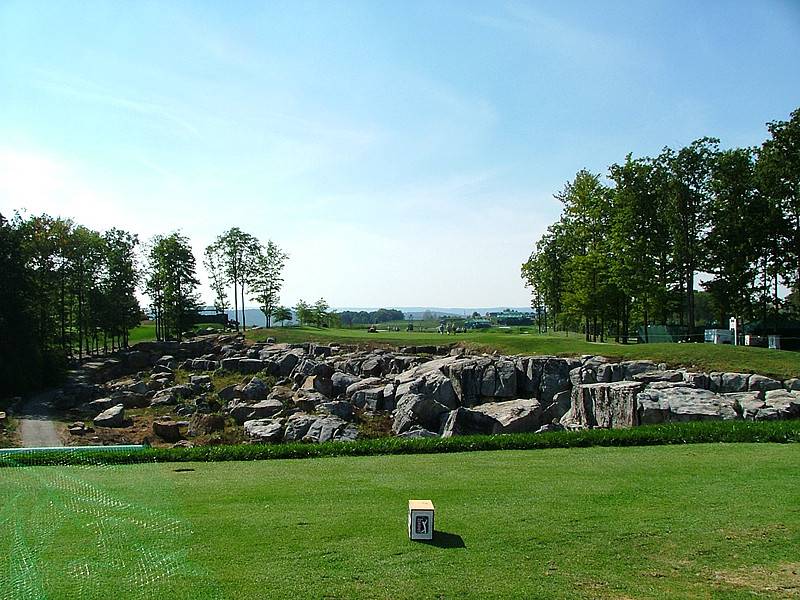
In a year when all four majors were captured by first-time winners in a variety of dramatic scenarios, the PGA Championship may have proved to be the most dramatic of all.  25-year-old Keegan Bradley trumped the field with final round performance full of moxie and guile we would not have expected from a rookie on the PGA tour.

Keegan’s competitive career has always shown moxie-as a Nationwide guy last year he made the cut in 18 of his 28 events, finishing top 25 in 15 of those to earn his PGA card as the 14th ranked player on that tour.  His first year on the big tour has been much of the same-he made 16 cuts out of 24 starts including 2 wins, 3 other top tens, and 10 top 25s on his way to earning $3,432,000.  When this guy puts the stare on an event he intends to compete to the end and walk away with a serious pile of money.  Depending on how he does in the playoffs he has a real chance at the unheard of double honor of Rookie of the Year and Player of the Year in the same year.

His performance yesterday was as riveting as his stare-you could tell that his playoff win at the Byron Nelson this year and his excellent showing in the WGC Bridgestone a few weeks ago prepared him well to deal with the unbridled pressure of winning the first major he ever played on a course that brought the best in the game to their knees, holding their head in their hands wondering what went wrong.

For Keegan, his birdie response in the final round on 16 and 17 after the train wreck triple bogey on 15 that left him five shots back of Jason Dufner was the seminal statement of the event.  Coupled with the good fortune Dufner conveyed by going three over in the last four hole gauntlet at the Atlanta Athletic Club, there was little doubt going into the three-hole playoff who was going to prevail.  Dufner hit it to six feet on the first playoff hole and Bradley one-upped him by stuffing it even closer and making the putt for birdie and a one shot lead.  On 17 and 18 Bradley fearlessly ignored the more conservative approach and took dead aim at the flag clearing the water by just feet on both approach shots.  The resulting pars seemed to deflate Dufner’s resolve and it was just a cool walk to the trophy ceremony for Bradley from there.  It should not go unnoticed that Bradley beat a host of twenty-something American hopefuls to a first major victory-guys like Dustin Johnson, Nick Watney, Rickie Fowler and others who have gotten all the press as the next great American golfing hope.

Kudos to Jason Dufner who displayed almost equal resolve as a relative unknown coping with the pressure of leading a major on the final day.  He showed real class after fumbling the trophy down the stretch saying,  “I’m disappointed now but there are a lot of good things to take from this week……I know the media tries to define careers of certain players…you did this…you didn’t do that….I want to be as good as I can be.  If that is 20th in the world with no majors or first in the world with ten majors or never win a Tour Event, I’ll be fine with that.  Hat’s off to Keegan, he played great to get into the playoff and played great in the playoff. He deserved to win”.  This is a guy with his head on straight who will build a solid career on the tour because he has proper perspective and ambitious expectation at the same time.

On a lighter note, after it was said and done, Keegan Bradley tweeted the interested masses that he was celebrating with  “3 Bud Lights, Cereal, and P.P. & J.”.  I have a feeling that once the check clears the account he will be looking at a serious upgrade in his post victory celebrations in the future.

August, 2011

Golf Magazine Top 100 Courses 2011

The lists of 100 best courses are compiled every year by a variety of golf magazines in a very subjective process so what makes the list is in the eye of the beholder. But no matter how you slice it for a course to appear on the list at all means they are in a very exclusive group and it is worth taking notice.

Golf Magazine came out with their top 100 for the year in the U.S. and the World and many of the household names still dominate the top ten. Pine Valley is at the top, Augusta, St. Andrews, Oakmont, and Muirfield and in the top ten. But what is more interesting is what new sites have been added to the list. Enjoy a look at some of the new entries shown below.

Tom Doak and Jim Urbina designed a seaside treat in Old Macdonald at Bandon Dunes in Oregon a tribute to the great Charles Blair MacDonald who designed some of the most memorable courses in the Golden Age of American design of the 20’s and 30’s. This one was number 43 on the U.S. List.

Old Macdonald Bandon Dunes, Oregon (John Henebry)

At number 70 in the U.S. Fazio did a stunning course called Grozzer Ranch on the treed rocky bluffs overlooking Lake Coeur d’Alene in western Idaho. Here he employed some very imaginative design features that only enhance an already breathtaking visual golf experience.

Grozzer Ranch Coeur D

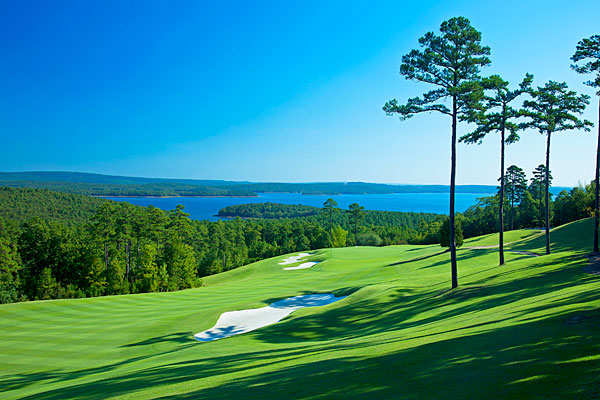
In Arkansas Tom Fazio did an Augusta National like gem called The Alotian that is number 76 on the U.S. best 100 on a rolling, wooded tract studded with azaleas in spring and an ambiance of relaxed exclusivity.

The Alotian Arkansas (Rob Brown)

Some design tweaking to Caves Valley Golf Course outside of Baltimore, Maryland moved this Fazio design onto the U.S. list at number 82. This was the site of a Walker Cup and a U.S. Senior Open in the last decade but the members have continued to put a concentrated effort into refining the course and made it into something special.

Caves Valley Owings Mills, Maryland (Larry Lambrecht)

Looking at this list makes you understand how much catching up there is to do if you intend to play a significant percentage of the greatest courses in the world. So start making plans!!!

(Click here to see Golf Magazine’ World 100 Best Courses for 2011)

(Click here to see Golf Magazine’s US 100 Best Courses for 2011)

August 2011