The Golden Age of Golf Course Design

The Golden Age of Golf Design LogoAt the turn of the century golf course design in the United States was in a nascent and mundane state. Building a new course was pretty much about staking holes in straight lines on flat terrain with a few hurdle hazards to make it challenging. Thankfully with the immigration of golf “professionals” from Scotland and England in the early 1900’s the strategic thoughts and concepts of course design from the links courses of the British Isles started to infiltrate the thinking as new courses were built to meet a fast growing interest in golf in the states.

In his book “The Golden Age of Golf Design” journalist and author Geoff Shackelford catalogs the accomplishments of a new age of golf course architects that marked the most prolific and creative period of course design in the past century. Men like Charles Blair Macdonald, Seth Raynor, George Crump,  George Thomas, Donald Ross, Hugh Wilson, William Flynn, A. W. Tillinghast, and Alister MacKenzie completely changed course construction introducing new and bolder routings, hazards, and green complexes to usher in a new strategic approach to course design.

These guys and their associates were downright prolific-the number of courses in the U.S. expanded from around 700 in 1916 to over 5900 by 1930. They went on to produce some of the most memorable courses as well.  As Shackelford points out a Golfweek list of the Top 100 American Courses opened before 1960 indicates that 84 of the top 100 were constructed between 1910 and 1937.

The Golden Age of Golf Design is a beautiful leather bound biographical encyclopedia of information on about 40 of the most influential characters of this period. To make this intelligible Shackelford groups the architects into five-plus “schools of design” of his own making-The National School, The Philadelphia School, The Ross School, The MacKenzie School, The Monterey School, and Other Schools. Each school is made up of a number of architects who studied each other’s works and helped leverage new course production in different regions of the country. What defies his distinctions is that many of these designers cross pollinated schools by expanding their contributions across the country and even around the globe. But there is little doubt that the era spawned mentorship and collaboration which hastened the proliferation of new and better designs
over a very short period of time.

Shackelford provides well researched detail of the interactions of these designers to explain the evolution and dissemination of the new strategic concepts. He has a credential page on each architect which includes their interests, published writings, career influences, golfing ability, methodology, design characteristics, best original designs,
and a personal quote. He supports this with a trove of original black and white photos of the holes from some of our classic golf courses to give context to their conceptual elements.

A wonderful accent to the book are the watercolor drawings of Mike Miller on the cover and at the beginning of each chapter of iconic holes from Merion, Los Angeles Country Club, Royal Country Down, Pine Valley, and Pebble Beach among others. The vivid renderings give the reader a surreal feeling for the character and design of these classic courses.

Geoff’s book provides a synthesized understanding of the contributions of these designers and their influences on each other in setting a new standard for quality course design in the Golden Age. For an armchair course architect the book is a go-to reference manual that codifies the genealogy of the influential architects from the most significant age of American golf course design.

The Golden Age of Golf Course Design
Geoff Shackelford (1999)

moerate3

The Magnificent Masters

Jack Nicklaus, Johnny Miller, Tom Weiskopf, and the 1975 Cliffhanger at Augusta

Magnificent Masters LogoThere are seminal moments in tournament golf, specific instances where the tournament, the venue, the protagonists come together in a perfect storm to showcase an historically significant event that changes forever our perception of a major tournament. Before 1975 The Masters was a major, it had it’s share of great winners and dramatic endings but it was mostly a vivid beginning of the golf season for American golf viewers, set in a resplendent arboretum in Georgia.

In 1975 three of the best players in the game, Jack Nicklaus, Johnny Miller, and Tom Weiskopf did what rarely happens. They came to Augusta with their A-games, lived up to all the hype, and put on a competitive show for the ages. Gil Capps, a longtime golf industry veteran for NBC Sports and The Golf Channel, brings an attention to detail of the 1975 Masters that allows us to relive the round-to-round drama like we are watching it unfold right before our eyes and properly places it as one of the seismic moments in Masters golf history.

There have been a number of wonderful historical accounts of golf tournaments, matches, and prominent characters released in the last 10 years. If you have read and enjoyed Kevin Cook’s “Tommy’s Honor” or Mark Frost’s “The Greatest Game Ever Played”, “The Grand Slam”, or “The Match” you know what I am talking about. You will find this account of the lives of these three champions and their elevation of The Masters to new heights equally intriguing.

The author has an intimate knowledge of Augusta National and the Masters and his detailed research provides the reader with an inside view of the history and development of the event over the last 80 years. For example, he talks about the stark white sand so prominent in our television images that create the bold faces of the MacKenzie bunkers. Clifford Roberts sourced the material from feldspar mining operations in North Carolina. It is actually crushed rock not sand and, as a result, when it is dry will disperse as balls hit avoiding embarrassing buried lies. There are countless other tidbits about the stewardship of Bobby Jones and Clifford Roberts helping this annual outing of a bunch of golf buddies evolve into a major championship.

The book is presented in a Kiefer Sutherland time-lapse format chronicling the practice rounds and the four tournament days as unique segments of the whole. This makes the reading a “real time” experience and the interplay of the subplots make the eventual outcome more vivid.

The Thursday round begins with “the most anticipated first-round tee time in Masters history” as he describes Lee Elder’s breaking of the color line at this most famous of southern golf venues. It includes an entertaining vignette about Bob Murphy and Lee Trevino two guys who never played up to their potential at Augusta. Capp says “The two players had four things going against them: their lack of length, their left-to-right ball directions, their low ball flight, and their attitude”.

The pattern of the book is established as he wanders off for a biographical chapter on Nicklaus, the first of three he intersperses between accounts of the four days of play. The reader gets a good sense of the importance of the golf character and motivation of Bobby Jones as a competitive impetus to Nicklaus. Jones cared only about the majors and therefore Nicklaus saw winning majors as the ultimate benchmark of golf achievement.

Biographical sketches of backgrounds of Johnny Miller and Tom Weiskopf provided the strongest additions to my historical golf knowledge from reading this book. Miller was the roman candle of the era, bursting on the scene with a victory in his first pro event in 1969 at the age of 22, proceeding to win almost every tournament played in the arid climates over the next decade. His 63 in the final round at Oakmont to win the 1973 U.S. Open was one of the most jaw dropping accomplishments in history. Miller was driven to be the best in the game and never was afraid of Nicklaus. In fact in Miller’s 25 wins on the PGA Tour Nicklaus was second in 5 of them. From 1969 to 1983 Miller was always in the conversation at the majors until, as Capp says, “Miller had fallen out of love with the process that had driven him to the top of his sport”.

Weiskopf was another story, he had to bear the yoke of following in Nicklaus’s foot prints, growing up in Ohio and playing at Ohio State just behind him. Weiskoff was a perfectionist with no patience for mediocrity, a slam dunk to be the next great in the game. His game had “both arrogance and elegance to it….It was the tempo and rhythm that others swooned over…..a grace and smoothness rare for a tall man who always finished in perfect balance.”

Weiskopf won 16 times on the PGA Tour including one major at the 1973 Open Championship at Royal Troon and finished second or third in majors 8 times from 1969 to 1978. But for all of that accomplishment he was considered an underachiever.

His Achilles Heel was his perfectionist attitude and the expectation of greatness heaped upon him in comparison to Nicklaus. In a big event he could be in the thick of contention or seemingly out of touch. As Capp says, “If Weiskopf was playing well and in contention, there was complete resolve. If he was playing poorly, he could totally disengage”. The roller coaster ride of Weiskopf’s professional career took a severe personal toll and he dropped off the golf radar screen after his last win in 1982 at the Western Open.

I leave the description of the golf to your reading of the book, the drama Capp conveys is just captivating. Suffice it to say that Miller shot 65-66 on the weekend, Weiskopf 66 and 70 and had a putt for a playoff on the final green. The rest is history….magnificent history.

.
Gil Capps (2014)

moerate4

Every Shot Counts

Every Shot Counts CoverIf you have watched any golf TV broadcast in the last year in a conscious state then you know the PGA Tour has wrapped it’s arms around a new statistic for putting performance called Strokes Gained Putting. It has become the overnight standard for determining who is putting the best in any given Tour event.

The genius behind this concept is Mark Broadie professor and research maven at Columbia University and a single digit handicapper to boot. His background is in statistical analysis of financial performance dealing with unintelligible things like pricing of derivative securities, risk management, and qualitative decision-making under uncertainty. Sounds to me like a man who can get to the bottom of your putting woes.

Mark Broadie’s recent book “Every Shot Counts” is the professor’s exhaustive explanation of the Shots Gained statistical approach to performance in all aspects of the game of golf. With the help of the PGA Tour’s commitment since 2004 to collect exacting data on every shot and putt at PGA Tour events through their Shotlink system, Broadie has found the ocean of data to develop his theories and articulate how to explain much of what we see week-to-week on the tour.

He starts from an obvious premise that the benchmark statistics that have been used for years to measure golf performance, Fairways Hit, Greens In Regulation, Scrambling, Putts Per Round, and Putts Per Green In Regulation are too shallow to give any meaningful direction to the players on how to improve their performance vis-à-vis their peers.

From the stats he gleaned that PGA pros average 29 putts a round with an average score of 71. Tournament winners average 67.4 strokes per round so the differential between winning and the average is 3.7 strokes per round. Pertinent question is what part of their game contributes to the 3.7 strokes per round advantage of the winner over the field, their shots gained on the field.

To that end he says, “The final score on a hole typically results from the accumulation of fractional gains and losses on each stroke.” “The quality of a golf shot is measured by progress to the goal of getting the ball in the hole in the fewest possible strokes”. “Strokes gained [was developed] to measure a player’s shot outcome against a peer performance benchmark for the same shot.” “Strokes gained measures [a player’s] progress to the hole in terms of the average number of strokes to hole out.”

A similar conundrum has existed in baseball for a century. Broadie says, “In baseball batting average was long the main stat used to measure proficiency at the plate……the sabermetrics revolution in baseball stats….. show that another stat, the on-base plus slugging percentage is a better predictor of a batter’s contribution to runs scored.”

With the help of the Shotlink data available to him Broadie sketched out how strokes gained putting could prove a more accurate measure of putting performance for the professionals. The average strokes gained putting for all golfers in a PGA event gives the ponderous among us a simple and reliable measure of the players relative putting proficiency that week. If Luke Donald is 15 feet from the hole and makes the putt and the average number of putts a pro takes from 15 feet is 1.78 then Luke has .78 strokes gained putting for that effort. If Vijay is five feet from the hole, where the average pro takes 1.23 strokes to hole out, and two-putts then he has a -.23 strokes gained putting on this hole. The sum of the strokes gained putting for the 18 holes based on their first putt is the player’s strokes gained putting for the round.

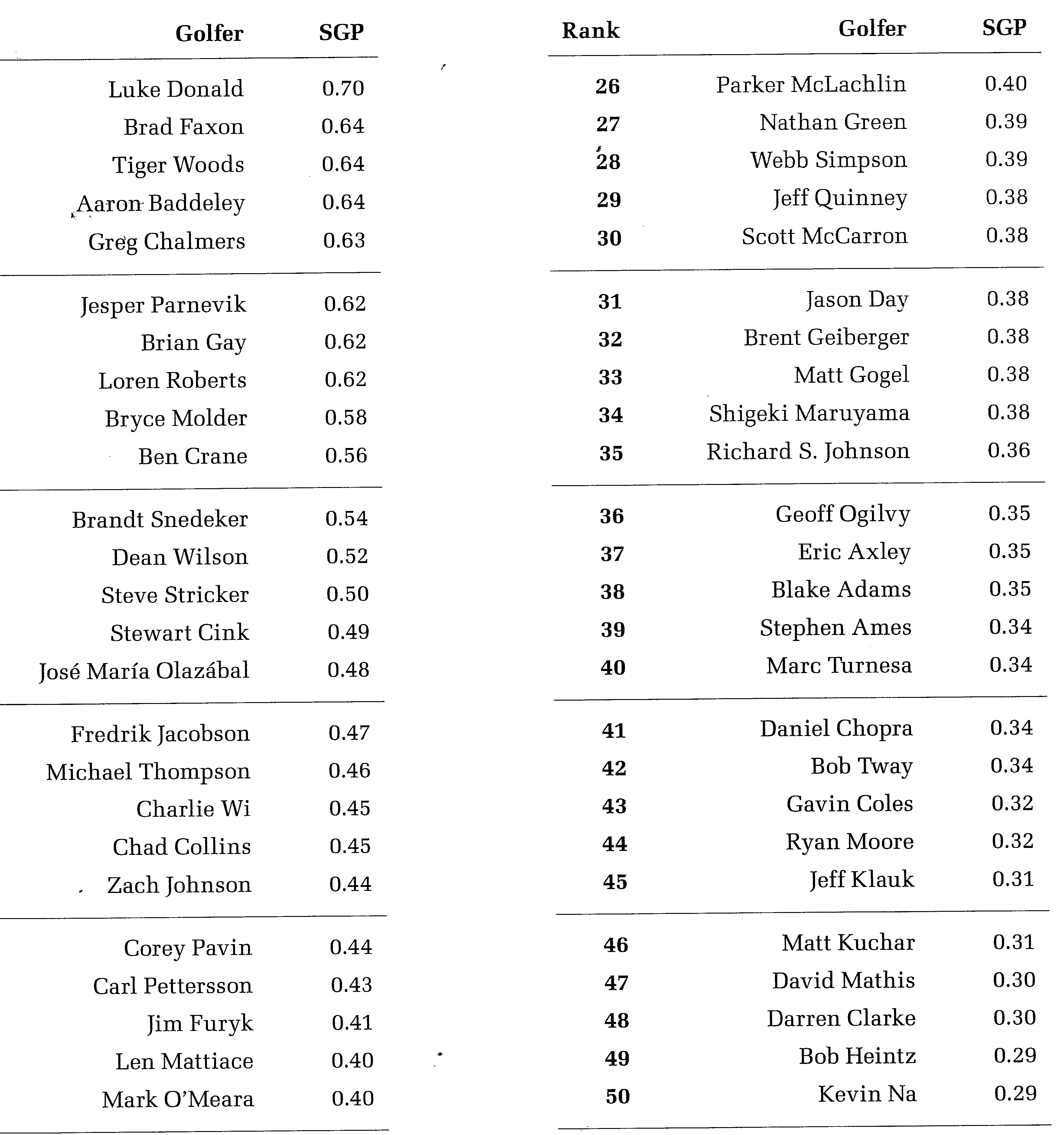
Below is a Broadie chart that shows the top 50 putters on the PGA Tour from 2004 to 2012 using Strokes Gained Putting (SGP) as the measure of relative performance. Not surprising Luke and Tiger are in the top five but so are Aaron Baddeley and Greg Chalmers. Some surprise in the names not in the top 20.

Top 50 SGP
Broadie has moved on to trying to convince the Tour on using a similar statistical method on evaluating tee shots, approach shots (over 100 yards), and short game shots. It measures how much a person gains on a shot he has played by measuring the decrease he has accomplished during this shot in the average number of strokes to hole out minus one to account for the shot played. Simply stated a shot that is better than Tour average will have positive strokes gained and a shot worse than average has negative strokes gained.

Using this method the strokes gained can be used to compare driving, approach shots, short game shots, and putting because the proficiency of all the shots are measured by a common unit of strokes gained.

After applying this to the Shotlink data Broadie concludes that for the top 40 golfers from 2004 to 2012, putting only contributes 15% to their scoring advantage over the field while driving contributes 28% to their scoring advantage.

He asserts that an extra 20 yards of driving distance, without regard to accuracy, is worth about .75 strokes gained per round. This extra distance gives them a shorter approach shot, with a lower average shots left to hole out, and that translates into strokes gained. So it is more important to drive it long on the Tour than hit fairways in terms of gaining strokes on the competition.

When it comes to hitting approach shots it is all about proximity to the flag to improve one’s strokes gained. This has been Tiger’s secret in dominating the game the last decade and a half. The closer Tiger’s shot from 175 yards out gets to the flag versus the average Tour player the more strokes gained he has on the field.

Top 50 SGAThis chart shows Strokes Gained Approach (SGA) and you can see that Tiger’s SGA of 1.28 is .73 better than the average top 40 player. When Broadie breaks it down further you can see that on meat and potato approach shots from 100 to 150 yards and 150 to 200 yards Tiger is hitting it considerably closer to the hole than his peers and that is where he gains his shots on the field.

The only problem with all of this is that it relies on the inundated accurate data collection of every shot a pro plays in a tournament round. No such data collection vehicle exists for the average player to use or even for researchers to use to compile strokes gained benchmarks for the common golfer. This is a huge case of having the cart before the horse when it comes to helping you and me.

This review just scratches the surface of what Broadie reveals in this readable and informative treatise on this Shots Gained Method for analyzing golf stats. He dispels many of the myths and certitudes we have held dear for years about golf performance. You can pitch “Drive for show and putt for dough” right over the embankment along with a bunch of others.

Broadie devotes an entire chapter to the relative difficulty of uphill versus downhill putts, importance of break on putts, and what distances actually separate good putters from average putters. He even includes practice drills that can help you understand the strengths and weaknesses of your game around the greens and work on the things that will make a difference in gaining strokes on your buds.

He presents the book in a very readable format with lots of substantiating charts and graphs to help you comprehend what he has concluded. Like all good college text books he has reiterative summaries at the end of each chapter that make prepping for the exams much easier.

This is not a fast read but it is a worthwhile intellectual indulgence for the inebriated golf fan. The shelf in your golf library is yearning for this one.

.
Every Shot Counts

Mark Broadie (2014)

April, 2014
moerate4

Sand and Golf: How Terrain Shapes The Game

Sand and GolfPlaying on the links at Royal Dornoch or Pacific Dunes or The Old Course you cannot help but understand that there is is a different type of golf you are asked to play.   Links golf is played closer to the ground, emphasizing finesse and position,  thoughtful approach and recovery.   This style of golf in unique both in strategy and shot implementation.  The lure of links golf is infectious to those who have experienced it and explains why so many of us will travel to obscure destinations to experience it again and again.  The subtle question that almost never occurs to us when we are playing links golf is how much does the sandy soil itself account for the character of these courses and the style of play they dictate.

To George Waters, a course architect with plenty of credential from working on sandy soil terrain, this seemed a subject worth addressing in a book.  He has worked on the construction or renovation of some of the best sandy soil courses in the world including Barnbougle Dunes in Australia, Sebonack in Long Island, The Renaissance Club in Scotland, and Pinehurst #2 in North Carolina.   He spent considerable time working at Royal Dornoch as well as studying courses in the Sand Belt of Australia, Bandon Dunes in Oregon, the Sand Hills of Nebraska, and links courses throughout the British Isles.

His photographs and the accompanying text convey how the sandy soil and the topography that has evolved with it provide an opportunity for architects to create these sand based links, wonderful compilations of features provided by the great greenskeeper in the sky and some thoughtful contributions of their own.   With a unique set of elements   “designers let terrain shape the game rather than the other way around…. the key is to give players room to adjust their strategy to the conditions and their style of play.   This puts a premium on analysis and problem solving, making golf more a thinking game.”

Water’s asserts that sandy soil gives these architects the optimal conditions for creative design.  The rapidly draining turf allows them to maintain firm and fast conditions almost all the time.  The natural depressions in fairways and greens can be employed in the design since they will not collect water creating troublesome soggy areas.  Hearty long stemmed fescue and bent grasses thrive in this soil and can be kept closely cropped to allow for consistent firm and fast conditions.

Nature’s evolutionary effect on the sand based topography creates an array of natural hazards the designer only needs to compose rather than create.  Fierce and penal blow out bunkers are only a scratch of the surface away which allows more arbitrary location of the fairway bunkers.  Existing grassy mounds and protrusions can be employed in the lines of play to force strategic choices that need to be carefully considered but depending on the day’s wind direction and intensity.  Native grasses and low growth plantings can be used to shore up these natural hazards further erosion and give these hazards an aged, seamless character “blurring the edges between golf and nature”.

These same native grasses create rough that is imposing but playable, “the perfect balance between penalty and recovery”.  With the exception of the prickly dense gorse bushes that impose their presence on some sandy soil courses, recovery shots from the rough require a calculated assessment to determine just how much recovery is plausible on the next shot.   Approach and recovery play a pivotal role on this type of course.  “On well designed sandy courses, the interplay between firm conditions and clever architecture places approach and recovery shots among the highlights of any round.”

Playing these courses we come to quickly understand that the irregular natural terrain and the ever present wind dictate a more grounded style of play.  Mildly articulated washboard roll outs or heaving tempests of hummocks and hollows can lead to existential shot results. A strategy of play to minimize their effect must be respected.  But these same topographical irregularities are an ally in controlling the pace of a ground approach to firm, contoured, and wind swept greens that may not abide an airborne approach.

He talks at length about the green complexes on sandy soil courses being in sync with the topography.  “Fairways relate to approaches, and approaches to greens, with continuity that is nearly impossible to achieve on other types of terrain.”   Table top greens, greens with shoulder pads, punch bowl greens, greens with sweeping contours, and greens that just seem to be a natural extension of the fairway all are possible on this sandy soil base.  With the challenge these complexes present green speeds do not have to be pushed to the maximum to challenge even the best players-this makes the course more playable and fun for players of all ability.

Waters concludes, “It is much easier to design and maintain a golf course in harmony with a sandy environment.  On a forested site, comprised of heavy soils and replete with ponds and bogs, a golf course is more an installation in the landscape than a natural part of it.”  The character of sandy soil courses “illustrate the advantages of valuing fun and playability above difficulty and perfect conditions, as well as the benefits that come with accepting some natural imperfection.”

If books like “Scotland-Where Golf Is Great”, “Emerald Gems-Links of Ireland”,  “Links Golf” by Paul Daley and “Grounds For Golf” already adorn your personal golf library, “Sand and Golf” will find a comfortable spot right beside them.

Sand and Golf: How Terrain Shapes The Game

George Waters (2013)

January, 2014

moerate3

True Links

True LInksTwo former editors of golf magazines of substance have put together ‘True Links’ an illustrated guide to the 246 Links golf courses in the world.  Much in the vein of Larry Lambrecht’s ‘Emerald Gems’ and James Finegan’s ‘Scotland-Where Golf Is Great’ this is a thoughtful presentation of photos and supporting research on the links courses that define the game of golf.

George Peper, a former editor of Golf Magazine, and Malcolm Campbell, a former editor of Golf Monthly, bring their expertise to the task of defining and documenting the active links courses around the world.  Augmented by the vivid photography of Iain Lowe and other supporting photographers this book brings to life the grandeur of links courses from the British Isles and around the world and puts their individual stories in the context of the evolution of golf over the centuries.

Their premise is that links courses remain the soul of a game that has spawned over 30,000 golf playing grounds around the world.  In the prologue they say, “Links golf is the game distilled to its core virtues.  To walk beside the sea with a brisk breeze on your cheek and firm,sandy turf beneath your feet is to experience golf not only as it was hundreds of years ago but arguably as it should be today-a simple, beguiling game in need of no embellishment.”

If you asked the greatest players who ever played the game where they would prefer to play every day links courses like The Old Course at St. Andrews, Royal Country Down, Muirfield, and Ballybunion would come to their lips.  The style of golf these courses demand bring out the deep seated talents of all players so the satisfaction of playing them well is very special.

Tom Watson, arguably one of the most successful players in Open Championships contested on links courses, slowly came to accept and embrace the demands of links golf.  He describes what he discovered, “Don’t fight it…enjoy it.  Solve the puzzle……Calculating the wind, allowing for the firm terrain, trusting your judgment and feel…that is the joy of playing a links.  You need almost a sixth sense, an ability to adjust to all the conditions and somehow get your ball to travel the proper distance-whether through the air or along the ground.  That is the essence of links golf.  But the links giveth and the links taketh away.  It can be cruel and beautiful in the same round, occasionally on the same hole, and once in a while on the same shot.  When you figure out all the equations properly and the shot comes off as intended, nothing is more satisfying.”  I have a feeling Phil has come to share this sentiment recently.

True Links begins by defining what distinguishes under 250 of the courses in the world as Links courses.  The British Golf Museum in St. Andrews defines linksland as “a stretch of land near the coast…characterized by undulating terrain, often associated with dunes, infertile sandy soil, and indigeneous grasses as marram, sea lyme, and the fescues and bents which, when properly managed, produce the fine textured tight turf for which links are famed.”  Add to this the quirky and sudden changes of wind and rain that seaside venues present and you have a chess game on grass against the elements and the higher order who choreographs them.

The result of this requirement of turf, terrain, and weather is that many of the most familiar and storied seaside courses are left off of the list of Links courses.  Pebble Beach, Cypress Point, Royal Melbourne, Whistling Straits, Shinnecock Hills, and The Ocean Course at Kiawah are spectacular and challenging venues we equate with links golf but they lack either the firm sandy turf, the associated dunes, or the close proximity to the sea that strictly defines a links course and the brand of low to the ground golf associated with them.

The authors pay homage to the great architects that drew links courses out of the unique terrain nature presented in the British Isles.  From Old Tom Morris to Harry Colt, James Braid, C.B. MacDonald, Alistar MacKenzie, Donald Ross, and A.W. Tillinghast they show the linkage of thought and design the great architects made studying the challenges of links courses and how they incorporated them into what would become the classic courses of the Golden Age of Course Architecture.   This respect for links design feature continues to be seen in the contemporary work of Pete Dye, Tom Doak, Ben Crenshaw, Bill Coore and others in places like Whistling Straits, Bandon Dunes, Sand Hills, and Cabot Links.

The Crucible is a chapter dedicated to the grand daddy of them all, The Old Course at St. Andrews.  Tracing it back to days of shepherds hitting rocks with their herding staffs, through Royal edicts against playing, to Rabbit Wars for the land’s usage, we get a sense of how the game evolved.  Rules, equipment, course construction and maintenance were forged over centuries throughout Scotland.  The standard of the number of holes, the routing, the cup, the ball, and all the rest came from trial and error and the guiding will of a series of individuals who sought to regiment and standardize the game they were playing.

What follows is a chapter called The Icons which gives vibrant imagery and context to the 25 links courses that have defined the game.  Quirky courses-Lahinch and Ballybunion, original classics-Prestwick, North Berwick, and Rye, the full array of Royals-Aberdeen, Birkdale, St. Georges and Portrush , and the mysticals- Royal Dornoch and Royal County Down come to life as the authors explain the developmental history and unique characters of these pioneering links.

The Classics are the next level spawned by the Icons-they are the broader inventory we have come to know as links courses.  Many are familiar, Machrihanish, Lundin Links, Waterville, Country Sligo, and St. Andrews Jubilee.  Others less so The Island, Enniscronne, Gullane, Aberdovey, and Ballyliffen.   From there they go to The Exotics covering the links courses outside the British Isles in The Neatherlands, Germany, New Zealand, Australia, and South Africa.

The journey ends with The Moderns, links courses that have come on line in the last forty years and reinvigorated the interest of golfers in the true tradition of the game.  New entries in Ireland-Tralee, Doonbeg, and The European Club, Scotland-Kingsbarns, Castle Stuart, and Trump International, and North America-Bandon Dunes, Pacific Dunes, Old MacDonald, and Cabot Links are testimony that the influence of links golf design on the pleasure and enjoyment of golf continues.

Peper and Campbell argue that the future of golf remains in the hands of this movement.  The demands of environmental responsibility and financial viability in developing new courses once again directs the architect’s attention to the minimalist approach to designing and maintaining a links course.  Jim Arthur, an agronomist and promoter of natural links in Scotland put this way.  “Lack of money has always been a great limiting influence on the making of mistakes.  The poorest clubs have the best courses…in greenskeeping one should ask a farmer what to do and then go and do exactly the opposite.”   The coast of Oregon and Nova Scotia, the sand hills of Nebraska, and down under in Tasmania Australia credence has been paid to this notion with fine result.

For an understanding of the place of links courses in the historical time line of golf, simple reminiscence of the places one has played, or in developing a bucket list of what is yet to come, True Links is a book that should have a place on your library shelf.  This is a book you will reach for on a regular basis.

True Links

George Peper and Malcolm Campbell (2010)

October, 2013

moerate5

The Right Sticks

The Right SticksPlaying golf efficiently requires a precise match of your personal physical parameters and athletic skill to your equipment.  Unlike driving a performance car to the club it is more than just a seat adjustment that is needed to give you the greatest pleasure of the experience.  More important, the claims of the equipment goliaths who make the “new and improved” product are often hollow or misguided and will more likely create game frustration than game improvement.

Tom Wishon’s book, The Right Sticks, is a club maker’s valued attempt to educate golfers about the elements of club design, production, and fitting.  He fingers through 37 equipment myths that will be surprisingly familiar to you and helps you understand what is really behind the technological improvement in equipment over the last 50 years and how to properly apply it to improve your satisfaction in playing golf every day.

You may not come out of reading this with all the answers but at least, for the first time, you will have the right questions to ask of the guys selling or fitting you for the newest equipment offerings.

The most consistent claim year-to-year from equipment makers is that they will add distance to your game with their latest changes.  What they do not tell you is that all of these manufacturers, behind the improvements of cavity backed design, space aged club head materials, and a wider array of shaft fabrications, have made most of the gains in distancing by simply delofting your clubs.  What he calls “the dreaded vanishing loft disease”.

This snippet from Wishon’s book says it all:

7-Iron loft over the decades:

60’s 70’s Loft   40 degrees

80’s Loft           38 degrees

Early 90’s         36 degrees

Since 1997        34 degrees

No wonder you can hit that 7-iron 15 yards farther than when you were a young buck.  But also consider that your current five iron has the loft of an old three iron which explains why you can no longer consistently elevate any iron longer than that (ergo, the timely introduction of the new family of hybrids to address this elevation problem they created).

Enigmatic acronyms like CG (center of gravity), COR (coefficient of restitution), and MOI (moment of inertia) often dominate the ads or the reviews in your golf magazines.  Keep in mind those reviews are really infomercials for the manufacturers whose ads underwrite the magazine or website you are reading.  Wishon helps explain what these terms really mean to the performance of your golf shot and how appropriate or inappropriate they are vis-à-vis the claims of the shill masters.

In the end it is really about getting the modern equipment to be properly fitted to your individual physical and skill parameters.  Proper loft, lie angle, shaft type, shaft torque, shaft length, swingweight, and grip size can make a world of difference in you getting what you deserve out of the thousand dollar expense for the latest full set of clubs.

Mostly out of a need to limit the inventory offerings required by club purveyors the manufacturers present a single average set of specifications for the clubs.   The truth is that no one fits an average set of specifications and it is totally trying to fit a square peg into a round hole if you are silly enough to buy a set off the rack. It is equally bad if you go through an “inventory convenience fitting” in a golf super store by a quasi-educated operative (probably just a single digit player with little equipment fitting experience).

In my experience, consistent with Wishon’s claim, there is only one way to get golf equipment that properly suits your game and will enhance your every day golf experiences.  You have to buy your equipment through a qualified and experienced club fitter who will make sure the right things are taken into consideration in picking the specifications for assembling your clubs and will verify that every club he delivers is consistent with those parameters.  Yes, there is a fitter’s fee involved, they have a right to make a living.  But this fee will be amortized quickly because the fitter will make sure you do not “overbuy” the product that is appropriate for your game and you will no longer be back seeking replacement equipment every year in a vain search for that holy grail of the right stuff.

This is true for golfers of all genders, age groups, or talent levels.  A beginner, your spouse, or your uncle Harry will find tangible benefit and a faster improvement curve with equipment sized and assembled by a qualified fitter.  More people fall out of the game from frustration exacerbated by improperly fitted equipment than you can ever imagine.

This book is chock full of “de-mythifications” that will help you stave off the annual pitches of the golf manufacturers and media producers who are currently preying on your ignorance about what will make a difference in your enjoyment of the game.  I recommend you read it, highlight it, and go back to it regularly to help validate or discard the next set of claims you get from the brand name equipment purveyors.

The Right Sticks

Tom Wishon (2008)

(Note: If you search on line you are unlikely to find this new.  Your best bet is to buy it used for under $5 and pay the shipping.  This comes out cheaper than most paperbacks)

(If you are looking for a top line club fitter in the Washington, DC area I recommend you visit Wade Heintzelman at the Golf Care Center)

moerate3

Creating Old Macdonald

You ever sit around after playing a wonderful golf course for the first time wondering how cool it would be to play this gem with the course designer so you could understand what was going through his mind. Well if that course was Old Macdonald at Bandon Dunes then your wish has come true.

Creating Old Macdonald

With the considerable filmmaking skills at work of Los Angeles producer Michael Robin, the DVD “A Journey to Golf’s Past: Creating Old Macdonald” is packed with intimate goodies on the conception, planning, and creation of the latest links offering at Mike Keiser’s Bandon Dunes resort.  For the golf junkie and armchair course architect this is like manna from heaven.

Old Macdonald was the brain child of Mike Keiser who wanted to build a little bit of Scotland in America and honor the genius of C.B. Macdonald the father of golf architecture in America.  With the help of the foremost American expert in links design Tom Doak and his valued associate Jim Urbina they set about gathering characteristics of holes that C.B. had done through his career and composed the best of them into the glistening collection holes that make up Old Macdonald.

The feature presentation is over an hour of interviews with all the protagonists of the project covering the processes of planning, design, and execution of the course construction. The interviews with Mike Keiser give you real insight into his thinking as he has stewarded ambitious golf projects like Bandon Dunes.  It also includes vivid footage of the holes at Old Macdonald as well as their counterparts at St. Andrews, North Berwick, Prestwick, Yale Golf Course, and The National Golf Links.  Doak walks through the characteristics of the original holes at these venues and his interpretation of them in the new holes in Bandon.

There is also detail about construction challenges and techniques when it comes to building a links golf course.  Whether it is hand raking fairways to get them just right, feathering the final contours of the massive greens, or building a sod wall bunker one row at a time this is fascinating to watch.

As is the case with all these DVDs there are some extras to add value to your purchase in the form of “special features”.  The coolest extra is a hole-by-hole tour of the 18 at Old Mac with Tom Doak as your guide.  This is like having a video yardage book with the designer as narrator.  If you have played the course you will find this feature very enlightening.

For ten bucks plus shipping you can find this DVD on the shopping portal of the Bandon Dunes website.  The quality of Robin’s video and production along with the ethereal Scottish sound track by Mason Daring make for a very enjoyable and informative walk through the creation of Old Macdonald.

A Journey To Golf’s Past

Creating Old Macdonald

Michael Robin (2011)

(Click to read the moegolf review of the Old Macdonald Golf Course)

moerate4

Scotland-Where Golf Is Great

Where Golf Is Great

Whether you want to take sentimental memory walk through a recent trip across the pond or help  planning the trip of your life to the home of golf next summer, James Finegan’s “Scotland-Where Golf Is Great” belongs on your coffee table. This is the seminal work of the most informed American golf writer on the subject of golf in the British Isles.

Since his first visit in 1952 he has traveled the to Scotland over 30 times playing the great and the unknown courses across the length and breadth of the country.  With his wife Harriet he spent a dozen summers renting a flat overlooking the splendor of St. Andrews and played the Old Course more than 100 times.  A low single digit player he has developed a keen understanding of the nuances and pleasures of links golf in the old country and shares it with the rest of us in this fine book.

His writings herein on the golf courses, accommodations, and sights of interest in Scotland are second to none.  The presentation is further embellished by the breathtaking golf course photography of Laurence Lambrecht (author of Emerald Gems)  and the images of sights of interest by Tim Thompson.

Through his lens you can experience the uniqueness of the golf experience of over 90 courses in Scotland.  Finegan takes you on a counterclockwise tour that begins at the Kingdom of Fife with St. Andrews and Carnoustie, meanders north to the gems of the Scottish Highlands from Cruden Bay to Royal Dornoch, back down the west coast to the remote island outposts of Machrihanish and Machrie, on to west coast treasures of Loch Lomand, Royal Troon, and Turnberry, and finishing with the East Lothian Coast  home of North Berwick, Gullane, and the storied Muirfield Links.

From his pen:

The Old Course: “The most useful tip I can provide … is one you won’t get from a caddie..roughly 80% of the putts are straight, whether from 40 feet or 4 feet.”

Carnoustie: “Puts more pressure on the swing than any course in the British Isles….No
shot is a breather….this is the most confrontational golf course we will ever play.”

Cruden Bay: “Should on no account be missed..(standing) beside the clubhouse and looking down….. in all its turbulent splendor, lies one of the most awe-inspiring stretches of linksland ever dedicated to the game.”

Royal Dornoch:  “We are consistently struck by such a wonderful sense of naturalness as we make our way around…everything simply looks as if it has been this way for centuries.”

Machrihanish:  “The opening hole is…superior to just about every other 1st hole in the world…Our drive is fired on the diagonal across the Atlantic’s waves to an undulating fairway that skirts the shoreline…This is thrilling, tempting, tantalizing business…away we go on a round that will give us enormous pleasure not only as we play it but as we hark back to it again and again.”

Turnberry:  “The next eight holes (starting at 4) are strung out like a necklace, along and above the sea.  If there is any other links course where eight consecutive holes are able to produce challenge of this level and pleasure of this depth, I don’t know where it might be.”

North Berwick:  “For pure golfing pleasure, a pleasure bred of diversity, challenge, unpredictability, proximity to the sea, and the satisfaction of true links shot making, few courses can equal North Berwick’s West Links.  Is it a candidate for one course to play, day in and day out, for the rest of your life? Oh my, yes.”

An invaluable extra for trip planning, Finegan includes experienced recommendations of places to eat and places to stay.  His reviews take you right down to what primo room to request and what delectable dish to order.

Your coffee table is beckoning for this one.  If this book is within reach of your most comfortable reading chair you will find yourself leafing through it regularly to relive the grandeur and excitement of the links experience.

Scotland-Where Golf Is Great

James W. Finegan (2006/2010)

moerate5

Grounds For Golf

This book is subtitled “The History and Fundamentals of Golf Course Design” and that is an accurate description of what it is about.  Fundamentals, not the wonky details, of course design is what Shackelford successfully relates to the arm chair course architects out there.

You know who you are.  Guys who regularly are moving bunkers or rerouting the front and back nine on their home courses over clam chowder after an above handicap performance and a loss of two out of three on the morning Nassaus.  Or guys who come back from that man trip with a litany of “suggestions” on how those name brand architects could have made the courses just a tinch more playable.

This is an informative and very readable primer on golf course design and the history that has brought us to where we are today.  Shackelford is a bright guy with an easy going writing style who is well briefed in the subject and opinionated enough to make it thought provoking.  He is a guy who has played all the holes he discusses and has done the necessary background research as well.  The book is full of thoughtful quotes from C.B. Macdonald, Alister MacKenzie, Ben Crenshaw, Tom Doak, Pete and Alice Dye, among other design authorities that lend credibility to his opinions on the history of the development of course design.

For example:

“We want our golf courses to make us think.  However much we may enjoy whaling the life out of the little white ball, we soon grow tired of play a golf course that does not give us problems in strategy as well as skill.”
Bobby Jones

Add to this the etchings of Gil Hanse, a fine course designer in his own right, and it is a well presented and balanced presentation on a subject that too often is discussed vociferously without adequate background knowledge.

The book is compartmentalized by subject to cover what is architecture, schools of design, evolution of the craft, principles of design, great holes and classic designs, and even the nomenclature of the industry.  His two chapters on Comic Relief in quality design and the role of Temptation as a key element in challenging players to make quality decisions that will affect their scorecards are particularly interesting.

Shackelford has the distinction of having dabbled in design as a consultant on a track not far from Los Angeles called Rustic Canyon that he did under the tutelage of Gil Hanse and Jim Wagner.  This is a natural looking daily fee course they created in the rugged foothills of Southern California and it avails him the opportunity to explain many of his theories of design as expressed through their own experience in creating this course.

The print version is accessible for a steep price in the used market but you can get the Nook electronic version for about $7.99 through the internet.

This book is not for everyone, you need a bias of interest in the topic to wade through the detail he presents.  If you are an armchair architecture wonk like me this is something you need to have read if for no other reason than to have some basis for your personal authority when criticizing the Pete Dye design that just ate your lunch.

Grounds For Golf

Geoff Shackelford (2003)

Dream Golf-The Making of Bandon Dunes

Dream Golf is required reading if you are going to play this new west coast mecca of American golf.  Stephen Goodwin writes a detailed account of the conception, planning, construction, and operation of Mike Keiser idyllic contribution to the inventory of American golf destinations.  Goodwin’s access to Keiser, David Kidd, Tom Doak, Bill Coore, Ben Crenshaw and so many other protaganists who were instrumental in this exercise make this an informative read.

To dream of bringing true links golf to America was an audacious ambition on it’s own.  But Keiser, a wealthy entrepreneur from his success building Recycled Paper Greetings, took this a whole step further.  He saw himself as the George Crump of our time-the man who in 1913 conceived and funded the building of the most famous golf course in America Pine Valley on obscure sandy scrub hills outside of Camden, New Jersey.

To this end Keiser not only conceived of the idea he went through the painstaking process of becoming an expert in links golf by assiduously playing all the greatest links venues in the world and tirelessly networked with architects and experts on the subject.  Using his own money and connections he searched for just the right raw venue that could be a home to his dream until he landed on this remote site in southern Oregon.

The book documents Keiser’s immersion in the process and his entrepreneurial risk taking it took to bring it to fruition.  He landed the best young architects of our time before they were famous and full of themselves.  As a result he pushed them on to create something very unique-real links golf courses on American soil.

David Kidd-a young Scotsman-did the first course Bandon Dunes in the late 1990s.  Tom Doak, one of the truly knowledgeable people when it comes to traditional links course design, did Pacific Dunes next in 2001.  Bandon Trails was the work in 2005 of Bill Coore and Ben Crenshaw who had to negotiate the blending of more rugged inland terrain with the desired seaside features.  Tom Doak came back in 2010 to create Old Macdonald a testimonial course to the pioneering influence of C.B. Macdonald considered by many to be the grandfather of American golf course architecture.

This book provides marvelous insight into the planning of golf courses and the special challenge of bringing authentic links design features to an American seaside venue.  The detail of conversations and the evolved thinking that brought these courses-all of which are in the top 100 in America by the magazine rating listings-to reality makes this a rich and engaging read.

The bonus is that for each course the author played a round with the designer and Goodwin gives a hole-by-hole account of the experience.  This is like getting a course guide written by the architect as a primer before playing the course.  Very cool indeed.

I highly recommend this read whether you are going to Bandon Dunes or not.  If you are going to Bandon it will provide unique insight to the facility and the guys who created and still run the place.  If not you will just become much more knowledgeable about the Herculean effort it takes to create a storied venue.

Dream Golf

Stephen Goodwin (2010)