A Firm Handshake

The opening hole at Royal Portrush is a classic links hole. Modern architects who worry about such things as packed tee sheets and pace of play gridlock in the first three holes would not have the nerve to place a vending machine bunker in the face of the hill below the first green.

What is weird to me is that standing on the tee the bunker gets into your head even though you cannot reach it. It is like the architect is whispering in your ear, don’t hit this drive out of the fairway because your second shot will be incrementally more difficult if you do.

With a wee Irish breeze in your face you are tasked with trying to calibrate an additional club and a half up that hill on your approach. Not hitting from the short grass, it just takes the slightest timidity for a shot that clears the bunker to get sucked back off the false front into this sandy abyss. If you overswing and yank it the sand cavern 12 feet below green on the left is likely to see some action.

I remember walking off this green the first time I played it, after making a double, thinking this is going to be a difficult day.

December, 2025

Arnie’s Home Game

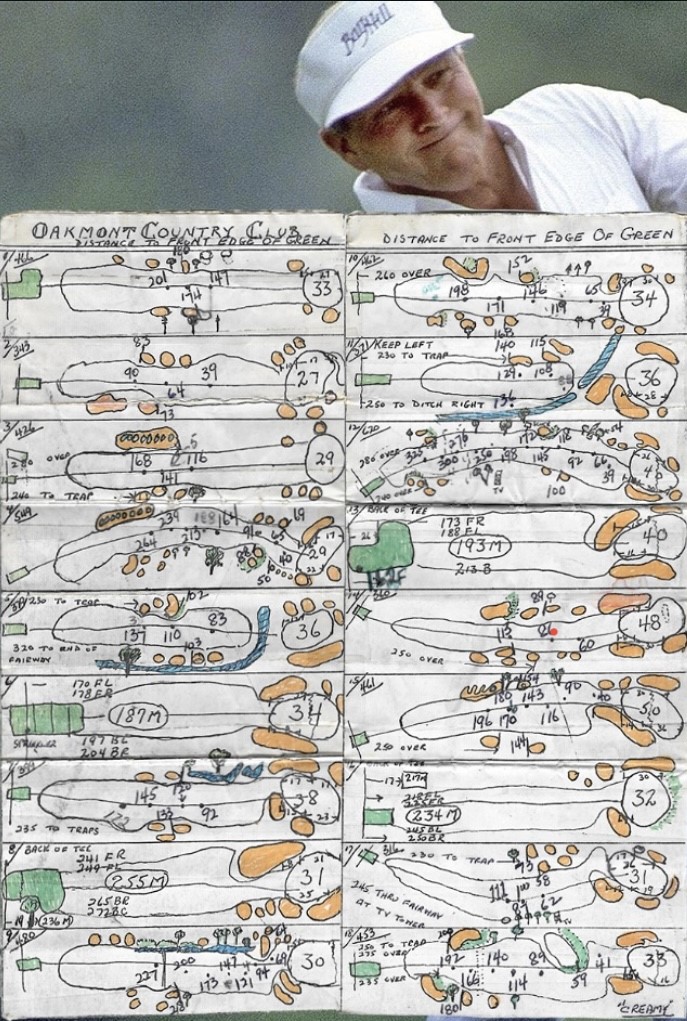
Found this super cool artifact on social media this week just in time for viewing the U.S. Open at Oakmont. Growing up and living in Latrobe in western Pennsylvania Oakmont Country Club, 20 miles north of Pittsburgh, was just a three-shot Par 5 from Arnie’s home. He played there quite often over the years and knew the course like the back of his hand. Here he transcribed his knowledge to a cheat sheet for playing the course.

Note, like most tour guys yardage books, the measurements are to the front of the green with the green sizes shown for further calibration. The Par 3’s Arnie gives the measurement to the middle (M) of the green. The overall measurement for each hole from the back of the championship tee is in the top left corner under the hole number.

I love the fact that he bothered to do this rendering in color and even shows the shape of tee boxes that are oddly configured. If you squint hard enough he has some pertinent carry yardages for hazards in the intended line of play.

Not sure when he authored this but my guess is in the 1970’s. Watching the course they are playing for the U.S. Open this year all the parameters of this yardage book still seem accurate.

Instagram Posting (2025)

The Shot

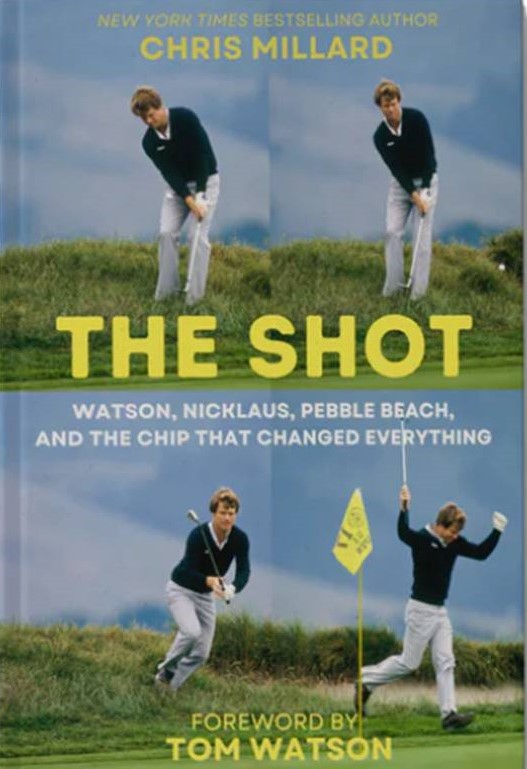
Following golf over the last fifty years the image of Tom Watson chipping in on #17 at Pebble Beach to take the lead in the 1982 U.S. Open is firmly wedged in my golf consciousness as his most triumphant moment in a folkloric golf career. So when I heard that Back Nine Press had recently published this book “The Shot-Watson, Nicklaus, Pebble Beach, and The Chip That Changed Everything” by Chris Millard I clamored to their website to order a copy.

Millard is an accomplished golf journalist and writer and he did a wonderful job sewing together a very readable tale of Watson’s first and only U.S. Open victory at Pebble in 1982. But the book offers so much more as Millard made a diligent research effort to track the history of Pebble Beach Golf Links and its role as a host to USGA events over the last 100 years.

The book catalogs the course’s evolution from it’s creation in 1919 at the capable hands of Jack Neville and Douglas Grant. Then under the stewardship and promotion of Samuel F.B. Morse, with significant renovations by W. Herbert Fowler and H. Chandler Egan, it became the site of the prestigious U.S. Amateur in 1929. This was a big leap of faith because previously the USGA had not held a championship west of the Mississippi River. But the 1929 U.S. Am had a stellar field including Bobby Jones and the tournament’s success established Pebble Beach as a destination resort for the wealthy and famous.

Over the next half forty years Morse continued to promote Pebble Beach for significant golf events, including the annual National Celebrity Pro-Am (a.k.a. the Crosby Clambake) starting in the 1940’s, the U.S. Amateur in 1961, and the U.S. Open in 1972, the last two won by none other then Jack Nicklaus. The celebrity exposure of Crosby each year at Pebble Beach provided a significant crucible for the development of broadcast coverage of golf on TV.

The U.S. Open in 1972 and 1982 were two more quantum leaps for Pebble’s notoriety as well as premier broadcast events for ABC the undisputed giant in sports network television. With Nicklaus and Watson at the height of their competitive powers the 1982 U.S. Open promised to be another chapter in the developing rivalry that transcended the Majors the previous 10 years. Four days on the shores of Monterey Peninsula did not disappoint and it came down to the outrageous chip shot on the penultimate hole to pave the way to Tom Watson’s long sought win of our national championship.

This book is chock full of interesting factoids and anecdotes about the development of Pebble Beach and the careers of Jack and Tom. There is even a chapter devoted to Tom’s 30-year relationship with Bruce Edwards his long time caddie.

I highly recommend this if you have played Pebble, admired Pebble annually on TV, or simply have an architectural interest in how Pebble Beach became one of the most famous golf venues in America.

The Shot

Chris Millard (2024)

The Magnificent Masters

Jack Nicklaus, Johnny Miller, Tom Weiskopf, and the 1975 Cliffhanger at Augusta

Magnificent Masters LogoThere are seminal moments in tournament golf, specific instances where the tournament, the venue, the protagonists come together in a perfect storm to showcase an historically significant event that changes forever our perception of a major tournament. Before 1975 The Masters was a major, it had it’s share of great winners and dramatic endings but it was mostly a vivid beginning of the golf season for American golf viewers, set in a resplendent arboretum in Georgia.

In 1975 three of the best players in the game, Jack Nicklaus, Johnny Miller, and Tom Weiskopf did what rarely happens. They came to Augusta with their A-games, lived up to all the hype, and put on a competitive show for the ages. Gil Capps, a longtime golf industry veteran for NBC Sports and The Golf Channel, brings an attention to detail of the 1975 Masters that allows us to relive the round-to-round drama like we are watching it unfold right before our eyes and properly places it as one of the seismic moments in Masters golf history.

There have been a number of wonderful historical accounts of golf tournaments, matches, and prominent characters released in the last 10 years. If you have read and enjoyed Kevin Cook’s “Tommy’s Honor” or Mark Frost’s “The Greatest Game Ever Played”, “The Grand Slam”, or “The Match” you know what I am talking about. You will find this account of the lives of these three champions and their elevation of The Masters to new heights equally intriguing.

The author has an intimate knowledge of Augusta National and the Masters and his detailed research provides the reader with an inside view of the history and development of the event over the last 80 years. For example, he talks about the stark white sand so prominent in our television images that create the bold faces of the MacKenzie bunkers. Clifford Roberts sourced the material from feldspar mining operations in North Carolina. It is actually crushed rock not sand and, as a result, when it is dry will disperse as balls hit avoiding embarrassing buried lies. There are countless other tidbits about the stewardship of Bobby Jones and Clifford Roberts helping this annual outing of a bunch of golf buddies evolve into a major championship.

The book is presented in a Kiefer Sutherland time-lapse format chronicling the practice rounds and the four tournament days as unique segments of the whole. This makes the reading a “real time” experience and the interplay of the subplots make the eventual outcome more vivid.

The Thursday round begins with “the most anticipated first-round tee time in Masters history” as he describes Lee Elder’s breaking of the color line at this most famous of southern golf venues. It includes an entertaining vignette about Bob Murphy and Lee Trevino two guys who never played up to their potential at Augusta. Capp says “The two players had four things going against them: their lack of length, their left-to-right ball directions, their low ball flight, and their attitude”.

The pattern of the book is established as he wanders off for a biographical chapter on Nicklaus, the first of three he intersperses between accounts of the four days of play. The reader gets a good sense of the importance of the golf character and motivation of Bobby Jones as a competitive impetus to Nicklaus. Jones cared only about the majors and therefore Nicklaus saw winning majors as the ultimate benchmark of golf achievement.

Biographical sketches of backgrounds of Johnny Miller and Tom Weiskopf provided the strongest additions to my historical golf knowledge from reading this book. Miller was the roman candle of the era, bursting on the scene with a victory in his first pro event in 1969 at the age of 22, proceeding to win almost every tournament played in the arid climates over the next decade. His 63 in the final round at Oakmont to win the 1973 U.S. Open was one of the most jaw dropping accomplishments in history. Miller was driven to be the best in the game and never was afraid of Nicklaus. In fact in Miller’s 25 wins on the PGA Tour Nicklaus was second in 5 of them. From 1969 to 1983 Miller was always in the conversation at the majors until, as Capp says, “Miller had fallen out of love with the process that had driven him to the top of his sport”.

Weiskopf was another story, he had to bear the yoke of following in Nicklaus’s foot prints, growing up in Ohio and playing at Ohio State just behind him. Weiskoff was a perfectionist with no patience for mediocrity, a slam dunk to be the next great in the game. His game had “both arrogance and elegance to it….It was the tempo and rhythm that others swooned over…..a grace and smoothness rare for a tall man who always finished in perfect balance.”

Weiskopf won 16 times on the PGA Tour including one major at the 1973 Open Championship at Royal Troon and finished second or third in majors 8 times from 1969 to 1978. But for all of that accomplishment he was considered an underachiever.

His Achilles Heel was his perfectionist attitude and the expectation of greatness heaped upon him in comparison to Nicklaus. In a big event he could be in the thick of contention or seemingly out of touch. As Capp says, “If Weiskopf was playing well and in contention, there was complete resolve. If he was playing poorly, he could totally disengage”. The roller coaster ride of Weiskopf’s professional career took a severe personal toll and he dropped off the golf radar screen after his last win in 1982 at the Western Open.

I leave the description of the golf to your reading of the book, the drama Capp conveys is just captivating. Suffice it to say that Miller shot 65-66 on the weekend, Weiskopf 66 and 70 and had a putt for a playoff on the final green. The rest is history….magnificent history.

.
Gil Capps (2014)

moerate4

True Links

True LInksTwo former editors of golf magazines of substance have put together ‘True Links’ an illustrated guide to the 246 Links golf courses in the world.  Much in the vein of Larry Lambrecht’s ‘Emerald Gems’ and James Finegan’s ‘Scotland-Where Golf Is Great’ this is a thoughtful presentation of photos and supporting research on the links courses that define the game of golf.

George Peper, a former editor of Golf Magazine, and Malcolm Campbell, a former editor of Golf Monthly, bring their expertise to the task of defining and documenting the active links courses around the world.  Augmented by the vivid photography of Iain Lowe and other supporting photographers this book brings to life the grandeur of links courses from the British Isles and around the world and puts their individual stories in the context of the evolution of golf over the centuries.

Their premise is that links courses remain the soul of a game that has spawned over 30,000 golf playing grounds around the world.  In the prologue they say, “Links golf is the game distilled to its core virtues.  To walk beside the sea with a brisk breeze on your cheek and firm,sandy turf beneath your feet is to experience golf not only as it was hundreds of years ago but arguably as it should be today-a simple, beguiling game in need of no embellishment.”

If you asked the greatest players who ever played the game where they would prefer to play every day links courses like The Old Course at St. Andrews, Royal Country Down, Muirfield, and Ballybunion would come to their lips.  The style of golf these courses demand bring out the deep seated talents of all players so the satisfaction of playing them well is very special.

Tom Watson, arguably one of the most successful players in Open Championships contested on links courses, slowly came to accept and embrace the demands of links golf.  He describes what he discovered, “Don’t fight it…enjoy it.  Solve the puzzle……Calculating the wind, allowing for the firm terrain, trusting your judgment and feel…that is the joy of playing a links.  You need almost a sixth sense, an ability to adjust to all the conditions and somehow get your ball to travel the proper distance-whether through the air or along the ground.  That is the essence of links golf.  But the links giveth and the links taketh away.  It can be cruel and beautiful in the same round, occasionally on the same hole, and once in a while on the same shot.  When you figure out all the equations properly and the shot comes off as intended, nothing is more satisfying.”  I have a feeling Phil has come to share this sentiment recently.

True Links begins by defining what distinguishes under 250 of the courses in the world as Links courses.  The British Golf Museum in St. Andrews defines linksland as “a stretch of land near the coast…characterized by undulating terrain, often associated with dunes, infertile sandy soil, and indigeneous grasses as marram, sea lyme, and the fescues and bents which, when properly managed, produce the fine textured tight turf for which links are famed.”  Add to this the quirky and sudden changes of wind and rain that seaside venues present and you have a chess game on grass against the elements and the higher order who choreographs them.

The result of this requirement of turf, terrain, and weather is that many of the most familiar and storied seaside courses are left off of the list of Links courses.  Pebble Beach, Cypress Point, Royal Melbourne, Whistling Straits, Shinnecock Hills, and The Ocean Course at Kiawah are spectacular and challenging venues we equate with links golf but they lack either the firm sandy turf, the associated dunes, or the close proximity to the sea that strictly defines a links course and the brand of low to the ground golf associated with them.

The authors pay homage to the great architects that drew links courses out of the unique terrain nature presented in the British Isles.  From Old Tom Morris to Harry Colt, James Braid, C.B. MacDonald, Alistar MacKenzie, Donald Ross, and A.W. Tillinghast they show the linkage of thought and design the great architects made studying the challenges of links courses and how they incorporated them into what would become the classic courses of the Golden Age of Course Architecture.   This respect for links design feature continues to be seen in the contemporary work of Pete Dye, Tom Doak, Ben Crenshaw, Bill Coore and others in places like Whistling Straits, Bandon Dunes, Sand Hills, and Cabot Links.

The Crucible is a chapter dedicated to the grand daddy of them all, The Old Course at St. Andrews.  Tracing it back to days of shepherds hitting rocks with their herding staffs, through Royal edicts against playing, to Rabbit Wars for the land’s usage, we get a sense of how the game evolved.  Rules, equipment, course construction and maintenance were forged over centuries throughout Scotland.  The standard of the number of holes, the routing, the cup, the ball, and all the rest came from trial and error and the guiding will of a series of individuals who sought to regiment and standardize the game they were playing.

What follows is a chapter called The Icons which gives vibrant imagery and context to the 25 links courses that have defined the game.  Quirky courses-Lahinch and Ballybunion, original classics-Prestwick, North Berwick, and Rye, the full array of Royals-Aberdeen, Birkdale, St. Georges and Portrush , and the mysticals- Royal Dornoch and Royal County Down come to life as the authors explain the developmental history and unique characters of these pioneering links.

The Classics are the next level spawned by the Icons-they are the broader inventory we have come to know as links courses.  Many are familiar, Machrihanish, Lundin Links, Waterville, Country Sligo, and St. Andrews Jubilee.  Others less so The Island, Enniscronne, Gullane, Aberdovey, and Ballyliffen.   From there they go to The Exotics covering the links courses outside the British Isles in The Neatherlands, Germany, New Zealand, Australia, and South Africa.

The journey ends with The Moderns, links courses that have come on line in the last forty years and reinvigorated the interest of golfers in the true tradition of the game.  New entries in Ireland-Tralee, Doonbeg, and The European Club, Scotland-Kingsbarns, Castle Stuart, and Trump International, and North America-Bandon Dunes, Pacific Dunes, Old MacDonald, and Cabot Links are testimony that the influence of links golf design on the pleasure and enjoyment of golf continues.

Peper and Campbell argue that the future of golf remains in the hands of this movement.  The demands of environmental responsibility and financial viability in developing new courses once again directs the architect’s attention to the minimalist approach to designing and maintaining a links course.  Jim Arthur, an agronomist and promoter of natural links in Scotland put this way.  “Lack of money has always been a great limiting influence on the making of mistakes.  The poorest clubs have the best courses…in greenskeeping one should ask a farmer what to do and then go and do exactly the opposite.”   The coast of Oregon and Nova Scotia, the sand hills of Nebraska, and down under in Tasmania Australia credence has been paid to this notion with fine result.

For an understanding of the place of links courses in the historical time line of golf, simple reminiscence of the places one has played, or in developing a bucket list of what is yet to come, True Links is a book that should have a place on your library shelf.  This is a book you will reach for on a regular basis.

True Links

George Peper and Malcolm Campbell (2010)

October, 2013

moerate5