Isleworth Golf and Country Club

Isleworth is a 600-acre private gated community surrounded by picturesque lakes and about 10 miles of private waterways.  It is ten minutes from the center of booming Orlando and provides these pros everything they are looking for in a residence community.  Except for one infamous middle-of-the-night fire hydrant incident back in November of 2009, there is rarely anything that disrupts the solitude of this place.

The schools are good, income taxes non-existent, major airport a drive and a five iron away,  tolerable weather ten months of the year, and a golf facility fine tuned to their every want and desire.  As a result, it is the home of a plethora of PGA and LPGA pros including John Cook, Stewart Appleby, Darren Clarke, J. B. Holmes, Paula Creamer, Annika Sorenstam, and Yani Tseng.  Other sports and entertainment stars and high worth individuals have purchased homes here as well so there is a real who’s who atmosphere on the property every day.

The Isleworth Golf and Country Club is the centerpiece of the community that was started by a group of investors in the mid 1980s.  The Tavistock Group subsequently took over the development in 1993 and worked to bring it up to a standard that would attract the golf professionals and high worth individuals for their permanent residences.  They built an exquisitely appointed 82,000 square foot club house that blends classic design with casual elegance.   From the locker room to the wellness center everything about this place speaks to daily needs of their members in an informal atmosphere of comfort.  Tavistock even appointed the property with distinguished pieces of lawn sculpture from artists like Henry Moore, Phillip Jackson, Eric Goulder, and Arturo Dimodica.

Charging Bull Greets You At The First Tee

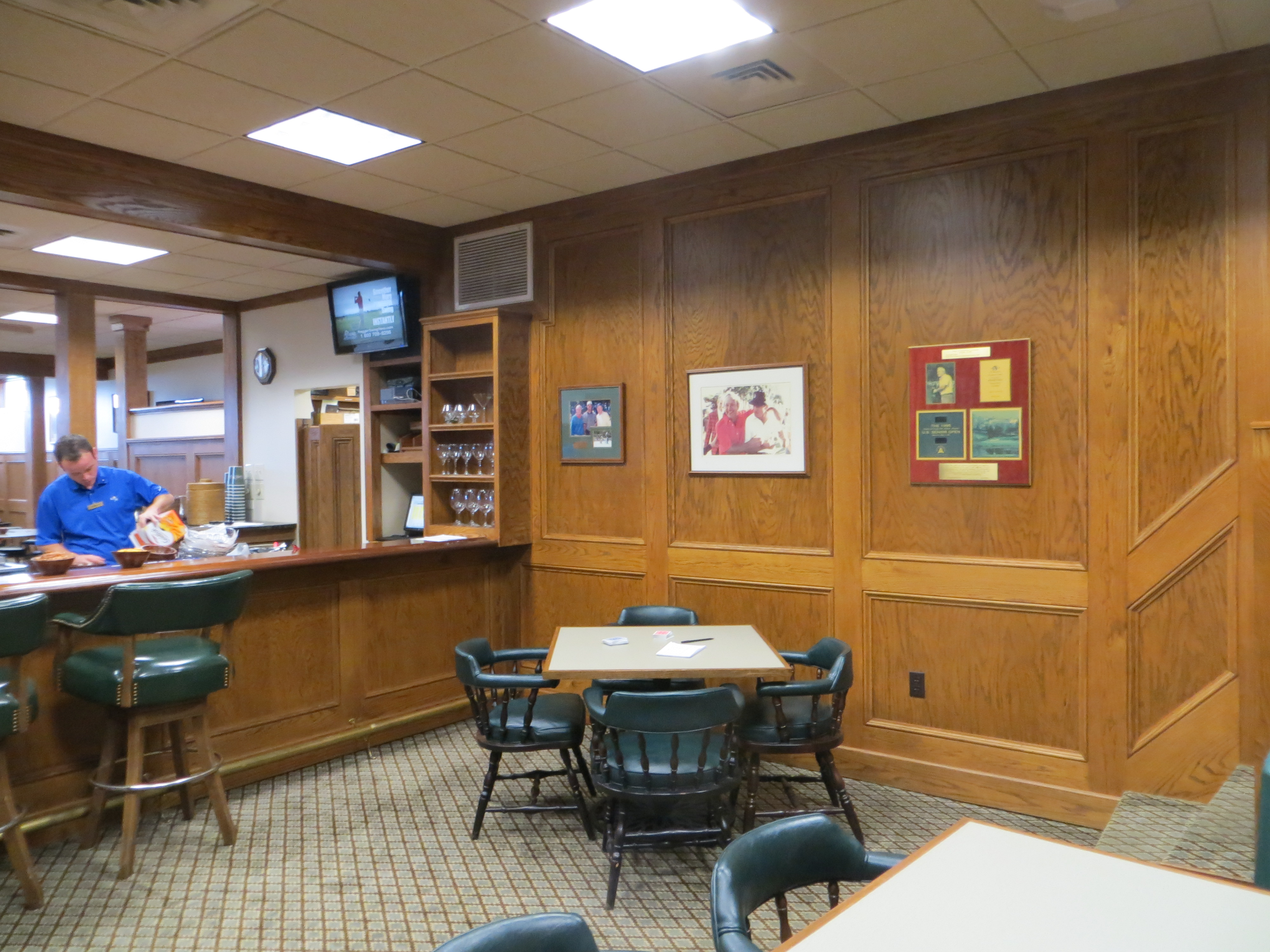
To most guys the Champions Grill is the centerpiece of the Isleworth experience.  This grillroom is something to behold.  You walk down a spiral staircase from men’s locker room surrounded by the golf bags bearing names of the pros who are members at the club.  This leads you to an area with a manly wood appointed  bar and restaurant outfitted with comfortable seating and a flat screen TV everywhere you look.  The walls are covered with captivating memorabilia including plaques for each Major Championship with winners listed who are Isleworth members. Adjacent is a large recreation room with a putting green and a half court basketball court as it’s centerpiece.  Additionally you will see every boy toy ever invented including a pool table, ping pong table, video games, table top shuffleboard, dart boards, air hockey, and a golf swing simulator.  There are cushy spectator chairs horseshoeing each of those so there are lots of ways to settle a push bet on the back nine with your buddies.

The golf facility leaves no pebble unturned.  It includes a massive practice facility with reclusive areas where the pros can practice without disruption.  Tiger Woods got his own secluded pad on the driving range with an extra 50 yards of carry room so he doesn’t bomb any of the other patrons while practicing his stinger.  They have a two-acre short game area with replica bunkering from Augusta National and TPC Sawgrass and an 11,000 square foot putting green.  Plenty of room for the pro, the caddy, and a couple of hundred of their brand of shag balls for the daily practice grind.

The golf course was originally designed by Arnold Palmer and Ed Seay and was subsequently modified extensively under the direction of the very capable architect Steve Smyers.    The course has a distinct Florida target-golf character to it-this was probably intentional to give the professionals a way to simulate the challenges they see during their regular work day.  It is a testing golf course with six sets of tees that can be stretched to as much as 7500 yards for those with masochistic proclivity.  At 6400 yards it is all most amateurs can handle so pick your teeing ground with proper forethought.

The most distinctive characteristic of this course is the very demanding driving areas.  Throughout you see harrowing bunkers hugging the corner of the doglegs adjacent to which is the most advantageous approach angle to the green.  But unlike other courses, the other side of the fairway provides little respite-there is no safe way to play off the tee on most of the holes.  You have to take on the challenge through the day if you want any chance of hitting these greens in regulation.

The course does not have very many stunning holes you will not forget but there are quite a number that will get your competitive attention.  Once you get over the greeting of the Charging Bull on the first tee you have a relatively routine opening hole.  But your heart beat will be prompted by the harrowing challenge of the “Cypress Chute” you have to negotiate on the par 3 second.  Two through four are the three lowest handicap holes on the front so reaching the fifth tee with a scorecard still in tact is your biggest challenge. A little bit of a breather over the next few holes brings you to Champions Point and a view of some really nice boat slips with their matching bungalows.   “Best of Bessie” is a very challenging par four at the eight and you close the opening nine plotting your way “Around the Lake” with another technical par four.
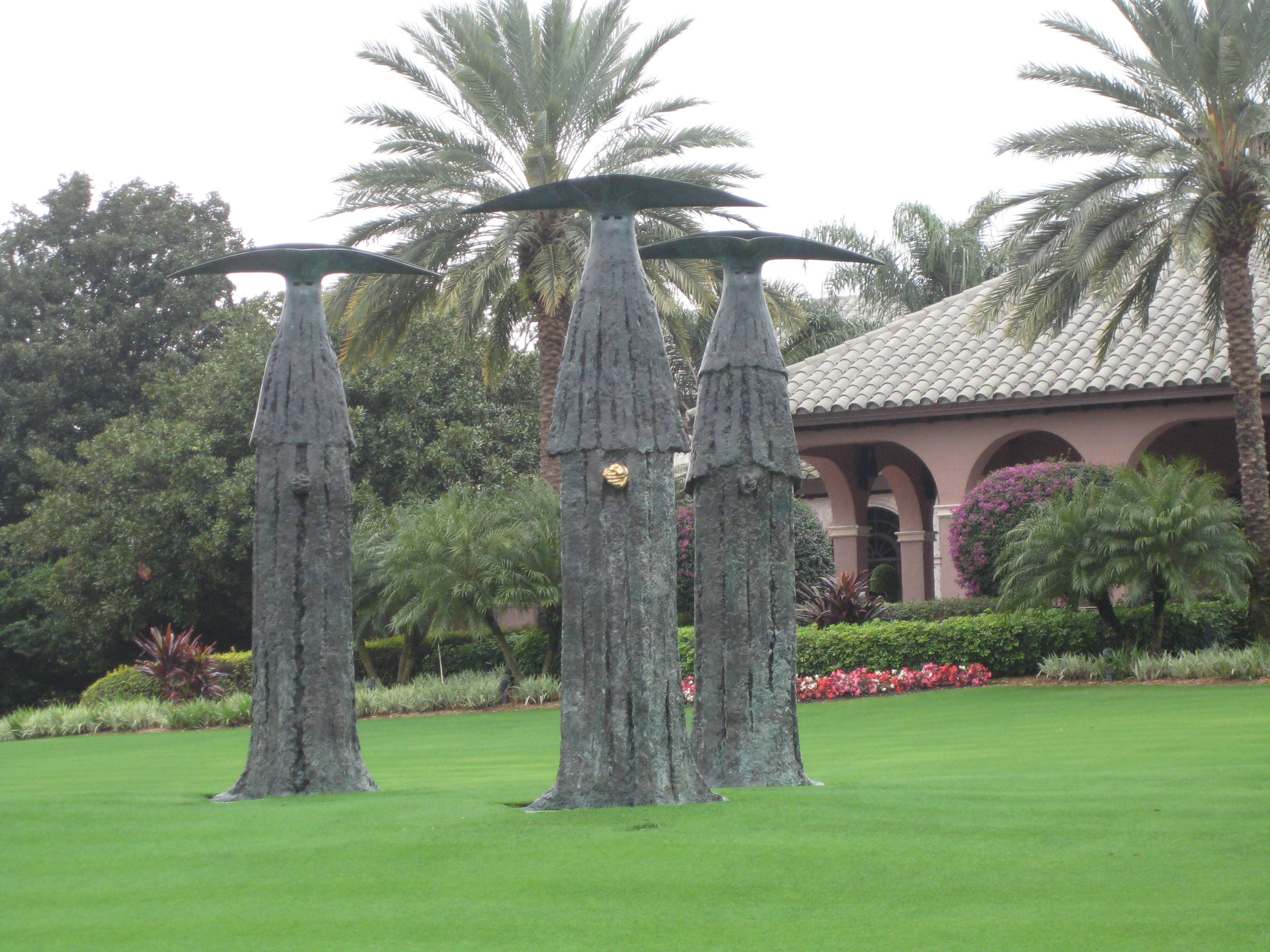
Three Monks Overlook The Front Drive

A bit of a ethereal moment as you leave the cart park next to nine and drive by the Three Monks on the front lawn of the clubhouse driveway.   Seems appropriate to mutter a little deferential prayer on your own behalf before heading to the back nine.

The back nine starts routinely enough but, like the front, you get a sizeable challenge on the next two holes.  The 11th  with its beautiful flower beds behind the green is the Kodak moment of the day.  But this is a full metal challenge with a 150 yard club-especially if the wind is influencing.  The 12th provides another daunting approach with the green wedged between a pond and a side hills on the right.  The par five 13th is a bit of a breather-more lakeside residential eye candy…..these people must have large families or extensive wait staffs.

From here to the end the holes a not bulky in length but they will challenge you constantly to execute well planned shots.  After an interesting short hole on sixteen, the last two are the hardest handicap holes on this side and they well deserve that distinction.  Both green settings are diabolical so the real challenge on each of them is at the end.  The final hole is a bear-this is two booming shots or a deft up and down if you need a par to wrestle away the back nine Nassau.

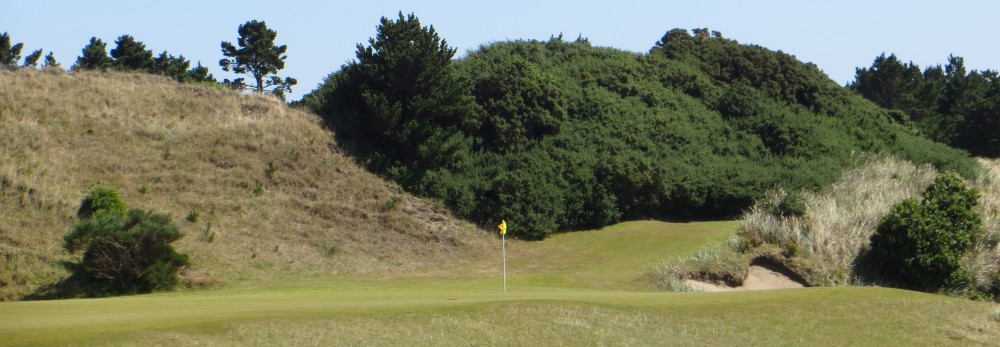
Challenging Green Arrangement At Par 5 17th

Isleworth, when taken in total,  is quite the golf experience.  If it presents itself as an opportunity just throw caution to the wind,  pay the ticket, and indulge yourself for the day in the life of the rich and famous.

Windermere, Florida

Architect: Arnold Palmer/Ed Seay (1986)
Steve Smyers (renovation)

Tees            Par    Yardage      Rating     Slope
Lewis          72       6765           72.9        139
Chase         72       6409          70.8         134
(Click here to review Isleworth hole-by-hole descriptions)

Crooked Cat-Orange County National

This place is a real golf factory facility with two championship golf courses, a 360 degree grass driving area the size of Nebraska, and a golf shop that will make you feel like you are in Nordstroms.  The place has hosted the final stage of the PGA Qualifying School a number of times.  Coupled with how many pros and wanna-be pros living in the Orlando area you are going to see lots of sticks out there practicing and honing their games.

The fare is reasonable for a facility of this quality and the golf and related accommodations are very much what you would expect.  The golf shop is humongous with every major line of apparel represented-if you cannot find something memorable to add to your wardrobe you are either blind or too picky.

This course is one of two that were designed by the team of Phil Ritson, Dave Harman, and Isao Aoki.  They moved a lot of dirt to get the sculpting and landscaping they were after but the result is a course that is very challenging but totally playable.  The variety of the holes is it’s strong suit.  There are the typical Florida holes with adjacent water or environmental areas but there are even a few with an Irish lilt thrown in.  The handicapping of the holes is very realistic-three of the five pars are the 16th, 17th, and 18th handicap holes and two of the par threes are the 4th and 5th handicap holes.  They put real thought into which holes needed the handicap assistance rather than just looking at length to determine it.

If you look carefully at the GPS images of the holes the lines of play are fairly obvious.  Most of the sculpted areas of the fairways are still fairway it is just that hitting from them is a less advantageous place to play from relative to the green.  As with most good courses, driving the ball on the proper line and in the short grass is the best way to get aggressive places to play from.  The greens are plenty large but segmentation and tiering require proper planning on the approach shots to avoid three putts.

The yardage book in the shop is major old school-hand drawn with lots of particulars.  Problem is that it is virtually unreadable to a non-tour mortal so you are better off saving the $7 and just go with the provided GPS in the cart.

This is a very enjoyable afternoon of golf.  As always, play from a tee length with hole distances that are comfortable for you.  The challenge you seek is here at whatever length you choose to play at.

Winter Garden, Florida

Architect: Phil Ritson/Dave Harman/Isao Aoki (1997)

Tees                  Par         Rating        Slope        Yardage

Green               72            73.7            132            6927

Blue                 72            71.4            126            6432

White               72            68.8            122            6020

(Click to see complete Crooked Cat hole-by-hole descriptions)

Bay Hill Golf Club

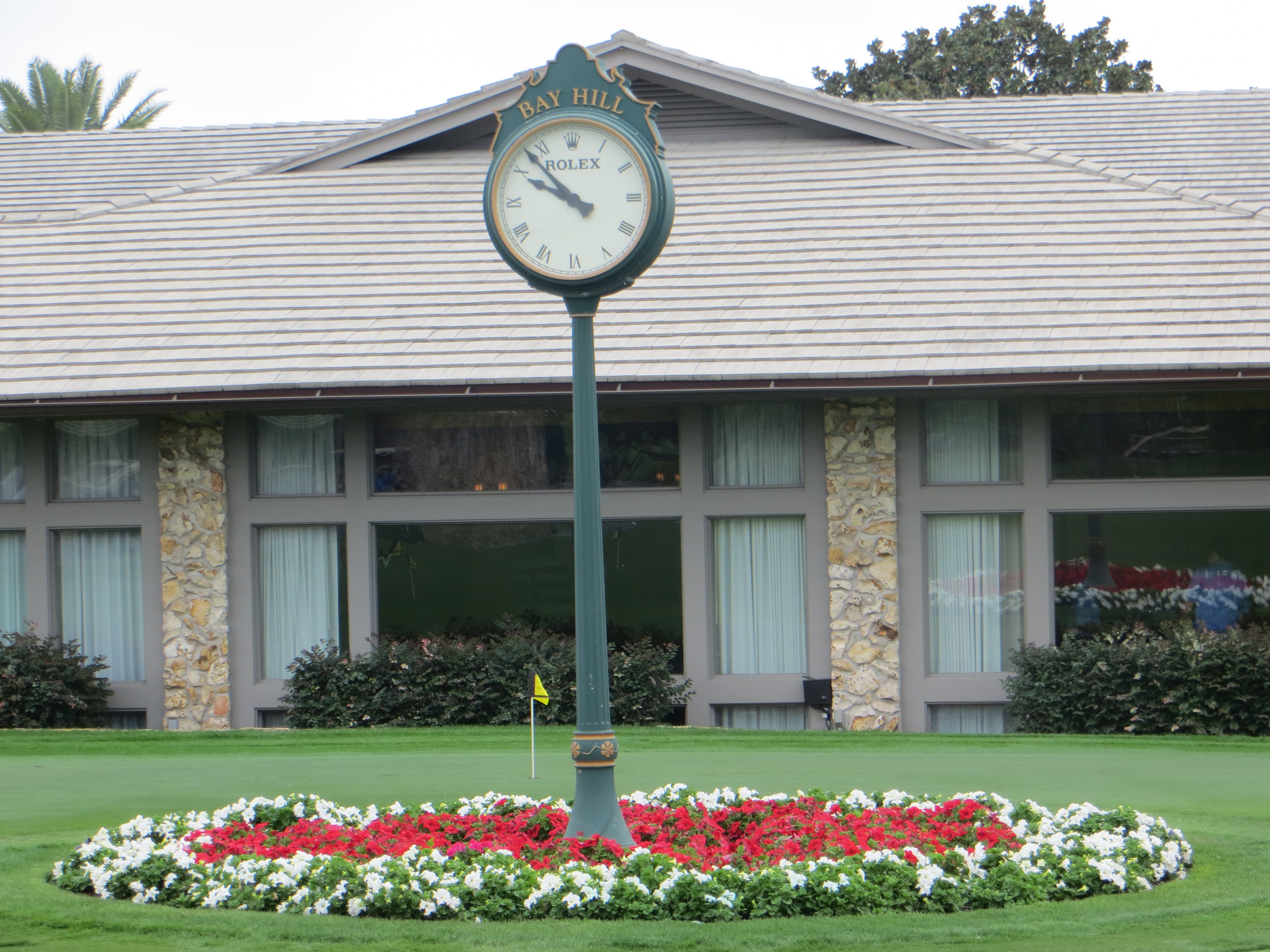
Bay Hill is synonymous with Arnold Palmer as his winter retreat and the host venue for the golf tournament that bears his name. The facility was built in the early 1960’s by a group of Nashville businessmen who hired Dick Wilson-one of the prominent architects of the day-to build a championship course in the middle of nowhere. Arnold came to the recently opened course in the mid-sixties to play an exhibition match with Jack Nicklaus and fell in love with the quality of the course as well as the reclusiveness of Orlando. In the early 1970’s through the connections of Mike McCormick and IMG, Arnold put together a group of investors to buy Bay Hill from the original Nashville businessmen who put it together.

Winnie and Arnie made sure all the players would not miss their tee times

Winnie and Arnie made sure all the players would not miss their tee times

The rest was history as Arnold began to spend more and more time at Bay Hill with Winnie his wife and her Golden Retriever Riley and they put their personal stamp on every aspect of the operation.

Arnie and one of their Goldens

The casual character of this first class destination facility is clearly a reflection of their personalities and values. Arnold and Ed Seay have continually tweaked the course itself to keep it up to standards to challenge the PGA touring pros that play there every spring. Yet it remains totally playable to the large contingent of members and guests who play it every day.

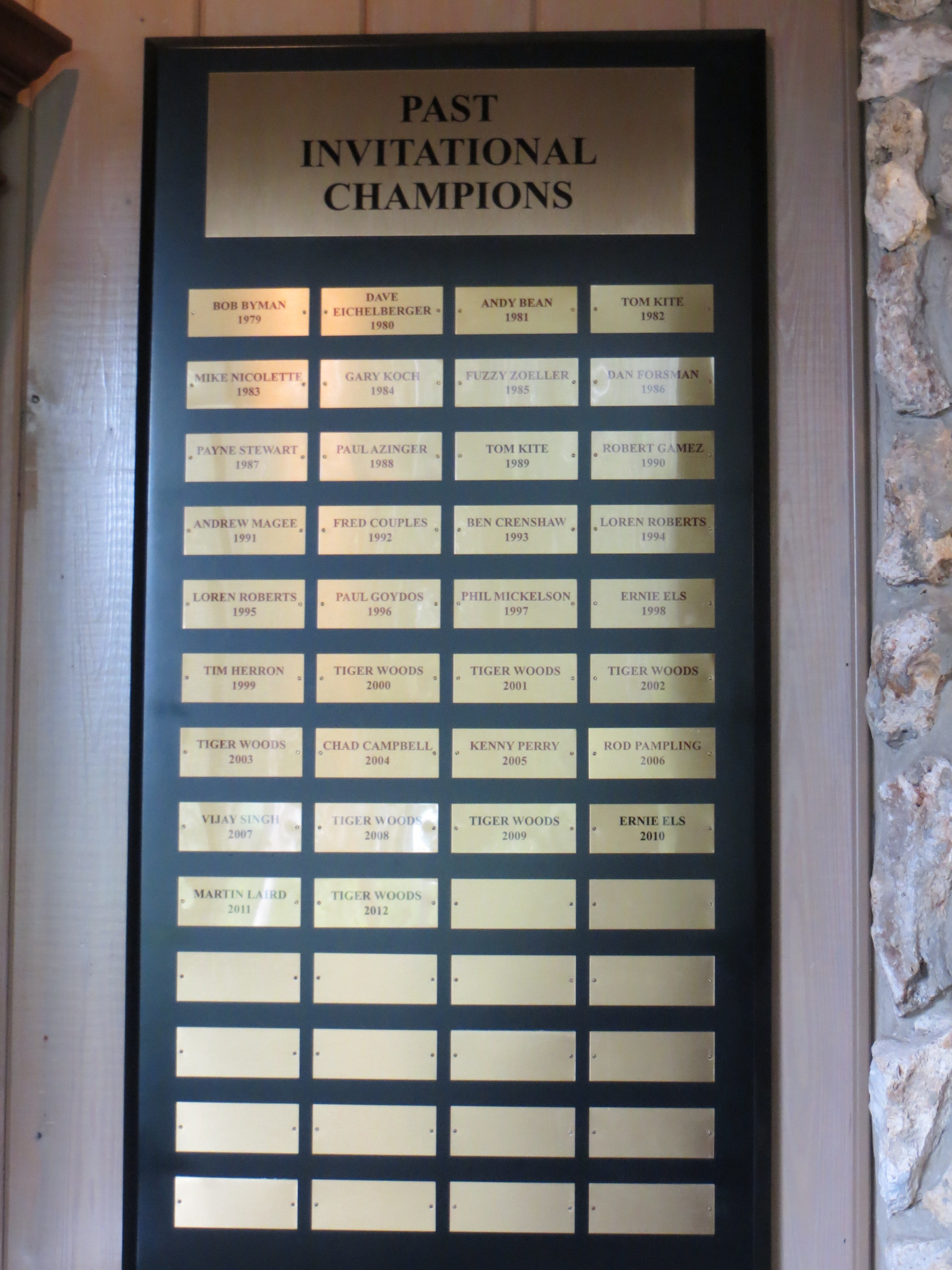
Past Champions Plaque(Click on any picture to get an enhanced view of the image)

The first impression of the course is that it is not as macho as you would expect after seeing it year after year on TV. The who’s who of winners over the last 30 years shows an amazing diversity of players win here-from Andy Bean, Gary Koch, and Tom Kite to Freddie Couples, Phil Mickelson, and Tiger Woods (6 times).

Wharf arrangement on the Par 5 6th rewards tactical restraint and precise execution.

Wharf arrangement on the Par 5 6th rewards tactical restraint and precise execution.

The course itself is not particularly brutish in length but it is technical enough to require really good management of ball flight and distance. The greens are quick and undulating so it takes tactical planning with approach shots and aptitude with the flat stick to score well.

The par 4 8th is not long but it is very demanding..especially on the approach.

The Par 4 8th is not long but it is very demanding..especially on the approach.

The topography is actually un-Florida-like so you have your share of up and down holes to deal with. The par fives are not particularly long-at least two are reachable if you crank your driver-and there are not really many stout par fours of 425 or longer. The shorter par fours are the most difficult to me-they all have a good measure of Arnold’s favorite risk-reward thinking to them. The overall variety of holes is it’s strongest suit-no two holes feel remotely alike. Fairway bunkers are sprawling but tactically placed.

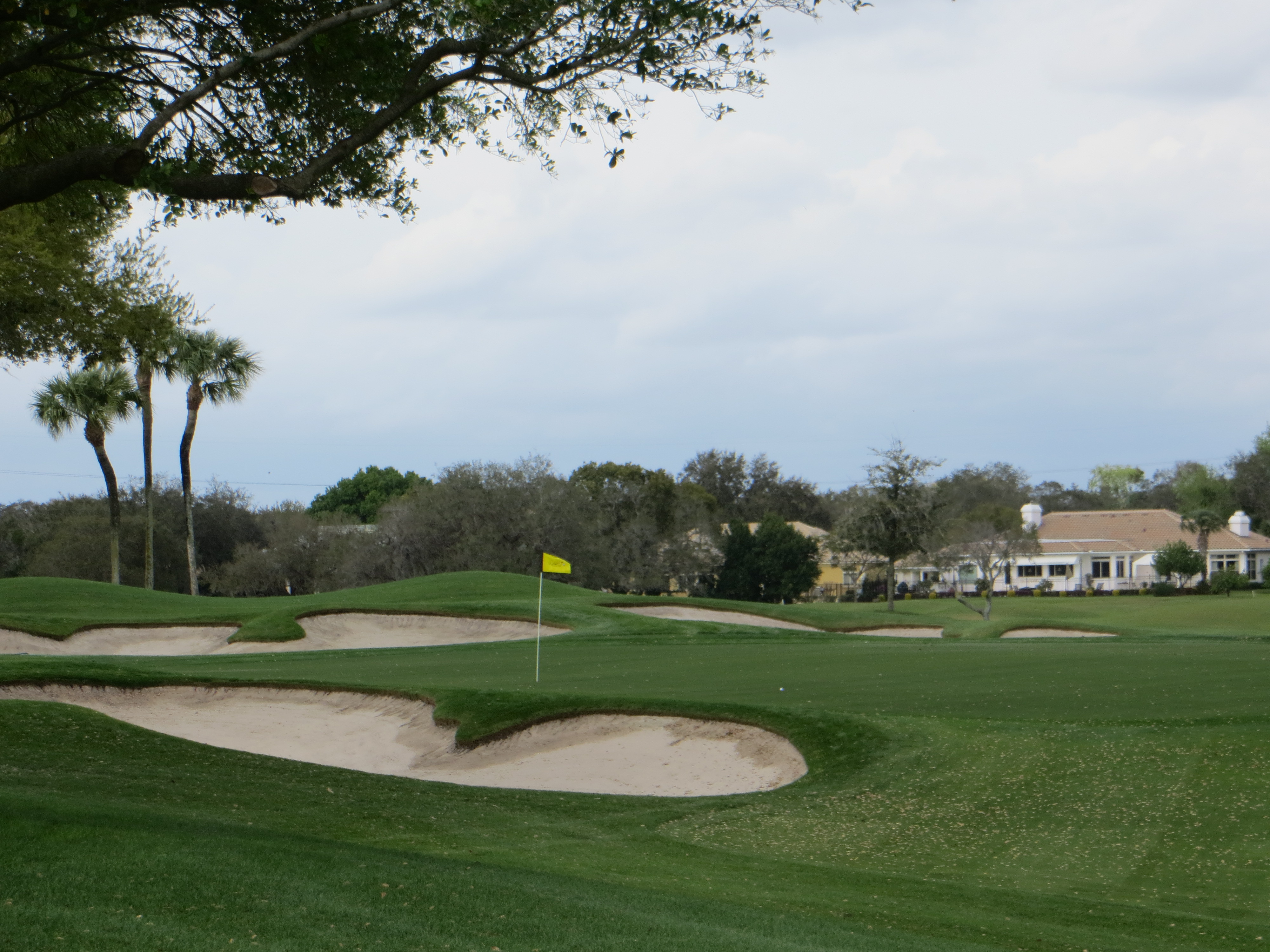
Bunkering on the Par 3 7th is, as Goldilocks would say, just right!

Bunkering on the Par 3 7th is, as Goldilocks would say, just right!

You cannot help but notice the artistry of the shaping and vistas of the bunkers-they are in the right places to make you think hard before taking the aggressive line on most holes. Greenside bunkering is not overdone but they are very steep sloped so you can get some very challenging exit paths, especially if you short side yourself on an approach miss.

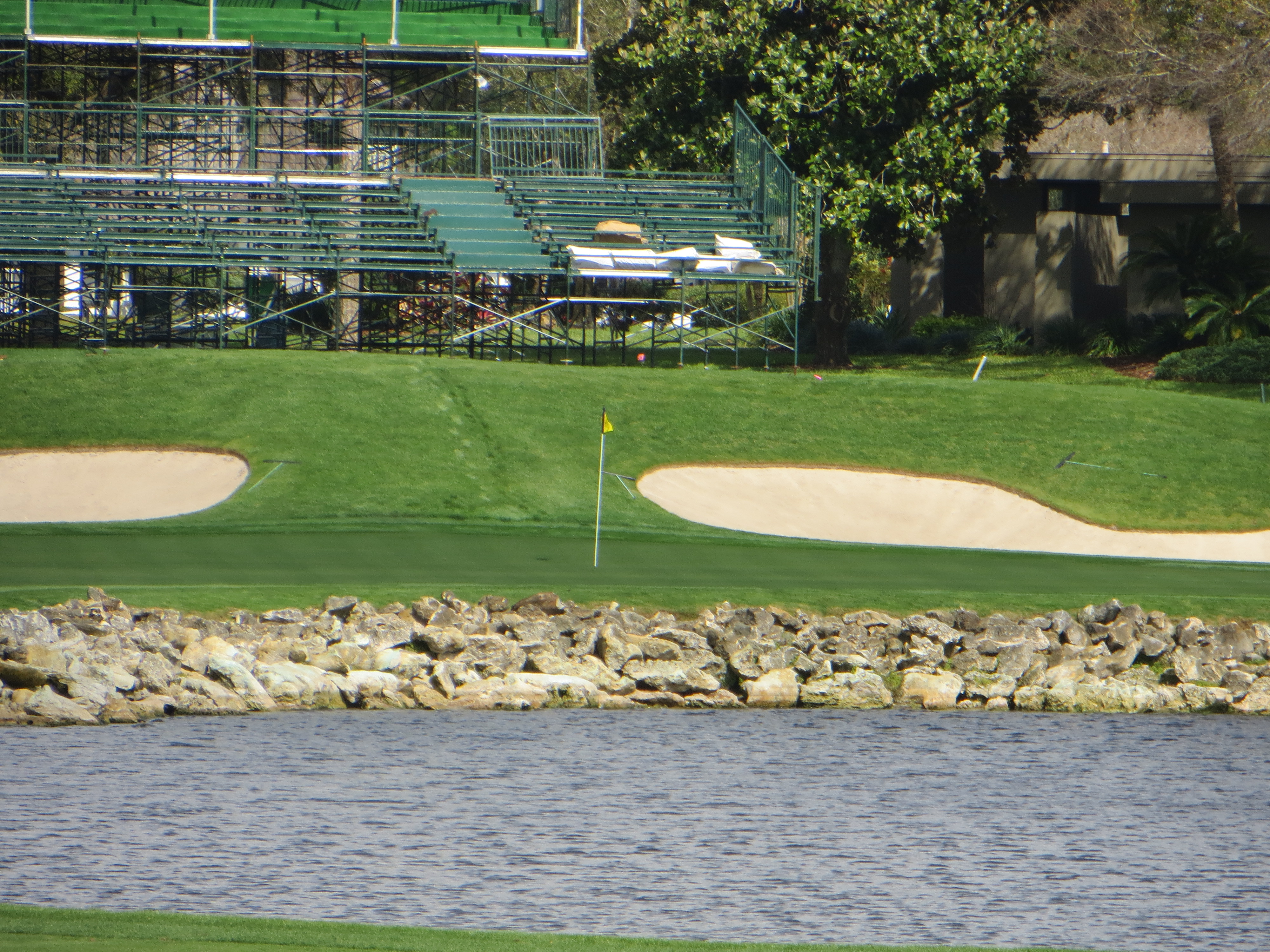
The iconic rock trim carry into 18 has made many a tour player take pause

The iconic rock trim carry into 18 has made many a tour player take pause and reflect

This is clearly a course where knowing when to attack and when to back off make a real difference in your final score. Thoughtful aggressiveness is the mantra here. You have to go for it when the odds are in your favor because you need some low scores to balance the few paybacks you are likely to render through the day.

A locker room with showers, gin tables, and a bar..how old school!

A locker room with showers, gin tables, memorabilia, and a bar..how old school!

Do not miss the men’s locker room-it is a throwback to the days before political correctness dominated our lives. It is a place for men to unwind after a round-have a drink, play some cards, and settle all the bets of the day. The memorabilia on the walls is enough to fill a museum.

Orlando, Florida

Architect: Dick Wilson (1963) Arnold Palmer/Ed Seay (since 1970)

Tees        Par    Rating     Slope     Yardage

Green      72      75.4         142        7381

Blue        72      73.7         139        6895

Yellow     72      71.6         134        6437

(Click to see complete Bay Hill hole-by-hole descriptions)

(Click to see the moegolf Bay Hill Charger Nine review)

(Click to see the moegolf Bay Hill Short Game Area review)

(Click to see more photos in a Postcard From Bay Hill)