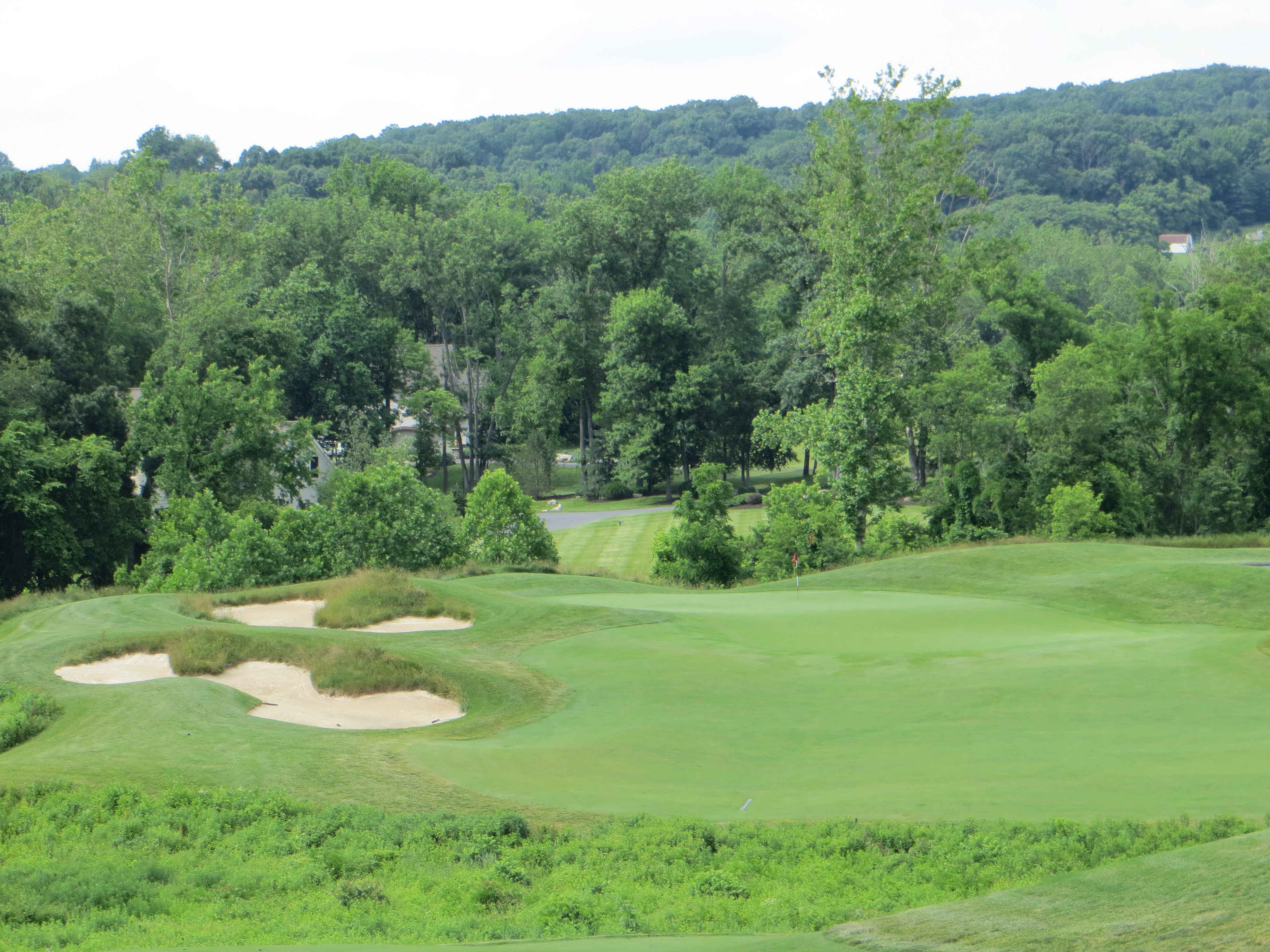

Highland Links Golf Course

Highland Links LogoFounded in 1892 and heralded as Cape Cod’s oldest golf course, the Highland Links in North Truro is one of America’s nostalgic golf treasures, perched high along windswept bluffs overlooking the Atlantic next to the vintage Highland Lighthouse on Cape Cod.  This is not going to appear on anyone’s top ten courses in Massachusetts much less the northeast, yet if you are truly a student of the game this is a must play if you are on the Cape.

The original Highland House Golf Links was an adjunct to an ocean hotel and cottage resort operated for years by Isaac Small of Truro and his family.   After years of growing wear and tear the links were refurbished in 1955 by owner Hal Conklin.  In the 1960’s, when Congress approved President Kennedy’s Cape Cod National Seashore Act, Highland Links became Federal property leased to the Town of Truro.  This is now an inexpensive public golf course available for the pleasure of anyone visiting the northern end of Cape Cod.

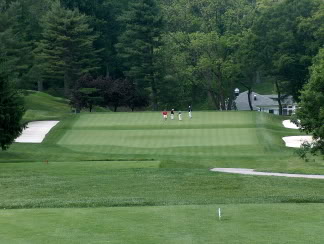
The second would feel at home anywhere in Scotland or Ireland.

The second hole would feel at home anywhere in Scotland or Ireland.

Deep natural rough, Scottish broom, thick gorse and low bushes, hilly terrain with non-irrigated open fairways, and spectacular ocean views make this course a genuine links in the Scottish tradition.   Wind, weather, rock hard fairways, and high rough are always a factor at Highland Links. Add to this the up and down elevations and gently rolling fairways you will have a links golf experience that you will not soon forget.

Each hole requires a second time around.

Each hole requires a second time around.

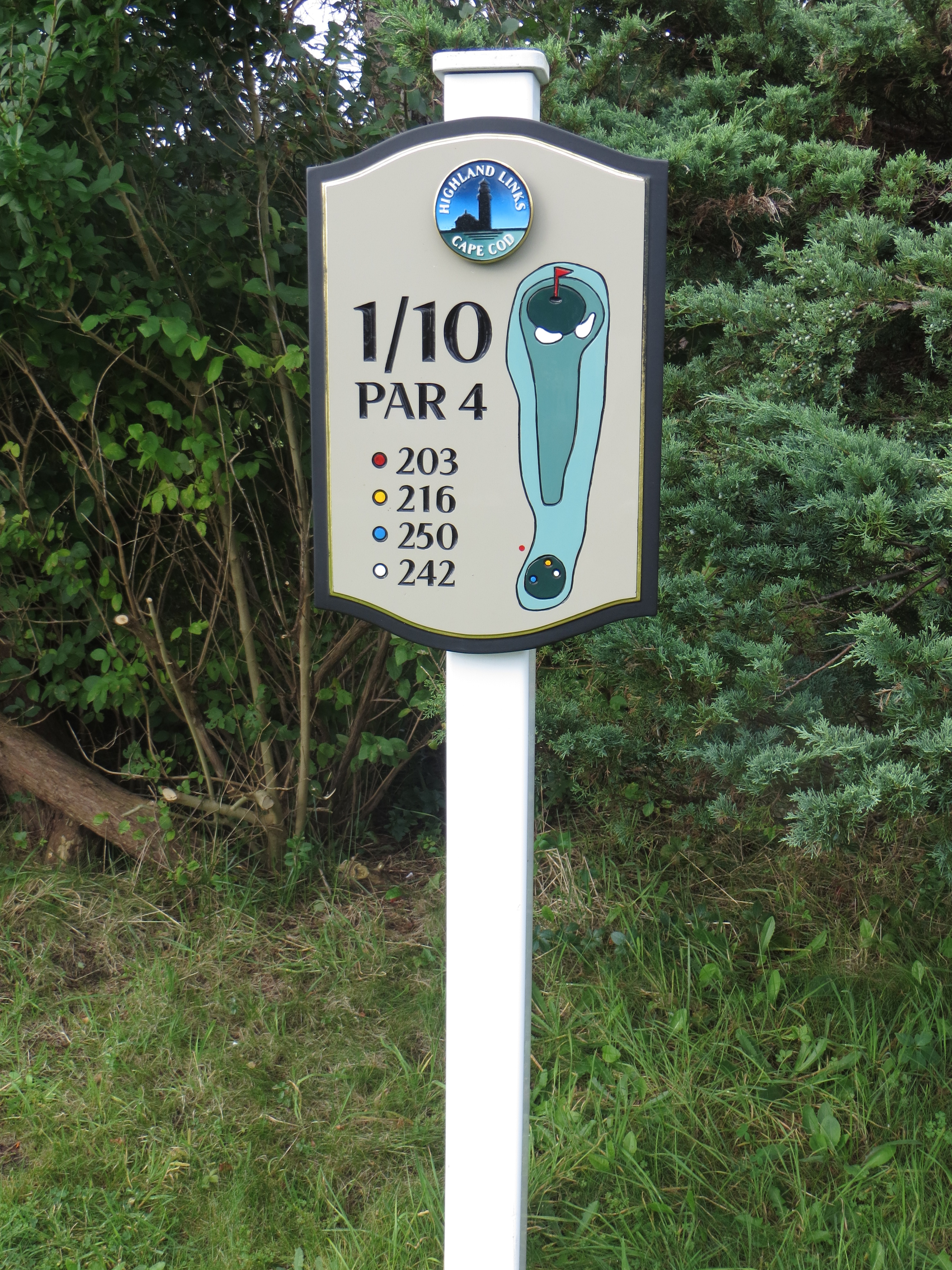
This is only a nine hole course but they have two sets of tees so you can make a second loop to get in the full eighteen.  I highly recommend you do that because the first time through there is a steep learning curve on how to play these holes successfully.   As you play the nine again from slightly different tees it is interesting that the men’s inward nine is 200 yards shorter while the women’s inward nine is 30 yards longer.  The second hole is a par 5 on the front and a much shorter par 4 on the back.  The fourth goes from a par 4 to a par 5 as the thirteenth.   With different teeing lines, the shorter distance on the second nine seems a harder round to the measure of par.

Elevation change and wind have to be constantly condsidered.

Elevation change and wind are constantly considered through your day.

If you are used to lush fairways and fair bounces you need to check your ego at the door of the golf shop.  This is golf the old way, rock hard fairways with existential bounces, small putting surfaces with angular fall offs, and serious slopes to navigate on the greens.  The wind will be a major influence so trajectory control and creative attack lines are called for.  If you have a quiver of links shots bring them with you because the ground is your friend and you will have to make some strong up and downs to play well here.

Full links drama on the drive on the Par 5 sixth.

Full links drama unfolds before you on the drive at the Par 5 sixth.

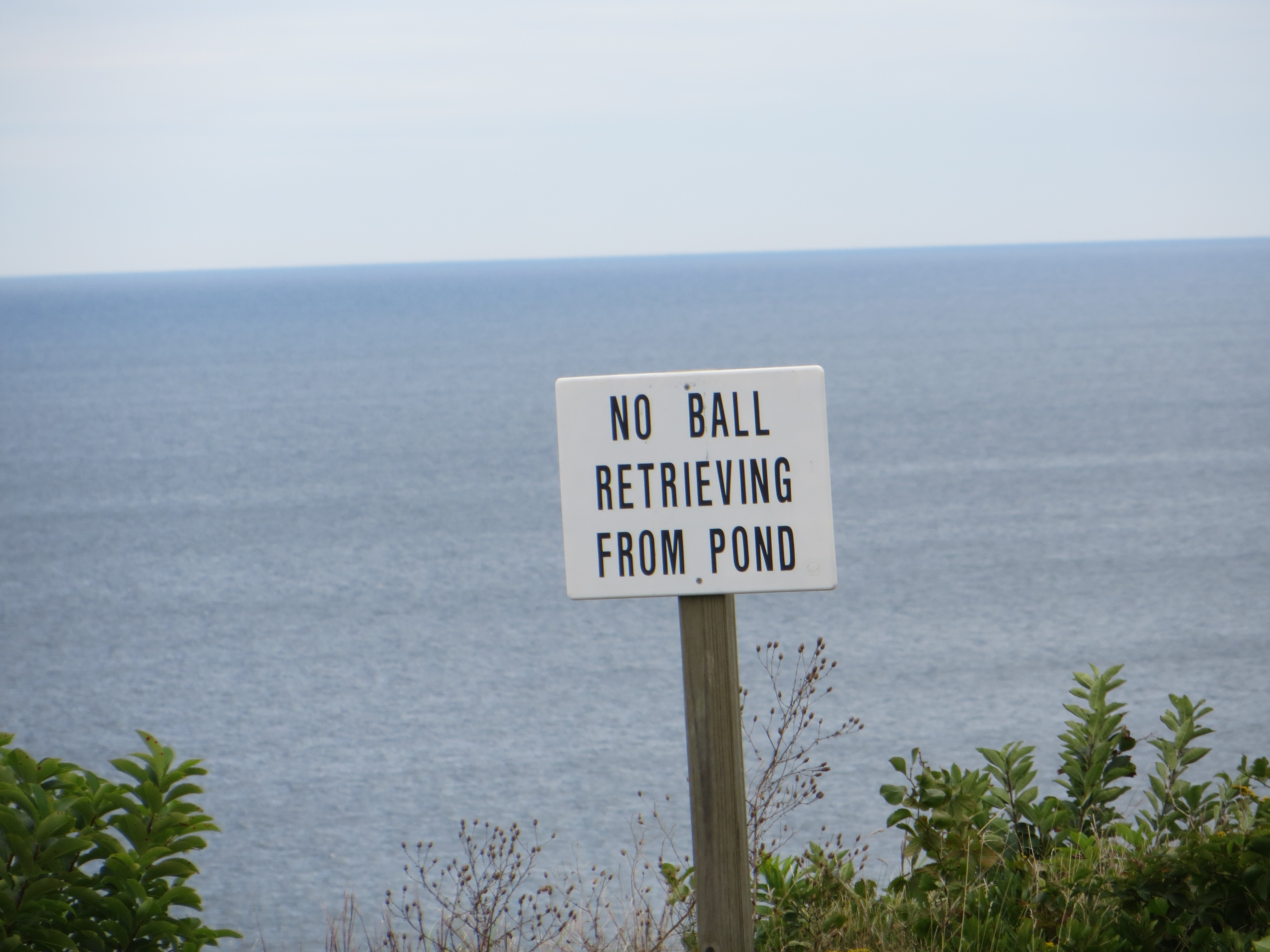
The views on the high holes are just spectacular.  When you get to the tee box on six you are perched on a cliff about 400 yards above the ocean with a drop dead panoramic view worth a digital moment.  This place is not without a sense of humor.  There is a sign adjacent to this tee box on the walking path to the cliff that says, “No Ball Retrieving From Pond”.   You would need a grappling hook, lots of rope, and a lobster basket.

The PondThe Highland Lighthouse is prominent on the horizon through the round but never more spectacular then when it is the backdrop to the finishing par three on each nine.  In fact on the Truro Links website under “Directions”  they have:

Scotland:

Sail Southwest until you reach the 42nd parallel. Then head due West until you see Highland Light.

The views do not get any better than this.

View at the Par 3 ninth……it does not get any better than this.

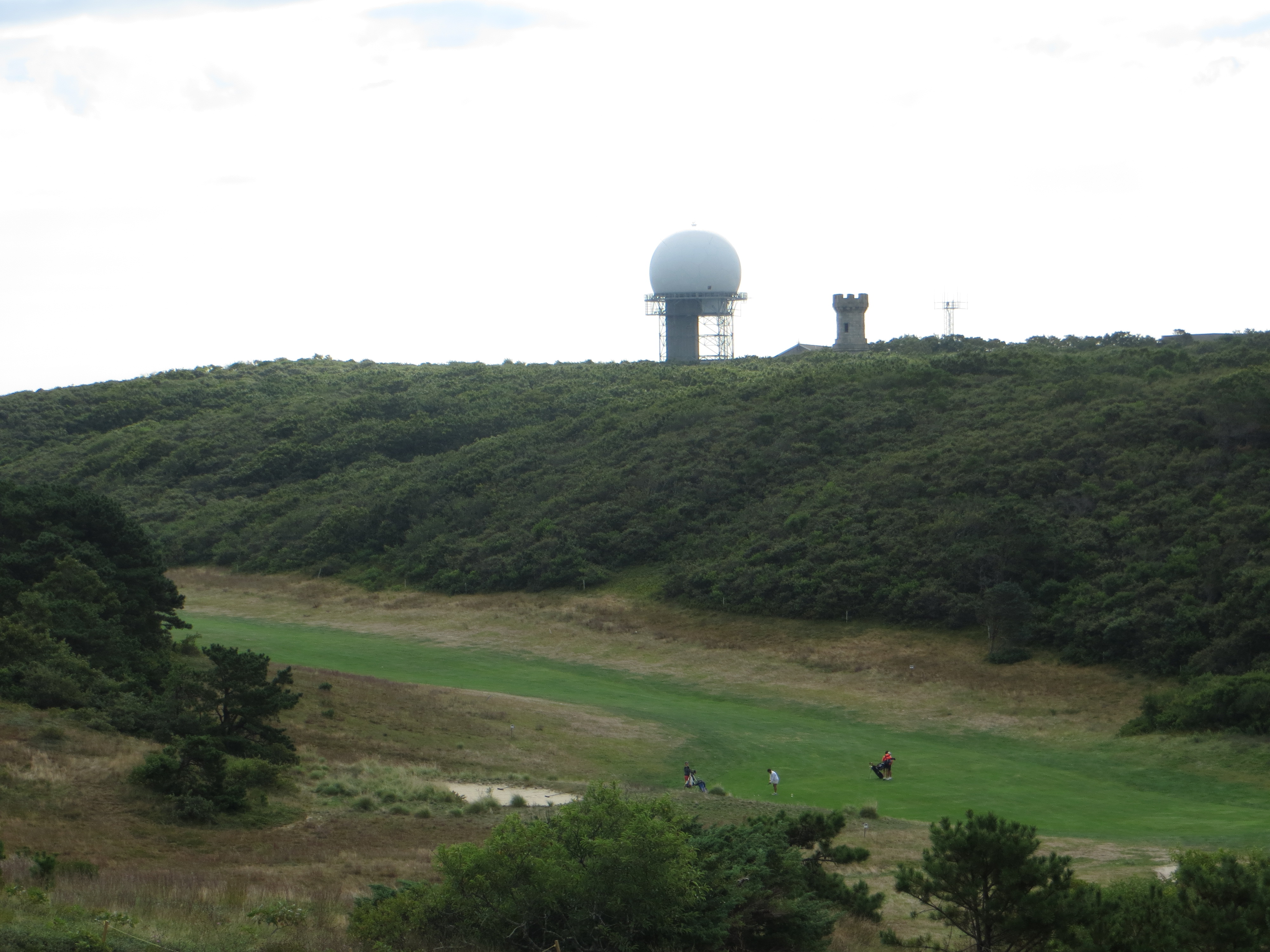
There are also two other curious architectural artifacts on the top of the dunes behind the second and third holes.The first is a globe that looks straight out of Epcot Center at Disneyworld.  It is an old FAA service dome that originally was used by the Air Force as a surveillance station during WW II.  Juxtaposed to it stands a 55-foot tall medieval looking granite tower on which you would expect to see Mel Gibson in full Braveheart garb wielding his sword and a shield.  This is the Jenny Lind Tower that was transplanted from Boston in 1927 as a gift to Truro from Harry Aldrich, a rich Boston attorney.  The tower was famous because Jenny Lind, the most famous singer in the world in 1850, delivered a concert from the top of it to a throng of people who could not fit into the auditorium she was scheduled to perform in at Boston and Maine’s Fitchburg Depot.  I am thinking that a young and impressionable Mr. Aldrich must have been in that crowd.

The embellishments on the horizon seem to span centuries.

The embellishments on the horizon seem to span centuries.

What this place lacks in polished feature and comfort detail it more than makes up for in traditional links look and feel.  For those who love a rough and tumble British Isles golf experience there may be no better place on the east coast to find it than a double lap at Highland Links.

North Truro, Massachusetts

Architect:  Willard Small (1892)/J. Henry McKinley (1913)

Tees                Par     Yardage      Rating     Slope

Blue                 70        5332           67.0        114

Red                  72        4587           67.8        117

(Click here to review the complete Highland Links Golf Course hole-by-hole descriptions)

For more pictures click to review Postcard From Highland Links

Merion Golf and Cricket Club

Merion LogoIn 1914 the members of the Merion Golf and Cricket Club tapped one of their premier players, Hugh Wilson, with the responsibility of creating a championship golf course on a mere 110 acres of hilly ground outside of Philadelphia.  This was no small task considering he had no previous experience in course design.  He took a trip to England to study the construction of the great courses of the British Isles and came back inspired that his first stab at golf design could be a success.

           With the invaluable help of a young William Flynn as his lead construction man, later one of the most prolific designers of this Golden Age of course design, the two of them created one of the memorable tracks one will ever play.   Except for Pine Valley, Oakmont, and Pebble Beach, there are no other examples of such quality design by an individual on his first try. 

Merion has a certain mysterious quality about it that kind of creeps into your mind long after you have left the course. The sequence of holes defies any obvious pattern which gives you a sense of arbitrary fate as you work your way through the course.  There are no distance markers on the course either on the tees or in the fairways-no indications of pin positions.  Fortunately, there are a group of the most knowledgeable caddies you will find anywhere, and they know the distance from every blade of grass on the course and the break on every putt down to the most subtle nuance.

This is a course that asks you to show great patience, to wait for the opportunities as they occur.  You cannot force a good score, you must knead one out of the layout with great patience and adept shot execution.  There are very few tricky holes, all the challenges are quite obvious, but they are also quite real.  If you try to bite off more than you can chew you will likely choke on the effort.  Carefully pick and choose your challenges and when you set your mind to taking one, do not waffle on that decision-you must play every shot with great confidence or the course will eat you up.

With both five pars in the first four holes you find yourself searching for rest holes the last three hours of your day.  You are going to be rudely disappointed because even the shortest par fours, and there are a plethora of them, do not provide you with obvious scoring opportunities.  You can have short irons and wedges in your hands for second shots all through the first thirteen holes but it better be from the fairway and you better keep those approaches beneath the flag sticks.  The last five holes are as harsh of a finish as you can imagine.  It is full prevent defense of your scorecard the rest of the way to the clubhouse.

The most obvious characteristic of this course is the impeccable quality of the putting surfaces.  The greens are the finest I have ever seen, very fast, very true with lots of pitch and yaw.  The condition of the course is equally impeccable-it looks like a fine manicured yard everywhere you look.  Another signature characteristic is the severe bunkering-the bunkers are deep and often strewn with wild sage grass.  The best strategy is to stay out of the sand entirely and when you get in one take the most conservative path to exiting it.

The full Merion experience begins when you get out of your car and ends after a refreshing post game shower.  There is a special hamish relationship between the members and their long standing employees that run the place.  An informal atmosphere exists without much of the pomp and circumstance typical of an old line club.  The floors are uneven and creaky and there is a bit of a musty odor pervades the place-it feels like a comfortable visit to your grandma’s place when you were a kid.  The members themselves take great pride in the tradition and care of this place.  Try to take a mulligan off the first tee and they will show you the door.  My host was walking the fairways bending over to pull offending weeds from the turf-a bit of greens keeping vigilantism.

          The signature of Merion are the wicker baskets atop the flag sticks.  Makes it tough to get a wind reading on the green from the fairway.  Unsubstantiated rumor says that Hugh Flynn, on his pre-design trip to the review the great courses of Britain, saw shepherds tending their flocks with long staffs with hollow wicker baskets on top where they would stash their lunches to keep them away from prying animals.  He thought that was a cool look and came back to the states with this notion for unique flag sticks.  With the help of local artisans he had them made and patented and today they are guarded as treasure, taken in every night at the end of play to insure no one comes hunting for souvenirs.

          Playing this course is much more than a simple round of golf, it is a golfing experience.  The place is steeped with tradition and memories of golf’s greatest players making great shots in major championships.  You cannot help but get caught up in the ghosts of championships past.  Take in all this ambiance as you stroll these fairways and enjoy the special character of this hallowed place.

Philadelphia, Pennsylvania

Designer: Hugh Wilson (1914)

Tees          Yards   Par    Rating Slope

Blue           6482    70      73.5     149

Middle        6103    70      71.6     144

(Click to read hole-by-hole descriptions of Merion Golf and Cricket Club)
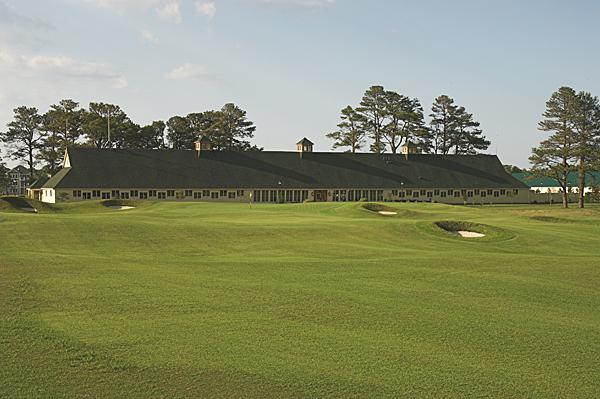
Bedford Springs-Old Course

Established in the late 1800’s this place is a small scale version the old line rich man’s retreat, on the order of a Homestead or Greenbrier, full service food, accommodations, golf, spa, family recreation, and all. It has a much more casual presentation than those others but that may be a function of the new day more than anything else.  A very comfortable atmosphere-well managed-it makes for a perfect two-day getaway from the hub-bub of urban life.

Par 3 “Tiny Tim” even has the chocolate drop mounds (omnihotels.com)

The golf course is quirky but very interesting.  It is the result of the efforts of three architects over a thirty year period-and it has been recently updated in 2007 without changing the effective old style character of the links.  Spencer Oldham did the original 18 holes in 1895 featuring chocolate drop mounds, geometric S-curve bunkers, and donut bunkers.  In 1912 A.W. Tillinghast got his hands on it and scaled it back to a nine-hole course with his own architectural features.  In 1923 Donald Ross took it back to a full 18-hole track and you can see raised greens with lots of tiering, artistic bunkering constellations, and, most distinctively, a creative and strategic use of the Shober’s Run that meanders throughout the entire golf course.  The renovation work in 2007 was done by Forse Design Company of Pennsylvania who are known for doing period restoration and  renovation work throughout the US and Canada-they have recently had their hands in renovation work to the Broadmoor-East Course in Colorado and the Newport Country Club in Rhode Island-sites of  recent U.S. Senior Opens and U.S. Women’s Opens respectively.   They did a wonderful job retaining the characteristics of all three of these fine architects while making it a very playable and a challenging golf experience.

The entire course is in the flood plain of the Shober Spring Stream and sits nestled between the foothills on either side.  There is a good bit of meandering back and forth so the holes do not route in a typical outward and inward loop.  For a course set in the foothills there are not that many severe elevation changes on holes and you get surprisingly few side hill or billy goat stances during the round.   As with most old style courses the track does not sprawl-the next tee is a few steps from the last green and the round has a tidy-compact feel to it.  Green surfaces are totally updated-very quick-lots of pitch and undulation and oddly shaped which makes for really small targets from the fairway.  You will do some pitching and chipping to save pars.

The green speed is the course’s major defense considering the tiering and undulations you will face.  But at the same time these characteristics provide you with a good correction mechanism for your approach shots if you pay attention to green topography and use it accordingly.  Big hitters will be frustrated by the many times they cannot just haul off and hit as much as they can-position off the tee is extremely important to getting the best angle of attack into the greens.

The last characteristic worth noting is the balance of the types of holes and the sequencing.  Five Par 5’s, Five Par 3’s, and 8 Par 4’s (only one over 400 yards) means you are hitting lots of finesse shots through the day and the mix is pretty random.  There is a sequence from 2 to 6  where you play par 3, par 5, par 3, par 5, short par 4-other than the driver on the second par 3 you have no long shots for five holes.  From 9 through 14 you have a similar 5-3-4-4-5-3 run but in the midst of this one you have two of the longest holes you play all day.  My point is you have to be very mentally agile to play this course effectively-there is no natural rhythm to the course other than the constant sound of the babbling of the ever present Shober’s Run.

Bedford Springs, Pennsylvania

Architects: Spencer Oldham (1895), A.W. Tillinghast (1912), Donald Ross (1923), Forse Design (2007)

Tees                 Par            Rating            Slope            Yardage

Medal                72               73.4               140                6785

Ross                72               71.9               136                6446

Tillie                  72               69.3               130                6023

Oldham            72               69.8               122                5106

(Click here to review Bedford Springs hole-by-hole descriptions)

Musket Ridge Golf Club

Set in the terrain of the foothills of the Shenandoah Mountains this is a hilly course with dramatic up and down holes and stunning vistas all around. The golf course is in the same neighborhood as Arthur Hill’s Maryland National to which it tends to regularly be compared.  In my estimation Musket Ridge is hands down more fun and interesting.   What differentiates it from Maryland National is that it is a consistent strong design without any trickery.  Balance of long and short holes is right, par threes have good variety, and the teeth of the course are the in finish on both sides.

Playing Musket Ridge, the first thing one comes away with is the beauty of the settings that surround the course.  There are so many holes where you stand on the tee looking at the hole ahead and your eye just gets drawn to something five miles in the distance.  At times it can be distracting because the mind starts wandering and the scale of the task at hand gets dwarfed by the panoramic view that is consuming your attention.

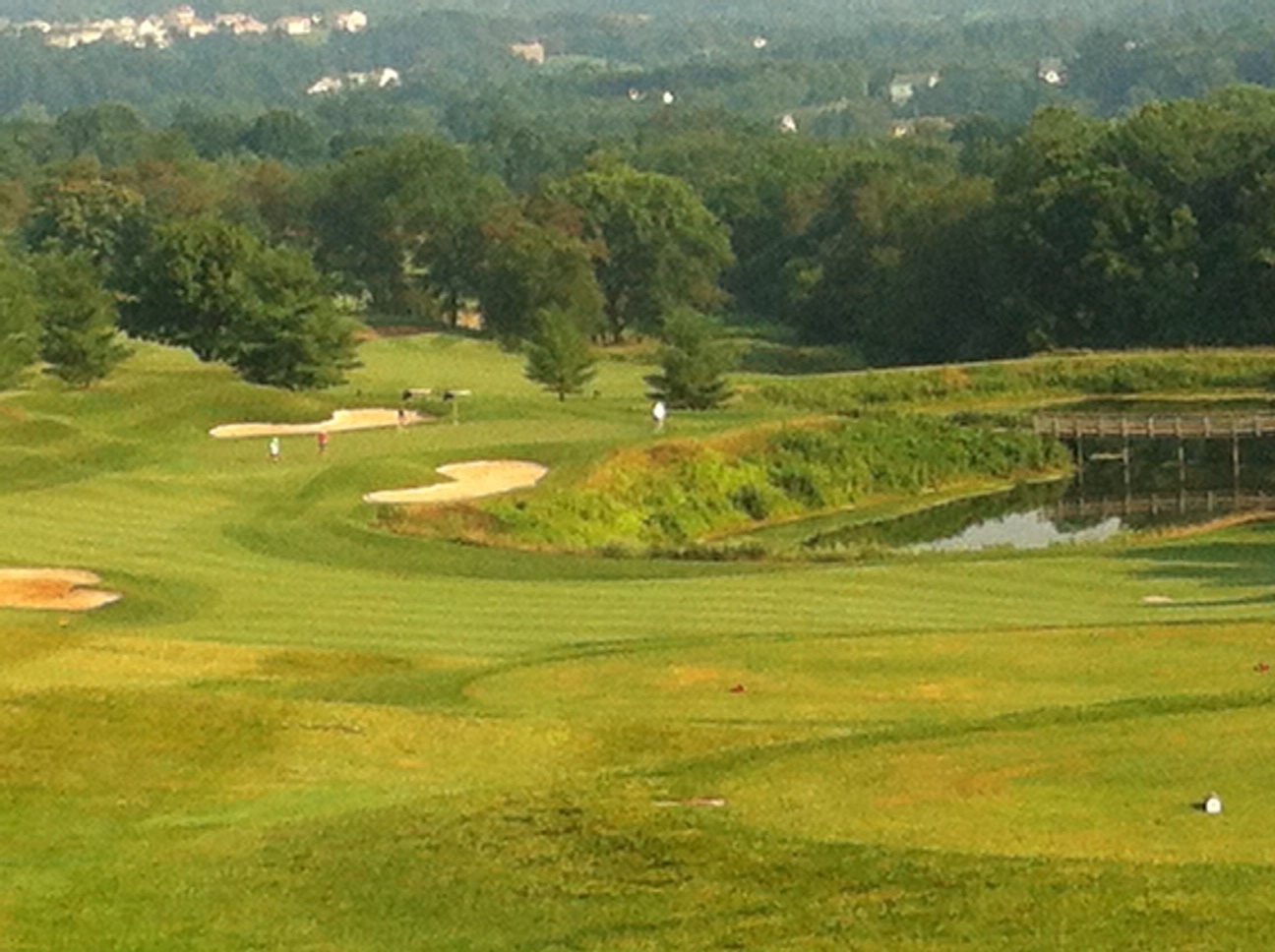
From the first tee the scenic beauty of this region is revealed

The second characteristic worth noting is the quality of the greens.  Pretty generous in size the greens are big without being sprawling.  Unlike so many new courses these days these are not tricked up with buried pachyderms or absurd segmentation.  Occasionally multiple tiers appear but it is selective and makes sense when it is used.  The bunkering around the greens is strategically positioned and can be punitive so you must respect their proximity when picking your approach lines.  To my experience, the quality and maintenance of the putting surfaces has been top notch.  They can be speedy when cut low but most of the time they run at a comfortable speed for recreational play.

Lastly it is noticeable the way the holes are routed across the hills.  Most holes traverse the fall line of the hills so there is a stacked effect to the arrangement of the holes.  The designer uses ridges along the side to define and contain each hole and give you relatively level ground to play from.  But the influence of the prevailing slope of the property will influence the movement of your ball on the ground.  Wandering  beyond those ridges puts your ball in the jeopardy.  To accentuate the look they have let the grass on these side hills grow to three feet plus so you have to keep your ball within the parameters of the playing area or you will pay a price.

A little floral embellishment on #17 and this could be a postcard

The variety of the holes is astounding.  No two holes look remotely alike.  There is a great mix of long and short four pars-ones you think you can drive the green and a number where a solid drive still leaves you the full measure of a fairway metal to reach the green.   The front and back both start with scenic holes that tumble below your feet and set a tone for the drama of the day.  Strength of both sides is in the last four holes where if you lose your focus you will lose control of your scorecard.  The challenge from the Blue Tees is more than enough for the mere mortal-play at this distance and you will get your money’s worth.

Even though you rarely hear Joe Lee’s name mentioned among top designers, he has been around a long time and done wonderful work.  He spent most of his career being the junior co-designer with Dick Wilson building courses like Cog Hill #4, Laurel Valley, La Costa, and the Blue Monster at Doral.  But in the last 20 years until his passing in 2003, he has done lots of work on his own that stands to its own distinction.

A book was written by Ron Whitten on Joe Lee’s work in which Lee is quoted as saying of his design philosophy,   “I start with the premise that golf should be enjoyable, not a chore. Golfers want a challenge, but they want a fair one. An architect cannot put a foot on the golfer’s neck and keep it there all day.”   His philosophy of design is evident in this layout-it is a challenge, but an enjoyable challenge.  One cannot help but walk away shaking their head about what could have been, soon to be followed by the nagging sirens calling them back for another go at it.

The look up 18 captures the balanced majesty of this place

Take the time when you are done to enjoy the food service in the grill room.  It is an intimate room with a great view of the finishing holes on both sides.  Food is quite good and makes for a nice accent to a wonderful golfing day.

Myersville, Maryland

Architect: Joe Lee (2002)

Tees                 Par        Rating               Slope       Yardage

Gray                 72            73                    140            6902

Blue                 72            71.1                 130            6416

White               72            68.9                 123            5884

(Click here to review Musket Ridge hole-by-hole descriptions)

Hidden Creek Golf Club

Bill Coore was asked by a wealthy New Jersey real estate developer, Roger Hansen, to create distinctive golf course on 750 acres of sandy rolling pine barren woodlands he acquired outside of Atlantic City.  He had in mind a golf club in the Pine Valley tradition-a private haven where wealthy people with presence in this area could entertain their friends and colleagues with the highest standard of golf, food, and accommodations in a casual environment without pretense.

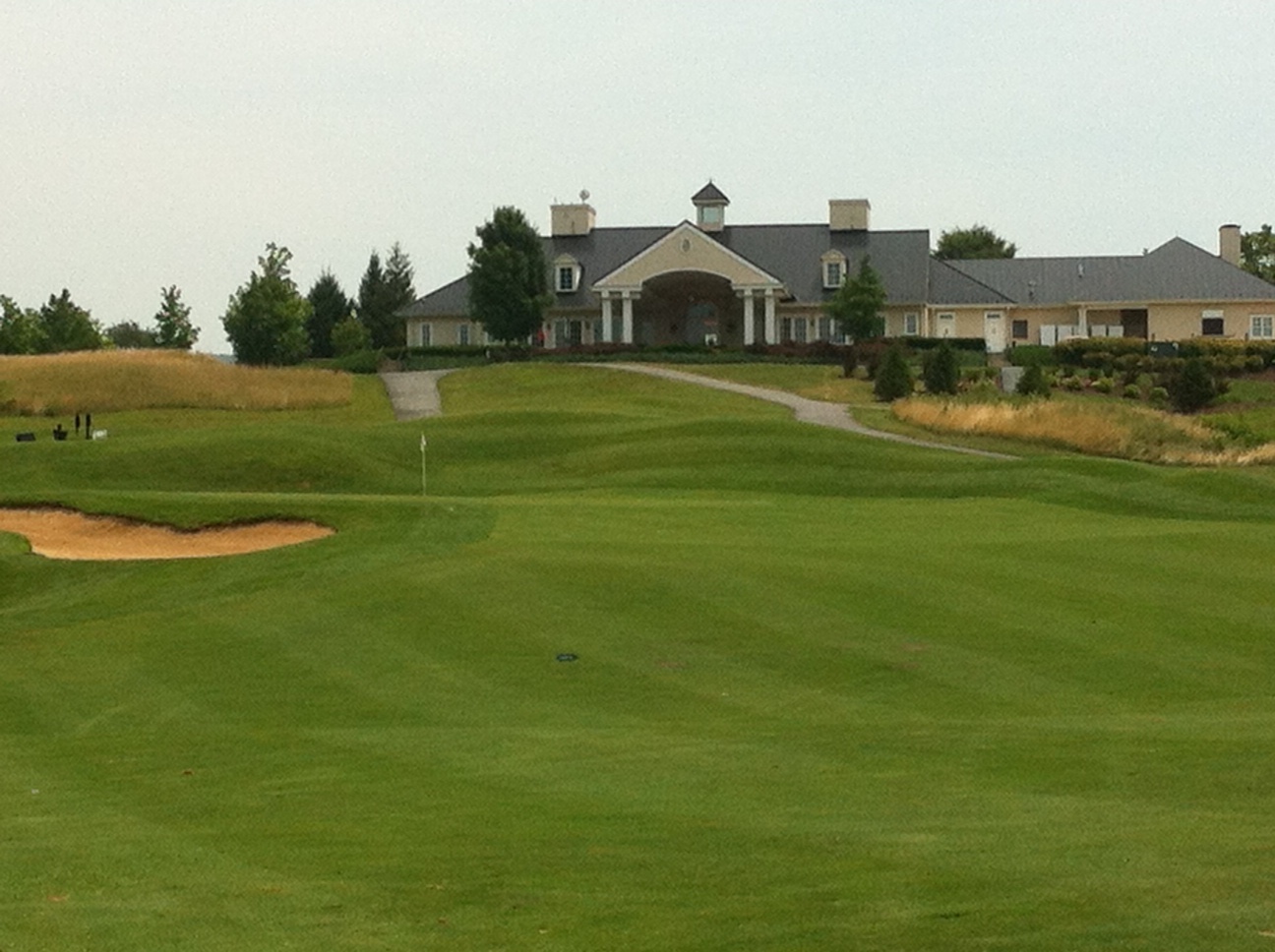
The understated look of the back of the clubhouse coming down #9

Click on any photo for an enhanced view of the image

Coore spent a considerable amount of time walking the ground before a contract was prepared and determined it offered an opportunity to create rustic walking course with a character unique to this region.  There was enough elevation change in the property to make holes with distinct topological interest and plenty of natural vegetation to provide the look and feel of an old English heathland course.

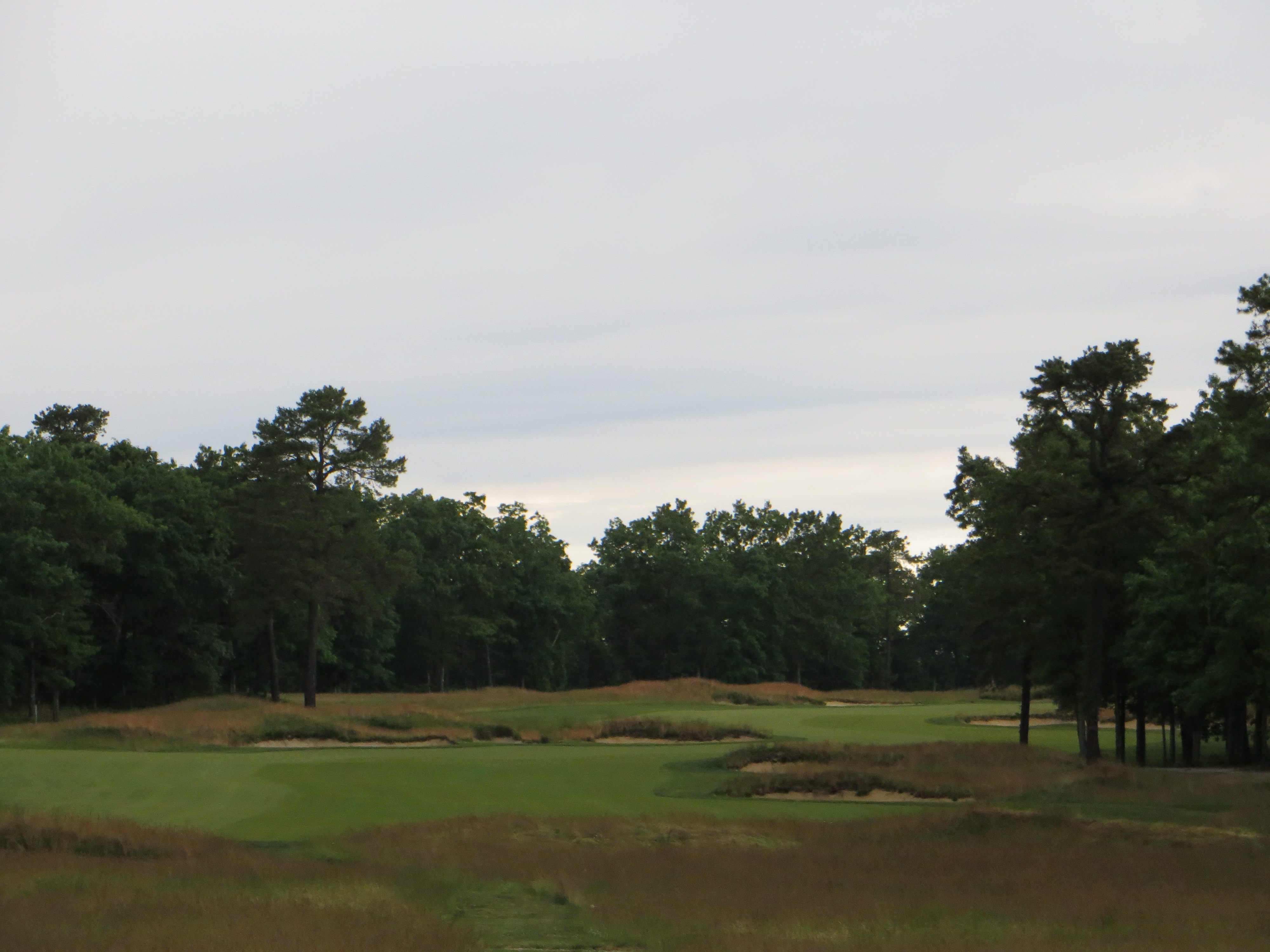
The natural look brings to mind the heathland courses outside of London

What he came up with was an old style walking course, short walks from greens to tees, that clings to the upland part of the property.  With a minimal amount of dirt being moved, it would have the raw and natural looking hazards of mounding, deep bunkers, and long fescue grasses you might see at a course like Sunningdale outside of London.  There would be no paved cart paths, no houses interrupting the landscape, just natural delight as far as the eye can see.  Coore said of the project,  “The Hidden Creek site required very little alteration to the landscape.  The holes lay on the ground pretty much the way we found it.”

Coore and Crenshaw embrace the old style principles of great designers of the golden age providing plenty of  room to play the course and generous access to the greens.  There may be ferocious bunkering on one side of a fairway or green but you will rarely see both sides cordoned by trouble.  This makes the play much more enjoyable for the recreational player who does not want to take on the macho challenge.  Like many of the great courses of that period, playing this course well is about thoughtful tactical intention with adept execution of the shots required.

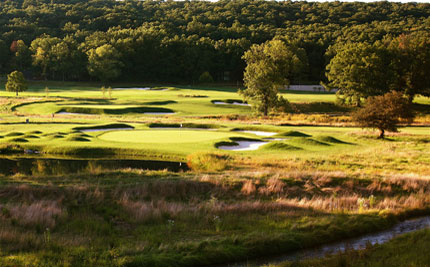
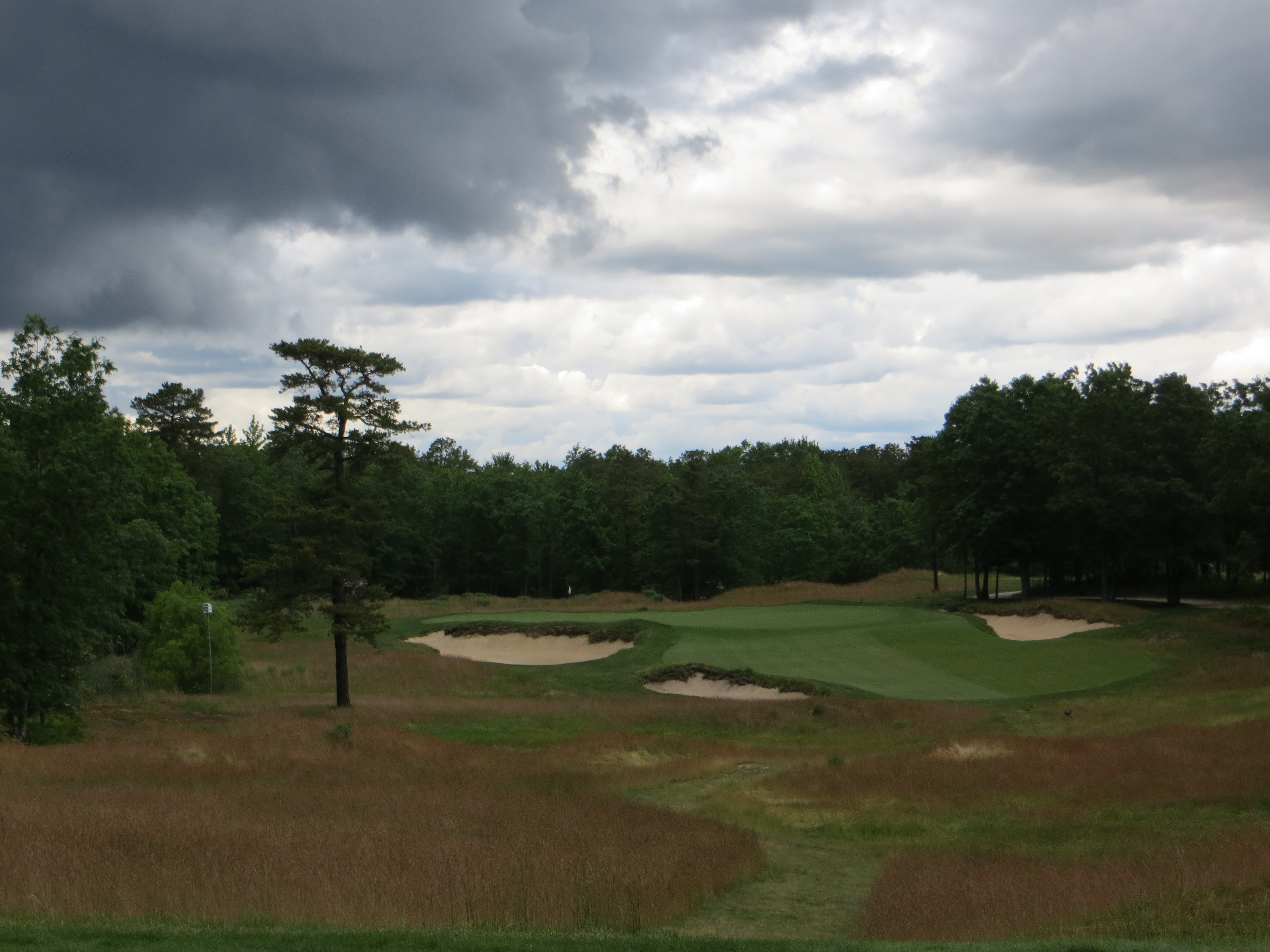
Large setbacks provide a beautiful backdrop for a stunning view like the Par 3 #4

They created big set backs for the holes from the existing trees-this makes for an enhanced canvas on which to present the holes.  Lush bent fairways throughout set against gold fescue grasses make for a beautiful presentation.  The most distinctive characteristic is the seemingly random mounding and bunkering that provide most of the hazards.  There is no water in play on the course-they did not route any of the holes through the wetlands that take up almost half of the property.  The randomness of the placement of the hazards defies the symmetrical look of so many modern designers and it makes the playing lines infinitely more interesting to discern as you plan your shots.

There are over 100 bunkers on the course and they often have eyebrows of natural long fescue reminiscent of Royal County Down-this makes them very intimidating looking from afar as well as difficult from which to extricate yourself if you are too close to the front of the bunkers.  Pay particular attention to the relative position of the hazards to the landing areas and greens.  With some optical trickery they can seem more imposing than they really are-there is often more wiggle room in the formula than meets the eye.

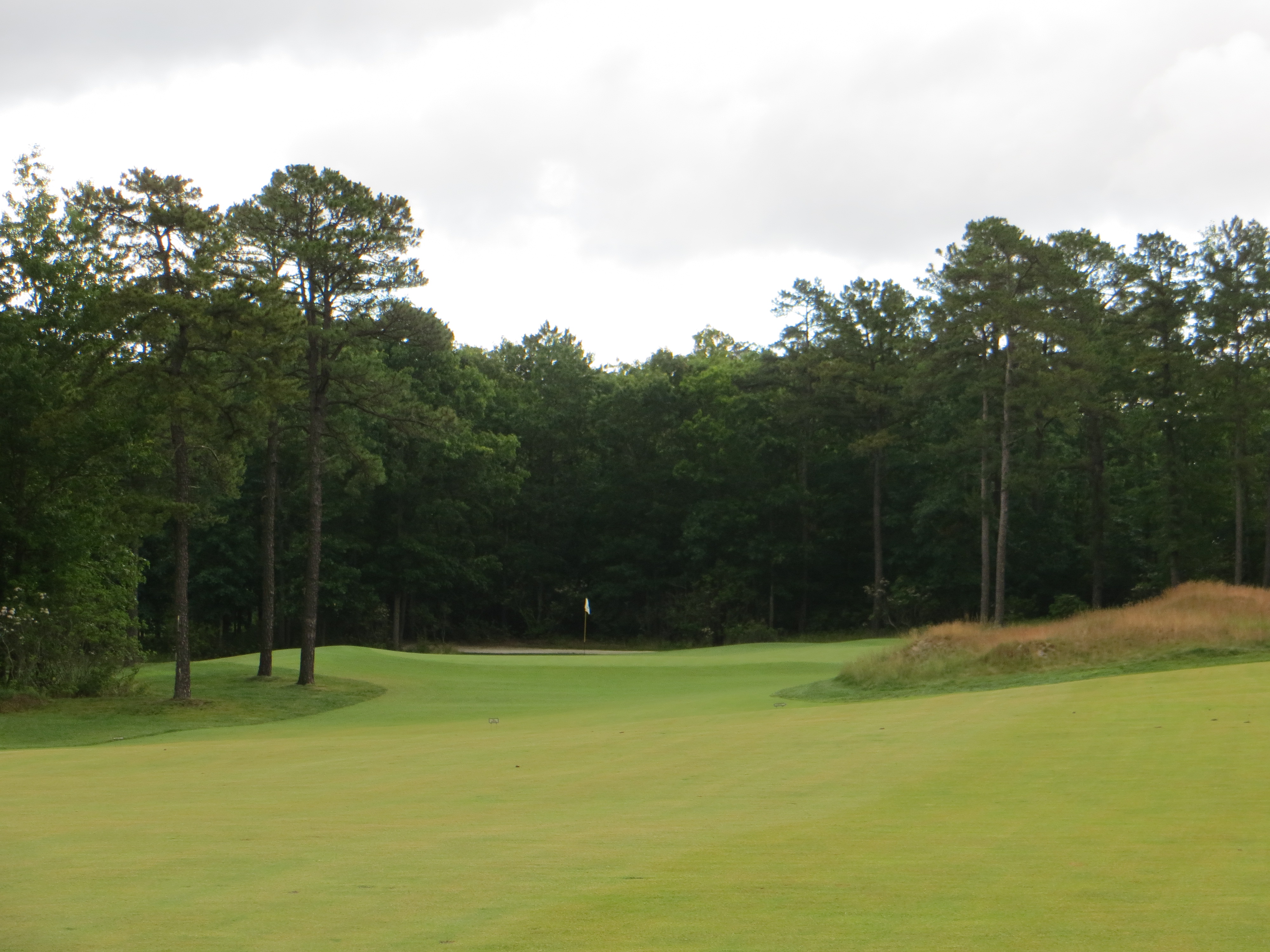
You can see on #5 the minimalist presentation with a tactical emphasis

I found the mystery of the greens particularly intriguing.  These are big, sprawling oceans of green with pitch and undulations that will confound you both on your approach shots and your putting.  Local advice is essential until your personal knowledge of the greens is up to speed. These guys have real genius giving you plenty of room to approach but giving you little room to approach successfully.  You can hit what seems like a wonderful shot that seems to randomly separate from the hole against all your intentions.  The greens roll very nicely and have lots of speed, especially down hill.  This is not really a set of greens that call for a nickel defense but you have to be careful when the speed conditions of a particular putt are at the optimum.

This 110 yard short pitch and putt on #11 is anything but a push over

What is an architectural accomplishment of no small order, given that the property itself does not have inherent dramatic topography, is no two holes on the course look remotely similar.  You cannot anticipate what is coming next because there is no pattern to the sequence or the hole designs.  The sequencing of the holes is brilliant, you might have a monstrously long par four followed by a short pitch par three or a reachable par five.  This keeps the player off balance because the challenges vary dramatically from hole to hole.

The entire facility is top notch.  The locker room, eating facility, and practice facilities are as good as any high end club you will visit.  Like you would see at Pine Valley or Caves Valley they built very nice lodge to accommodate out of town guests in for a multi-day visit to the club.  You are going to need an invite to get here but if you can find one you will not be disappointed in what they have created.

Egg Harbour Township, NJ

Architects:  Bill Coore/Ben Crenshaw (2002)

Tee                         Par    Yardage    Rating      Slope
Championship        71      7023         73.5         136
Member                 71      6562         71.6         131
Forward                 72      5486         72.3         127

(Click here to review Hidden Creek hole-by-hole descriptions)

Spring Creek Golf Course

Spring Creek Golf Course was created to support a high end housing community about seventeen miles east of Charlottesville.  When it came on line the economic infarction of the time seems to have upset real estate sales, yet this course has design quality and integrity that should make it a success as a fee course until that trend turns around.  Ed Carton has considerable deputy experience with Tom Fazio and it shows in the presentation of this course.  Like his mentor this course is visually pleasing and seems to fit into the regional topography very comfortably.    The course has won some instant national recognition by the national golf magazines and has been favorably compared in reviews to the other jewel of Virginia, Lester George’s  very private Kinloch Golf Club outside of Richmond.  The difference is this place is totally accessible to the fee paying public.

For a residential community course this has a modern design characteristic rarely seen in these type of developments-generous hole setbacks from the residential lots.  The owner, Charles Kincannon, showed great discipline in allowing the design team to employ such setbacks which make the holes seem very comfortable in their surroundings without visual encroachment.  Given the dramatic topography on which this course is built that has resulted in holes of stunning visual stature as well as tactical uniqueness.

Creative use of the topography create visuals like the par 4 #14

The most obvious characteristic is the generous use of sand throughout the course.  This is an expensive design decision but, as you see on Fazio style courses, free form expansive bunkering is a visual accent that can be psychologically intimidating and provide tactical parameters that challenge the golfers as well.  My wife said on about the eighth hole, there must have been no sand left in Virginia Beach once this course opened for play.  Most interesting is that she played the entire 18 holes and was not in a single bunker-now that is good design.

The Alien Gingerbread Man bunker hunkers over # 3 green

Another unique characteristic for this region is the choice of bent grass for the fairways and tees.  Zoysia and Bermuda grasses are usually the choice when you get this far South but the bent works well and it displays beautifully when it is well maintained and manicured as it is out here.  There is also the clever use of indigenous rock accenting some of the low creeks, crossing bridges, and the high areas behind some greens.  Given the severity of the topography this stone softens many of  the visual transitions that were required.

Sprawling greens with undulations and fall offs that will challenge

The greens themselves may be the most unique part of this design.  They are vast, sprawling green surfaces with lots of facet and undulations.  The speed on these greens, especially down the slopes, can be disarming.  You need to play this course a number of times to understand the tactical requirement of your approach positions into these greens.  On many holes the greens have fall offs in more than one direction or insidious little donut depressions that feed to side pitching areas.  Knowing how to negotiate these and leave yourself an uphill putt you can play aggressively is the secret to scoring well.  The pro told me before I played  that the yardage on the card belies the difficulty that the rating and slope indicates.  The need to be able to approach these greens with a club you can control is critical so pick your tee length conservatively if you want to enjoy your day.

The front side starts with a wonderful challenging par four that will set the tone that ball control and accuracy are at a premium.  The next two holes, a very technical par five and a seemingly innocuous par four that is in fact the first handicap hole will serve to reiterate that notion.  From four to nine, with the exception of a bear of a challenge on six, the yardage will not overwhelm you but don’t be lulled into a sense of security, good planning and articulate shot execution will be rewarded.

Some pixie dust might help resolve the mysteries of #16

Once you turn to the inward nine the adrenaline rush will begin on the tenth tee.  This is an old classic style 90 degree dogleg right which means it is all about position off the tee followed by an aggressive uphill carry shot into a well guarded green.  The next three holes are very interesting technical holes that present your best scoring opportunity run of the day.  On the fourteenth tee you will witness the anti-gravitational moment  of being atop of the highest point of your favorite thrill ride.  Other than a reprieve on the short par three seventeenth from this point it is just one G-force experience after another that will exhaust your strength and test your resolve all the way to the house.  The eighteenth hole, a wild and wooly par five that is a hooker’s nightmare, is one of the most difficult holes you can face if you need a par to close out a match.  Just a terrific exclamation point for a course that has no shortage of thrills and spills.

The wharf green setting on #18 is a formidable challenge

If I have any criticism it is the array of par threes.  All four of them play within one club of each other so the yardage demand on the short holes does not vary much at all.  The four par threes are of distinct characters but they are probably the least interesting offerings of the day for me.

What sets this course apart for me is that, for an architect without a vast resume of his own courses to fall back on, Barton has succeeded in putting together 18 wonderful holes that work well together.  You would think in such an early effort there would be at least two or three holes that either did not fit in or just did not work.  Cannot say that about this place, every hole seems to fit the motif and there is not a single hole out there that will fail to stimulate your aesthetic and athletic sensibilities.  This place may seem out of the way but it is well worth the effort to seek it out and play it more than once.

Gordonsville, Virginia

Architect: Ed Carton (2006)

Tees                 Par            Yardage      Rating     Slope

Marble              72               6673           73.2        145

Onyx                72               6197           70.9        138

(Click here to review Spring Creek hole-by-hole descriptions)

Whiskey Creek Golf Club

At the height of the golf course construction boom in the late 90’s there were high end daily fee courses being built all around the Washington, D.C. area.  Of all those introduced Whiskey Creek, a collaborative design of J. Michael Poellot and Ernie Els, was probably at the top of that heap.  Considerable intellectual and financial capital went into the design and construction of this course on a beautiful piece of  rolling farmland in rural Maryland.  My bet is that the two of them were awe struck by the natural vistas they found on their first visit to the property.  Just looking up at the farm houses on the hills it very obvious how natural and stunning their green constellations could look if they routed this thoughtfully.

Skeleton of a 19th Century stone house is your aiming device on 18

The result speaks for itself, an artistically designed course with a wide array of holes sporting traditional tactical design features.  No trumped up hazards or artificial challenges-unless you consider a 19th century stone farmhouse in the middle of the 18th fairway artificial.  I consider it artistic license and it actually makes the hole tactically interesting.  There is generous use of stone and boulders throughout the course to accent the natural presentation of the holes.  A sensible use of the natural flow of the topography was employed integrating environmental hazards and water-enough to be challenging without being excessive or punitive.

The greens are large flowing surfaces with lots of facet-you really have to focus on the way the green sits to the fairway approach area to figure how to get it in the right portion of the green.  In some ways the green sets have a bit of that Irish/Scottish feel to them-big undulating oceans of green that wave mysteriously among the hills.   Most of the greens are approachable without carrying the bunkers and many are actually inviting to bump and run-especially when the pins are in the front.  The fairway and  greenside are similar to the greens-large deep rambling pits stuck into the hillsides and below the putting surfaces.

Visual green settings like this at #18 require tactics and precision

Being successful here is about taking the time on each tee to plot a reasonable series of shots based on the wind and pin positions of the day.  Sticking to that plan and not trying to overwhelm the challenges with brute strength will reward your scorecard accordingly. Most of the holes you can get a good look at what is in front of you, but many of the putting surfaces are masked from the approach area.  As Ernie says in the yardage book, big wide driving areas were provided on most holes but position is still important to get the best angle of approach to the greens.  In planning your approach consider everything-the entry openings to the green, the diagonal the green sits to the approach line, the prevailing banking of the green, and the relative punitive payment for missing on the short side of the flag position.  Sometimes a uphill pitch and a putt are a better formula to making par than hitting the green in regulation above the flag and having an unmanageable putt down the slope.

The yardage of the course is deceiving-it may be the shortest 6500 yards you will ever see.  Most of the long par 4’s and the par fives are downhill so they play considerably shorter than the yardage.  Many of the shots look much longer than they really are-you have to trust the available yardages and pick the right club accordingly.

Framed driving area on the tempting downhill Par 5 9th.

The front nine is an interesting ride-plenty of challenge but not overwhelming.  The fourth hole is a wonderful uphill par five that scales the terrain to an alcove green set among natural boulder outcroppings.  The next hole is a vertigo par four that tumbles down the hill like the final plunge on the log flume ride at Hershey Park.  The last two holes on the outward nine are terrific-a swerving par four working down the hill adjacent to number four followed by a tantalizing downhill par five that will tempt you to reach for something extra to end the side with a birdie.

Carry across the abyss on the Par 4 12th is a harrowing challenge

Once you have the dog at the turn the challenge ratchets up.  This side begins with a  technical hole that will give you heartburn if you are not careful.   Eleven is the postcard signature for Whiskey Creek just a thing of beauty that will make your heart race.  Starting at the twelfth the challenge heightens considerably with three visually intimidating par fours.  These next three are mostly about position off the tee and then resolve on the second into very tight green arrangements.  Sixteen through eighteen provide three distinctly different challenges in one of the most unusual finishes you will play in this area.  You could just as easily play these three holes two under or six over-it is about managing risk through intelligent decision making.

The fortress green setting at the Par 5 16th

The clubhouse is a simple wood frame construct that fits into the country theme of the property.  A high beamed ceiling and great visibility of nine and eighteen in the grill/lounge area makes for a comfortable atmosphere for watching  the action on the course or on Golf Channel with a hearty sandwich and an adult beverage in hand.  Food is strong bar food-tasty and satisfying.

What I like most about Whiskey Creek is that for a daily fee course they have figured out a way to meet the maintenance budget with appropriate funds to keep the place in top condition.  The fairways are always lush and the greens smooth with pace-more like a country club than a fee course.  Kudos to Kemper Sports who operate and manage this fine facility.

Ijamsville, Maryland

Architect: J. Michael Poellot, Ernie Els (2000)

Tee                  Yardage          Par     Rating     Slope

Blue                 6525               72        72.1        136

White              5979                72        69.3        129

(Click here to review Whiskey Creek hole-by-hole descriptions)

Man O’ War Golf Course

Man O’ War is one of two courses Joel Weiman built for the Glen Riddle Golf Club outside of Ocean City, Maryland.  Weiman designed the Uplands Golf Club (of blessed memory) in Denton, Maryland off Route 404 on the way to the Maryland/Delaware Beaches.  Similar to that effort,  here he took a flat piece of farmland and turned it into a very interesting golf course that pulls links style features into play and makes for a wonderful afternoon of golf challenges that we are not used to seeing in this part of the world.  Add the wind factor, since this is just off the Bay side of the Ocean City area, and you do have a course that will give you a new riddle to solve every time you play.

                           Early Wake Up Call on Par 3 Second Hole

Click on any picture to get an enhanced view of the image

Be clear, that in spite of all the marketing hype, this is not a links course.  It lacks many of the inherent environmental necessities of a links course-sandy turf, proximity to a major ocean or sea, tall sand dunes, treeless surroundings.  But, to his credit, Weiman found a way to embed many of the links style challenges in this course-blind shots, random bounces,  awesome topographical intrusions, scantly bunkered green constellations, slick and windswept putting surfaces.  You will have a few of those head scratching “is this too arbitrary” or “is this unfair” kind of thoughts when you think back over your day of golf.  But truth is what you should come away with is a satisfying sense of mental exhaustion from having been challenged throughout the day.

Intimidating Beauty Par 4 #11

What you do get are well manicured Bermuda grass fairways that wend their way through an interesting array of swales and hollows, startling bunker clusters, and imaginative green constellations.  Weiman introduces the links arbitrary bounce feature through the creation throughout the course of what we have coined “Worm Berms”.  When you look at the holes on the GPS imaging in the cart there are manufactured ridges in many fairways that look like worms-these will repel a ball without the proper level of intention to places that seem arbitrary and punitive.  But for anyone who has played across the pond you know that the rub of the fairway is an elemental part of the links golf experience.  The bent greens are severely sloped and segmented with tiers and fall offs that make it essential to plan your approach angles to leave your ball where you can putt aggressively. Being on the wrong side of the hole all day will leave you a bushel full of three putts.  Creative pitching and chipping will go a long way to keeping you on your game-the unusual green constellations will afford you plenty of opportunity to ply that craft.

Like most good courses driving the ball on the right line is essential to success.  Weiman used creative bulldozing to inject some very obtrusive obstacles in your path.  Picking the right club off the tee and the best angle from which to play your next shot will help you negotiate these challenges with much less pain.  The blind shots and other visual misdirection techniques in the architecture will cast further doubt in your mind, but you have to trust your instincts and have conviction of intent on every shot.

Home Hole Par 4 #18

This is a wonderful afternoon of golf with a distinct links flavor to it.  Enjoy the arbitrariness of the experience and go with the flow-you will have some sweet recollections of the day’s challenges if you don’t let it wear you out.

(Photos from gwowi.com)

Berlin, Maryland

Architect: Joel Weiman (McDonald Design Group) 2006

Tees          Par    Rating    Slope    Yardage
Blue          72      71.6       133        6556
Silver        72      69.1       128        6086

(Click to see complete Man O’ War hole-by-hole descriptions)

Laurel Hill Golf Club

In the early 00’s the DC Department of Corrections closed their Lorton detention facility in Northern Virginia and returned the  property, which included 4000 acres of hilly dairy farm land, to Fairfax County to redeploy for public use.  The county wisely decided to take full advantage of this opportunity to build a high school, an equestrian park, a museum, an athletic complex, an arts center, and a high-end municipal golf course.   With close to 300 acres at his disposal Bill Love, an accomplished designer with an environmentally sensitive approach to course design, was asked to oversee the project and he put together what has turned out to be one of the real gems in the Washington Metro area.

The juxtaposition of the property's former use to it's current use is intriguing.

The juxtaposition of the property’s former use to it’s current use is intriguing.

The golf course he created has stunning aesthetic beauty combined with challenging strategic design and will provide you with an afternoon of sheer golf delight.  Standing on many of the tees you cannot help but stop to appreciate how the holes gently follow the natural flow of the land bringing your attention the sheer beauty of nature’s features therein.  This would be a particularly inspiring experience in October with a little leaf color and a slight chill in the air.

October fall colors are already adding flavor to the driving area on #9.

October fall colors are already adding flavor to the driving area on #9.

The course is built to the top specifications featuring generous bent grass rolling fairways in impeccable condition, over 100 bunkers in places that make you think and think again, rough that will take control out of your hand on recoveries, and firm and fast greens with plenty of interesting contours to consider.

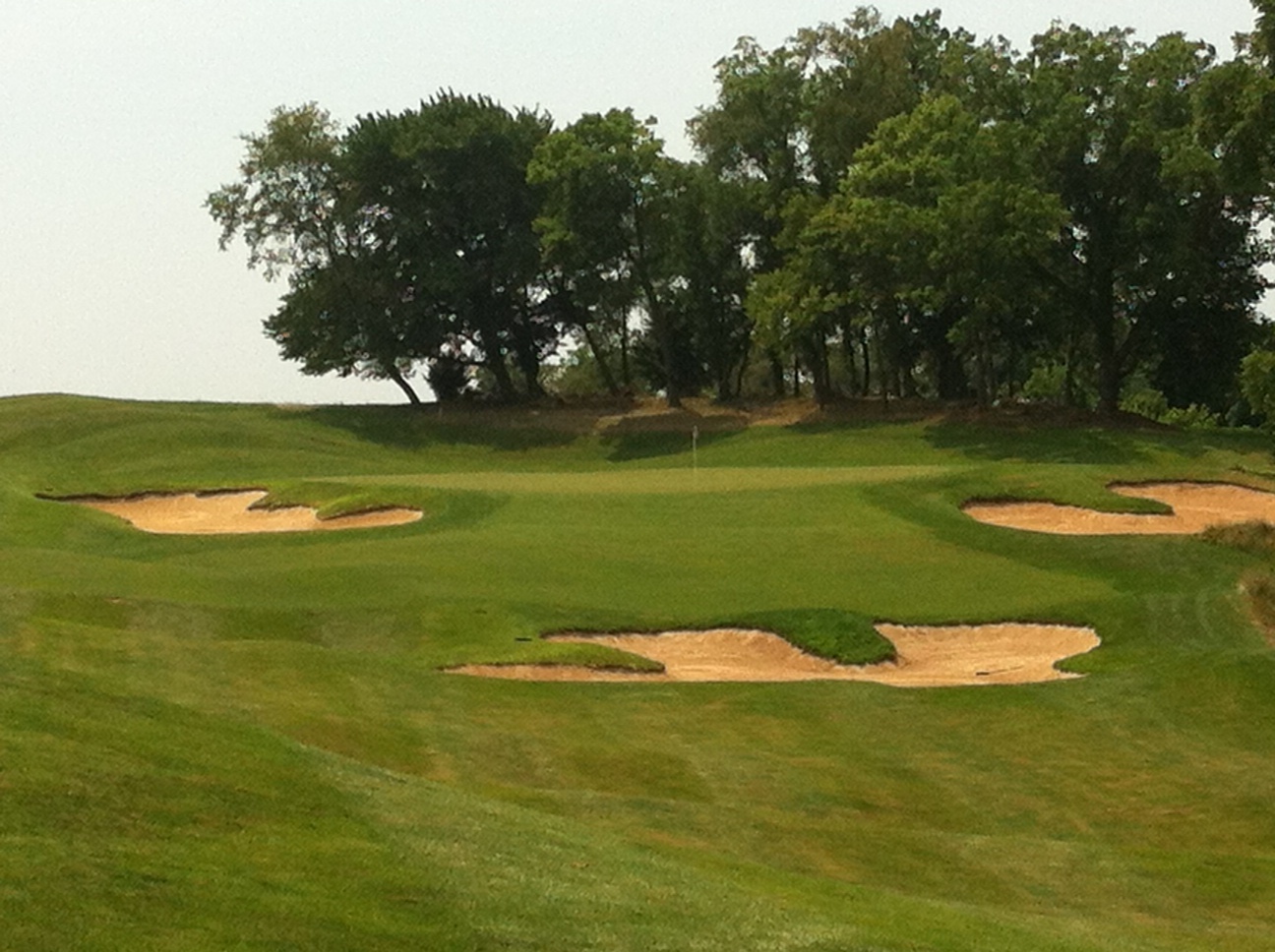
Just one nest of sand madness you must avoid in front of #5 green.

Just one nest of sand madness you must avoid in your path to the #5 green.

On many holes you just have to scratch your chin and ponder the possibilities before you decide how you are going to play effectively.  The county has committed serious budget money to keep this in top flight condition so the consistency of this experience is gratifying. Golfweek Magazine recently put this course as #13 in their list of top municipal courses in the country.  The top 15 on that list include Bethpage Black, Chambers Bay, Torrey Pines, TPC Scottsdale, and Harding Park.  Pretty heady company for our local muni, huh?  Based on this pedigree the USGA held their 2013 Public Links Championships at Laurel Hill.

The uphill climb on the long 439 yard 3rd has plenty of obstacles to

The uphill climb on the long 439 yard 3rd has plenty of other obstacles to consider.

What I like the most about what Love has done is the variety in the types of holes he presents.  The par 71 is not because of only 3 par fives-it is because of 5 par threes and these are some of the most interesting visuals of the day.  You have monster par 4s that are 425 to 450 yards and uphill to boot.  You have reachable Par 5s under 500 yards with major decision making parameters.  Two par threes under 150 and three par threes between 180 and 210.

#14 is 212 yards and a club and half uphill with a three tier green to boot.

#14 is 212 yards and a club and half uphill with a three tier green to boot.

There are steep uphill approaches, dramatic two-club less downhill shots, forced carries over environmental areas, and just some of those approaches where you have to slip it between the this bad thing and that.   Every club in your bag will be dirty when you are done-the variety of shots you are going to be asked to hit will run the full gamut.

There is a natural flow to the design as you see off the tee box on the long par 4 17th.

There is a natural flow to the design as you see off the tee box on the long par 4 17th.

In general the driving areas are wide, but the preferred areas are always cordoned by bunkers or bordering angular topographies.  On a number of the doglegs it is nests of bunkers that are your no-no not trees but trees do frame many of the landing areas and generally define the line of the holes.

The short par 4 7th tempts the bomber but the Jack-O-Lantern bunkering will spook them.

The short par 4 7th tempts the bomber but the Jack-O-Lantern bunkering will spook them.

The greenside bunkering is very imaginative-often nested to one side to force you to work the ball into a green set on the diagonal line of the green.  The greens themselves have lots of segmentation and tiering so you have to be careful to recognize where the pin is located and where the prevailing slope goes to keep your ball under the hole.  There is not much overt water in play but there are some moist ditches and adjacent environmental areas that can lead to double bogies.  Both nines end with a short par five that has real visual and strategic interest.  This gives you a chance for redemption or damnation at the end of each side.

The postcard 16th has alternate tees to change the challenge but not the pleasure of the view.

The postcard 16th has alternate tees to change the challenge but not the pleasure of the view.

The entire facility is done to high standard.  The clubhouse is small but well appointed and functional.  The grass driving range is very roomy and has the same bent grass the course.  The pitching and putting areas have much of the course feature so you can practice the things you will be called on to play during your round. For a municipal fee course price you are really getting a high-end golf product.  This is a must play and needs to be on your short list.

Lorton, Virginia

Architects: Bill Love (2005)

Tee          Par    Rating    Slope    Yardage
Blue         71      73.3       142        6730
White       71      71.7       139        6386

(Click to see complete Laurel Hill hole-by-hole descriptions)

Lake Presidential Golf Club

This is a new upscale residential development golf course by the Landmark Land Design company that has done places like Kiawah Island, Oak Tree,  PGA West, and Doonbeg. True to their formula they have made sure this is a real upscale development with full feature through out-they have skimped on nothing that I can see.  Just stand in the pro shop and look out the back window at the pure splendor of the vista presented-this is just a brilliant marketing feature-you just can’t wait to see what the rest of the course looks like.

The architect of the course were in-house guys from Landmark,  but they are obviously people of talent because this is one rugged piece of wooded property that they succeeded in presenting as a very scenic and playable golf experience. It has much of the up and down feel of Avenel but with a less punitive edge.  Routing of the holes are similar, two loops that create interior space that are natural with umpteen housing opportunities around outside ring. When all the houses are done I think it will have the unwanted feel of an urban golf setting.  But for now it is quite a nice experience.

Visual Par 5 8th (Steve Uzzell/panoramio.com))

The course has a nice flow to it-both sides have their difficult stretches in the middle but let up considerably on the last two holes to give you a shot of confidence and possible redemption for your scorecard.  Some of the fairway bunkering is a bit overdone for my taste-long adjacent bunkers that are very visually intimidating without adding much real strategic value.  The greens have lots of slope and segmentation, so when they get to the point where they can speed them up the putting will be a major challenge.  The high trees and the low alcove areas will create places where growing and maintaining the grasses may be a major maintenance headache.  There is a section of the back nine which is confined and low to the water table-much like the stretch from 10 to 12 at Avenel-this is where the built up heat and humidity-along with little sunlight will present a problem.

Pure Finesse Par 3 12th (Steve Uzzell)

That said the back nine is as fine a set of holes as you will see in our area, you will have to play with imagination and skill to score well back there.  What I like the most about this place is that there are a number of very interesting holes with novel architectural features.  The visual wow factor hits high on the meter a bunch of times during your round.  This is a place where you have to focus and maintain your concentration to decide what challenges to take on and what to play away from.  The potential for high scores lurks on many, many holes-so you have to be smart to maintain a chance at a good score.

Upper Marlboro, Maryland

Architects: Chris Cole and Jeff Potts    (2008)

Tee           Par       Rating       Slope      Yardage
Black        72         72.1          137          6725
Blue          72         70.2          129          6315
White        72         67.3          122          5660

(Click to see complete Lake Presidential hole-by-hole descriptions)