
Evolution Of The Golf Ball

If you need something to fill and hour and a half of your Covid downtime, I invite you to listen to a series of three internet broadcasts, part of the Fried Egg Stories Series, narrated by Garrett Morrison who escorts you through 170 years of the development of the golf ball and it’s effect on the game.

Besides connecting a bunch of dots about the role of this essential piece of equipment in the development of the modern game, you are going to realize that the discourse of reigning in the effect of technological innovations to save the game is not new and really has not changed that much over the last two centuries.

If you are a conservative by nature, that is to say someone who wants to conserve the game and it’s challenge by putting constraints on the introduction of new technologies in the development of the equipment, you have to face the fact that this battle is being lost today just as it was lost in the first two decades of the 1900’s.

Below is a synopsis of each episode and the link to the Fried Egg Podcasts themselves. I encourage you to enjoy this fascinating stroll through golf history.
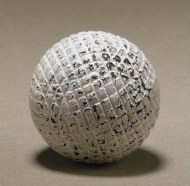
Part I: The Gutty

For nearly three centuries the game of golf in Scotland was played with the Feathery Ball.  This was an expensive ball created by the hands of artisans stuffing goose feathers into hand sewn leather covers.  The ball worked well but it was not very durable, especially in wet weather, and was prohibitively expensive making the play of the long game of golf the purview of the wealthy and the professionals who made the clubs and balls for them.

Around 1850 someone discovered that using Gutta Percha, the rubber gum sap from a tree in Malaysia, a solid core rubber ball could be economically produced that was durable, repairable, and went way further then the Feathery of the day.  The introduction and acceptance of this new ball opened the long game up to thousands of Scots who previously could not afford to play. 

The durability of the ball also allowed the proliferation of the use of iron clubs that would not impart harm to the Gutta Percha Ball as they did to their leather skinned predecessors.  The crafty players of the day quickly learned that the irons added a new level of control over the flight and spin of the ball which allowed them to play more boldly over hazards and stop the ball more abruptly on the green.  As you can imagine this presented a huge advantage and took performance to an entirely new level.

Turns out the advantages of Gutta Percha were much bigger outside of golf-it revolutionized product production in the industrial world in the late 19th century.  It was used to insulate undersea cables in the new world of telegraph communications and helped introduce the first mode of instantaneous communication across the world.

(Click to listen to Part I: The Gutty)

____________________________________________________

Part II: The Wound Ball

By the turn of the century another inquisitive mind,  Coburn Haskell, came up with the idea of replacing the solid rubber core Gutty with a liquid center ball wrapped tightly in rubber bands and covered in gutta percha. 

The Haskell Ball was introduced around 1899 in the United States where it caught on like wild fire among American golf crazies.  By 1905 the Scots recognized that the superior length which the Haskell traveled and additional spin created by the rubber band core made it the next go to step in the evolution of the golf ball
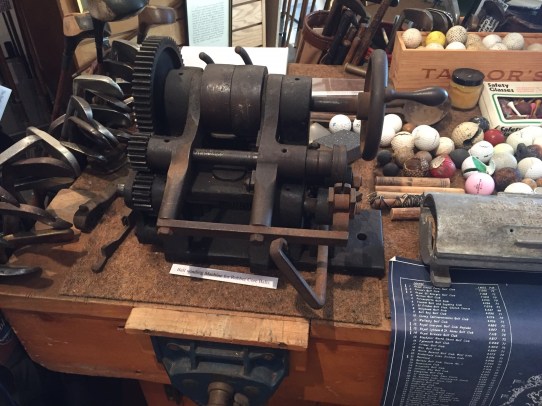
This is the contraption they used to wind the rubber bands around the new Haskell Ball (as seen at Archie Baird’s “Exhibition-The Heritage of Golf” in Gullane, Scotland)

But not everyone in the Scottish golf world was enthused about this development and recognized that the introduction of these technological efficiencies were going to make the challenging game easier and possibly require renovation of the existing links which would be overwhelmed by the capability of this new ball.

What ensued was a massive debate between traditionalists (conservatives) who wanted to ban the new ball to protect the sanctity of the game and its playing fields and the new thinkers who wanted to allow libertarian principles to prevail to make the game more equitable to all players by letting all innovations manufacturers came up with be implemented without regulation.

With classic courses succumbing to the ghastly distances the new improved balls were traveling, the R & A and an amalgamation of American golf organizations including the fledgling USGA agreed in the early 1920’s to come up with a size and weight regulation for a legal ball they thought would provide some tether on the manufacturers. The ball had to be at least 1.68 inches in diameter and could not weigh more than 1.62 ounces.

Nice try, but it did not work.  The manufacturers found ways to continue to improve the performance of the ball within these parameters and massive amount of redesign of classic courses ensued.

The die was cast, as long as the ball was made within these two parameters, it could be made in any way or with any material and be considered conforming to the rules of the game.

(Click to listen to Part II: The Wound Ball)

____________________________________________________

Part III: The Better Ball

Fast forward about a half a century and what we saw was a frenzy of development in golf equipment from the 1970’s through the 1990’s.  Titanium replaced Persimmon making drivers and fairway woods longer, composite shafts replaced steel adding club head speed for players of all ability, and cavity backed irons made of combinations of space age materials added trajectory which allowed manufacturers to de-loft the irons considerably to add length and forgiveness as well.

But with all of that, it is the enhanced engineering of the ball itself, with the use of varieties of plastic based materials, that continue to have the most significant impact on how the game is played.

Spaulding introduced the solid core two-piece Top Flite ball in the 1970’s which had more power in it’s core and less spin creating another new “distance” ball.  This became a ball for the masses which coupled with the other equipment changes made the old courses shorter and shorter for those with distance aspirations.  The lack of spin control around the green kept the professional acceptance of this technology at bay….at least for a while.

In the mid 1990’s Spaulding stepped it up a notch with the introduction of the Strata, a  three-piece ball-solid core with a thin mantle layer to add spin for control on the shorter clubs, and a urethane cover that was more durable than balata used by Titleist.  Once the pros got their hands on this combination of ball engineering it changed everything , as it had with the introduction of the Haskell a century earlier.

The change was so profound that in 2000 Titleist, manufacturer of the number one ball among touring professionals, had to protect it’s turf by abandoning its top selling Titleist Professional wound ball and introduce the three-piece Pro V1 which parroted the technologies of it’s main rival.

In 2020 we have four-piece balls with dual cores.  The technology train keeps chugging along.

Good news is all these space age material ball improvements are conforming to the size and weight parameters of the ruling bodies, bad news is we are running out of real estate to lengthen courses to accommodate them.

(Click to listen to Part III: The Better Ball)

Fried Egg Stories Series (2020)

Fried Egg Golf Podcasts

A Pairing To Remember

A story related in Ron Read’s “Starting The U.S. Open” about a young boy who was first alternate in his Local qualifying for the U.S. Open who never dreamed he would ever get into the Sectional much less whom he would be paired to play with for a morning walk.

________________________________________________________

Larry rang the first alternate, a sixteen-year-old, who most certainly would accept his invitation.  It was the dad who took Larry’s call, since the boy was still in school.

“Do you accept the position in Sectional Qualifying?” Larry asked the father.  He already knew the answer.

“Yes…yes….YES!” Dad excitedly responded, but he had a few questions for Larry.

“Are you sure you are who you say you are?”, Dad was suspicious.  Then he added, “Are you sure of what you are telling me?”

Larry answered those questions, twice each, before the father finally believed him.  Now Larry could fill him in on the details.

“Do you know his pairing?” Dad asked.  “Who’s he playing with?”

“Yes,” the USGA good Samaritan said. “Arnold Palmer.”

There was now a really long pause.

“Are you really serious?”

“Yes.”

“My son’s only sixteen years old!”

Larry’s surprise was beginning to sink in.

“What’s he going to do?  He’ll be scared to death.”

Larry finally convinced Dad that everything would be fine and that it would be a special experience.

Do you think?

By this time in his career, Arnie was no longer exempt into the Open, but true to his nature, he was going to try, just like nine thousand others.

The day after Sectional Qualifying, Larry took a call from the boy’s father.

“Mr. Adamson, I had to call,” he said.  “I can’t tell you what an experience our son…well, in fact, the whole family had yesterday.…How kind….how nice Mr. Palmer was to our son.  As our son came to the first tee,  Mr. Palmer went to him, introduced himself, and told him, ‘Young man, just play your game, enjoy this day and time.  You’ll be fine.’”

Dad broke down.

“What a nice man,” he managed to finally say.  “What a day he made for our son…What a memory…What a memory he gave to all of us.”

“Sometimes, the best thing we can give or receive in life, “ Larry told me, “is a good memory”.

Arnold Palmer did that for all.

Ron Read

Starting The U.S. Open

Handicaps

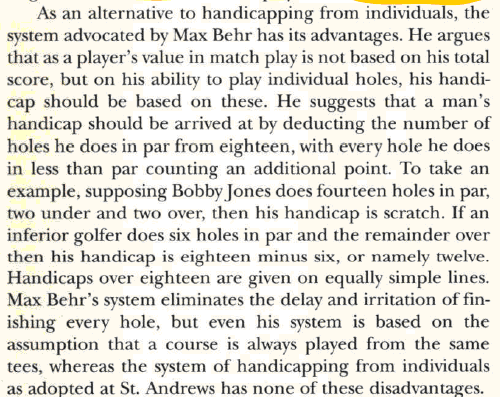
The maintenance of equitable individual handicaps is a tedious labor intensive effort that has been a challenge for golf administrators for over a century.  The latest fine tuning with the adoption of the World Handicap System in 2020 by the golf governing bodies has done little to simplify it or make the calculations intelligible.

In the spirit of simplicity I share a snippet I found in Alistar Mackenzie’s “The Spirit of St. Andrews” that fiddles with the handicap calculation issue.

No doubt it is simple, intelligible, and passes most of the tests of logic.  It really would be most appropriate for creating a home course handicap and is not readily transferable for play at other places.

In our current realm of multiple tees on our home course, it would take a little adjustment to incur fairness for players in competitions using this “home course handicap” playing from different tees.  Also, as suggested by Max Behr, something along similar lines would have to be developed for players whose skill level is beyond 18.

Never to be adopted but it is food for thought.

Alistar MacKenzie

The Spirit of St. Andrews

The Spirit of the Game

John Updike is one of great American writer’s of his generation and has written extensively over his career for various publications on one of his favorite subjects-the game of golf.  His book “Golf Dreams”, a compilation of his writings on golf, is a staple on the bookshelves of most serious golfer readers.

His style of writing is soothing like a warm fire in the hearth on a chilly New England evening with an undercurrent of humility and humor that evokes a knowing nod and a smile as we just shake our head as to say, yes that is how it is with golf.

Sometimes he is stating the obvious, “The golf swing is like a suitcase into which we are trying to pack one too many items – if we remember to keep our heads still, we forget to shift our weight; if we remember to shift our weight, we lift our head, or stiffen the left knee, or uncock the wrists too soon.” And sometimes he is more subtle and descriptive, “The secrets of a locale declare themselves in the interstices of a golf game: the sun-baked spiciness of Caribbean underbrush, the resiny scent and slippery lie beneath a stand of Vermont pines, the numerous anthills of Pennsylvania, like so many cones of spilled coffee grounds.”  The insight he provides as he reflects on the mystery of this great game leaves the reader feeling richer for the experience, much like a walk with friends on the links.

John Updike wrote his wonderful essay “The Spirit of the Game” as part of the USGA’s Centennial Celebration in 1994.  The USGA included it as the introduction in their Centennial book saying, “The USGA Museum is proud to honor one of golf’s greatest writers, in his own words”.

(Click here to enjoy John Updike’s essay “The Spirit of the Game”)

John Updike

USGA Centennial Celebration Book, 1994

Urban Renewal

Some times it takes synergy of widely divergent sources to pull off a project of major scale and importance, but it also takes the stewardship of a visionary to collate those sources, convince them of shared purpose, and compose a finished proposal that has a chance to get to the finish line.

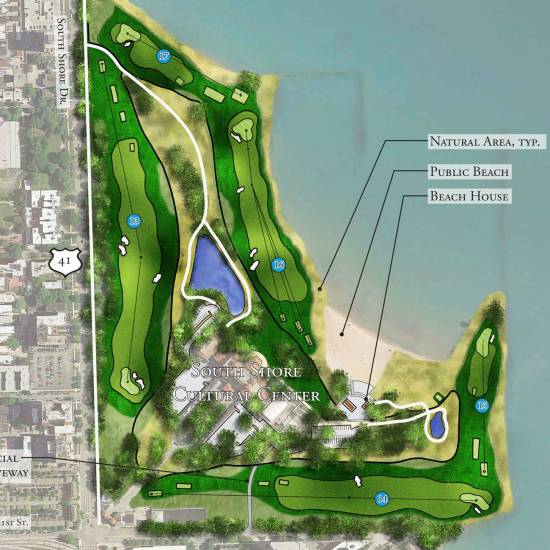
In the case of the restoration of a pair of age old public courses in the South Side of Chicago on the shores of Lake Michigan that visionary is Mark Rolfing.  Those sources are Tiger Woods, Barack Obama, Mike Keiser, and Al DeBonnett who have collectively brought to the brink of reality a restored municipal golf venue that is a win-win-win-win for all the parties involved.

If they have there way they will create, at a minimal cost to the public coffers,  a restored Jackson Park 18-hole Championship Course complete with public access to the beach, a community cultural center, affordable greens fees, and viable youth employment program.

The final march along the shore line of Lake Michigan should provide stunning views of the lake and the impressive Chicago skyline

The model for this project is totally unique in the way it is funded, the pricing structure for the golf, the caddie program, and  community amenity improvement possibilities that it will create and support.

It is hard to imagine totally funding this with private donations, greens fees on a championship layout of less then $50 for the neighborhood locals, a robust caddie program that could provide employment of 150 to 200 inner city kids, and improvement and support of non-golfing community recreational amenities.  This is the type of stuff often discussed but rarely accomplished in major urban renewal projects.   But that is what this confluence of sources has brought to the table to the benefit of this community and it’s residents.

Pour yourself a cup of refreshment and take a few minutes to read Dylan Dether’s fascinating account of the development of this unique project to renew Jackson Park Golf Course and dramatically enhance this neiborhood in the South Side of Chicago.

(Click to read Dylan Dether’s Golf.com article on Jackson Park Renewal)

Dylan Dether

Golf.com (2018)

Justice Reckoned

Back in 2012 Max Adler, a writer from Golf Digest, got interested in the case of Valentino Dixon, a young man who was serving 39 years to life in Attica State Prison for a murder that he claimed he did not do.

That original article, and you can read it here through the link to our moegolf posting “Justice Served?”, outlined how Max had come to know of Valentino’s plight and his side story that golf, a game that Valentino had never played, was providing him solace and the will to continue to fight his conviction.  Max was convinced from studying the exhaustive paper record of Valentino’s trial and subsequent legal efforts that he was in fact wrongfully convicted and this was a miscarriage of justice.

Fast forward six years!!

Through the persistent efforts since 2012 of Max Adler, Valentino’s wife Louise, the Dixon family, and a host of lawyers and advocacy groups, the conviction of Valentino Dixon has finally been overturned and he was released from prison in September 2018.

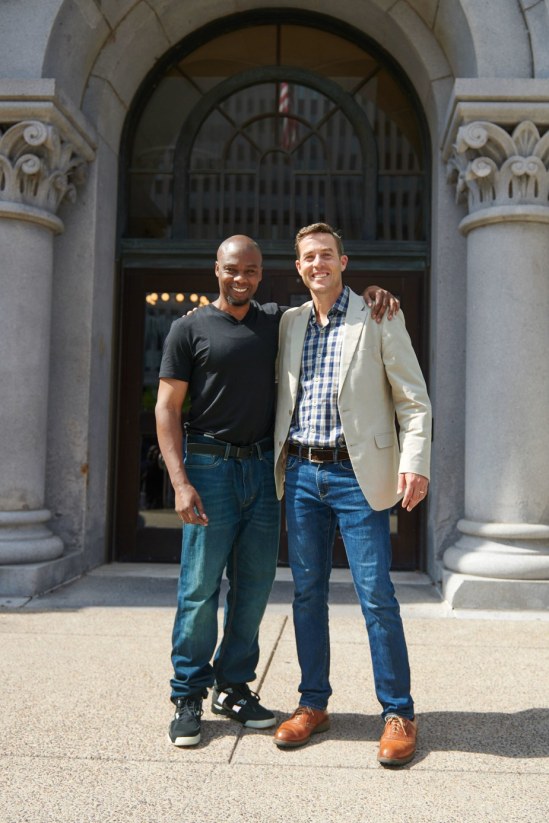
Valentino and Max smiling inside and out in front of the courthouse after his release

Take a few minutes to read Max Adler’s recent Golf Digest article that details the difficult and turbulent road Valentino faced these last six years in overturning his conviction.  Make sure to watch the embedded video in the article that provides a moving epilogue to this tale.

(Click to read Max Adler’s Golf Digest Article “Valentino’s Redemption”)

At the end of the article there is a link to a GoFundMe drive that Valentino and his wife Louise have set up to help them fund their next challenge, a legal battle with U.S. immigration, that would finally allow them to be permanently reunited here in the United States.  Now wouldn’t that provide a real happy ending.

Max Adler

Golf Digest (2018)


Changes In The Rules For 2019

As you probably are aware the rules gurus of the USGA and R & A have put their heads together over the last couple of years and have been in serious discussions on how to simplify the rules of our game.

The result is that the total number of rules is being reduced significantly and many of the most confusing rules have been refashioned to make them simpler to understand and easier to apply.

You will find through this link a summary of the major changes in the rules that go into effect on January 1, 2019.  Many of these rule changes were designed to speed up play as well as make them much easier and fairer to enforce.

(Click to see the summary of the Major Changes In The Rules Of Golf For 2019)

You can also take a look at our Rules Education Forum-it is chock full of entertaining explanations of the rules that often confound people.  These too have been updated to reflect the rule changes for 2019.

(Click to see visit our Moegolf Rules Education Forum)

It Is All About The Money

Or maybe it’s not!

For 20 year-old Maverick McNealy, the number 2 ranked amateur in the world, winner of the Haskins Award given to the #1 collegiate male golfer in the country,  a U.S. Walker Cup standout, and a participant in a number of PGA Tour events , the world could be his oyster if he goes the standard route of pursuing fame and fortune on the PGA Tour.

Morning foursomes at the Walker Cup-Royal Lytham and St. Annes last fall

Embed from Getty Images

.

Or maybe he will be the exception to the rule and simply make amateur golf part of a bigger life that could include pursuit of success in the business or non-profit world. Now that would break the american sport prodigy enterprise mold with a sledge hammer.

Toiling with the pros at the Greenbrier Classic in 2015

Embed from Getty Images
.

You can read an interesting story from the Wall Street Journal’s Brian Costa and decide for yourself.

(Click to read “Why America’s Best Golf Prospect May Never Turn Pro”)

.
Brian Costa

Wall Street Journal

June, 2016


The Long Form

The Players Championship LogoThose of us who grew up reading “the long form” articles in periodicals like New Yorker, Sports Illustrated, Rolling Stone, and the New York Times Magazine always enjoyed the half hour and a cup of joe it took to digest a full compilation of research and opinion on a current topic of interest.  The trend today in the print media as well as the digital world is to give us stories in bite-sized doses that seem more like executive summaries than full conversations.

Other than a few specific websites and a bunch of individually supported blogs the art of covering an issue in sufficient depth to be informative seems to be fading in the rear view mirror.  It is not that it cannot be done and maybe done even more effectively with the varied digital tools that are now at hand, it seems that the will of publishers and their dues paying advertisers to support long form writing is just not there.

This incredible article about Rickie Fowler, called  “The Natural”, was written by D.J. Piehowski and presented on PGATour.com this week. It is a refreshing testimony to what can be done when the long form and the digital age intersect.  An enlightening biographical look at one of the rising stars in our game comes to life as if in a documentary film with plenty of time for the reader to stop, reflect, and peruse related insights into this story.

The storied island green strikes fear in the hearts of contenders on Sunday

Embed from Getty Images

.

To those who watched it on TV, Rickie’s come from behind win at The Players Championship last year was one of the exhilarating performances on the PGA Tour in the last five years.  He came from eons back nine on Sunday, playing the final four holes birdie-eagle-birdie-birdie, to outpace all but Sergio Garcia and Kevin Kisner by the end of regulation.  He then survived a three-hole aggregate playoff and eventually won in Sudden Death when he birdied the feared 17th Hole at TPC Sawgrass for the third time in about two hours.

Through the imaginative compilation of great research, clever writing, and supporting still photos, graphics, and live video Piehowski relates a riveting tale of Rickie’s rise to stardom.  He says of Fowler, “the way in which he won, and the way he made it to the PGA Tour in the first place……As unorthodox as the story is, The Players also felt like another stop on the ride toward the inevitable.  Fowler’s rise to the forefront of golf has always felt more like destiny than possibility”.

This enjoyable read is enhanced by a seamless presentation of correlated information from Fowler’s childhood, developmental years, and his early pro career in all modes the media has to offer.  It seems to move magazine story telling from simple composition to elaborate production but does it in a digestible way that in no way seems overwhelming.

The only questions is what took it so long for this to happen and why aren’t we seeing this all over the journalistic spectrum.

Kudos to PGATour.com for committing the resources required to pull this off and D.J. Piehowski diligence in providing us with a new school long form version of Rickie’s story we could sink our teeth into.

(Click here to read D.J. Piehowski’s “The Natural” from PGATour.com)

D.J. Piehowski

PGATour.com

May, 2016


Making A Splash

The Players Championship LogoThe Players Championship celebrates it’s 34th year at the Tournament Players Club at Sawgrass. Deane Beman’s concept was another Major to be played on a punitive course drawn out of the swampy muck of Ponte Vedra, Florida by the most notoriously devious designer of them all Pete Dye.

As you can read in this retrospective article by Gary Van Sickle from the SI Vault, Deane threw the PGA Tour into the deep end of the cash pool with his reinvention of the Players Championship in 1982. Though it took the impish act of an impetuous young pro, Jerry Pate, to galvanize the interest in this event and change the public perception of the PGA Tour forever.

Full Extension….Pate joins the commish and the evil architect in the pool

Embed from Getty Images
.

Bruce Litzeke says in the article, “It was the end of the Tour slipping quietly into town, playing its event, and slipping quietly out. After Jerry’s dive the Tour make a bigger noise. When more TPC courses started showing up, golf got bigger and wilder and louder…..It all started there that week.”

Other than Arnold Palmer and Tiger Woods, Deane Beman is probably most responsible for the generous livelihood enjoyed by players and their wives today. As the new commissioner Deane had a horde of new fangled ideas on how to increase the visibility and the popularity of a stodgy PGA Tour. He dragged them kicking and screaming into a new era of bigger TV contracts, inflated purses, and broader player exemptions-all of which greatly enriched the bank accounts of guys in Sansabelt slacks and white shoes.

.
Deane’s concept included this 5th Major that would attract the best field of the year playing “Stadium” course that put the players feet to the fire, especially coming down three infamous finishing holes with everything on the line. This would be a career changer for many guys-big payday, prestige of winning a quasi-major, and one of the most generous tournament qualifying exemptions ever conceived. Win The Players and a journeyman could almost settle his playing schedule for the rest of your PGA Tour life.

Snoopy’s perspective of the final stage for this drama

Embed from Getty Images

.

Over it’s history unexpected winners like Craig Perks, Fred Funk, and Stephen Ames have survived the pressure, as well as “best players never to win a major” like Sergio, Stenson, and Kooch. But it is the list of true major champions like Tiger, Phil, Adam, Greg, and Freddie that have won and moved the popularity needle for this event over the last three decades.

The Players has grown in it’s stature because of the difficulty of the test, four excruciating days over the most testing stadium course of them. The final chapter is always riveting as the players face a true risk-reward decision on the par five sixteenth followed by a raucous crowd and a devilish pitch into the island green at 17. Finally they must negotiate the hardest finishing tee shot on tour to find the fairway on the Dye-A-Bolical 18th if they want to plant a smacker on this piece of crystal

Rickie staring at a career change after last year’s Player’s performance

Embed from Getty Images
.

Last year it was Rickie Fowler doing a cannonball on the field. He was five shots back with about an hour to go in this final round but was five under over the last four holes to set up a dramatic four hole playoff with Sergio and Kevin Kisner. His remarkable play continued through a three-hole aggregate playoff and he finally ended it all in sudden death with a lawn dart into the island 17th for his third two of the day on that hole-one last bit of birdie drama.

It should be interesting to watch who makes waves at Ponte Vedra this year.

Gary Van Sickle
SI Vault
March, 2004