AdapTee Golf Demonstration and Exhibition Match

Determined2Heal-White-Logo

For those of you who read the previous posting about my fascinating golf round with Josh and William playing ApapTee Golf, here is your opportunity to see this in person on Tuesday September 10th at Sligo Creek Golf Course in Silver Spring, Maryland.

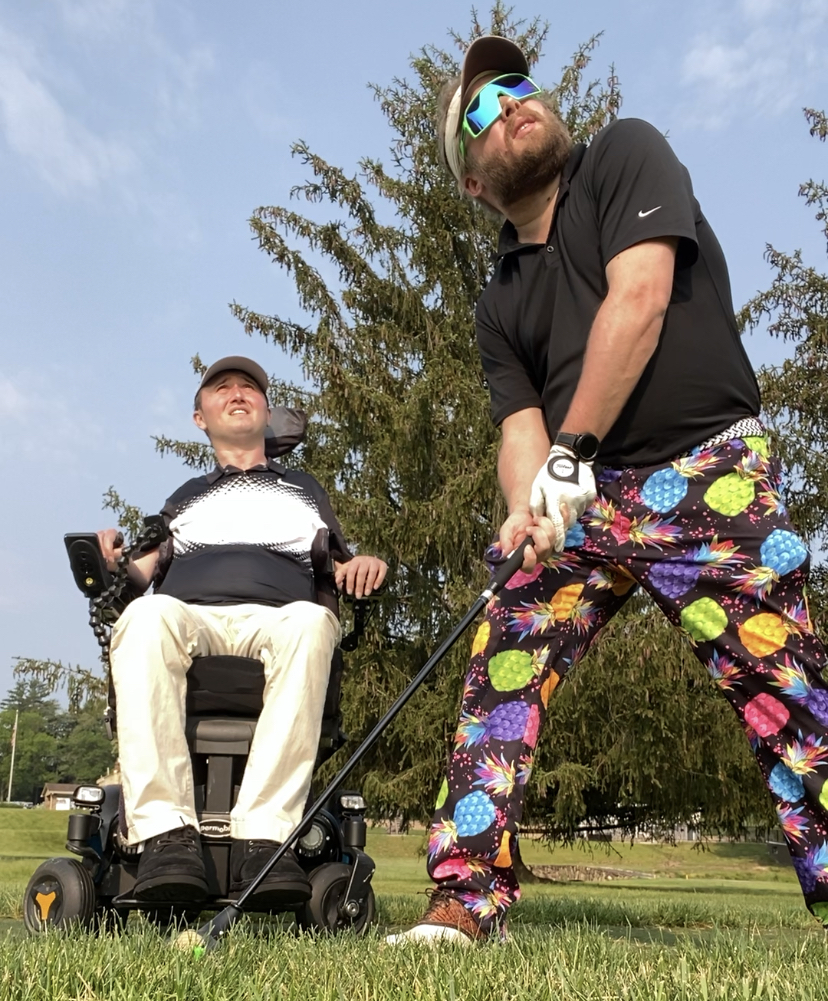
Josh and Andrew With The Power2Golf Club

Josh giving Andrew last minute adjustments for tee height, foot alignment, and shaft angle to get the intended result.

Josh and Andrew, his golf facilitator, will be hosting a demonstration of the ApapTee equipment starting at 2:00 pm at Sligo.  It will be followed by a 3:00 pm Exhibition Match between Josh and Andrew and the head pro at Sligo Creek Dave and his son Nick.

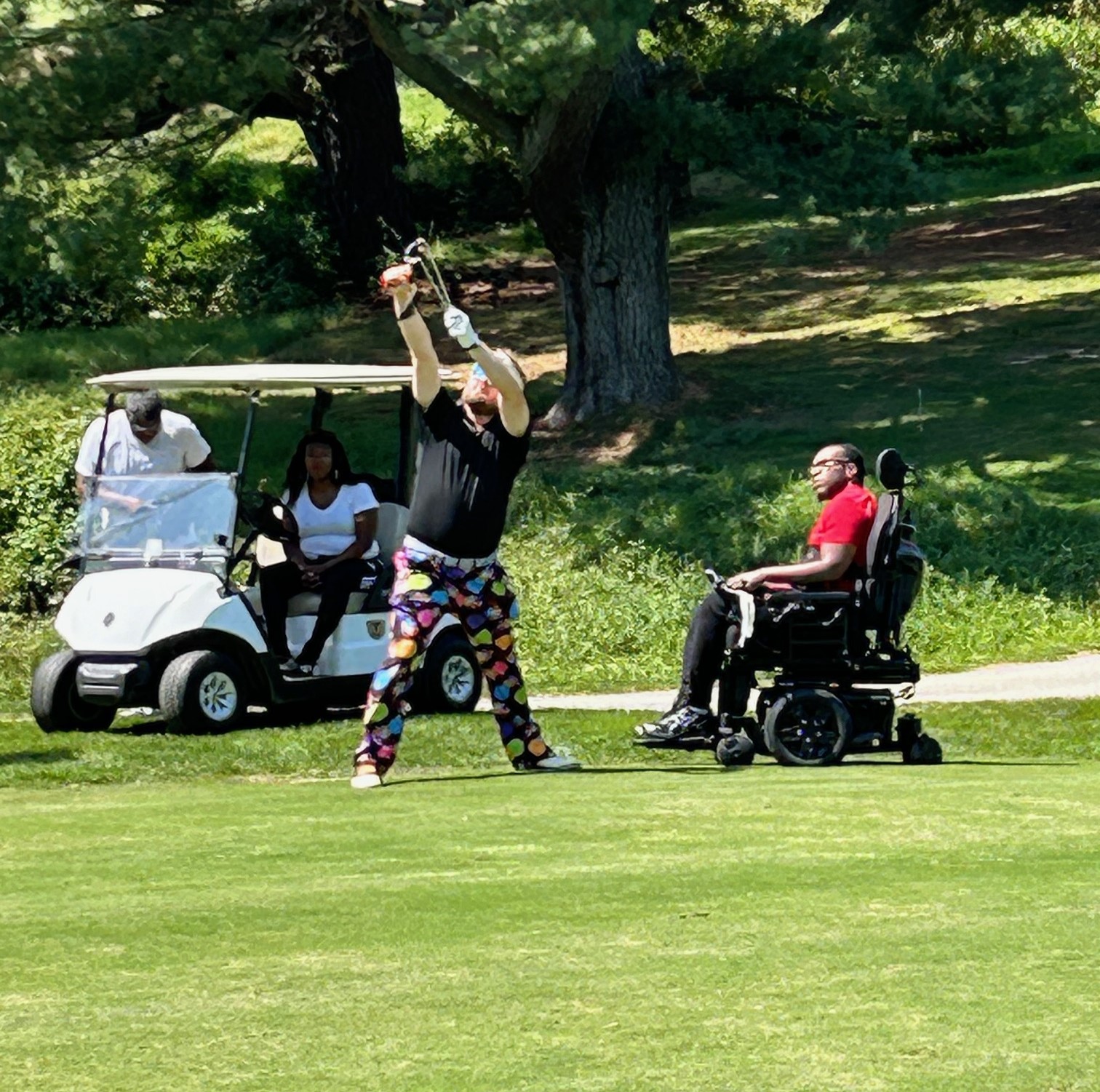
Andrew Recover Shot For William

William carefully examines the initial flight trajectory as well as how far to pull the sling back. To the elbow? To the arm pit? Decisions…Decisions.

This is an opportunity to see the AdapTee concept up-close-and-personal plus to even try your hand at using the equipment.  As an added bonus any wheelchair user can schedule a future 9-hole round with Andrew as their caddy.

This is a unique and cutting edge experience you will want to see for yourself.  Click on the link below for the details of this Demonstration and Exhibition Match.

Click For Details To Tuesday September 10th’s Demonstration and Match

September, 2024

AdapTee Golf

I recently had one of the most delightful and interesting golf experiences of recent memory.  I had the pleasure of playing 9 holes at one of our local muni’s with two quadriplegic power wheelchair users.  I am talking about two guys who spend their entire lives in a power wheelchair and have no functional use of their arms or legs.

You are scratching your head right now going no way this was real golf.  But take my word for it, they played every shot from the tee through the green, including putting, and as a threesome (and then some).   We covered the nine in under two hours, kept up with the group in front of us, and never held up the group behind us up the entire nine holes.

Group Shot

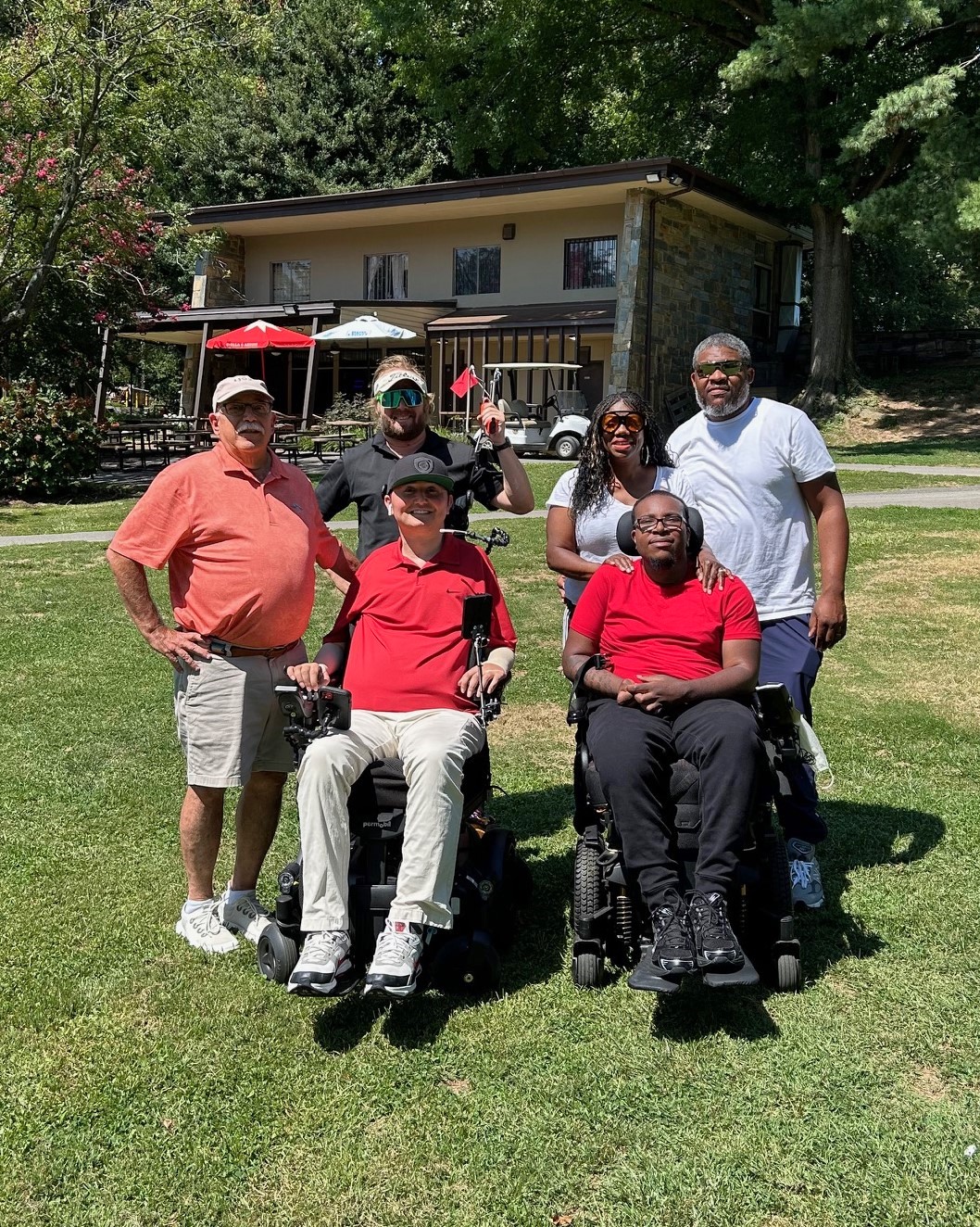
Our Seven-Some: Moe, Andrew (the golf facilitator), Tomeka and Shan (William’s caregivers), Nyasha (not pictured-Josh’s caregiver), William, and Josh.

A little back story here will give this some context.  Josh Basile was an elementary school classmate of my son Noah and, about 20 years ago, experienced a calamitous spinal injury  that left him totally paralyzed from the neck down.  Josh, being the type of person he is, came out of this incident and the initial recovery determined to do whatever it would take to reclaim control over his life.  He finished his college education, got a law degree, and set out to lay claim to the rest of his life.  With the help of his family he created the Determined2Heal Foundation, the purpose of which was “To simplify the transition into life with paralysis. We provide information and advice for people with spinal cord injuries, their families and friends, as well as rehabilitative adventures”.

Determined2Heal-White-Logo

You can click on the logo above to see the unbelievable array of initiatives, projects, and information sources Josh has brought together for this purpose.

Recently Josh said to me that he wanted to get out and play some golf so he could introduce me to the AdapTee Golf concept he had been working on.  Our family being an annual supporter of his good work, I was totally intrigued by this invitation.

Josh decided a number of years ago to flesh out this AdapTee Golf idea.  He started by accumulating available equipment, modifying other existing stuff, and creating his own implement if none existed for his purpose.  With the help of his friend and Golf Facilitator Andrew, Josh has been playing golf this way for a number of years, as well as introducing it to others, and plays at least a couple of times a month through the golf season.

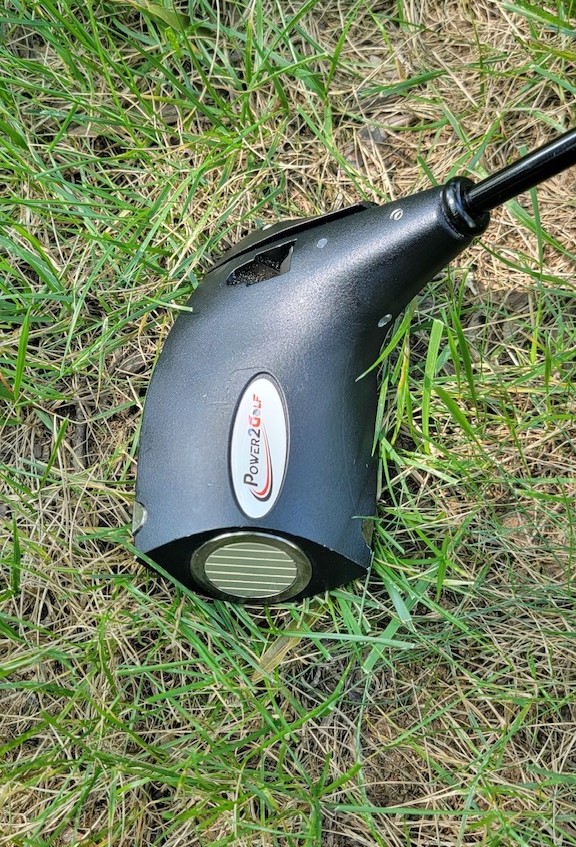
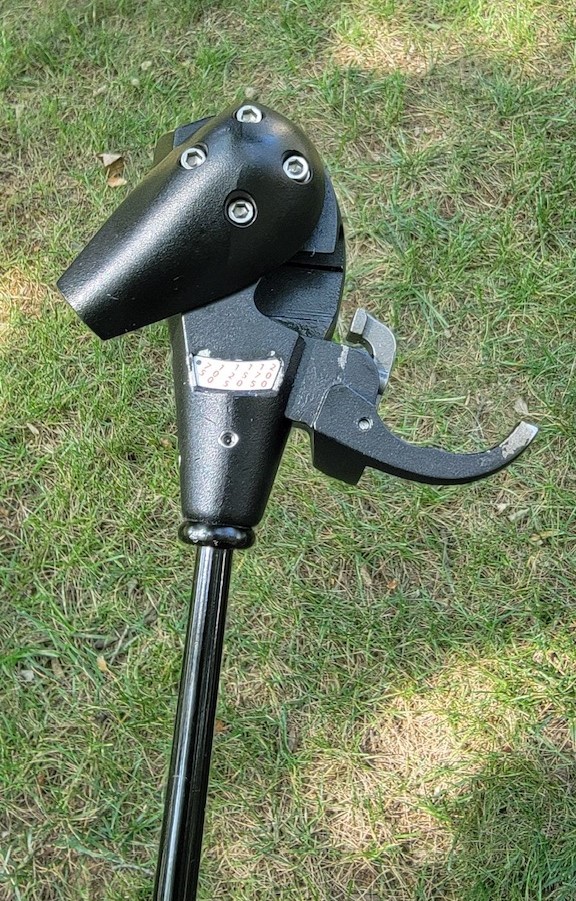
He started by locating a propulsion golf club made by Power2Golf to use from the tee to about 75 yards from the green.  This club was invented by a retired NASA engineer who wanted to help his older golf friends who had lost their agility to swing a golf club continue to play golf.  The Power2 uses a cartridge to propel the ball anywhere from 75 to about 200 yards based on player set adjustments on the back of the club.

Power2Golf Club Front

Power2Golf Club Adjustment Lever

Trajectory of the ball, carry, and spin can be controlled by the facilitator at the direction of the player, who sits behind and calls the parameters of each shot.

For shots inside of 75 yards, Josh modified a hunter’s sling shot, making the ammo pouch large enough to handle the golf ball.  Again, the player behind the facilitator directs the angle of his arm and the length of the pull back to get the appropriate shot result for the circumstance.

Slip Shot 1

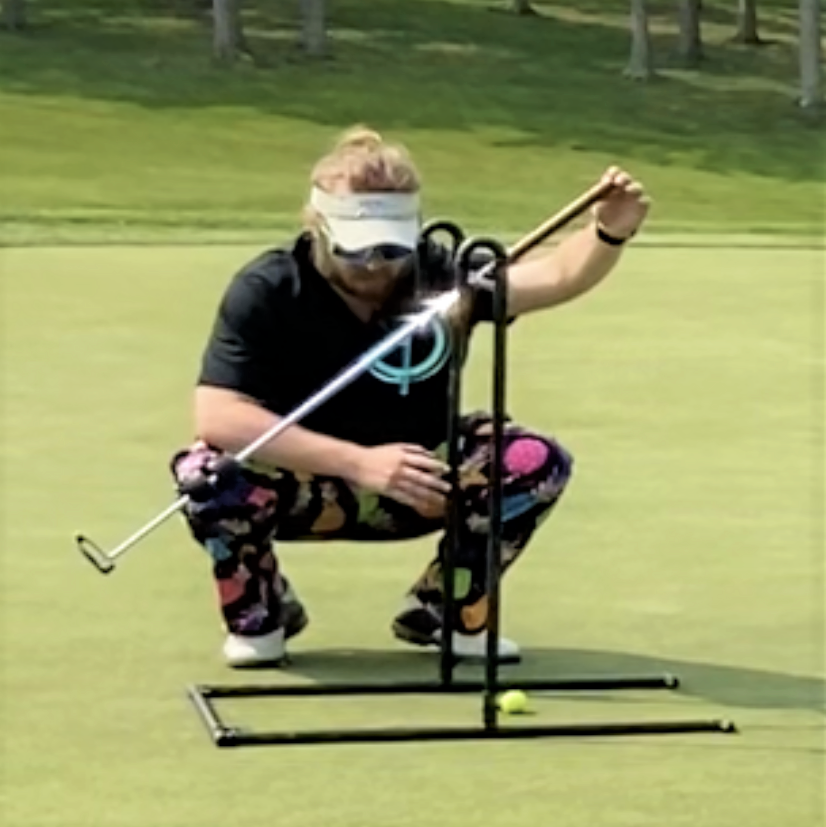
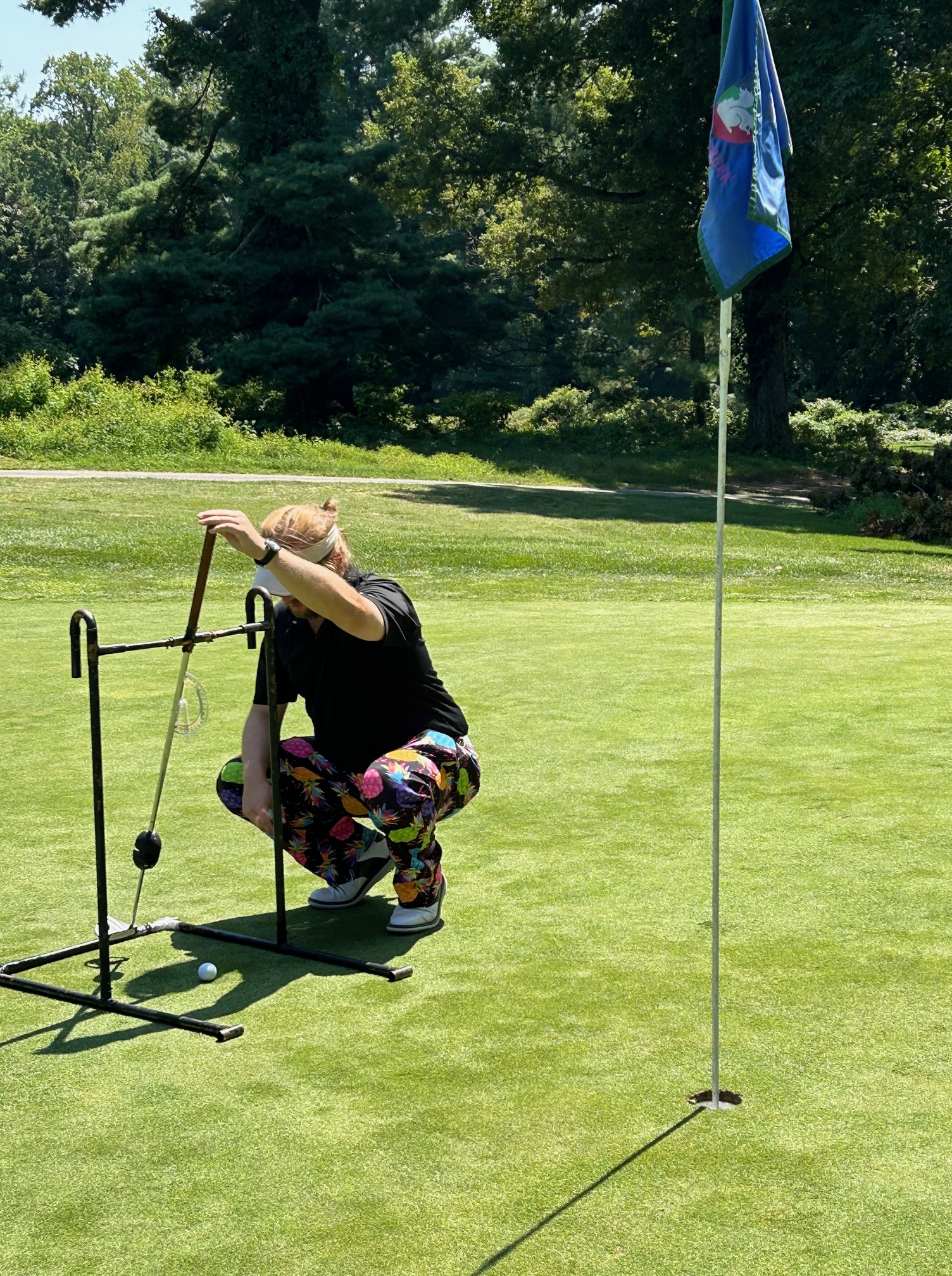
There was no appropriate putting device on the market so Josh went into his workshop and created one of his own.  The pendulum putting device he fabricated is aligned by the player from the edge of the green (his wheelchair is too heavy to drive on the green).  He then directs the facilitator how far back to pull the putter head before letting go and implementing the stroke.  You will note that Josh put a protractor with an adjustable pointer on the shaft of the putter so the player can instruct the facilitator exactly what degree to pull it back to get the desired roll out distance.

Andrew And Putting Pendulum

So how did it go on the course….kind of like a typical round with your buddies.  There was conversation about various strategies to play the hole, avoiding the short side approach, respecting the false front of the green, and all the related trash talk to go with it.

Josh and Andrew With The Power2Golf Club

Josh giving Andrew last minute adjustments for tee height, foot alignment, and shaft angle to get the intended result.

On approach shots the key is trajectory and roll out with the sling shot.  As in our regular game it is always tempting to go for the high flopper/lawn dart, but something lower with a bit of roll out might be a better option.

Andrew Recover Shot For William

William carefully examines the initial flight trajectory as well as how far to pull the sling back. To the elbow? To the arm pit? Decisions…Decisions.

On this 230-yard uphill Par 4 with a sharp dogleg left into the green, Josh decided the risk vs reward made it worth trying to cut the corner, cover the tallest tree top 165 yards away, and try to catch a piece of the green.  To my amazement it worked and he had a 75-foot eagle putt from the front edge.

Tee Line On Dogleg Left #7

Solid lag putt left them with a 7-footer for birdie, which after considerable collaborative conversation they rolled in for a three.

Remaining 5 Footer on 7

On every putt Josh or William would stalk the putt, wheeling themselves around the perimeter of the green to get the low side read before ending up directly behind  Andrew for final adjustments for line and pace.  Lots of conversation on every putt before agreeing to the exact angle of the protractor pointer and directing Andrew to release the putter.

Josh and William Putting

So where does AdapTee go from here?

Josh has big plans to share this concept with quadriplegic power wheelchair users all over the country.  He has gotten the backing of a private foundation to the tune of a $189,000 two-year grant to support Determined2Heal’s roll-out of this program to metropolitan facilities all over the country.  They will provide the equipment and facilitator training in conjunction with a local municipal golf provider to allow wheelchair users with limited or no arm movement to play golf with their friends.

If Josh and Andrew have their way, there will be AdapTee facilities in Washington, DC, Nashviille, Minneapolis, and San Diego the first year.  Two more metropolitan areas to follow in year two.  This is an ambitious goal, but from what I know of Josh Basile’s track record I would not doubt that they can pull this off.

Josh and Andrew Following High Flight

Josh and Andrew are contemplating soaring heights for this program.

If you are interested in learning more about this program and other Determined2Heal initiatives or to provide support to their ambitious efforts, you can click the link below to get to his Determined2Heal-Contact Us page on their website.

Determined2Heal-Contact Us

August, 2024

Jordan Being Jordan

Mark Immelman is one of the best golf broadcasting voices out there. He brings his experience as an author, analyst, and golf instructor to the PGA broadcasts and the listeners are the beneficiary of his encyclopedic knowledge and experience garnered from years covering the professional game.

In this 45 minute episode from his “On The Mark” PGA Tour Podcast Mark interviews Jordan Spieth, a guy he clearly admires and respects for all that he has brought to what will be a hall of fame career.

Much as he does as the lead commentator of PGA Tour coverage, Mark is enthusiastic and thorough as he prods Jordan on the many chapters of his Tour career. It includes his early family life before the tour, storied amateur accomplishments, meteoric rise as a professional right out of the gate, and how he has worked through the inevitable ups and downs that have affected his career in recent years.

Jordan is a wonderful interview because, as we have seen over his career, he is not one to hide behind cliches and generalities when he is asked a question. Rather he is thoughtful and articulate in his responses, not afraid to deal with even the most introspective inquiries into how he approaches the game. This interview does not disappoint in that regard.

As Mark says in the interview Jordan really needs no introduction. He won two U.S. Junior Amateurs, a collegiate National Championship, three Major Championships, a FedEx Cup, and boatloads of money along the way. His Ryder Cup and President’s Cup record is stellar and he has recently accepted positions on the Tour policy board dealing with the schism that the invasion of LIV has created in the world of professional golf.

More than anything, much like Phil Mickelson in the early years, Jordan is must see TV every time he is on a weekend golf broadcast. Hell it is worth it just to hear Jordan’s stream of consciousness conversations with his caddy Michael Greller on how to play the next recovery shot. It is like two millennial fathers in the pickup line at kids rec soccer discussing the best way to make a peanut butter and jelly sandwich including whether it should be JIf or Skippy, Smooth or Crunchy, on Wonderbread or seeded Jewish rye. It’s all in the details.

There are plenty of nuanced Jordan explanations throughout but one of my favorite was his response to Immelman’s question on why Jordan plays so well at Augusta.

Jordan’s view is that courses like Augusta or Kapalua or the links courses of the British Isles present topographical or environmental conditions that fix a flaw in his game. The flaw in his game…..his inability to curve the ball dramatically on demand. On courses with fairways with pervasive uneven stances or green complexes with lots of movement due to topographical features the uneven lies or the sloped landing areas create big curves on their own. Same is true when the wind is up as it often is on links courses, the wind creates curve.

At Augusta, Kapalua, or Royal Birkdale these features “correct” the perceived flaw in his game by making the ball curve big time on it’s own. It is simply up to the player to read the required shot, embrace these tendencies, and plan the start lines accordingly. This is another example of the cerebral side of Jordan’s game.

There are lots more goodies revealed, so pour yourself a tall one and click on the link below to enjoy Mark Immelman’s revealing conversation with Jordan Spieth.

On The Mark with Mark Immelman

January, 2024

Click To Listen To “Jordan Spieth On Golf” Episode of On The Mark

McKellar Magazine-A Golf Companion

The digital age has wreaked havoc on print journalism turning the most established outlets upside-down shaking the most valuable assets from their trouser pockets into a discarded heap on the ground.

As a result we now have golf magazines trying to fill a hollow digital footprint without the credible writers to produce content worth reading. What you have left are internet magazine subscriptions to lists of Top 100 Golf Courses, collections of worthless golf tips, reviews of the latest “new and improved” equipment you don’t need, and infomercials for the next great destination golf resort of your dreams. If you are truly interested in creative golf content this is not going to scratch that itch.

Fortunately a couple of new print publications have risen from the ashes who have assembled the best golf writers, photographers, and illustrators to create long form articles on a wide array of subjects of golf interest. The templates are like none you have seen before-little or no advertising to distract you from the content, no grandstanding articles about the professional golf tours and their stars, and no sell-your-soul patronizing reviews of the next generation equipment that is going to shave strokes off your scores.

One of these publications is McKellar Magazine which has been publishing since 2018 under the capable direction of their founding editors Lawrence Donegan and Thomas Dunne. The list of contributing writers they have assembled is a Who’s Who of accomplished golf scribes of the last thirty years. It includes Michael Clayton, Lloyd Cole, Lorne Rubenstein, John Huggan, Mark Cannizzaro, John Strawn, Geoff Shackelford and many, many more.

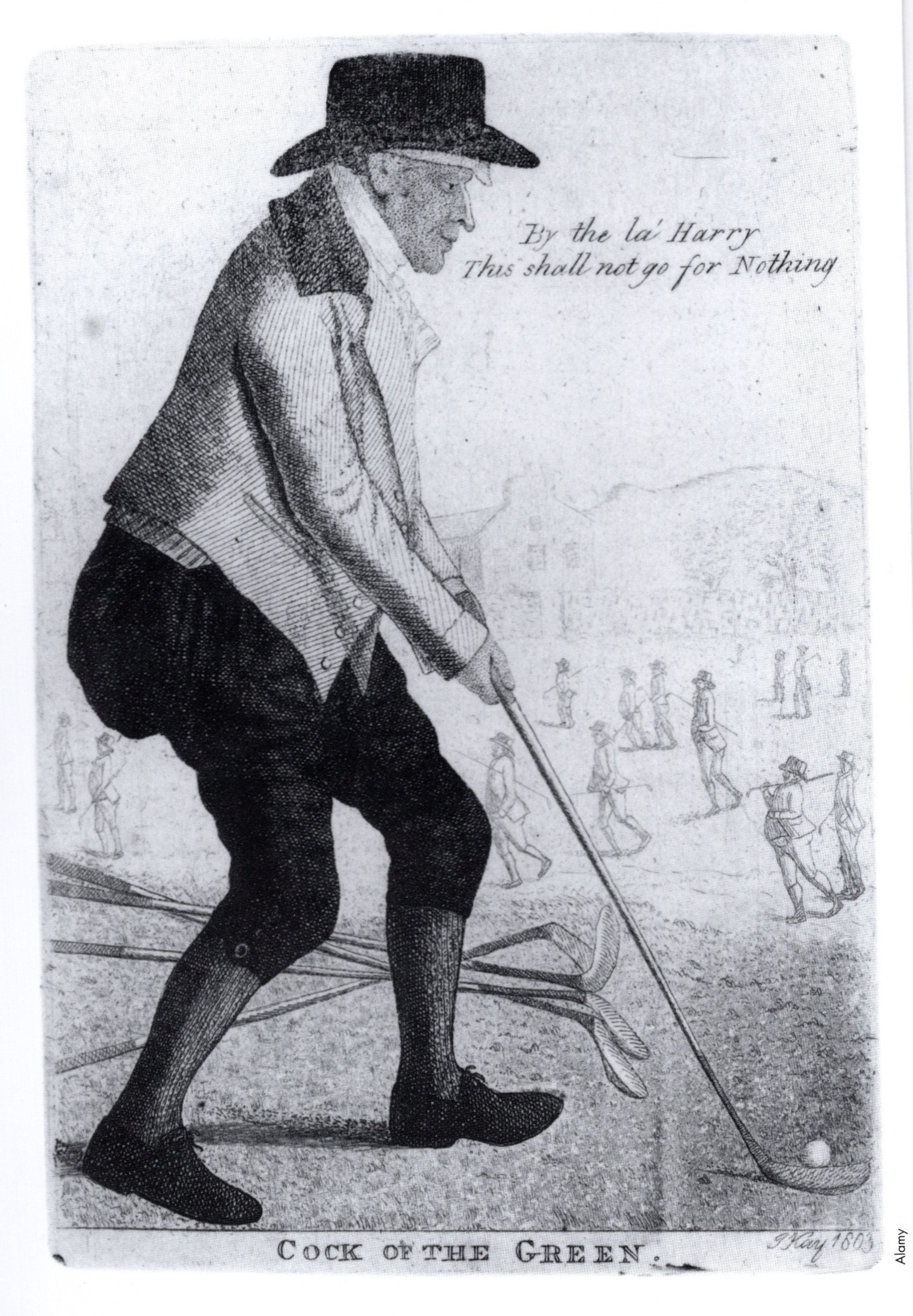
The journal’s namesake-Alexander McKellar-his thought over every golf shot “This shall not go for Nothing” is something we can all relate to.

In the five editions they have published so far you will find a wide array of excellent articles to tantalize your golf interests. These include glib interviews with Dottie Pepper, Chubby Chandler, and Rory McIlroy, an article about the symbiotic relationship between Sweeten’s Cove and The Waffle House, the back story of why Amana appeared on the hats of golf greats Bob Goalby, Julius Boros, and Jim Colbert, and Michael Clayton’s proverbs of the design features of venues in the Australian Sand Belt that are influencing the works of today’s most prolific course architects.

Every edition is chock full of this kind of well written, engaging stuff that will keep you glued to your favorite reading recliner. For a generation of people who grew up getting ink on their fingers from reading print publications this is manna from heaven.

You can learn more about what these guys are up to and order the magazine through the McKellar Magazine Website. At a cost of about $20 an issue delivered the price may seem steep but remember this is not your father’s golf magazine business model-there are no advertiser revenues to subsidize your reading habits.

McKellar has put out five robust issues so far. So don’t tarry, invest in the most recent issue, this is a Golf Companion you will be glad you welcomed into you personal library.

McKellar Magazine (2021)

Green Speeds…Get Over It

How many times have you looked forward to playing a course of special interest, maybe on a vacation or in an event in your area, only to come away disappointed because they had the greens jacked up so fast that only gutter bumpers could save you from three-putting all day long. My guess is this is experience is all too familiar to many of you.

In the attached article by John Steinbreder in this week’s Global Golf Post a strong case is made by many of the biggest names in golf architecture that the “Arms Race” for faster and faster green speeds, at private and public courses all over the country, is totally out of control. As a result, the courses are just no fun for anyone who does not carry a handicap index in the low single figure range.

There is little question that a kabal of low-handicappers who dominate green’s committees at these places are driving the bus and, in an effort to keep the “rating” of their course” in the top quartile, have made them virtually unplayable for the bulk of their membership.

This started out isolated to “premier” show-off events like the annual Member-Guest, but now has creeped into their Club Championship, Opening Day, Calcutta Event, and even day-to-day play at their courses. Who wants to compete in these things if you have to wear protective gear just to get through the experience.

We visited this issue in our “Is Faster Really Better” posting back in 2011 that featured an article by Ian Andrews a renowned architect from north of the border. The issues have not changed in 10 years, in fact the incidence seems to have gotten worse in my humble opinion.

It is long overdue for the decision makers at golf facilities to bring a little sanity back to daily course set up and let all players smell the roses once again.

John Steinbreder

Golf Global Post (2021)

(Click to read Global Golf’s article “Slippery Slope”)

Lee Trevino

In the late 1960’s Lee Buck Trevino was a disruptive intrusion to the Big Three Plus One status quo on the PGA Tour. No one really knew what to make of this Mexican-American upstart with the flat swing, low left-to-right ball flight, non-stop wise-cracking chatter, and gunslinger’s no-fear attitude playing against Nicklaus, Palmer, Player, and Casper.

In this Shotgun Start Spotlight Podcast Brendan Porath and Andy Johnson provide an informative historical perspective of the early career of Lee Trevino. This podcast is a deep dive into the challenging path Lee took from an impoverished Texas upbringing to being the most significant foil to the dominance of Jack Nicklaus in the early 1970’s.

Lee was not a product of the country club mold that is for sure……

Embed from Getty Images

As Andy points out, in the 10-year period from 1968 to 1977 Lee Trevino was arguably the most dominant player other then the GOAT himself. Over his storied career Trevino won six majors-two U.S. Opens, two Open Championships, and two PGA Championships. In 1971 he was named Sports Illustrated’s “Sportsman of the Year”. Over a three-week period in June and July of that year Lee garnered three national championships, beating Jack Nicklaus in a playoff at Merion to win the U.S. Open, won his first of two Canadian Opens, and outlasted England’s Tony Jacklin and Taiwan’s Lu Liang Huan at Royal Birkdale for his first British Open Championship. No one else in the golf history has ever done that.

The podcast is rich with Lee’s legendary personal musings as well as the entertaining perspective of Dan Jenkin’s the premier golf journalist the time. There are lots of revealing quotes from his peers that leave little doubt as to the impact Trevino made on the staid order of the PGA Tour. The language was not always politically correct by today’s standards, but it was representative of the mood of the time.

Set aside the time to listen to this 90 minute podcast, you will not be disappointed. This is a nostalgic romp from those of us who grew up with Lee challenging the golf establishment. For those who only know him only as a golf myth, it is an opportunity to put his accomplishments in real perspective.

Brendan Porath and Andy Johnson

Shotgun Start (June 2021)

Playing Augusta National-Architect’s Perspective

Augusta National is a course whose strategic approach the avid golf watcher would say he understands just based on the sheer number of times he has seen The Masters broadcasts over the years.  Yet every year there is one shot a leader or a chaser hits on Saturday or Sunday that leaves the TV patron scratching their head wondering why did they try to do that.

The answer to that question and many, many more can be found in this in depth Fried Egg Podcast interview with major champion and golf course architect Geoff Ogilvy.  Andy Johnson plies Ogilvy’s knowledge of every hole at Augusta-one to eighteen-from both a playing and competitive standpoint to give you a much richer understanding of the challenge the top professionals in the world face as they wend their way through the tournament set up at The Masters.

Because of his accomplished playing career and his subsequent devotion to golf course architecture and design, Ogilvy is uniquely qualified to provide this guided tour.  He had 16 professional wins over his career-8 on the PGA Tour that include a U.S. Open and 3 World Golf Championships.  His record in the four Majors during the height of his career speaks to his deep understanding of championship golf courses and the challenges they present in major championships.

The fact that Augusta National is an Alister MacKenzie design and Ogilvy grew up and is cutting his course architecture teeth in the Sand Belt Region of Australia where MacKenzie also plied his craft adds to the depth of understanding he has of the strategic approach of this unique venue.

Ogilvy points out that Augusta National is routed in such a way that the holes traverse the severe topography of the land which is why their is so much movement on the fairways and the greens.  This also lends itself to severe side hill stances on approach shots that often are counter to the shot shape required to get at specific pins.  A good example is the hook stance from the fairway on the Par 5 13th into a green that favors a fade to most pins to counter the risk of traversing the diagonal relation of Rae’s Creek to the putting surface.

On almost every hole there are repel pin positions and collection pin positions, so the tournament powers that be can change the difficulty factor dramatically from day-to-day simply by the location of the hole.  As Ogilvy points out this also changes the preferred driving position and angle of approach in each round. 

The wide variance of potential score on a hole in a given day based the hole positions is what makes the course endlessly interesting for the player and the viewing patron alike.  Depending on the player’s position on the scoreboard on Sunday afternoon there are holes that they must make decision after decision to either take on the challenge or protect their score. In the vernacular of risk and reward Ogilvy’s experience at Augusta is that takes a care-free aggressive approach to be successful at Augusta National.

Fair warning, this interview is almost two hours in it’s entirety but it is chock full of stuff you have not heard before so it is well worth it if you have the time.  Even if you just listen to a chunk of it, your understanding of what you see the next time you are watching The Masters will be greatly enhanced.

(Click to listen to Geoff Ogilvy’s Interview on the Fried Egg)

Geoff Ogilvy-Episode 196 (2020)

The Fried Egg Podcast

Rocco

There are a handful of golfers like Tiger, Phil, Jack, Rory, or Brooks whose first names alone bring to mind their huge accomplishments in the game. Rocco Mediate is one of those guys but not because he won the big one, but because he lost it in a memorable playoff……..to Tiger Woods

No won will forget Rocco’s name or his performance in his 2008 loss of the U.S. Open at Torrey Pines to Tiger.  In some of the most riveting playoff golf we have ever witnessed, Rocco took Tiger, the #1 Player of our time, to the 19th hole of a playoff watched by a gazillion golf fans playing hookey from Monday’s work. He was not intimidated by the task of playing Tiger one-on-one in a playoff for a Major. Rocco relished the moment and would not have wanted it any other way.

Wearing his emotions on his sleeve-an air of quiet confidence always prevails

Embed from Getty Images

This interview on the No Laying Up Podcast, couched in Rocco’s own devilish story telling style reveals all that has been through over a 35 year professional career-including 6 wins on the PGA Tour, years cast out to the hinterland because of chronic back issues, more then a few flirtations with winning a major, a colossal train wreck on #12 at Augusta in 2006, the aforementioned playoff in 2008 at Torrey Pines, and a second life winning 4 times on the PGA Tour Champions including a Senior PGA.

Rocco methodically won 13 times over his professional career

Embed from Getty Images

Growing up a drive and a 5-iron from Latrobe, Rocco talks at length about his relationship with Arnold who served as a second father and a life coach throughout his career.  Rocco played hundreds of rounds with The King over the years, including walking with him for his final two rounds in the 1994 U.S. Open at Oakmont, a home game for both of them.

But it was his golf mentor Jim Ferree, one of the great ball strikers of all time, who taught him the fundamentals of the game that would serve him so ably for years on the Tour.   To this day he still has the same neutral grip that Jim taught him as a teenager and does not wear a golf glove just like his mentor.

As to Tiger, Rocco literally saw him coming, he was in attendance when Tiger won his first U.S. Am at Sawgrass where Rocco was living at the time. Tiger’s immediate success on the Tour was no surprise to Rocco, he knew that this kid had a set of skills the Tour had never seen before.  There were a few Tiger tales of course, the tallest of them all being that fateful week they shared in La Jolla at the 2008 U.S. Open.

Wearing red for the Monday playoff Rocco and Tiger were equals that week

Embed from Getty Images

There are plenty of other nuggets in this interview, you just have to play really close attention since Rocco’s hyperactive pace of delivery can make it a real challenge to follow the details of the script.

My favorite part of the interview was Rocco’s description of his last PGA Tour win at the Frye’s in 2010.  He holed out four times over the four days, the last time on the 17th on Sunday where he asked his playing partner to mark his ball even though Rocco was 116 yards from the pin.  The rest is history.

Take a listen to this one, it is full of giggles and grins…..just like Rocco.

(Click to hear the No Laying Up Interview with Rocco Mediate)

Rocco Mediate-Episode 365 (2020)

No Laying Up Podcast

Phil Being Phil

As is usually the case, in this interview on The Clubhouse With Shane Bacon we get the Phil MIckelson unvarnished authoritative views on a range of subjects from the importance of the Majors to his enterprising made-for-TV matches with Tiger.

Shane Bacon, an experienced golf broadcaster who has been an unfortunate casualty of Fox’s decision to let go of it’s hold on the USGA TV broadcasts this year, does an expert job in staging this entertaining interview with one of the most knowledgeable and opinionated stars of the modern era. 

He starts right out of the gate with the question burning in every golf fan’s mind, how did Phil feel about being chosen by Alex Trebek and crew as the Final Jeopardy answer in a recent broadcast.  Phil was honored but his ego took a little hit when no contestant got the right answer.

Shane moves on to Phil’s view of the PGA Tour Champions where he is currently undefeated in his first two events and playing to a stroke average of 65.  He throws in a few good stories about his relationships with guys on both tours and some insight into his respect for and his evolving friendship with Tiger.

The most interesting part of the interview for me was Phil explaining why he is such an insightful commentator on live golf broadcasts when he has been invited up into the booth after his day’s play.  The detail with which he looks at the consideration of each shot challenge for the players is a function of his own preparation to play each week, but it is his ability to relate this in intelligible terms an average viewer can comprehend that makes him so interesting.

There are plenty of snippets in this hour long broadcast like his recuperative preparation of his Match III partner Charles Barkley swing, the relentless pursuit of driving distance on the PGA Tour, his most memorable Phil elevator shot, and his view on personal health and fitness as it relates to him remaining relevant for such a long time on the tour.

Phil is one of the most thoughtful and engaging golf personalities of his generation and this interview does nothing but enhance that view.  It is why so many people want to hear what he has to say and why it is worthwhile for you to click the link below to listen to his interview.

(Click to hear The Clubhouse With Shane Bacon Interview Of Phil Mickelson)

Phil Mickelson-Episode 162 (2020)

The Clubhouse With Shane Bacon Podcast


Playing With Hickories

The personal isolation created by the pandemic has given us all lots of time to catch up on things we have meant to do for a long time. For me this included the idea of someday “playing with hickories”, something I wanted to do for years but just never found a way to get to it.

You see the problem had always been where does one get a reliable set of hand made clubs that are 100 years old. The point was not just to own a few hickory clubs as collector’s items but to play with them, not just once, but often enough to understand how guys like Jones, Hagen, Vardon, and Ouimet were able to play the game at such a high level with this antiquated hardware. There were plenty of hickory shafted clubs from different sources out there on the internet but how could I be sure if they were authentic, still in playable condition, or were worth anywhere near what people were asking for them.

Then in my covid catch-up reading I stumbled on an article in The Golfer’s Journal about a small artisan company called Louisville Golf that had been making custom persimmon head clubs for the last 50 years and had taken up reproducing hickory shafted clubs in the 1990’s in an attempt to survive in what was a shrinking persimmon niche market. Four older gentlemen made all the clubs by hand and the reproduction of lines of vintage hickory clubs became the staple that kept them in business.

A little more research revealed that there were only two companies in America that still made hickories to the original specifications and Louisville Golf offered the widest variety of woods, irons, niblicks, and putters that were authentic reproductions of the most famous products of the hickory era. Sure seemed like the avenue I had been waiting for to explore this world of hickory first hand.

A study of the Louisville Golf website followed by a conversation with the owner Jeremy Wright got me out of the gate. Since a full set of these would be no small investment, it made sense to get a couple of clubs to begin with to see if it was even feasible for me to handle the clubs proficiently enough to enjoy the challenge of playing with them on a regular basis. I started with their 1920’s vintage Precision Series Mashie (an equivalent to a modern 8 iron) and a 21-degree persimmon headed Jack White Special Cleek (an early version of a utility wood).

A couple of weeks worth of range and on course work with these two convinced me that there was nothing intrinsically difficult about hitting hickory clubs and with some patience and perseverance it was possible to play them on the regular course and appreciate the skills of the ancient greats of the game.

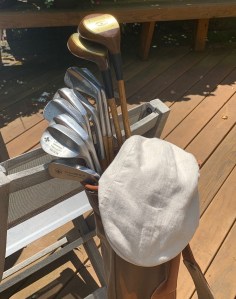
Within a month I had my own custom crafted set of hickory shafted clubs-made up of a 14-degree Wilsonian Brassie for driving and fairway play, the Jack White Cleek, the full array of Precision Series dimpled faced irons, and a replica Bobby Jones Calamity Jane blade putter.

Now the fun would begin, exploring the parameters of this new set of old clubs to find out just how playable they would be on my regular hunting grounds. Sessions on the range with my Rapsodo launch monitor would supply ball speed, club head speed, launch angle, and carry distances for comparing the performance of clubs of the same loft from my hickory set vs my modern equipment.

The dimple faced Precision Series Mashie and Pitching Mashie are identical lofts to a contemporary 8 and 9 iron respectively

For someone like me with a relatively modest swing and ball speed, 80 and 100 mph respectively with my PXG 6-iron, the launch monitor numbers were surprising in that the differences in the irons were statistically insignificant.  Launch angles were a tinch lower with the hickories but the club and ball speed and the carry distances were less than 3 percent apart throughout the iron range.

The hickory shafts make the clubs heavier in hand then their composite shafted relatives from my modern set, but choking up an inch and concentrating swing rhythm and timing seems to take care of it.  The dimpled face does not impart the kind of spin we get off grooved face irons today so some adjustment for roll out is necessary on carry shots into the greens.

The forgiveness of these irons is surprisingly adequate so I really did not pine for the cavity backed feature of modern irons.  But the club head seems more sole weighted and balls that climb up to the thinner part of the face, especially in the rough, can come off with insufficient enthusiasm and a dampened trajectory.

Shape of the Niblick and the SM Niblick behind looks pretty to the contemporary eye

The Mashie Niblick (PW), Niblick (GW), and SM Niblick (56 degree SW) do a good job for the approach distances of 110 yards and in.   Trajectory is very similar to my modern versions of the same clubs and, except for a little less spin off the face, hitting the click-stop array of half, three-quarter, and full shots has been very manageable.

The close-in pitching and chipping game around the green is very familiar.  I have found that the sole weighting on the irons gives a little more aggressive roll out in these shots so I have actually lofted up one notch using the Mashie-Niblick (PW) for shots I usually play with a 9 iron and the Niblick (GW) for shots I most often play with my modern wedge.  The 56 degree SM Niblick has plenty of lift for the lofty pitches and the bounce is appropriate for playing the array of sand shots we generally run in to.
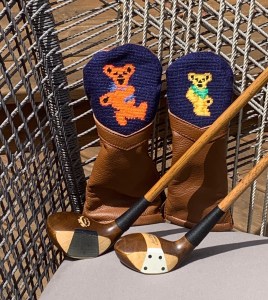
The heads on the Brassie and Cleek will remind you of the persimmons you played with as a kid

The Brassie and the Cleek had significantly lower launch monitor numbers then the high tech hybrids and driver in my current set.  The more significant factor had nothing to do with the hickory shafts but rather the persimmon heads.  As you might remember from playing persimmon heads from the 60’s though the 80’s, the sweet spot on these woods is the size of a dime, so the mishits are real foul balls and could be seriously off line and 30% shorter than a solid one.  The practical playing yardage of the course at 6200 yards gets seriously longer as a result.

Calamity Jane, complete with the Bobby Jones’s three extra whipping shaft wraps, has great strike balance with the offset hosel

Maybe the most pleasant surprise was the putting experience with the Calamity Jane blade putter.  Having played a heel shafted putter most of my golfing life the overall feel is not unfamiliar to me.  The tall unscored paddle face does take some getting used to but they engineered the balance of the club with the offset head so you get a good aggressive roll on it time-after-time.  On the slick downhill putt the toe putting trick works very well to dampen the speed.

Having played more than a dozen rounds with my hickories I have a some of takeaways on how to play these clubs effectively.

1. The differential in the carry yardage of the driving clubs coupled with the variance of distance and direction on the mishits puts real pressure on recovery shots.  Acceptance and humility are very important in these situations.  On the four pars when this happens it seems prudent to give up the hope of reaching the green and play a lay up to an intelligent  short iron distance from which an up-and-down save is possible.

2. Recovering from the rough, given the tendency of the ball to ride up to the thin part of the face on the irons, favors playing finesse shots with the Cleek or choking up on the irons to intentionally hit them a little thin on the meaty part of the club.

3. In planning shots from the fairway, the lower launch angles off the face and the lack of spin control favors a more links-like, ground game approach into the green openings allowing for roll out.  Three quarter and half shots are an art with these clubs and it seems to me the shaft and the club head weighting makes them very conducive to success on these type of plays.

4. The 13 inch long leather grips take some getting used to.  First of all they are a little firmer then the softer rubberized grips on most clubs today.  In the heat, if you do not wear a glove, they can get a little slippery from your hand sweat.  Most peculiar, since the grips are 3 to 4 inches longer then what you are used to, when you grip down on the chip shots around the green or on less then full shots in the fairway you have to recalibrate how far down the grip to set your hands to get the club length right. It took me a couple of sessions at the short game area to work this out.

5. Scoring to your normal handicap is going to be a challenge because some of the precision the new technology gives to your equipment is not there, so you have to adjust your expectations accordingly.  I suggest you track a separate handicap for your hickory rounds so as not to distort your regular index.  Playing the course a tee up may make sense to increase your enjoyment by taking some of the pressure off the wood club differentials and allowing yourself the opportunity to play approach shots with irons you are used to.

6. Most important, embrace the challenge and allow your strategic approach to playing to be more old school.  Most of us grew up playing in a time when the hard turf and less manicured conditions left a strong bit of existential outcome in the game.  The style of play with the hickories matches up to that way of playing nicely if you can accept the mind set and play accordingly.

A minimalist canvas walking bag with a Truckin’ theme seemed right

I have had to put up with the snickers of macho friends who wonder why in the world a sane person would give up current technology to play with a bag full of antiques.  But it is like joining a vintage car club and going off on a sunny summer day for a country ride in a classic fin back convertible with your favorite squeeze.  Some things just have to be experienced to be appreciated.