Unknown's avatar

About moegolf

Moe is a narcotic golfer, father, and lover of golden retrievers, chocolate and well done fries. He plays the holes over in his head endlessly at night.

TPC Sawgrass

As the first iteration of Dean Beman’s stadium course concept and the permanent home of The Players Championship, Pete Dye put together a course that would challenge the best players in the world and create iconic images in the minds of golf fans.  The original design was impossibly difficult and somewhat controversial, but a bottomless well of tour money has allowed them to continuously tinker and improve the layout and get much more unanimous professional approval as a result.  The reconstruction of the fairways and greens in the last decade plus the introduction of Sub-Air technology under the putting surfaces allow the tour to prepare this course as hard and fast as they desire.

Dye’s hazards do not discriminate on whom they inflicted scoring damage

Embed from Getty Images

Make no mistake about it, there is nothing timid about this course.  Pete has a garage full of intimidation factors in his design repetoire and he dipped into that reserve generously in putting this together.  Massive waste bunkers, huge mounding to mask landing areas, plumes of sage grass, and water galore amassed together make for a house of horrors to the average player.  Truth is the intimidation is more psychological than real so the trick is to look beyond the surface veneer and focus on a playable line to each hole which he graciously provides. The combination of intelligent decision making and unwavering focus on a playable line can make for  an enjoyable day.

Looking at the winners of The Players over 30 years you will see the unexpected names like Calvin Peete, Mark McCumber, Tom Kite,  Lee Janzen, Justin Leonard, Fred Funk, and K. J. Choi.  Look at runners up and you have Larry Mize, Mike Reid, Jeff Sluman, Glen Day, Jay Haas, and Scott Verplank.  Occasionally a name guy like Eldrick Woods or Philip Alfred Mickelson has seen success here.The common denominator is accurate driving and competent putting on fast greens.

Tiger has a few of these in his trophy room

Embed from Getty Images

Anything out of the fairway off the tee increases the challenge of hitting greens by a factor of 1.5 and the score goes up accordingly.   This is target golf with serious penalty for missing your intended shot lines.  The fast greens are very segmented and steeply sloped so regularly putting from outside the section that has the flag will have similar deleterious impact on your scoring.

As is recommended by the yardage book, pick a tee marker that is appropriate for you skill level.  If your average drive is 235 or less play white, 235 to 250 play blended blue/white, over 250 play blue.  Don’t consider the back tee unless you have your name embroidered on your golf bag.  The key is to have the driving areas reasonably within your range so you can actually enjoy the challenging approaches into the greens.

At 220 yards plus the Par Three 8th has bedeviled it’s share of scorecards

Embed from Getty Images

The sequence of the golf challenge is carefully architected.  Both sides start a bit easier with scoring opportunities early, but ratchet up considerably around the fourth hole.  The last three holes on both the front and the back make keeping a score in tact a whole lot of work.  The eighth hole is a brutal par 3 7/8ths and the ninth can eat your lunch six ways to Sunday.  Better than the finish at any of regular tour stops, sixteen, seventeen, and eighteen collectively present opportunity for glory or disaster  in equal measure.  This is target golf at it’s most extreme.

Personally I think the par 5 sixteenth is one of the coolest holes out there.  For the long hitting pros going for the green in two is a must but there is a huge penalty for bailing out left to avoid the harrowing water that encroaches on the right.  Any wind at all makes this huge green very elusive.

Sergio has experienced the thrill of victory and the agony of defeat at the 17th

Embed from Getty Images

Nothing more need be said about the iconic island green at 17, you have witnessed a boatload of heartache and misery in HD watching the broadcasts over the years.  The eighteenth is as hard a par to make as you could ever imagine.  Missing your approach into the grassy moguls right of the green can lead to a downright embarrassing sequence of recovery attempts.

In the last renovation they built a clubhouse that is worthy of being the home of the PGA Tour.  You will find an endless offering of tour memorabilia to add to your study.  The locker rooms, eating facilities, and practice areas are something to experience as well.

Playing the course that so adequately bevils the top 50 in the world each year is definitely a thrill.  Just play it at a reasonable yardage and don’t beat yourself up if Pete and Alice have their way with your scorecard.

Ponte Verde, Florida

Architect: Pete Dye (1980)

Tees                 Par            Yardage      Rating     Slope

Blue                 72                6661           73.9        146

White               72               6103            70.9        137

(Click here to review TPC Sawgrass hole-by-hole descriptions)

American Golf Laureates

When it comes to American golf writers  there is little doubt that, as Bing Crosby said,  Herbert Warren Wind was the dean of them all.  In this article by Furman Bisher for Sports Illustrated he talks of Wind’s personal relationship with Bobby Jones and his special connection to the The Masters.

There is a stateliness to the fabric of The Masters.  Much of it has been the result eloquent descriptive writings of people like Wind who seared dramatic images into our memory banks of the golf contested at Augusta.

Bisher knew Herbert Warren Wind rather well, “He and I were, in our prime, course walkers, and there we came to know each better than we would have otherwise. We followed the game wherever our inkling took us, and there was no more inviting venue than Augusta National when the Masters was in play.”

Bisher pays the highest tribute to Wind when he says, “When one writer writes of another writer, such as Herbert Warren Wind, modesty comes easily. Envy is a professional response, and so it is that when I read Herb’s handiwork on golf, and golf at the Masters, I have read golf in its truest form.”

(Click to read Furman Bisher’s article “Gospel Truth”)

Furman Bisher

Sports Illustrated

April, 2011

_______________________________________________________

Furman Bisher, a columnist for the Atlanta Constitution, has been a “Masters Storyteller” as well, covering the event for 62 consecutive years with insightful prose until his passing in March of 2012.

In this tribute article in Sports Illustrated by Gary Van Sickle you can read a wonderful excerpt from a book Bisher wrote called “Augusta Revisited: An Intimate View”.  It describes the atmosphere once the tournament is over and the award presentations are done.  A delightful description of the remorse we feel when something eagerly anticipated and thoroughly enjoyed is over.

Reading this is a wonderful tribute to another gifted American writer who has entertained and educated us for over a half century with his writings on golf.  For all those who follow golf his voice will be greatly missed.

(Click to read Gary Van Sickle’s article “The Long Goodbye”)

Gary Van Sickle

Sports Illustrated

April, 2012

Through The Looking Glass

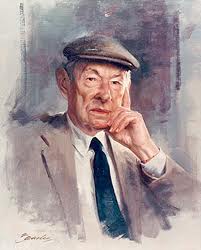
Herbert Warren Wind (usgamuseum.com)

Ever wish you could sneak into the study of a great writer and rummage through their desk to see just where all that genius comes from.  Better yet, how about getting to read some personal letters from major celebrities and stars in the game they wrote so eloquently about.  Well here is your chance.

Golf Digest recently published this short piece called “Treasured Links:  Letters To Herbert Warren Wind” which are original letters written to him from people like Bobby Jones, Gene Sarazen, Ben Hogan, Jack Nicklaus, Bing Crosby, Arthur Schlesinger, and others.

Herbert Warren Wind wrote about golf and other sports for The New Yorker
and Sports Illustrated for over 50 years,  His famous books include co-authoring Hogan’s “Five Lessons: Modern Fundamentals of Golf” and “Following Through-Writings On Golf” a collection of his writings about everything from The President’s Putter Competition to his first sight of the Links at Ballybunion.

There are some whimsical ones from fellow writers like George Plimpton and P.G. Woodhouse as well as a number of solemn letters from Byron Nelson and Gene Sarazen.  My favorite is the one from Bing Crosby thanking him for a wood shafted putter Wind had sent him as a present and giving Wind his thoughts about the U.S. Open coming to Pebble Beach for the first time in 1972.

Revealed in these short letters is evidence of his connection with all the central characters of golf over it’s developmental years.  These relationships helped fashion and enhance the intimacy of his writing.  This was another time when the relationships of writers and protagonists were shaped by mutual conciliation not confrontation.

Unfortunately, with just 13 of these letters, your stay in his study is too short,  There must have been a sound in the hallway that sent you scurrying back out the window.

(Click to read Golf Digest’s presentation of “Letters to Herbert Warren Wind”)

Golf Digest

May, 2012

World Golf Rankings-2 and 20

Much like an investor in a hedge fund to whom the Black Box strategy of investing and the 2% administrator/20% shared profit fees make them wonder whose interest is really being served in this investment, the average golf fan scratches his head when he tries to make sense of the list of the 50 top players in the world as determined by the Official World Golf Rankings (OWGR).

As you can read in this Golf World article by Mike Stachura there is a built in set of biases that make the Official World Golf Rankings anything but objective. The points are pre-weighted based on a tournament’s subjectively judged and assigned importance by the gurus of the OWGR. As he says in the article this approach is, “making a methodology based on a pre-weighting of those tours open to charges of randomness and even political favoritism”.

The system was created by Mark McCormack, the original super agent who ran IMG and his agenda was clearly to promote the game through the players from his camp.  Of his effort McCormack said it is the “answer to the grill room question.  I have it all now, the gall, the system and the conviction and am prepared to defend this first statistical presentation of who is the best, regardless of where they play, how much money they win, what their stroke averages are, and all normal ways of judging golfers”.  Now that sounds objective to me.

The system became “official” when it was embraced by the five major tours in 1997 and it’s methods have been tweaked regularly to make it more credible.  But the statistical methodology is still secretive and subject to the same biases so obscure players playing in obscure events benefit from higher rankings than guys who are much more household names to regular golf fans.  In effect the OWGR’s real purpose seems to be as “an effective marketing tool for global golf”.

This article discusses a proposal from two Ivy League professors, Mark Broadie and Richard Rendleman who would like to see the rankings based on more standard statistical models.  They argue their approach would remove the biases and present a more understandable and credible ranking of the best players in the world.  Considering how important a top 50 ranking is to a player’s income flow this would be a welcome change to the tour players.

A more objective approach to the OWGR would put it’s purpose back to answering the simple grill room question and put the marketing of global golf back in the hands of the Madison Avenue crew where it belongs.

(Click to read Mike Stachura’s article “An Outside The Box Proposal”)

Mike Stachura

Golf World

April, 2012

If you want a little less sophisticated but equally intriguing approach to resolving the problems of the current Official World Gold Rankings read this article on J.S. Elliot’s Fantasy Golf Report website.

He would like to see the rankings be based solely on the head-to-head play of the best players in the world so it is all about their performance at the Majors, the World Golf Championships, and The Players Championship.  There is logic to this approach because most fans would agree that surviving the pressure cooker created by these events is the appropriate measure of who is the best player in the world.

(Click to read Fantasy Golf Report’s “FGR World Rankings)

J.S. Elliot

Fantasy Golf Report

April, 2012

Phil and Amy-The Real Deal

Phil Mickelson has a way of connecting with people that brings back memories of Arnie in his heyday.  But, more importantly, Phil and Amy Mickelson have quietly devoted themselves to causes and individuals in the community who need their support.

As you can read in this article by Alan Shipnuck for Golf.Com, the list of folks that have seen their lives improved by the Mickelson’s humble devotion to philanthropy is a long one indeed.  Many of the causes are very visible-the Mickelson ExxonMobil Teachers Academy that helps train math and science teachers every summer or their Start Smart program that provides kids from low income school districts in San Diego with school supplies and clothing each fall.

Many others are off the radar entirely, like Phil’s relationship with David Finn, a young man who suffers from a mitochondrial disorder that keeps him wheel chair bound and makes communication with others very difficult.  Phil connected with David during a practice round at the 2005 PGA at Baltusrol by greeting him and handing him an autographed golf glove.  When Phil won his second breakthrough major a few days later, he had the presence of mind and concern to ask David if he would like to have a photo taken with Phil and The Wanamaker Trophy.  This was an act of dignity and humility that says all you need to know about Phil.

Maybe the most interesting fact to glean from Shipnuck’s article is that Phil and Amy’s foundation is funded solely by them.  Unlike many other celebrities, their foundation does not solicit money from others.  The causes this foundation supports are the beneficiaries of their personal philanthropic grace.

There are many other touching and revealing stories in this article.  It is evident that Phil and Amy’s impact on the world reaches far beyond the fame he has made for himself in the world of golf.

 (Click to read Alan Shipnuck’s article about Phil Mickelson’s philanthropy)

Alan Shipnuck

Golf.com

May, 2012

Photo-John Munson-Newark Star-Ledger

Ten Best Shots in 2011

If you are a golf addict you probably witnessed 8 of these 10 best shots in 2011 from the comfort of your family room couch.  That would mean 8 times you lept from the couch and shouted at the family pet, “You’ve got to be kidding!”  He is still wondering why you keep saying that.

This is spine tingling stuff.

(Click to see PGA of America’s 10 Best Shots of 2011 On The PGA Tour)

PGA of America

December, 2011

Ladies Masters……At Augusta National?

Talk about thinking out of the box, for the LPGA tour this defines it.  It is so crazy and unlikely to occur it is just worth debating in the abstract.

With the 2014 U.S. Open for both the men and women coming to Pinehurst #2 in succession, it becomes a legitimate conversation to stage major men’s and women’s events on the same course.  Putting the tees and pins in the right place for each group will result in an equally compelling competition with the same riveting factors capturing our attention.

So how cool would it be to see Suzann Pettersen and Yani Tseng agonizing over club selection on #12 or the decision to carry a second shot over Rae’s Creek into #13 while playing Amen Corner.

As Paula says in an intriguing article by Tommy Hicks on AL.com, “Are you kidding me? Of course that would be something. That’s when we’d know we had really made it, if something like that happened.”

You can take all the talk of Augusta being an all men’s club out of the conversation, it would clearly have to have changed for this to happen at all.  Once that occurred any objection on the part of the LPGA players playing there would dissipate in a heartbeat.

The more difficult question is whether the green jacketed decision makers at Augusta would consider giving their course away for another two-week period and whether they thought such an annual event might diminish some of the luster from “the grand daddy of em all” in April.  My suggestion is go to Pink Blazers and couple the event with proceeds supporting breast cancer research.  Talk about a win-win-win situation.

Equally problematic would be how much such an annual event might take away from the Kraft-Nabisco (a.k.a. Dinah Shore) which is the closest thing the ladies tour has to a major event that returns to the same venue every year.  But if you kept enough separation between them on the schedule I think that could be managed with proper PR.

This is not going anywhere but I think it will make for lively conversation among enlightened regular Saturday foursomes.

Who would a thunk we would get to the moon in a decade so this could be…….one small step for Augusta National….one giant leap for the LPGA.

(Click to read Tommy Hicks article on AL.com)

April, 2012

Trick Shot Artistry

You have seen shows of guys who do trick golf shots for a living.  But how about a trick shot show by top European professional golfers who just do it for fun.

Enjoy the attached video with Rory McIlroy and Jason Day doing the Happy Gilmore or George Coetzee doing a very cool version of the wedge flyback thing or Peter Lawrie reliving the day of defeating a Stymie or Rafael Cabrera-Bello successfully playing the shot that could have won Phil a fourth green jacket.

Boys will be boys.

(Click to watch the golf-monthly.co.uk video on pro trick shots)

Shane Bacon, Golf Blogger

April, 2012


If you want to see another array of this kind of artistry take a look at this video of trick shots from professional Gareth Maybin.  Some serious slight of clubhead,  hand, and other body parts in this one.

Warning:  Do not try this at home.

(Click to watch Gareth Maybin-Sportsrisq video on trick shots)

Gareth Maybin

July, 2011


The Concession Golf Club

The Concession, a collaborative design between Jack Nicklaus and Tony Jacklin, was first opened in 2006 in the Sarasota area to be the centerpiece of  a high end exclusive residential golf development.  It gets it’s name from the fact that these two were the protagonists in a famous concession of a two-foot putt at the final match of 1969 Ryder Cup that resulted in the first tie in the match’s history.  In the annals of golf this goes down as one of the most gracious gestures of sportsmanship we have seen in our sport.  The golf course was designed with match play in mind in hope that some day a Ryder Cup will be contested there.

With the downturn in the economy right after the course opened the residential sales floundered and they only reached about half of the 200 members they had planned on.  Under this economic distress foreclosure loomed for the club and the surrounding residential real estate.  In 2009 Bruce Cassidy, the wealthy owner of a mining construction company, rode in on a white horse and put together an investment group to purchase the golf course and the 520 pristine acres of land it sits on.

He subsequently finished the construction of a planned $15 million dollar clubhouse and brought Nicklaus back in to make some course modifications to soften and make it a bit more playable for it’s members.  The only rooflines you will see are the clubhouse,  Mr. Cassidy’s home, and a couple of palatial guest houses for visiting dignitaries.  The result is an underutilized luxurious golf only facility with about 125 well heeled local, national, and international members.

Everything about the place is top shelf.  The clubhouse is appointed throughout with historical memorabilia to make you stop and stare.  Pro shop, locker room, bar, and dining facility are lavishly appointed and serviced with a casual air you would expect.  From the moment you hand your clubs to the young men at the bag drop to the time you pull away at the end of the day, they provide you with everything you want for a great day of golfing with friends.

The 23 acre practice facility alone is to die for.  Dual ended driving range sporting 10 target greens with full bunkering and Titlest Pro-V1s at every station.  A state of the art short game area where you can practice up to 80 yard shots and a 14,000 sq. ft. pitching green with bunkers and pitching areas that replicate what you will see on the course.  The practice putting green is 10,000 sq. ft. and has the same grasses, speed, and undulations as the course greens.  You could spend a whole day tooling around this practice area working on your game.

With so much ground to work with Jack and Tony designed a course that has unique character for this part of Florida.  The holes are framed with pines and oaks as well as low palmettos and pine straw.  Water comes into play on 15 holes and the bunkering throughout is generous.  Controlling your direction is key to avoiding the high numbers on your scorecard.  Fairways are Tiff Bermuda which can be maintained with minimal watering to keep them firm and fast.  The greens are also Bermuda and have the fancy sub-air system embedded in their understructure to manage ground moisture and temperature to optimize the grass condition and support lightening speeds.  Segmentation and tiering of these green complexes coupled with stimp readings of 12+ put this course in the championship caliber.

There are five sets of tees so it is incumbent upon you to listen carefully to the advice of your caddie and consider the day’s wind condition to pick a set that will allow you to be competitive and enjoy your afternoon.  They made the course eminently playable if you play with proper forethought.  Most holes have distinct challenges presented but, with careful planning,  there are alternative safer routes to play to avoid the dreaded stuff.  Take a page out of the Scottish/Irish playbook-play a match with your golf mates and make the medal score secondary to maximize your enjoyment.

The fairway bunker constellations are enormous and set opposed to most of the water hazards.  Generally the best line of play is close to those constellations but ending up in them can be as penal as the fish habitats.  Take a good look at the yardage book depiction on each tee and plod a route of play that makes the most sense. What is cool about the bunkers is that the sand is imported “Jack” sand which means it is firm, avoiding plug lies, and very playable from the fairway or greenside bunkers as well.  Most of the fairway bunkers have a foxhole character with a raised back edge so you can distinguish them clearly from the direction you are playing.  Once you walk past them they seem to disappear into the greenscape which gives for clean and majestic appearance when you look back down the fairway.
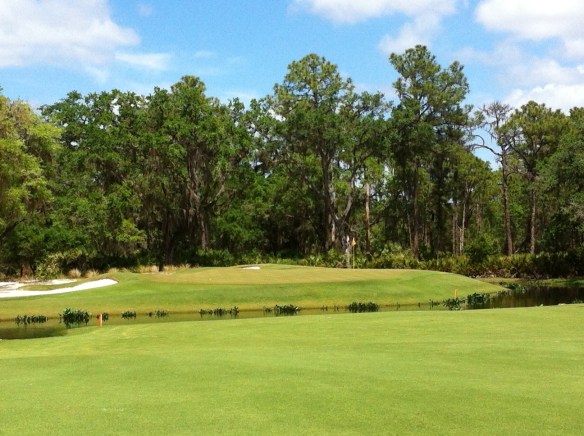
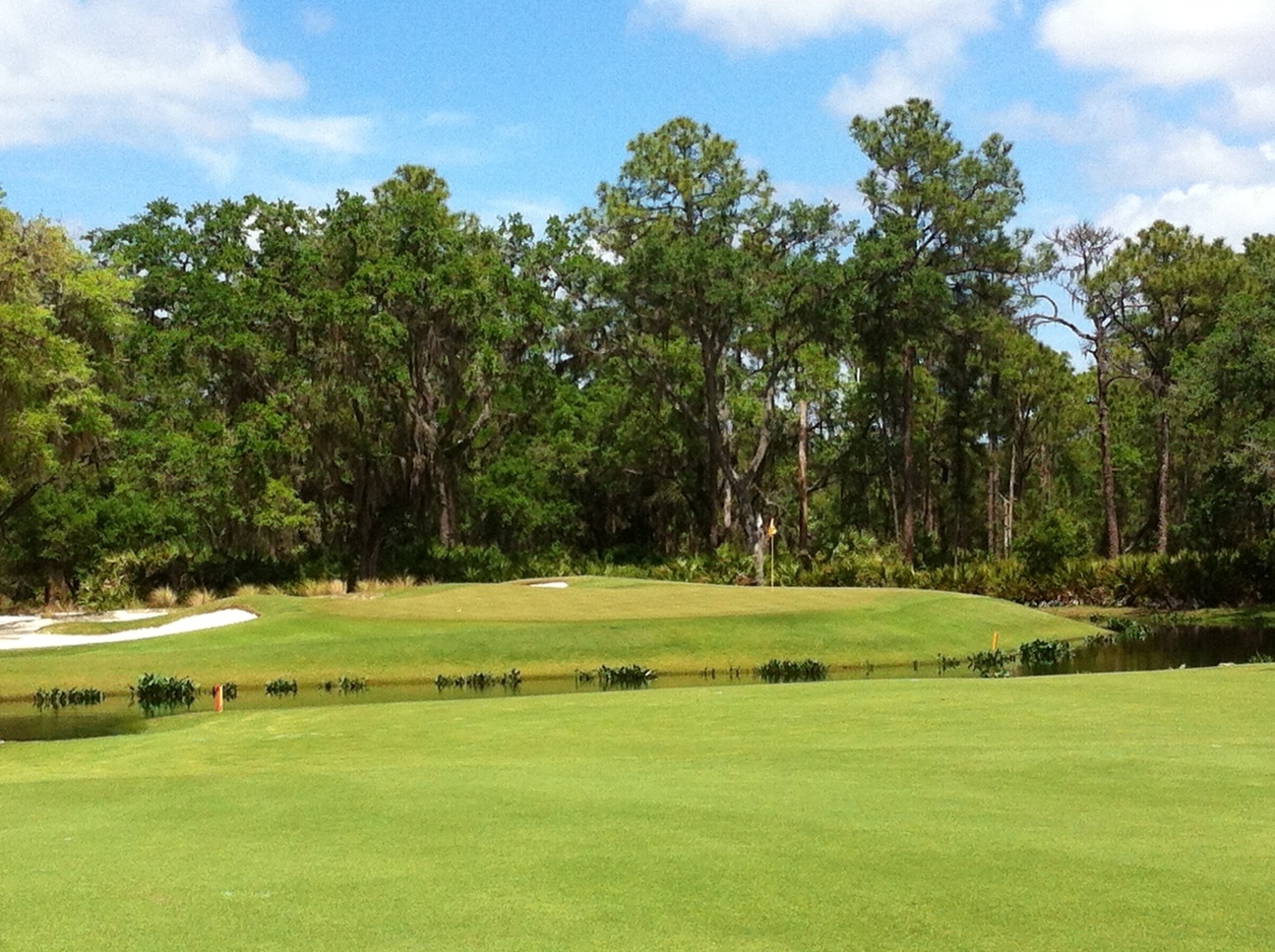
Short Par 4 8th has trouble lurking in the lagoon

 (Click on any picture to get an enhanced view of the image)

There is an equal balance right and left challenges, which for Jack is unusual, so you are required to pick a line of approach and try to shape your shot accordingly.  Fortunately they were generous in the design and provide bail out areas if the shot required is not comfortable and even some collaring bunkers and grassy areas to take some of the harshness off the forced carries required.  Short and long hitters will both find what they like through the day-some of the most challenging holes are the ones where distance is of no advantage and articulate shot execution returns a premium.

Green setting at Par 5 15th requires pure precision

As a collection of holes, the five pars are the coolest holes you play all day.  Every one is a visual delight with protracted segmentation to give you many tactical approaches to playing them.   In most cases your second shot choices  are determined by your first shot result and often the best choice is not the obvious one.  This is not a simple I can go for it in two or I better lay up.  There are good lay ups and better lay ups and you may be abandoning your standard lay up distances depending on circumstance.

The par threes are the least memorable holes but in no way are they without interest.  Fact is the tactical approach to every one of them will change dramatically based on the daily pin position and the prevailing wind.  This is where you have to be careful of how much risk you take because missing on the wrong side will leave you very difficult recovery shots and an opportunity to waste valuable strokes.

Green at the 5th hangs precariously over the water

Many of the par fours are double breakers for me-holes that change direction twice-once on the tee shot and in opposition on the approach to the green.  Proper positioning off the tee makes the second shot considerably more manageable but getting to those spots can entail greater risk.  In match play this really puts pressure on you to play smart based on what your opponent has done.

Great look from the tee on the finishing Par 4 18th

Since you are unlikely to see more than a handful of groups out there taking the time to appreciate the scenery and the wildlife therein makes sense.  Beautiful birds can be seen throughout that compliment the flora and natural vegetation but there are alligators in the water hazards so don’t go mindlessly plodding about if you hit a wayward wet one.

To play here you will have to make an arrangement through your pro or know a member who can host you appearance.  This place is expensive so the beauty comes at a price.  But the value is in the full experience-atmosphere, scenery, and an afternoon of memorable golf.

Lakewood Ranch, Florida

Architect:  Jack Nicklaus & Tony Jacklin (2005)

Tee             Par    Yardage    Rating     Slope
Blue            72      6440        72.7        146
White          72      5909        69.6        137

(Click here to review The Concession hole-by-hole descriptions)