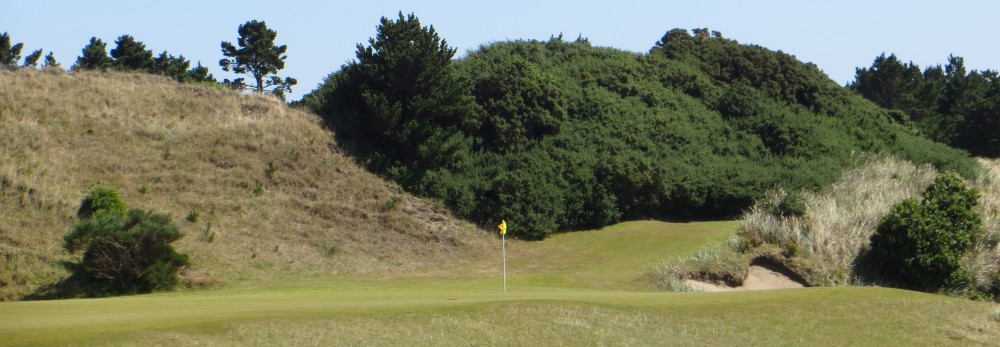

Royal Aberdeen Golf Club

Royal Aberdeen LogoDating back to the formation of the Society of Golfers at Aberdeen in 1780 Royal Aberdeen is the sixth oldest golf club in the world. A sense of golf legacy is felt everywhere you go on the property. For the first hundred years golf was just played on ground within the town but in 1887 the land just north of the estuary of River Don at Balgownie was leased and the Simpson Brothers helped bring this historic links to life. Willie Park Sr. and Tom Simpson later took their part at shaping these links.

The simple but stately clubhouse is full of evidence of tradition

The simple but stately clubhouse is full of evidence of Scottish golf tradition

The first nine holes are considered by some among the very best in Scotland as they wind through the full rapture of links features-towering dunes, rolling fairways, gorse, heather, and tightly textured seaside turf. You cannot help but be caught up in the course’s beguiling solitude and seclusion. As you often see from courses of this era Royal Aberdeen is the classic out and back links arrangement.
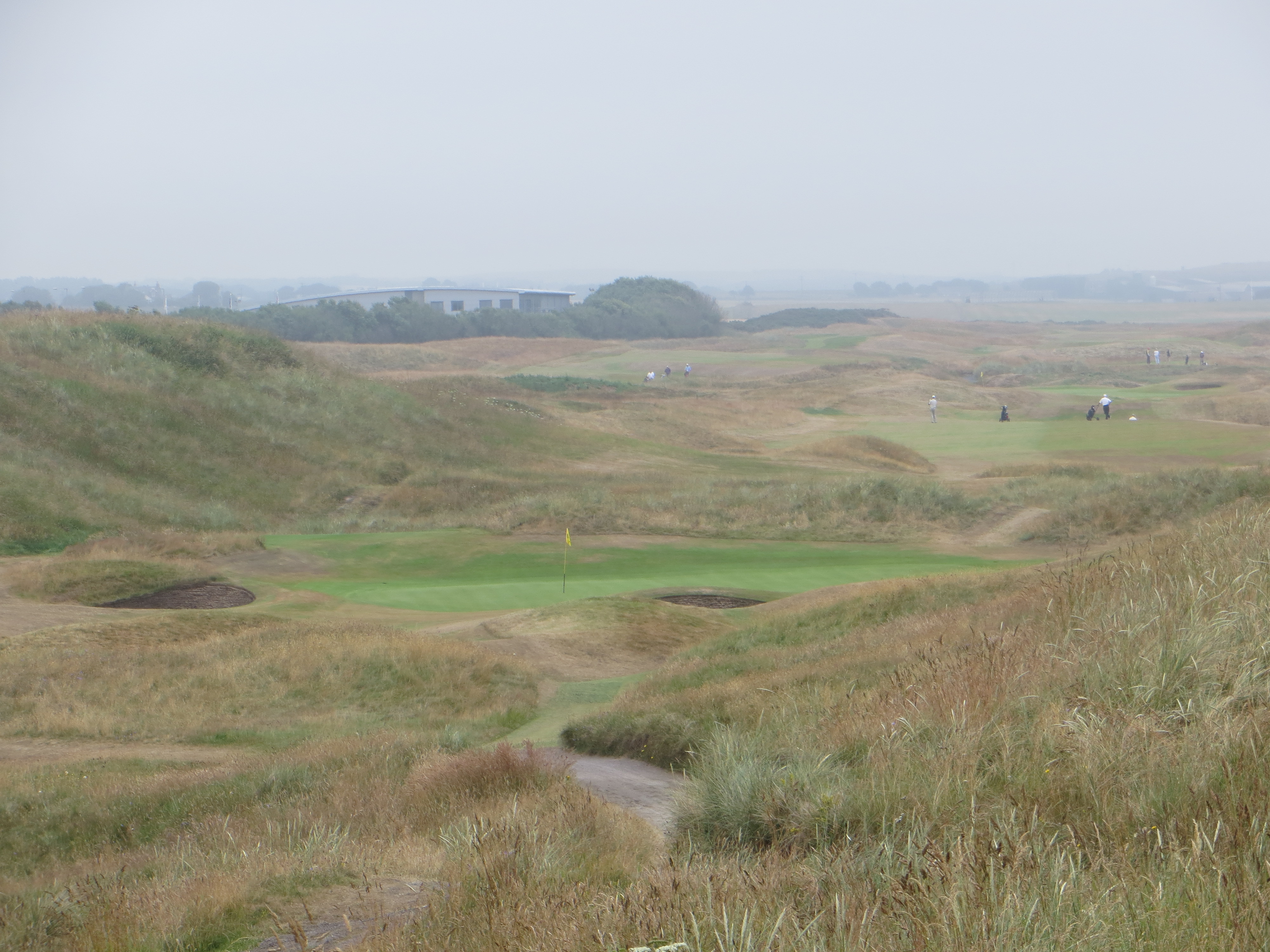
The Par 3 third is typical of the enveloped look of the front side holes

The Par 3 third is typical of the enveloped look of the front side holes

The second nine is shorter and runs along the high plateau overlooking the front nine. You are likely to see an opposite direction in the wind influence over the inward nine. Some say this side lacks many of the features that make the front so memorable but there is an array of blind tee shots, hidden troughs, and very difficult putting surfaces to keep the challenge fresh.

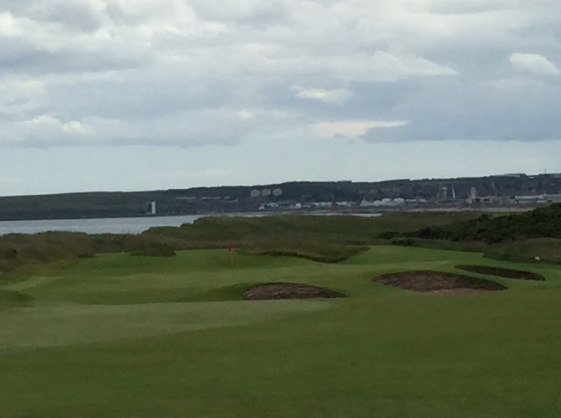
Sea is over the dune behind the Par 3 8th-just a postcard moment

Sea is over the dune behind the Par 3 8th-just a postcard moment

What I enjoy about this place is that the links design gives the greens keeper the latitude to make the course playable each day as the wind changes. The greens are sufficiently long to allow for back pins down wind and front pins when the gale is in your face. Plenty of options to use the ground as your friend on approach shots. Take careful note that often the fronting green side bunkers are not at the green but well short of the putting surface to accommodate this option to feed approach shots onto the green.
A typical approach #15..bunkers need to be avoided

A typical green complex approach #15..bunkers set off the right-passing access from the left

Covering the Wailing Wall from the green side bunker on #15 is intimidating

Covering the Wailing Wall from the middle green side bunker on #15 is intimidating

The greens have lots of undulations which again provide the creative player with ways to carefully maneuver pitch shots to snuggle up to the hole. The game inside of fifty yards at Royal Aberdeen may provide some of the most lasting memories of the day.

The back nine climbs to the plateau and gives wind a maximum chance to affect your game

The back nine climbs to the plateau and gives wind a maximum chance to affect your game

As mentioned tradition is on display in troves throughout the clubhouse. You will see documents that show the first interclub tournaments held in the late 1800’s with guys from St. Andrews, Dornoch, Prestwick, and others. Those away games must have been a hoot. In 1783 the folks at Royal Aberdeen were responsible for establishing a five minute time limit on search for a lost ball. The Royal and Ancient adopted this practice shortly thereafter.  Other concepts Royal Aberdeen introduced include that the winner of a hole is entitled to the “honor” of playing first on the next hole and that the ball furthest from the hole is played first.
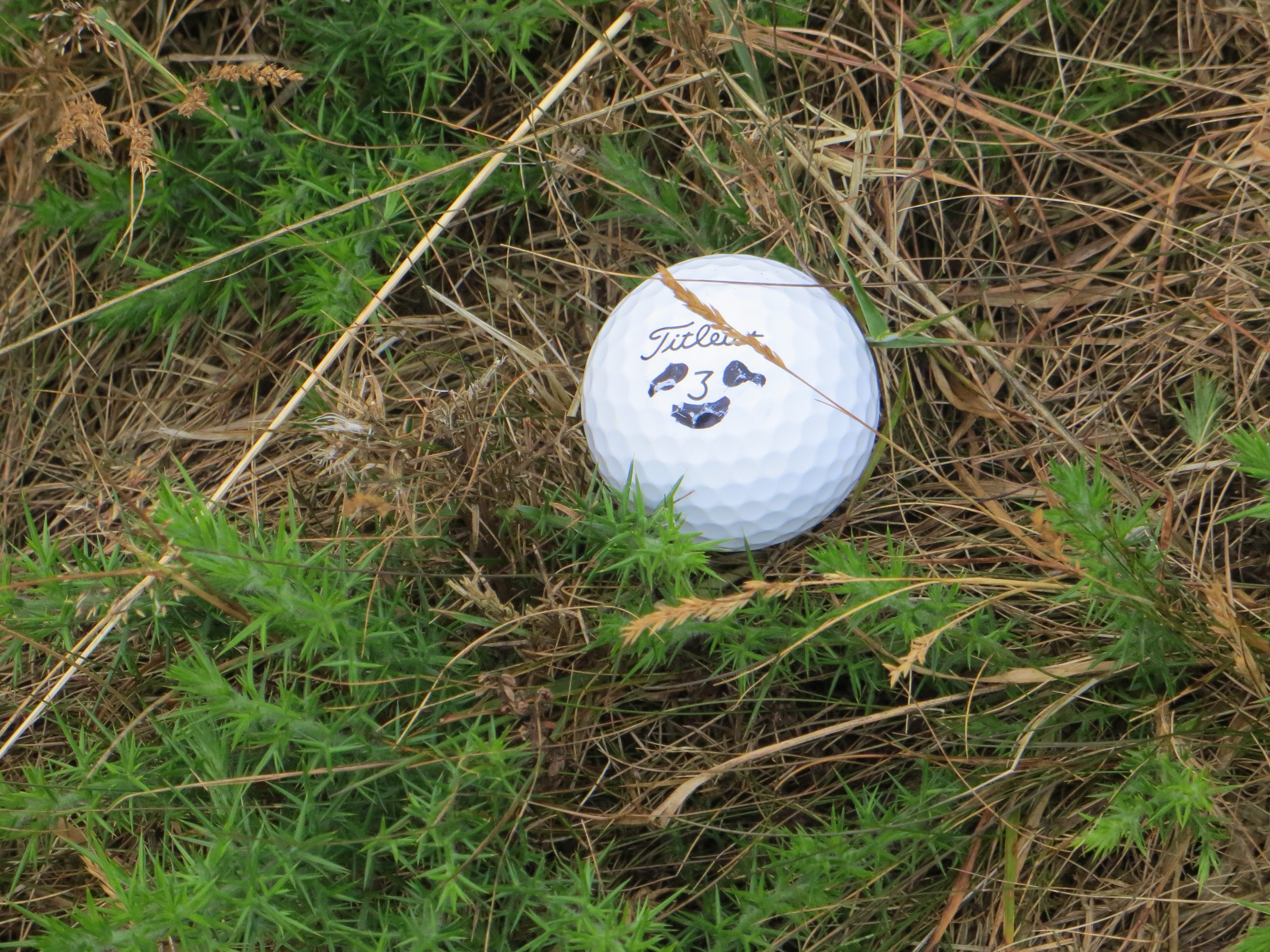
Here is one we found in the gorse within the allotted five minutes

Here is one we found in the gorse within the allotted five minutes

There are elaborate uniforms of the membership, endless pieces of competitive memorabilia, and wonderful pictures of the recognizable champions who have played and won in competitions contested on these links. Make sure to lunch in the grill room that overlooks the first tee it provides one of the great panoramic views of links golf in Scotland.

Last look up the 18th you see the clubhouse in the misty distance

Last look up the 18th you see the clubhouse peering at the green through the mist

The golf shop is a kitchy little building just below the first tee. Nooks and crannies full of stuff you will be temped to buy. As is often the case in Scotland, no practice area is evident. Hit some putts on the practice green and just soak in the gestalt of this place to prepare to play. If you are a discerning player this is a links experience you will never forget. Don’t say you were not warned……..the devil is in the details so make sure to read the hole-by-hole descriptives below.

Aberdeen, Scotland

Architect: Robert and Archie Simpson (1890)

Tees      Par     Yardage     Rating     Slope

Blue       71         6861         74.3        145
White     71        6497          72.7        142
Yellow    71        6214          71.3        140

(Click here to review the complete Royal Aberdeen hole-by-hole descriptions)

For more pictures click to review Northern Scotland-Day 6b:  Royal Aberdeen Golf Club

Keep Your Head Down

PGAProfessionalLogoThe most common unsolicited remark a golfer hears from a playing partner when a shot goes awry. Doesn’t matter if it was popped up, skulled, foozled, or socketed, the advice is usually the same. Depending on the chutzpah level of the person rendering the remark it could also be you are lunging, swaying, coming over the top, or the over-rotation of your hips is affecting your club head speed (if the Traveler’s dog happens to be in your group). My thought when I witness these retorts is “Do you have your name embroidered on your bag or do you have a PGA teaching certification I don’t know about”?

Why a 20-handicap guy who breaks 90 twice a year feels it is his obligation to try to instruct a fellow player on the error of their ways is beyond me. The worst iteration of this helicopter partnering is when it involves a husband or father. There is some familial
obligation being implemented here to direct their helpless wife or inexperienced child through the trials and tribulations of discovering a competent golf game.

The problem with all of this is three-fold.

A. The guy giving the corrective directions is not objective, the weight of the personal relationship blinds him to the real athletic aptitude of their relative.

B. The guy barely can hit it consistently out of his own shadow so his advice is like the
blind leading the blind out of a burning building.

C. Who asked.

It is really no better if these kind of “suggestions” come from a single digit advisor. There is a reason there are so few good certified teaching pros, it takes a gift for full speed diagnosis, lots of fundamental knowledge, and an ability to communicate. Just having a low handicap does not mean you have any of those.

I have been playing golf for going on 55 years and have enjoyed the golfing company of my wife and/or son for a good half of that. When my wife asks me on a particular shot what club to hit my response is “you are 120 to the center of the green, slightly uphill”. If my son asks me what was wrong with the swing that just rendered the snapping turtle ball flight that has his Titleist now residing in the knee-high stuff on the left my answer is “so what did the pro tell you the last time you were together?” Truth is golf is a game of self direction and self discovery it needs no tour guides unless they are professionally trained and being paid for their services.

My idea has been that couples and father/son tournaments should have a stipulation that you must have someone of no relation as your partner. It would remove the urge for frivolous on course correction, be more fun for your partner, and give your team a much better chance to win sweeps.

This tirade extends to all kinds of advice given on the course. How many times did a person in your group standing above the cup on a steep green ask you whether it is fast or not? Your answer is “like a greased duck on a slip-n-slide”. The result is they leave it hanging half way to the cup with a four-putt now hovering in the balance. Or they are 130 to clear the pond in front of the green and want to know if they should lay up. No matter what you say they manage rinse the next one botching the aggressive or conservative advice rendered.

Best answer to these kinds of rhetorical inquiries is “you’re holding the club, go with your gut” it usually leads to an acceptable result.

It is my hope that when the USGA finishes the Pace of Play/While We’re Young advocacy campaign they will tackle this one. My suggestion is Charles Barkley as the spokesperson of the Zip-It…No more golf disinformation please.

In the meantime, if you hear “Keep your head down” in your group politely respond with
“Keep it to yourself”. It should help your game the rest of the day.

June, 2014

Up To The Challenge?

Pinehurst 2 US Open LogoMartin Kaymer, Pinehurst #2, or Erik Compton….in all three cases an emphatic YES!

Martin Kaymer torched the field by 8 shots in this U.S. Open return to Donald Ross’s fabled Pinehurst #2. As the fourth biggest margin of victory on record, this performance is on level with the runaway wins of Tiger at Pebble in 2000 and Rory at Congressional in 2011.

The scoreboard doesn’t lie

Embed from Getty Images

.
His back-to-back 65’s in the first two rounds were the first time anyone has had two 65’s in a U.S. Open. The 9-under finish was the third lowest score to par in U.S. Open history. With stats like 77% fairways hit, 63% greens in regulation, average driving distance of 305 yards, and 110 putts, an average of 1.53 per hole, he was hitting it in play, sticking it close, and making the putts that mattered. There is no wonder he waxed the competition.

Another first, Kaymer has won a quasi-major (The Players) and a major (The U.S. Open) in just six weeks……and he beat two of the strongest fields of the year….leading wire-to-wire. This is Ubergolf if we have ever seen it….it puts him comfortably among the top performers of his generation.

Kaymer got everything he asked for and more

Embed from Getty Images

.
Golf journalist Rex Hoggard said, it was like Kaymer was playing the more pedestrian Pinehurst #5 for four days while the rest of the field was playing the championship Pinehurst #2. As we saw with Tiger and Rory sometimes one player shows up at a major with a game the rest of the field cannot recognize.

.
Pinehurst #2 held up to the expectations of the USGA in fine fashion. Mike Davis continues to break the mold of playing U.S. Opens on monster long emerald green layouts with knee high rough. It started with bringing the Open to a municipal course at Bethpage Black in 2002 and continued by returning it to the more modest distances of Merion last year. Aligning with the Pinehurst powers to restore #2 to it’s original Ross character by removing 40 acres of Bermuda rough and allowing the adjacent areas to the fairway to return to their native roots, the USGA presented a fast and firm challenge that looked more like an Open Championship than a U.S. Open. With Chambers Bay and Erin Hills on the schedule two of the next three years this sand based, brown is beautiful campaign will likely continue.

Pinehurst #2 was not your typical day at the office for these guys

Embed from Getty Images

.
The players seemed to relish the challenge presented by unpredictable lies off the fairway and the unique domed greens of Pinehurst #2. Sand shots took on a totally new connotation when any ball was wayward. The green side recovery shots we witnessed were a far stretch from the typical hack and flop of a U.S. Open weekend. Putts on greens in regulation took on a whole new meaning since more than one of the guys putted off a green he had already hit in regulation. If you remove the outlier of Kaymer’s 9-under performance there were only two others in red figures at 1-under par. That passes a U.S. Open litmus test every time.

Then there was the Erik Compton story. Clawing his way to a second place finish at 1-under par in the pressure cooker of a U.S. Open with his second transplanted heart (the useful life of his original and it’s first replacement had been spent) Compton mustered resolve, courage, and fortitude that would make John Wayne feel proud. For the last three days Compton did what major winners like Justin Rose, Keegan Bradley, Adam Scott, Rory McIlroy, and Jim Furyk could not do-he took on every challenge that #2 presented shooting 3-under when it mattered and did not give any ground to the blitzkrieg of Martin Kaymer.

Erik Compton handled all the challenges at #2

Embed from Getty Images

.
This from a man who has seen his life pass before his eyes at least twice already and who takes more medications in a month than many of us take in a life time.
As Randall Mell said of Compton’s inspirational play, “They’ll never forget what this remarkable man did here……nearly trumped the Miracle at Merion, Ben Hogan’s victory in his return from a nearly fatal car accident in the 1950 U.S. Open”.

LPGA pros in the on-deck circle

Embed from Getty Images

.

And if you haven’t had enough of the all-you-can-eat Pinehurst experience the Women’s U.S. Open Championship begins at the same venue starting today. Shorter tees, hotter temperatures, same native rough areas and turtle back greens…..just another stern USGA test with a different set of protagonists in soft spikes.

June, 2014

Donald Ross Meets The Wayback Machine

Pinehurst 2 US Open LogoWhen the head honchos of Pinehurst called on Bill Coore and Ben Crenshaw in 2008 to consider restoring the famed Pinehurst #2 to it’s original Donald Ross character they had to feel like Mr. Peabody and Sherman cranking up the old Jay Ward Wayback Machine.

Coore and Crenshaw (C & C) were the obvious choice for this task because of their success with sand based terrain in Nebraska and Oregon and their reputation for copious attention to architectural detail of the classic golf courses. With the USGA’s Mike Davis enthusiastic in supporting this change it added to the pressure that it would need to be done in time to showcase #2 for unprecedented back-to-back appearances of the men’s and women’s U.S. Open Championships at Pinehurst in June of 2014.

From it’s introduction in 1907 Pinehurst #2 was Donald Ross’s obsession. He spent the next 35 years tinkering with a flat piece of North Carolina sand hills terrain turning it into one of the most captivating strategic golf challenges in the states. It built it’s reputation through the 30’s, 40’s, and 50’s hosting some of the most important annual professional and amateur events and national championships in the game of golf.

Bronze tribute to Donald Ross the famed designer of Pinehurst #2

Embed from Getty Images

Ross’s architectural principles were pretty simple-use the sandy base to create a wide open hard and fast running layout with interesting twists and curves into accessible small convex green arrangements made up of sharp falloffs, grassy hollows, and bunkers. In the original design there was virtually no rough just wide fairways between the tree lines and primitive adjacent landscape full of sand, scrub brush, and wiry vegetation.

This put a premium on making the right positioning decisions off the tee for the day’s flag position. Executing precise approach shots into these mounded green complexes would be the key and being able to play creative recovery shots when they were rejected would be equally important.

This style of design lent itself to flexibility in strategic approach and enjoyment of the game by players of wide ranging golf aptitudes. As George Waters says in his book “Sand and Golf-How Terrain Shapes The Game”, “Too many golf courses focus on separating a good shot from a bad one. The real goal should be to separate a good shot from a great one, while allowing the bad shots to eventually find their way home”. Pinehurst #2 was always a championship caliber course playable by every man.

Time and taste in golf course design changed all of that and the owners of Pinehurst #2 let it morph over decades into a Bermuda grass laden array of 18 lush green bowling alleys between the pine trees. It lost the unique rugged look and strategic character that Ross had envisioned. Worse, the holes meandered off the original strategic lines that Ross had created.

By the end of 2008 the groundswell of criticism got to the owners and C & C were brought in to rediscover and reveal the original Donald Ross intent. They were given a Carte Blanche to do whatever they felt need to happen to bring #2 back to it’s original glory. For the most iconic golf resort in the U.S. this was not without great risk since the American golfer’s appetite for the lush Augusta Green look had not abated.

C & C started the work in 2009 and two very fortunate things happened early in the process. First, Bob Farren, Pinehurst’s director of course maintenance, told Coore that the original center fairway irrigation line installed 80 years ago and long since abandoned was still in the ground. Revealing that line and an associate 30 yards on either side of it gave them the original fairway borders to work with. They now had an accurate skeleton of the original design.

Second, Craig Disher, a Pinehurst resident who knew spent much of his retirement years studying course design, revealed a cache of low-level aerial photos taken by the War Department in 1943 which would provide them with the blueprints they would need of original green sizes, fairway lines, and shapes of bunkers. These photos proved invaluable during restoration in understanding and implementing the original design and intent.

Over the next four years the C & C operatives marshaled the stripping of over 35 to 40 acres of lush green Bermuda rough grass and the reintroduction of the natural sand and scrub off fairway areas of Ross’s day. The replacement of this rough with sparse native planting created natural looking inconsistent rough areas with a perfect balance of penalty and recovery available. Pros and schlubs alike meandering off the fairways would be presented with a new set of strategic decisions to make off of unpredictable lies.

Approach and recovery from this makes Pinehurst #2 unique

Embed from Getty Images

As Waters says, “On well designed sandy courses, the interplay between firm conditions and clever architecture places approach and recover shots among the highlights of any round”. The added bonus was the restored #2 had 700 less sprinkler heads and needed 40 percent less irrigation to maintain it’s firm and fast playability.

The routing of the course did not change so the basic 70 par and strategic approach to playing is in tact.  Mike Davis of the USGA did prevail on C & C to flip the par on the 4th and 5th holes.  The 5th was the hardest par 4 on the course and with a new tee lengthening the yardage into the high 500’s it will now be the hardest par 5 on the course.  The main difference is that the 6 or 7 some of the players would have made on the hole anyway will seem less of a self-esteem issue.  The 4th had the tee relocated to the original Ross location  further to the left.  It now will be a seriously long wrap around dogleg left par 4 where a pitch and a putt may be needed to save par.

.
With the two U.S. Open Championships now at hand it will be up to the professionals to give the renewed Pinehurst #2 their blessings as an appropriate venue for competitive golf at it’s highest level. It will remain for the owners to convince the green’s fee paying public that brown is the new green. Then this entire experiment might turn out to be, pardon the Jay Ward pun, a watershed moment in the time-line of American golf course design.

June, 2014