The Moment

While marshaling a Par 3 at a U.S. Open:

I remember how strangely trivial a golf ball looked in this interim, resting between strokes, like the weary face of an actor relaxing offstage.  One moment, the spotlight focus of the multitudes, and the next, a lowly orb half-hidden in the anonymous grass.

John Updike

Memoirs of a Marshal

Golf Dreams-Writings On Golf

Swing Management

Now, I take it that there is no other game in which these three fundamental factors-the physiological, the psychological, and the social or moral-are so extraordinarily combined or so constantly called into play.

In no other game that I know is, first, the whole anatomical frame brought into such strenuous yet delicate action at every stroke; or, second, does the mind play so important a part in governing the actions of the muscles; or, third, do the character and temperament of your opponent so powerfully affect you as they do in golf.

To play well, these three factors in the game must be most accurately adjusted, and their accurate adjustment is as difficult as it is fascinating.

Arnold Haultain

The Mystery of Golf (1908)

Morning

It was a morning when all nature shouted “Fore!”…..The fairway, as yet unscarred by the irons of a hundred dubs, smiled greenly up at the azure sky; and the sun, peeping above the trees, looked like a giant golf ball perfectly lofted by the mashie of some unseen god and about to drop dead by the pin on the eighteenth.

P. G. Wodehouse

Moe Norman

For 98% of the golfing public the name Moe Norman does not ring a bell at all, but for those truly schooled in the history of the game his name strikes a mystical resonant chord not dissimilar to Shivas Irons from Michael Murphy’s “Golf In The Kingdom”.

Embed from Getty Images

As you can read in this 1995 Golf Digest article written by David Owen, one of the most observant writers about things golf, there are many layers to the story of “Moe Norman-Golf’s Troubled Genius”.

Norman spent most of his career in what would have to be characterized as golf obscurity.  He was born in Canada and most of his considerable golf accomplishments, both amateur and professional, took place in the 1950’s outside of the lens of the American golfing public.

He never won on American soil,  his quirky personality and vagabond lifestyle just did not fit among the Sansabelt crowd of the U.S. Tour.  To many of the professionals of his day his unconventional swing, despite the purity of his ball striking, made him the object of derision rather then admiration.

Embed from Getty Images

But to any of the professionals who were actually paying attention, Moe had an uncanny ability to hit a golf ball exactly the way he wanted to and where he wanted to, over and over again.  He was a pure striker of the ball, a coveted characteristic at the top levels of the game.  Guys who know it when they see it, Lee Trevino, Ken Venturi, and Paul Azinger, say he was maybe the purest ball striker the game has ever seen.

Certainly his stiff posture, constrained body rotation, and single plane swing path were an oddity, but many of the game’s purest strikers-Trevino, Azinger, and Furyk-had self taught unconventional swing mechanics that they could repeat and their winning aptitudes at all levels bear witness to the fact that the conventional way is not the only path to success in the game.

It is interesting to me that a more athletic version of Moe Norman’s approach has sprung onto the scene in the persona of Bryson DeChambeau.  No one would teach his unique swing method to a young player, but his success, one rung from the top level of today’s game, reiterates the point that there are many ways to successfully manage a ball around a golf course.

As Owen’s tale reveals there is a semi happy ending to Moe Norman’s journey as a couple of well placed people in the golf hierarchy embraced the importance of Moe’s legacy and saw to it that he at least had some semblance of comfort and golf joy in his declining years.

Pull up a comfortable chair, set a spell, and enjoy this odd tale of one of the game’s true savants……you will be glad that you did.

(Click to read David Owen’s Article “Moe Norman-Golf’s Troubled Genius”)

David Owen (1995)

Golf Digest

The Spirit of the Game

John Updike is one of great American writer’s of his generation and has written extensively over his career for various publications on one of his favorite subjects-the game of golf.  His book “Golf Dreams”, a compilation of his writings on golf, is a staple on the bookshelves of most serious golfer readers.

His style of writing is soothing like a warm fire in the hearth on a chilly New England evening with an undercurrent of humility and humor that evokes a knowing nod and a smile as we just shake our head as to say, yes that is how it is with golf.

Sometimes he is stating the obvious, “The golf swing is like a suitcase into which we are trying to pack one too many items – if we remember to keep our heads still, we forget to shift our weight; if we remember to shift our weight, we lift our head, or stiffen the left knee, or uncock the wrists too soon.” And sometimes he is more subtle and descriptive, “The secrets of a locale declare themselves in the interstices of a golf game: the sun-baked spiciness of Caribbean underbrush, the resiny scent and slippery lie beneath a stand of Vermont pines, the numerous anthills of Pennsylvania, like so many cones of spilled coffee grounds.”  The insight he provides as he reflects on the mystery of this great game leaves the reader feeling richer for the experience, much like a walk with friends on the links.

John Updike wrote his wonderful essay “The Spirit of the Game” as part of the USGA’s Centennial Celebration in 1994.  The USGA included it as the introduction in their Centennial book saying, “The USGA Museum is proud to honor one of golf’s greatest writers, in his own words”.

(Click here to enjoy John Updike’s essay “The Spirit of the Game”)

John Updike

USGA Centennial Celebration Book, 1994

Unplayable Lies

Unplayable LiesThe fans of the finest golf writer of the last half century, Dan Jenkins, will be pleased to know they can add a new publication, “Unplayable Lies (The Only Golf Book You’ll Ever Need)” to the Dano section of their golf library. This is a compilation of 41 essays on our sport-about half of them new writings and the rest adaptions of articles previously published in Golf Digest.

Typically such “collections” are scrap books of dated writings with a nostalgic value to the regular readers. But Jenkins is anything but typical. He adds a ream of new fodder for diehards to consume covering topical subjects like “Is Your Country Club Old or New Money”, “Titanic and I”, “Junior Golf”, and “Talking Heads” with his typical combination of wit and insight. It will have you chortling in your man cave reading chair.

In the forward his daughter Sally Jenkins, a talented and accomplished writer and author herself, captures his gift succinctly. “I reread the old work and look at the new, and what I see is a constant stripping away of pretense, and of the profligate excesses of feeling that surrounds golf….to find the truth underneath”.

A few nuggets:

Old Money vs New Money

Old Money will always have money. Three members of New Money are in the process of asking the Federal Reserve for a free drop from an unplayable lie.

The Comeback

Ian Baker-Finch was a surprise winner of the 1991 British Open at Royal Birkdale, then disappeared. When he attempted a comeback at Troon in ’97 he appeared to be a bit wild off the tee. His round consisted of 92 strokes, 4 dead, 55 injured, and 67 missing.

The New World Tour (includes)

The Socialist Paradise Invitational in Buenos Aires. The field must be limited to fifty pros who have never won a tournament of any kind and hate the capitalist societies into which they were born. All fifty will be declared winners and given equal prize money and identical trophies.

The Immigration (a team event). A team would consist of a name pro, an illegal alien, a border guard, and a member of the U.S. Senate. First prize for the winning team would be Yuma, Arizona. Second prize, Nogales.

His description of the PGA Merchandise show is priceless. It includes Putter Man’s booth. The proprietor, who could have passed as a Texas Ranger, has retrofitted classic putters into fire arms. “When the flash mobs come over the fence and onto the fairway to get your goods, you can take out the first wave by yourself”. The Bullseye is “loaded with nine-millimeter Gold Sabre 147 grain jacket hollow points. You can get thirteen hundred feet a second at the muzzle”.

Jenkin’s parody of the network vanilla Talking Heads describing the golf action will bring tears, of laughter, to your eyes. It is Jim Nance and his politically correct Pollyannaisms leaping off the page at you.

Let us not forget that Dan Jenkins has covered more majors than the average fan’s age in dog years so this collection is lush with wonderful anecdotes and enlightening personal statistical compilations of the accomplishments of guys from Bobby Jones to Ben Hogan to Tommy Bolt To Jack and Tiger and about 50 others in between.

To the delight of his readers, Dan Jenkins, at the tender age of 85, was still pumping out the finest combination of golf satire and fact, often in the same sentence. This one is a must read for cynical golf addicts everywhere.

Unplayable Lies

Dan Jenkins (2015)

.

moerate4

Golf Deprivation Release

With all the restrictions from the Coronavirus Edicts you may be suffering from FGD (forced golf deprivation).  Maybe your club is closed or you don’t trust the operatives at the local Muny to properly sanitize the pull carts or cart steering wheels after every use.  Or maybe contemplating playing with strangers is just a scary proposition at this point in time.  It is a sad moment for golf addicts.

So I decided to do something about it by getting back in touch with my young teenage golfing id with a DIY Approach & No-Putt Course at a local public park.  Below is the descriptive of “The Old Course at Avenel Park”….a Golden Age track with all the architectural integrity my imagination could muster.

Played with two clubs-a wedge and a 53-degree sand iron-and two balls, so mulligans are built in.  There are no holes just proximity to objects you aim at….and no putting…double leather is a one-putt, everything else is a two-putt.

#1 Par 3  45 yards (Go)

Since there is no practice ground for warm up it makes sense the opening hole is a simple short pitch into the left half of the double green it shares with the 8th.  If you get it to within 10 yards starting with a par is a cinch.

#2 Par 4.2 140 yards (Garo Yepremian)

Gets it’s name from the trees that frame the drive as well as the soccer goal you can just make out in the distance that is your goal on this one.
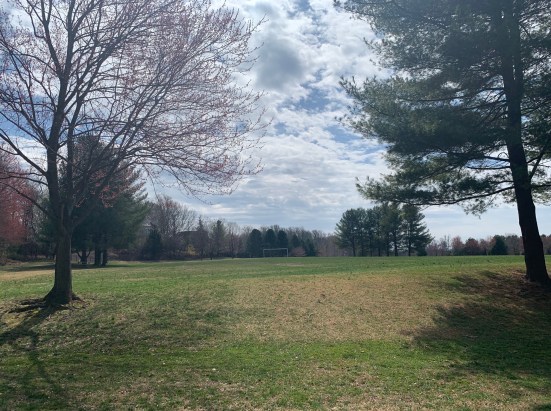
The squeeze on the drive is mostly psychological but you want to get enough carry to leave a short pitch from the pitch to the left post of the goal.  A bogey is a good possibility…thus the .2 increment from the analytic staff on the par.

#3 Par 3 65 yards (The Road Hole)
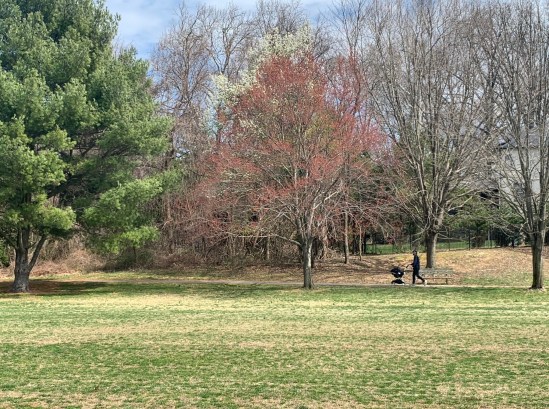
Like so many great links courses you need to remember this track is on public land so you have to share it’s access with parents with strollers, dogs on leads, power walkers, and lots of wildlife.  This is a short pitch at the base of the red flowering tree but care must be taken since the road lurks just beyond the tight green complex.

#4 Par 3.97 137 yards (Wide)
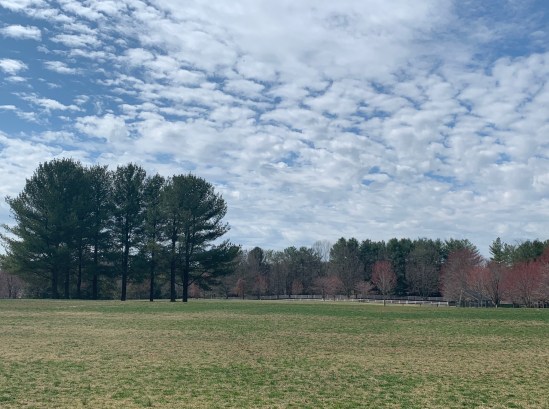
The driving area on this one is as wide as the wild blue yonder (shown) so just let out the shaft on the PW to lay up to the end of the fairway just right of the pines.  As you can see the approach is to a sand based complex that sits considerably below you with the pitching rubber as its target.
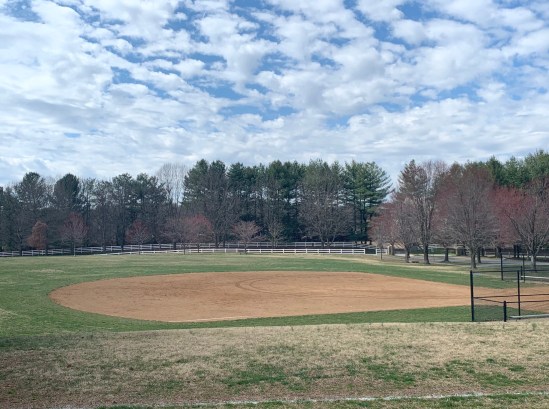
Hardest part is figuring the roll out once the ball lands on this very generous no-putt surface.  You might want to think about a two-bounce tight spinner.

#5 Par 3.8 120 yards (Power Alley)

The teeing ground is just off the Home dugout adjacent to the 4th green (brown actually) with the target just beyond the asphalt warning track in left center.  The second probably calls for a high flopper but getting within Double Leather for a birdie is a good possibility.

#6 Par 4.44 125 yards (Equestrian Jump)
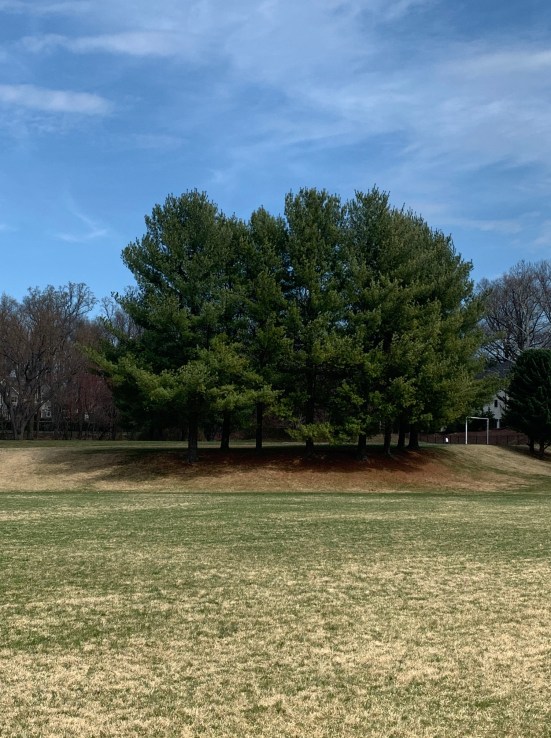
Huge risk-reward decision here in that the target is just on the other side of that hedge row of pines but if you fail to clear who knows how much pine sap will be on your ball and what tree root on which it will end up.  Alternative is to lay-up left of the pines leaving a back-door, steep elevation pitch into the pine straw complex.

#7 Par 4 101 yards (Alcove)

The view from this confined back tee gives the hole it’s moniker but it is the tight green complex just left of the pine stand on the right that creates the challenge.  The second is a short pitch but, like on #3, the road and a trash strewn penalty area lurk just behind which can catch an approach with overzealous intent.
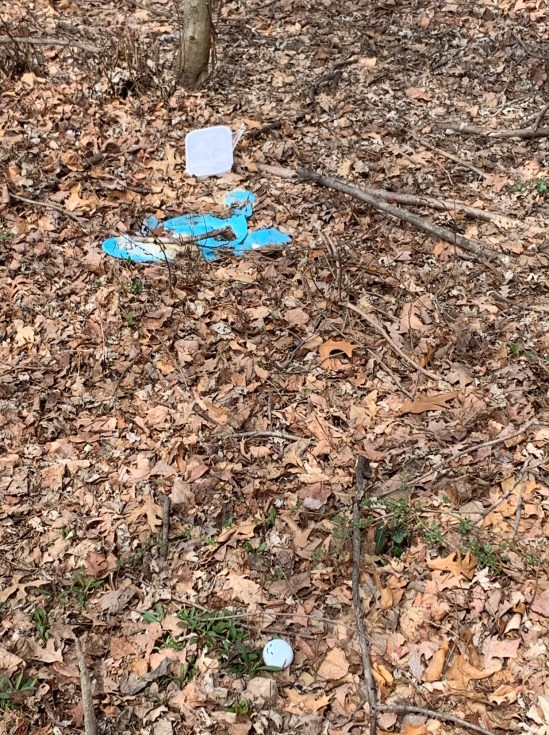
#8 Par 3.13 85 yards (Waste Management)
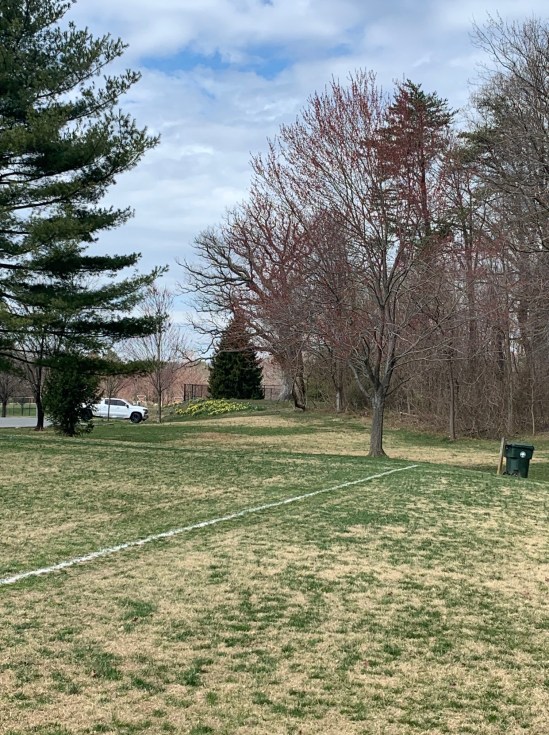
This is a very narrow approach that requires a high pitch with a parachute to fit into the right half of a double green wedged between the treed native area on the right and the bumper of the maintenance vehicle.
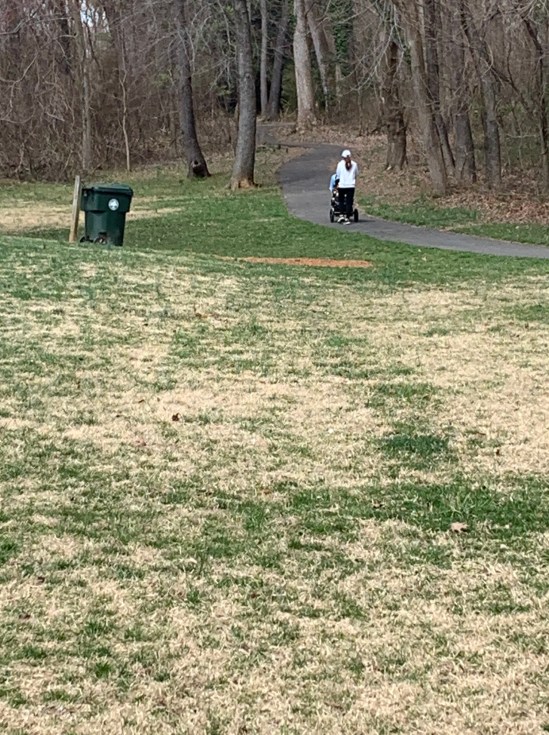
This part of the course is a bit of a bottleneck so you may have to wait for the group in front of you to clear the can and head for the next tee.

#9 Par 3.29 79 yards (Clown’s Mouth)
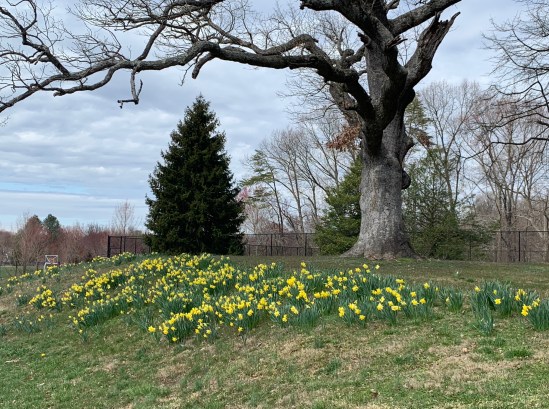
You can see by the daffodils and the spooky hardwood adorning the back tee box on the home hole that we spared no expense to create memorable ambiance for this classic track.
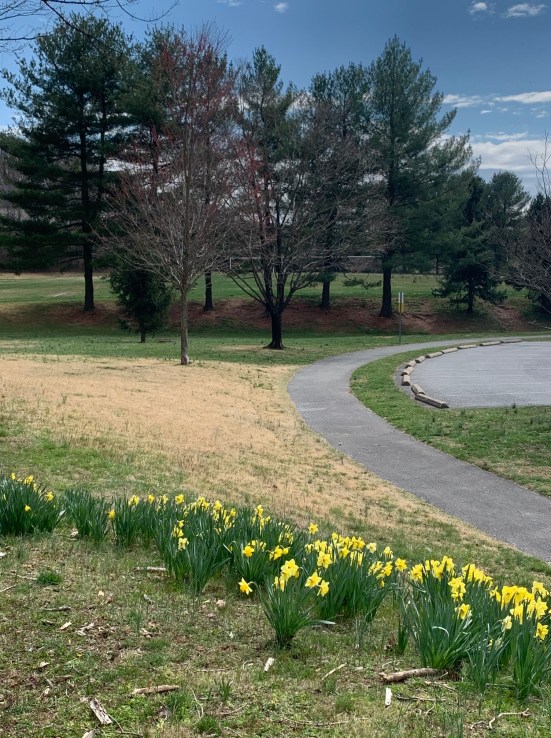
This one gets it’s name out of respect for a Mini-Golf Facility we used to play in those halcyon college days in College Park where the final shot required pitching the ball into gaping mouth of a circus entertainer.  Your target is the narrow opening between the tree and the No Parking sign adjacent to the OB parking lot on the right.  Take note that the hard scape runs diagonal to your target so anything wayward right could result in a big bounce into Sherwood Forest beyond which could end your day with a bad taste in your mouth.

All-in-all this stroll requires a little bit of golf acumen and a dose of self-delusion.  It reminds me that so often it is not the quality of the golf course that matters, it is the quality of the golf experience….and in this case that is totally in the mind of the beholder.

Potomac, Maryland (2020)

Trust

Trust the swing.

I can’t go to Havana or Japan and have a new swing.  I’ve got to have a swing that I’ve been using for a long time. As you start it, don’t anticipate where you’re going to let go; just let the swing do itself.

Quite trying to guide everything.

Jack Burke Jr.

The Golfer’s Journal (February 2020)

How A Senior Must Prepare For Golf

Swallow a couple of Bufferin against the old back injury…a swift application of some mild anaesthetic for the bothersome scar tissue from that old haemorrhoidectomy…clean the spectacles…rub a little resin on the last three fingers of the left hand.

Stand up straight-think of Raquel Welch (on second thoughts, don’t think of Raquel Welch)

Comb the hair smoothly and think of the swing of Dave Marr.

Walk very slowly, masterfully, to the first tee.

Put on the cap bought in Edinburgh and think of Hogan.

Stand up Straight.

Alistair Cooke


We-Ko-Pa Golf Club-Saguaro Course

In my experience when you venture out to play a Coore-Crenshaw course you are not likely to be bowled over by the dramatics of the design, rather you are going to be nudged and tugged by the subtlety of the presentation. Guys like this from what is now coined the “Minimalist School” impress you with their eyes not their shovels. It is the composition of the holes, what they saw in the ground and chose to draw out and emphasize, not manufactured features to stun your senses and distract your attention from the real task at hand.

The Saguaro Course at We-Ko-Pa is about flow and feel and how it engages your golf decision making while allowing you to appreciate the marvelous setting within which it lies. Driving up to this location from the flats of Scottsdale you realize that you are engaging the mountains not just seeing them as a backdrop canvas. Taking in the surroundings as you pull up to the clubhouse you sense that the topography will have influence on how the ball responds once on the ground, the minimalists will make sure of that, and so your strategic choices will require proper weight to consequence of one position or one route over another in playing each hole. As Ben said, “This old boney ground has some ‘sting’ to it” and they found it without having to produce a swarm to prove it.

The approach to the first melds a dry bed creek into the challenge

The width of the long Par 4 opening hole sets a tone for the day-you think you can hit it just about anywhere and have a look at the green. Yet as you can read in the hole-by-hole detail in the link below the shape of your tee ball can determine how to get up the fairway and give yourself the best approach line to a perched green complex still a ways away. Oh, did I mention they drew in a dry creek bed traversing the fairway which may put some doubt in your mind whether you can reach at all if you don’t hit the drive with enough intent.

The full flavor of Saguaro is revealed on the second tee-you figure out where to hit it!

Step on the tee of the quasi-drivable second and it is full desert static with scrub to carry off the tee and sand and more wilderness encroaching your playing path. Throw in a dramatic backdrop of an entire mountain range in the near distance and it becomes pretty hard just to sort out your choices for proper play. The course they present defies playing script or sequential rhythm. Each hole presents choices and requires your reaction. How you choose to react on one challenge drastically changes the next one.

A bit of superstition imposed upon the view of the Par 4 6th.

As you get into the middle of the outward half the topography gets more severe and the ground influence on your shot making grows accordingly. Now you feel the mountains start to hover above the course rather than just frame the target. The sixth is a good example of this, you drive from teeing pods set in the hill over a high ridge in the fairway that completely masks the landing area. Standing next to your tee ball in the fairway the influence of the promontory peak of Superstition Mountain just beyond the green complex is firmly in your mind before hitting the approach or making your first putt. The coolest part about this minimalist thing is that everything matters. If it comes into your minds eye then it is worth considering.

The roller coast ride on the Par 5 8th ends in this station

A fine sandwich with kettle chips awaits behind the 9th green.

Coming off the long and serpentine Par 5 eighth, the front side finishes with a short uphill pitch into a green with the playing width of a two-lane country road. The contrast in shots required in a two-hole stretch is not lost on those with proper awareness. Don’t miss the tuna or turkey sandwich with the home made kettle chips at the turn. It will refill the tank and make the challenges that come next all the more manageable.

The Par 3 15th, at well over 200 yards, adds to the challenge of the next stretch.

With only one five par on the inward half, three Par 4’s over 400 yards, and a one-shotter well over 200 yards the scoring opportunities will be few and far between. The stretch of big holes from twelve to fifteen give this side it’s distinct character.

The drive area on the 13th looks confined but it is really quite generous but precision is required to set up an aggressive approach to a minimalist green complex.

The back-to-back long Par 4’s at twelve and thirteen give you wide scale driving areas with greens with minimal bunker coverage. Yet both require precise driving to get the best angle to manage the long approach beyond the single greenside bunker. Good news is they provided wide expanses of short grass around these greens so recovery with a crafty short game can still keep par in play.

For architecture aficionados their tribute to the Lido Hole will feel quite familiar.

The closest thing to design shock is the view off the tee on Bill and Ben’s risk-and-reward testimony to the Lido Hole on the long Par 5 fourteenth. You are offered two different fairways to which to impart your drive-the narrow one on the right shortens the hole considerably so for the long baller this will be tempting. The more sensible play is a wide berth on the left fairway which will still leave you with two kitchy plays as the hole doglegs sharply to the right. Even a well place lay-up into the narrowing area at about 100 yards out leaves a very challenging pitch into a long and narrow putting surface perched in a corner to the right. Your plays on this hole will revisit you in bed at night between sheep counts.

The view down the 17th has a calming effect that you can certainly use at this point in the round.As you wend your way back to the house the short sixteenth will tempt your boldness off the tee but the best scores here are likely with a wedge and a putt. Seventeen is a serene tumbling affair, very soothing to the eye after all the mishugas of the last five holes. The home hole is a monstrously long Par 4 with a full desert buffet yet kindly it somehow plays much shorter and less harrowing than it appears from the tee.

My guess is you will agree agree with Ben’s sentiment when you are done.

As you settle in for an Arnold Palmer in the clubhouse bar after play you are going to be struck by how fatigued you are from the day’s golf decisions. There were no single challenges that seemed overwhelming but the relentless requirement to think two shots ahead has a way of wearing on you. Coore and Crenshaw’s design approach got this one right-they made a bold statement without raising their voices.


Fountain Hills, Arizona

Architects: Bill Coore-Ben Crenshaw ( 2006)

Par   Rating   Slope   Yardage
Saguaro     71       72       137       6966
Purple        71      70.2     132       6603
White         71      68.8     125       6252
Comp. (L)  71      72.0     128       5786

(Click to see the hole-by-hole detail of the We-Ko-Pa Saguaro Course)