Playing a round recently with members of the military I quickly came to understand that for the highest ranking officer in our group there was no time limit when searching for his ball.
October, 2012
Playing a round recently with members of the military I quickly came to understand that for the highest ranking officer in our group there was no time limit when searching for his ball.
October, 2012
One would think that recounting three days of Ryder Cup tweets would be a mundane read of fossilized observations. But this is Dan Jenkins and his observations are never mundane and usually prescient.
You will get a chuckle out of his time phase thoughts on subjects like club house architecture, fashion statements, game no-shows, play late-shows, production decisions, and other successes and failures.
(Click to read the Ryder Cup Tweets of Dan Jenkins)
Dan Jenkins
golfdigest.com
September, 2012
The colossal collapse of the American Ryder Cup team at Medina this weekend is wrought with all kinds of hubris. Down 10 to 6 going into the Sunday Singles the Europeans gathered themselves winning 8 of the 12 matches outright to snatch victory for the jaws defeat and return the Gold Cup to European soil for the next two years.
So many personal vignettes from this weekend-below are reflections on some of them.
Jose Maria Olazabal: A direct connection to Seve who remains the heart and spirit that drives the European Ryder Cup successes. Some delayed gratification to Jose for having to putt through the American footprints at Brookline in 1999.
Ian Poulter: The flashy duds are just a distraction. There is a heart of a champion burning in his chest and the Ryder Cup is a personal display case for this. He just cannot seem to hasten it in the Majors but maybe it is just a matter of time. In retrospect, Poulter’s late birdie run in the exhilarating comeback in Saturday afternoon’s four-ball match against Johnson and Dufner may have been the turning of the tide. Four wins this week and 12-3-0 overall in the Ryder Cup is an impressive resume.
Justin Rose: This man will win a major in the next 18 months. His gutsy performance making the par saving putt on 16 and the two daggers on 17 and 18 to pull out the seminal singles match against Phil should dispel the notion that Rose cannot putt when it matters. The bigger the stage, the more difficult the track the better this man performs.
Rory McIllroy: The yoke of #1 in the world can be heavy but he has proven time and again this season that he is strong enough to bear it’s burden. Besides the small matter of not being able to set his alarm clock for his Sunday appointment, at 23 years old he was a true leader for this team. He came through with Poulter on Saturday night and had a convincing win against Keegan on Sunday that helped right the European ship.
Sergio Garcia: He cannot ever make up for his perception as an underachiever because of his lack of a major victory, but the Ryder Cup has always been his forte. Teaming with Luke Donald they beat Tiger-Stricker in the other key Four-Ball match on Saturday and a gusty back nine performance Sunday outfitted Jim Furyk for the another goat costume in the singles. Sergio may not believe in himself but the Europeans sure believe in him and were sure glad to have him back on the team.
Luke Donald: May not be a true #1 in the world but you could see throughout this competition that his competitive grit and amazing short game make him a formidable foe. He surely silenced the babbling Bubba as the first match out this Sunday.
Nicolas Colsaerts: His 1 and 3 performance as a rookie was only so-so but an eight birdie-one eagle performance to single handedly beat Tiger Woods and Steve Stricker in the Friday Four Ball is a thing of Ryder Cup lore.
Martin Kaymer: Proof that, if you have the right stuff, you can 180 a bad career trend in one afternoon. His steely five-foot par putt on 18 against Stricker erased some bad German memories from the 1991 War By The Shore and put the Cup back in a first class trans Atlantic seat for the ride home.
____________________________________________________________
Davis Love III: He brought the right temperament to the U.S. squad to make these show ponies feel comfortable. Some will second guess a couple of line up moves but winning the first three sessions you have to think he put the Americans in a position to be successful. The abject failure of his hottest players to win a point in the first five matches on Sunday has to fall on the players not the coach.
Steve Stricker: Next time you see him at a team event he will be wearing an earplug as a captain’s assistant.
Tiger Woods: 1/2 a point contribution….really…you have to expect more from your top stallion no matter how poorly his support staff supports.
Zach Johnson: Testimony that it is not the size of the dog in the fight but the size of the fight in the dog that matters. His two wins with Dufner may have lacked sizzle but they helped build a formidable American advantage through two days. A sound drubbing of a struggling Graeme McDowell may have been one of the reasons that the competition came down to the last three games.
Keegan Bradley: The crazed look, the boundless reservoir of energy makes him the ultimate warrior to have with you in the fox hole. He single handedly revived Mickey’s Ryder Cup performance and that was no small order.
Phil Mickeson: In some ways he may be the greatest sportsman of this golf generation. There is so much Arnold fire and Nicklaus grace sewn into his competitive personality. Phil handled the Justin Rose onslaught on the final three holes of their singles match with dignity and aplomb worth sharing with your children.
Jason Dufner: We have to accept his flat line TV persona as a genetic given but he shown in this Ryder Cup that he has the fire and talent set to perform at the highest level in the biggest events. He, like Rose, will win a major in the next couple of years and maybe more than one.
Jim Furyk: Not withstanding the 5-hour Energy sponsorship, he is a tired figment of his former warrior self. It has been difficult to watch him be placed in the cross hairs at a major golf competition so many times this summer. Another one who may be better outfitted with a head set for the next international team competition.
In the end we have seen that the Ryder Cup remains a compelling piece of golf drama and that the Europeans continue to write the script. They have won five of the past six and, more than anything, this means that home court advantage for the Americans is just a figment of our imagination.
September, 2012
Check out indelible images of the Ryder Cup 2012 from Guardian UK
With the deluge of Golf Channel pre-game coverage for the 2012 Ryder Cup at Medinah this weekend our heads are bursting from pundit past analysis versus future predictions…..Brandel Chamblee alone has compiled an encyclopedia of data to justify any outcome you could possibly imagine.
Bottom line is that based on history alone the European Team has the advantage no matter what soil the matches are played on. It is going to take some very stellar team play, something the Americans have not proven to have an high aptitude for, by both veterans and rookies to bring this trophy by the American soil.
The secret weapon may be the putting of rookies like Sneds, Keegan, Webb, and Dufner. Making putts wins Ryder Cups.
Here is the skinny on the basic stats in the last 13 Ryder Cup Competitions between 1985 and 2010.
…………………….United States Europe…………………………..
Wins 4 8
Ties 1 1
Matches Won 142 175
Points Won 171 193
Foursomes Points 48.5 55.5
Four Ball Points 41.5 62.5
Singles Points 81 75
Besides the obvious that Europe in the Seve and After Era has dominated the results with a 66% winning percentage they have also won this thing three times on foreign soil. They can handle the partisan crowds. The Europeans have also won 56% of the matches outright which goes a long way to explaining the 22 points spread overall in the 13 appearances.
Maybe the most startling and unexpected difference is that the Euros have outscored the Americans by 21 points in Four Ball matches. It is not obvious why the Europeans would have an advantage in Best Ball matches, the likes of which they have played their entire competitive lives back to the cradle. Frank Nobilo’s theory is that the Americans do not communicate well with their partners and are not willing to defer their tactics to protect their partners in these matches.
The American’s 7 point edge in the Alternate Shot Foursomes is pretty hard to figure as well. I guess there is no deference required there, you just have to hit it where your partner put it.
The slight edge of 6 points in Singles makes sense because this is the least team oriented format and, if as so many of these pundits have posited, the Americans are more lone wolves than team players they would fare best in the format where they rely solely themselves only.
Brandel had one very interesting stat he shared the other night. According to him during this same period the team that won the first match in the first session won the Ryder Cup over 60% of the time. He said no other first match in any session had such a distinct correlation to overall outcome. I guess if I am Olazabal I am putting Rory and Graeme out in the first foursomes match on Friday morning. Not sure who the best duo for DL III would be under this theory.
One last thought. If the Americans fail once again to take back this piece of hardware home I think they should suggest changing the Ryder Cup format to a Golf-Ping Pong Biathlon. According to this article, Matt Kuchar could be the Roger Federer of table tennis and Mickelson and Tiger are plus fours and would be a formidable combination in the Ping Pong Foursomes.
September, 2012
With the Ryder Cup on our golf radar screens this week Golf Channel is airing a documentary on the most memorable and infamous edition of the Ryder Cup played at Kiawah Island in 1991. It was captioned by the American promoters at the time as “The War By The Shore”. You can read in the attached article by John Garrity, who covered this event for Sports Illustrated in 1991, that in spite of what many feel was the most compelling golf competition ever played it had a dark side to it that hangs in the air like a bad pail odor.
Garrity says in his recollections, “The ‘91 Ryder Cup stoked the competitive fervor…well beyond the norms for athletic rivalry….The opening ceremonies were a paean to the American War Machine…The European golfers, watching from the stage, looked like Soviet dissidents forced to witness a Mayday parade of weaponry in Red Square”. “Once play got underway, the two sides went at each other with uncharacteristic fury.” “But mostly I remember the fear, I had seen nervous golfer’s before, but nothing like the boys of Kiawah Island. European dominance of the Cup had turned the matches into a test of national character, and it was a test that even the best players approached with resentment and anxiety”.
The excessive behavior was not limited to the participants, the fans from both sides displayed rowdy partisanship that was akin to an acrimonious soccer match between sectarian rivals not a golf competition between friendly allies. Unfortunately this behavior carried on for years on both sides of the Atlantic and many players were subject to personal verbal abuse at the Ryder Cup and other major competitions.
I distinctly remember watching this competition and sharing Garrity’s basic sentiment, I was appalled at what I witnessed. It seemed to me that all the vulgarity that was overwhelming professional tennis at the time had finally spilled over into what had been previously a dignified sanctum. For me the fault laid at the feet of the prime protagonists in 1991, Dave Stockton the intense American Captain and Seve Ballesteros, of blessed memory, whose tenacity and competitive drive had reignited the fortunes of the European Ryder Cup team through the 1980’s. The characterization of the competition as a war fostered a contentious atmosphere of winning at any cost, without regard to the collateral effect of those costs. It made for some unbelievable golf drama, but not without it’s very ugly moments.
I watched this documentary by Ross Greenburg which used original TV footage and interviews with the participants to do an admirable job presenting the event very much as it went down. It was great to see the compelling golf performances but there were once again moments when I cringed and shook my head wondering “what were they thinking” when they behaved like that.
It has taken over 20 years for The Ryder Cup to get back a semblance of it’s dignity and it’s stature as a fairly played international sporting competition. Jack Nicklaus once said that the thing he loved about golf is that you could spend four hours on the course trying to beat the brains out of the competition and then wrap your arm around the other guy’s shoulder afterward and have a beer together to recount how much you enjoyed the game. It is my hope that what we will witness at this year’s Ryder Cup at Medinah will move this event closer to that norm.
(Click to read John Garrity’s recounting of the ‘War By The Shore’)
September, 2012


Brandt Snedeker controlled his own destiny going into the final stage of the PGA Tour Playoffs and proved up to the task on Sunday shooting a 2-under par 68 on his way to winning the Tour Championship and the Fed Ex Cup for 2012.
You can relive the final round below, just like the Post Game on Golf Channel but without the sophomoric blabber of Rich Lerner, Charlie Rymer, and Brandel Chamblee.
______________________________________________________________________________
Thursday September 20th before round 1
Fed Ex Kup Standings:
1st Rory McIllroy
2nd Tiger Woods
3rd Nick Watney
4th Phil Mickelson
5th Brandt Snedeker
All five can determine their own fate. Win the Tour Championship they win the FedEx Cup and all the semolians. For Rory it would sear his brand on the #1 World Ranking. For Tiger it would be his fourth win of the year and put him back in the discussion as Player of The Year. This opportunity frames the hot new Rory-Tiger rivalry that has developed since the PGA Championship at Kiawah.
______________________________________________________________________________
Sunday 1:00 PM before leaders tee off
Tour Championship Standings:
1st Brandt Snedeker -8 Justin Rose -8
3rd Ryan Moore -6
4th Rory McIlroy -5 Bubba Watson -5 Jim Furyk -5
Snedeker has the most to gain with this win. A quasi-major in the Tour Championship and a super major in the FedEx Cup and over $11,400,000 in cash would certainly change his life.
For Rose and Moore 24th and 28th respectively in the Fed Ex Standings at the beginning of the week the win of the Tour Championship would be a prestigious feather in their career cap and about $1.4 million in their bank accounts. But they would need serious help to repeat Bill Haas’s accomplishment of stealing the cup from the bottom quartile. It seems unlikely that McIllroy and Woods will both fall far enough from grace to give them a shot at the Overnight Delivery Grand Prize.
As this day has begun it looks like Mickelson and Watney are no threat to McIllroy. It is only Eldrick and Sneds that have Rory’s attention at this point. Pretty confident that McIlroy is only seriously worried about the man in the red shirt.
______________________________________________________________________________
Sunday 3:30 PM leaders thru #8
Tour Championship Standings:
1st Brandt Snedeker -8
2nd Justin Rose -6
3rd Ryan Moore -6
4th Jim Furyk -5
5th Bubba Watson -4
After an early birdie got him to 10 under Sneds had his first hiccup with a nervous double bogie on six he looks shaken going to the seventh tee.
A great bounce back birdie for Snedeker on 8 asserting the long putting prowess that has buffeted him all week. Justin Rose has struggled with two bogies so far but made a nice par save on the same hole to stay in touch with Snedeker.
Got to marvel at Ryan Moore handling this pressure. With great focus he is finding fairways and greens. So far the hole has been about 1/2 an inch too narrow to grace him with the birdies he has deserved with his aggressive putting. But he is not going away.
At this point, McIllroy and Woods are both 4 over through the first seven and in a tandem nose dive to 11th and 14th respectively. Not the start of the compelling duel between them that Tim Finchem was hoping for.
______________________________________________________________________________
Sunday 4:00 PM leaders thru #10
Tour Championship Standings:
1st Brandt Snedeker -8
2nd Ryan Moore -7
3rd Justin Rose -6
4th Jim Furyk -5
5th Bubba Watson -4 Webb Simpson -4 Luke Donald -4
The pressure is starting to take it’s toll across the field. Rose has had a number of chances to close the gap with some terrific iron play but his putter has lacked sufficient enthusiasm to cash in.
Moore just made a long birdie putt on the par three 11th to close within one shot. But Snedeker answered with a clutch sand save on 10 right behind him-he is giving no quarter.
Jim Furyk is parring the course to death through the first 12 holes but him making pars does not make up any ground.
McIllroy finally made a birdie on 12 to stop the hemorhaging and settle back to 2 under. Unlike the first three days, he looks uncomfortable out there, his distance and towardness control into the greens is sketchy and the ball on the green does not seem to have eyes for the cup.
______________________________________________________________________________
Sunday 4:40 PM leaders thru #13
Tour Championship Standings:
1st Brandt Snedeker -9
2nd Ryan Moore -8
3rd Justin Rose -7
4th Luke Donald -5 Webb Simpson -5
6th Bubba Watson -4 Jim Furyk -4
Luke Donald is proving he is still one of the best in the world on the greens. With five birdies through 16 holes….only three bogies has kept him from from seriously threatening the lead.
Dustin Johnson has not been a factor. He did show a momentary spark with an eagle on 15 after knocking it in close and made a birdie on the tough 17th with a long range bomb from way uptown. But gave most of it back with bogies on 16 and 18.
Webb Simpson still has bad memories of blowing out all four tires in last year’s Tour Championship and setting up Bill Haas’s unlikely come from the oblivion win in the Fed Ex Cup. His play today provides some redemption. Five birdies, including one on the tough par three finishing hole, earned him a 66, tie for the low round of the day, and moves up to 4th in the Tour Championship.
Once again Sneds long putting is proving to be his own best friend making another improbable one for birdie on the 13th to assert his advantage back to two shots.
Ryan Moore is one cool cucumber with that smooth unorthodox swing and those unorthodox True Linkswear shoes. He has shown his ability to cope with the challenge burying a long one on 14 to get back to within one and take over second alone at 8 under.
It is likely that scoring opportunities on the par five 15th will be pivotal for guys who are chasing. Hitting the fairway on the water confined 17th and showing respect for the difficult pin placements on 17 and 18 will be crucial for the leaders trying to avoid a train wreck that could decide this championship.
______________________________________________________________________________
Sunday 5:10 PM leaders thru #15
Tour Championship Standings:
1st Brandt Snedeker -10
2nd Ryan Moore -9
3rd Justin Rose -8
4th Luke Donald -6
5th Webb Simpson -5 Bubba Watson -5
A shout out for the Tour’s tribute to the military on the 16th hole where every player walking off the green has the opportunity to shake the hands of active military personnel and thank them for their contribution to the freedom’s we enjoy.
As predicted Moore carded a second consecutive birdie on the pivotal 15th, chasing a hybrid approach just past the hole and getting up and down from behind the flag for a four. This threw down the gauntlet putting him into a tie at the top of the leader board at 9 under.
But Sneds answered the challenge hitting the green in two and lagging it for a tap in birdie to get the lead back alone at 10 under.
Rose had a little magic of his own with a sand save birdie from the front bunker on 15 to stay within two.
One last bit of heroics for Luke-he hits it to 10 feet of the phone booth pin placement on the finishing par three and buries it for one more birdie to shoot 67 and take fourth alone at this six under.
______________________________________________________________________________
Sunday 5:45 PM-The Finish
Tour Championship Final Standings:
1st Brandt Snedeker -10
2nd Justin Rose -7
3rd Luke Donald -6 Ryan Moore -6
5th Webb Simpson -5 Bubba Watson -5
Fed Ex Cup Final Standings:
1st Brandt Snedeker 2nd Rory McIllroy 3rd Tiger Woods
Tiger reclaimed a little bit of the red hue in his Sunday shirt hitting it stiff on 18 and sending the green side crowd into a momentary delirium as he had a tap in birdie to end his day. Mission not accomplished, his two over 72 did not do much to improve his position in this championship, the FedEx Standing, or the Woods-McIllroy Rivalry.
Rory never had it together today with three bogies and a double ending the day with a lackluster four over 74. Because of the reset bias from winning two previous playoff events he still finished second in the Final Fed Ex standing.
In a quaint memory moment, Furyk had the identical bunker shot up and down on 18 that won him the Tour Championship and Fed Ex Cup in the rain two years ago. But his two over score left him high and dry today.
Bubba Watson made a scintillating birdie on 17 but hit the green side bunker going for the flag on 18 resulting in his fourth bogey to go with his four birdies. Result was he treaded water at five under for fifth place in the championship.
In a sharp reversal of fortune down the stretch, Ryan Moore squandered his chance with back-to-back-to-back bogies on 16, 17, and 18 getting out of position and missing all three greens. Ends up T-3 with Looooook.
In retrospect it was apparent from the start that today was to be Snedeker’s coronation as a deserving champion of both the Tour Championship and the Fed Ex Cup. The bounces went his way right to the end. He banked his drive off the hospitality tents next to the driving area on 17 and then cleared the front bunker by two feet on his approach into the green. He proceeded to replicate his hero Tom Watson’s accomplishment holing a short pitch for birdie on the 71st hole to seal the victory. A safe bogey on the finishing hole and he had his arms around both trophies and a pile of cash.
______________________________________________________________________________
Snedeker’s stats for the week tell it all.
Number one in Birdies.
Number one in Strokes Gained Putting.
Number two in Putts Per Round.
Number three in Putts on Greens in Regulation.
Second in Fairways Hit.
Seventh in Greens In Regulation.
He only missed one putt from 8 feet or in all week.
That will get it done.
September, 2012
(For more background on Sneds read moegolf’s posting earlier this year)
 Coore and Crenshaw may have had the hardest task at Bandon being asked to bring a third course on line following the accolade and fanfare the two spectacular links courses Bandon Dunes and Pacific Dunes had received. The rugged terrain they were working with was much more challenging with distinct elements of sand dunes, grassy meadows, and dense forests. It was going to be a monumental task to deliver 18 walkable holes with unified character and natural flow.
These guys are key protagonists in the “minimalist” approach to course design that seems to be pervasive today. Their goal is not to move a bunch of dirt to create holes with a signature Coore-Crenshaw look but rather to discover holes that nature has lurking in the existing terrain. As Coore says in the book Dream Golf, “We don’t want our holes to look like golf holes…they should look like landscapes which just happen to include a golf hole”. Their approach to designing Bandon Trails was to spend endless hours walking the ground learning the site discussing all the possibilities as they enticed these holes to reveal themselves. The result is a cohesive presentation of unique and challenging holes distinctly different than their links cousins but just as enthralling.

The first would feel right at home at Enniscrone or Waterville in Ireland
(Click on any picture to get an enhanced view of the image)
The first hole is a classic links presentation with the tee looking out over a range of sea grass covered sand dunes that barely reveal a path for a golf hole. This is a bit of a design feint since you won’t really see this again until the final hole of the day. A fairway club with the correct shot shape will search out a path between the massive dunes leaving you a short pitch up to a long and narrow green wedged into the dunes above.
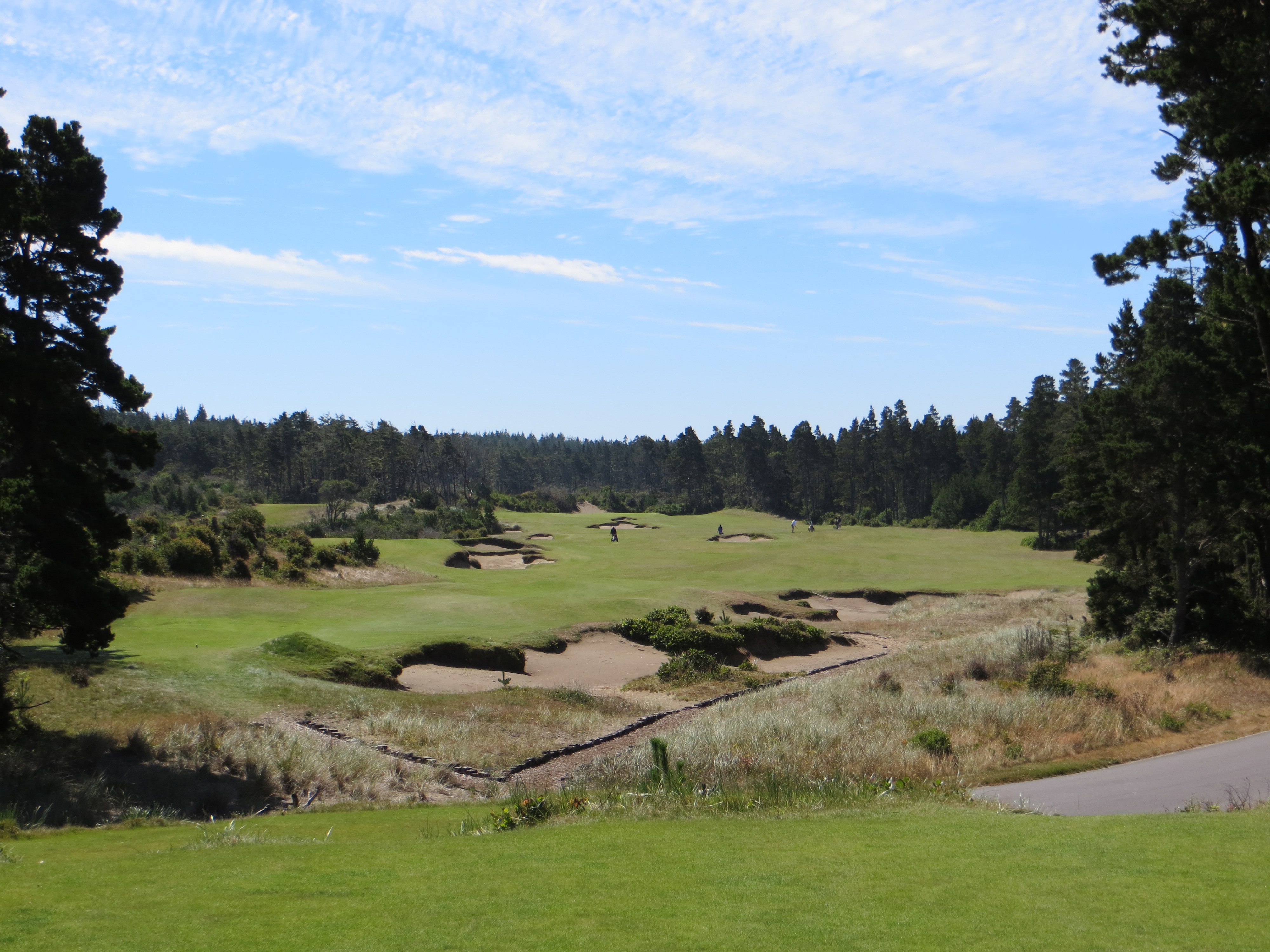
The full Pine Barrens look unfolds across the meadow on #3
As you come off the first green to the second tee the look transitions quickly from links to sand barrens as you are descending into the meadow. The next five holes would feel right at home at Fazio’s Pine Barrens course at World Woods as they are characterized by the meadow’s more subtle elevation changes, plentiful waste areas and penal blow-out bunkers, and a blend of fir and spruce trees, native vegetation, and sandy soil. Thoughtful navigation of these holes is required because the arrays of sand hazards must be avoided and the rolling contour of the firm fairways will make that a challenge. The third and fourth holes meander across the meadow with the sand and mounds giving you alternative routes to play depending on the wind effect and the pin positions. The par three fifth hole composes all of the elements in a jaw dropping Kodak moment that will take your breath away. The hole has a picket fence made of old tree branches in front of the tee and behind the green an indigenous accent used repeatedly throughout the course.

At #7 the ascent into the enchanted forest begins
At the seventh you are leaving the meadow and about to begin scaling the most rugged terrain of the course. The addition of elevation change to club selection will up the shot values from here out. The climb begins with a severe uphill par four that is the number one handicap hole on the course. Transition on this hole is so abrupt that the greenside bunker that has a two-club elevation change of it’s own.
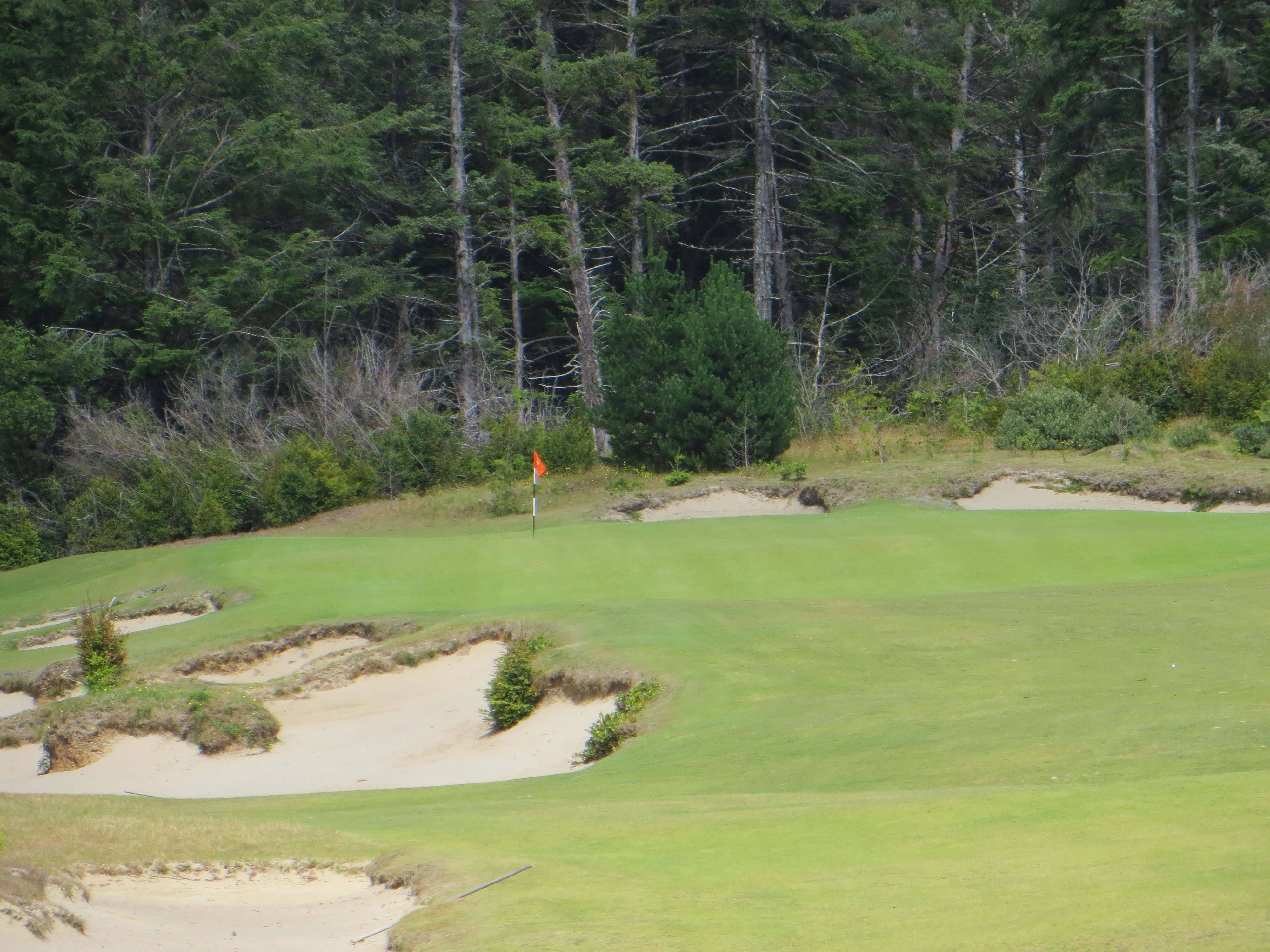
With a solid plan well executed you can avoid the awaiting trouble on #8
A technical test is next in a short, possibly drivable par four-a tight rope walk across a ridge with serious bunkering waiting to gather a shot without proper conviction. Lots of choices on how to play this one, it can be a scoring opportunity providing you plan wisely and execute accordingly.
The ascent to the top of the property resumes as you play a very engaging ramped par five to end the front nine. They used uphill to mask the generosity of the landing areas on each shot. This hole has a links feature you see throughout the course in that this green just seems to emanate from the fairway with little texture demarcation, This provides a very hazy frame of reference for approach and recovery shots. As you saw on the links courses use of your putter from well off the green can be a valuable tool when approaching a short side pin.
My conviction is that what makes this such a difficult course is controlling your roll outs due to the combination of the firm fairways and the downhill landing areas. The problems presented by the through space on the drive and approach on ten are good examples of this. You must shape your shot to move away from the waste areas or else the downhill roll out will bring them into play. The eleventh is an imaginative natural rolling par four that scurries up and over the existing fall of the land. All they had to do was mow some grass for the tees and green, nature had already done the rest.

The natural beauty of the setbacks frame the experience
In this middle section of the course there is dramatic scale created by the backdrops of dense hardwood trees perched on the rugged hills. Add to it the aromatic smell of the forest and a bold dash of blue sky above and it will captivate all your senses as you contemplate the shots to be played. At this point in the round you are as aware of the nature walk you are enjoying as the golf challenge you are experiencing.
From the thirteenth tee to the final green you are going to play a unique array of challenging holes traversing some of the most rugged terrain in Bandon. On the tee of the par four thirteenth you feel like you are standing in your socks at the top of a playground sliding board-good luck staying on your feet on any shot on this hole. The green itself is like a bikini waxed tortoise shell-getting the simplest pitch shot to remain where it lands is quite a chore.

The slippery topography on #13 makes controlling your result very difficult
It is such a severe transition from the thirteenth green to the Kitzbuhel starter’s gate that serves as the next tee box that they have to provide you an automated ride. The fourthteenth is a very enticing short par four where the effective landing area for your tee shot is the size of a picnic blanket. From the perfect landing spot the pitch required is very precise. The green is the shape of a size nine left orthotic insert and the surface available is not much bigger.
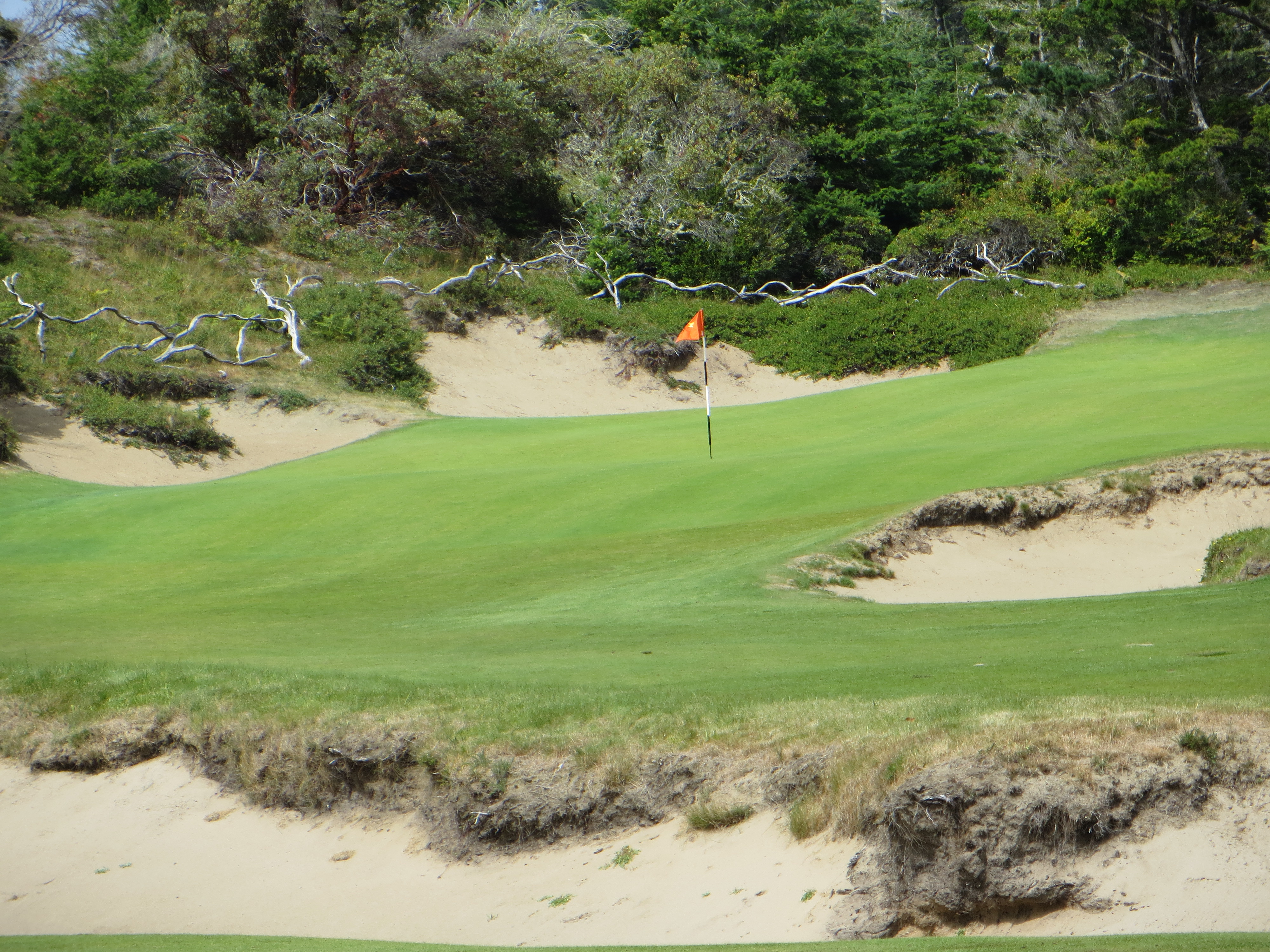
The green complexes like #15 put real pressure on where your approach ends
Fifteen is a quasi-breather because the landing area is sufficiently generous to fool you into believing this is an easy hole. But the second shot is to a raised narrow green set in a tight alcove of sand and furry growth. The shot demands the utmost accuracy to keep the ball under the hole and avoid a sure three-putt.
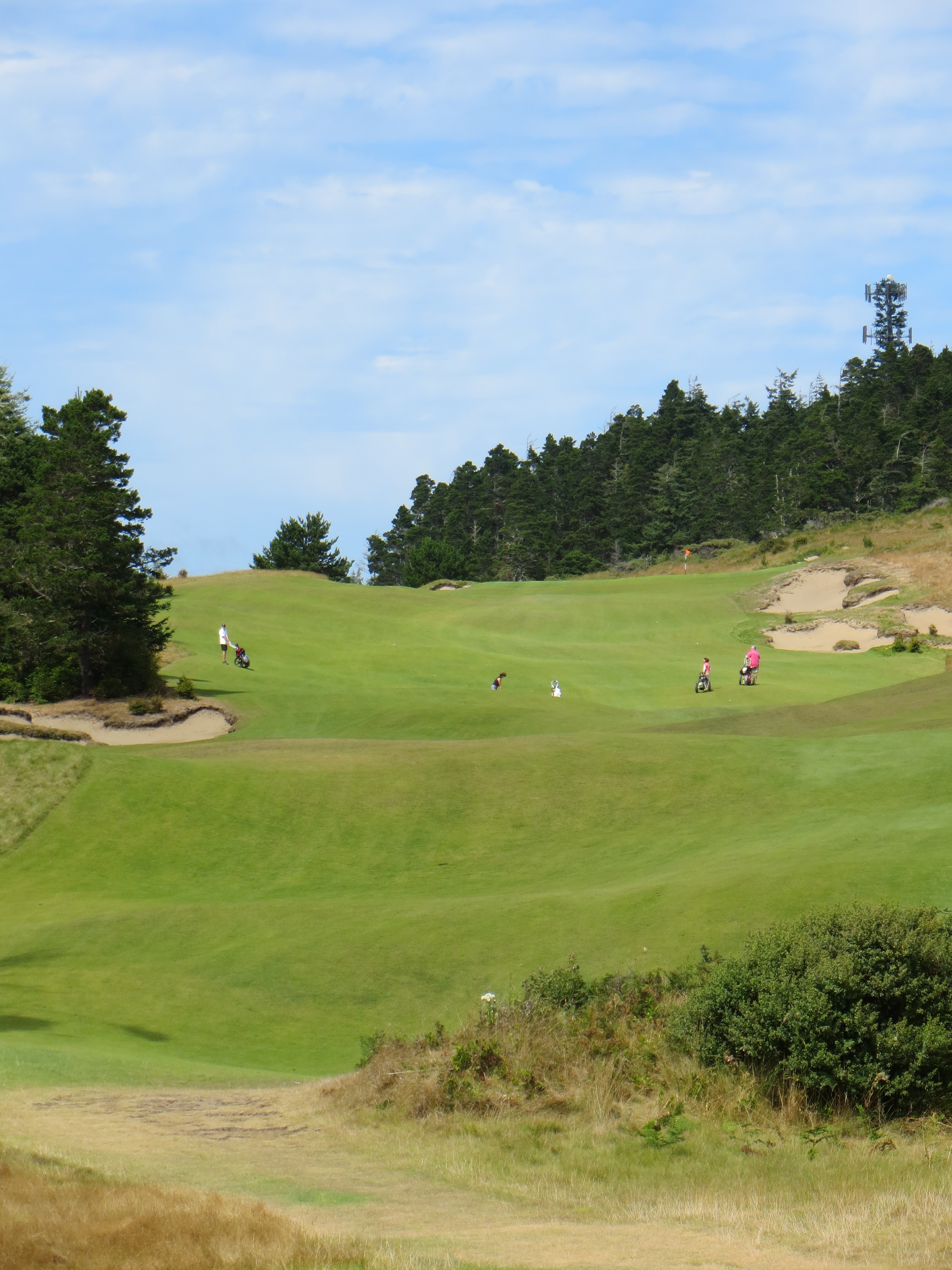
Cannot help but be overwelmed by the scale of the climb on #16
Standing on the sixteenth tee you have a sense of what it is like to be a window washer on the Empire State Building. You are looking straight up the face of a fairway incline that looks like it will not hold your ball much less your full body weight. Add a prevailing wind in your face and you have the full Chinese death march par five experience ahead of you. The good news is the ball seems to not only hold on the steep incline, but with the firm fairway, it actually bounces forward way more than you expect. The green sits exposed on another high point on the property so the real challenge here is getting an approach shot to hold on a firm windswept green and then two-putt on the way out of Dodge.

The devil is in the details at the visual par 3 17th
The par three seventeenth is the most photographed holes on Bandon Trails. Much like the postcard three par you saw on number five, which just so happens to be about 30 yards to your left, this one is pure eye candy. But beware this is an unwrapped Halloween treat tinged with a little of the wicked witch’s juice so prepare to be challenged. You are playing a short shot across an environmental divide to another tortoise shell green wedged between some very unforgiving bunkers. Good news is they gave you a chipping area long and right. Bad news is the recovery shots from there are as difficult as from the unforgiving bunkers. If they offer you a bogey and a free pass to the eighteenth tee I would take it.
You are now transitioning rapidly out of the sand barrens to the links motif you started with four hours ago. Much like number one, the Trail ends with a finishing par four that is links golf from tee to green. The tee shot is a blind carry over a massive hill to an undulating landing hollow below and to the left. From there you have a three story short iron to a long and narrow green draped across a plateau adjacent to the clubhouse. This green is exposed to the Pacific winds and will be firm and fast so figure out a way to keep your approach in front of the flag you can barely see.

The final perch…where does the fairway end and the green begin?
Once you have putted out do a 180 and appreciate the stunning view back down this last hole and of the tree laden hills beyond. It should occur to you what a remarkable achievement it was that Coore and Crenshaw composed such a dramatic and playable golf course on this rugged and diverse terrain.
Bandon, Oregon
Architect: Bill Coore/Ben Crenshaw (2005)
Tee Par Rating Slope Yardage
Black 71 73.7 133 6765
Green 71 71.1 129 6260
Orange 71 70.8 122 5064
(Click here to review Bandon Trails Golf Course hole-by-hole descriptions)
For more Bandon Trails images click to see Postcard From Bandon Trails-Day 2.
 The Ricoh Women’s British Open proved to be a pure test of will against the elements of nasty weather on the western coast of England at Royal Liverpool Golf Club. Winds gusting to 50 m.p.h. forced cancellation of the second round of the year’s final major on Friday and set the table for a grueling 36 hole finish on Sunday for the championship. The weather for the morning 18 was good, but during the lunch break a meteorological hell broke loose and the final 18 would turn umbrellas inside-out and make finding fairways and greens a very stern task.
Jiyai Shin shot 64-71 on Saturday and Sunday morning to take a commanding lead at 10 under going into the final loop. With a triple bogey on the first hole in the final round it looked like it could be anybody’s ball game. But all the chasers were having their own lorry wrecks as the sideways rain and the gusting winds wreaked havoc on their scorecards. Continuing her fabulous play the last two weeks, Shin settled down and played steady golf in weather that could have parted the Red Sea. She made five birdies over the next 17 holes to post 9-under and win the championship rowing away.
Shin won this same major at Sunningdale in 2008 as a 21 year-old LPGA rookie. She is currently the hottest player on the LPGA Tour. Between her 9-playoff hole win at Kingsmill last week and this performance at the British she is 25 under par the last two weeks on tour. Shin is no stranger to the winner’s circle having 10 wins on the LPGA Tour and 38 tournament wins world wide.
The young 15-year amateur phenom Lydia Ko from New Zealand continued to impress the professionals winning low amateur in this major to go along with the same honor she earned in the U.S. Women’s Open. With her performance this week Ko, who won the Canadian Open a few weeks ago against a very strong field, showed she has the mettle to perform in the most challenging conditions.
This win perpetuates the dominating trend of Asian born players on the LPGA circuit. Women from the Pacific Rim have won all four majors this year and the last seven going back to 2011. South Korea’s Sun Young Yoo won the Kraft-Nabisco, China’s Shanshan Feng the LPGA Championship, and South Korea’s Na Yeon Choi the U.S. Women’s Open in 2012.
Watching her poise in the adverse conditions faced at Royal Liverpool today had a Darwinian feel to it and speaks volumes to Shin’s resolve to become the next force in women’s golf. Another win before the season ending CME Group Titleholders and Jiyai Shin could be challenging Yani Tseng for that Rolex #1.
September, 2012
“I had trouble getting the butterflies to fly in formation.”
On his nerves while playing in a final group for the first time on the PGA Tour.
William McGirt-PGA Pro
Golf Magazine
September, 2012
 Bandon Dunes was the first of the links courses Mike Keiser envisioned for this dreamy piece of coastline in Southern Oregon. His strategy from the outset was to introduce real links golf to America where it was all about walking the course, dealing with the elements, and playing golf close to the ground. All the trappings of the resort are simple and understated, he intended to let the courses speak for themselves in the pure language of golf that he experienced in Scotland and Ireland.

The Lodge quietly overlooks the opening and finishing holes.
His idea was to hire a young talent with a knowledge of links design who was not famous enough yet to ignore his suggestions. Fortunately, as you can read in the book Dream Golf-The Making of Bandon Dunes, Keiser spent years studying links courses all over the world so his opinions were worth taking into consideration. David Kidd was a twenty-something Scotsman with little design experience, the son of Jimmy Kidd who himself was a bit of a force in Scottish golf as the head caretaker at Gleneagles one of the most fabled resorts in Scotland. As with so much that has gone down in the development of Bandon Dunes, it was just Keiser’s gut feelings that told him David Kidd was the man for this job.
The landscape canvas Kidd had to work with at Bandon was smothered in gorse, a wiry sticker bush that is native to the British Isles. Gorse harbors the ultimately unplayable lie and is the signature element of the links courses of Scotland. The fact that it existed at all in this remote corner of Oregon was the result of a seemingly arbitrary act of an Irishman who settled in this area in 1875 and introduced the plant. Gorse flourishes like a weed and it quickly came to cover the sand dunes and gorges throughout Bandon. The gorse provided a unique opportunity to chisel a true links course out of the palisades of this seaside terrain and have it retain an aura of Scotland unfamiliar in this part of the world.

A full array of links elements are present on the par 3 second hole.
(Click on any picture to get an enhanced view of the image)
What Kidd produced was the perfect introduction to links golf in America. The Bandon Dunes Golf Course has it all-firm sandy turf for hard and fast fairways, gorse and sea grass covered sand dunes through which to wend holes, natural blow-out bunkers created by the elements pepper fairways and green complexes, stunning cliff-side exposure to the Pacific Ocean for visual drama, and, of course, plenty of seaside wind to validate the links style of golf most suited for the sum of those parts. To look at what he created it belies his prior lack of experience in links design and confirms Keiser’s feeling that a Scotsman brought up in a family where links course care and maintenance were the topic of conversation at the dinner table every night would be the right man to figure out how to draw eighteen unique and genuine links holes out of this coastland.
The course begins benignly enough from a tee box in front of the viewing windows of the Lodge. A wide and inviting driving area masks the importance of picking a very particular landing area for the best look at a very severe green complex you cannot see from the tee. This is a theme that is repeated throughout, very accurate driving lines, particular to the tee marker you are playing from and the wind direction and velocity of the day, is a must to having good chances to hit greens in regulation and putt for pars. This is why your caddie counsel is crucial to success on all of the Bandon courses-you need local knowledge even the first time you walk these links.
The opening stanza of the first three holes is just a warm up for what is to come-he gives you a chance to find a swing and start to understand the bounce of the turf and the effect of the wind. After you chase down your drive on the fourth hole you turn the corner and get your first jaw dropping view of the Pacific framing this green. Your first reminder that this is links golf is in this approach shot. Links Rule Number 1- the ground is your friend and a low pitch and run into a tight green complex minimizes the influence of the wind and improves your odds of getting it close.

The first ‘Wow’ of the day is the view of the fourth green against the Pacific.
The next two holes turn to the North into the prevailing breeze and now trajectory control on all shots becomes paramount. Your second shot into number five is a classic links look through a hallway created by ridges of sea grass laden dunes on either side to an alcove green set against a gorse covered back drop. Yes Dorothy, you are now in Scotland. What follows is the first of a seemingly endless number of dramatic seaside par threes on these courses that are suspended over the Pacific. You will find that measured distance means nothing at Bandon-effective distance is what you must determine. Links Rule Number 2-a one club wind on the inland holes becomes a two to three club wind on those holes exposed to the beach.
Seven to nine turn inland but they do not provide much of a breather. Kidd used the rippled and rolling topography to create wonderful elevation change and roll out puzzles to solve on each approach shot. One of the real challenges he presents is trying to determine just where the fairway ends and the putting surface begins on these green complexes. The grasses used for fairway and greens are so similar and kept tightly mown that you almost get no visual distinction between them. The good news about that is that without much transition you can often putt from 20 to 50 yards from a hole position. This is a very valuable arrow to have in your quiver instead of a pitch especially downwind or if you short side yourself on the approach. Links Rule Number 3-you can putt from anywhere.
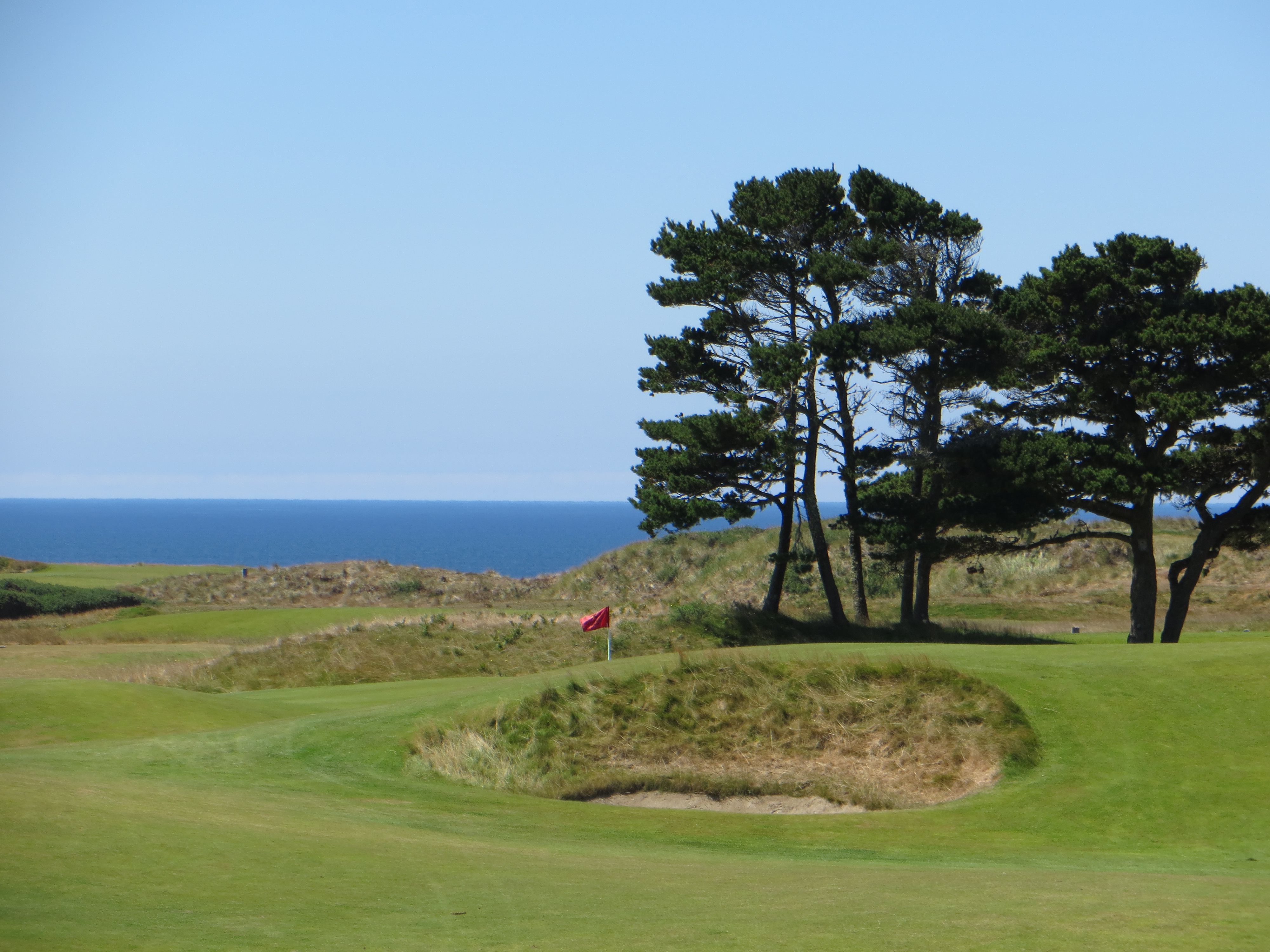
At the 10th your driving strategy must account for the blind access to the green.
The inward nine begins the march back to the sea with a funky links hole that will blow your mind. Another wide open driving area that demands a precise decision to place your ball in a position to negotiate the blind approach to the green created by a giant mound about 50 yards short of the green. This hole reiterates Links Rule Number 4-measured distance on the scorecard tells you nothing about your likeliness of making a par.
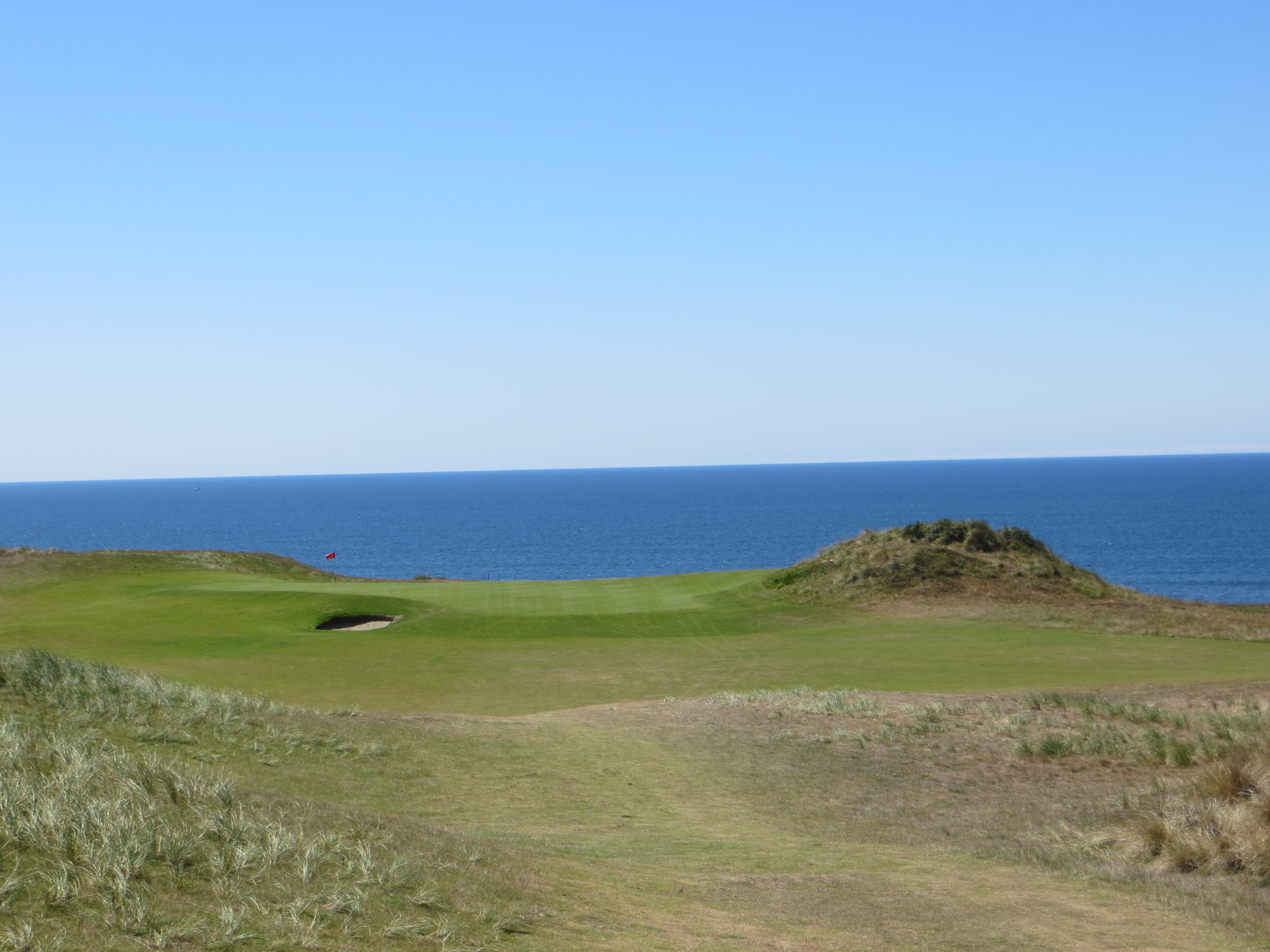
Don’t be fooled by the visual serenity of the par 3 twelfth.
The twelfth hole is probably the most photogenic of all the three pars on the grounds. It is innocuous enough looking from the elevated tee with the green sprawled across a mound wrapping around a sod-wall bunker and framed by a tufted muffin dune on the right and a small wall of dunes on the left. Oh, did I mention that there is this ocean that dominates the rest of the horizon. The shot required from about 150 yards here will take all your guile and talent to pull off. The best shot is an Irish knock down draw that starts at the front right edge of the green and uses the curve and contour of the putting surface to feed to the pin. Links Rule Number 5-the best shot path is often not directly at your target. Using ground contour and roll out in a diversionary approach to your destination is often the preferred route.
Kidd takes you away from the sea for two holes to catch your breath like he did on the front but is setting you up for the crescendo, a finish that will dominate your thoughts well past dinner. The fifteenth is a marvelous par three, not dissimilar to number six but with a little less visible exposure to the ocean. When you walk around the dune behind this green to the sixteenth tee prepare to be wowed…..let me take that back…prepare to be overwhelmed by the distracting coastline vista that dominates the next hole.

Shock and Awe from the 16th Tee-click to enlarge the awe (photo courtesy of Les Samuels)
From the tee on sixteen you look across a rocky gorge at a split fairway created by a furry bunker laden ridge that bisects the landing area. You likely have a wind aided drive so the upper (and desired) fairway is well within reach. Links Rule Number 6-the actual size of the challenge is often disproportionate to it’s appearance. As it says on your side view mirror, things are often closer than they appear. If you hit a soaring tee ball to the upper fairway the walk up that ridge to rediscover your ball is very pleasing indeed. It will be followed by a knee-knocking sensation as you contemplate the short pitch to a wind exposed green hanging perilously over the gorge.

Seventeenth green is wedged by a canyon that eats meek or overzealous approaches.
Turning for home the last two play along a cavernous environmental area on the right that separates Bandon Dunes from Bandon Trails and the Bandon Preserve Links Par Three Course. The visuals here of cypress trees, gorse canyons, and majestic shorelines make it well worth the cost of admission.
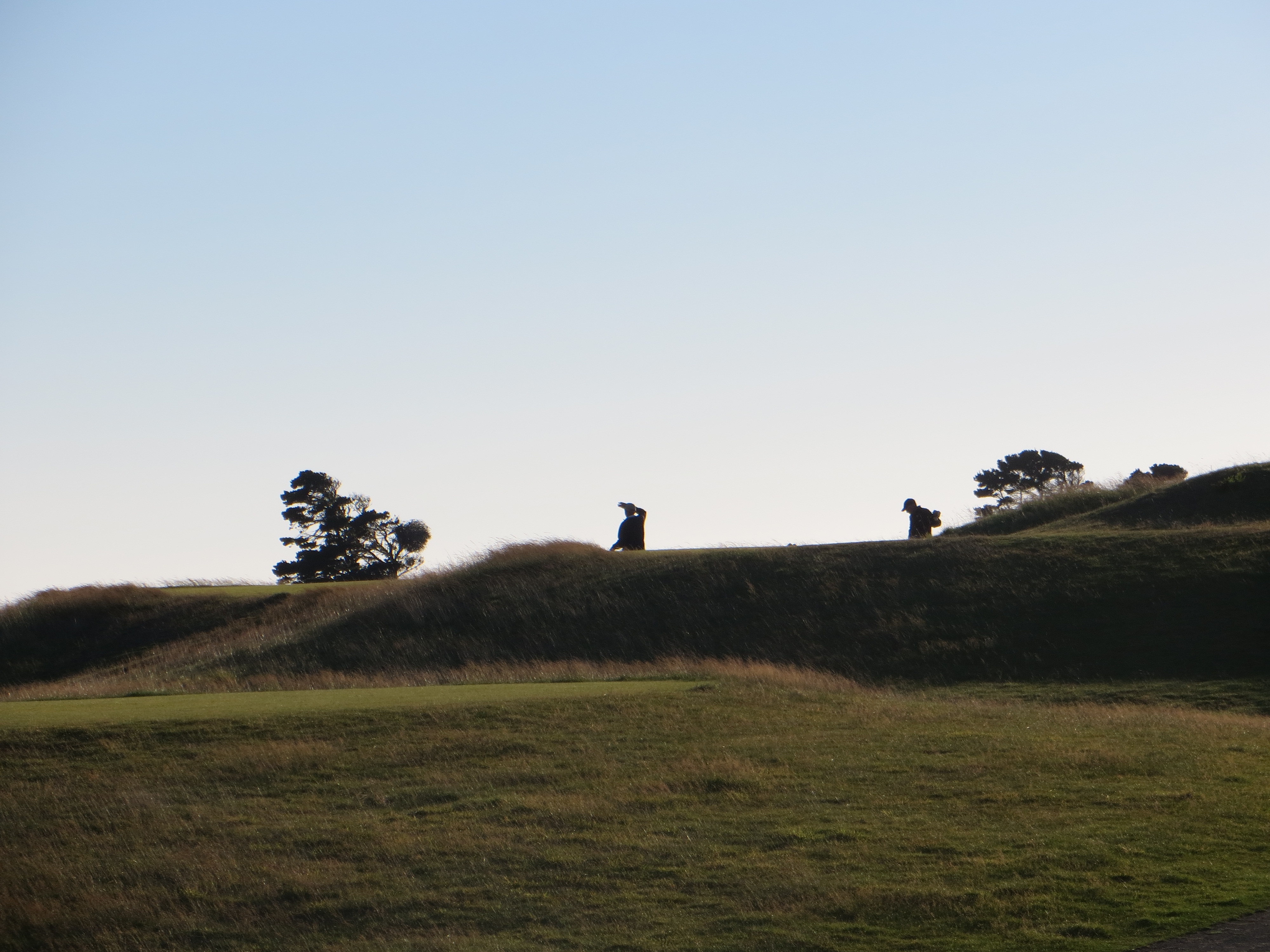
A captivating image-a late look down number 10.
When you are done take the time for a 19th hole refreshment in the Lodge bar that overlooks the tenth tee. The sublime image late in the day of golfer silhouettes walking into the setting sun captures the true spirit of Bandon Dunes.
Bandon, Oregon
Architect: David Kidd (1999)
Tee Par Rating Slope Yardage
Black 72 74.1 143 6732
Green 72 71.7 139 6221
Orange 72 72.4 128 5072
(Click here to review Bandon Dunes Golf Course hole-by-hole descriptions)
For more Bandon Dunes images click to see Postcard From Bandon Dunes-Day 1.
 moegolf