A Firm Handshake

The opening hole at Royal Portrush is a classic links hole. Modern architects who worry about such things as packed tee sheets and pace of play gridlock in the first three holes would not have the nerve to place a vending machine bunker in the face of the hill below the first green.

What is weird to me is that standing on the tee the bunker gets into your head even though you cannot reach it. It is like the architect is whispering in your ear, don’t hit this drive out of the fairway because your second shot will be incrementally more difficult if you do.

With a wee Irish breeze in your face you are tasked with trying to calibrate an additional club and a half up that hill on your approach. Not hitting from the short grass, it just takes the slightest timidity for a shot that clears the bunker to get sucked back off the false front into this sandy abyss. If you overswing and yank it the sand cavern 12 feet below green on the left is likely to see some action.

I remember walking off this green the first time I played it, after making a double, thinking this is going to be a difficult day.

December, 2025

U.S. Adaptive Open 2025

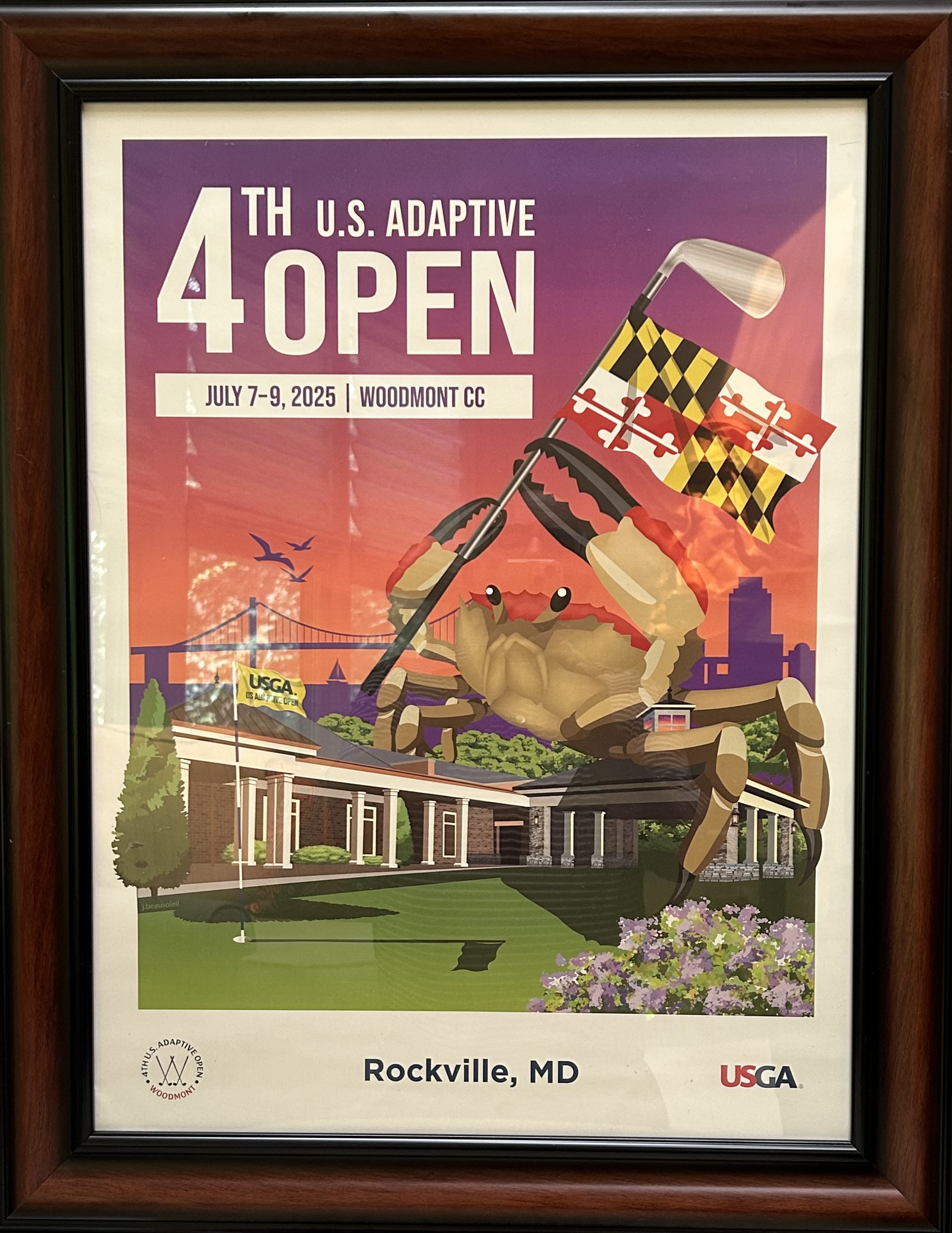
The 4th Annual U.S. Adaptive Open came to Woodmont Country Club to showcase the amazing golfing talents of 96 golfers from all over the globe who have taken on and conquered the impairment challenges that life has presented them to play the game they love. For our members and staff it was an honor and privilege to host this prestigious event and support the inclusion of these great athletes in a major U.S.G.A. Championship.

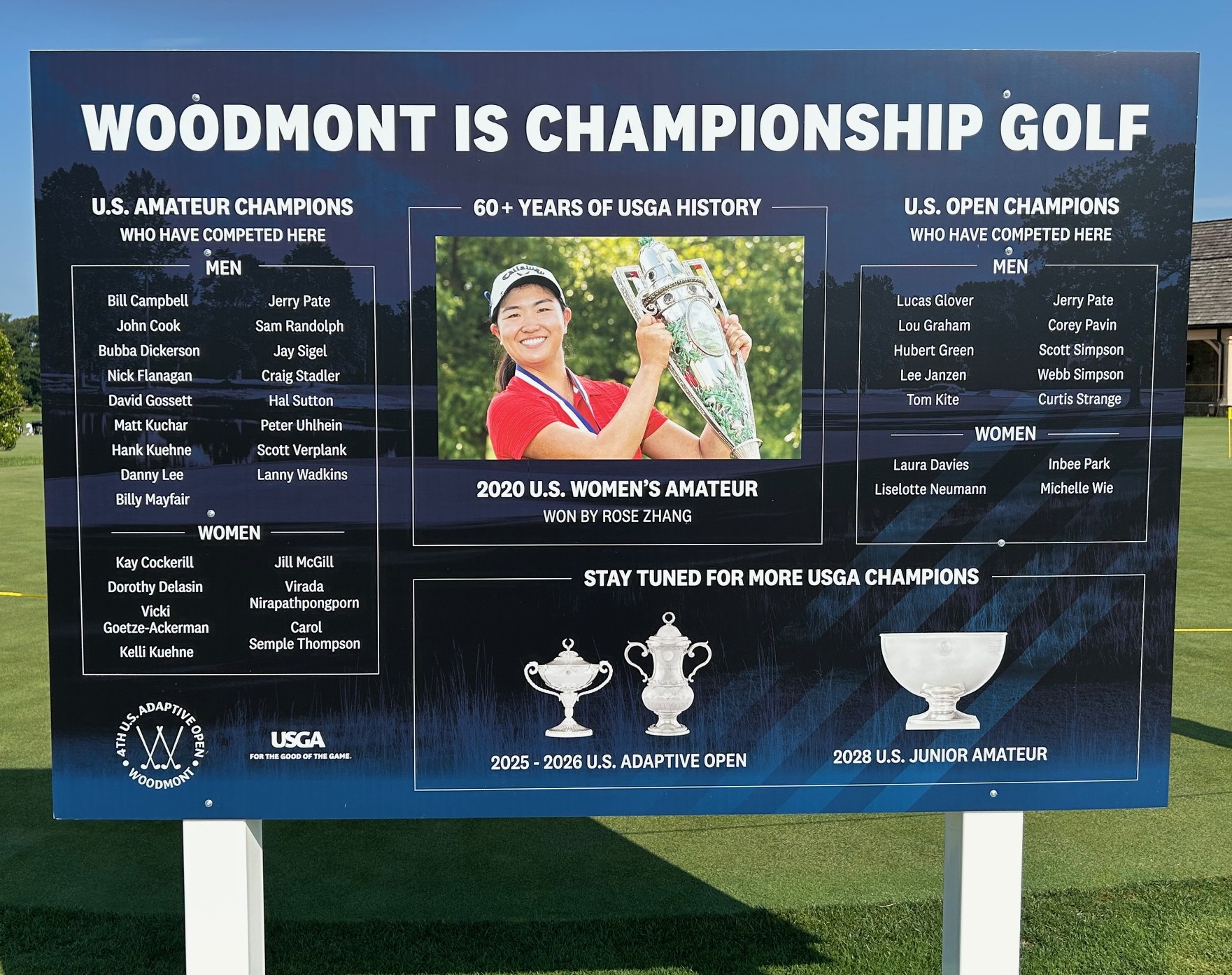
Woodmont has a long history of association with the U.S.G.A. We have hosted the annual final stage men’s U.S. Open qualifying for close to 40 years, been the site of 17 year old Rose Zhang’s historic come from behind playoff win in the 2020 U.S. Women’s Amateur, and will be staging the Boys and Girls U.S. Junior Amateur in 2028.

Woodmont has a long tradition of the presence of Major winners playing competitions on our grounds

The U.S.G.A. has taken the admirable attitude to elevate the impact of this championship with all the bells and whistles of a major event. In just four years it has taken on a ground breaking reputation of inclusion, expanding the reach of the game in recognition of the determination and abilities of these players by embracing the use of adaptive methodologies that allow them to compete at the highest levels.

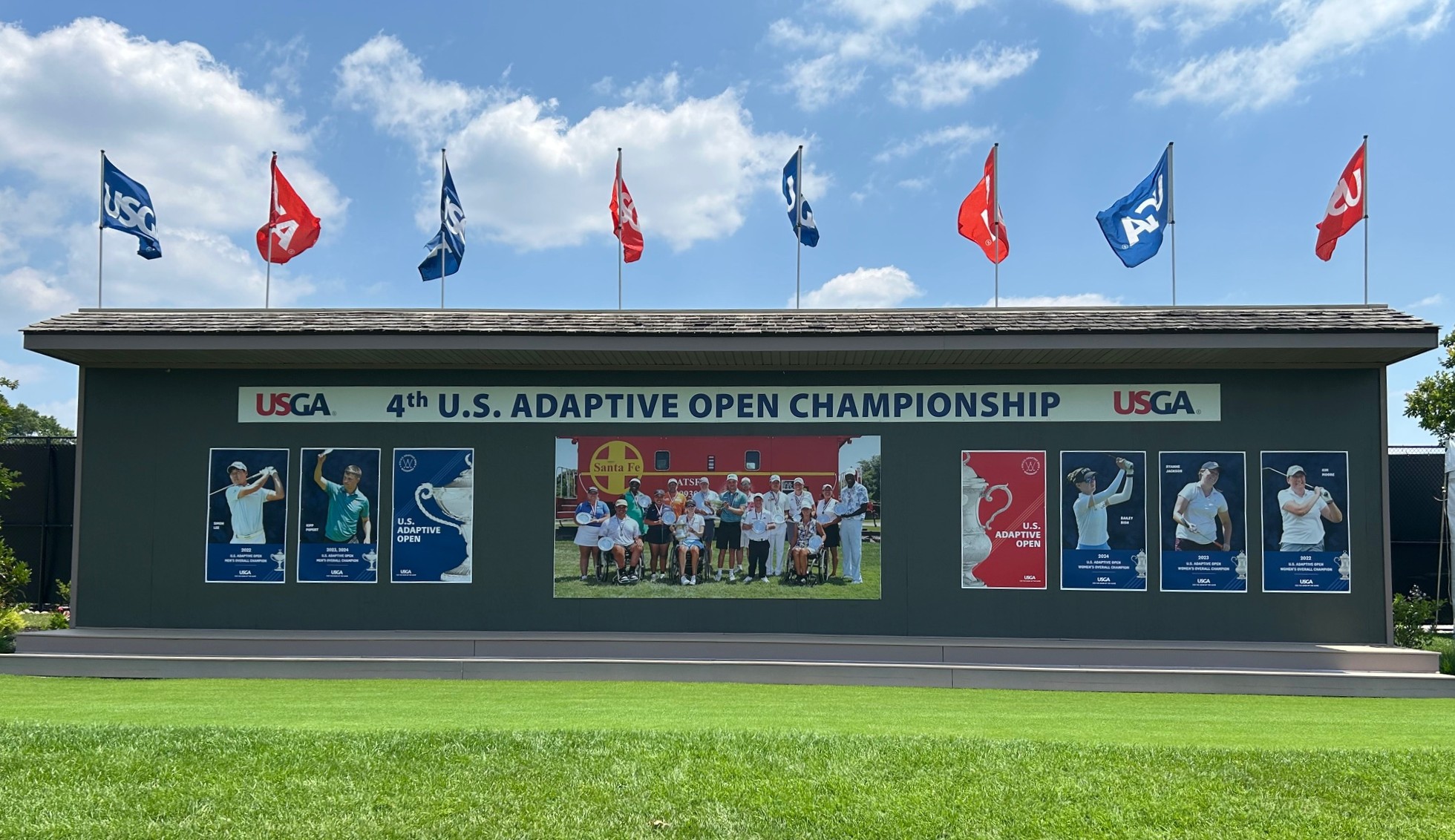
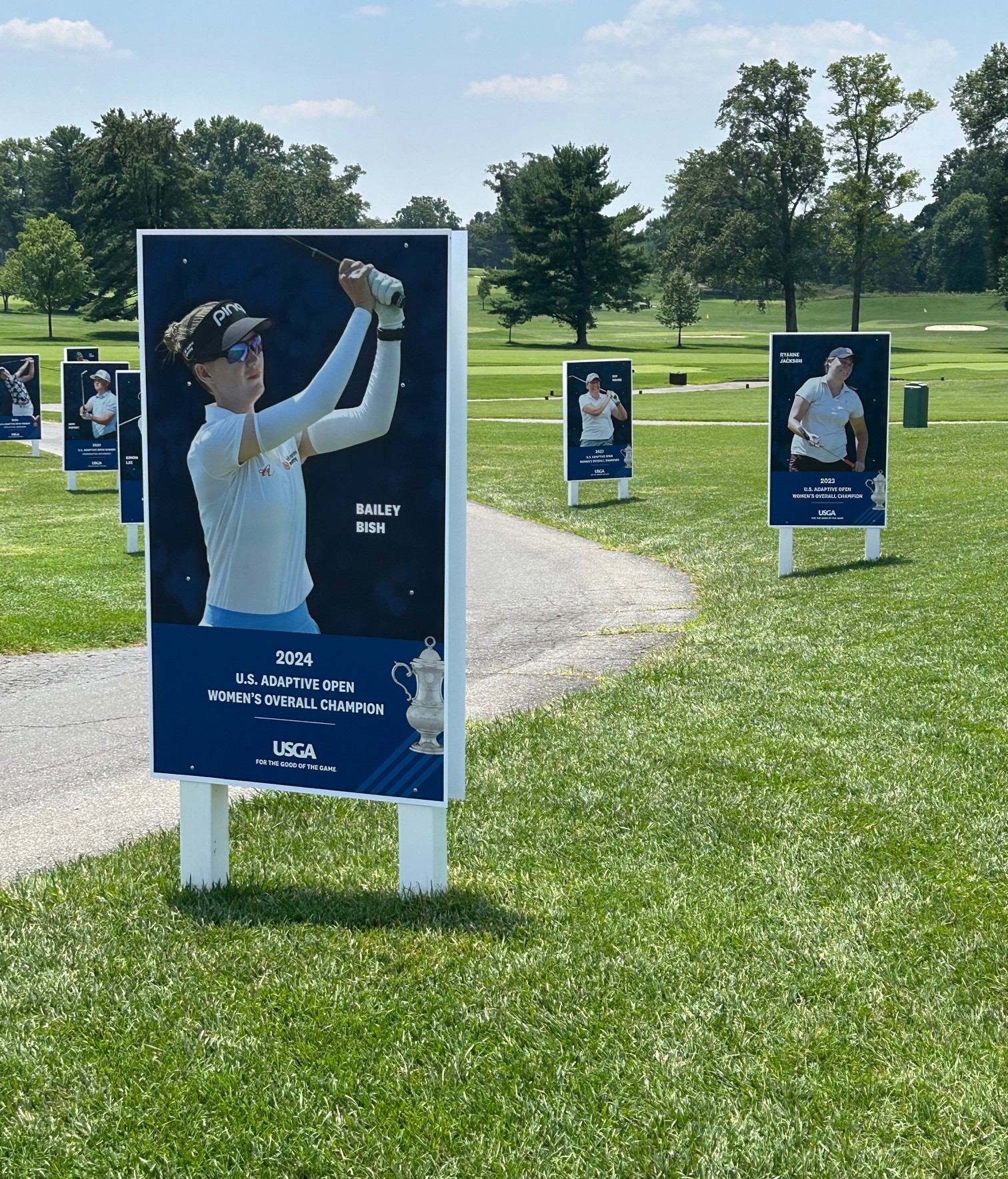
The pageantry of a major event was evident all across our campus
Past Champions Alley…a prestigious place for your name to be seen

Woodmont became a perfect candidate to consider as a host venue for this event when we began a total renovation of the South Course in 2020 under the direction of course architect Joel Weiman. His concept was to replicate the look and feel of the Australian Sandbelt courses expanding the summer zoysia grass fairways to accommodate vast driving areas with very little rough, incorporating 30 plus yard short bermuda grass surrounds to sprawling and generously contoured green complexes to facilitate short game recovery, and throw in an accent of visually intimidating razor sharp bunker edges to complete the Melbourne look.

Clean look on the accessible approach of the Par 4 10th
Contrasted by some native grass accents that adds mishugas to a massive fairway bunker constellation on the 11th
Signature look the short Par 3 12th which boasts a putting surface the size of a Walmart parking lot with seismic undulations

For 96 competitors with widely differing impairments, the U.S.G.A. has fashioned a competition that identifies a men and women’s champion with three days of medal play playing the course at four different tee lengths based on their impairment challenges. Champions are also identified for each gender in eight separate categories of impairment, Coordination Impairment, Intellectual Impairment, Lower Limb Impairment, Upper Limb Impairment, Multiple Limb Amputee, Seated Players, Short Stature, and Vision Impairment.

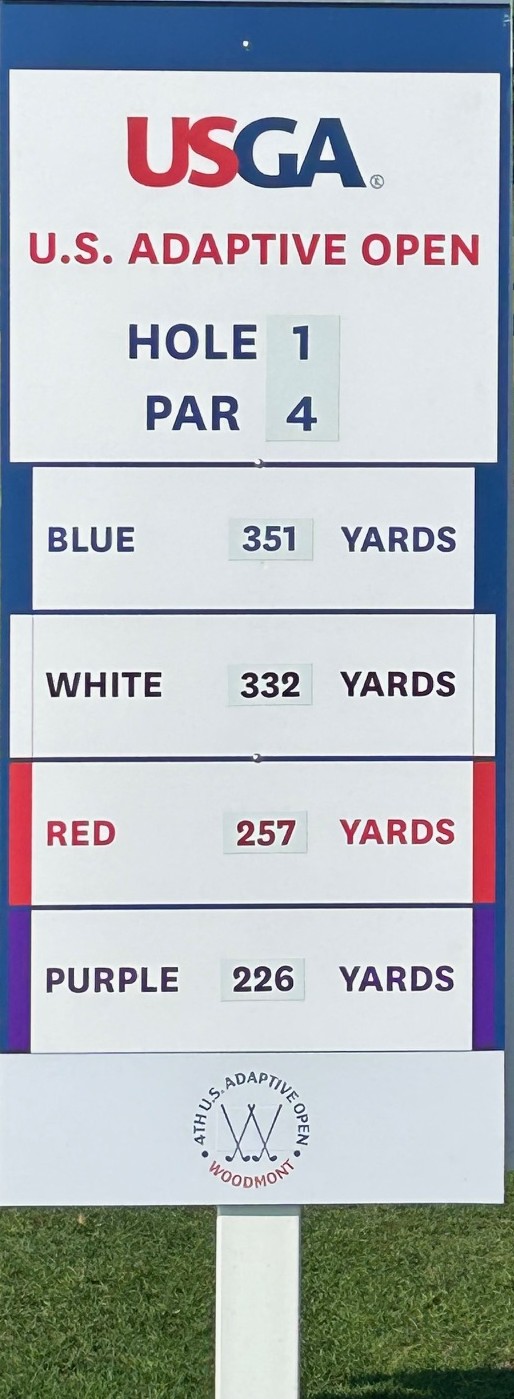
The renovated South Course allowed the competition committee to vary the set up every day. Playing in the same competition the longest Blue Tees challenged players at over 6,600 yards and the Purple Tees at a much more modest overall distance of about 4,600 yards.

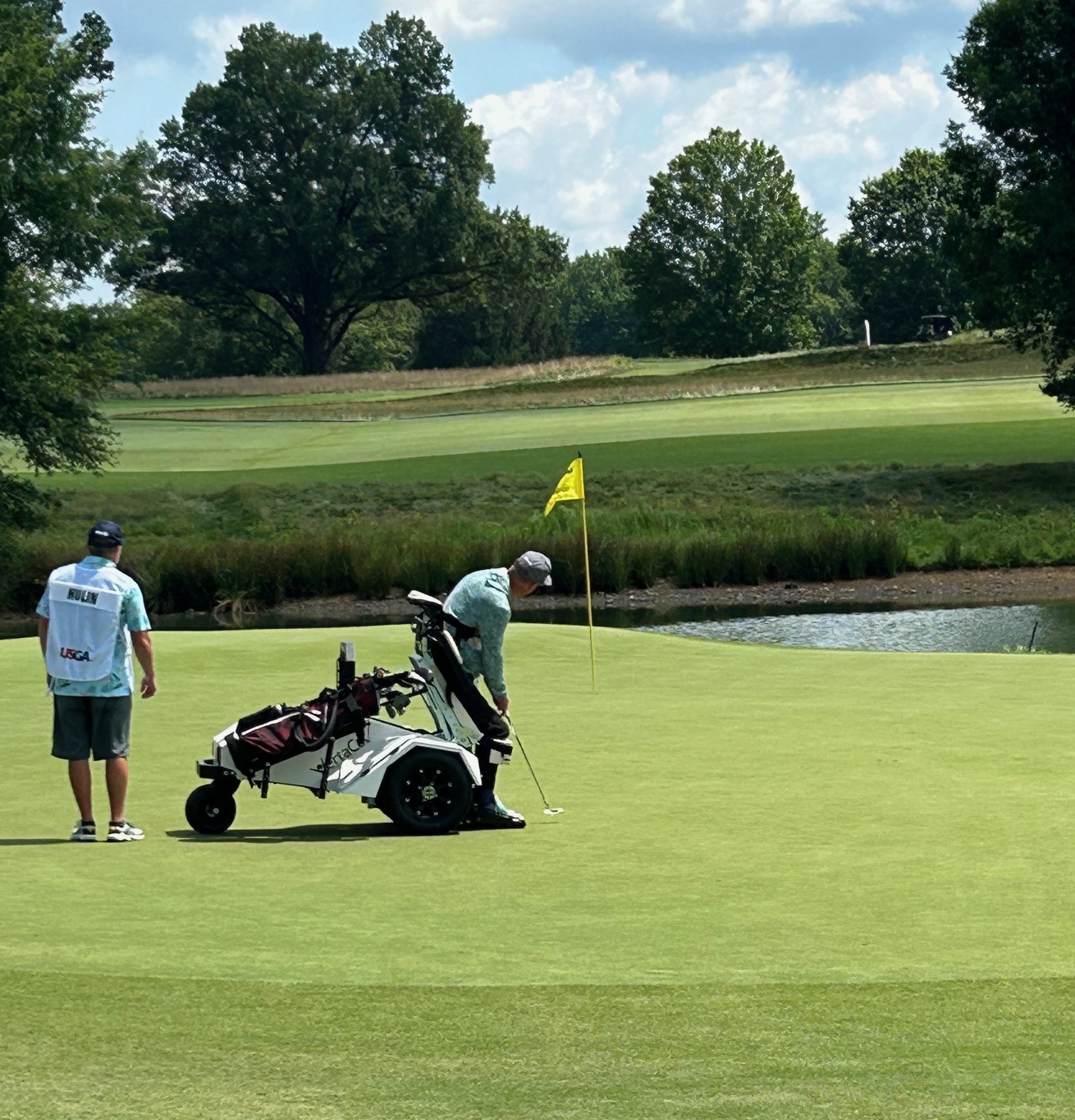
Minimal walks between greens and tees, short grass everywhere, and low edge bunkers makes accessibility to the playing areas very fluid even for those playing in adaptive motorized devices.

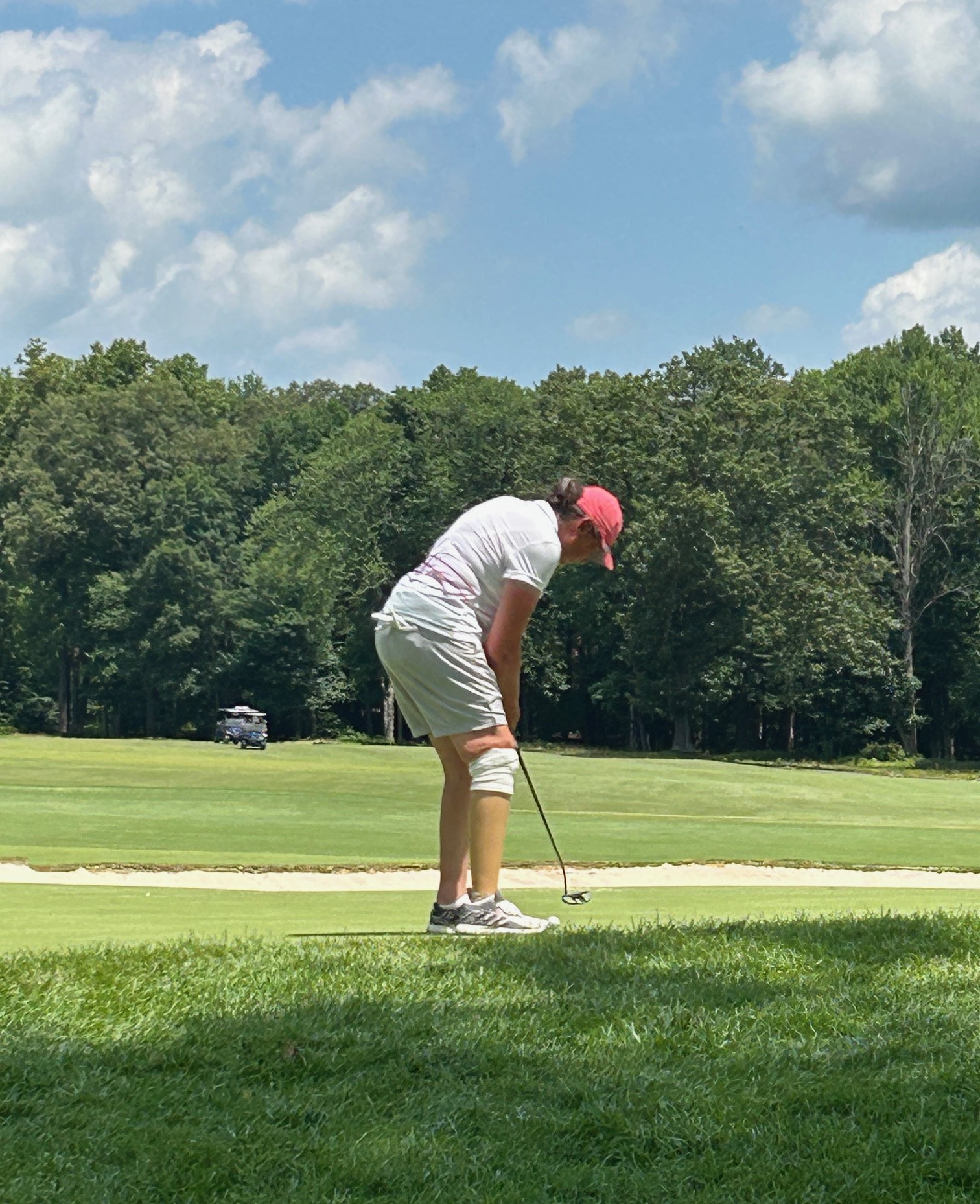
Seated competitor putting from his VertaCat cart on the sprawling 5th green
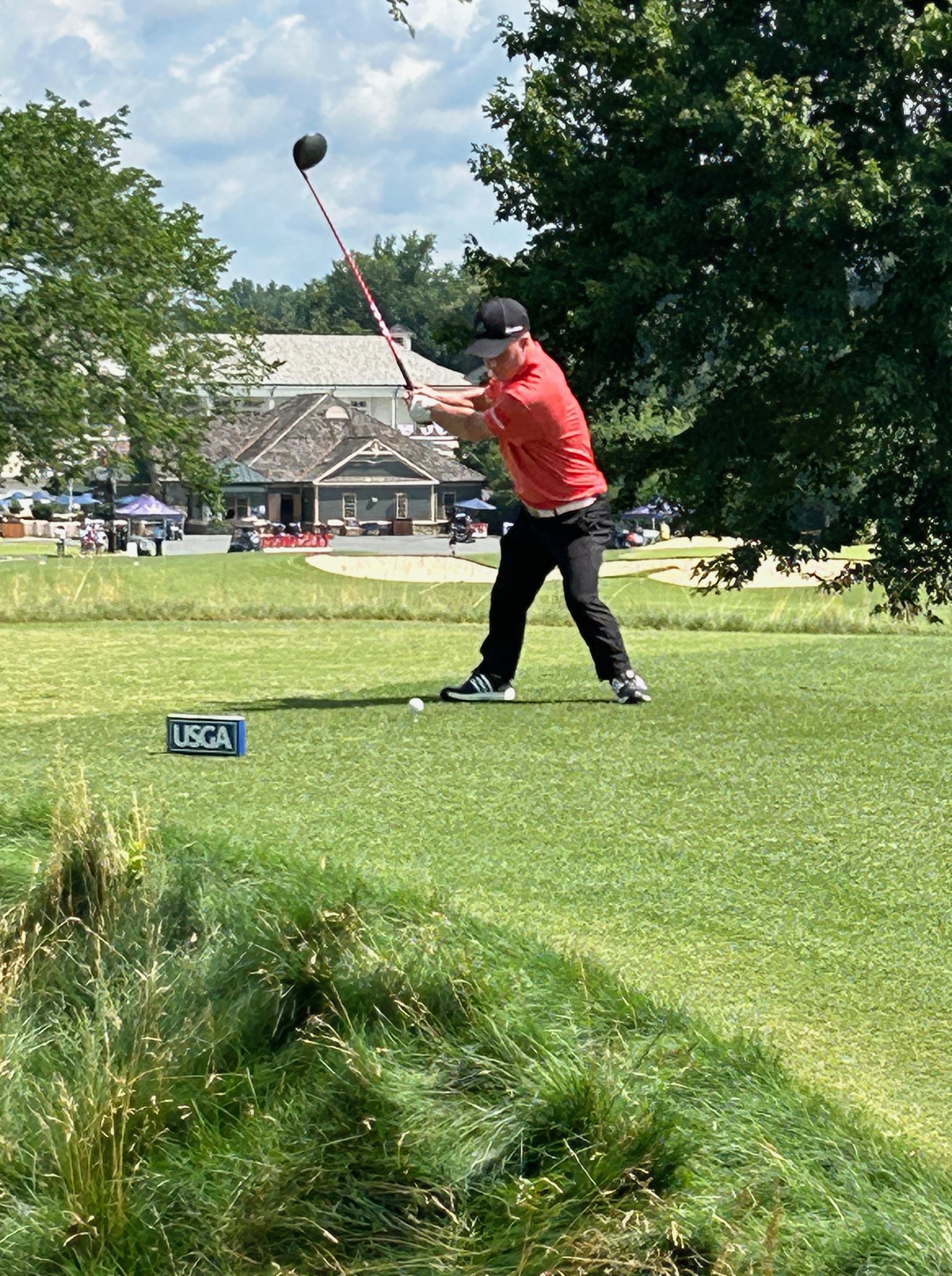
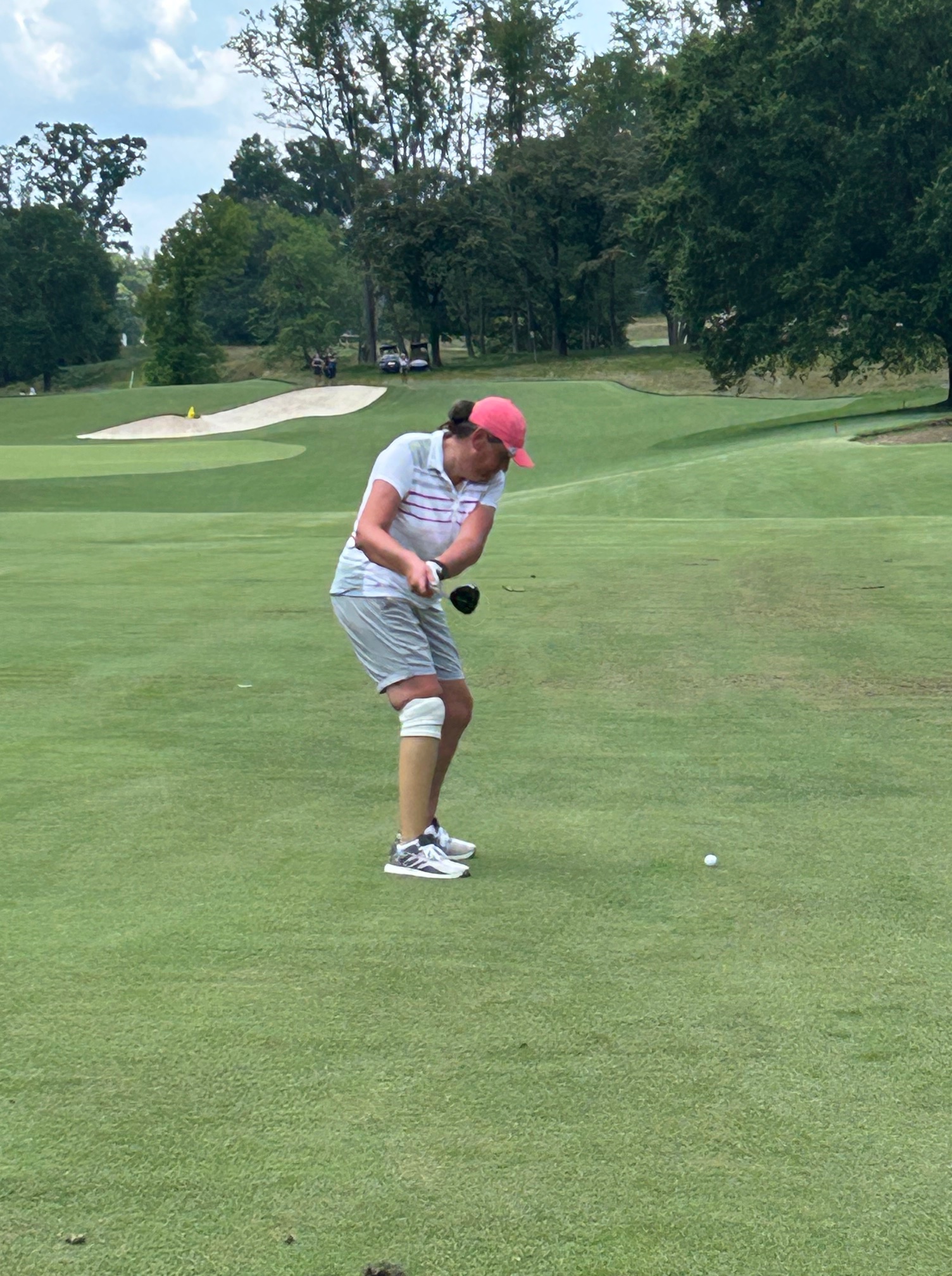
Player from the Lower Leg Impairment category driving off the 1st teeing ground
Brendon Lawlor of the Short Stature group hit this about 235 yards on the Par 5 7th
Fairway metal lay up is a piece of cake from the connecting fairway between the 3rd and the 5th
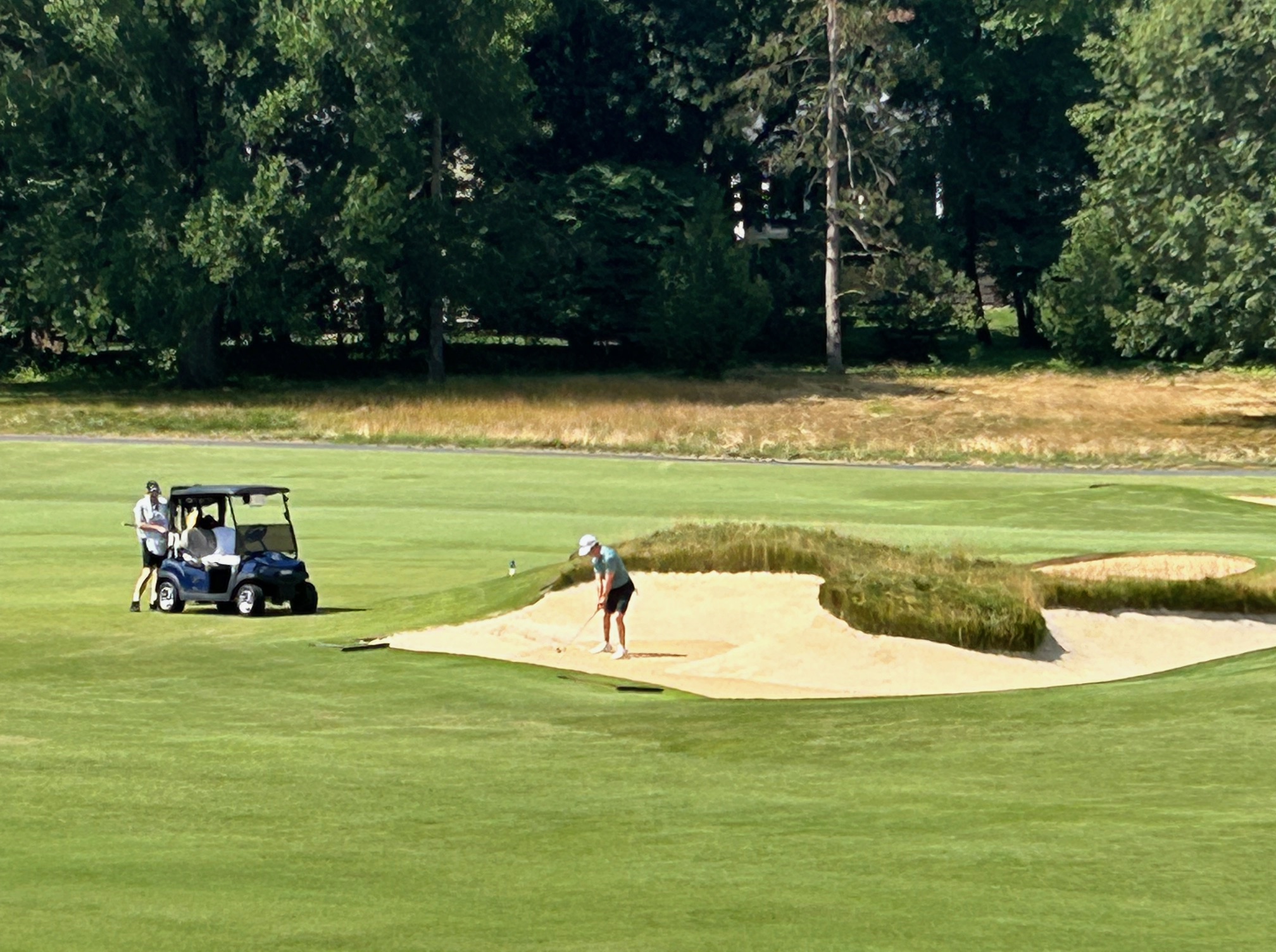
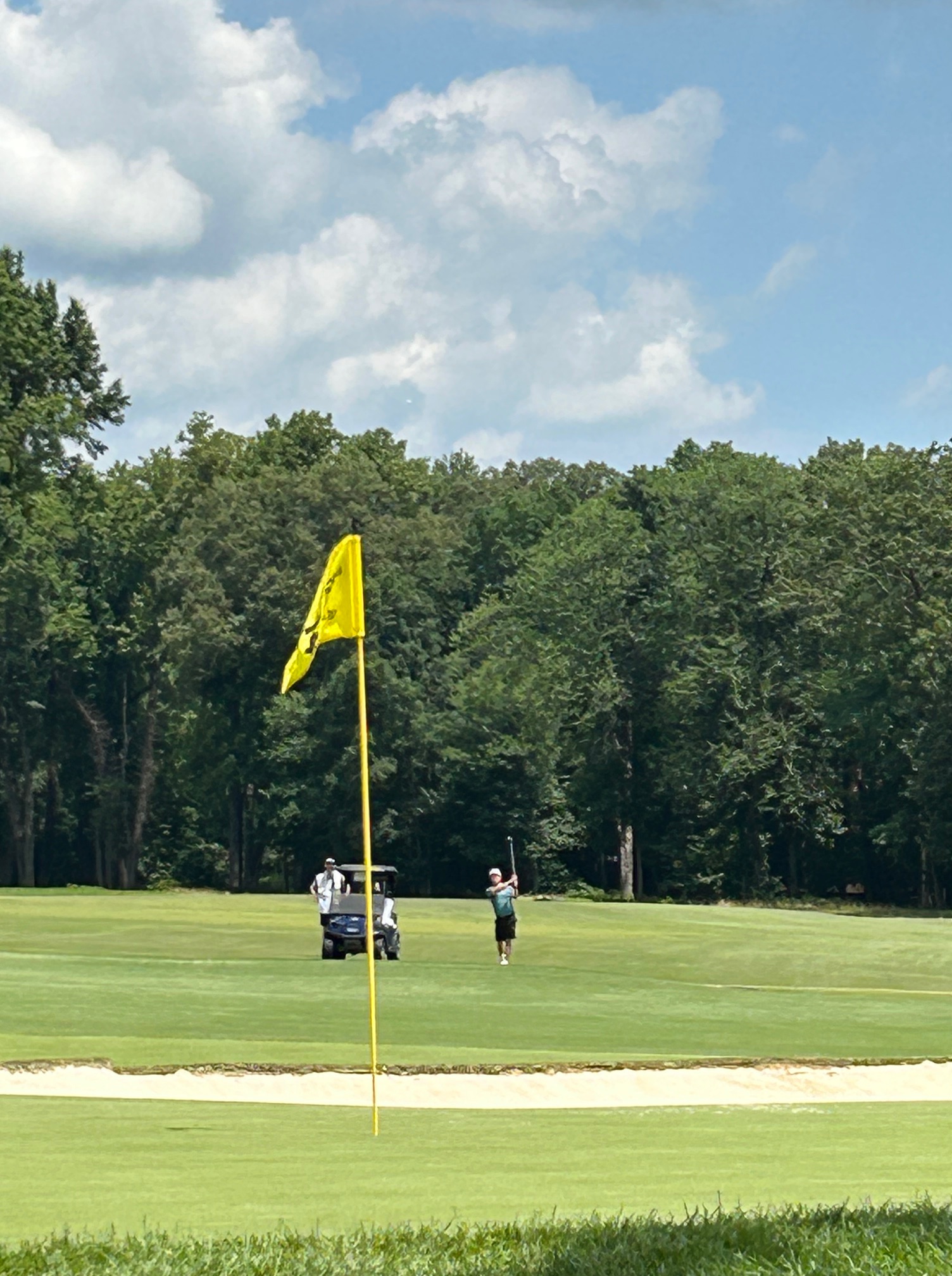
Eventual men’s champion Kipp Popert extricates himself from the shared fairway bunker constellation between the 2nd and the 6th hole

But at the end of the day this is a competitive U.S.G.A. national championship to be decided by talent, grit, and determination. Top competitors in both the men’s and women’s divisions displayed solid mechanics, strategic creativity, and flawless shot making acumen throughout the three days of competition.

Ladies overall champion Kim Moore coaxes one down the slope on the 14th
Kim shuts the door with this remarkable second shot on the Par 5 16th from 180 out to inside of 20 feet and a two-putt birdie
Kipp Propert textbook swing mechanics led to a 11 under par 61 on day one.
Kipp’s distance control on 14 was astounding settling this 100 yard pitch to 6 feet between the bunker’s edge and the hole for another birdie
After reaching the Par 5 16th in two he lagged his 14 foot eagle putt to the front lip for a tap in birdie

Kipp Popert registered a three-peat winning the Adaptive Open the first three years, lapping the men’s field with an astounding overall score of 24 under par. Kim Moore had won the inaugural event in 2022 and took her second Adaptive Open Championship posting 16 over for a three shot win on the ladies side.

For the third time in a row Kipp Propet of England hoisted the silver trophy
This was Michigander Kim Moore’s second go around as the women’s overall champion

Thanks to the U.S.G.A. and the over 200 staff members and volunteers who helped make this event a community success. For those who witnessed this event in person or who watched the final round on the Golf Channel they walked away with a sense of respect for the camaraderie this event engenders and the determination it takes for people like this to embrace their dreams and take life’s challenges head on.

Will Kipp finish the rare Adaptive Quadrilateral in 2026?

We look forward to seeing him try when once again when the prestigious U.S. Adaptive Open returns to Woodmont Country Club in 2026 for a second time around the block.

Woodmont Country Club

Rockville, Maryland

Arnie’s Home Game

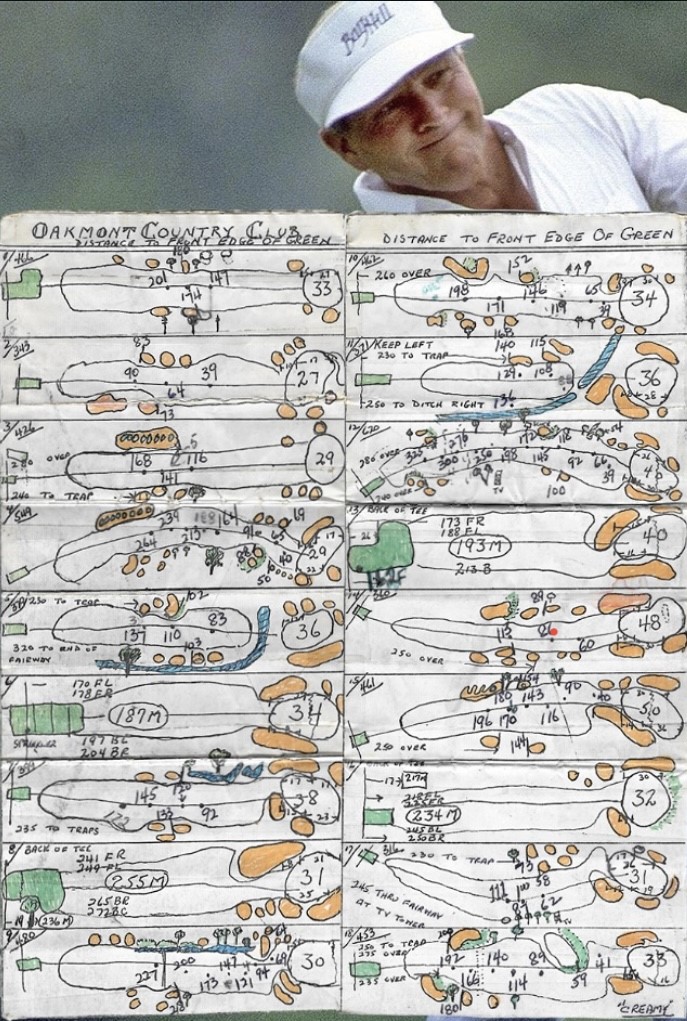
Found this super cool artifact on social media this week just in time for viewing the U.S. Open at Oakmont. Growing up and living in Latrobe in western Pennsylvania Oakmont Country Club, 20 miles north of Pittsburgh, was just a three-shot Par 5 from Arnie’s home. He played there quite often over the years and knew the course like the back of his hand. Here he transcribed his knowledge to a cheat sheet for playing the course.

Note, like most tour guys yardage books, the measurements are to the front of the green with the green sizes shown for further calibration. The Par 3’s Arnie gives the measurement to the middle (M) of the green. The overall measurement for each hole from the back of the championship tee is in the top left corner under the hole number.

I love the fact that he bothered to do this rendering in color and even shows the shape of tee boxes that are oddly configured. If you squint hard enough he has some pertinent carry yardages for hazards in the intended line of play.

Not sure when he authored this but my guess is in the 1970’s. Watching the course they are playing for the U.S. Open this year all the parameters of this yardage book still seem accurate.

Instagram Posting (2025)

Golf Is Not A Game Of Perfect

In the crowded universe of golf psychology books there are two that stand above all others in my mind. Along with Zen Golf by Joseph Parent, Bob Rotella’s 1995 contribution, Golf Is Not A Game Of Perfect, is a regular re-read for me at the beginning of most golf seasons.

Unlike so many of the new age golf psych books you do not need to fill out any questionnaires, prepare any worksheets, or tabulate any mental acuity scores to satisfy your need to improve your mental outlook on the game. Rotella’s approach is based more on common sense observation of human tendencies as they relate to helping or impairing your performance on the golf course. I find his old school approach more intelligible and relatable for someone who has enjoyed the game as long as I have.

Rotella has had the ear of a litany of PGA Tour and LPGA Tour stars including Rory McIlroy who recently ended his 11 year Majors drought in winning the 2025 Masters and joining that very select group of those distinguished professionals who have won all four Majors in their careers. It was very evident through Rory’s comments during and after the tournament that he was relying on daily conversations with Rotella to keep him on an even keel and focused on what it would take to break through with this career defining victory.

Others from his client list include Tom Kite, Nick Price, Brad Faxon, Corey Pavin, John Daly, Davis Love, Seve Ballesteros, Pat Bradley, Val Skinner, and many more. The book is chock full of anecdotes involving his conversations with them that convey Rotella’s principles for successful mental management in the game of golf.

The basis of all of his thinking is that players have the free will to manage their thinking processes and must discipline themselves to confine their work on swing mechanics to the practice ground and trust their swing and feel once they stand over the ball on the course. When it comes to a swing process on the course they need to focus on small targets, a specific edge or a bunker or limb on their intended line, rather than a general side of the landing area or part of the green. Small targeting is essential to precise execution of a shot intended because it helps prevent distractions.

Visualization of the result as part of the pre-swing process is important because it is telling the body what you want to execute. Having a well honed pre-shot routine is the foundation of consistent performance on the course. Put succinctly he says “When great players are playing well, trust becomes a habit. He simply picks out a target, envisions the kind of shot he wants to hit, and hits it.”

Rotella emphasizes the importance of the short game, the last 120 yards to the hole, to success of his players. At this distance there are no swing thoughts just focusing on the target. He takes it a step further saying that for the best players pitching and chipping the ball, they do not think about getting it close, they think about holing the shot.

Maybe the most important principle is having a consistently positive attitude when you play and making sure you are having fun. As the title of the book says, golf is not a game of perfect and good golfers have to get over the notion that they only want to hit perfect shots, they have to learn to enjoy winning ugly. Smothering perfectionism and unrealistic expectations lead to a sense of constant disappointment and a lousy golf disposition. He says the best thing to do when you step on the course is cast away your expectations and just play golf.

There is lots more to glean from this read, so for the good of your game take the time to read what Bob Rotella has to say about managing your thoughts and playing your best golf.

Golf Is Not A Game Of Perfect

Bob Rotella (1995)

The Shot

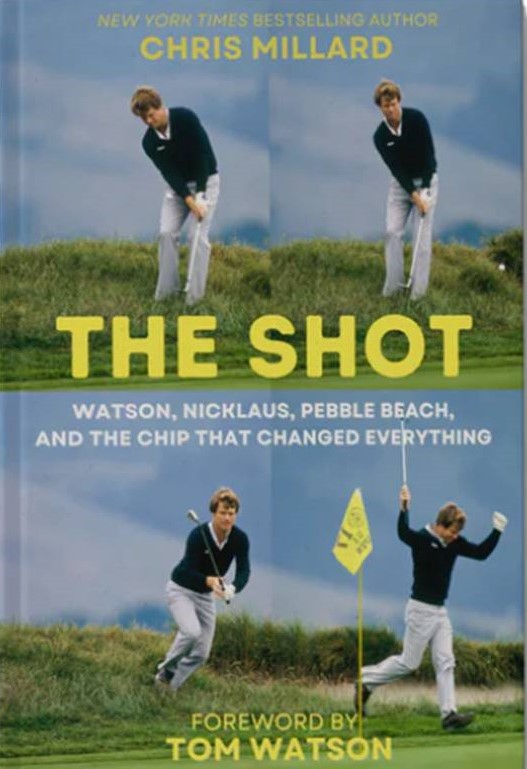
Following golf over the last fifty years the image of Tom Watson chipping in on #17 at Pebble Beach to take the lead in the 1982 U.S. Open is firmly wedged in my golf consciousness as his most triumphant moment in a folkloric golf career. So when I heard that Back Nine Press had recently published this book “The Shot-Watson, Nicklaus, Pebble Beach, and The Chip That Changed Everything” by Chris Millard I clamored to their website to order a copy.

Millard is an accomplished golf journalist and writer and he did a wonderful job sewing together a very readable tale of Watson’s first and only U.S. Open victory at Pebble in 1982. But the book offers so much more as Millard made a diligent research effort to track the history of Pebble Beach Golf Links and its role as a host to USGA events over the last 100 years.

The book catalogs the course’s evolution from it’s creation in 1919 at the capable hands of Jack Neville and Douglas Grant. Then under the stewardship and promotion of Samuel F.B. Morse, with significant renovations by W. Herbert Fowler and H. Chandler Egan, it became the site of the prestigious U.S. Amateur in 1929. This was a big leap of faith because previously the USGA had not held a championship west of the Mississippi River. But the 1929 U.S. Am had a stellar field including Bobby Jones and the tournament’s success established Pebble Beach as a destination resort for the wealthy and famous.

Over the next half forty years Morse continued to promote Pebble Beach for significant golf events, including the annual National Celebrity Pro-Am (a.k.a. the Crosby Clambake) starting in the 1940’s, the U.S. Amateur in 1961, and the U.S. Open in 1972, the last two won by none other then Jack Nicklaus. The celebrity exposure of Crosby each year at Pebble Beach provided a significant crucible for the development of broadcast coverage of golf on TV.

The U.S. Open in 1972 and 1982 were two more quantum leaps for Pebble’s notoriety as well as premier broadcast events for ABC the undisputed giant in sports network television. With Nicklaus and Watson at the height of their competitive powers the 1982 U.S. Open promised to be another chapter in the developing rivalry that transcended the Majors the previous 10 years. Four days on the shores of Monterey Peninsula did not disappoint and it came down to the outrageous chip shot on the penultimate hole to pave the way to Tom Watson’s long sought win of our national championship.

This book is chock full of interesting factoids and anecdotes about the development of Pebble Beach and the careers of Jack and Tom. There is even a chapter devoted to Tom’s 30-year relationship with Bruce Edwards his long time caddie.

I highly recommend this if you have played Pebble, admired Pebble annually on TV, or simply have an architectural interest in how Pebble Beach became one of the most famous golf venues in America.

The Shot

Chris Millard (2024)

Unplayable Lies

Unplayable LiesThe fans of the finest golf writer of the last half century, Dan Jenkins, will be pleased to know they can add a new publication, “Unplayable Lies (The Only Golf Book You’ll Ever Need)” to the Dano section of their golf library. This is a compilation of 41 essays on our sport-about half of them new writings and the rest adaptions of articles previously published in Golf Digest.

Typically such “collections” are scrap books of dated writings with a nostalgic value to the regular readers. But Jenkins is anything but typical. He adds a ream of new fodder for diehards to consume covering topical subjects like “Is Your Country Club Old or New Money”, “Titanic and I”, “Junior Golf”, and “Talking Heads” with his typical combination of wit and insight. It will have you chortling in your man cave reading chair.

In the forward his daughter Sally Jenkins, a talented and accomplished writer and author herself, captures his gift succinctly. “I reread the old work and look at the new, and what I see is a constant stripping away of pretense, and of the profligate excesses of feeling that surrounds golf….to find the truth underneath”.

A few nuggets:

Old Money vs New Money

Old Money will always have money. Three members of New Money are in the process of asking the Federal Reserve for a free drop from an unplayable lie.

The Comeback

Ian Baker-Finch was a surprise winner of the 1991 British Open at Royal Birkdale, then disappeared. When he attempted a comeback at Troon in ’97 he appeared to be a bit wild off the tee. His round consisted of 92 strokes, 4 dead, 55 injured, and 67 missing.

The New World Tour (includes)

The Socialist Paradise Invitational in Buenos Aires. The field must be limited to fifty pros who have never won a tournament of any kind and hate the capitalist societies into which they were born. All fifty will be declared winners and given equal prize money and identical trophies.

The Immigration (a team event). A team would consist of a name pro, an illegal alien, a border guard, and a member of the U.S. Senate. First prize for the winning team would be Yuma, Arizona. Second prize, Nogales.

His description of the PGA Merchandise show is priceless. It includes Putter Man’s booth. The proprietor, who could have passed as a Texas Ranger, has retrofitted classic putters into fire arms. “When the flash mobs come over the fence and onto the fairway to get your goods, you can take out the first wave by yourself”. The Bullseye is “loaded with nine-millimeter Gold Sabre 147 grain jacket hollow points. You can get thirteen hundred feet a second at the muzzle”.

Jenkin’s parody of the network vanilla Talking Heads describing the golf action will bring tears, of laughter, to your eyes. It is Jim Nance and his politically correct Pollyannaisms leaping off the page at you.

Let us not forget that Dan Jenkins has covered more majors than the average fan’s age in dog years so this collection is lush with wonderful anecdotes and enlightening personal statistical compilations of the accomplishments of guys from Bobby Jones to Ben Hogan to Tommy Bolt To Jack and Tiger and about 50 others in between.

To the delight of his readers, Dan Jenkins, at the tender age of 85, was still pumping out the finest combination of golf satire and fact, often in the same sentence. This one is a must read for cynical golf addicts everywhere.

Unplayable Lies

Dan Jenkins (2015)

.

moerate4

Lost Balls

lost-ballsThis is familiar psychological territory for golfers of all abilities, coping with the potential harrowing effect to their scorecard if the next swing goes wayward and the result is an unrequited search resulting in a lost ball.  As John Updike says in the foreword of this clever book, “this lost ball represents two strokes, and two extra strokes could mean the hole and even, if could be, the match, the entire outing, the day itself.”

In a very creative photographic collection Charles Lindsay has brought life to this unique aspect of our game in a book called “Lost Balls-Great Holes, Tough Shots, and Bad Lies”.

It is worth it for the Updike forward alone where he eloquently frames the issues that lost balls play in our game and why it strikes such a familiar chord for us.  “The whereabouts of the ball are in a sense the key to every ball game, but the whereabouts are most picturesque in golf.  Tangles of raspberry….sandy beds of shallow little watercress-choked creeks….snake infested moonscapes of pre-Cambrian basalt…all these nasty patches of environment can play host to a misplayed golf ball.  We have all been there.”

Through his camera lens Charles Lindsay captures the wild, the innocent, and the five-minute shuffle that accompanies all of these often futile searches.  He includes images of domestic animals, wild animals, and a few upright animals against dramatic topography from Ireland to Idaho and everywhere in between.

As a bonus, Lindsay peppers it with some wonderful quotes you can repeat in your Saturday group.

Mark Twain’s politically correct:  “It’s good sportsmanship not to pick up lost golf balls while they are still rolling.”

Ullyses S. Grant: “It does look like a very good exercise.  But what is the little white ball for?”

Alan Shepard from the moon surface: “Got more dirt than ball.  Here we go again…..”

This is the ultimate coffee table book for your home or office.  Every golfing friend who picks this up will give you that twisted, knowing smile as they leaf through an assembly of engaging photos that depict disturbingly familiar circumstances from notable golf venues around the world.

Lost Balls: Great Holes, Tough Shots, and Bad Lies

Charles Lindsay (2005)

moerate4


Out Of The Rough

Out of the RoughAs you can read in this book review by Jaime Diaz of the recent biography of the caddie days of Steve Williams the book has been generally panned by the reviewing pundits as a sensationalist hanging out of Tiger Woods dirty laundry.

But Diaz does not agree with this assessment and he feels that when the reader looks beyond the few charged quotes being used by the publishers to market the book Williams actually gives a fairly balanced account of his experiences with the players he has worked for, the most famous of whom was Tiger Woods.  Diaz says of Williams,  “For all his gruffness, he’s intelligent, insightful, frank, and on his subject, extremely knowing. On balance, he’s given us an important golf book”.

Jaime Diaz is the most insightful golf writer of his generation and having read the book I see where he is coming from.  The book is a detailed compilation of Steve Williams’s interpretation of incidents and relationships with Tiger and others that we may not have previously understood for lack of transparency.  But I think Diaz overstates how important the book is as a contribution to our golf knowledge.

This is your basic “lift and tell” book which sounds like a transcript of Williams talking into a dictaphone at his kitchen table. The writing is very mundane it takes an effort to keep reading and honestly Williams is not that interesting of a subject to write about.  Williams is a smart guy, successful sportsman, and very capable caddie, no doubt he influenced the careers of a number of great players in a positive way, including Eldrick.  But like many others  before and after him, Williams was also a lacky for Tiger and Steinberg doing their bidding to protect the brand.

What I got more than anything from this read is how sterile a character Tiger is.  He was a trained automaton by his father and pretty much guided awkwardly through all his personal foibles by his agent and his handlers.  Tiger’s attitude toward the other pros, the fans, and the people whose efforts benefited his career lacks any humility or personal sensibility.

Tiger has never been, and still remains, not his own man.  For all the money and fame he just lacks the simplest interactive social skills to treat people with honesty and integrity.  I blame this on his upbringing which clearly emphasized it is always about winning and nothing else.

If there is any contribution from this book for me it is Williams accounting of Tiger behaviors while they were together that confirm Tiger’s lack of personality.  To anyone who has watched the Tiger drama unfold over the last twenty plus years this was always pretty obvious.  So I do not share with Diaz that this book is a significant add to the public knowledge and, IMHO, it may not even be a wise use of four to six hours of your reading time.

Steve Williams (2015)

moerate1

Unconscious Putting

Unconcscious PuttingAfter listening to Feherty’s interview with Dave Stockton this week I was intrigued by how little one of the greatest putters of our era had to say about putting. Well what I actually mean is how little he had to say about the mechanics or techniques of putting. So I decided to fill in the blanks by reading his 2011 signature offering on the subject called “Unconscious Putting”.

In an act of full disclosure, even though I am a self-confessed obsessive golfer I read very little instructional material on the subject. My extensive golf library has maybe 8 books that involve golf instruction and none of them were published after 1975.

I gave up my subscription to Golf Digest about 20 years ago because the magazine was all resort ads or those one page instructional caricatures with doozies like “for proper posture on a bunker shot imagine you are standing on the sidewalk and someone is dropping a sack of potatoes to you from the first floor fire escape of a Brooklyn tenement building…….”.

My standard response to someone who asks me for swing advice on the course or the range is, “it is an act of lunacy to accept swing advice from anyone you are not paying to give it to you” .

Which is probably why I found Stockton’s book so intriguing. There are only a handful of putting drills mentioned in the book. In 90 pages of text there are almost no professed must-do putting mechanics that are emphasized. He provides no metrics for swing length, swing path, or cadence of a stroke. The closest he gets to putting minutiae is waffling on whether it is acceptable to leave a putt 16 or 18 inches past the hole. If you are the type who is only satisfied when every box on the New York Times Crossword Puzzle is filled in this book is probably not for you.

His core assertion is ”Unconscious Putting involves learning how to accurately see the optimum line that a putt should take to the hole and giving yourself a consistent pre-putt routine that lets you preserve that visualization and roll the ball on your intended line”.
This should be the focus of all your practice time and pre-round preparation.

That is pretty much it though he does provide eight chapters to emphasize and support this thesis. He suggests that about 50% of your practice time should be on building a sound repeatable pre-shot process for ascertaining the proper line for a putt. The rest of it should be spent building a confident stroke that can roll your ball on the intended line. There is plenty in the book on learning to read greens properly, refining your pre-shot routine to make it efficient and serve the Unconscious Putting axiom, and managing your emotions so that your putting can be productive and fun.

As to putting mechanics he has no preferences or biases. It is only a 36 to 48 inch swing from end to end so how much mechanics can be involved in it. He feels that If you can deliver the club face to square of the intended line and two inches past it you can pretty much do it with any grip, swing path, swing length, cadence, or putter, for that matter, that works for you. Trusting your inner putting zen is very important to Unconscious Putting.

He is not in favor of spending hours on the putting green hitting the same length putt over and over. He says, “you should never practice with more than two balls at a time and you need to change up the length and break of the putts after every sequence of two putts”. Stockton says that of all of the instruction he has ever gotten on putting “90% of it has been on the mental side-maintaining my routine, staying positive, believing I would make every putt, and not blaming myself when the ball didn’t go into the hole”.

On this last point he gives the example of Nicklaus who he says believes he never missed a putt when the tournament was on the line. Truth is he missed his share but to his credit he never carried the misses with him after the fact. His miss amnesia ability was instrumental to his putting success in major events. I heard a teaching pro recently say to his student during a putting lesson, pick your line, put a good stroke on it on the intended line, and if it doesn’t go in blame the green superintendent.

This is a book well worth reading even if you do not buy fully his emphasis on feel over putting mechanics and result analysis. Stockton has helped some of the greatest players in the game, Mickelson, Sorenstam, Tiger, and Rory, rediscover their putting Id through the philosophy fleshed out in this book. It has to help your golf game to read what Stockton has to say about unlocking “your signature stroke” and then step back and give it some air on the putting green.

.
Dave Stockton (2011)
.

moerate4

Golf Rules Illustrated

Golf Rules IllustratedThe USGA publications tend to be dry, button-down, corporate presentations that are about as much fun to read as the obituary columns in your local paper.  But they stepped out of their blue blazer mode in the publication of Golf Rules Illustrated 2012-2015-The Official Illustrated Guide To the Rules of Golf.

Every one who plays the game is confronted with rules conundrums whether it is from their Saturday group, an outing they are playing, or the live action they are watching during the Sunday tournament broadcast.  The first person they are likely to ask is the head pro at their place and the second person is probably a single digit guy they barely know walking through the locker room.  More often than not they come away more confused about the rules then when they posed the question.

Sure there are on-line sources like Barry Rhodes Rules School who is probably the reigning authority outside of the USGA/R & A tandem when it comes to answering rules questions.  You could check resources like our Keepers Rules Education Initiative which explains frequently asked rules incidents with on course scenarios to clarify the nuances of rules in your day-to-day game.

But for coherent answers to all golf rule questions you need only have a copy of the Golf Rules Illustrated book at your disposal to get meat of the matter in a hurry.  The book is organized with color-coded index for each chapter that covers one the 34 rules in the game.  For each rule and it includes an explanation of the rule and it’s related sub-cases with a combination of easy to understand text, simple illustrations, relevant photos, and real incidents and frequently asked questions.

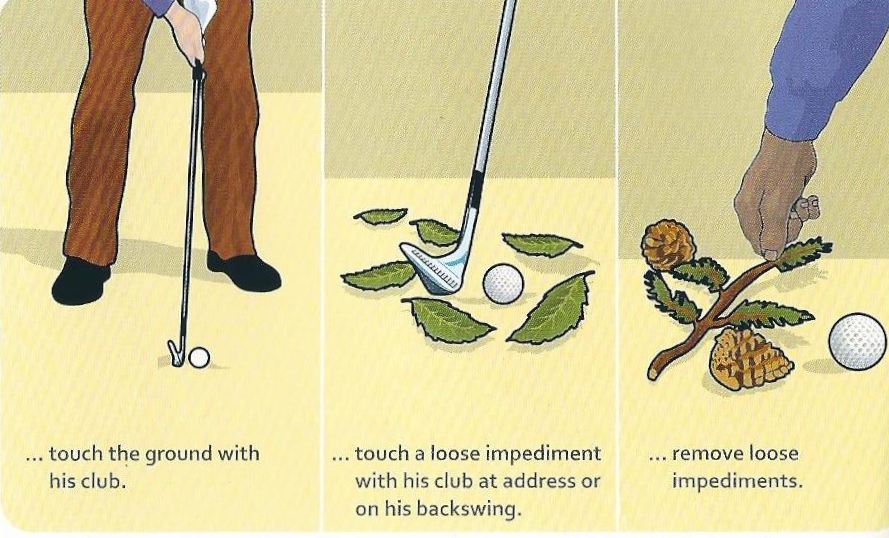
A simple visual explains what you are prohibited from doing in a bunker

Ball In Bunker Prohibited ActionThe table of contents makes it easy to find what you are looking for and once there you will find yourself perusing the related sub-cases as well as real incidents from the tour that will bring the rules to life for you.  The FAQs help to fill in the gaps so you reconcile the obvious questions that come to mind as you start to understand the rule at hand.

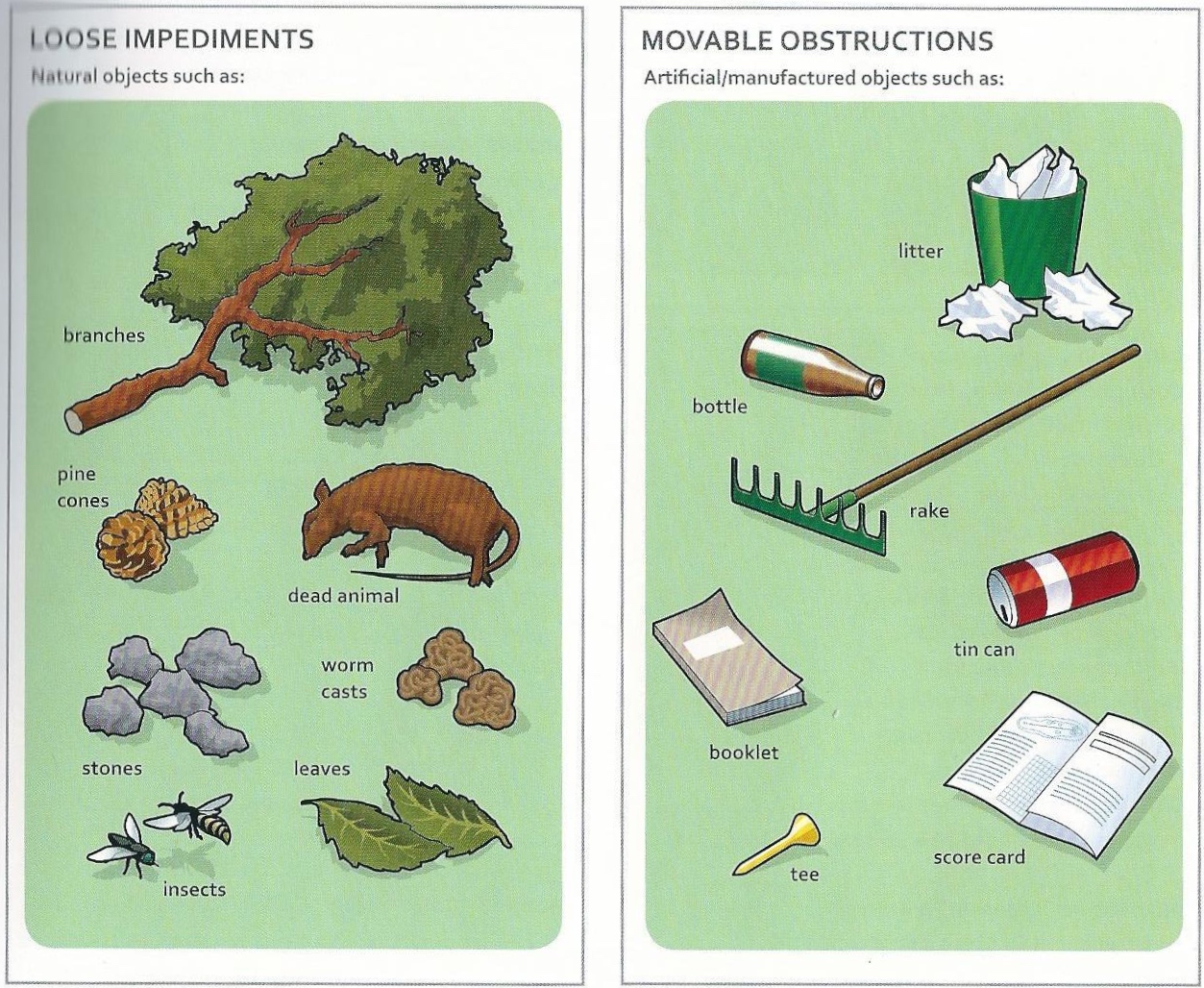
Let’s say you need to know if the pile of rabbit poop your ball landed in can be removed without penalty as Loose Impediments (Rule 23).

This illustration defines Loose Impediments vs Movable Obstructions
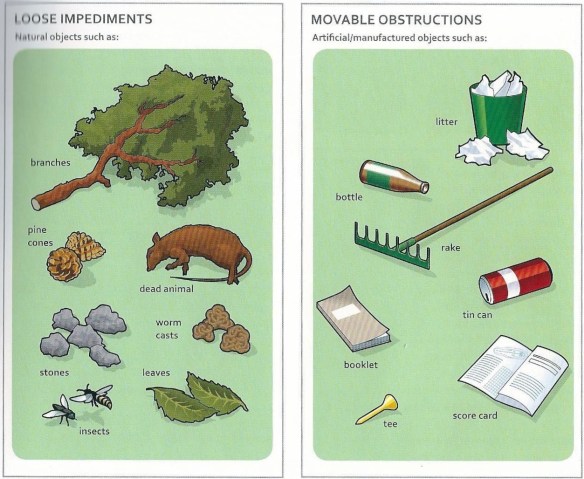
Loose ImpedimentsYou recall that crazy situation when Tiger got to move a boulder in Arizona, a loose impediment in his way that took an army of people to remove.  Check the incident section of Rule 23 for an account of that crazy affair and the logic that supported the ruling.

Embed from Getty Images

.

It then occurs to you, can you remove sand on the putting even though your ball lies off the putting surface….check the Frequently Asked Questions at the end of the chapter.

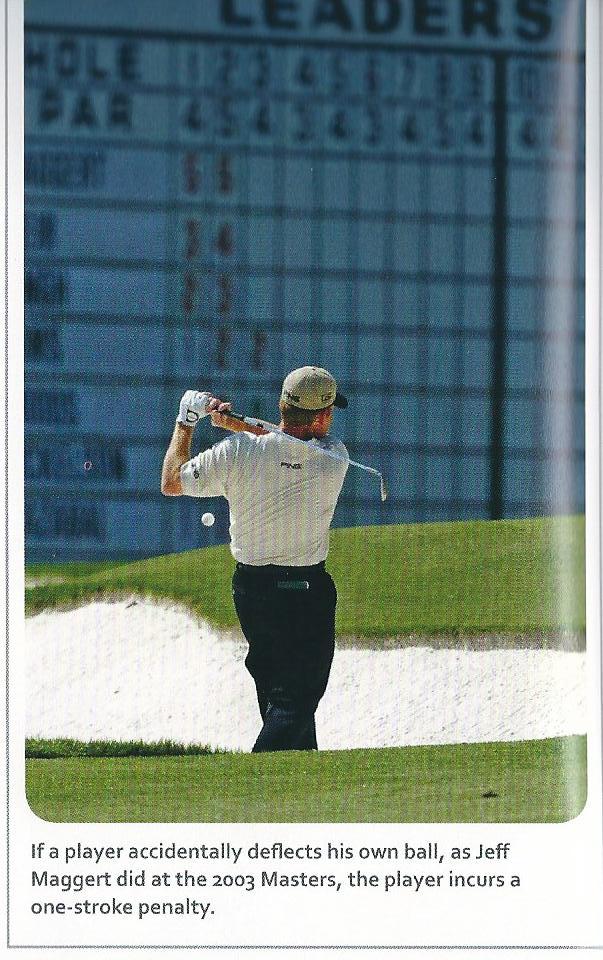
Maybe you were playing with your buddies the other day and one of them hit a ball off a steep upslope that came straight up and deflected off this body.  Any penalty for that?

Happened to Jeff Maggert at the 2003 Masters and cost him a one-stroke penalty
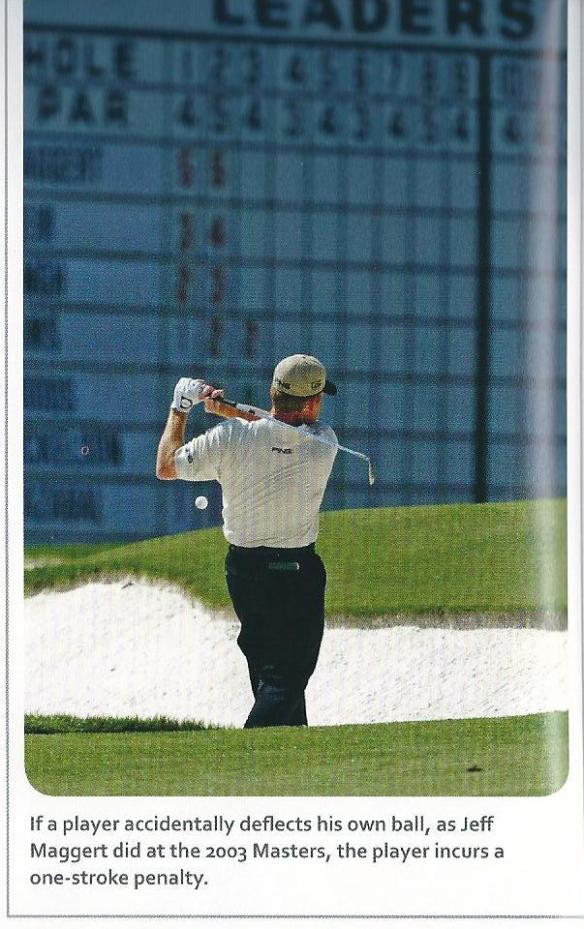
Ball Hitting A PlayerBut this leads you to wonder about other incidents where a ball is stopped or deflected by hitting your opponents bag or another ball in motion.

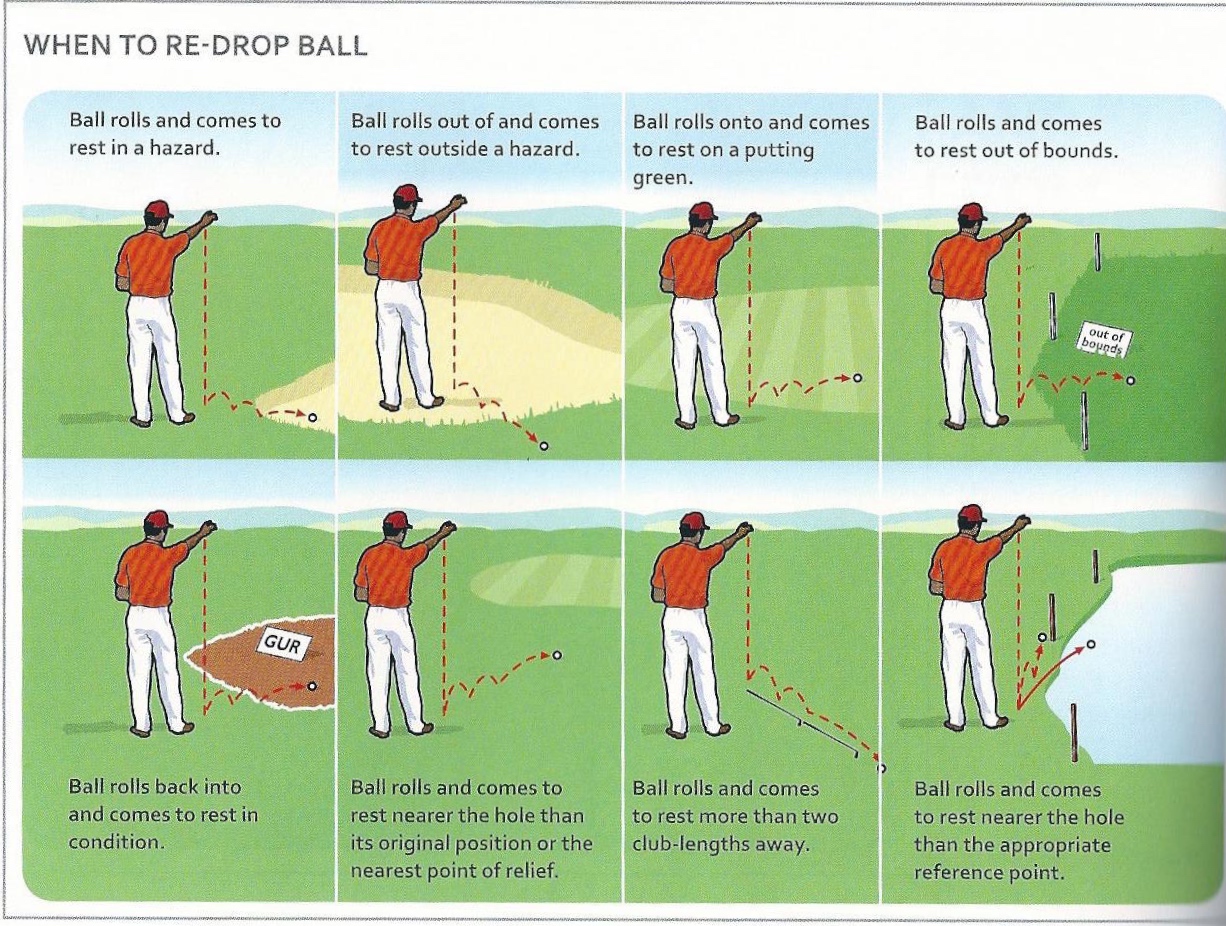
Ball In Motion DeflectedDropping the ball whether for free relief or in implementing a penalty can lead to all kinds of variations of events.  In the chapter on Rule 20-Lifting, Dropping and Placing-it clearly explains a litany of scenarios including cases when you must re-drop.
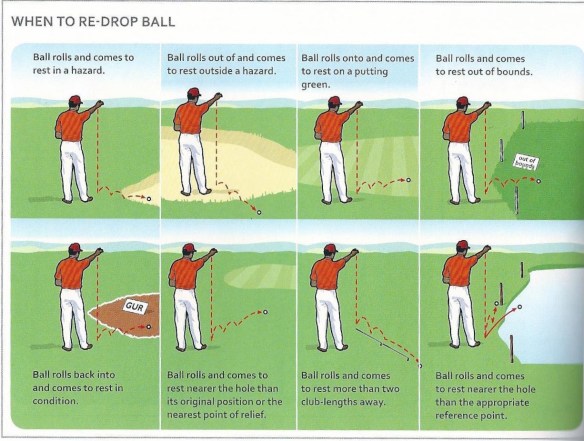
RedroppingUnder the FAQ they address whether a player is required to mark the position of a ball he is going to drop before lifting it.

Remember Van de Velde’s choosing this option from the water hazard at the Open

Embed from Getty Images

.

This book is an invaluable reference for getting the rules right because it cuts through all the legal language to present an intelligible understanding of the rules and related issues as well as providing simple visuals to reinforce the logic of how the rules must be implemented.

For about 15 bucks you can get this from any number of the on-line book purveyors. Golf Rules Illustrated should have a front row spot on your golf library shelf.  The pages will become dog-eared in no time.

(Illustrations and photos from Golf Rules Illustrated 2012-2015)

February, 2015

moerate4