Art In Golf Architecture

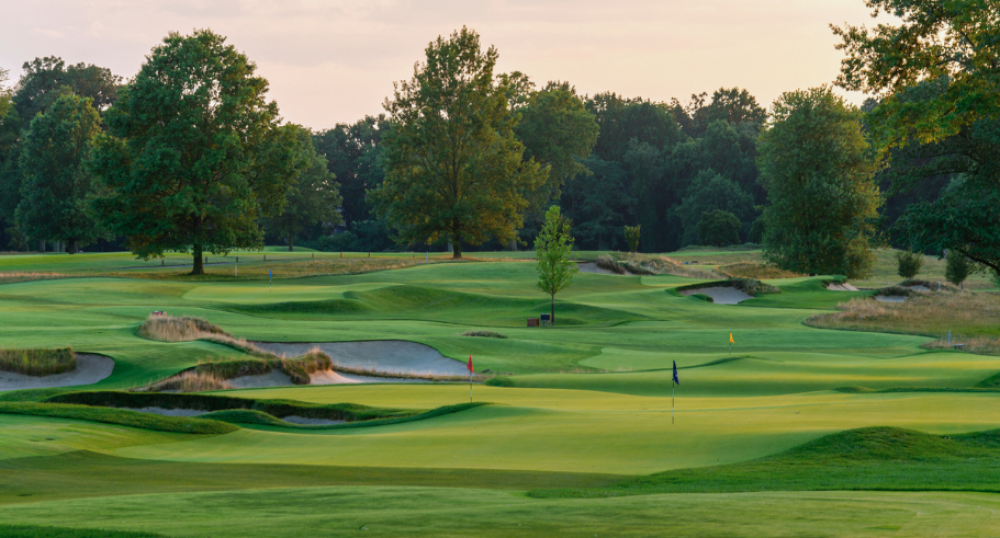
It is evident in reading his philosophy of golf architecture that Max Behr might have been one of the early “Minimalist” proponents in his field.  In this piece he wrote in 1927 you can hear a voice that has reached architects like Tom Doak and Ben Crenshaw who are strong proponents of the minimalist approach to course design.  We may not all agree with Behr’s sentiments but he does express an argument worth considering as we try to evaluate the trend toward bigger and bolder artificial design elements over the last century.

The question he poses in this essay is a simple one,  “What, then, is art in golf architecture? What are the values we should seek, and the method we should adopt to arrive at them?”

For the most part Behr believed that the natural elements of the land should be the guiding force in design and that architects should resist the temptation of imposing their will upon what the topography presents just to make a personal statement.

“We forget that the playing of golf should be a delightful expression of freedom. Indeed, the perfect rhythmic coordination of the muscles to swing the club makes the golf stroke an art. And, being such, it is apt to induce an emotional state, under the stress of which human nature is not rational, and resents outspoken criticism. It follows that when the canvas of Nature over which the club-stroke must pass is filled with holes artificially designed to impede the golfer’s progress, these obvious man-made contraptions cause a violation of that sense of liberty he has every right to expect. This accounts for the checkered history of every artificial appearing golf course.”

“He must first feel before he thinks. He must perceive in the ground what might be, not conceive in his mind what must be.”

His criticism is that architects tend to become formula oriented in enforcing their will instead of letting them become an expression of the natural surroundings.  As a result they become complacent in a sense of their omnipotence and what we see is redundant and gaudy instead of a pleasing reflection of nature itself.

Remember he wrote this in 1927, he must be rolling over in his grave looking at the work of some of the high profile architects of the modern era.

He is not saying that the courses need to be simplistic just to respect the natural appearance of the topography, rather Behr would argue that some elements of design being used to make the game easier or more presentable easier are not appropriate either.

“Sand is now being used, not solely for its legitimate purpose as a hazard, but as a species of beacon to guide the player in estimating distance. Thus a crutch is thrown into the landscape upon which the eye of the golfer may lean, and the hazard of indefinite space, calling for intelligence to solve, is to that extent mitigated. And greens are now being purposely tilted toward play, collars and mounds are being placed around them to keep the ball from straying, and enfeebled skill rejoices. Loose from any responsibility to obey geological law, the architect continues to invent devices to coddle the golfer. It is this disregard for the laws of the medium that explains ‘freak’ architecture.”

The goal should be for the architect to strike a proper balance of ego and humility in creating something pleasing to the eye as well as challenging to play.  He can best achieve this by being respectful of natural elements of the land itself.

“It should now be apparent that true architecture can alone spring from observance of the laws accountable for the character of the earth’s surface. The forces of Nature must expend themselves in the design.”

(Click here to read the full article by Max Behr “Art in Golf Architecture”)

Max H. Behr

The American Golfer

August, 1927

Golf Magazine Top 100 Courses 2011

The lists of 100 best courses are compiled every year by a variety of golf magazines in a very subjective process so what makes the list is in the eye of the beholder. But no matter how you slice it for a course to appear on the list at all means they are in a very exclusive group and it is worth taking notice.

Golf Magazine came out with their top 100 for the year in the U.S. and the World and many of the household names still dominate the top ten. Pine Valley is at the top, Augusta, St. Andrews, Oakmont, and Muirfield and in the top ten. But what is more interesting is what new sites have been added to the list. Enjoy a look at some of the new entries shown below.

Tom Doak and Jim Urbina designed a seaside treat in Old Macdonald at Bandon Dunes in Oregon a tribute to the great Charles Blair MacDonald who designed some of the most memorable courses in the Golden Age of American design of the 20’s and 30’s. This one was number 43 on the U.S. List.

Old Macdonald Bandon Dunes, Oregon (John Henebry)

At number 70 in the U.S. Fazio did a stunning course called Grozzer Ranch on the treed rocky bluffs overlooking Lake Coeur d’Alene in western Idaho. Here he employed some very imaginative design features that only enhance an already breathtaking visual golf experience.

Grozzer Ranch Coeur D

In Arkansas Tom Fazio did an Augusta National like gem called The Alotian that is number 76 on the U.S. best 100 on a rolling, wooded tract studded with azaleas in spring and an ambiance of relaxed exclusivity.

The Alotian Arkansas (Rob Brown)

Some design tweaking to Caves Valley Golf Course outside of Baltimore, Maryland moved this Fazio design onto the U.S. list at number 82. This was the site of a Walker Cup and a U.S. Senior Open in the last decade but the members have continued to put a concentrated effort into refining the course and made it into something special.

Caves Valley Owings Mills, Maryland (Larry Lambrecht)

Looking at this list makes you understand how much catching up there is to do if you intend to play a significant percentage of the greatest courses in the world. So start making plans!!!

(Click here to see Golf Magazine’ World 100 Best Courses for 2011)

(Click here to see Golf Magazine’s US 100 Best Courses for 2011)

August 2011

Play It As It Lies

Tom Doak at St. Andrews      (www.renaissancegolf.com)

As Tom Doak points out in this article about his approach to golf course design, the rules of the game state that a player must play the ball as it lies.

He would argue the same thing should apply to course architects-they should seek out the natural features of the land to decide how to design a particular hole and not add artificial elements simply to make a  hole more challenging or visual.

He asserts that the best golf course architects out there “route as many holes as possible whose main features already exist in the landscape, and accent their strategies without overkilling the number of hazards.”  The object should be to create holes that challenge a shotmaker to use his judgment to help him succeed not to overwhelm him with a challenge that has only one solution.

Too many designers get carried away with creating artificial challenges instead of studying all the facets of a hole site-topography, vegetation, prevailing wind direction, and the like to choreograph existing conditions to present a challenge that will require the proper combination judgement and shot execution.  The best part is that these holes look like they are a product of the natural environment not of the architect’s far fetched imagination.

Those who have seen or played Tom Doak designs like Beechtree Golf Club (of blessed memory) in Aberdeen, Md, Old Macdonald in Bandon Dunes, Atlantic City Country Club, Cape Kidnappers in New Zealand, or Ballyneal Golf Club in Colorado understand that Doak has created very dramatic and very challenging courses that have a visual appeal and character that look like a natural product of their surroundings.

In an age where name architects seem to be more concerned with expressing their vast ego in their designs or simply creating inordinate challenges to emasculate the best players, there is something to be said for this minimalist approach to course design.

(Click here to read Tom Doak’s article The Minimalist Manifesto)

Tom Doak

http://www.renaissancegolf.com

The Evolution of Augusta National

What would the Good Doctor Say?

“Augusta, after all, is not your local neighborhood golf course; indeed, it is not even your standard, run-of-the-mill, Major championship venue. By hosting The Masters every peacetime April since 1934, it has inevitably been subject to the sort of nipping and tucking that generally takes place perhaps once a decade (when a U.S. Open or PGA Championship visits) at places like Winged Foot, Oakmont or Pebble Beach. But at Augusta, well-intended ideas to improve the golf course seldom are tempered by several years worth of study and debate; with the next Major never more than 12 months away, they happen quickly and, in the contemporary era, with almost numbing regularity.”

Which is why we are mesmerized every spring leading up to The Masters by the same burning question, what new changes have the the boys in the green jackets made to Augusta and how will that affect who has a chance to win this year.

In this fascinating piece Daniel Wexler analyzes the changes to Augusta National from it’s original masterful creation by Bobby Jones and Alister MacKenzie back in 1933 right up through Hootie’s Tiger Proofing of the course in recent years.  Referencing the original plans of the course, he reveals the tactical thinking of these two golfing greats in creating what has become one of the most iconic golf venues in the world.  He then goes through every hole and every significant change that has happened to present a scholarly analysis of the effect of those changes on what is played today.

Get yourself a Venti Cappuccino because this is a very detailed and engaging piece of architectural analysis that demands your full concentration to appreciate.

(Click here to read Daniel Wexler’s article on The Evolution of Augusta National)

Daniel Wexler

Golf Club Atlas website

March 2011

Is Faster Really Better?

As so many of the clubs around our area are spending boatloads of member money on redesigning their courses and using the latest agronomic technology to build the perfect greens, there is enormous pressure on the decision makers at these courses to make the greens “putt off the stimpmeter” just like they see on television.

This article, by Ian Andrew a course architect from Canada, challenges this conventional thinking as shortsighted and counter productive to the enjoyment of the playing members of these courses.  Best part is that he casts Johnny Miller as the villain for always harping on the daily stimp readings of the courses in the tournament broadcasts.

Have to say that I agree with him-we have gotten too wound up in trying to emulate “major conditions” on our courses everyday.  This excess just makes the courses unplayable for mere mortals and it serves as a disincentive to people to play often and enjoy the game more.  I am not saying that fast greens are not fun, they just don’t have to be white knuckle scary every day.  We need for rationality to prevail in the daily prep of the course-give us greens that don’t embarrass the paying patrons.

(Click here to read Ian’s article from his Caddy Shack website)

Ian Andrew

The Caddy Shack website

February, 2006

Mike Strantz-Walked To A Different Beat

There was a wonderful interview with the golf architecture website Golf Club Atlas back in 2000 with Mike Strantz.  In the interview we get a sense of the artistic approach this man took to designing golf courses.  To anyone who has played Royal New Kent, Stonehouse, Tobacco Road, or any of the other Strantz creations they know that if the man brought anything to his projects it was an open mind and an artistic eye-his courses never lack for visual stimulation and interest.

This interview gets into the men who influenced his approach to design and the philosophies he developed in doing his work.  Very insightful, funny, and respectful at the same time.  As the interview reveals, unlike most “successful” course architects, he only did one project at a time totally immersing himself in the task at hand.  He would actually wander about a potential site with his sketchpad and pastels and create artistic renditions of the holes he was visualizing before he ever got to measuring and drawing plans.

Unfortunately, he died a few years ago from cancer at a very young age.  We can only feel remorseful for what he never got a chance to create because, based on what we have seen, there would have been some very memorable additions to a body of work that is already replete vitality and originality.

(Click here to see the full interview with Mike Strantz)

Golf Club Atlas website

Sometime in 2000