
Unknown's avatar

About moegolf

Moe is a narcotic golfer, father, and lover of golden retrievers, chocolate and well done fries. He plays the holes over in his head endlessly at night.

The Ocean Course-Kiawah Island

Simply put this is Dante’s Inferno above ground.  Pete Dye has tried and succeeded in producing the most diabolical compilation of golf holes he could conceive with the sole purpose being to humiliate the pros and mere mortals alike.  It is safe to say that this course is truly unfair, almost unplayable, and just not alot of fun.  It would be better to buy the 1991 Ryder Cup tape on video and enjoy the train wrecks from the comfort of your own home.

Not so much a real test of golf-it is more like an inquisition-meant to break your spirit and mind and  bring you to your knees.  It amply achieves all of this by the fifth tee.  You will notice by the time you are done that all the people in front of you and behind you are trudging slowly like lemmings through the waste areas, head down, shoulders slumped, resigned to their sentence in this demonic golf hell.  This is not an experience for the faint of heart.

The course is routed in an S-hook shape which means the first four and last five holes are in the same wind direction and the middle nine are in the opposite direction.  The problem here is that if the middle nine are all upwind you will need a medvac helicopter by the fourteenth tee.  Since the entire track is totally exposed to the ocean you will get ferocious winds on days that are calm back at the condo.  Determining required distance and club selection are a major problem all day long.  You can get real tired of hitting your 3-wood 175 into the prevailing breeze.

Pete and Alice pulled out all the stops on this one.  You have your massive waste areas like TPC Sawgrass, your signature Dye railroad ties hardening the edges of the hazards, and Alice even raised the fairways on the inland leg of holes adjacent to the ocean to make sure you get the full brunt of the wind effect all day.  Much like his other “made to humiliate the pros” tracks at Sawgrass and PGA West, this one is pure punitive target golf.  Every tee shot or shot at a green is a forced carry or to a confined arrangement that has a penalty shot or an impossible recovery tied to your lack of success.  Some of the adjacent waste areas run the entire length of the hole-and most are from five to eight feet below the playing area-making your extrication from same seriously problematic.  Nothing is “kept” here-it is all raw and natural-that presents a beautiful esthetic background to enjoy if you were not in such physical and emotional agony.

Stunning beauty of the long awaited finish at 18 (pga.com)

I have great respect for Pete Dye as an innovative designer who successfully broke the mold of his predecessors Robert Trent Jones and Dick Wilson of designing long, boring heroic courses.  But Pete might have slipped over the edge on this one.  There are interesting tactical elements with risk/reward decisions attached but the ever presence of stiff Atlantic breezes make it far too punitive to enjoy.  As a result, it seems to me that he ended up with a course that is nothing but a scenic and perverse marketing ploy meant to attract the “grip it and rip it” crowd in the golf demographic.

Kiawah Island, South Carolina

Architect: Pete Dye (1991)

Tee                 Par     Rating     Slope    Yardage
Tournament    72       77.2        144       7356
Ocean            72       73.6        138       6779
Dye                72       72           134       6475

(Click here to review Ocean Course hole-by-hole descriptions)

Objects May Be Closer Than They Appear

Like the cyclists in the velodrome at the London Olympics, Keegan Bradley drafted the back nine in the wake of Jim Furyk’s apparent wire-to-wire victory pace passing him on the last leg on the way to a 64 and a stunning come from behind victory in the WGC Bridgestone Invitational.

Playing in the final group with Jim Furyk who set a torrid pace with birdies on the first three holes on Sunday, Keegan just kept himself within sight of the leader until they turned the back nine.  Starting with two birdies on the back and a scrambling par on 12 Keegan had that look in his eye that he was not going to be shaken off the leader’s pace.

The key moment was probably at the 16th hole. Louis Oosthuizen who was two back at the time pulled the Tiger Woods Houdini flop shot from the spinach behind the green to make an unlikely birdie and get within one of Furyk.  Furyk playing with the confidence that had built his the lead through 69 holes would not be outdone, he make a 25-footer of his own for birdie to maintain his position.  Keegan then made a statement, making a 15-footer on top of Furyk to stay within striking distance one back.

With a one-shot lead, apparently Furyk failed to heed the warning message screened on his side view mirror coming down eighteen. When they both failed to hit the green in regulation it was Keegan who made a miraculous up and down par from a plugged lie in the green side bunker and Furyk who blinked taking two shots from off the green to get on and two more putts on the way to a disappointing double bogie and a two-shot swing.

As we saw with Keegan at last year’s PGA, this young guy has a knack for making big putts.  He was first or second in all three of the putting stats this week averaging just 26 putts a round over the four days.  As to the final 15-foot par putt that forged him into the lead he said, “I didn’t think for a second I was going to miss it….I knew exactly how it was going to break….I just needed to hit it hard enough….and it was dead center”.

Steve Stricker played some outstanding golf himself shooting 64 on Sunday.  Putting like the Stricker of old he birdied four of the last five holes in a final sprint that grabbed a share of second place.

With only the PGA Championship next week between them and the eight automatic Ryder Cup Team assignments, Keegan consolidated his grip on a valued position moving from 9th to 4th on the list.   Both Stricker (moving from 13th to 10th) and Furyk (moving from 15th to 11th) have positioned themselves for a final push next week.  Finishing outside the top 15 this week, Rickie Fowler, Brandt Snedeker, and Dustin Johnson all have serious work to do if they want to avoid begging for a captain’s choice.

The FedEx Cup Playoffs with a pot of gold at the end of the rainbow are less than a month away.  Serious jockeying for improved position in that race is going on and Furyk and Stricker both  moved up significantly to get into the top 16.  Keegan made the biggest move of all from 26th to 7th after today’s win.  There will be a whole lot of listening for footsteps behind them as this qualifying race heads down the final stretch.

August, 2012

The Humor Of Golf

The humor of golf is a divine comedy in the deeper sense.  Like all sources of laughter it lies in contrast and paradox; in the thought of otherwise grave men gravely devoting hours and money to a technique which so often they, apparently alone, do not know they can never master.  The solemnity of the eternal failure is vastly comic.  The perpetualness of their hope is nobly humorous.

R. C. Robertson-Glaskow (1901-1965)

Quoted in: Grounds For Golf

Geoff Shackelford (2003)

Loose Chippings

This warning is seen around rural Ireland where gravel tends to build on the narrow roadways from shoddy construction and wear and tear. It is an admonishment to drivers to beware because traction and control can be lost when navigating these surfaces.

With the WGC Bridgestone Invitational and the PGA Championship over the next two weeks, there are a number of players who need to heed this warning as they try to consolidate their grip on the roadway in an effort to make the Ryder Cup Teams or position themselves to feast on the $32 million available in the four FedEx Cup Playoffs  events starting later this month.  Failing to carefully negotiate this competitive terrain could leave them stranded off to the side of the road with the emergency flashers blinking.

Jim Furyk, who is currently wallowing at 15th in the Ryder Cup Standings and 25th in the FedEx Cup race, got everyone’s attention with his opening round 63 at Firestone yesterday.  His seven birdies and an eagle thrust him to the front of the pack in Bridgestone Invitational.  Keegan Bradley who is hanging on by his fingernails to a 9th spot on the Ryder Cup list relied on a hot putter to make seven birdies to offset four bogies on his way to 67 and a T-9 going into Friday’s second round.  Dustin Johnson and Steve Stricker at 12th and 13th in the Ryder Cup list respectively, will need to do better than their one and two under scores from day one if they are going to grab a secure spot in the Ryder top 8 and avoid having to solicit Captain DLIII for a captain’s choice on the squad.

Tiger Woods, in an event that he has won 7 times since 1999,  continued to show the inconsistent form he has displayed all year.  He managed to guide his ball between the shoulders of the roadway yesterday hitting 65% of the fairways and 78% of the greens.  But his putter, or maybe his green reading eye, let him down big time with 33 putts including a gagged 3-footer on the 18th hole for his third bogey on the back side on the way to a mundane par round and a T-31 to this point.  He has good company in the mediocre pit with Rory, Graeme,  Kootch, and Rickey Fowler all on that number.

So much will be decided over the next eight weeks-Fed Ex Champ, Player of the Year,  Stewards of the Ryder Cup, and much more.  How the top players do at Firestone and Kiawah the next two weeks will have much to say about their chances pursuing the treasures at the end of this road.

August, 2012

Bedford Springs-Old Course

Established in the late 1800’s this place is a small scale version the old line rich man’s retreat, on the order of a Homestead or Greenbrier, full service food, accommodations, golf, spa, family recreation, and all. It has a much more casual presentation than those others but that may be a function of the new day more than anything else.  A very comfortable atmosphere-well managed-it makes for a perfect two-day getaway from the hub-bub of urban life.

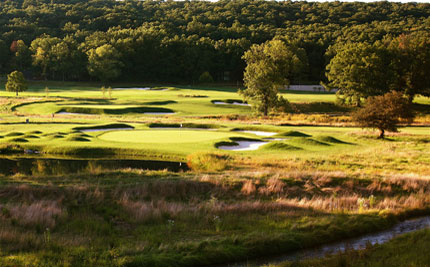
Par 3 “Tiny Tim” even has the chocolate drop mounds (omnihotels.com)

The golf course is quirky but very interesting.  It is the result of the efforts of three architects over a thirty year period-and it has been recently updated in 2007 without changing the effective old style character of the links.  Spencer Oldham did the original 18 holes in 1895 featuring chocolate drop mounds, geometric S-curve bunkers, and donut bunkers.  In 1912 A.W. Tillinghast got his hands on it and scaled it back to a nine-hole course with his own architectural features.  In 1923 Donald Ross took it back to a full 18-hole track and you can see raised greens with lots of tiering, artistic bunkering constellations, and, most distinctively, a creative and strategic use of the Shober’s Run that meanders throughout the entire golf course.  The renovation work in 2007 was done by Forse Design Company of Pennsylvania who are known for doing period restoration and  renovation work throughout the US and Canada-they have recently had their hands in renovation work to the Broadmoor-East Course in Colorado and the Newport Country Club in Rhode Island-sites of  recent U.S. Senior Opens and U.S. Women’s Opens respectively.   They did a wonderful job retaining the characteristics of all three of these fine architects while making it a very playable and a challenging golf experience.

The entire course is in the flood plain of the Shober Spring Stream and sits nestled between the foothills on either side.  There is a good bit of meandering back and forth so the holes do not route in a typical outward and inward loop.  For a course set in the foothills there are not that many severe elevation changes on holes and you get surprisingly few side hill or billy goat stances during the round.   As with most old style courses the track does not sprawl-the next tee is a few steps from the last green and the round has a tidy-compact feel to it.  Green surfaces are totally updated-very quick-lots of pitch and undulation and oddly shaped which makes for really small targets from the fairway.  You will do some pitching and chipping to save pars.

The green speed is the course’s major defense considering the tiering and undulations you will face.  But at the same time these characteristics provide you with a good correction mechanism for your approach shots if you pay attention to green topography and use it accordingly.  Big hitters will be frustrated by the many times they cannot just haul off and hit as much as they can-position off the tee is extremely important to getting the best angle of attack into the greens.

The last characteristic worth noting is the balance of the types of holes and the sequencing.  Five Par 5’s, Five Par 3’s, and 8 Par 4’s (only one over 400 yards) means you are hitting lots of finesse shots through the day and the mix is pretty random.  There is a sequence from 2 to 6  where you play par 3, par 5, par 3, par 5, short par 4-other than the driver on the second par 3 you have no long shots for five holes.  From 9 through 14 you have a similar 5-3-4-4-5-3 run but in the midst of this one you have two of the longest holes you play all day.  My point is you have to be very mentally agile to play this course effectively-there is no natural rhythm to the course other than the constant sound of the babbling of the ever present Shober’s Run.

Bedford Springs, Pennsylvania

Architects: Spencer Oldham (1895), A.W. Tillinghast (1912), Donald Ross (1923), Forse Design (2007)

Tees                 Par            Rating            Slope            Yardage

Medal                72               73.4               140                6785

Ross                72               71.9               136                6446

Tillie                  72               69.3               130                6023

Oldham            72               69.8               122                5106

(Click here to review Bedford Springs hole-by-hole descriptions)

Is It The Water?

Apparently there are no suspended particles because the scoring through the first two rounds in the Evian Masters has been nothing shy of pure!

In a tournament where 15-under generally wins the day Stacy Lewis is already 12-under through two rounds.  Her 9-under performance on Thursday which included 7 birdies in a row was bubbling over the top.  She is back on simmer with a complimenting 69 today and leads the field by one shot.

Other notables are scorching the Evian Masters Golf Club as well.  Inbee Park of South Korea shot an 8-under 63 with a balance of 4 birdies on each side in today’s round.  Paula Creamer shot a 67 to go with her fine 68 and is T-3 with Inbee.  Beatriz Recari had a 66 today and So Yeon Ryu, the U.S. Open champ, found her travel legs after a lackluster 73 on day one and shot 7-under to get herself into the mix for the weekend. Lots of other proven competitiors are within 7 of the lead including Se Ri Pak, Karrie Webb, Jiyai Shin, and Azahra Munoz.

The rough is not what it was last year and the hot weather must have the balls bounding to support this low scoring.  It seems we will be watching a shoot-out on the shores of Lake Geneva on the Golf Channel this weekend.

July, 2012

Dream Golf-The Making of Bandon Dunes

Dream Golf is required reading if you are going to play this new west coast mecca of American golf.  Stephen Goodwin writes a detailed account of the conception, planning, construction, and operation of Mike Keiser idyllic contribution to the inventory of American golf destinations.  Goodwin’s access to Keiser, David Kidd, Tom Doak, Bill Coore, Ben Crenshaw and so many other protaganists who were instrumental in this exercise make this an informative read.

To dream of bringing true links golf to America was an audacious ambition on it’s own.  But Keiser, a wealthy entrepreneur from his success building Recycled Paper Greetings, took this a whole step further.  He saw himself as the George Crump of our time-the man who in 1913 conceived and funded the building of the most famous golf course in America Pine Valley on obscure sandy scrub hills outside of Camden, New Jersey.

To this end Keiser not only conceived of the idea he went through the painstaking process of becoming an expert in links golf by assiduously playing all the greatest links venues in the world and tirelessly networked with architects and experts on the subject.  Using his own money and connections he searched for just the right raw venue that could be a home to his dream until he landed on this remote site in southern Oregon.

The book documents Keiser’s immersion in the process and his entrepreneurial risk taking it took to bring it to fruition.  He landed the best young architects of our time before they were famous and full of themselves.  As a result he pushed them on to create something very unique-real links golf courses on American soil.

David Kidd-a young Scotsman-did the first course Bandon Dunes in the late 1990s.  Tom Doak, one of the truly knowledgeable people when it comes to traditional links course design, did Pacific Dunes next in 2001.  Bandon Trails was the work in 2005 of Bill Coore and Ben Crenshaw who had to negotiate the blending of more rugged inland terrain with the desired seaside features.  Tom Doak came back in 2010 to create Old Macdonald a testimonial course to the pioneering influence of C.B. Macdonald considered by many to be the grandfather of American golf course architecture.

This book provides marvelous insight into the planning of golf courses and the special challenge of bringing authentic links design features to an American seaside venue.  The detail of conversations and the evolved thinking that brought these courses-all of which are in the top 100 in America by the magazine rating listings-to reality makes this a rich and engaging read.

The bonus is that for each course the author played a round with the designer and Goodwin gives a hole-by-hole account of the experience.  This is like getting a course guide written by the architect as a primer before playing the course.  Very cool indeed.

I highly recommend this read whether you are going to Bandon Dunes or not.  If you are going to Bandon it will provide unique insight to the facility and the guys who created and still run the place.  If not you will just become much more knowledgeable about the Herculean effort it takes to create a storied venue.

Dream Golf

Stephen Goodwin (2010)

Minimalist Design

In the Coore-Crenshaw theology, the cardinal sin of golf course architecture is anything that appears to be forced or contrived or “thought out”.  The hand of the architect should be invisible-and this takes much labor and patience and discipline. “We don’t want our holes to look like golf holes,” Bill says, “They should look like landscapes which just happen to include a golf hole”.

Dream Golf

Stephen Goodwin

2010

Big But Uneasy

What we witnessed at the Open Championship this year is hard to fathom.  Ten to fifteen mile an hour winds turned the last day into a slapstick circus act that included final round pie-in-your-face performances by Tiger (+3) who double wall-balled it out of the bunker on #6 on his way to a triple bogie, Sneds (+4) with back-to-back double bogies on #7 and #8, and Gmac (+5), who grew up with the winds of Northern Ireland as his teacher, befuddled by the with wind, carding 7 bogies over the last 18 holes.

But the biggest pie, the grand daddy of them all, was saved for Adam Scott who stood on the 15th tee with a four shot lead and four letters already etched on the Claret Jug and inexplicably played the final stretch four-over-par to lose to the Big Easy by one.

Ernie must have a regular Saturday foursome at Lytham.  He was second in the Open Championship there back in 1996 and third when it returned in 2001.  His play all week showed total mastery of the complicated driving script, especially on the difficult back nine.  32 on Sunday-four birdies over the last nine holes-capped a 7-under performance on the back nine over the four days.  That lapped the field for the inward half.  The crescendo created when he buried his birdie putt on 18 with authority to post 7-under for the championship clearly unnerved Scott who was half way down a vortex to infamy.

That trip for Adam was slow and agonizing-more a series of fender benders than a full blown crash and burn.

He missed a short one on 15 to make bogie, made a contortionist’s escape from a bunker on 16 only to miss another short one to make bogie.  From the middle of the fairway on 17 he jerked his 170-yard approach into the fur back left of the green.

His playing partner McDowell remarked afterward, “Half of England is to the right of that pin and he missed it left…..the alarm bell started to ring.  I thought, ‘Hold on, we’ve got a problem here’”.  The result was his third bogie in three holes and he was now tied with Ernie sipping iced tea in the clubhouse.

Maybe the least understandable choice was on 18 tee where, needing par to make a playoff, Scott abandoned his strategy of playing iron off this tee in the first three rounds  to avoid the bunker constellation in the driving area and pulled a three wood to try to set up a more aggressive approach hoping to make birdie and win the championship outright.  The three wood did not slide to right as intended and left him in one of those revetted nasties with no shot at the green.  He managed to play a third shot to 10 feet but the par putt never threatened the hole and the last chapter of this sorted tale was now in ink.

Ernie Els, a four time major winner, was as graceful in victory as Scott was in defeat.  Among other supportive condolences Els shared with Scott afterward he said, “I’ve been there before.  I hope he doesn’t take it as hard as I did.”

Bill Dwyre of The Tribune Newspapers said in his article, “Champions come along every day.  Compassionate ones do not.  On Sunday at the British Open, Ernie Els was there for everybody.”

That is true but there is a small lorry full of skeletons being FedExed to Adam Scott this morning.  He will need  a big closet and a very short memory to overcome the disappointment of this one that got away.

July, 2012