Putter Walk

Putter Walk LogoGolf inebriates are always looking for a new game to spice up the competition on Saturday with the regular buds. Kaptain Keith conjured up a this one this past summer and, given the bonus from the Golfing Gods of a 59-degree day in December, it seemed like as good of an opportunity as any to give it a test drive.

It is an old adage of the game that the sweetest walk in golf is the last 175 yards of a Par 4 with your putter under your arm. So the Putter Walk competition gets it’s name.

Best played as a two-man match with player’s of similar ability the rules are relatively simple-it is the total Putter Walk Yardage for a player over the 18 holes. On each hole a player’s Putter Walk Yardage is the distance of his shot to the flag if his approach stays on the putting surface. Any hole where the approach play is under 75 yards yields no Putter Walk Yardage.

.
Two additional wrinkles provide some drama:

The Daily Double: If a player hits a qualifying approach and makes the one-putt his
Putter Walk Yardage is doubled for that hole. Alex Trebek would approve.

The TPR (Three-Putt Reduction): If a player hits a qualifying approach and
three-putts his Putter Walk Yardage is cut in half for that hole. Kind of a Putter Walk
validation.

A running total of each guy’s Putter Walk Yardage must be kept to keep the focus of the players keen. A quality yardage gun or cart GPS and a portable calculator or a guy who had at least 650 on his Math SAT will make this a much more intelligible experience.

Putter Walk Scorecard-we started on #10 in this gripping match

Putter Walk Scorecard-we started on #10 in this gripping match

You can click on the photo to enlarge the image

In today’s test drive match between Kaptain Keith and The Kommish the gauntlet was thrown down early by Kaptain Keith whose hybrid approach on the first hole was worth 197. But this is a volatile game and The Kommish turned the tables quickly with a 164 yard approach on the second to 20 feet and made the putt for The Daily Double! A little parry on the third and then the match hit a speed bump with only one Putter Walk Yardage between them over the next six holes. At the turn it stood 563 to 362 in favor of The Kommish.

More bobbin’ and weavin’ over the first three holes on the inward nine until Kaptain Keith landed a decisive blow hittting the green on the 13th hole of the day and burying a 20-footer for the Daily Double and 240 points. The game was on again.

Another speed bump run for the Kommish over the next four holes and standing on the final tee Kaptain Keith had a 36 yard advantage. His GIR from 134 on the last closed out the match with a final score of 1119 to 949 in favor of the Kaptain. It only seemed appropriate that the man who invented the game should be the first walk off
Putter Walk winner.

As you can imagine, this is a ball striker’s game, short game saves mean nothing.
We found that GIRs on the par threes are critical and proper lay-ups on the five pars can put low hanging fruit within reach. Making a long putt after an approach that counts is a game changer.

This has to be played under the auspices of, as David Owen would say, “your usual game”. No gaming the system will be tolerated. Hitting five iron on a Par 4 to set up a 175 yard hybrid approach is considered inappropriate Putter Walk behavior.

The Putter Walk is a perfect adjunct to your regular four-man game on Saturday. It is relatively easy to track on a separate card, adds a few more bucks to the kitty, and can provide separate bragging rights to the conversation over lunch.

Once this goes viral I am sure GolfNow.com (a.k.a. The Golf Channel in Sheep’s Clothing) will add it as a feature to their smart phone mobile app. Remember you heard it here first so……….Go Play!

December, 2014

Oak Creek Golf Club

ocgc-logoVisiting the Newport Beach/Orange County area and looking for another course to add to your dance card? This Tom Fazio design at Oak Creek Golf Club in Irvine is a place to seek out. Without the ocean views and the rugged coastal terrain to work with Fazio did a brilliant job orchestrating a golf course through subtle rolling terrain, framing trees groves and flora, and an array of creeks and lakes to create a course that will challenge both your mind golfing skills.

#7 Hourglass captures the rapture of Oak Creek

#7 Hourglass captures the full rapture of Oak Creek

Click on any picture to get an enhanced look of the image

Tactically this is a positional golf course with clever offsetting angles of approaches to greens. Plotting your strategy from the green backward gives yourself the best chance of success into difficult green constellations. Buy the yardage books so you have some idea of the layout of the holes and hazards-better yet hook up with a seeing-eye-member who can be your Sherpa guide for the day. The bulldozers had their way here so as was the case with so many courses created in the 90’s the fairways are sculpted giving a lyric flow to the ground that affords very few level lies.

Bull nosed bunkering...what an apt descriptive

Bull nosed bunkering…what an apt descriptive

The green side bunkering is described as bull-nosed on the web site and you can take this literally because playing a recovery out of the nostril of a massive male cow is no picnic. Having said that, these green complexes are not overdone. There is, as the great golf architect Max Behr would say, a line of charm into each one of them if you thoughtfully position yourself for the approach.

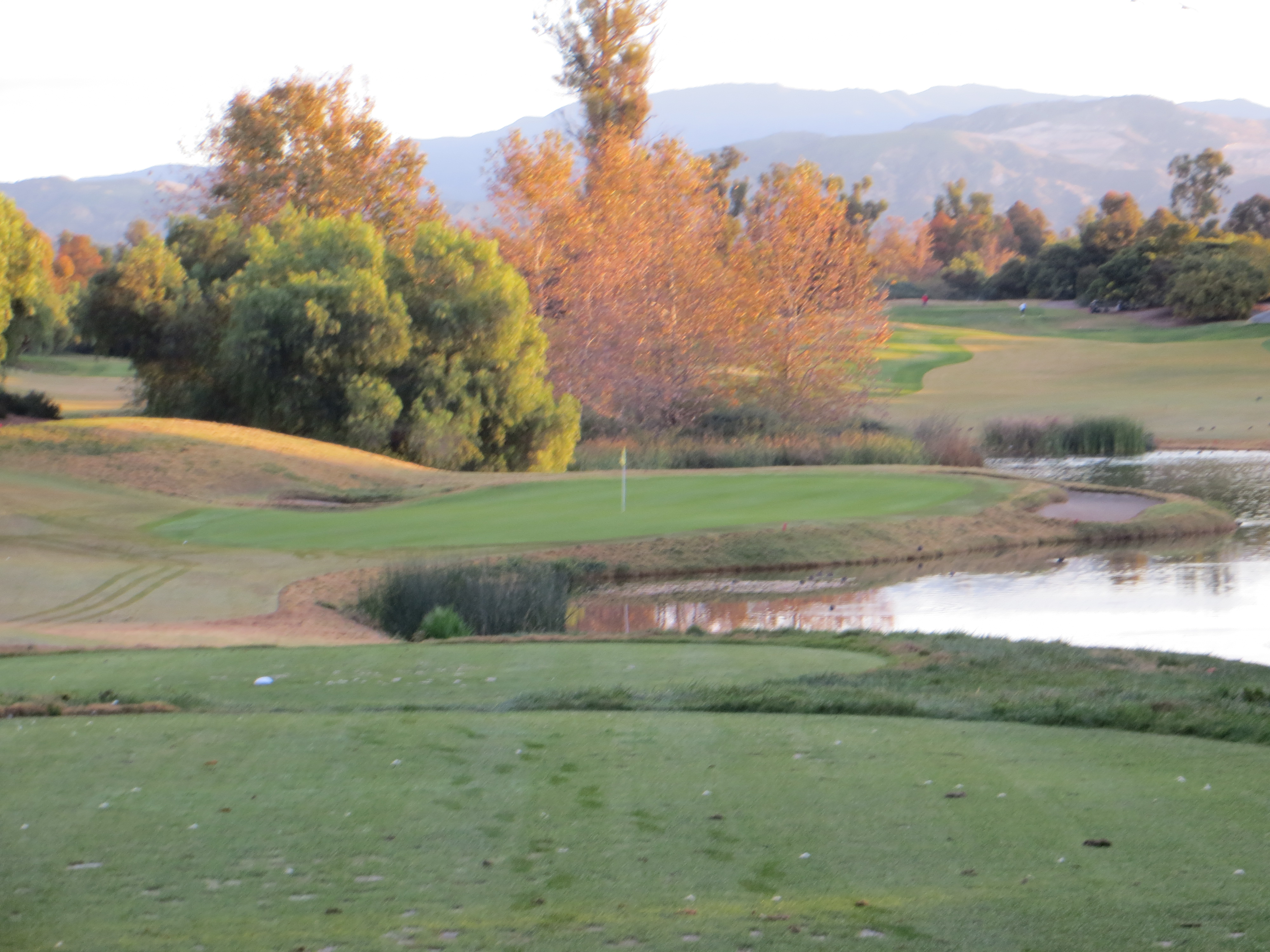
Brady's pond frames the difficult task at hand on #3

Brady’s Pond frames the difficult task at hand on #3

The front side begins modestly enough with a couple of manageable par fours but climbing to the tee overlooking the Par 3 third your heart will get to racing taking in the view of the green jutting out precariously into Brady’s Pond. Think Alcatraz with grass. This begins a sequence of holes which make it evident that positional golf is the order of the day.

What a jaw dropping look at the surrounds of Orange Country in the distance

What a jaw dropping look at the surrounds of Orange Country in the distance

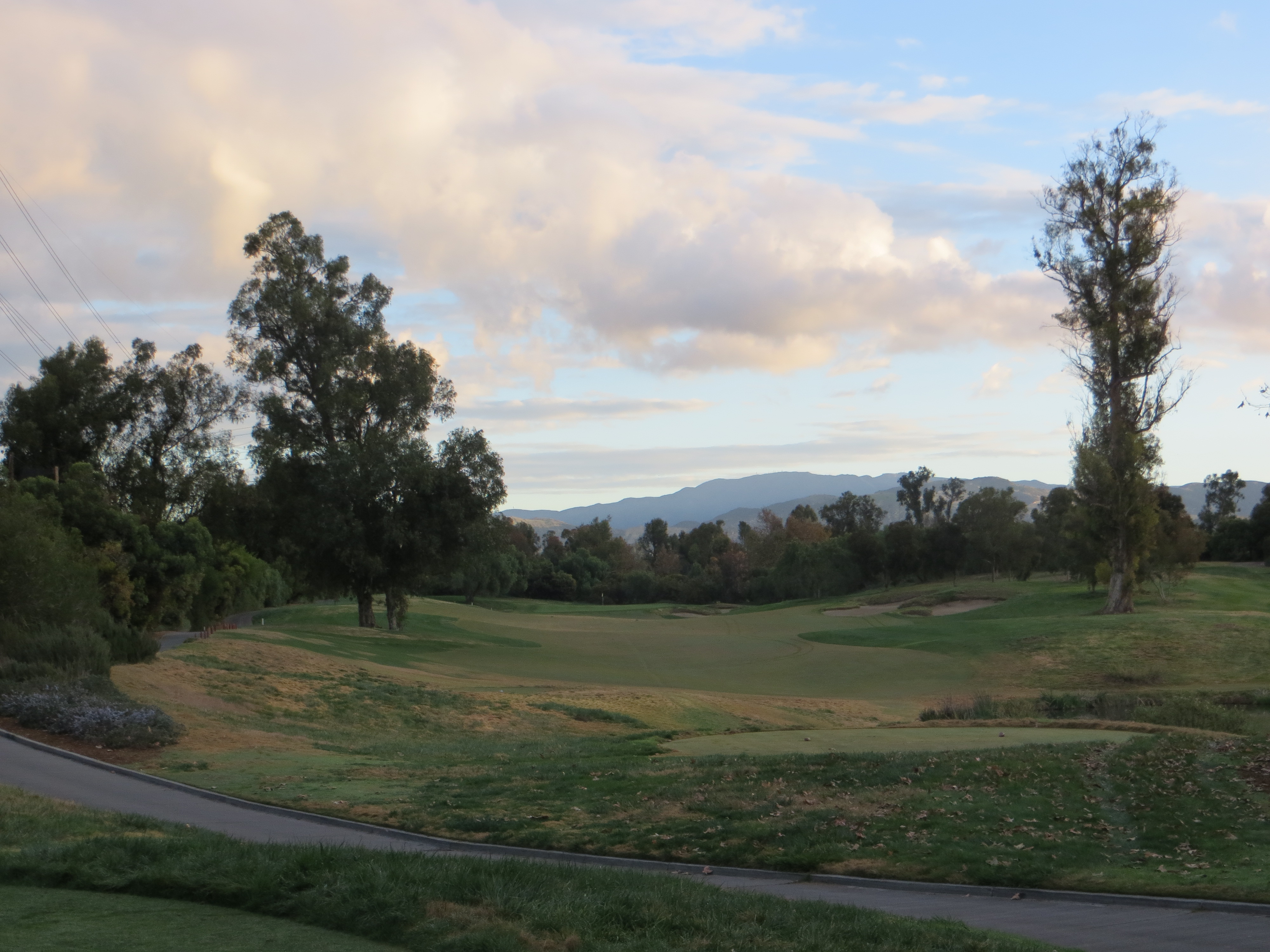
From the tee of Par 4 fourth, called The Grove, you see a driving area framed by a pair of towering goal post trees that have little tolerance for wayward tee shots. The trees behind the green is where the hole get’s it’s name but the low mountains in the distance give it some southern California romance and remind you that the ocean not so far away.

There is no missing right on #6 where Lowell's Creek awaits

There is no missing right on #6 where Lowell’s Creek awaits on all three shots

A quick switchback and the challenge ramps steadily up from here to the turn with a stout par four that which calls for length off the tee and careful precision into the green nestled on the other side of Brady’s Pond. Lowell’s Creek is the prominent feature on the long par 5 sixth as it wends it’s way up the right side from the beginning of the fairway all the way to the green surface. Even with a short club in your hand this is a dicey approach as green leans right feeding balls to the edge overlooking.

There club house frames the approach into #9

The club house proudly frames the approach into the 9th hole

The front side ends with a monster of a par four calling for a long drive to reach the top of the hill revealing a compelling look at a green nestled just below the tile roofed Adobe clubhouse .

.

The back nine will capture your focus early and not let it go until the last drop falls on the finishing hole. The Par 5 Breakout is a mind bending three shot hole for most of us. The key here is staying out of the sand on all three shots. A strong drive on the left sets up a lay up well to the right for a short downhill pitch into one of the tightest green settings you see all day.

The Great Depression #11 requires calculation of elevation change and shot shaping

The Great Depression #11 requires calculation of elevation change and shot shaping

The eleventh is a subtle and picturesque par 3 where the green sits below the tee carved out of the foot of the hill behind. The shot shape is left to right and you must use the green contour to get it close.

Chicanery...lurking everywhere...on #14...

Chicanery…mischief lurking everywhere…on #14…

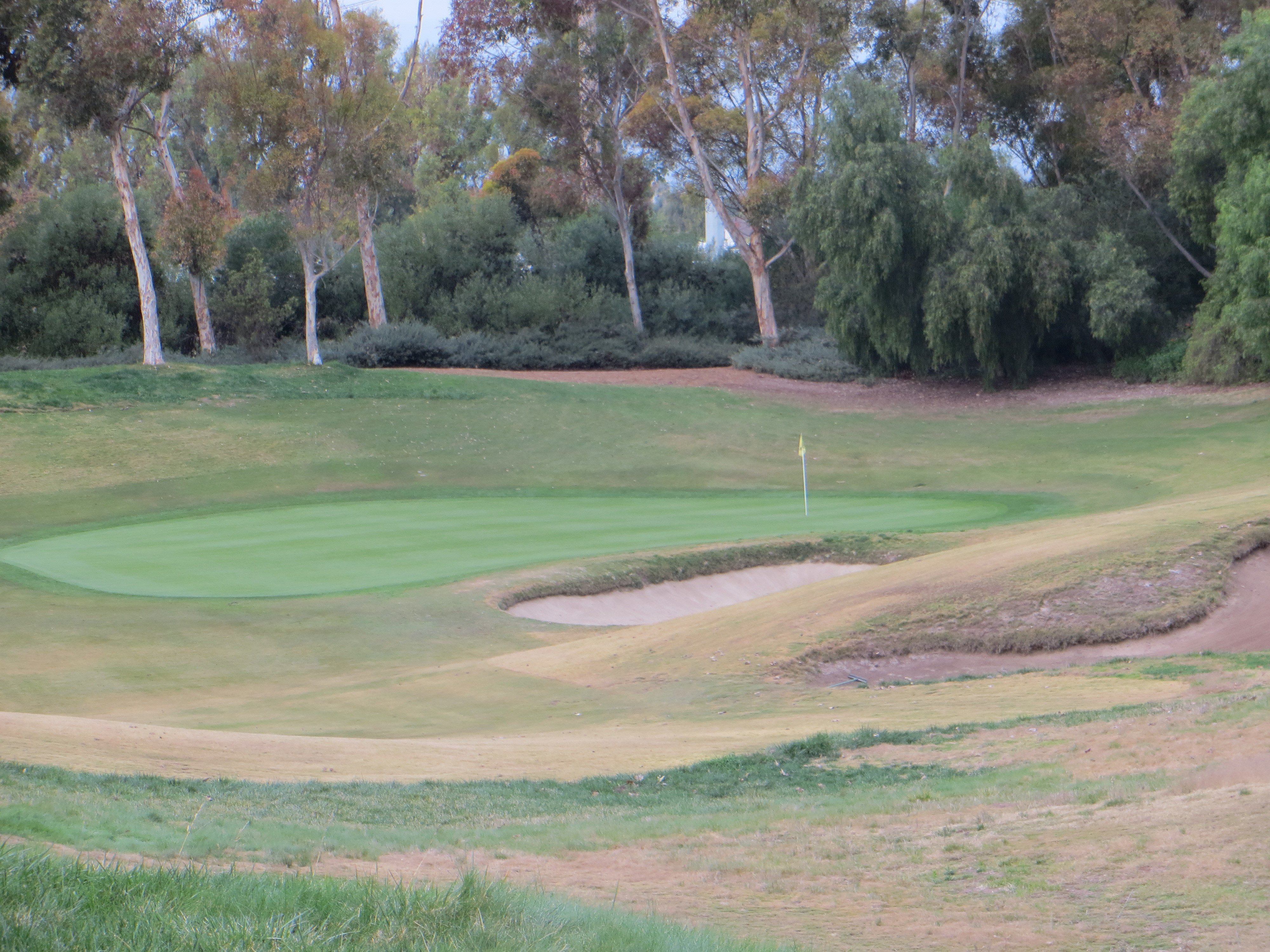
Two long par fours with plenty of issues bring you to Chicanery a short par four that will drive the big hitters bonkers. The tee shot is into a narrow neck of the fairway just below a hidden fairway bunker on the right. From there Fazio stuck the green into a narrow closet below the fairway that will require a lawn dart approach to get close. The canopy of eucalyptus trees create a feeling that you are hitting into the Hollywood Bowl during sound check. Just a fabulous golf hole.

A stunning wrap-around route on the Crescent Moon Par 4 16th

A stunning wrap-around route on the Crescent Moon Par 4 16th

It only gets harder from here with a long par four called Outback, the number 1 handicap hole. This is a full par 4.75 and a bogey will feel like a par. The middle sized par four that follows is like a cape hole without the water. Named Crescent Moon it adequately describes the profile of the hole and the two slinging right-to-left shots it will take to get on to the green.

Arnie would love the fortitude required to play the finishing hole

Arnie would love the fortitude required to play the finishing hole

One more long and strong Par 3 sets up the dramatic finish into Fortitude a dicey short Par 5 that will remind you of the finish at Bay Hill. The drive is a power slinger from the right to try to catch the power slot and chase one down within reachable distance of another peninsula green. More likely you are laying up in the neck of fairway cordoned off by the water that defines the right side of the hole the last 175 yards in. If you land the approach on this green in regulation and you can finally exhale.

Oak Creek does not have much national notoriety but Fazio did an excellent job composing a visual golf experience that will be an enjoyable afternoon for players of all skill levels.

(Click to review the complete hole-by-hole descriptive of Oak Creek Golf Club)

Irvine, California Architect: Tom Fazio (1996)

Tees      Par     Yardage     Rating     Slope

Black     71         6850         72.7        132

Gold      71         6543         71.3         129

White    71         6187         69.4         125

Silver    71         4989          69.0         120

Geoff Ogilvy Knows His Golf

Among sports journalists, analysts, and pundits the most overused term today is a guy’s sport’s IQ. It refers to a player’s innate ability to make the right decision time-after-time in the heat of action. The guy with a high sports IQ sees the game circumstance developing in front of him in slow motion and somehow synthesizes the information intuitively to make the right athletic move leading to a score.

This is often used to explain why certain players, like Manu Ginobili in the NBA or Drew Brees in the NFL, without the obvious physical gifts of other superstars seem to consistently make critical plays that help their teams win championships.

In golf we have examples of high sports IQs in overachievers like Zach Johnson, Jim Furyk, and young Jordan Spieth. These guys play the game with an in-game intellect that helps them perform at a level we would never expect looking at their physical size or the purity of their golf swing.

But the nature of the game we love, the inherent richness of it’s historical lore, the cerebral aspect to the creation of it’s playing fields, and slower pace of play which encourages comaraderie and social interaction of it’s participants provide a unique opportunity to develop a Golf IQ. High Golf IQ requires a perceptive individual to collect, ponder, and catalog a cache of golf knowledge and experience.  Time then intercedes to allow them to develop the proper humility and an articulate voice to share it with others.

Geoff Ogilvy has a Golf IQ much higher than the average bear

Embed from Getty Images

.

Geoff Ogilvy, born in Australia, learned his love for the game playing the bouncy fairways and slick putting surfaces on classic Sandbelt courses like Metropolitan, Kingston Heath, and Royal Melbourne.  He has won a U.S. Open, three World Golf Championships, and another nine professional tournaments over his 16-year folf career. As good as Geoff is to watch plying his trade with a 3-iron he is actually much more interesting to experience with microphone in his hand or keyboard in front of him.

Distilled Ogilvyisms:

He categorizes himself as a History Guy “always talking about old players, old courses, the history of majors….knows not only about architects, but when and where they were born”.

Seve Ballesteros had “the right look over the ball…when he settled in and waggled that immediately conveyed perfection to the human eye….but if you examined Seve for too long all kinds of unconventional things would emerge and the perfection would go away”.

Seve’s lyric style of playing golf shots often did not abide convention

Embed from Getty Images

.

Good golf is not meant to be played on long and narrow fairways or  lush, perfectly manicured greens. “The best courses (like The Old Course, Royal Melbourne, and Cypress Point) are playable for golfers of all standards. There’s width to the fairways…..the real challenges are around the greens”. For good golf, courses should have large greens “incorporating interesting undulations….nothing too silly though…they will be firm…..golf is infinitely more interesting when the ball bounces and rolls after it lands on the ground”.

Royal Melbourne has width off the tee and challenge around the greens

Embed from Getty Images

.

Short courses: His experience playing the 12-hole par 3 course at Turnberry with his buddies the week before the Open Championship reminded him how much fun the game can be. “Golf needs more pitch-and-putt courses….they require a wedge and a putter, it’s free, and you can play in jeans and a T-shirt….they are magnets for interest.”

On how the American game has been hijacked by scoring with an obsession of medal over match play “In my experience everyone is much happier when they play match play…..stroke play is a necessary evil for professionals, but for amateurs it should be the exception not the rule. Adding up scores isn’t often fun”.

The unique character of the Old Course casts long shadows over all others

.

His perfect course “a welcoming and friendly environment……no cart girls….a halfway house where sausage sandwiches will be available…a small range where you can hit a few 5-irons before you wander to the 1st tee carrying your own bag. At the end of the round you will be able to get your own car…..and walk around with your dog on a leash if you wish….no wasted manpower, no wasted energy, and no wasted money”.

I share with you links to three samples of his golf voice that support the notion that Geoff may just be the most interesting man in the world…… when it comes to golf.

Click to read the Golf Digest article “Geoff Ogilvy- The Thinker

.
Click to read the GolfAustralia.com posting “Geoff Ogilvy-My Perfect Golf Course”

.
Click to go to the listing of State of the Game Podcasts on iTunes.

If you have the time pick Episode 25 to download a wonderful 80-minute long conversation with Geoff Ogilvy.  This is “The Golf World According Geoff Ogilvy” providing his unique perspective about preparing for the 2013 Open Championship at Muirfield, what interests him in golf,  and so much more.

.
Geoff Ogilvy
December, 2014

The Golden Age of Golf Course Design

The Golden Age of Golf Design LogoAt the turn of the century golf course design in the United States was in a nascent and mundane state. Building a new course was pretty much about staking holes in straight lines on flat terrain with a few hurdle hazards to make it challenging. Thankfully with the immigration of golf “professionals” from Scotland and England in the early 1900’s the strategic thoughts and concepts of course design from the links courses of the British Isles started to infiltrate the thinking as new courses were built to meet a fast growing interest in golf in the states.

In his book “The Golden Age of Golf Design” journalist and author Geoff Shackelford catalogs the accomplishments of a new age of golf course architects that marked the most prolific and creative period of course design in the past century. Men like Charles Blair Macdonald, Seth Raynor, George Crump,  George Thomas, Donald Ross, Hugh Wilson, William Flynn, A. W. Tillinghast, and Alister MacKenzie completely changed course construction introducing new and bolder routings, hazards, and green complexes to usher in a new strategic approach to course design.

These guys and their associates were downright prolific-the number of courses in the U.S. expanded from around 700 in 1916 to over 5900 by 1930. They went on to produce some of the most memorable courses as well.  As Shackelford points out a Golfweek list of the Top 100 American Courses opened before 1960 indicates that 84 of the top 100 were constructed between 1910 and 1937.

The Golden Age of Golf Design is a beautiful leather bound biographical encyclopedia of information on about 40 of the most influential characters of this period. To make this intelligible Shackelford groups the architects into five-plus “schools of design” of his own making-The National School, The Philadelphia School, The Ross School, The MacKenzie School, The Monterey School, and Other Schools. Each school is made up of a number of architects who studied each other’s works and helped leverage new course production in different regions of the country. What defies his distinctions is that many of these designers cross pollinated schools by expanding their contributions across the country and even around the globe. But there is little doubt that the era spawned mentorship and collaboration which hastened the proliferation of new and better designs
over a very short period of time.

Shackelford provides well researched detail of the interactions of these designers to explain the evolution and dissemination of the new strategic concepts. He has a credential page on each architect which includes their interests, published writings, career influences, golfing ability, methodology, design characteristics, best original designs,
and a personal quote. He supports this with a trove of original black and white photos of the holes from some of our classic golf courses to give context to their conceptual elements.

A wonderful accent to the book are the watercolor drawings of Mike Miller on the cover and at the beginning of each chapter of iconic holes from Merion, Los Angeles Country Club, Royal Country Down, Pine Valley, and Pebble Beach among others. The vivid renderings give the reader a surreal feeling for the character and design of these classic courses.

Geoff’s book provides a synthesized understanding of the contributions of these designers and their influences on each other in setting a new standard for quality course design in the Golden Age. For an armchair course architect the book is a go-to reference manual that codifies the genealogy of the influential architects from the most significant age of American golf course design.

The Golden Age of Golf Course Design
Geoff Shackelford (1999)

moerate3

The Magnificent Masters

Jack Nicklaus, Johnny Miller, Tom Weiskopf, and the 1975 Cliffhanger at Augusta

Magnificent Masters LogoThere are seminal moments in tournament golf, specific instances where the tournament, the venue, the protagonists come together in a perfect storm to showcase an historically significant event that changes forever our perception of a major tournament. Before 1975 The Masters was a major, it had it’s share of great winners and dramatic endings but it was mostly a vivid beginning of the golf season for American golf viewers, set in a resplendent arboretum in Georgia.

In 1975 three of the best players in the game, Jack Nicklaus, Johnny Miller, and Tom Weiskopf did what rarely happens. They came to Augusta with their A-games, lived up to all the hype, and put on a competitive show for the ages. Gil Capps, a longtime golf industry veteran for NBC Sports and The Golf Channel, brings an attention to detail of the 1975 Masters that allows us to relive the round-to-round drama like we are watching it unfold right before our eyes and properly places it as one of the seismic moments in Masters golf history.

There have been a number of wonderful historical accounts of golf tournaments, matches, and prominent characters released in the last 10 years. If you have read and enjoyed Kevin Cook’s “Tommy’s Honor” or Mark Frost’s “The Greatest Game Ever Played”, “The Grand Slam”, or “The Match” you know what I am talking about. You will find this account of the lives of these three champions and their elevation of The Masters to new heights equally intriguing.

The author has an intimate knowledge of Augusta National and the Masters and his detailed research provides the reader with an inside view of the history and development of the event over the last 80 years. For example, he talks about the stark white sand so prominent in our television images that create the bold faces of the MacKenzie bunkers. Clifford Roberts sourced the material from feldspar mining operations in North Carolina. It is actually crushed rock not sand and, as a result, when it is dry will disperse as balls hit avoiding embarrassing buried lies. There are countless other tidbits about the stewardship of Bobby Jones and Clifford Roberts helping this annual outing of a bunch of golf buddies evolve into a major championship.

The book is presented in a Kiefer Sutherland time-lapse format chronicling the practice rounds and the four tournament days as unique segments of the whole. This makes the reading a “real time” experience and the interplay of the subplots make the eventual outcome more vivid.

The Thursday round begins with “the most anticipated first-round tee time in Masters history” as he describes Lee Elder’s breaking of the color line at this most famous of southern golf venues. It includes an entertaining vignette about Bob Murphy and Lee Trevino two guys who never played up to their potential at Augusta. Capp says “The two players had four things going against them: their lack of length, their left-to-right ball directions, their low ball flight, and their attitude”.

The pattern of the book is established as he wanders off for a biographical chapter on Nicklaus, the first of three he intersperses between accounts of the four days of play. The reader gets a good sense of the importance of the golf character and motivation of Bobby Jones as a competitive impetus to Nicklaus. Jones cared only about the majors and therefore Nicklaus saw winning majors as the ultimate benchmark of golf achievement.

Biographical sketches of backgrounds of Johnny Miller and Tom Weiskopf provided the strongest additions to my historical golf knowledge from reading this book. Miller was the roman candle of the era, bursting on the scene with a victory in his first pro event in 1969 at the age of 22, proceeding to win almost every tournament played in the arid climates over the next decade. His 63 in the final round at Oakmont to win the 1973 U.S. Open was one of the most jaw dropping accomplishments in history. Miller was driven to be the best in the game and never was afraid of Nicklaus. In fact in Miller’s 25 wins on the PGA Tour Nicklaus was second in 5 of them. From 1969 to 1983 Miller was always in the conversation at the majors until, as Capp says, “Miller had fallen out of love with the process that had driven him to the top of his sport”.

Weiskopf was another story, he had to bear the yoke of following in Nicklaus’s foot prints, growing up in Ohio and playing at Ohio State just behind him. Weiskoff was a perfectionist with no patience for mediocrity, a slam dunk to be the next great in the game. His game had “both arrogance and elegance to it….It was the tempo and rhythm that others swooned over…..a grace and smoothness rare for a tall man who always finished in perfect balance.”

Weiskopf won 16 times on the PGA Tour including one major at the 1973 Open Championship at Royal Troon and finished second or third in majors 8 times from 1969 to 1978. But for all of that accomplishment he was considered an underachiever.

His Achilles Heel was his perfectionist attitude and the expectation of greatness heaped upon him in comparison to Nicklaus. In a big event he could be in the thick of contention or seemingly out of touch. As Capp says, “If Weiskopf was playing well and in contention, there was complete resolve. If he was playing poorly, he could totally disengage”. The roller coaster ride of Weiskopf’s professional career took a severe personal toll and he dropped off the golf radar screen after his last win in 1982 at the Western Open.

I leave the description of the golf to your reading of the book, the drama Capp conveys is just captivating. Suffice it to say that Miller shot 65-66 on the weekend, Weiskopf 66 and 70 and had a putt for a playoff on the final green. The rest is history….magnificent history.

.
Gil Capps (2014)

moerate4

Spieth Ability

aus_open_logoBy any measure 21-year old Jordan Spieth has had a phenomenal first two seasons as a PGA Tour player. With his first Tour Event in 2013 at the John Deere Classic at age 19 he became the first teenager in 82 years to win a tour event. Garnering close to $3.9 million in winnings he was a “within the leather” for Rookie of the Year in 2013.

In 2014 with a 2nd at the Masters, 8 top tens on the PGA Tour, and a successful Ryder Cup appearance he took the next step forward with another $4.2 million in tour earnings. The lack of a second tournament win was the only “blemish” in an otherwise accomplished season.

Young Spieth and Reed held their own at the 2014 Ryder Cup

Embed from Getty Images

.

Taking a page from the Peter Uihlein/Brooks Koepka book of young player development, Jordan Spieth took his game on the road, the global road, the last two weeks, playing in the Dunlop Phoenix on the Japan Tour and then the Australian Open in Sydney with good results.

As Aussie Mike Clayton was quoted in Geoff Shackelford’s website posting, “It is more than heartening… he seems to understand the importance of developing his game outside of America. Players can make fortunes without ever owning a passport….but to be judged a truly great golfer one needs to venture beyond the shores of the United States and both test and develop a game in unfamiliar conditions.”

Foreign time zones and reverse toilet flushes aside, Jordan stood up to the test nicely finishing tied third behind Hideki Matsuyama in Japan and then bested a talented field in Australia, which included World #1 Rory McIlroy and the favorite son down-under Adam Scott, with a final round bogey-free 63 to win the Australian Open at 13-under by six shots. The Stonehaven Cup bears the names of many of the games greatest players including Gene Sarazen, Gary Player, Jack Nicklaus, and Greg Norman. The significance of this was not lost on Spieth.

Trying to defend was a trying experience for the World #1

Embed from Getty Images

.

The Australian Golf Club, host venue for this year’s Emirates Australian Open, is one of the oldest clubs in the country dating back to the 1880s. Recently renovated with an unlimited budget under the direction of Jack Nicklaus the course may be the best championship test in Australia.

This place has an Americanized look of tight driving throats, serpentine fairway routings, threatening water and sand, and small segmented greens with lots of facet.  It has more of the feel of a Sea Island, Georgia course then the Melbourne Sand Belt tracks we have come to associate with Australian championship golf. The green complexes in particular, many raised from the fairway and presenting narrow segments for pin placements meant that a creative and adept short game and nerveless putting would be required.

In a zone Jordan had more than his share of fist pumps on Sunday

Embed from Getty Images

.

Add more than a spot of wind this week and scores in red numbers were hard to come by. Only eight players were under par for the week. Jordan played an unperturbed final round with 8 birdies and no bogies. His three birdies in a row on the front side kept all the competitors at bay and three birdies over the last four holes on the inward nine slammed the door with authority. His 21 putts in the final round is something Aussies will be talking about for years to come.

Jordan said, “This week was big because I was able to close it out. If felt the pressure and felt the nerves and performed the best I’ve ever performed.” Rory Mcilroy’s tweet to Jordan afterward is revealing, “You could give me another 100 rounds today at The Australian and I wouldn’t sniff 63….well done…very impressive”.

Spieth is forever connected to the great names who have won here

Embed from Getty Images

.

On what handling the pressure in this international win means to future “major” successes Spieth said, “In order to do this in majors, it’s going to take a lot more than it took this week”.  Pretty sobering thinking for a 21-year old.

From what we have seen this week Spieth has the full set of skills and is not afraid to use them. It is not going out on a limb to predict that a major tournament trophy will bear his name sooner rather than later.

.
November, 2014