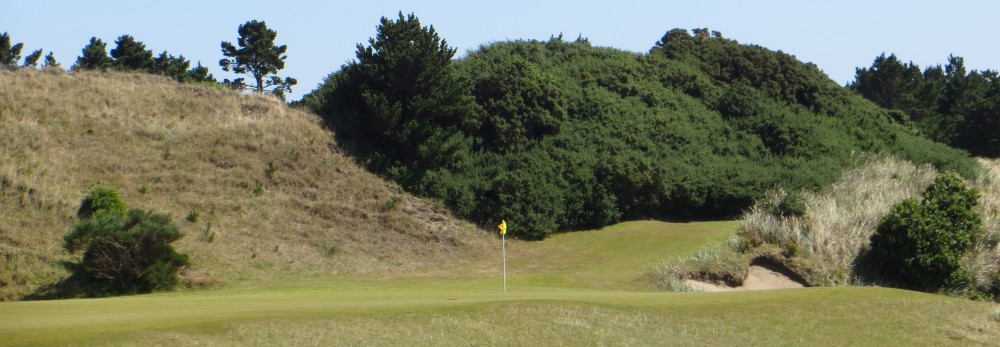

It is really cool when you walk into the bar area of a classic old course like this and see the names Brad Faxon, Billy Andrade, and Brett Quigly on the club championship plaques. These are the favorite sons of the state who grew up playing there and later went on to a career on the PGA Tour.
This place has tradition seeping out of every pore and you cannot help but anticipate the experience of playing a course where players of this caliber honed their skill before making it on the big stage.
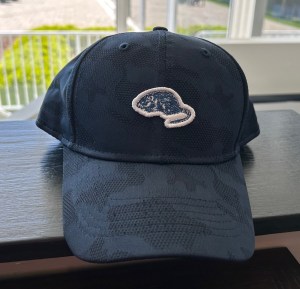
What is even more enticing is the informality of the place, nothing is overstated it all just feels comfortable in its own skin. You might note that the logo features a muskrat, a critter that made its presence known as they were excavating the holes close to the shore line holes a century ago. A visit to the golf shop will give you the opportunity to by a cute muskrat hat as a piece of memorabilia.
Donald Ross routed this track in 1911 and very little has changed since. Like so many of his designs that populate this part of the country, Ross simply took what the ground was offering and found hole sequencing and strategic challenges there to be unveiled. Green complexes are the jewels here, plenty of challenging bunkering to deal with, but, as was custom in the hickory club age of the time, access to most of the greens can be handled using the ground as your friend.

The course plays to a par 71 with only three par threes and two par fives so you have a large inventory of four pars to encounter along the way. The low handicap holes are very long par fours that establish the challenge of the day but there are a number of short ones that require more tactical decisions and precise shot execution to help balance your scorecard.

The day begins with a simple downhill par four that introduces you to the first of two inverted bunkers on the course. These are nothing but large turtle back bunkers that present you with a sand shot below your feet. Both the one here and on the ninth are really not a factor in the playing strategy of the hole. What you do get on the first is the typical corridor of bunkers leading up to an accessible green complex with plenty of contour. This is a formula you will see throughout the day.
The next two holes start to define the character of this charming Ross creation. Driving the ball in the fairway is a premium for playing aggressively into the green complexes. The sloped ledged green setting on the second will challenge you keep your approach in the area of the day’s flag. The uphill third has a domed green that repels balls in all directions so a sharp short game is needed here to make a par.

The fourth is the first harrowing visual statement you will encounter as the hole presents itself as a slippery downhill par four into a tiered green across a meandering creek. This is where paying attention to landing areas off the tee makes a huge difference in getting playable approaches into the greens. You will find full detail on a strategic approach to play in the printable Hole-by-Hole Analysis through the link at the bottom of the posting.
Two short, scoreable holes follow in a technical par three and a theoretically reachable par four. One of the things I really like about this course is the opportunity to hit precise short irons into small sloped targets to help your scorecard.
The balance of the outward nine is a series of long holes where you just have to hitch up your pants and drive the ball solidly to have a prayer of reaching the greens in regulation. Don’t be surprised if you are hitting a 60-yard pitch and a putt on the longer holes in an effort to save a par.
When you make the turn take a moment to visit the halfway house next to ten tee for a hearty snack before you attack the second nine. Very old school looking structure with real character.

By now you have probably noticed that you have only played one par five and one par three so far. The odd sequencing of the non-par fours continues on the back nine. The tenth is a strong par three with a sweeping contoured putting surface that requires precision with a longer fairway club to get a reasonable two-putt opportunity for par.
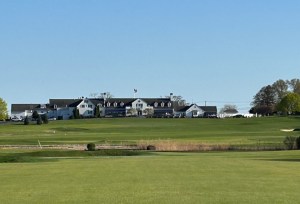
The last par five of the day is next, a sweeping dogear left with a panoramic view of the clubhouse on the horizon. Scoring on this one and the short twelfth is a must because there are a couple of hearty par fours that follow before you cross the road and head to the four bayside holes that define the challenging finish.

As you cross the road to the fifteenth you cannot help but be a bit overwhelmed by the site of the lighthouse and the bay that will overlook your play on the last four. The wind now becomes a major factor in club selection and line so there is a strategy change at hand to control trajectory and mitigate wind effect from here to the house.
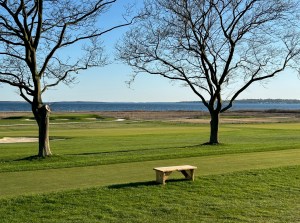
The short three par 17th is a Kodak moment for sure and probably the place where the muskrats made their last stand before becoming part of the lore of this place. A beautiful and challenging finishing hole with a green majestically set into a hill behind presents a tantalizing finish to this classic old course.
.Barrington, Rhode Island
Architect: Donald Ross (1911)
. Par Rating Slope Yardage
Blue 71 71.1 130 6396
White 71 70.1 127 6117
Red (L) 71 68.6 124 5786
Gold 71 65.5 116 5259
If you would like a printable PDF of this posting including a yardage book quality hole-by-hole description of how to play the course hit the link below.
 moegolf
Moe:
this is Jim Doane we met when I was a guest of Marc Fink. I grew up in RI and caddied RICC and went back to play it a few years ago.
A great course and loved your description of it, well done, and best regards.
These old courses in the Northeast are very special in the simplicity of their architecture and playing enjoyment for for people of all skill levels. I love the muscrat in the logo, it shows these folks know how to laugh at themselves. My only disappointment all day was the Halfway House was closed when got there at 5:15, missed out on what would have been needed refreshment before attacking the back nine.
one of several delightful Ross courses in my home state. He had a summer house in Sakonnet and that and Wannamosiett are his 2 best in the state.
curiously we had a summer house just about 1/2 mile from RICC but they didn’t let our people play there in the 60s.
Not surprised about your last sentence. As I have heard of Eastward Ho on the Cape, some of these courses required evidence of of family lineage dating back to the Mayflower to join.
finally played it about 10 years ago in a charity tournament. the water you see on the final 4 holes is Narragansett Bay above the Barrington Beach. Spent many a day at that beach as a young child never knowing right about us they were golfing